

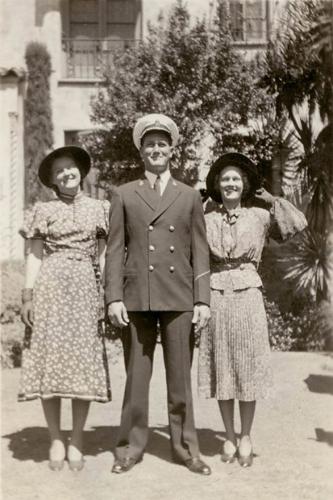
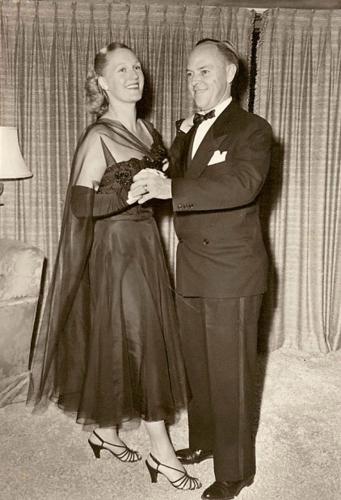
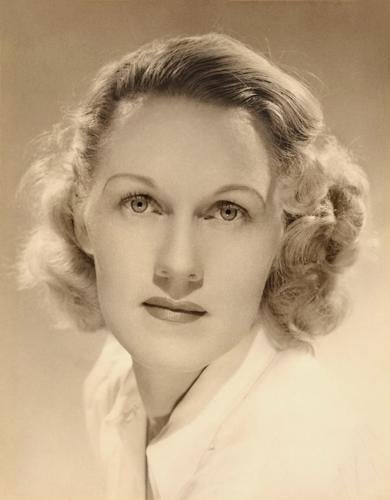
Betty Krucker knew what it was to go without.
Not because she grew up poor.
As the daughter of a mine boss living in Bisbee in the early 1920s, Krucker and her family were better off than most. But she saw the impact poverty had on other families in town.
That early recognition of the disparity between the haves and have-nots set Krucker on a path of community service.
During her lifetime, Krucker founded and served on dozens of boards and belonged to myriad associations focused on social work, health care, family services, adoption, the economy, prison reform, mental health treatment, education, performing arts, and local culture.
She was appointed the legislative chairwoman for the Arizona Conference on Social Work in 1954, she was Tucson's Woman of the Year in '56, and she represented Arizona during the 1960 White House Conference on Children and Youth in Washington, D.C.
People are also reading…
In a 1968 Tucson Citizen article, Krucker said: "I find I'm happiest when working under a little bit of pressure - not enough for ulcers, but enough to get things done."
Krucker managed to nurture her community as well as two children, Tom and Kathy, with Judge Herbert Krucker, her husband of nearly 40 years. Helen Elizabeth "Betty" Krucker died Nov. 5 at age 94.
"Some people are raised that public service is what you do, and that's the way Betty was," said Joana Diamos, a member of Las Doñas de Los Descendientes del Presidio de Tucson. Krucker, too, was a Doña, a title that is awarded each year to one woman in the community who is 70 years or older and exemplifies what it means to be an outstanding member of society.
"Effervescent and bubbly doesn't describe her. She was just full of energy and a really civic-minded woman," Diamos said.
Krucker earned a psychology degree in 1935 from the University of Arizona and used her education and early childhood experiences to better the lives of others.
"Growing up in Bisbee was really quite lonely," said friend and "opera buddy" Sue Peterson. "She was from the rich family, the boss's family. Her mother always kept her so well dressed."
Young Betty was cognizant of how her appearance compared to those of most of her classmates from less fortunate families. She'd been taunted and shunned by the other children for the fine clothes she wore.
"She had this pretty little coat her mother made her wear to school in the wintertime," Peterson said, but as soon as Betty was out of her mother's sight, she would wad up the coat and tuck it into a hidey-hole so she would better blend in with her classmates. Even when Betty did make friends, their parents didn't want their children playing with the boss's daughter.
Occasionally, when she was in middle and high school, Betty took overnight business trips to Florence with her father. On one visit she was given a tour of the women's prison, Peterson said. At the prison she saw the poor conditions in which the women were living and the mistreatment they endured at the hands of guards. That experience later prompted Krucker to advocate for prison reform.
Said Peterson, "She was this woman I would want to be."
During World War II, Krucker worked for the American Smelting and Refinery Company and volunteered on the midnight to 4 a.m. shift at a Red Cross canteen where she met the troop trains, handed out hot coffee and snacks to the servicemen, and washed dishes.
For Krucker, the effort went beyond good citizenship. Her older brother, Thomas Patrick McGrath, was a Navy lieutenant. He survived the Japanese attack on Pearl Harbor, where he distinguished himself with gallant actions aboard a sinking battleship, before he died, at 26, aboard the submarine USS Pompano, which disappeared on a combat mission against Japanese forces.
Marietta Luce had known Krucker for 70 years. Luce used to baby-sit for the Kruckers.
"My association with Betty has been absolutely joyous. She was such an elegant beauty all of her life. Even in her old age she was absolutely beautiful," Luce said. "She was into everything. We did a lot of straightening out the world's affairs when we got together. It was a really great time."
Krucker's mother, an archaeologist, "was a very strong, independent woman and just beautiful too," Luce said.
In recent years a stroke had taken a physical toll on Krucker, but her memory remained sharp.
"I would sit with her and just howl," Peterson said of Krucker's quick wit and sharp tongue. "She was a master of verbiage. She was so interested in everything and everybody. She was a grand lady."
To suggest someone for Life Stories, contact reporter Kimberly Matas at kmatas@azstarnet.com or at 573-4191.