

Skip to main contentSkip to main content
Register for more free articles.
Log in Sign up
Back to homepage
Subscriber Login
Keep reading with a digital access subscription.
Subscribe now
You have permission to edit this collection.
Edit
Arizona Daily Star
83°
  • Sign in
  • Subscribe Now
  • Manage account
  • Logout
    • Manage account
    • e-Newspaper
    • Logout
  • News
    • Sign up for newsletters
    • Local
    • Arizona
    • Business
    • Crime
    • Nation & World
    • Markets & Stocks
    • SaddleBrooke
    • Politics
    • Archives
    • News Tip
  • Arizona Daily Star
    • E-edition
    • E-edition-Tutorial
    • Archives
    • Special Sections
    • Merchandise
    • Circulars
    • Readers' Choice Awards
    • Buyer's Edge
  • Obituaries
    • Share Your Story
    • Recent Obituaries
    • Find an Obituary
  • Opinion
    • Submit a Letter
    • Submit guest opinion
    • Letters to the Editor
    • Opinion & Editorials
    • National Columnists
  • Sports
    • Arizona Wildcats
    • Greg Hansen
    • High Schools
    • Roadrunners
  • Lifestyles
    • Events Calendar
    • Arts & Theatre
    • Food & Cooking
    • Movies & TV
    • Movie Listings
    • Music
    • Comics
    • Games
    • Columns
    • Play
    • Home & Gardening
    • Health
    • Get Healthy
    • Parenting
    • Fashion
    • People
    • Pets
    • Travel
    • Faith
    • Retro Tucson
    • History
    • Travel
    • Outdoors & Rec
    • Community Pages
  • Brand Ave. Studios
  • Join the community
    • News tip
    • Share video
  • Buy & Sell
    • Place an Ad
    • Shop Local
    • Jobs
    • Homes
    • Marketplace
    • I Love A Deal
  • Shopping
  • Customer Service
    • Manage My Account
    • Newsletter Sign-Up
    • Subscribe
    • Contact us
  • Mobile Apps
  • Weather: Live Radar
  • Facebook
  • Twitter
  • Bluesky
  • YouTube
  • Pinterest
  • Instagram
© 2026 Lee Enterprises
Terms of Service | Privacy Policy
Arizona Daily Star
News+
Read Today's E-edition
Arizona Daily Star
News+
  • Log In
  • $1 for 3 months
    Subscribe Now
    • Manage account
    • e-Newspaper
    • Logout
  • E-edition
  • News
  • Obituaries
  • Opinion
  • Wildcats
  • Lifestyles
  • Newsletters
  • Comics & Puzzles
  • Buyer's Edge
  • Jobs
  • 83° Sunny
Share This
  • Facebook
  • Twitter
  • Bluesky
  • WhatsApp
  • SMS
  • Email
14 plants to bring hummingbirds to your yard
Share this
  • Facebook
  • Twitter
  • Bluesky
  • WhatsApp
  • SMS
  • Email
  • Print

14 plants to bring hummingbirds to your yard

  • Jun 28, 2015
  • Jun 28, 2015 Updated Mar 19, 2018
Prefer us on Google

Plant these, and get ready for the hummingbird show in your backyard

Hummingbird magnets

Hummingbird plants

Natural habitats give hummingbirds, like this purple-throated lucifer hummingbird found in Ash Canyon in the Huachuca Mountains, places to forage for insects, perch, roost and build nests.

Dale and Marian Zimmerman

Editor’s note: With hummingbird migration gearing up in July, birder and garden consultant Marcy Scott chose 14 plants for Tucson-area gardens, including a few summer bloomers, that will attract the tiny birds. What follows are short excerpts from in-depth profiles on those plants from her new book, “Hummingbird Plants of the Southwest.”

Hummingbirds have been capturing imaginations as long as there have been imaginations to capture.

“Glittering fragment[s] of the rainbow,” John James Audubon dubbed these most marvelous creatures, and indeed it is next to impossible to entertain a discussion about hummingbirds without waxing poetic.

***

A hummingbird habitat is much more than a profusion of red flowers, although the more of these the merrier as far as the birds are concerned. Certainly, feeders can help fill any voids in flower availability, but a number of other features are important as well. Natural habitats are often quite sparse on blooms, but they provide other amenities that are less obvious but just as necessary, such as places to forage for tiny insects, prominent perches from which to monitor a territory, open spaces for courtship flights, roosting spots to spend the night, and secretive places to build nests.

***

As habitat across the Southwest dwindles, how we decide what to replace it with becomes increasingly significant. If we think of our yards as outcroppings of habitat of which we are the stewards and strive to manage them accordingly, we have a tremendous opportunity to make a genuine difference to hummingbirds and the extraordinary flowers they pollinate.
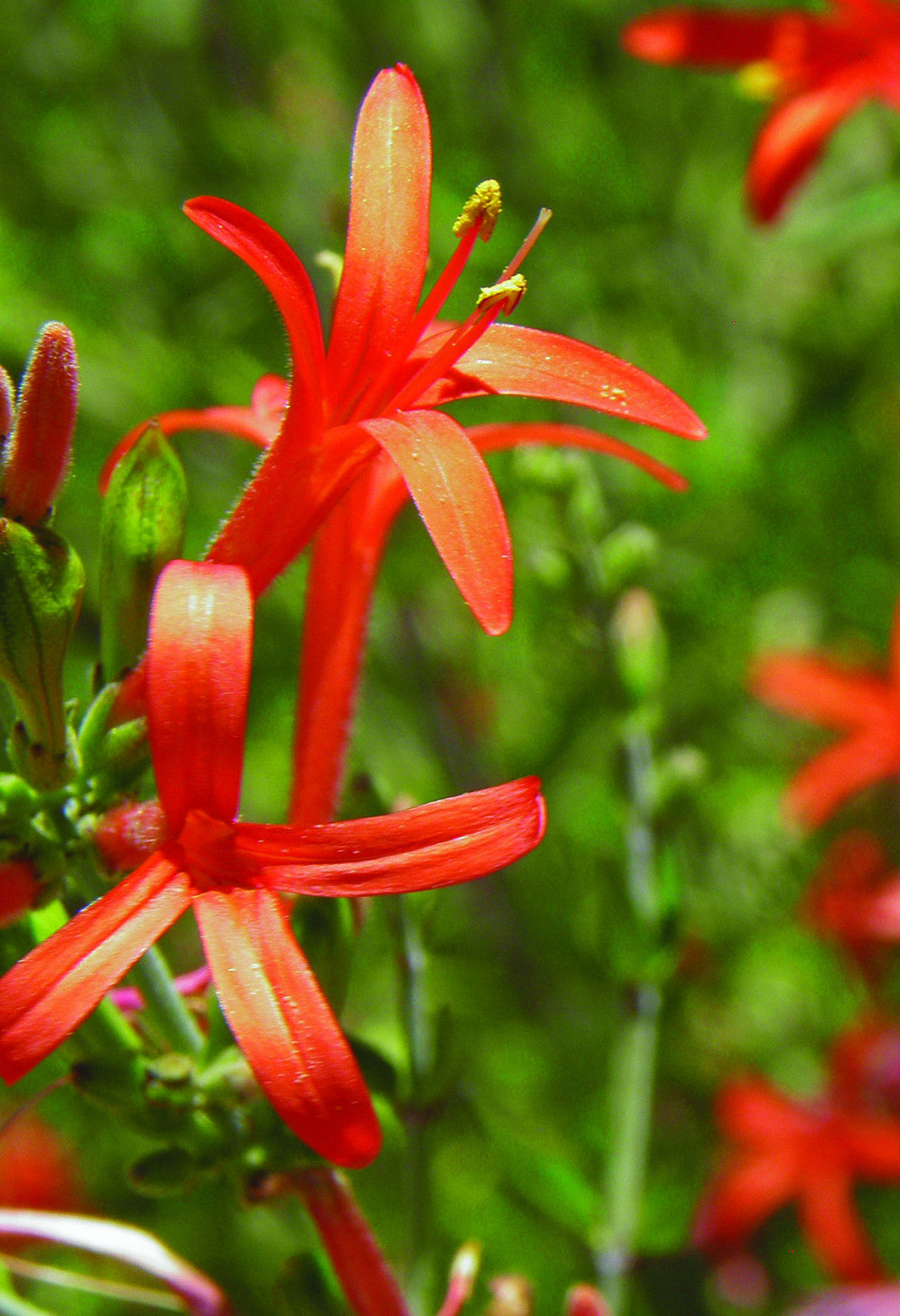
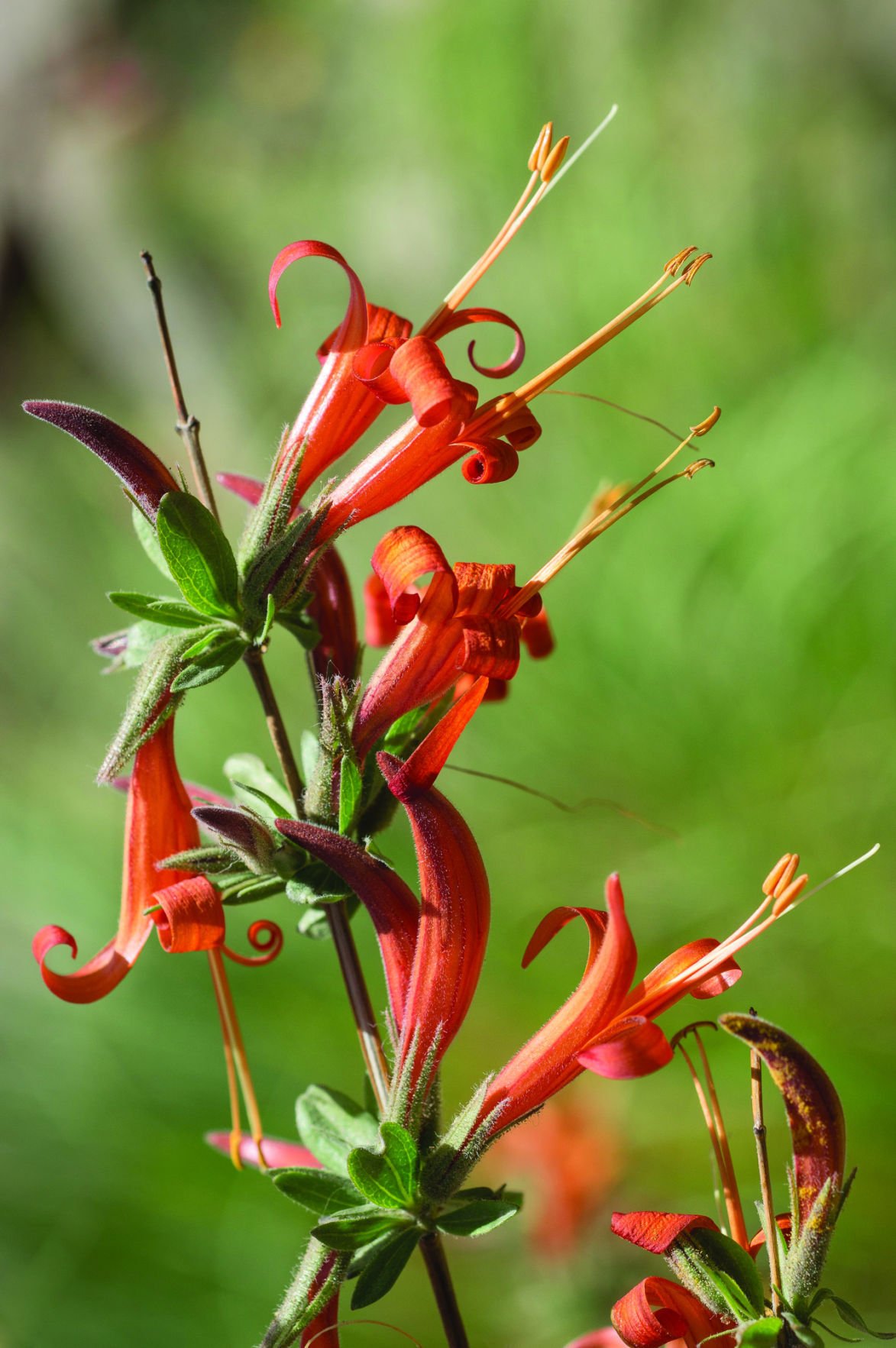
Flame Acanthus, Wright’s Desert-Honeysuckle

Hummingbird plants
Wynn Anderson

Flame Acanthus, Wright’s Desert-Honeysuckle (Anisacanthus quadrifidus)

Type: Deciduous shrub

Size: 4–5 feet high, 4–5 feet wide

Bloom: June–November

Water use: Low to moderate

This pretty shrub is an outstanding performer and should be a mainstay of the summer hummingbird garden. Its delicate tubular blooms of flaming scarlet appear from early summer until frost, providing a nonstop nectar reserve for nesting and post-breeding hummingbirds.

The plant is quite drought tolerant once established. Full sun is usually best for optimum flowering, but plants in hot low-elevation locations may not mind some afternoon or filtered shade. Good drainage is preferred, although plants seem to be able to tolerate a wide range of soils from clay to caliche.

Use as a flowering specimen along walkways, in a container on a patio, or grouped as an informal low hedge in a wildlife garden. Wherever placed, it is certain to be discovered by hummingbirds.

Desert-Honeysuckle, Taperosa

Hummingbird plants
Lisa Mandelkern

Desert-Honeysuckle, Taperosa (Anisacanthus thurberi)

Type: Deciduous shrub

Size: 4–6 feet high, 3–4 feet wide

Bloom: January–April in Sonora, April– June in U. S., sporadic fall

Water use: Low to moderate

This is a charming shrub for the spring hummingbird garden, especially for difficult, hot, low-desert landscapes. The tubular blooms, in shades that range widely from golden yellow to burnt orange to nearly vermilion, provide valuable nectar for nesting hummingbirds.

Established plants are quite drought tolerant once established, requiring a deep soaking only once a month during summer dry periods. Desert-honeysuckle prefers to be in full sun and even tolerates reflected heat. Other than insisting upon good drainage it is not fussy about soil. Plants seem to perform best if cut back hard in late winter every few years.

Groupings can be incorporated into an informal border or seasonal hedge, and singular plants work well in patio plantings and along pathways.

Claretcup Cactus

Hummingbird plants
James Zabriskie

Claretcup Cactus (Echinocereus species)

Type: Succulent

Size: 1 foot high x 1–2 feet wide or more

Bloom: April–June, depending upon elevation

Water use: Low

The proper classification of these spectacular cacti has long been a prickly issue among taxonomists, but one certainty is that hummingbirds, caring naught about nomenclature, visit all of them wherever they are in bloom. The large red flowers remain open for several days and literally gush nectar.

Claretcups require excellent drainage and are susceptible to fungal infection with too much water. Plants typically do best in sunny or lightly shaded exposures but in extremely hot locations prefer mid-afternoon shade. Like most cacti, they perform beautifully in containers. Once established, they require little supplemental water, and will slowly grow to a nice-sized clump of virtual hummingbird magnets.

These distinctive cacti are too frequently yanked from the wild, often illegally, so purchase only plants that have been seed-grown or legitimately salvaged.

Hummingbird Trumpet, California Fuchsia

Hummingbird Trumpet, California Fuchsia (Epilobium canum)

Type: Shrubby perennial

Size: 1–2 feet high x 2–4 feet wide

Bloom: July–October, or until first hard frost

Water use: Low to moderate

Hummingbird trumpet may not be the tidiest plant and its brilliant scarlet flowers can sometimes seem almost garish, but the myriad hummingbirds that pollinate it do not seem to mind. Its brittle arching stems break easily and give the plant a twiggy look in the wintertime.

The plant needs a light, well-drained soil and a deep soaking at least twice a month in summer. This tough perennial usually handles heat extremes well but in the lower deserts does best in part or filtered shade. Leggy plants may be cut back hard in early spring to promote density.

Hummingbird trumpet both reseeds itself and spreads by underground rootstocks, so it may pop up in areas of the garden where not intended. This fast-growing plant works well along pathways, in rock gardens, as a ground cover, and in large containers.

Ocotillo, Devil’s Coachwhip, Albarda

Ocotillo, Devil’s Coachwhip, Albarda (Fouquieria splendens)

Type: Deciduous shrub

Size: 8–12 feet high, 6–10 feet wide

Bloom: March–June, depending on elevation and latitude

Water use: Low to moderate

Hillsides of this showy plant in the springtime serve as nectar and insect cafeterias for migrating and nesting hummingbirds.

This is an extremely slow grower that can be tricky to establish, but when happy is long-lived. Ocotillos prefer full sun and take reflected heat well. They demand excellent drainage and will rot with too much water; a deep soaking once or twice a month during summer droughts should be sufficient to prevent leaf drop.

This is a fine accent plant for courtyards, rock gardens, and naturalistic plantings. Ocotillos are not widely propagated because of their slow growth. Buy seed-grown plants if available, and purchase only bare-root plants that have been legitimately salvaged.

Red Yucca, Redflower False Yucca, Semandoque

Red Yucca, Redflower False Yucca, Semandoque (Hesperaloe parviflora)

Type: Succulent

Size: 3 feet high, 3 feet wide, with 4–6 foot flower stalks

Bloom: May–September, into fall if pods removed

Water use: Low to moderate

This yeoman of the spring and summer hummingbird garden is neither red (though plants may become purple-tinged in winter) nor a yucca, but its less-than-accurate common name makes little difference to hummingbirds.

This sturdy succulent is both drought tolerant and heat loving. It tolerates a variety of soils, demanding only fast drainage. In extremely hot locations, a deep soaking once or twice a month in the summer will improve its appearance; in very wet areas the plant is likely to rot.

This low-maintenance evergreen is widely available and works beautifully as an accent for courtyards, poolsides, and patios, along walkways, in rock gardens, or massed as a tall ground cover. It also makes an excellent container plant.

Chuparosa, California Beloperone

Chuparosa, California Beloperone (Justicia californica)

Type: Semi-evergreen shrub

Size: 4–5 feet high, 5–6 feet wide

Bloom: October–June in frost-free areas, February–March peak

Water use: Low to moderate

The name chuparosa, which in Spanish means hummingbird, honors the star pollinator of this long-blooming shrub. Its bright scarlet to dark red blossoms are an extremely important source of nectar for wintering hummingbirds.

Chuparosa will grow in a variety of sandy or rocky soils but excellent drainage is essential and it absolutely will not tolerate humidity. For best appearance, give plants a deep soaking once or twice a month during summer, and then harden them off by reducing water in the fall.

Plant this iconic hummingbird magnet in full sun or light shade in courtyards and desert gardens. Chuparosa also works beautifully in a large pot, provided drainage is good.

Desert Beardtongue, Canyon Penstemon, Mojave Beardtongue

Desert Beardtongue, Canyon Penstemon, Mojave Beardtongue (Penstemon pseudospectabilis)

Type: Perennial

Size: 1 foot high, 2 feet wide, with flower stalks to 5 feet high

Bloom: March–June

Water use: Low to moderate

Desert beardtongue is a captivating perennial with deep rose to salmon-pink flowers that provide valuable spring nectar for nesting hummingbirds. The tubular flowers appear in whorls along the flower stalk and bloom from early to late spring.

As with many others in its family, desert beardtongue needs a gravelly, well-drained soil, filtered or afternoon shade, and a deep soaking once a month during the summer to prevent dormancy.

This showy hummingbird magnet is marvelous for rock gardens, seasonal washes, mixed borders, raised beds, and mass plantings.

Firecracker Penstemon, Eaton’s Firecracker

Firecracker Penstemon, Eaton’s Firecracker (Penstemon eatonii)

Type: Perennial

Size: 1–2 feet high, 2 feet wide, with flower stalks to 3 feet high

Bloom: April–June

Water use: Low to moderate

When in bloom, firecracker penstemon more than lives up to its name. Its showy spikes of fiery red tubular flowers are pollinated by, and an important nectar source for, migrating and nesting hummingbirds.

This penstemon is quite heat tolerant and normally prefers full sun, but in extremely hot summer regions it may appreciate some filtered or afternoon shade. Mulching lightly in the summer will help keep roots cool. A deep soaking once or twice a month during summer will keep foliage looking more attractive, but otherwise firecracker penstemon is quite drought tolerant.

This is a great accent plant for rock gardens or courtyards and is particularly striking when massed in borders, in beds, or along walkways.

Superb Penstemon, Coral Penstemon

Superb Penstemon, Coral Penstemon (Penstemon superbus)

Type: Perennial

Size: 1 foot high, 1–2 feet wide, with flower stalks 3–6 feet high

Bloom: March–May

Water use: Low to moderate

This penstemon is a vigorous grower and, if allowed to colonize a bed or corner of the garden, will delight humans and hummingbirds alike for many years. Its vivid coral-red tubular flowers are packed with high-sucrose nectar and are avidly visited by hummingbirds.

Plants prefer a sandy or gravelly well-drained soil and are fairly drought tolerant, in most situations needing only a deep soaking once or twice a month during the summer if not on drip irrigation. They abhor overhead watering, including roof runoff. In most instances they do well in full sun to part shade; the shade of mesquites or acacias provides an ideal niche.

Superb penstemon is terrific for rock gardens, borders and mass plantings.

Parry’s Agave

Parry’s Agave (Agave parryi)

Type: Succulent

Size: 1–2 feet high, 2 feet wide, with 13–20 foot flower stalk

Bloom: June–August

Water use: Low

Parry’s agave commands the attention of all hummingbirds in the vicinity when it is in bloom. Not only are the blossoms rich in nectar, but they also attract many small insects that are easy pickings for hummingbirds.

Plants need only a coarse, well-drained soil and full sun or light shade. Give them a deep soaking once or twice a month until established, weekly during summer dry spells. Mature plants are quite drought-tolerant, but look best when watered monthly during the growing season.

[Parry’s agave] makes a striking accent or addition to a naturalistic desert garden, but be sure to locate it away from walkways. [It] offsets freely, so even once flowering occurs and the mother plant dies, pups will be there to take its place.

Desert-willow, Mimbre, Willowleaf Catalpa, Wash Willow

Desert-willow, Mimbre, Willowleaf Catalpa, Wash Willow (Chilopsis linearis)

Type: Deciduous tree

Size: 20 feet high, 20 feet wide

Bloom: May–June, intermittent in summer with water/rains

Water use: Low to moderate

This graceful tree provides ruffled, orchid-like, pale pink to rich burgundy (or occasionally white) flowers that peak in springtime but often continue intermittently throughout the summer. Fast-growing when young, irrigated plants can shoot up as much as three feet in a single season. Persistent tan seedpods provide interesting winter character that tidy-prone gardeners may consider shaggy.

Desert-willow tolerates most any soil and it is quite drought tolerant, although supplemental water once or twice a month during the summer will prolong flowering and prevent the foliage from dropping from drought stress. It blooms best in full sun and stands up to reflected heat well.

This tough performer lends charm to whatever spot it is given, and can be used to shade walls, as an accent in the garden, and for erosion control.

Parry’s Penstemon, Varita de San José, Pichelitos

Parry’s Penstemon, Varita de San José, Pichelitos (Penstemon parryi)

Type: Perennial

Size: 1 foot high, 1–2 feet wide, with flower stalks to 3 feet high

Bloom: March–April

Water use: Low to moderate

The enchanting funnel-shaped flowers of deep rosy pink are reason enough to plant this penstemon, but they are also a valuable source of nectar for nesting hummingbirds.

A coarse, well-drained soil low in organic content is preferred. Plants thrive in full sun in most areas but also do not mind a bit of afternoon shade, particularly in extremely hot locations. Too much shade, on the other hand, tends to result in leggy growth and sparse bloom.

Parry’s penstemon works beautifully in rock gardens, borders, and massed plantings, and is especially suitable for difficult low-desert landscapes in the filtered shade of palo verdes or mesquites.

Autumn Sage, Cherry Sage, Gregg Salvia

Autumn Sage, Cherry Sage, Gregg Salvia (Salvia greggii)

Type: Semi-evergreen subshrub

Size: 2 feet high, 2–3 feet wide

Bloom: August–November, again March–May, sporadic summer

Water use: Moderate

This is a tough and well-behaved little shrub, whose charming hot pink to cherry-red flowers blanket the plant in autumn and again in spring. The one-inch tubular flowers appear in loose spikes and are quite showy, flowering in successive waves from spring to fall.

This is a very forgiving plant with ample irrigation, requiring only fast-draining soil and an eastern exposure or filtered afternoon shade. A deep soaking twice a month during the summer will keep it looking its best, but avoid overwatering.

Autumn sage works beautifully in courtyards, patios, and perennial beds, or massed as a low hedge or ground cover, and it also makes a delightful container plant.

Want to know more? Buy the book

Want to know more? Buy the book

“Hummingbird Plants of the Southwest,” by Las Cruces, New Mexico-based birder and garden consultant Marcy Scott, is published by Tucson’s Rio Nuevo Publishers.

The 344-page, soft-cover book retails for $18.95 and is available at these Tucson locations:

Antigone Books, 411 N. Fourth Ave.;

Native & Nature, 2021 N. Kinney Road;

The University of Arizona Bookstore, 1209 E. University Blvd.;

Magic Garden Nursery and Landscape, 7909 E. 22nd St.;

Mesquite Valley Growers, 8005 E. Speedway;

Petroglyphs Gallery, 228 S. Park Ave.;

Rillito Nursery, 6303 N. La Cholla Blvd.;

San Xavier Mission, 1950 S. San Xavier Road;

The West, 5615 E. River Road;

Tohono Chul Gift Shop, 7366 N. Paseo del Norte; and

Tucson Botanical Gardens, 2150 N. Alvernon Way

Related to this collection

Arizona Daily Star
  • Facebook
  • Twitter
  • Bluesky
  • YouTube
  • Instagram
  • Arizona Daily Star Store
  • This is Tucson
  • Saddlebag Notes
  • Tucson Festival of Books
Prefer us on Google

Sites & Partners

  • E-edition
  • Classifieds
  • Events calendar
  • Careers @ Lee Enterprises
  • Careers @ Gannett
  • Online Features
  • Sponsored Blogs
  • Get Healthy

Services

  • Advertise with us
  • Register
  • Contact us
  • RSS feeds
  • Newsletters
  • Photo reprints
  • Subscriber services
  • Subscription FAQ
  • Licensing
  • Shopping
© Copyright 2026 Arizona Daily Star, PO Box 26887 Tucson, AZ 85726-6887
Terms of Use | Privacy Policy | Advertising Terms of Use | Do Not Sell My Info | Cookie Preferences
Powered by BLOX Content Management System from bloxdigital.com.
  • Notifications
  • Settings
You don't have any notifications.

Get up-to-the-minute news sent straight to your device.

Topics

News Alerts

Breaking News