Despite a small uptick between mid-2016 and the first quarter of 2018, homeownership in the U.S. has been on the decline since 2005. Prolonged effects from the Great Recession, steep home prices, increasing mortgage rates, and the rise of the millennial demographic have all contributed to a national trend that favors renting over buying.
According to the U.S. Census Bureau, there are approximately 75 million owner-occupied housing units across the U.S. Of these, fewer than 10 percent are owned by millennials, who for the purpose of this study are defined as the demographic between the ages of 15 and 34. For millennial families in particular, later marriage, student loan debt, stagnant wages, and high childcare costs have made it more difficult to buy homes.
As a result, millennials lag previous generations in homeownership even when adjusted for age differences. In 2016, the national homeownership rate for 15-34 year olds was 32.6 percent, compared to 63.6 percent for all ages. This represents an 11.4 percent decrease from just five years prior, compared to a 3.8 percent decrease across all ages—a difference that in part highlights the more significant effect macroeconomic factors are having on the millennial generation than others.
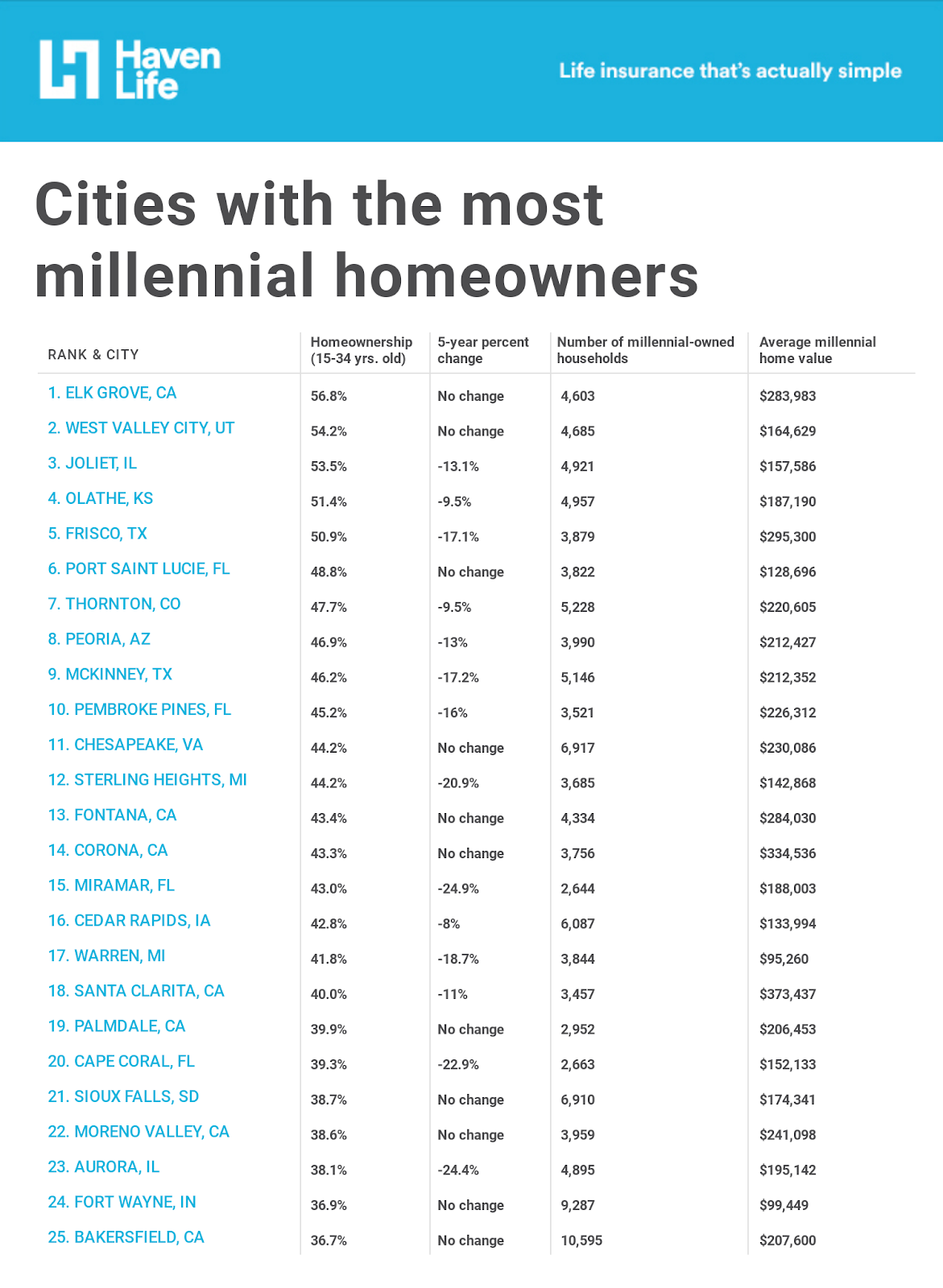
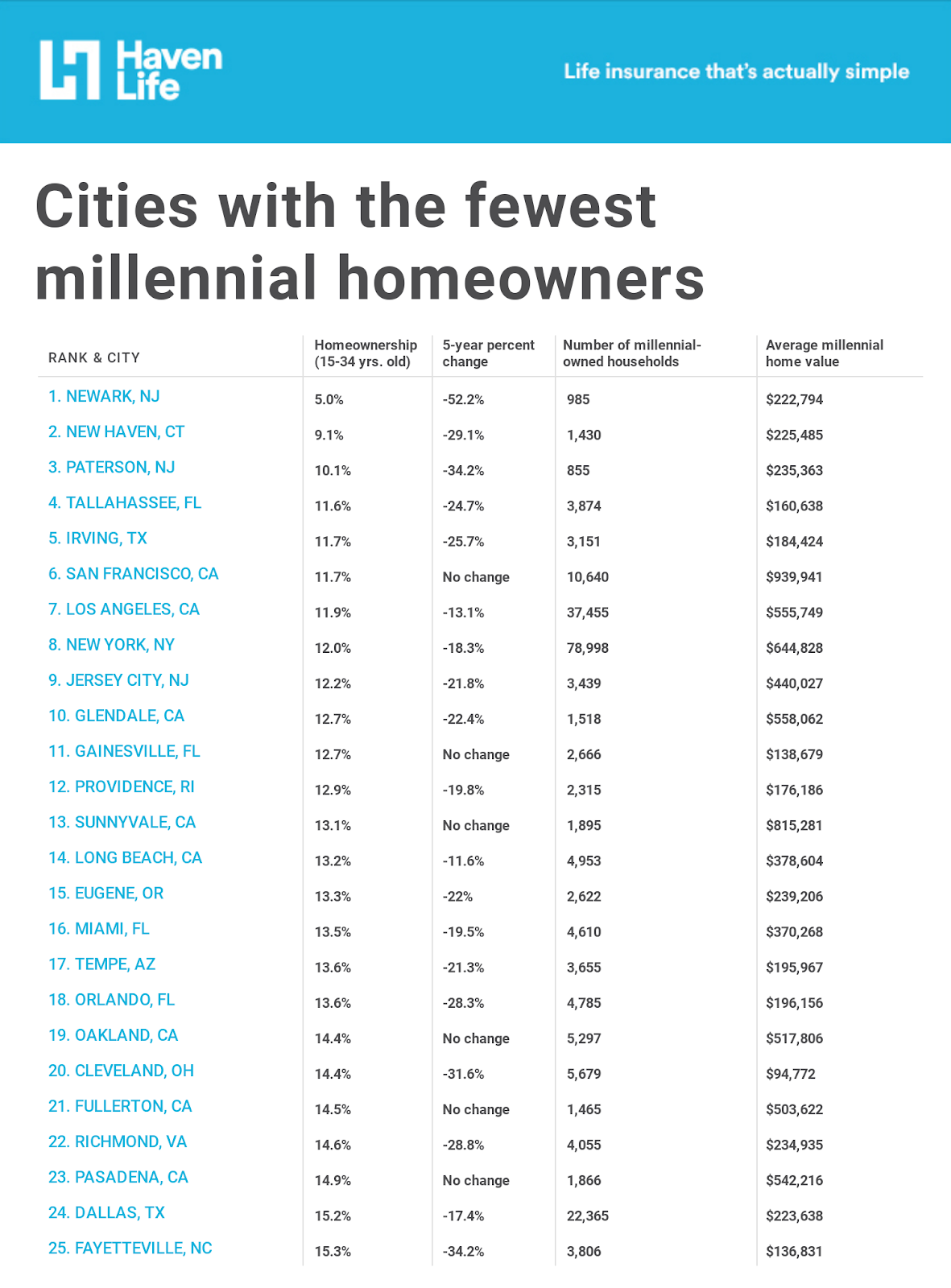
Despite the nationwide trend of low homeownership among millennials, the rates vary significantly from city to city. To see where millennial homeownership is highest and lowest, researchers at online life insurance agency Haven Life used data from the U.S. Census Bureau 2016 American Community Survey to analyze the top 200 cities in the U.S. by population. Here’s what they found:
- The average millennial home value in the U.S. ($204,504) is 23% lower than the average home value across all ages ($264,588).
- There are affordable cities where millennials are buying homes at rates significantly above the national average of 32.6 percent for their demographic. The homeownership rate for millennials in the 25 cities with the highest millennial homeownership rate is 44.0 percent, compared to 12.7 percent for cities with the lowest millennial homeownership rate.
- Low-millennial-homeownership cities tend to be more expensive than their counterparts. The average millennial home value in the 25 low-millennial-homeownership cities is $493,314, compared to $199,915 for the 25 high-millennial-homeownership cities.
- Homeownership rates in the low-millennial-homeownership cities fell more over the past five years (-16.9 percent) than those in the high-millennial-homeownership cities (-7.5 percent).
- Most high-millennial-homeownership cities are in the Midwest, while almost all cities with low homeownership rates are coastal.
Despite attracting large millennial populations, many of the most populous U.S. cities have some of the lowest millennial homeownership rates. To show just how challenging it’s been for millennial families to buy in the nation’s urban centers, Haven Life’s researchers also included statistics on the largest 25 cities in the U.S. From a low of 11.7 percent in San Francisco, to a high of 32.5 percent in Fort Worth, all of the largest cities have a millennial homeownership rate that’s below the national average of 32.6 percent.