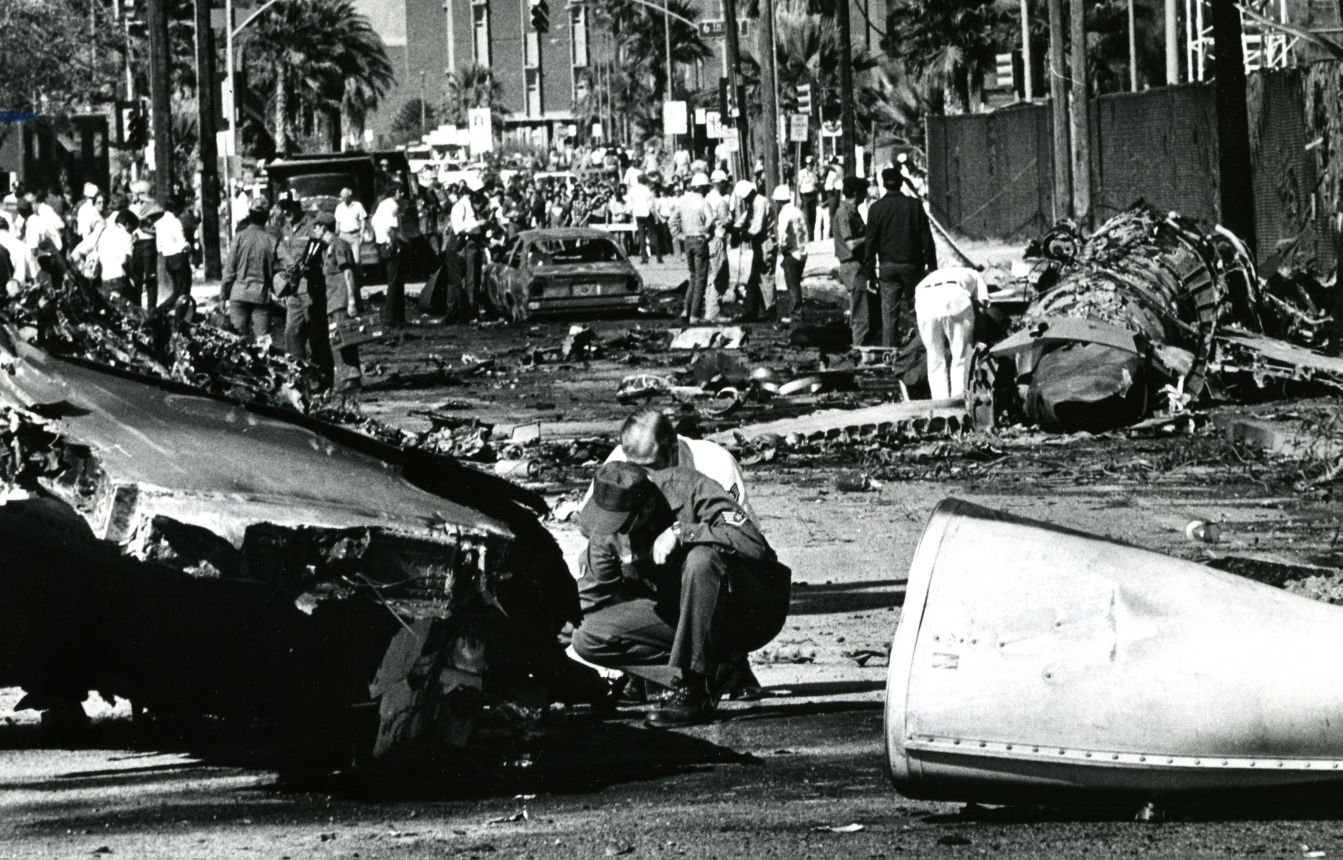
A-70 Corsair II jet crash at 7th and highland. D-M personel survey the debris from the crash. Arizona Daily Star file photo taken 10/26/78 by Ron Londen.
When the Morgue Lady first began working in the Arizona Daily Star Library quite a few years ago, she was told of a list the library kept of dates she would need. These dates corresponded to the biggest news stories in Tucson, those stories about which readers would occasionally call to ask, "When exactly did that happen?"
The list included the day an Air Force jet crashed just south of the University of Arizona. That crashed happened October 26, 1978.
It's a sure bet that the parents of children at Mansfeld Junior High School would never forget that day. The jet narrowly missed the school. The children were all safe, but that didn't save the parents from extreme worry for a short while.

Flight path — The dark line follows the path of the jet as it headed toward the Air Force base. The letter A shows about where the plane developed engine trouble. B is where it crashed, and C is where it was supposed to land.
From the Arizona Daily Star, Friday, Oct. 27, 1978:
Jet kills 1, spares kids
Fiery debris spews over school area
By DIANE JOHNSEN
The Arizona Daily Star
An Air Force jet fighter crashed in a street just south of the University of Arizona shortly after noon yesterday, killing one person but narrowly missing students on the playground at Mansfeld Junior High School.
The plane's pilot suffered only a scraped ankle after he ejected 200 feet over the UA campus, but the aircraft ignited a wall of flames several stories high as it hit on one wing and skidded along North Highland Avenue south of East Sixth Street. Six persons were injured, one very critically.
After compression in his engines failed, the pilot aimed the plane for a UA football practice field just east of Highland, but instead it plummeted onto the street, showering cars in the area with burning fuel and debris.
Engines on his plane, an A-7D Corsair II, stalled eight miles north of the Davis-Monthan Air Force Base runway for which he was headed, said Brig. Gen. Robert S. Kelley, commander of the base.
Harry Brannon was sitting outside his home at ---- E. Silver St., when he heard a popping sound from the plane as it passed over North Sixth Avenue and East Grant Road, then the engines died.
"I thought he was turning on his afterburners to slow him down, but then he went to coasting," he said.
The crash raised anew questions of the safety of D-M flight paths over the university. Rep. Morris K. Udall, D-Ariz., called a meeting of city, county and Air Force officials for 9 a.m. today in the City Council chamgers to discuss the incident.
The 40 A-7Ds at the base will not be grounded and will be flown normally pending the investigation and a review of the planes' maintenance history, said Maj. Myron Donald, assistant public relations officer at the base.
A long string of Air Force jet flights over the UA continued unbroken after the crash. Students cramming the sidewalks near the site had to shout on occasion to make themselves heard above the planes' roar.
The woman who died in the crash and the most seriously injured victim were in a compact car engulfed in flames from the plane. They have been identified as sisters, but hospital officials were not sure last night which had died. An imprint of the dead woman's teeth was taken, and positive identification was expected today.
Believed to have been burned to death was Leticia Felix Humphrey, 22, of ---- N. Columbus Blvd. Her sister is Clarissa Felix, of ---- E. Eighth St. The woman believed to be Clarissa was in extremely critical condition in University Hospital last night with third-degree burns over 90 percent of her body.
Alice Minder, 48, of --- N. Vine Ave., and her 18-year-old daughter, Joan, were in stable condition at St. Mary's Hospital after their moving car was ignited by debris from the plane several feet farther south on Highland.
Another daughter, Erin, 12, was walking nearby at the time and suffered cuts while pulling her older sister, crippled by a birth defect, from the car. Erin was treated at University Hospital and released.
In stable condition at University Hospital was Richard Flagg, 56, address unknown, who apparently was walking in the area when he was knocked unconscious by the force of the crash.
Mansfeld seventh-grader Christopher Duarte, 12, was released from University Hospital after being trreated for bruises he received when he was thrown to the ground by the concussion.
The crash burned four unoccupied cars on Highland, officials said.
Though the plane is equipped to carry 20,000 pounds of weapons, it was unarmed.
The plane's pilot, Capt. Fredrick L. Ashler, 28, ejected as the plane soared powerless over the UA campus. Seen by scores of students from high-rise classroom windows, he parachuted down to land on a grassy area outside campus police headquarters at East Fifth Street and Highland.
Students lounging in the sun during the noon hour on the UA mall heard an explosion overhead as Ashler ejected, then rushed en masse the few blocks south the where his plane came to rest at about 12:16 p.m.
"Everybody was just looking at it — and it was like 'Oh, my God.' Then everybody was running over there," said UA student Frank Hunt, 23, from Tucson.
UA sophomore Danny Taylor, 21, said the plane hit the ground at an angle of 45-60 degrees. "I was walking back to my dorm. There was a loud explosion first when the pilot ejected, and then the plane crashed. It was the loudest thing I've ever heard."
Kelley said Ashler, an instructor pilot with more than 1,000 flying hours and 764 in the A-7D, had intended to set the plane down on the practice field. But witnesses said that after he ejected, the aircraft suddenly veered eastward to its right and slammed into the street between the field and the school. The plane was going about 200 mph on impact, Kelley said.
He said a compression failure caused the plane's engines to stop, and praised Ashler for doing all he could to land the plane safely. Witnesses at the UA agreed.
"He laid it down really nice," said Mario Zappia, 22, from Oracle. "He didn't know he was going to hit anybody. The cars turned onto the street after he had chosen it."
An investigation into the cause of the crash will be conducted by the Air Force. The Federal Aviation Administration will not be involved, said Carl Swanson, FAA representative here, because a military craft was involved.
Ashler, who had been assigned to the 357th Tactical Fighter Training Squadron here for about five months, was picked up by Air Force medics within minutes after he parachuted to safety. He was hospitalized overnight for observation, and unavailable for comment.
The fiery crash drew at least 150 law-enforcement officers, according to Police Capt. Leonard Dietch. It took 35 firefighters in four engine companies and two ladder trucks to quell the flames with foam, officials said.
A crowd of thousands formed around the crash site within minutes, and several hundred remained behind police barricades as long as two hours later. Police arrested Lawrence Dunn, 33, of --- E. University Blvd., and charged him with disorderly conduct when he refused to leave the scene, they said.
Shortly before 2 p.m., a parade of D-M vehicles, including two dump trucks, a bulldozer and a long flatbed truck, arrived escorted by motorcycle police to being cleaning up the plane's debris. They finished the job by 5:30 p.m.
Police officials doubted that Highland would be reopened immediately, however, because of deep ruts the plane scraped into the asphalt. The road was scorched for several hundred feet, beginning about half a block south of Sixth where the plane first hit.
The plane knocked down a telephone cable, and service was cut off to 200 customers between East Sixth and Seventh streets from North Mountain Avenue to North Cherry Avenue, said Mountain Bell spokesman Rick Hays. He said service should be restored by 3 a.m. today. A power outage in the area lasted about 45 minutes.
Udall said he hoped the meeting this morning would help clear and "perhaps reassure some people" about flight safety in the future.
"As long as I've been in Tucson, there've been arguments about Davis-Monthan, its proximity and flight patterns. But I think D-M has done a pretty good job with the least possible danger to the university and to the city."
UA President John P. Schaefer, who was out of the state yesterday, issued a statement calling for talks between community leaders and Davis-Monthan officials to work out ways to "minimize danger to the public." He had not yet been notified about today's meeting, but spokesman Hugh Harelson said the university would be sure to have a representative at the session.
City Councilman Tom Volgy, a UA political science professor who saw the plane go down, said he and a Udall aide had talked to D-M officials three or four weeks ago about the danger and noise caused by the Air Force landing patterns over the campus.
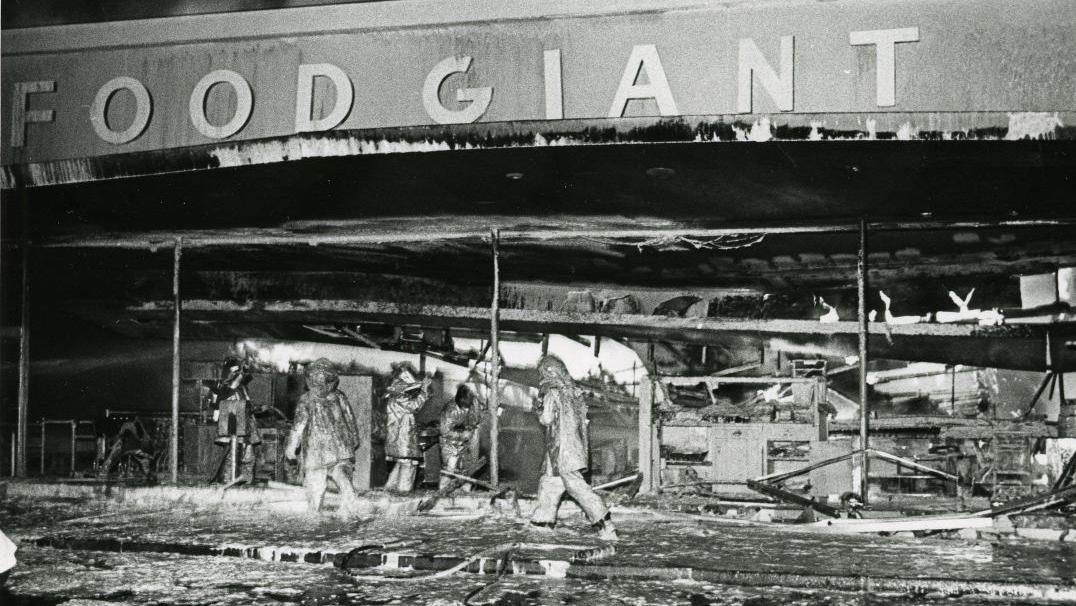
The safety of D-M planes over the city has been a persistent controversy in Tucson. The issue has been a sleeping one, however, since a furor over the crash of an F-4D jet into an eastside supermarket that killed four persons in 1967.
"We don't like to crash airplanes," said Kelley yesterday. "We're proud of the fact that we've had a very good accident record."

Crash-bound over campus — The broken line shows the path across the University of Arizona campus that the jet fighter took before crashing on Highland Avenue.
Monday: Stories of fear and courage.