Sunday, Nov. 18, 1984
On Nov. 13, 1983, a Corvette owned by the Busch family of St. Louis hurtled off the pavement and went airborne on River Road, tossing a young Tucson woman to her death. A bloodied August A. Busch IV remembers driving that night ─ he'd grown tired, gotten out of his car and gone to sleep by the side of the road, and possibly he'd been run over, he said. A year later, lawmen who handled the investigation discuss the case ─ months after it was closed with no charges brought against the young Busch heir. Prosecutors insist that the right decision was made. The Busch family declines to comment. Uncertainties linger.
By R.H. Ring
The Arizona Daily Star
The case, as one prosecutor reflects, "had a lot of juice." A teenager from one of the nation's prominent families. His new Corvette. Disco drinking. A wreck after midnight, and a dead Tucson woman.
No doubt, many Tucsonans were cynical when it was announced that no charges would be pressed against August A. Busch IV after Michelle Frederick died.
Months after the case was closed, The Arizona Daily Star met with lawmen who handled what they characterized as the most intensive traffic-fatality investigation in the history of Pima County.
Prosecutors insisted the right decision was made. The Busch family declined to comment. A year after the wreck, uncertainties linger.
• • •
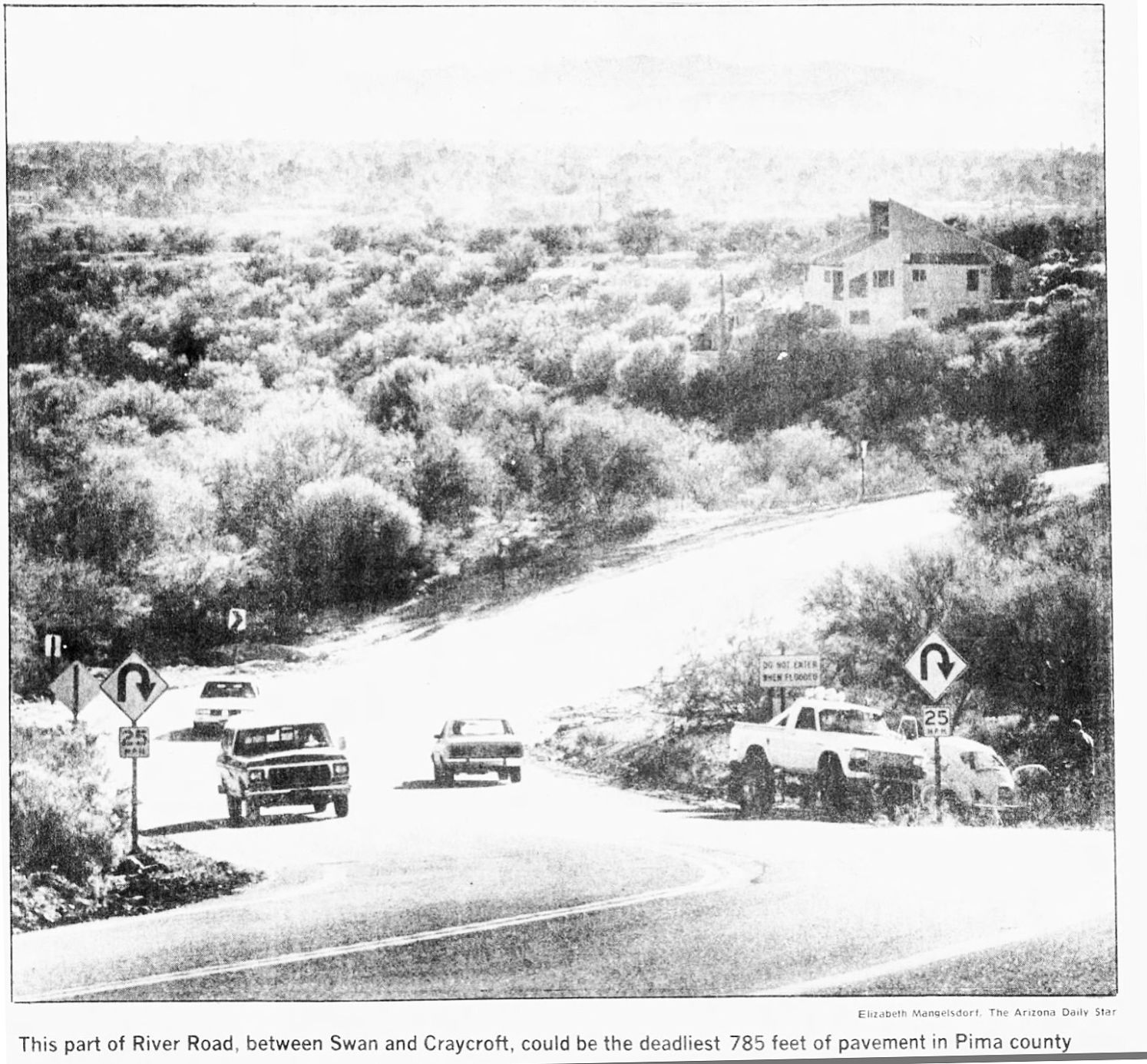
In the foothills above the city lights, the Corvette sped through the twists and turns of River Road sometime after 1 a.m. last Nov. 13.
At a tight, dipping S-curve ─ nicknamed Dead Man's Curve ─ the Corvette hurtled off the pavement and went airborne, crashed into a dirt bank and came to rest teetering on the driver's side.
A young woman was thrown from the car as it rolled. She hit a palo verde tree, snapping some branches, and died of head and chest injuries shortly after landing.
The wreck, in the desert 70 feet off the pavement, did not draw much attention at first.
About 6:30 a.m., in the early morning light, a man walked along River Road about a mile away. There was blood on his head, his shoulders, his clothes.
At least three drivers stopped and talked to the bloody pedestrian.
The man appeared dazed. He said he didn't know what happened. He declined a ride to a hospital, and instead accepted a ride home.
Despite the strange hour and circumstances, none of the passers-by reported the bloody pedestrian to officials until hours later.
The wrecked Corvette was reported to the Pima County Sheriff's Department about 8:30 a.m. Deputies responded, as did the Rural Metro Fire Department.
Deputy Ronald Benson, one of the county's top accident investigators, arrived half an hour later and was not pleased with what he found.
Firefighters had been tromping all over. The Corvette had been rocked, so that a bloody tarp and a jacket underneath could be removed. Other items had also been disturbed.
Benson ordered photographs made of various footprints, and examined the body.
The woman had been dead at least a couple of hours. An expired driver's license identified her as Michelle C. Frederick, 22, of Tucson.
Benson continued his survey. He found one empty beer can ─ a Budweiser Light ─ up by the road, and several more under the car. I
In front of the smashed Corvette, a radar detector was lying in the dirt. Benson also found a .44 Magnum pistol.
A check was run on the Corvette's Missouri license plates. They were registered to August A. Busch III, of a St. Louis suburb.
Benson also looked through a wallet found at the scene. It contained two Missouri driver's licenses for August A. Busch IV. One was a sophisticated fake, with a phony birth date that added four years to Busch's age, then 19.
• • •
Two deputies were sent to a local address listed on one ID. It was a townhouse on a bluff over the Rillito River. They got no response at the door. But they could see a light inside, and hear music.
The deputies went in and called for Mr. Busch. "Yes?" came the reply from a back bedroom.
Busch IV was lying on a bed with a sheet draped across his middle. Blood had dried on his forehead and shoulders and on the pillow. His bloody clothes were piled nearby.
He was all right, he offered, though he wasn't sure what had happened. He appeared somewhat dazed and his eyes were glassy, but he was responding. To one deputy, he appeared lucid.
The deputies read Busch his rights. He said he understood. He remembered driving the night before he'd grown tired and gotten out of his car, gone to sleep by the side of the road, and possibly he'd been run over.
Waiting for the ambulance, one deputy noticed a mirror that carried the Anheuser-Busch brewing company logo, and asked: Are you related to the Busch family?
Busch said he was. His father, August A. Busch III, is the company's president and chairman of the board.
On the way to the hospital, Busch IV talked to two medics. He wasn't sure how his injuries had occurred. He did say he'd had "quite a bit" to drink the night before one or two vodkas and some light beers.
Both medics thought their patient was alert and oriented to reality.
At Tucson General Hospital, an osteopathic hospital, Busch was treated for loss of blood and a depressed skull fracture; 50 cc of blood was drained from the area of the fracture.
Two traffic deputies arrived and talked to Busch briefly. He repeated his earlier account: He'd fallen asleep, perhaps he'd been run over. He couldn't recall.
A crucial legal question had arisen: Was there justification for taking blood and urine samples? The samples could be checked against traces at the wreck, and they could also indicate any alcohol or drug use by Busch.
Normally, in a possible DUI (driving under the influence) case, samples are drawn as quickly as possible, at the request of the law officer.
This time, legal advice was sought from Ed Nesbitt, a deputy county attorney who had been called out on a Sunday to assist with the case. Nesbitt was aware of the connection to the Busch family, the resources that could be brought to bear, and he was worried.
If samples were taken, a good lawyer could argue there had been no reason to suspect Busch at that point. Any results could be ruled inadmissible in court.
Nesbitt did not handle many DUIs. He decided to stress caution. Blood and urine samples were drawn. They would be held at the hospital until lawmen obtained a search warrant against Busch.
• • •
The investigation of the wreck at Dead Man's Curve consumed more than 400 man-hours. Deputy Benson was the spearhead, backed by seven other deputies.
Twenty-nine people gave detailed, tape-recorded statements. Another 40 were interviewed. Still more were contacted briefly.
From the interviews, Benson pieced together this history:
The day before the wreck, Busch went jogging, worked out at his gym, and dined out with a close friend. It was a Saturday, so the University of Arizona freshman had no classes.
After dinner, Busch visited his friend's place in the foothills. Coming back into town, Busch drove his Corvette. His friend drove a Camaro Z28.
The Camaro was pulled over on Craycroft Road south of River Road and Busch's friend was ticketed for doing 65 mph in a 45-mph zone.
The men drove on to Voila's, an upscale discotheque on the eastside commercial strip. They arrived about 9 p.m.
In the loud frenzy of the crowded disco, the men were socializing with a loose group of friends. Others in the group, and waitresses and bartenders, gave varying reports of Busch's drinking.
One waitress said she'd served Busch five or six vodka Collinses. The close friend said Busch had consumed six or seven. Other reports were vague, or of lesser amounts.
One of the partyers at Voila's was Michelle Frederick, a Sahuarita High School graduate who was out with three girlfriends. She had met Busch at a campus burger bar where she worked as a waitress.
At closing time, the group made plans to continue the party at a mid-town residence. In the parking lot, Frederick got into the passenger seat of Busch's Corvette.
Busch drove east away from the planned party. One witness said she tried to follow, but the Corvette pulled away too rapidly. Busch was driving 65 mph and passing cars on Tanque Verde Road (where the limit is 45 mph), the witness said.
Busch and Frederick never made it to the party. Deputy Benson tried to reconstruct their probable route east on Tanque Verde to Sabino Canyon Road, north on Sabino to . . .
Benson was never able to conclusively fill in the gap. He drove at high speeds from Voila's up Sabino and west on River Road to Dead Man's Curve, to determine the earliest time the wreck could have occurred. It took half an hour. The wreck could not have occurred before before 1:30 a.m.
The next evidence linked to the wreck is the sighting of Busch, walking on River Road at dawn.
All the medical examiner could say was that Frederick had died closer to 1:30 a.m. than to 6:30 a.m.
Benson checked the log sheets of patrolling deputies, looking for a contact with the Corvette and its occupants in the intervening period. He thought the couple could have parked in the desert for a while. The check turned up nothing.
Through many long Saturday nights, Benson waited along River Road near Dead Man's Curve, writing down license plate numbers of cars. He traced down the drivers, but no one had noticed anything unusual the night of the wreck.
Benson also checked Busch's driving record here. Three months before the wreck, Busch had pleaded no contest to a speeding ticket and paid a $65 fine.
• • •
Benson and other sheriff's experts reconstructed the wreck itself, using complex calculations based on observations of the roadway and the desert, the weight distribution of the Corvette, the damage to the car and its occupants.
"It's not so much a science as an art," Benson says.
In the end, the deputy concluded:
- Busch was driving the Corvette when it ran off the road.
- The car was doing 42 to 52 mph in a curve where the limit drops suddenly from 35 to 25.
- No brakes had been applied before the car became airborne.
That was about all Benson was able to say, despite his legwork.
The skull injuries suffered by Busch were consistent with amnesia, and Busch provided no further information about the accident.
The photographs of footprints around the wreck which might have shown Busch's movements turned into another dead end. All the prints belonged to firemen or others who arrived at the scene before Benson.
The big frustration was trying to determine Busch's blood-alcohol level the night of the wreck.
A search warrant was eventually obtained for an analysis of the blood and urine samples taken at Tucson General Hospital nearly a week after the samples were drawn. It took that long, says the Pima County-Attorney's Office, to establish a "probable cause" that Busch had been drinking and driving.
But when it came time to analyze the samples, they were found to be no longer usable. The urine sample had been lost. The blood sample had been "spun down" to its basic components, a procedure used for some analyses but which makes alcohol and drug testing impossible.
Despite intensive questioning of the staff at Tucson General, Benson was never able to determine who was responsible for handling the samples. He fumes at the telling.
Jim Howard and Thomas Zawada, the deputy county attorneys who handled the case, say the loss of samples is "not that unusual."
"It happens more often than the public would stand for," Howard says.
Gilbert Contreras, head of the hospital blood lab, admits "there might have been a problem with communication." But Contreras points back to the County Attorney's Office for not ordering tests as soon as Busch entered the hospital.
"Usually we do our alcohol tests immediately. I would question why they didn't do that," Contreras says.
Busch's blood-alcohol level could only be estimated. He weighed about 155 pounds, and drank seven vodka Collinses in four hours at Voila's, according to the most damaging report. Prosecutors used that report to theorize what they call the worst possible case against Busch.
The light beers found at the wreck or mentioned by Busch could not be positively linked to the case. Fingerprint tests on the beer cans showed nothing conclusive.
Putting the accident time at 2 a.m. ─ fairly close to the reported drinking ─ Busch's blood-alcohol level was only 0.04 to 0.05 percent. That was the professional opinion of Walter Tannert, the head chemist at the Tucson Police Department-Pima County Sheriff's Department crime lab, and Thomas E. Henry, the county medical examiner. A person is legally drunk in Arizona with a blood-alcohol level of 0.10 percent ─ about twice the theorized "worst case" against Busch.
• • •
There is little doubt that any defense of Busch would have been thorough and competent.
A few weeks after the accident, Busch's legal representation included attorneys from two prominent local firms ─ Carmine Brogna of Kimble, Gothreau, Ryan, Nelson & Cannon PC; and John W. McDonald of Chandler, Tullar, Udall & Redhair ─ and Norman London of St. Louis.
London is known as a top criminal defense attorney. In 1977, he handled a defense of August Busch IV's uncle, Peter W. Busch.
Peter Busch pleaded guilty to manslaughter after he shot and killed a friend when a revolver discharged accidentally on a Busch country estate outside St. Louis. He was given five years' probation.
In addition to London and the other attorneys representing August Busch IV, at least one private detective agency had been hired, along with highway-safety and accident experts from St. Louis, Texas, California, Illinois and Colorado.
On Nov. 28, the experts assembled at Dead Man's Curve. The road was blocked off. Numbered signs had been placed along it, as reference points. A new Corvette, rented in Phoenix, was repeatedly driven through the curve. Its travel was recorded by cameras. A second test was held that night.
Deputy Benson believes it was preparation for a counterattack ─ a challenge of the county's road design at Dead Man's Curve.
• • •
From the first, the Busch wreck landed smack in the public eye. The story was featured in newspapers and broadcast news for weeks. Reporters bothered Frederick's family in Nogales. Her mother was said to be crying every night for a month.
A controversy erupted over a request for additional samples of blood, urine and hair from Busch. In January, Benson filed for a search warrant, claiming "probable cause to believe that the crimes of manslaughter and leaving the scene of an accident involving death" had occurred.
Attorney London filed a response saying the facts were insufficient to support the allegations.
He cited Arizona law, which says that to be guilty, a person must know an accident and death have occurred. Benson's petition described "a seriously injured, disoriented young man who does not recall any accident," London contended.
The Arizona Supreme Court found enough reason to take the samples, and in March, Benson flew to St. Louis, where Busch had been taken shortly after the accident.
Benson was met and chauffeured around St. Louis by a Busch company security guard. He obtained the samples and left that evening. The Busch family paid for his trip first class on the way to St. Louis, and coach fare going home.
The samples were given to the Arizona Department of Public Safety crime lab in Tucson, and a new controversy brewed as the lab gave the case a low priority. The preliminary report was not released until July 11. Benson thought it had taken "a damn long time."
The tests established that Busch's blood type showed up on the driver's door, the driver's visor and other portions of the wrecked Corvette. That indicated Busch had been the driver, Benson says.
The analysis, and all the controversy, did not seem relevant in the end. Prosecutors had decided there wasn't enough evidence to make a criminal case.
Recklessness or negligence could not be proved because there was "every indication that speed was not the cause of the accident," prosecutor Howard says.
Tests showed a Corvette could navigate Dead Man's Curve at the speeds estimated by Benson, Howard said recently.
The case was not taken to a grand jury. Within the County Attorney's Office, there was "some disagreement" over that decision, Howard said. "Everybody looked at it like a close decision."
Howard acknowledged he might have been able to secure an indictment against Busch, but "that would have been a cop-out," he said ─ the indictment would have collapsed in court, where "proof beyond a reasonable doubt is a high standard."
Prosecutors insist they handled this case no differently from any other. They view the matters of breaking the speed limit and the phony driver's license as too minor to press as crimes.
Deputy Benson filled three 4-inch-thick file folders in the months he lived with the Busch wreck. "It's frustrating, no matter which way it went," he told the Star.
Benson lost a lot of sleep, waking up in the middle of the night to jot down some thoughts or go over some testimony. His cautious "informed opinion" on the case?
August A. Busch IV ran off the road, speeding, and a young woman died. Busch was enjoying the thrill of his sports car, and he lost it.