

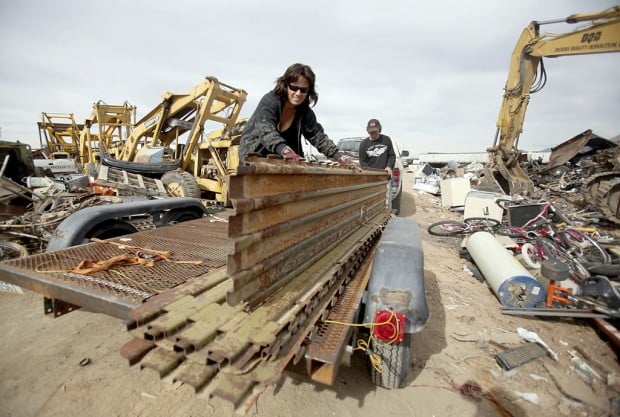

Local authorities hope a new investigative tool will help them to battle the stubborn and costly problem of scrap-metal theft.
The Arizona Department of Public Safety has launched LeadsOnline, which requires scrap dealers to enter information about metal sales into a database that's easily accessible to law enforcement agencies.
The database won't guarantee more arrests: Loopholes in current laws allow disreputable businesses to sell scrap metal undetected, and investigations are difficult because it's tough to trace metal back to a thief. But it's an important step, authorities say.
Scrap-metal theft has become a major problem for neighborhoods, cities and businesses across the state, costing the state tens of millions of dollars every year.
Incidents have soared as rising metal prices tempt thieves to tear out whatever metal they can find and sell it to scrap yards for cash. Thieves have stolen everything from air-conditioning units and pipes to copper wiring from park and streetlights, leaving areas in complete darkness.
People are also reading…
Last year, bandits ravaged several Tucson parks and even stole plaques from a neighborhood memorial at the Tucson Fire Department headquarters.
The problem prompted state lawmakers to present legislation last week aimed at curbing metal theft, including a law that would allow only certified businesses to sell coils and other parts from household and commercial air conditioners to scrap dealers.
State law already requires metal-recycling businesses to keep records of individual sellers and transactions, including the date, time, photographs of the metals, location, cost and the name of the seller.
But before the new system was implemented on Jan. 1, they either kept records on paper or entered the information into a database that officers couldn't access without going through the company that maintained it.
Now, law enforcement officers looking for information on a sale or a potential suspect will have direct access to the database.
"It's a lot faster than paper copies or going to the location," said Officer David Kleinlein of the Tucson Police Department Major Theft Offenders Unit.
Agencies already were using LeadsOnline to track pawnshop sales, but the DPS spent $100,000 to upgrade the whole system, he said. It will cost the agency $26,000 over the next five years to maintain the database, agency spokesman Bart Graves said.
Kleinlein said LeadsOnline will give officers capabilities they didn't have with the prior database. For example, they'll be able look up the address of someone who sold metals and see how many people are associated with the home, Kleinlein said.
Officers also will have access to license plate numbers, the type of metal sold, photos of the metals, cost and other items, and cross-reference the information at one time, he said.
"It's going to give us a lot more information to make an arrest," he said.
The new database won't erase some obstacles officers encounter when investigating metal thefts.
People with business licenses are not required to give their information when selling metals, which creates opportunities for non-reputable businesses to break the law, Kleinlein said.
Scrap yards also don't collect information on ferrous metals such as iron and steel. Metals such as copper, aluminum and tin are nonferrous.
Metal theft cases are hard to investigate because it's still difficult to trace an object back to the thief after it's been sold to a scrap yard.
"We need more surveillance time and more resources to follow them," Kleinlein said.
Roger McCrone, president of Scrap Metals Recycling, said his company wasn't affected by the database change because it had to report the same information, regardless.
"I think the database is probably more user-friendly for the authorities, which is a good thing," McCrone said.
The current laws and information requirements serve as a deterrent for thieves, he said.
"If they go sell something and they know we're required to get that information," he said, "it makes them think twice."
On StarNet: Want to know more about crime in Tucson? Check out the StarNet Police Beat blog at azstarnet.com/policebeat
$1,000 reward offered
CenturyLink, formerly Qwest Communications, and Crime Stoppers are offering a reward of up to $1,000 to help bring copper-cable thieves to justice, the company said.
Local residents can claim the reward by reporting information that directly leads to the arrest and prosecution of anyone stealing the company's cable, primarily copper cable.
Residents with information about cable-theft cases are asked to call the anonymous tip line of the Pima County Attorney's Office at 88-CRIME (882-7463, collect calls accepted). Tipsters also can send a text message by dialing 274637, then entering "tip259" and then a message; or submit a tip online at www.88crime.org
Contact reporter Jamar Younger at jyounger@azstarnet.com or 573-4115.


