When Russia invaded Ukraine, global companies were quick to respond, some announcing they would get out of Russia immediately, others curtailing imports or new investment. Billions of dollars’ worth of factories, energy holdings and power plants were written off or put up for sale, accompanied by fierce condemnation of the war and expressions of solidarity with Ukraine.
More than a year later, it’s clear: Leaving Russia was not as simple as the first announcements might have made it seem.

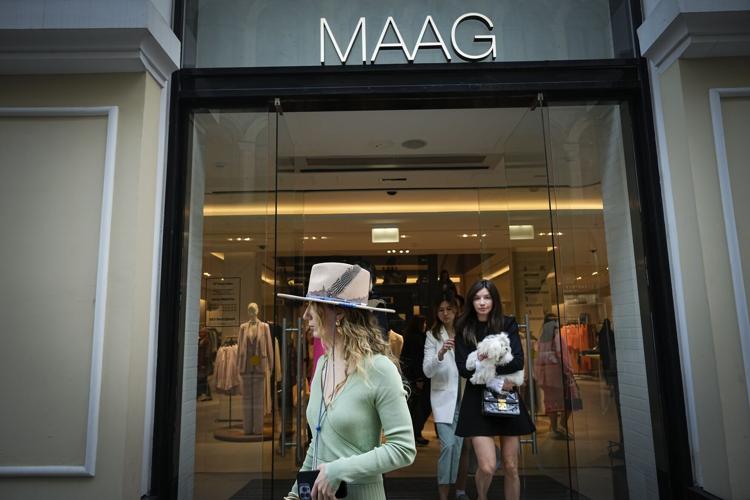
A woman exits a newly opened Maag store, a former Zara flagship store, on April 27 in Moscow, Russia.
Increasingly, Russia has put hurdles in the way of companies that want out, requiring approval by a government commission and in some cases from President Vladimir Putin himself, while imposing painful discounts and taxes on sale prices.
Though companies’ stories vary, a common theme is having to thread an obstacle course between Western sanctions and outraged public opinion on one side and Russia’s efforts to discourage and penalize departures on the other. Some international brands such as Coke and Apple are trickling in informally through third countries despite a decision to exit.
People are also reading…
Many companies are simply staying put, sometimes citing responsibility to shareholders or employees or legal obligations to local franchisees or partners. Others argue that they’re providing essentials like food, farm supplies or medicine. Some say nothing.
One is Italian fashion chain Benetton, whose store at Moscow’s now ironically named Evropeisky Mall — meaning “European” in Russian — was busy on a recent weekday evening, with customers browsing and workers tidying piles of brightly colored clothing. At Italian lingerie retailer Calzedonia, shoppers looked through socks and swimwear. Neither company responded to emailed questions.
For consumers in Moscow, what they can buy hasn’t changed much. While baby products store Mothercare became Mother Bear under new local ownership, most of the items in the Evropeisky Mall shop still bear the Mothercare brand.
That’s also what student Alik Petrosyan saw as he shopped at Maag, which now owns Zara’s former flagship clothing store in Moscow.
“The quality hasn’t changed at all, everything has stayed the same,” he said. “The prices haven’t changed much, taking into account the inflation and the economic scenarios that happened last year.”
The initial exodus from Russia was led by big automakers, oil, tech and professional services companies, with BP, Shell, ExxonMobil and Equinor ending joint ventures or writing off stakes worth billions. McDonald’s sold its 850 restaurants to a local franchisee, while France’s Renault took a symbolic single ruble for its majority stake in Avtovaz, Russia’s largest carmaker.
Since the initial wave of departures, new categories have emerged: companies that are biding their time, those struggling to shed assets and others attempting business as usual. Over 1,000 international companies have publicly said they are voluntarily curtailing Russian business beyond what’s required by sanctions, according to a database by Yale University.

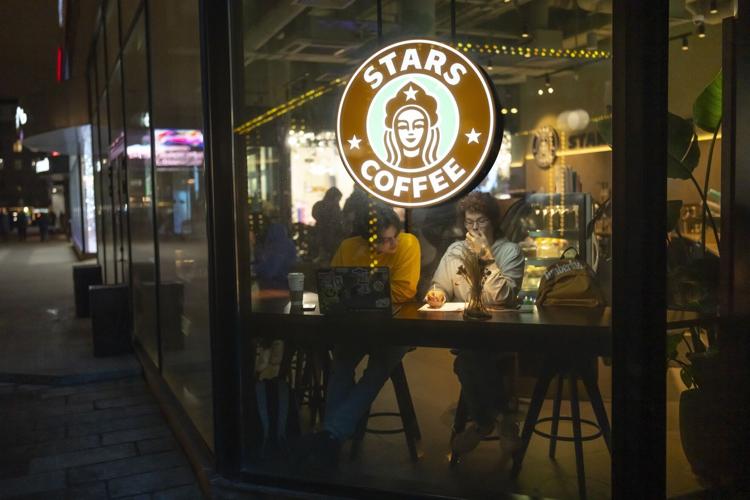
A logo of a Stars Coffee is seen in the former location of a Starbucks on Jan. 24 in Moscow, Russia.
But the Kremlin keeps adding requirements, recently a “voluntary” 10% departure tax directly to the government, plus an understanding that companies would sell at a 50% discount.
Danish brewer Carlsberg announced its intention to divest its Russia business — one of Russia’s largest brewing operations — in March 2022 but faced complications clarifying the impact of sanctions and finding suitable buyers.
Another beer giant, Anheuser-Busch InBev, is trying to sell a stake in a Russian joint venture to Turkey-based partner Anadolu Efes and has forgone revenue from it.
Companies are lost in “a Bermuda Triangle between EU sanctions, U.S. sanctions and Russia sanctions,” said Michael Harms, executive director of the German Eastern Business Association.

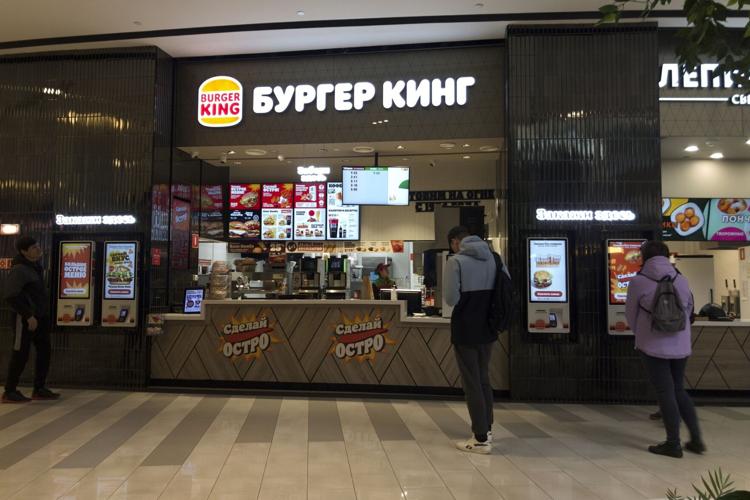
A Burger King kiosk is seen May 3 at Paveletskaya Plaza shopping mall in Moscow, Russia.
They must find a partner not sanctioned by the West. In Russia, major business figures are often people who are “well connected with the government,” Harms said. “For one thing, they have to sell at a large discount or almost give assets away, and then they go to people whom politically we don’t like — people who are close to the regime.”
The 10% exit tax mandated by Russia is particularly tricky. American companies would have to get permission from the Treasury Department to pay it or run afoul of U.S. sanctions, said Maria Shagina, a sanctions expert at the International Institute for Strategic Studies in Berlin.
Hundreds of companies quietly decided not to leave.
In a rare, frank explanation, Steffen Greubel, CEO of German cash and carry firm Metro AG, said at this year’s shareholder meeting that the company condemns the war “without any ifs, ands or buts.”
However, the decision to stay was motivated by a responsibility for 10,000 local employees and is “also in the interest of preserving the value of this company for its shareholders,” he said.
Marianna Fotaki, professor of business ethics at Warwick Business School, says business is “not just about the bottom line. ... You don’t want to be an accomplice to what is a criminal regime.”
Even if competitors stay, she said, “following the race to the bottom” is not the answer.
Photos: Scenes of Russia's economy since war in Ukraine

FILE - People are seen through a window inside a restaurant at Patriarshiye Prudy with the word on the wall reads "Patriki" which means Patriarch's Ponds, a hip restaurants and bars district in Moscow, Russia, on Feb. 10, 2023. Russia has weathered sweeping Western economic sanctions better than many expected. Economic life for everyday Russians hasn't changed that much, with familiar imported goods either still available or replaced by local knockoffs. (AP Photo/Alexander Zemlianichenko, File)

FILE - The tanker Sun Arrows loads its cargo of liquefied natural gas from the Sakhalin-2 project in the port of Prigorodnoye, Russia, on Oct. 29, 2021. After a year of far-reaching sanctions aimed at degrading Moscow's war chest, economic life for ordinary Russians doesn't look all that different than it did before the invasion of Ukraine. But with restrictions finally tightening on the Kremlin's chief moneymaker — oil — the months ahead will be an even tougher test of President Vladimir Putin's fortress economy. (AP Photo, File)

FILE - A view of the business tower Lakhta Centre, the headquarters of Russian gas monopoly Gazprom in St. Petersburg, Russia, on April 27, 2022. After a year of far-reaching sanctions aimed at degrading Moscow's war chest, economic life for ordinary Russians doesn't look all that different than it did before the invasion of Ukraine. But with restrictions finally tightening on the Kremlin's chief moneymaker — oil — the months ahead will be an even tougher test of President Vladimir Putin's fortress economy. (AP Photo, File)

FILE - An oil tanker is moored at the Sheskharis complex, part of Chernomortransneft JSC, a subsidiary of Transneft PJSC, in Novorossiysk, Russia, on Oct. 11, 2022, one of the largest facilities for oil and petroleum products in southern Russia. After a year of far-reaching sanctions aimed at degrading Moscow's war chest, economic life for ordinary Russians doesn't look all that different than it did before the invasion of Ukraine. (AP Photo, File)

FILE - Russian state-run Sberbank headquarters in downtown Moscow, Russia on July 29, 2014. After a year of far-reaching sanctions aimed at degrading Moscow's war chest, economic life for ordinary Russians doesn't look all that different than it did before the invasion of Ukraine. But with restrictions finally tightening on the Kremlin's chief moneymaker — oil — the months ahead will be an even tougher test of President Vladimir Putin's fortress economy. (AP Photo/Ivan Sekretarev, File)

FILE - People line up to visit a newly opened restaurant in a former McDonald's outlet in Bolshaya Bronnaya Street in Moscow, Russia, on Jan. 25, 2023. Crowds might have thinned at some Moscow malls, but not drastically. Some foreign companies like McDonald's and Starbucks have been taken over by local owners who slapped different names on essentially the same menu. (AP Photo/Alexander Zemlianichenko, File)

FILE - People wait in a line to pay for her purchases at the IKEA store on the outskirts of Moscow, Russia, on March 3, 2022. Furniture and home goods remaining after IKEA exited Russia are being sold off on the Yandex website. (AP Photo, File)

FILE - Russian President Vladimir Putin gestures while speaking at a news conference following a meeting of the State Council at the Kremlin in Moscow, Russia on Dec. 22, 2022. Russia's economy has weathered the West's unprecedented economic sanctions far better than expected. But with restrictions finally tightening on the Kremlin's chief moneymaker — oil — the months ahead will be an even tougher test of President Vladimir Putin's fortress economy. (Sergey Guneyev, Sputnik, Kremlin Pool Photo via AP, File)

FILE - Deputy Chairman of the Russian Security Council Dmitry Medvedev, second left, accompanied by Russian Presidential Envoy to Ural Federal District Vladimir Yakushev, left, visits the Uralvagonzavod factory in Nizhny Tagil in Nizhny Tagil, Russia, on Oct. 24, 2022. Russia has weathered sweeping Western economic sanctions better than many expected. (Ekaterina Shtukina, Sputnik, Government Pool Photo via AP, File)

A view of the Audi Center Altufievo one of 36 dealerships of Avtodom in Moscow, St. Petersburg and Krasnodar, in Moscow, Russia, Friday, March 10, 2023. The auto industry is facing bigger hurdles to adapt. Western automakers, including Volkswagen and Mercedes-Benz, have left Russia. Foreign cars are still available but far fewer of them and for higher prices, said Andrei Olkhovsky, CEO of Avtodom, which has 36 dealerships in Moscow, St. Petersburg and Krasnodar. (AP Photo/Alexander Zemlianichenko)

People walk past a Sviaznoy mobile phone shop in a shopping mall in St. Petersburg, Russia, Friday, March 10, 2023. Apple has stopped selling products in Russia, but Wildberries, the country's biggest online retailer, offers the iPhone 14 for about the same price as in Europe. Online retailer Svaznoy lists Apple AirPods Pro. (AP Photo)

FILE - Few visitors pass inside the GUM department store with lots of boutiques closed due to sanctions in Moscow, Russia, on June 1, 2022. U.S. officials say Russia is now the most sanctioned country in the world. But as the war nears its one-year mark, it's clear the sanctions didn't pack the instantaneous punch that many had hoped. (AP Photo/Alexander Zemlianichenko, File)

New made "Moskvich" cars are seen at the assembly shop of Moscow Automobile Plant "Moskvich" with the banner reads: "Moskvich (Muscovite) returns" in Moscow, Russia, Wednesday, Nov. 23, 2022. The auto industry is facing bigger hurdles to adapt. Russia launched production of the Moskvich car brand at a plant near Moscow given up by the French carmaker Renault, with a new, modern Chinese design that barely resembles the Soviet-era classic. (Kirill Zykov, Moscow News Agency via AP)

FILE - Employees of the Almaz-Antey Corporation's Obukhov Plant work at its assembly shop in St. Petersburg, Russia, on Jan. 18, 2023. After a year of far-reaching sanctions aimed at degrading Moscow's war chest, economic life for ordinary Russians doesn't look all that different than it did before the invasion of Ukraine. The boon helped bolster the ruble after a temporary post-invasion crash and provided cash for government spending on pensions, salaries and — above all — the military. (Ilya Pitalev, Sputnik, Kremlin Pool Photo via AP, File)

A view of the Dealership Mercedes-Benz "Avilon" in Moscow, Russia, Saturday, March 11, 2023. The auto industry is facing bigger hurdles to adapt. Western automakers, including Volkswagen and Mercedes-Benz, have left Russia, but foreign cars are still available but far fewer of them and for higher prices. (AP Photo/Dmitry Serebryakov)

FILE - Newly built nuclear-powered icebreaker Ural, third of five icebreakers of Project 22220, begins its passage from the Baltiysky Shipyard to the northern city of Murmansk, in St. Petersburg, Russia, on Nov. 23, 2022. After a year of far-reaching sanctions aimed at degrading Moscow's war chest, economic life for ordinary Russians doesn't look all that different than it did before the invasion of Ukraine. But with restrictions finally tightening on the Kremlin's chief moneymaker — oil — the months ahead will be an even tougher test of President Vladimir Putin's fortress economy. (AP Photo/Dmitri Lovetsky, File)

FILE - A logo of a newly opened Stars Coffee in the former location of a Starbucks in Moscow, Russia, on Jan. 24, 2023. Crowds might have thinned at some Moscow malls, but not drastically. Some foreign companies like McDonald's and Starbucks have been taken over by local owners who slapped different names on essentially the same menu. (AP Photo/Alexander Zemlianichenko, File)

FILE - New vehicles Gazelle are parked in the territory of the Gorky Automobile plant (GAZ), one of the main budget-forming enterprises in the region in Nizhny Novgorod, Russia, on Aug. 11, 2022. After a year of far-reaching sanctions aimed at degrading Moscow's war chest, economic life for ordinary Russians doesn't look all that different than it did before the invasion of Ukraine. But with restrictions finally tightening on the Kremlin's chief moneymaker — oil — the months ahead will be an even tougher test of President Vladimir Putin's fortress economy. (AP Photo, File)

FILE - People line up to enter an H&M shop and buy items on sale in the Aviapark shopping mall in Moscow, Russia, on Aug. 9, 2022. Russians are snapping up While 191 foreign companies have left Russia and 1,169 are working to do so, some 1,223 are staying and 496 are taking a wait-and-see approach, according to a database compiled by the Kyiv School of Economics. (AP Photo/Alexander Zemlianichenko, File)

FILE - Men walk at the Nokian Tyres tire manufacturing plant in Vsevolozhsk, outside St. Petersburg, Russia, on June 29, 2022. Russia's economy has weathered the West's unprecedented economic sanctions far better than expected. But with restrictions finally tightening on the Kremlin's chief moneymaker — oil — the months ahead will be an even tougher test of President Vladimir Putin's fortress economy. (AP Photo/Dmitri Lovetsky, File)