


The streets in Dodge Flower are lined with trash, shopping carts and signs advertising cheap rent.
For residents who've made their lives in this Midtown neighborhood, such sights have become pitiful monuments to neglect — reminders of the transience, pockets of poverty and absentee landlords many blame for the neighborhood's descent.
In recent years, Dodge Flower and a handful of adjoining neighborhoods have become a mecca for meth dealers and users, drawn, residents believe, by the vast number of cheap rental properties.
"It was kind of a lovers' lane for people who wanted to buy and sell meth, and it resulted in a high volume of crime in that area," Tucson Police Capt. David Neri, commander of the Counter Narcotics Alliance, said of the cluster of neighborhoods around North Alvernon Way and East Grant Road.
People are also reading…
The deteriorating conditions and endless stream of suspicious strangers brought with them a plague of burglaries, theft and harassment.
For about 10 months Neri has been working with neighborhood leaders, the Meth Free Alliance, city and county officials and the Drug Enforcement Administration on a pilot program to reclaim the neighborhood.
The goal is not only to improve the quality of life, but to create a model for other meth-afflicted communities, which is why law enforcement officials across the nation are watching and waiting for results.
Although the yearlong pilot program of neighborhood empowerment has two more months to run, it's already paying dividends. The bust last week of a 24-person ring that was selling about 2 pounds of meth a week in Tucson was a direct result.
Until a few years ago, meth was used predominantly in rural areas. Over time though it has moved into cities, but it's sales have largely been between people who knew one another.
"It's been a person-to-person kind of network," said David Kennedy, a professor at John Jay College of Criminal Justice in New York who was in Tucson about six months ago meeting with police to discuss the program.
A concern among law enforcement officials, Kennedy said, is that meth may evolve into a drug sold in what's known as an "open-air drug market," a place where it is commonly known to be available and strangers can make connections to buy or sell.
"If it turns out that this is coming, and what is happening for this neighborhood in Tucson is a prelude to what other cities will be seeing," Kennedy said, "that will represent a new, serious development in the meth epidemic."
Neri said he doesn't see Dodge Flower as an "open-air market," and police are working with residents to make sure it doesn't become one.
Still, he said, "There is an urban meth epidemic right now. They are looking at the neighborhood because it's a potential solution."
Engaging the community
On its surface the pilot program sounds like a deceptively simple mix of police work and civic activism.
For the first three months of the program, undercover police flooded the neighborhood making drug busts and gathering intelligence. That was followed by a wave of much more high-profile police work with uniformed patrol and bike officers.
Activists, working with City Council and Board of Supervisors representatives, stepped up neighborhood organization efforts. And the city Neighborhood Resources Department backed cleanup efforts.
Between now and April, when the program ends, the police presence will be scaled back, with the idea residents will step up, filling more of a watchdog role and supporting one another.
"The long-term sustainability is the fact that the neighborhood comes out for itself," Neri said.
There has been no shortage of activities to boost community involvement, in hopes of making that happen. But the results have been mixed.
This summer, there was a block party to kick off the program. Residents have also walked the streets to collect meth residue from public places.
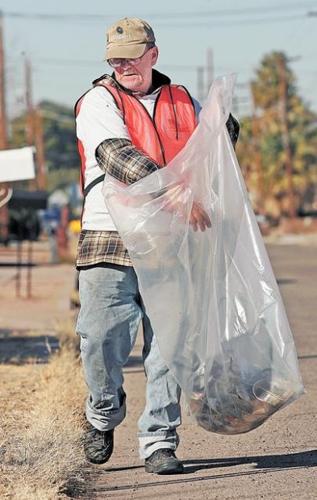
Yesterday, a handful of residents picked up trash in the neighborhood — an effort that, in a way, exemplified the neighborhood's problems.
While the activity was good, turnout could have been better.
"It seems like there is always the same people who come to the meetings," Barbara Lehmann, Dodge Flower president, said in a recent interview.
Mild-mannered and polite, Lehmann is in many ways the last person one would expect to be on the front lines of a fight against meth. But she's at nearly every community meeting, and Saturday morning she was working her way through the neighborhood, dragging a sack she gradually filled with trash.
"It's not directly related to meth, but you know everything crosses over," she said.
Just why the Dodge-Flower area has become a central point for buying and selling meth in the city is unclear.
"I wish we had an answer to that," Neri said. "Just looking at the area, it doesn't look any different to other parts of Tucson."
Relatively nondescript, the greater Dodge-Flower area is a confluence of small houses, trailer parks, condos, sprawling apartment complexes and a handful of substance-abuse treatment centers — which many residents believe bring users into the neighborhood.
"This is a rehab mecca," said Elizabeth Ramey, a property manager and neighborhood activist who has lived in Dodge Flower for the past nine years.
Neal Cash, CEO of Community Partnership of Southern Arizona, the regional behavioral-health authority that leases property in Dodge Flower to numerous treatment providers, rejected such a premise.
Community Partnership, a nonprofit, bought property on Dodge Boulevard in 2002, and Cash noted the neighborhood's problems are much older.
"It's always been a very distressed neighborhood, and so to the extent that people are saying that the problem is worse now, I'm not so sure about that," he said.
Relatively low income
Because of its location and demographics, Dodge Flower, in some ways, has the dynamics Kennedy said have defined open-air markets involving other drugs, like crack cocaine.
The neighborhood is relatively low-income, has access to major roadways such as East Grant Road and North Alvernon Way and has a disproportionately high rental rate. It is marked by a seemingly endless stream of traffic: cars, people on bikes and pedestrians, particularly on Flower Street near Alvernon.
It is the rental rate that residents have zeroed in on as the primary source of their problems. The streets in and around Dodge Flower are lined with rental signs, some of which make statements about not doing background or credit checks on prospective tenants.
"Our feeling is that with so many rental properties in our neighborhood, it's so much easier for them (meth users) to move around," said Blanche White, president of the Oak Flower Neighborhood Association, which adjoins Dodge Flower.
Statistics from the 2000 census show that 60 percent of the area's properties are rentals, but White and other residents, who have researched properties through the Pima County Assessors Office, claim the rate is closer to 80 percent.
The neighborhood associations have tried to work with landlords, sending more than 400 letters inviting them to a November workshop to talk about property maintenance and the importance of background checks among other topics. "Twelve or 13 showed up," Lehmann said.
Even before the pilot program, a police patrol car was devoted to meth crime in the area. For more than a year the car has been manned by officers Mark Ewings and Troy Perrin.
While meth is sold in Dodge Flower, there have been almost no meth labs in the area. So, Ewings and Perrin focus on the users and sellers, hoping to make them so uncomfortable that they will either leave, or preferably, enter treatment.
That can mean arresting a known meth user on suspicion of check-fraud or even stopping someone they suspect is a user for riding a bike at night without a light.
"The area has historically been a safe haven for meth users," Ewings said Wednesday night while on patrol.
One of his stops that night was a known meth house in a trailer park. The trailer had two surveillance cameras on its roof. Two men were out front fiddling with a propane tank.
The owner wasn't home, but inside was a teenage boy, as well as a woman and her teen-aged daughter. Ewings knew almost everyone there, and chatted them up, one by one, to see if they were doing meth.
Everyone claimed to be meth-free, which raised Ewings skepticism. "If you are not using meth, then why are you here?" he asked.
Nobody answered.
Mixture of hope and sadness
When residents of Dodge Flower talk about their neighborhood, they do so with a mixture of hope and sadness.
The pilot program, they say, has made them better organized and taught them how to engage the community or feel more comfortable speaking with police.
Lehmann, the neighborhood association president, said she often wonders what those outside the neighborhood see when they drive by.
"I think they are seeing an imploding Midtown neighborhood," she said. "A neighborhood that they just want to drive through. That they wouldn't want to be a part of. I think they see trash."
She's thought about leaving, but she's raised her family there and made lasting connections with her neighbors.
"We love the house. We love our neighbors; everything else we don't love," she said.
As the pilot program winds down, and extra police patrols pull out, Neri said he's aware the level of community involvement needs to improve for the program to have a lasting effect.
Whether residents are ready to stand up on their own is what everyone is waiting to see.
What is meth?
Methamphetamine is a stimulant that creates a sense of euphoria, heightened alertness and energy. It can be snorted, swallowed, smoked or injected.
A main ingredient is pseudoephedrine — an ingredient found in many over-the-counter cold and allergy medications, which can be combined with extracts from a number of common household products, including lye, drain cleaner and paint thinner.
For more information about meth prevention, visit the Meth Free Alliance Web Site: www.meth-free-alliance.org.



 101 homes to be built on NW Tucson corner

