

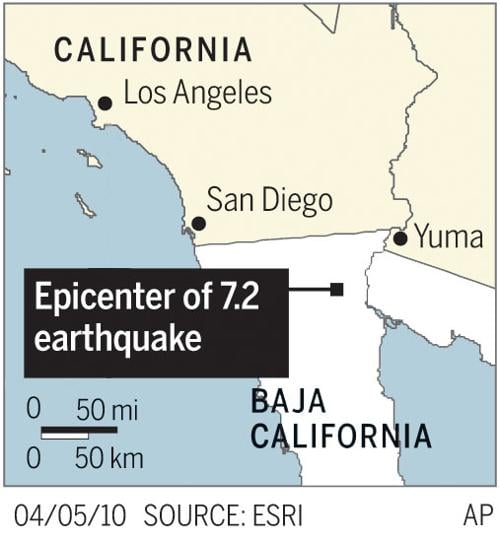
Tucsonans were shaken and rattled for about 30 seconds Sunday afternoon when a 7.2-magnitude earthquake struck in Baja California, Mexico, about 38 miles southeast of Mexicali, and resonated outward.
It was one of the strongest earthquakes to hit Southern California in decades and shook tens of millions of people in two countries and three states. At least two people were killed in Mexico.
The quake's epicenter was about 250 miles west of Tucson, but it brought waves locally that measured around 2.0 magnitude at around 3:40 p.m., the U.S. Geological Survey's Web site said.
For longtime Tucson residents such as communications consultant John Meek, the quake came as a surprise.
Meek, 80, marketed Arizona as the perfect location for an atom collider in the late 1980s because he was convinced the state "was pretty much earthquake-proof."
People are also reading…
But Sunday afternoon, as he read the paper, Meek was startled by vibrations that shook both the tile floor and a table in his home.
The rolling motion "like you're on a boat" that most Tucsonans felt represented the surface waves of the original quake spreading outward, said Morgan Page, a geophysicist with the U.S. Geological Survey.
Although a 2.0 can't cause damage, those on the upper floors of buildings or near water likely would have felt it, Page said. Tucsonans who packed parks for Easter celebrations probably didn't notice a thing.
Oro Valley resident Chris Bannon was watching a movie at his home with his son, Jack, when they noticed a lampshade shaking. "We went to the back door, and the pool was starting to rock. The water was rocking side to side and almost up to the edge," Bannon said.
The earthquake was felt the hardest in Mexicali, a bustling commerce center along Mexico's border with California.
Baja California state Civil Protection Director Alfredo Escobedo said a man was killed when his home collapsed just outside of Mexicali. He said the other man was killed when he panicked as the ground shook, ran into the street and was struck by a car. At least 100 people were injured, most of them struck by falling objects. At least 20 aftershocks were felt.
There was substantial damage on the other side of the border, in Calexico, Calif. Structural damage and broken windows had occurred in an older section of town, as well as leaking gas lines and damage to the water system, but no injuries.
The Calexico City Council met and declared a state of emergency. Law enforcement vehicles guarded downtown streets in Calexico, where windows were shattered, and bricks and plaster had fallen from some buildings.
In San Diego, there were reports of shattered windows, broken pipes and water main breaks, but no injuries.
The quake was felt for about 40 seconds in Tijuana, Mexico, causing buildings to sway and knocking out power in parts of the city.
Quake reports came in from around Arizona and even Las Vegas.
More than 3,000 people in Yuma experienced momentary power outages.
Clint Norred, a spokesman for the Yuma Police Department, said the quake was very strong there, but he'd heard no reports of injuries or major damage.
"In my house, it knocked a couple of things off the wall," he said.
Although the quake wasn't as pronounced in Tucson as it was elsewhere, it left many residents shocked.
One California transplant said he and his wife made a pros-and-cons list when considering moving from the Los Angeles area to the Old Pueblo.
At the top of the California cons? Earthquakes.
"We thought, 'Well, we won't have to put up with earthquakes anymore,' " said Andy Hohl, 50.
"Yeah, right."
Quakes of about a 3.0 magnitude have been reported all week in the Baja California area.
The Associated Press contributed to this story. Contact reporters Megan Neighbor at 307-0579 or mneighbor@azstarnet.com and Andrea Rivera at arivera@azstarnet.com or 807-8430.


 Nancy Guthrie's Tucson neighbors: Life with streamers 'unbearable'


