
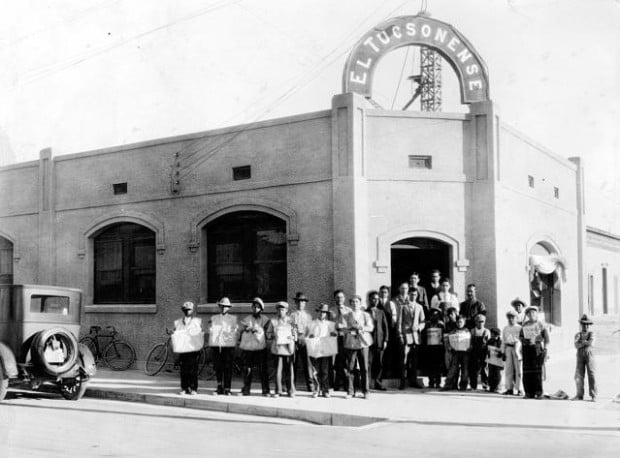
At the corner of South Stone Avenue and East McCormick Street, across from Tucson Mortuary and St. Augustine Cathedral, sits Old Pueblo Printers. The print shop, owned by Alberto M. Elias, is a well-known landmark for longtime Tucsonans.
To real old-timers, the print shop, with it's now-gone arch, was home to El Tucsonense, the Old Pueblo's longest published Spanish-language newspaper. It was the voice of Tucson's Spanish-speaking residents from 1915 to the early 1960s.
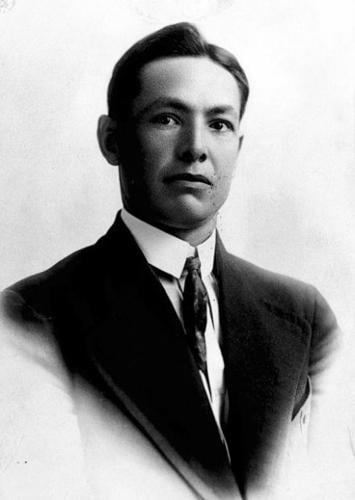
The newspaper, founded by Elias' grandfather, Francisco Santos Moreno, kept its readers informed of international, national and local news, births, deaths, marriages, accidents, arrests, politics, and social and cultural events.
The newspaper, which published on Tuesdays and Fridays and sold for a nickel for its entire life, "was the social glue" for Tucson's growing Mexican-American community, said Elias, 80.
People are also reading…
"He started this little newspaper when it was a whole new world for him and others like him," added Elias, who swept the floor, remelted lead type, and did other dirty work in his grandfather's print shop as a teenager during World War II.
"We were watching the community just blossom and grow," said Elias, father of Pima County Supervisor Richard Elias.
Moreno came to Tucson from Hermosillo, Sonora, as an orphan about 1889. He became a printer's apprentice with Charles Tully, a Tucson pioneer who co-founded The Arizona Daily Star in 1879.
Elias said his grandfather showed moxie and ganas to achieve something in his new home town. "He was one of those guys who was a self-starter," Elias said. "He saw a challenge out there and he was ready to reach for it."
Moreno started El Tucsonense in a friend's print shop on Stone Avenue. By 1922 he built his shop where the newspaper would flourish for several decades — long after Moreno's death, said Elias, who was born several months before his grandfather died.
Moreno died in 1929 and his widow, Rosa Elias de Moreno, became the owner and publisher. Over the years the Morenos' four sons — Gilberto, Federico, Arturo and Elias — managed the newspaper and the print shop. Their eldest was Ermelinda Moreno.
In its early years the newspaper's front page was filled with news about the Mexican Revolution, which continued to create turbulence, sending thousands of Mexicans to towns and cities north of the border, creating a demand and need for Spanish-language media.
But Spanish-language newspapers were not new. One of the first was El Misisipí, which was launched Sept. 7, 1808, in New Orleans. Spanish-language newspapers subsequently appeared in New York City, San Antonio and Los Angeles.
El Tucsonense was like other ethnic publications across the country, whether they published in Finnish, Italian, Hebrew, German, Chinese. El Tucsonense gave its readers news of the day, social events in the community, sports and commentary.
El Tucsonense also reported the aggressiveness of American authorities against Mexicans in the U.S.
During the Great Depression, tens of thousands of Mexicans, including American citizens, were forcibly repatriated to Mexico.
On its pages prior to World War II, El Tucsonense chronicled the moves of Nazi Germany and the growing conflict.
El Tucsonense also documented the sacrifices of Mexican-American youths who went off to war, who returned and who died.
On its Dec. 8, 1941, edition, a day after Pearl Harbor, the newspaper published President Franklin D. Roosevelt's "Day of Infamy" speech. It also reported the names and addresses of the boys who had enlisted on December 7:
Fernando A. Romero of North First Avenue, Mariano Tapia of Route 1, Estanislao J. Valencia of West Ontario Street, Ralf Martinez of South Fourth Avenue, Ramon O. Ruiz of East Fifth Street, and Alfonso Romero of North Anita Avenue.
With the end of the war, Tucson, like the rest of the country, underwent dramatic changes. El Tucsonense couldn't keep up.
Spanish-language radio, then television, supplanted the newspaper as the voice of Tucson's Mexican community, which continued to evolve.
Arturo Moreno, who had served as the newspaper's longest manager, closed the newspaper by 1963. Moreno was the father of Arte Moreno, owner of the Major League Baseball team the Los Angeles Angels of Anaheim.
Elias, a printer who had worked at The Arizona Daily Star, bought the shop from his grandmother in 1966 and renamed it Old Pueblo Printers.
In the corner of the shop, several shelves hold some browning, brittle copies of El Tucsonense. He can't touch them because the pages flake and become dust. But his grandfather's legacy remains solid and bright.
"He had real values in his life — family, work and community," Elias said. "I believe we continue to uphold those values."
Did You Know
Most of El Tucsonense, a Spanish-language newspaper published from 1915 to 1963, are on microfilm at the University of Arizona Main Library. Issues v.1-68, 1915-1957, are in the library's collection of Arizona newspapers.