Students in Amphitheater Public Schools fail classes less often than their colleagues in many Tucson-area districts, but may not deserve their high marks, an Arizona Daily Star investigation found.
While their counterparts around the city fail more often and still are promoted to the next grade, a practice called social promotion, it appears students in Amphi are promoted only when they earn it. But because students still fail state assessment tests as often as counterparts in other districts, experts question if students really earn the grades they receive.
The findings come as Amphi leaders talk publicly of grade inflation and the need for a more unified grading system, as well as how to address social promotion. District officials are mulling options for mandatory summer school and looking at other means of improving student achievement, preventing dropouts and ensuring students meet curriculum standards.
People are also reading…
The Star's findings are part of a larger investigation published in May that found tens of thousands of Tucson-area students every year were being moved to the next grade level even though their classroom marks didn't merit it. The investigation also found that many students were failing far less often in class than on state assessment tests.
The analysis confirmed what educators have discussed internally for years — and what parents have suspected — about classroom performance. The results reveal a pattern of failure, one that business leaders said could threaten the future of the regional economy because so many students are ill-prepared for the work force.
Although eight other districts provided records for the first analysis, Amphi did not, because officials there were concerned doing so might violate federal student privacy laws. In June, however, district officials gave the Star access to anonymous student grades, following public pressure to release the records.
Those records make it clear that Amphi fares better than many districts in terms of classroom achievement versus promotion. While the Star's initial investigation found that one in three students citywide were failing basic courses in English, math, science or social studies, only one in 20 Amphi students showed similar failure rates.
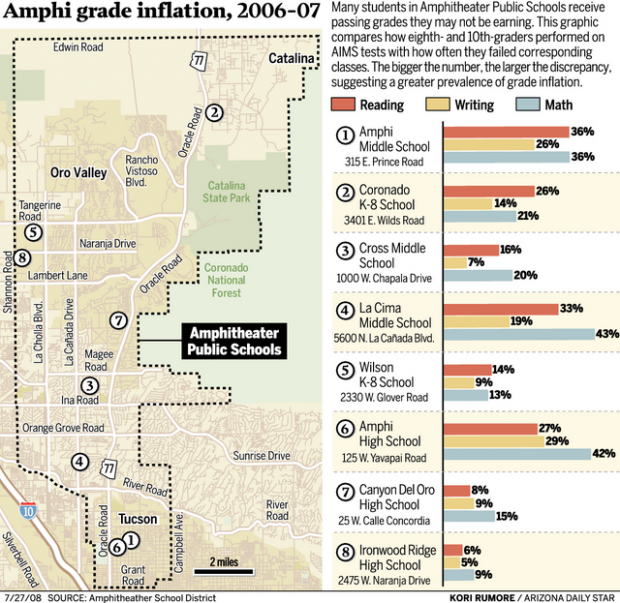
But in seven of the district's eight schools, including Amphitheater High School, there were double-digit gaps in the 2006-07 school year between the percentage of students who failed English or math courses and the percentage that failed reading, writing and math portions of Arizona's Instrument to Measure Standards, or AIMS. Experts say that likely means students are not learning what they're supposed to learn.
Amphi officials were concerned by the findings, but said AIMS is an imperfect assessment tool and they set and meet their own criteria.
"I wouldn't say that we're necessarily focusing on AIMS," Associate Superintendent Patrick Nelson said.
"We're focusing on key standards that we've identified. Key learnings that kids need. Key skills that kids need to do well in society."
Gaps between AIMS, grades
Some parents question whether classroom grades are accurate.
"The schools are not being run tight enough," said Ann Justus, whose four children attended Amphi schools and who has one grandchild at Ironwood Ridge High School now. Justus closely follows district decisions and was highly critical of the choice not to promptly release records to the Star.
Often, she believes, "the grades are slipshod."
But some Amphi students say they earn their marks.
"People who don't do the work fail. And if you do the work, you get a grade that shows how well you did," Coronado K-8 School eighth-grader Kelsey Glass said. "They give you the grade you deserve."
Teachers set standards students have to meet and if those standards aren't met, their grades reflect it, said Tyler Pearson, a sophomore at Canyon del Oro High School.
"If you don't do well, they're not going to pass you because the teachers have standards. I think you get good grades if you try hard and don't goof off."
Amphi's grades were usually on par with the rates at which students failed and how often they were promoted. At Amphitheater High School in the 2006-07 school year, for example, about 7 percent of 11th-graders failed one or more core classes — English, math, science or social studies — while 6 percent were retained, or held back.
That 1 percentage point gap is among the smallest of any schools the Star examined — a number that indicates few students are being socially promoted.
But at nearly every middle and high school in Amphi's boundaries, students fared far better in their classroom grades than on AIMS. Many grade levels showed single-digit retention levels — while a quarter or more students failed AIMS.
The investigation found similar patterns at more than a quarter of schools examined during the May analysis.
"I have no idea what's occurring," Amphi Superintendent Vicki Balentine said when presented with the findings.
"What I will tell you is that we have a definite goal to have our teachers meet and better calibrate their grading districtwide. We need a 'C' to be a 'C' everywhere."
The Star examined three years of data from Amphi, from the 2004-05 to the 2006-07 school years. Previous years weren't analyzed because older supporting data, such as class schedules, weren't available. The newspaper could not account for summer-school grades because student progress is reflected in a different record system, although the number of students in summer school is a fraction of the student body.
The results raise questions about how Amphi plans to address possible grade inflation. One solution, Balentine said, is that teams of teachers meet regularly to assess the essential elements involved in, for example, awarding an "A" or determining that a child at the elementary-school level has met or exceeded expectations.
"We are pushing that conversation among teachers," Balentine said. "Ultimately, I think it's an important focus."
What's a grade worth?
Not all Amphi schools have gaps in performance, the analysis showed. At Ironwood Ridge High School, there were small differences — less than 10 percent — between classroom and test failures.
Still, Amphi middle schools showed strong evidence of grade inflation, particularly Amphitheater and La Cima middle schools. At Amphitheater Middle School, for example, fewer than 2 percent of eighth graders failed math courses in 2006-07. Meanwhile, 38 percent failed the AIMS math test.
District officials admit that, in theory, a student who can obtain a passing grade in a math or English course should be able to pass the AIMS test. But they say scores don't fully represent student ability.
"A kid can do really well in class and still fail the AIMS test," said Amphi Middle School Principal Chuck Bermudez.
Pearson, the CDO sophomore, agreed.
"Some people do bad on tests but get good grades," he said.
Yet others point to AIMS as their best benchmark by which to measure the quality of a letter grade. Higher rates of failures on AIMS scores compared with classroom grades, such as in Amphi's case, indicates the grades may not be so accurate.
Jay Greene, head of the Department of Education Reform at the University of Arkansas, said that "if the standard for passing the state test isn't overly difficult, then observing this trend means that grades are being inflated significantly."
And even Balentine said AIMS is a type of appraisal, an "audit" of student performance.
AIMS has gotten easier, with the passing threshold dropped and the state giving students the option to use extra credit to augment their scores.
"I don't think AIMS is too hard," said Matthew Ladner, vice president of research at the Goldwater Institute, a conservative Phoenix think tank that often conducts education research. Because the test has been "dumbed down" since 2005, he said, "the problem is widespread, rampant grade inflation."
But others say AIMS is simply not a good measurement. "Our research shows that AIMS is irrelevant to the world of work and far too difficult," Gene V. Glass, a professor of education at Arizona State University, said in an e-mail.
Changing promotion policy
Another variable in the question of how well Amphi students are performing is that the district has one of the most stringent promotion policies of all the Tucson area's major school districts. Promotion at the middle-school level requires students to attain at least a 60 percent achievement level on daily assignments, projects and tests in most grading periods.
That may be pushing students to succeed, or it may be pushing teachers to hand out marks students haven't earned, experts say.
As officials work to ensure equality of grades, they may be implementing an even tougher promotion policy. Amphi's Governing Board soon will consider mandatory summer school for middle-school students who don't meet promotion criteria.
The board could make a decision on the issue as early as Aug. 12. If the board approves the district's recommendation, middle-school students who fail two or more classes in core subject areas will be required to attend summer school and risk retention if they don't make remedial efforts.
The solution to better classroom performance, district officials said, is to step back from the promotion-versus-retention debate and instead focus on remedial education and stronger standards. The thought echoes what experts said during the Star's first investigation in May.
District officials have increased summer-school participation in the last four years, said Nelson, the associate superintendent. Nearly 1,600 students attended the free classes this year compared with about 700 four years ago, he said.
"What we want to do throughout our K-12 system," Nelson said, "is have in place a series of interventions and support systems to continually identify the kids who need extra time, extra support and extra learning so they can achieve."
About the series
Read more about the Star investigation and find a searchable database of schools at azstarnet.com/socialpromotion.