

UPDATE: The National Football League’s joint stadium and finance committee voted Friday to recommend the league approve a maximum $200 million loan to Bills owners Kim and Terry Pegula, according to a league source. All league owners will vote Monday. Approval is considered a formality.
The long-anticipated Buffalo Bills stadium deal is about to take a significant step forward.
On Friday afternoon, members of the National Football League’s stadium and finance committees – which include representatives from 16 of the 32 teams – are expected to vote to recommend the league approve a maximum $200 million loan to Bills owners Kim and Terry Pegula to help build a $1.4 billion stadium in Orchard Park.
People are also reading…
Up to $150 million of the loan is forgivable, repaid through the visiting teams' share of Bills ticket revenue over 25 years, and is contingent on both public financing and the Pegulas contributing at least $200 million of their own equity to the project, according to the terms of the league's "G-4" loan program, which helps fund stadium construction and renovations projects.
If the joint stadium-finance committee, which does not include a representative from the Bills, votes to recommend the loan, as is expected, the league’s full ownership group will vote to approve the deal on Monday, as part of the NFL’s annual owners’ meeting in Palm Beach, Fla., according to league sources.
But here’s the catch: The deal to finance the stadium, which has been negotiated since late summer between the State of New York, Erie County and the Bills, is not yet signed. Gov. Kathy Hochul and Erie County Executive Mark Poloncarz have publicly indicated that negotiations are in the final stretch, but until a memorandum of understanding is signed by all parties, the NFL owners are voting on a proposed deal — not an actual one.
The terms of the deal – including length, immediate state and county contributions and financial obligations over time – are not publicly known.
Hochul has previously cited the New York state budget deadline of April 1 as the deadline for reaching a stadium agreement. That is next Friday — two days after the league meetings wrap.
“The Bills could seek league approval that is contingent on the governor and the political side coming through, consistent with what they presented to the league,” said sports consultant Marc Ganis, who has worked with most NFL teams and noted that owners often vote on deals that include contingencies. “This is a way to bridge the timing gap.”
A full, formal agreement will require approval from both New York State and Erie County legislators, as well as 24 of 32 NFL owners. Gaining the approval of those government bodies will take some time. Erie County Legislature members have indicated they may take up to 30 days to approve a deal.
But receiving a greenlight from NFL owners for G-4 funding is also key to keeping the project’s timeline on track. The Bills hope to open the stadium by 2026.

“The bottom line on it is we have to get a new stadium in Buffalo,” Goodell, a Jamestown native, said. “The governor has recognized that. It has to be a public private partnership. … She has shown great leadership in bringing the parties together … but there’s a lot to negotiate here.”
“The upcoming owners meetings are a part of the public-private partnership that we’ve stressed from day one,” said Ron Raccuia, executive vice president of the Bills’ parent company, Pegula Sports and Entertainment, and the team’s lead negotiator. “Our NFL partners are a huge part of that. G-4 funding is available to all 32 teams and we’re hopeful to include that in the final package.”
Raccuia declined to comment on specifics of the pending deal, following an agreement between all parties to avoid negotiating in public.
Hochul, who was born in Buffalo and raised in Hamburg, has emphasized that a deal will get done to finance the new stadium and keep the Bills in Western New York.
Hochul did not include stadium financing costs in the initial $216.3 billion budget she proposed in mid-January. But the bulk of the public funding is expected to come from the state, and the remainder from Erie County, which will own the stadium and act as its landlord, mirroring the arrangement in place since Highmark Stadium, the team’s current venue, opened as Rich Stadium in 1973.
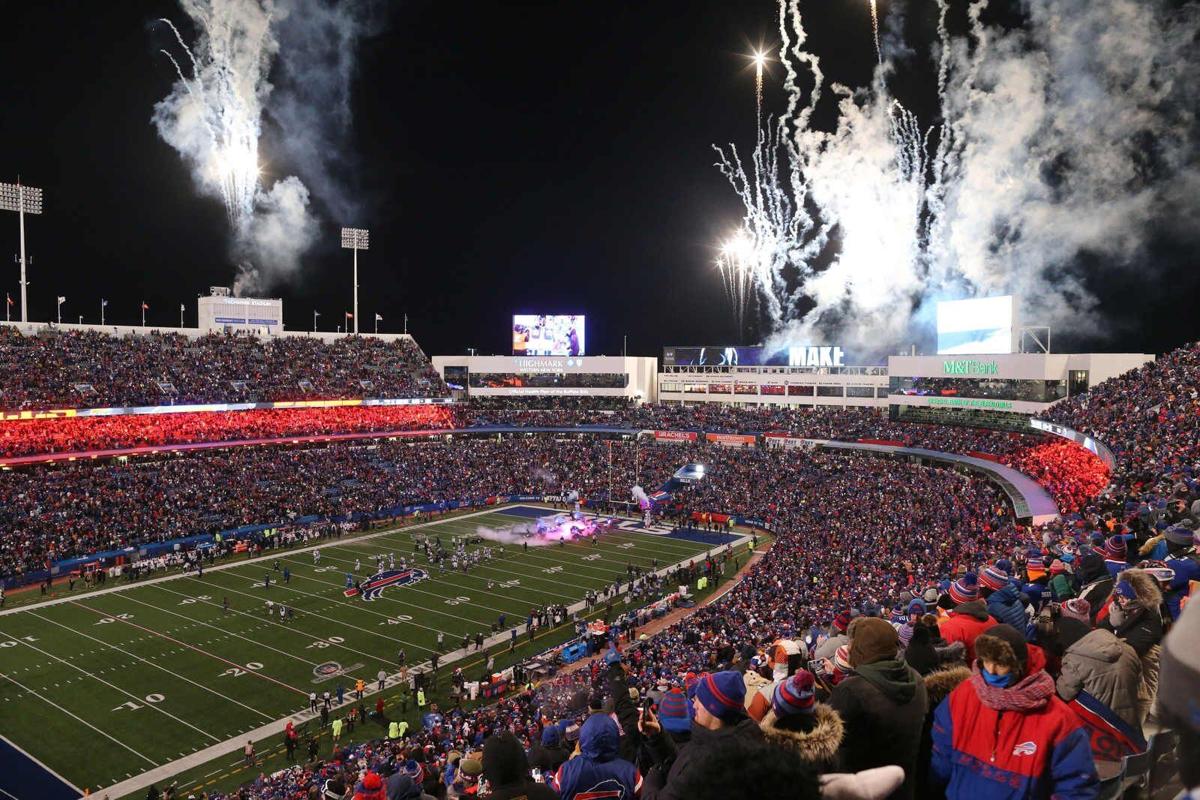
The years-long time crunch to build a new venue is in part driven by the condition of Highmark Stadium, which will likely need significant repairs, including a near-replacement of the upper deck, in the next half dozen years, according to a recent engineering report commissioned by the county.
How much?
Hochul and Erie County Executive Mark Poloncarz in recent days have both pushed back on the notion that the Bills could receive $1 billion in public funding.
“Where did you hear it’s a billion dollars for the Buffalo Bills?” Hochul asked a reporter, responding to a question during a Covid-19 briefing on Monday. “I would say, ‘Not negotiating in public. All will be told at the right time.’ ”
The Buffalo News has projected that the public could be asked to contribute approximately $1 billion, or around 73% of the construction costs. That percentage is consistent with stadium deals in smaller markets across the NFL.
A News analysis of the 21 NFL stadiums built in the last two decades found that in the nine smallest cities, public funding covered 73% of the costs. In the 12 larger markets, public funding paid for one-third of the construction.
Buffalo is the second-smallest market in the league.
The New York Post, citing an anonymous source, earlier this month reported the Pegulas were in line to receive “nearly $1 billion” in public funding.
Poloncarz said $1 billion in public funding for the Bills’ stadium is “not an accurate number,” but revealed no further details during an unrelated press conference Wednesday.
He said he hoped – but did not guarantee – the state, county and Bills would announce an agreement by April 1.
The Bills envision their new stadium seating between 60,000 and 62,000 fans, with room for up to 5,000 more spectators on a standing-room-only party deck, a capacity in line with historic attendance figures.

Hochul essentially confirmed that the negotiations are on track, and that she has nothing to announce – yet.
Approximately 80% of the seats will be covered by a partial roof or overhang.
The new stadium would have a grass field and far larger footprint than the team’s current 70,000-seat venue – approximately 1.5 million square feet, compared to about 900,000 square feet – which will allow for larger seats and concourses, other enhanced amenities and will help streamline gameday operations, PSE officials have said.
Why now?
The upper deck of Highmark Stadium was last reinforced in 2018, but the most recent engineering study, completed by DiDonato Associates on behalf of Erie County in early 2021, recommended replacing it in five to seven years.
Another study, conducted on behalf of the state by the engineering firm AECOM and released last fall, recommended against renovating Highmark. Citing that study, state, county and team officials have agreed that another renovation is not cost effective and that Highmark’s deteriorating condition creates urgency to build a new stadium.

“To keep it open air is part of the Buffalo bravado,” Gov. Kathy Hochul said in January, “which people love to showcase.”
The Bills have one season remaining on their 10-year lease at Highmark Stadium, which expires in July 2023. The Pegulas have refused to sign an extension until a deal is reached to build a new stadium.
Once the state, county and PSE reach an agreement, produce a signed memorandum of understanding and vote to finance construction of the stadium, the parties will draw up longform agreements.
These include a lease for the new venue, a lease extension at Highmark Stadium and perhaps a community benefits agreement. The process could take several months to complete.
Ganis, while speaking to The News this week, pointed out that if NFL owners sign off on a contingent deal, it will emphasize the importance of the government coming through to finish it.
“If the governor and the state legislature don’t perform,” he said, “that could be quite a statement also in the opposite direction.”
Both Poloncarz and Hochul have acknowledged the prospect of larger markets, without NFL teams, trying to lure the Bills.
“In today’s modern NFL, there is no guarantee a team will stay in its home city no matter how long they were located there,” Poloncarz said in a recent statement to The News. “If you don’t believe me, ask the people of St. Louis, San Diego and Oakland about ‘their’ teams. I do not, and I certainly believe the people of Western New York do not, want Buffalo to join that list of cities.”
The deal is likely to secure the Bills’ future in Western New York for decades. But finalizing the agreement will require support of legislators from across the state. As Hochul, who took over for Andrew Cuomo in August, runs for a full four-year term, she will face criticism from downstate interests who dislike the notion of funding a Buffalo stadium.
Ganis, noting Hochul’s public comments about the pending deal have been “wonderful,” cautioned she “doesn’t control the entire legislature.”
“In a political arena, there are things that happen that you just don’t see coming down the pike,” he said. “That’s the risk. But it’s a reasonable risk to take when a deal is this close.”


