

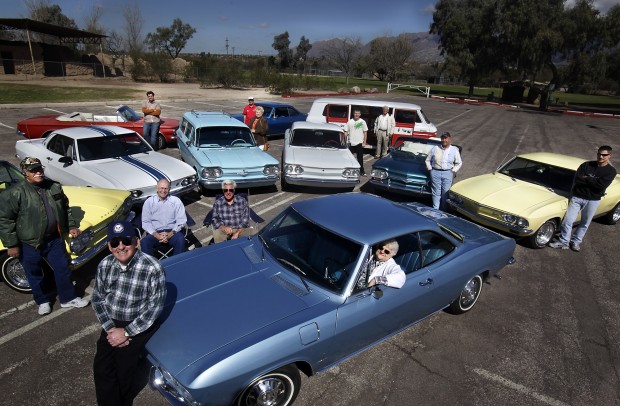
Some have been driving them since high school. Some don't own one at all.
But all have one thing in common: They're just nuts about Corvairs.
You know, those somewhat-boxy-yet-sporty little cars that came out in the 1960s? The ones with the engine in back?
"Every time I drive one, I either hear, 'I used to have one,' or 'What is it?' " says Barry Cunningham, 52, a charter member of the Tucson Corvair Association.
Either way, it gets the looks. "I was at three straight stoplights talking to people about mine," says Bill Maynard, 71, the proud owner of a 1961 baby-blue station wagon that he's spent $4,000 restoring. "It was completely rusted."
So was his first Corvair, a '63 convertible that he "rescued" in 1980 from a friend's yard in Prescott. "Everybody has one in their backyard," says Maynard.
People are also reading…
Or front yard.
"This one sat in my neighbor's yard. Since 1990 I've been watching it," says Ron Bloom, 69, who finally snagged the 1962 Corvair Greenbrier sports van last May. "I went over and asked my neighbor if he was ready to sell after 20 years. He was just turning 80. He sold it to me for $250. I had to push it over to my yard."
The last Corvair van was built in 1965. Bloom's van is white with orange trim. It sports facing back seats and holds nine people.
"I'm the second owner," says Bloom, pulling out the original title.
And yes, he got it running. "Ron and I have driven our cars to Palm Springs," says club President Ken Farr, 72, who bought his first Corvair in 1960 right off the showroom floor. Price tag: $1,800.
Since then, he's owned more than a dozen of 'em over the years.
"I found this one on Craigslist," he says, proudly pointing to a 1964 bright-yellow convertible with a saddle-brown interior. "I call it Tweetie," says Farr, adding that it was his wife, Heidi, who dubbed the car.
He completely redid the interior and dash, re-chromed the front bumper and put in a CD player. "I drive it quite often. So does my wife," says Farr.
"This is the cheapest antique car you can restore," says Van Pershing, 65, who drove his first Corvair while he was still in high school. "I had that one for three or four years. Then I bought one in 1970 after I got back from Vietnam. I've had one ever since. All my children drove them, too."
Currently, he owns a 1966 Yenko Stinger, which is a replica of the modified Corvair Corsa model. "Don Yenko wanted to race Corvairs, but they weren't competitive. They said he had to have 100 in production. So he made 100."
Pershing's replica is a two-door, white with blue trim, with a gray and blue interior and 140 horses under the hood (or where the trunk lid would be in a conventional car). "There are still a few idiots around who think they can race with this car," he says.
Owning a Corvair is no prerequisite for joining this club.
Lynn Marrs, immediate past president of the club, doesn't own a Corvair but finds them fascinating.
"You can put the engines in an airplane or a dune buggy," she says.
As for why she doesn't own one herself: "I can't fix them myself. And I live on a dirt road atop the Tortolitas."
The club, which has about 35 members today, began in 1975 with five guys, including Gordon Cauble and Frank McKenna, who were talking about the possibility of a club while in the parking lot of an auto-parts store.
"The first meeting was held in Frank McKenna's living room," says Cunningham, who along with his younger brother, Chris, were still teenagers at that meeting.
"My father bought me a Corvair in high school, a 1964 two-door. I had to become a Corvair mechanic to keep it running," says Barry Cunningham, who wound up buying the garage where most of the owners took their cars for work.
Today he's showing off a 1966 four-speed Corvair with bucket seats - one of five Corvairs he currently owns. "I've driven this car coast to coast," he says.
Many know the Corvair only through the 1965 book "Unsafe at Any Speed," which made Ralph Nader a household name.
But many may not know that only the first chapter of that polemic on auto safety dealt with the Corvair, charging that its rear suspension made it prone to roll over.
Although the suspension design already had been modified in the 1964 model, the damage was done. Corvair sales in 1966 plummeted by more than 50 percent. The last one rolled off the assembly line in May of 1969, ending a 10-year run that began in October of '59.
Members of the Tucson club - one of more than 50 around the country - still stand by the Corvair's safety, pointing to later government tests that rebutted Nader's charges.
Some also point to another reason for the Corvair's eventual demise: "In 1964, they came out with the Mustang," says Pershing. "It had bucket seats and was cheaper and faster."
Bonnie Henry's column appears Sundays and Mondays. Reach her at 573-4179 or at bhenry@azstarnet.com, or write to 4850 S. Park Ave., Tucson, AZ 85714.


