

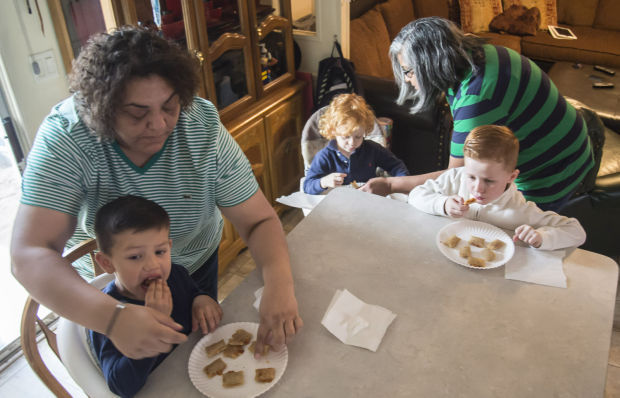
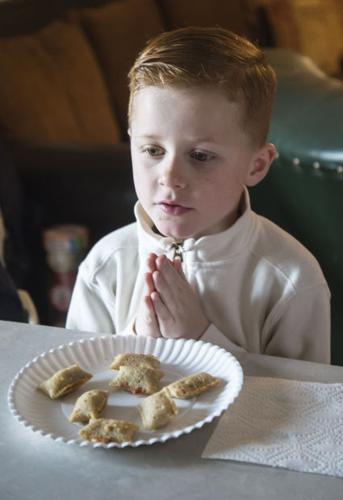
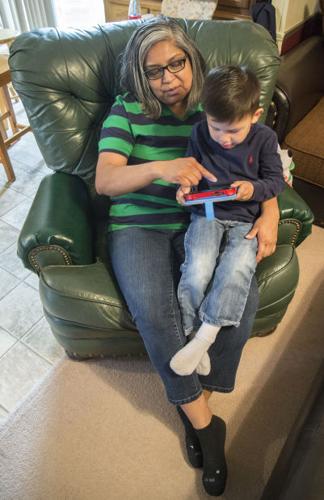
Milissa Mace and Catalina Garcia have been together long enough that they finish each other’s sentences, and they embody the axiom that opposites attract.
As parents to four boys, Mace’s warmth and outgoing nature are complemented by Garcia’s quiet and receptive approach.
When it comes to discipline, “we balance it out, so that way there’s not a good mom and a bad mom. We’re even,” Mace said.
This year, the couple of 20 years received the national Angels in Adoption award for opening their home to more than a dozen foster children from the Pascua Yaqui reservation and the Tucson area, four of whom they have adopted.
Mace and Garcia, who is a member of the Pascua Yaqui Tribe, said they were humbled and honored by the award.
“Being acknowledged makes us really proud of who we are,” Mace said. In September, the couple traveled to Washington, D.C., to receive their award, making tourist stops between meeting with legislators and adoptive families. They were among 127 national recipients of the award, given annually by the nonprofit Congressional Coalition on Adoption Institute in Washington.
People are also reading…
Mace, a pretrial services officer for the tribe, says she too often sees young people with backgrounds of abuse and neglect coming into the corrections system. As those children grow up, she’s watched some perpetuate the cycle of dysfunction when they have their own kids. Mace and Garcia hope that providing even a few months of stability will help children in the system break that cycle.
Their work in foster care began when they took in Garcia’s 3-week-old nephew, Victor, now 14, whom they eventually adopted. Licensed as foster parents through the tribe, they’ve fostered six kids from the reservation, always working closely with the foster kids’ biological parents to improve the chances of reunification.
“Cathy’s family is so big; all the kids we fostered were pretty much related to her somehow. We worked a lot to get them reunited with their families,” Mace said. “Every kid we get, we try to teach them we’re here for a little while. But what you learn from us, take with you.”
GETTING LICENSED
In 2012, Mace and Garcia were licensed as foster parents by Devereux Arizona, the child-welfare agency that nominated the couple for the award. They’ve fostered nine children through the state.
As of September, nearly 17,000 children in Arizona were in state custody — a 75 percent increase since 2007, when 9,700 kids were in state custody. The state Legislature’s 2009 cuts to family-support services — including subsidized child care — burdened families that were already struggling in the recession, said Lane Barker, Devereux Arizona’s executive director.
“Unfortunately, children’s services are often at the top of the list, in terms of cuts. We are seeing the aftermath of that now,” she said.
Devereux has been reaching out to same-sex couples and LGBT individuals in recent years to find loving homes for the overwhelming number of children in state custody.
PARENTING TOGETHER
Mace and Garcia say they always consult each other before addressing issues that arise with their children.
If one of their kids gets in trouble at school, the parents talk first about how to approach the child. Then, they always give him or her a chance to explain what happened, they said.
Garcia said her friends and family members say they make parenting look easy. While Garcia wouldn’t call it easy, the couple’s dedication to communicating with each another makes all the difference, she said.
“It’s hard,” she said, “but it’s worth it.”
SAME-SEX ADOPTIONS
Since the couple adopted Victor through the tribal courts, both of their names are on his birth certificate as parents. But for their three children adopted through the state of Arizona — John, 3, Julian, 4, and Jackson, 8 — only Garcia was allowed to officially become their mother. Mace is a legal guardian.
Arizona allows only a husband and wife to jointly adopt, leaving same-sex couples and unmarried heterosexual couples with less secure custody rights if anything happened to the partner who is officially the adoptive parent.
Attorneys say it remains to be seen if the legalization of gay marriage in Arizona will translate into a guarantee that same-sex, married couples can jointly adopt. That would probably be the only reason Mace and Garcia would consider marrying, they say, after 20 years of committed partnership.
On Pascua Yaqui sovereign land, there are no restrictions based on the sexuality or marital status for those who want to jointly adopt, said Alfred Urbina, Pascua Yaqui attorney general.
As in the rest of the state, the number of children on the reservation in out-of-home care is on the rise, he said.
Especially on tribal lands, the lack of jobs and economic infrastructure has meant more families struggling to meet their children’s basic needs, he said. Substance abuse is also a major cause for removals.
Foster and adoptive families like Mace and Garcia’s can be life-changing for children, Urbina said.
“They’re loving these children at the most important time in their life, when they’ve been removed from their home, and they’re scared and they don’t understand what’s going on,” he said. “It’s amazing what these foster parents do for these kids. It’s something we don’t celebrate enough.”
Contact reporter Emily Bregel at ebregel@tucson.com or 807-7774. On Twitter: @EmilyBregel

Emily Bregel
Border reporter




 Tim Steller's column: Macho politics turn tricky for Sen. Gallego

