Amid the Trump administration’s crackdown on both illegal and legal immigration, migrant and refugee servicing organizations across Buffalo echo the same sentiments: Fear is widespread among newcomers to the country, need is greater than ever and resources are dwindling.
People are also reading…
The Trump administration suspended the refugee resettlement program, which has brought thousands of people to Buffalo, on its first day in office in January. Then earlier this month, Trump announced a travel ban for people from 19 countries, including Myanmar (formerly known as Burma), Somalia and Yemen – the native lands of many immigrants who now live in metro Buffalo. And Trump’s “Big, Beautiful Bill” would further curtail legal immigration by imposing huge fees for many people who want to settle in America.
Adding it all up, Dr. Myron Glick, CEO of Jericho Road Community Health Center, notes a pattern. While Trump has welcomed white refugees from South Africa, he’s shutting the doors to people of color from other nations.
“This just reinforces a stereotype against the newcomers who are people of color or of a different faith background, that isn't based in fact at all, and it's not helpful,” said Glick, whose health center primarily serves Buffalo’s immigrant communities. “And it's actually harmful, not only to the people who can't come, but to the people who are here.”

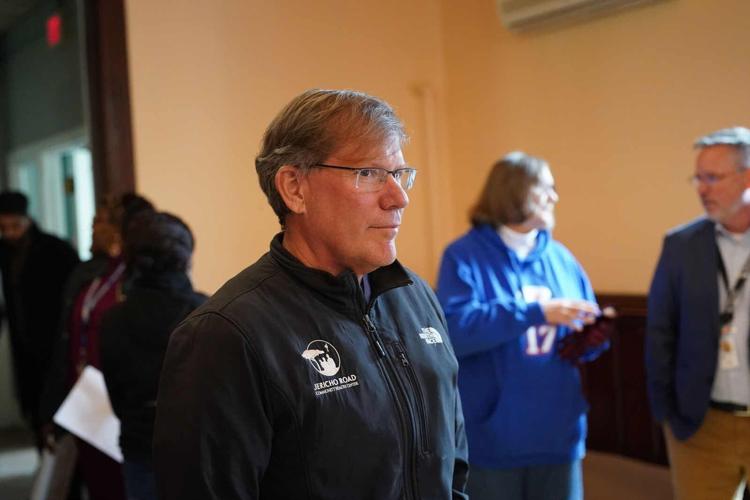
Dr. Myron Glick, Jericho Road Community Center’s founder and chief medical officer.
The Buffalo News reached out to several migrant-led organizations. Officials there all declined to comment out of fear for the safety of their clients.
Barring refugees
Trump suspended the 45-year-old refugee resettlement program in an executive order that said: “The United States lacks the ability to absorb large numbers of migrants.”
Yet that’s just what Buffalo has done for two decades. Fleeing trouble in their homeland, more than 15,000 refugees have come to the city legally in that time.
But no more. While refugee resettlement encompasses just 15% of the organization’s overall workload, the work is integral to Jewish Family s, one of Buffalo’s primary refugee resettlement agencies.
And right now, it’s been halted.
“We can’t serve refugees if they’re not admitted to the country,” said Molly Carr, the organization’s chief executive officer.
After receiving the stop-work order that suspended refugee resettlement in January, Jewish Family s was not only forced to cease case management for those not yet in the country, but lost support to the 731 refugees it already served in Western New York.
Jewish Family s is currently set to lose $6 million, nearly a third of its typical budget, because of the suspension of the refugee program. The organization also was forced to lay off 15 employees.
Shortly after the resettlement suspension, the Refugee Partnership was formed by five of the largest refugee resettlement and support agencies in the region to campaign for the restoration of funding lost to federal cuts.
“The work still needed to be done,” said Amanda Peralta, director of education at Journey’s End Refugee s, another agency in the Refugee Partnership.
The organization said it had to lay off 20 employees following the cuts. Newly arrived refugees were left without case managers, and community members feared the agency had shut its doors.
Although Journey’s End had anticipated cuts, Trump’s second term has brought about more drastic changes than Peralta’s ever seen, and she said not knowing what may come next is the worst part.
“You can only imagine how that (uncertainty) is amplified if you are lacking literacy and don’t fully understand the language,” Peralta said. “It’s like a game of telephone through different languages.”
Despite successful local collaboration with the Refugee Partnership, raising over $1 million, the cuts remain too deep to be filled by the efforts of one, or five, nonprofits.
The travel ban
Literacy Buffalo Niagara provides English language learning and literacy tutoring for adults, many of them immigrants, in Erie and Niagara counties. The organization has seen Trump’s policies imbue fear in its students and hinder its overall capacity to continue serving an increasingly at-risk community.
The organization’s steep decrease in enrollment is believed to be directly tied to the travel ban, according to Director of Operations Amy Mazur.
“We have a student who’s in Yemen right now, and he’s perpetually going to be stuck there,” Mazur said.
That’s because on June 4, Trump announced the travel ban, saying he was enacting it “to protect the United States from foreign terrorists and other national security and public safety threats.”
In Buffalo and elsewhere, though, the travel ban will affect immigrants who have never been a threat to the nation’s security.
Mazur said it’s common for immigrants to travel home to visit family members in the summer months. And when Trump announced a similar travel ban in his first term as president in 2017, some students left and did not return.
All the 200-250 students receiving English language learning s at Journey’s End still have family members abroad, who they are now unable to visit, according to Peralta.
As for the Yemeni student who went home earlier this year, “he’s been gone a couple of weeks,” Mazur said. “And I know his tutor had told us that she’s not sure when he’ll return because the airports are all essentially just in disarray there, and then the travel ban came up, so I don’t think he’ll be back.”

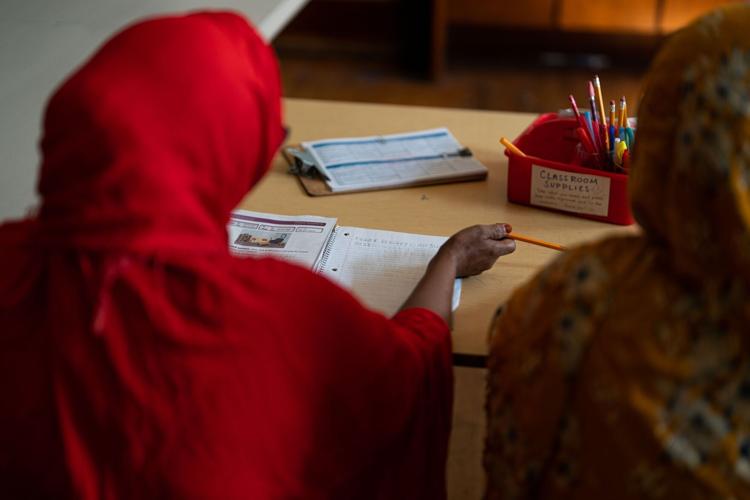
A student in an English class holds her pencil after writing out a sentence while learning at Vive shelter.
Mazur and Executive Director Tara Schafer said that Trump’s immigration crackdown prompted several students to go into hiding in the past few months.
Carr said she sees fear manifest in other ways. As ICE raids and travel bans dominate the national discourse, immigrant community members experience more anxiety, stress and depression.
The National Library of Medicine established a direct link between restrictive immigration policies and worsening mental health for migrants in research published this year.
"I think right now, for many people who are in the United States lawfully, there is genuine fear about how they'll be treated, including persons who have been granted asylum or refugee status or those who have been given special immigrant visas,” said Kelly Ryan, president of Jesuit Refugee Service/USA. “They're having to think about making plans in case they are mistakenly arrested, for example.”
Ryan – who, as a State Department official, led the effort to resettle refugees from Myanmar 20 years ago – said she’s particularly perplexed by the travel ban on people from that country.
“With the Burmese or the Myanmarese, it is not clear what genuine threat they pose, and they are certainly not systematically causing problems,” she said. “Quite the reverse. They're the ones who are here contributing to our country as refugees, and ultimately as U.S. citizens.”
A plan for fees
Separate from the refugee resettlement program, many immigrants seek political asylum in the U.S. The asylum program long has been seen as a troubled one that essentially opens the southern border to undocumented immigrants, and now the Trump administration has a plan for changing it.
Included in the “Big, Beautiful Bill,” the massive tax and spending bill currently under consideration in Congress, a series of fees would stand between many asylum applicants and legal status. Other prospective immigrants would face new fees, too.
• Applicants for asylum would have to pay a $1,000 fee. They would then have to pay an additional $100 annual fee while waiting for their claims to be processed.
• People admitted to the U.S. under the humanitarian parole program would also have to pay a $1,000 fee.
• People with temporary protected status would have to pay a fee of at least $500.
• All such immigrants who seek authorization to work would have to pay a $550 fee every six months to keep working.
• Those wishing to sponsor unaccompanied children who arrive in the U.S. would have to pay fees of $8,500.
Those fees “look punitive in nature,” said Thomas S. Warrick, senior fellow and director of the Future of DHS Project at the Atlantic Council, a Washington think tank.
“That has some really concerning, devastating impacts on people who are here and need to have work permits extended or while they're waiting for their asylum claim to be resolved,” said Warrick, formerly the deputy assistant secretary for counterterrorism policy at the U.S. Department of Homeland Security.
Despite that proposed policy – which, Warrick said, was inserted into the bill at the behest of the Trump administration – and all the administration’s other limits on immigration, some cases are processing normally, said Julie Kruger, a Buffalo immigration attorney.
But the administration’s policies have an indirect impact on immigrants, she added.
“A lot of immigrants have been very frightened by what they are hearing in the news,” Kruger said. “And there is just a lot of fear out there in the community.”