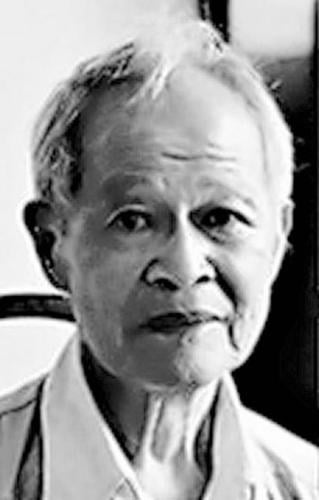
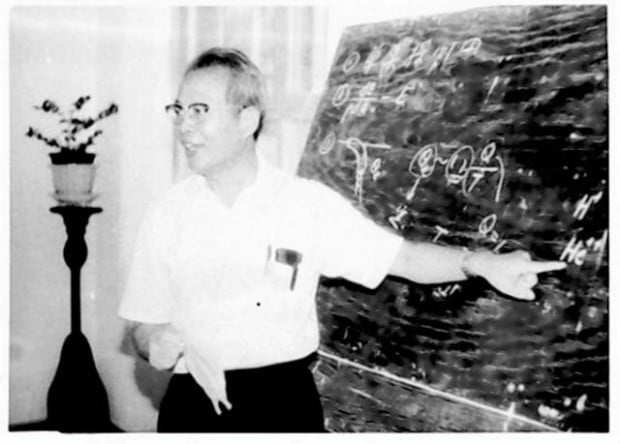
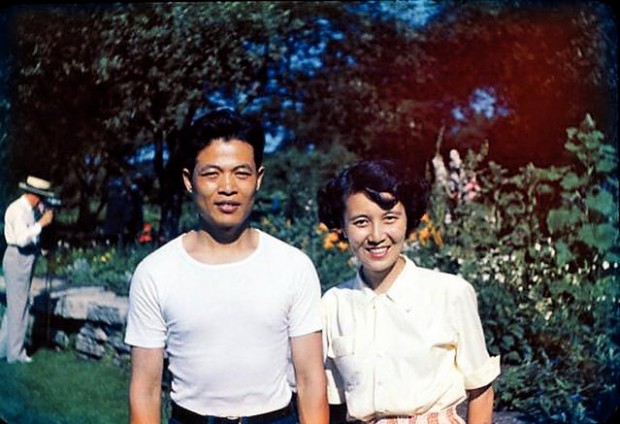
Self-determination transported Chang-Yun "Charlie" Fan from the cotton fields of a rural village in China to some of the top physics labs in the United States.
Though his parents were poor, they were strong role models for their son. Fan excelled in school despite the pressures of a country in turmoil and became a successful scientist.
Fan possessed a sharp mind, sly wit and agile body throughout most of his life, so it was a surprise to family and friends when the professor emeritus for the University of Arizona physics department was diagnosed with late-stage cancer in November.
"He led such a healthful lifestyle that he managed to ignore Stages 1, 2 and 3," said his daughter, Paula Fan. "He would say, 'The average life span of a male in the United States is 78.4 years, so I've done rather well.' "
Indeed. Charlie Fan was 91 when he died on Jan. 21.
People are also reading…
A descendant of the Song Dynasty, a period during which China experienced a prosperous renaissance with advances in technology, education, arts and agriculture, Fan's father hoped to become a scholar. Instead, he and his wife led an agrarian existence. Still, they were well-respected in their community. Fan's mother, though illiterate, was the arbiter of village disputes.
"He always spoke very highly of his mother's sense of fair play and judgment," Paula Fan said.
Charlie Fan was the second of three sons. He saw little of his father, who spent much of his time working, so Charlie modeled himself after his older brother, writing essays and practicing his Chinese characters. He also helped his family in the fields, picking cotton and carrying water from the river to the crops, rising early to do his chores before school.
Fan had to take a year off after grade school, and another before starting high school, because his parents couldn't afford the fees. In junior high, he was introduced to algebra, and his love of mathematics began.
He scored well on his college entrance exams, but his education was interrupted yet again in 1937, when the Japanese invaded China. The country had been weakened by years of civil unrest. Communist-led uprisings against the Nationalist Party and a harsh response gave Japan the opening it needed.
Fan and seven other college students fled inland on foot, trying to avoid capture.
"They walked to Zhenjiang, then caught a train to Nanjing, where they found a boat for refugees," Paula Fan wrote in an account of her father's early years. "Once again, money became an issue — he could only get as far as Wuhan, where he worked as a clerk for a while."
It was Fan's early practice in writing Chinese characters that allowed him to find temporary work when so many others could not, his daughter said.
After a year, Fan arrived in Chongqing, where the university had relocated, and continued his education, earning bachelor's and master's degrees despite ongoing unrest in the country.
"When bombs fell, there were blackouts," Paula Fan said. But "the physics students had a backup generator, so they could study and make tea."
It was at the university that Fan met his future wife, Tsung-Ying "June" Teng. The couple were married for 58 years and had three children.
Fan immersed himself in physics, but he didn't pressure his children to study the sciences. Paula, a pianist, and her brother, Michael, a violinist, both play in the Tucson Symphony Orchestra. Their sister, Anna, studied mathematics and works as a geographical information systems specialist for the city of Chicago.
After graduating from college in China, Fan taught physics for a few years before his application was accepted to study abroad at the University of Chicago.
After he left China, Fan never saw his parents again — they died before he could return in 1972 when U.S.-China relations normalized. Afterward, he visited the country many times with family, students and members of Tucson's U.S.-China Peoples Friendship Association. Fan made his final visit in May, when he gave a lecture to students and scientists in Beijing.
K.C. "John" Hsieh was a boy living with his family in Shanghai when Fan met his cousin, June Teng. While Fan was attending college in China, he visited Hsieh's home often. Fan sparked Hsieh's interest in physics and became a mentor to him when Hsieh traveled to the United States to study at Wabash College in Indiana.
"He belonged to the same generation as the first Chinese Nobel Laureates, Lee and Yang," Hsieh said, referring to Nobel Prize-winning physicists Tsung-Dao Lee and Chen Ning Yang, who shared the honor in 1957. "There were a whole generation of Chinese students at that time inspired by good physicists."
When Hsieh was still an undergrad, Fan hired him to work in his physics lab. Hsieh attended graduate school at the University of Chicago and a few years after Fan was recruited by the University of Arizona in 1967, he hired Hsieh for his scientific team.
Fan's areas of interest spanned the field, from nuclear to cosmic, atomic and astrophysics, and he worked with some of the top physicists of his time. His specialty was designing nuclear particle detectors that could be launched into space.
"Many of the good ideas (in physics) really started from Charlie," Hsieh said.
When the Van Allen Belt — a radiation belt of high-energy particles held in place by the Earth's magnetic influence — was named for another scientist, Hsieh said there was a joke among physicists at the University of Chicago that it should have been named "the Fan Belt."
Neil Gehrels was mentored by Fan.
"He influenced every part of my early life," said Gehrels, who works at NASA's Goddard Space Flight Center in Maryland.
As a UA physics student, Gehrels was invited by Fan to join a group studying cosmic rays.
"It was the most wonderful time of my life. He put me to work on lots of different topics, not just working on the same thing. I got a great training in all these different areas way beyond what you'd get in a class setting," Gehrels said. "Every day I would enjoy going up there.
"He just had a lot of enthusiasm and joy," he said. "Astrophysics was his hobby as well as his career. He would be thinking about it day and night and always be working on a problem or a new project. He lived astrophysics. It was his life. I learned that from him."
the series
This feature chronicles the lives of recently deceased Tucsonans. Some were well-known across the community. Others had an impact on a smaller sphere of friends, family members and acquaintances. Many of these people led interesting — and sometimes extraordinary — lives with little or no fanfare. Now you'll hear their stories.
On StarNet
Did you know Chang-Yun Fan? Add your remembrance to this article online at azstarnet.com/lifestories
You can find a photo gallery of this Life Story at azstarnet.com/slideshows