

Deron Beal is occasionally tempted by the riches his Internet empire has made available for free.
Just this month, he could have had his pick of a dwarf albino hamster, 15 feeder mice or two well-behaved rats.
He might have scored a 7-foot fake ficus, a huge Pooh bear, a Tiffany lamp, a half bag of dog food or a full bag of rags — all offered for free on the Tucson Freecycle site he created three years ago.
Beal's notion of an Internet link between people with surplus stuff and people who want it has attracted 2,431,247 members to 3,720 Freecycle groups in 70 countries.
But he is now under orders from his wife: He can give, but he can't receive.
She recently nixed his plan to add some telephone poles to the stack of railroad ties waiting for him to re-landscape his yard.
People are also reading…
"My wife is the minimalist in the family," Beal said.
"Stuff creates chaos," said his wife, Jennifer Columbus. "When you give it away, you get freedom."
Beal agrees with that. Giving, he says, is the linchpin impulse of Freecycle, the Internet movement he created on May 1, 2003, by sending an e-mail to 30 friends and a handful of nonprofit groups, seeking a home for half a warehouse full of stuff that the Downtown recycling outfit he ran couldn't recycle.
Today, Beal said, Freecycle keeps more than 200 tons of stuff out of the landfills each day while making thousands of people feel like benefactors. "Even the humblest of us can be philanthropists," he said.
Beal has received international praise for his vision. He has also been sued and vilified for it.
He's just happy to live the "green" life he promotes.
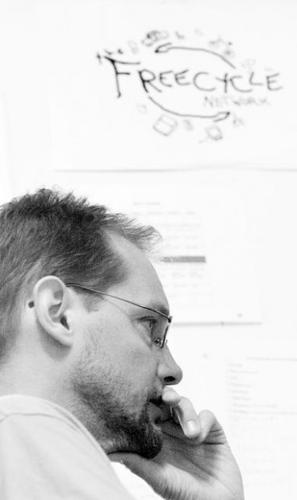
Long, lean, bearded and bespectacled, Beal will hug a tree when called upon. Earlier this month he threatened to stand between some trees planted outside his home and the city crew sent to trim them back. They negotiated a minimal trim that made it possible to see the stop sign at his corner without damaging the mesquites he had helped plant in a Trees For Tucson project.
He conserves fossil fuels, folding his 6-foot-6-inch frame onto a recumbent bicycle for his trips around town. He harvests rainwater and recycles building materials, even finding a user for his "urbanite" — chunks of concrete he jack-hammered up from his yard in the Dunbar-Spring Neighborhood near Downtown Tucson.
The Beal home is sparsely furnished with secondhand items, and he has given away his telescope and his ab machine, neither much used, on Freecycle.
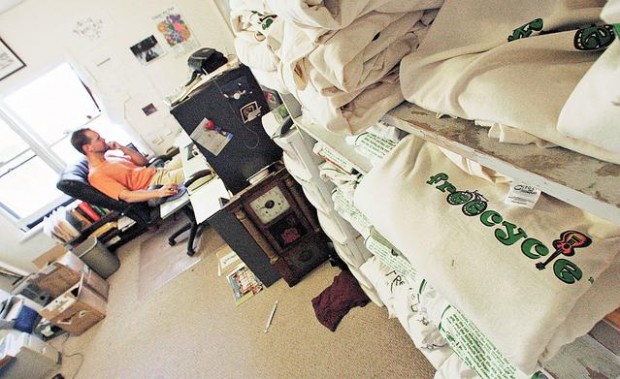
The small spare bedroom holds a desktop and two laptop computers. This is the international headquarters of his Internet empire. He shakes his head and smiles. He still can't quite believe it all.
Beal, 39, didn't grow up with a strong conservation ethic and at one point was more interested in climbing the corporate ladder on an international scale than in "saving the world one gift at a time."
Then he had one of those moments. He was a finance manager for Procter & Gamble in Germany, cashing in on his fluency in German, his degree in foreign service from Georgetown University and an MBA from the Thunderbird School of International Management.
He worked late into the night at the computer in his Frankfurt office, managing spreadsheets and databases, compiling reports that would allow P&G to squeeze more profit from its toothpaste sales.
"Procter & Gamble was buying out companies, firing mid- to top-level managers. Part of my job was figuring out who's gonna get cut. I'd go in and say 'You've got some redundancies here.' I hated it. I absolutely hated it. Staring at the computer, saying 'My God, is this what it's all about?' I thought, 'There's got to be something more than this.' "
Beal began teaching English at the community college and university level, discovered he didn't have "the teaching gene."
He decided to move back to Arizona. He had enjoyed his time in the desert while at Thunderbird but wasn't fond of its setting. "Tucson is a much cooler city than Phoenix," he said. He moved here in 1999.
After making his break from the corporate world, he had anticipated he'd be spending more time outdoors.
He explored becoming a park ranger, then took a job as development director for Native Seeds SEARCH, raising money to preserve heritage crops and educate Tucsonans about desert agriculture.
Next he became director of a recycling program created by RISE Inc. to foster recycling among Downtown businesses and provide a bridge to employment for folks having trouble getting or keeping a job — the homeless, people with substance-abuse problems.
The program ended up with a bunch of stuff it couldn't recycle, Beal sent out an e-mail and the rest is history.
These days, Beal is all Freecycle all the time, courtesy of underwriting support that allowed Freecycle to pay him a salary for the first time last year. He spends half his day communicating with the volunteer managers of the nonprofit corporation and the other half filling in spreadsheets and balancing the company books.
He's still chained to a computer ("It must be some sort of morbid attraction," he said), but at least now it produces more palatable results. "It's enormously fulfilling and I don't even notice the long hours," Beal said.
Beal is not totally out of the rat race, though he can describe his daily commute as "a shuffle down the hall in my slippers." Lately he's had to swap his shorts and T-shirt for dress shirt and necktie on visits to the federal courthouse.
His life has been complicated by lawsuits filed by and against him over the Freecycle trademark and battles with moderators and members who balked at the rules. Seems it's easy to ruffle feathers by enforcing modest standards on volunteers in the lawless intersection of the Internet and the green community.
He figures that Freecycle has lost or deposed 2 to 3 percent of its group leaders or "moderators" over rule violations or differences in philosophy.
Some of the splits left a Web trail of accusations and epithets.
"The Internet is not a pleasant place to work," Beal said. He finds it frustrating that the "2.4 million happy people" who are members of Freecycle and the thousands of moderators and volunteer managers who run the nonprofit can be eclipsed by "the extreme negativity of a handful of people."
The Web attacks are also at odds with the view of Beal held by those who know him best.
His wife, also long, lean and green-minded, says he is "the best person I've ever met. A very, very good person."
"He's principled," said T. VanHook, former director of RISE Inc., the consortium of four Tucson nonprofit groups that hired Beal to run its Downtown recycling program.
"That's part of what gets him in trouble. He puts ideas into action and stands up for principles," said VanHook, now the special projects administrator for the town of Marana.
Freecycle began as a small idea, she said. "Deron came to me one day and said 'Hey, why don't we create this Yahoo listserv' and see if we can find people who want this stuff we were accumulating.
"Your newspaper ran a story, AP picked it up and we had a national phenomenon. It was just supposed to be this little business forum and it got way out of control. I've got this little struggling nonprofit, and all of a sudden Deron's in People magazine."
All over the world, people wanted to form Freecycle groups. It was featured in magazines and on television news shows. Beal was saluted by the Environmental Protection Agency and named one of 50 environmental heroes by Organic Style magazine. His Web site was chosen one of the "Top 101" by PC Magazine and featured in Time magazine's "Top 50."
It became a balancing act, said B.J. Cordova, moderator for the 6,081-member Tucson Freecycle group, between keeping it loose and making sure it didn't get out of hand.
There are very few rules for his Tucson group or for any others, Cordova said, but it is necessary to monitor the members to make sure that Freecycle remains "free, legal and appropriate for all ages."
"We've had from Day 1, members who didn't want to follow the stated intent. I think that's a sign of a healthy society," said Cordova, who is also director of development and community outreach for Tucson Clean and Beautiful, one of the nonprofits targeted by Beal in that first e-mail.
In the first year of its existence, Freecycle grew from nothing to 100,000 members in 500 groups. With the exception of Beal, it is run totally by volunteers — people, said Beal, "with an absurd amount of energy and a yard-sale spleen."
The absurd amount of energy required to run Freecycle began to take its toll. "I had a full-time day job, I was working nights and evenings and weekends. It was crazy, just insane," Beal said.
His wife, among others, urged him to find a solution. "We have the same mindset that work shouldn't take over our lives," Columbus said.
Freecycle generated no income but it was costing Beal money in addition to time. "I needed to pay for the success. I began to look for benefactors."
Waste Management Inc. offered the group $120,000 a year and that allowed Beal to pay himself a $45,000-a-year salary.
The Waste Management grant triggered some of the defections. Others objected to a trademark fight. Some created rival groups.
"Anyone who wants to set up their own group, that's OK as long as they're not using our name," Beal said.
"Gifting is a beautiful thing."
●There are 45 Freecycle sites in Arizona. To find the one nearest you, go to www.Freecycle.org and click on "U.S. Southwest."
You must register as a member in order to browse the listings or place an ad. All items offered or sought on Freecycle must be free, legal and appropriate for all ages.

 Faculty concerned about changes to U of A admissions policy


