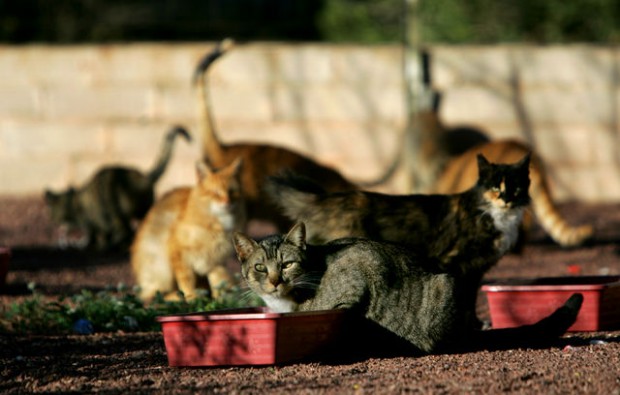

A small town in Iowa recently triggered an international controversy by putting a bounty on the heads of feral cats. And in Wisconsin a couple of years ago voters backed allowing stray cats to be hunted.
But one Midtown Tucson neighborhood, armed with $5,000 in taxpayer seed money, has taken a completely different approach to alley-cat overpopulation.
For the past year the Oak Flower Neighborhood has started trapping the cats, spaying or neutering them, giving them their shots and sending them back to the neighborhood to live out the rest of their sexless lives.
Over that same time, the Pima Animal Care Center has euthanized nearly 6,000 adoptable cats and kittens because there weren't enough people willing to pay the up to $95 fee for shots and neutering there.
The Oak Flower Trap-Neuter-Release program is patterned after a number of programs across the country and a similar citywide program operated by the Humane Society of Southern Arizona, which gets $18,000 in city funding.
People are also reading…
Residents "wanted them out of here," said Blanche White, president of the Oak Flower Neighborhood Association. "They didn't want them brought back."
Despite the catcalls, the neighborhood took a softer approach.
"We couldn't do that," White said. "It's not their fault they got left behind."
The $5,000 grant came from Pro Neighborhoods, a coalition which includes the city, county and several community organizations.
Catching, snipping and releasing stray cats has become something of a national movement in recent years as a number of animal-rights groups have argued it's a humane alternative to euthanasia. The theory is by fixing the alley cats, they will no longer reproduce, but can live out their lives on the streets.
It's a point of debate, though, whether such programs help the cats, who are exposed to disease, predators and cars and often don't live longer than five years. Meanwhile, research suggests cats — both feral and domestic — are decimating bird populations across the country.
Cats kill hundreds of millions of birds across the country every year, researchers estimate. In Southern Arizona, they have threatened such native birds as the black-throated sparrow, Gambel's quail and Gila woodpecker, among others, while also feasting on smaller rodents and reptiles that other native predators, like coyotes, hunt.
While there is no definitive research on the effects of cats on native wildlife locally, one University of Arizona study on five indoor/outdoor suburban house cats showed they killed a collective 113 animals in a 12-15 week period.
"We strongly support trapping and neutering, but we do not support releasing," said Paul Green, an ornithologist and executive director of the Tucson Audubon Society. He blamed a house cat for killing one of the last pygmy owls on the city's Northwest side.
"I think that people really truly don't understand the damage they are doing to the environment," Green said.
The solution, as Green and others see it, is to keep all cats indoors, noting the Audubon Society will soon begin working with the Hermitage Cat Shelter, a no-kill, cage-free sanctuary, on how to pursue this goal.
"I am not advocating for euthanization," Green said. "What I do advocate is removing these feral cats from the wild, neutering them and then keeping them enclosed for the rest of their natural lives."
Considering the sheer numbers of feral cats, not to mention their demeanor, that might prove easier said than done.
No one knows how many feral cats are in the U.S., but estimates peg the figure between 50 and 70 million. A number of cat- shelter workers and cat advocates in Tucson say the feral cat population here is at least 100,000 strong, but, like the national estimates, no one knows for sure.
While feral cats have had little luck finding owners, they have made plenty of friends.
There are several national groups — most prominently Alley Cat Allies — who advocate returning the cats to where they came from after sterilizing them.
Besides the Humane Society, a number of vets, and a handful of other less-known groups like the Hermitage Cat Shelter and the Animal Welfare Alliance of Southern Arizona support the practice. These groups say maintaining colonies keeps other feral cats from entering neighborhoods and feeding the cats regularly keeps them from hunting birds and other animals — but a growing body of research has showed managed feral cat colonies have taken a toll on wildlife in Hawaii, California, Florida and New Jersey, among other places.
Last fiscal year, the Pima Animal Care Center adopted out 1,538 cats, but it put down 5,761 cats, said manager Kim Janes.
While Animal Care doesn't actively practice catch, snip and release, Janes said it does support the practice, and often refers groups or concerned citizens to the Animal Welfare Alliance of Southern Arizona, and its burgeoning Spey Neuter Intervention Project program.
As one might guess from its name, the purpose of SNIP is to, well, snip cats and dogs. Dot Jones, SNIP program manager, said about a quarter of the calls the program gets from people deal with feral cats.
"My personal belief is that these are living creatures, these are sentient creatures," she said. "You just don't mass-kill animals."
When asked, though, why so much attention is being given to feral cats when thousands of other cats are being euthanized, Jones said the issue couldn't be viewed as either/or.
"It just totally makes me sick to hear that number," she said. "I don't know why people aren't adopting more cats."
While cat people and bird people agree cats kill birds, there is no agreement on the severity of the issue.
"I think the bigger problem for bird depopulation is encroachment by humans," Jones said.
Green agreed development is the biggest threat to native birds, but he said cats are "decimating" bird populations nationally to the tune of 350 million birds a year. Keeping cats indoors would go a long way toward protecting birds, he said.
He said Tucson Audubon plans to work with the UA to get some more definitive numbers on the city's bird population and the possible effect cats are having on it.
"We plan to design scientifically rigorous ways of testing the effects of cats," he said.
Equally debatable is how effective trap, neuter and release programs are. For example, in the Oak Flower neighborhood 100 feral cats were sterilized.
But "there are a lot more," said Sharon Chamberlain, who helped Oak Flower with the project. "There are cats that we could not get."
Similarly, in the last year SNIP was able to neuter or spay 636 cats and dogs — a mix of pets and some feral animals. The Humane Society has done 76 snip and returns since July, said spokeswoman Jenny Rose.
That means between them, the three groups reached far less than 1 percent of the estimated feral cat population.
Arizona Game and Fish Department has no official position on how to handle feral cats, but it has reported the average life- span of a feral cat is five years as opposed to an average lifespan of 17 years for indoor cats.
That's one of the reasons why Elissa Ostergaard, an urban wildlife biologist with Arizona Game and Fish and a cat owner, said she personally views euthanasia as more humane than trap and release.
"I just don't see how it's more humane to let them roam free than it is to euthanize because of all the things they can potentially die from," she said. "When you look at the intrinsic value of a feral cat, is that higher than a native wild animal?"
This type of perspective makes cat defenders like Mary Jo Spring, director of Hermitage Cat Shelter, furrow their brows.
"We don't think the solution is grabbing up cats and euthanizing them," she said. "Maybe they are not part of the wildlife that started in Tucson way back when, but they are now."
Cat people and bird people have been debating about this issue for years. And while the debate will, no doubt, continue, at least in Tucson, the two sides are focusing on what they have in common.
"The thing is, keep your cat indoors," Spring said. "Neuter your animals. I don't know why people think their cats need to go outside."
Said Green, "There is a simple solution to this: Catch the cats, feed them, look after them, make them well and keep them in captivity. … I can understand the compassion that people feel for (feral cats), but it's just the free-living nature that's the problem."
Keep cats indoors
Indoor cats tend to live much longer lives and have less of an effect on the environment than their outdoor counterparts. Here are some tips to keep cats healthy and happy indoors.
• Play with your cat at least 15 minutes a day.
• Offer paper bags and cardboard boxes for cats to play in.
• Keep cats on harnesses or leashes when they go outside.
• Plant grass in flower pots to let cats graze.
• Keep litter boxes clean.
Source: Arizona Game and Fish Department, American Bird Conservancy