
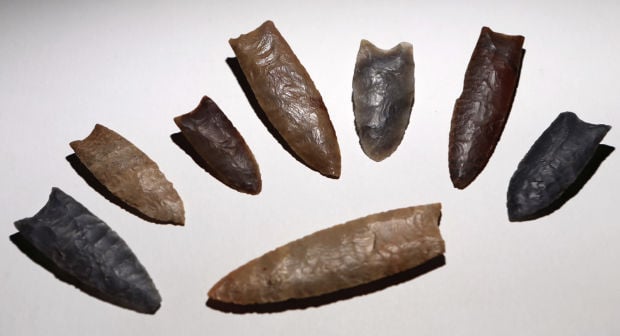
Several Clovis points discovered at the Naco mammoth kill site, from the collection of the Arizona State Museum.
We’re defining Tucson in 100 objects. The daily series began Sunday. Follow along at azstarnet.com/100objects/
These fluted spear points, averaging about 2 inches long, are evidence of the area’s first human visitors — the Paleo-Indians known as Clovis.
Tucson can lay claim to being continuously inhabited for 4,000 years, but humans regularly passed through some 13,000 years ago, at the end of the last Ice Age.
The region was a much cooler and wetter place, home to megafauna such as mammoths and bison.
Evidence for the existence of the Clovis people comes only from the spear points they left behind, some of them embedded in the remains of mammoths.
The first evidence of the hunts was uncovered near Naco, Ariz., in 1952, on an Arizona State Museum dig led by Emil Haury, the pre-eminent Southwestern archaeologist of the 20th century. The museum has an exhibit of the spear points and the mammoth bones, displayed as Haury found them.