Skip to main contentSkip to main content
Register for more free articles.
Log in Sign up
Back to homepage
Subscriber Login
Keep reading with a digital access subscription.
Subscribe now
You have permission to edit this collection.
Edit
Arizona Daily Star
68°
  • Sign in
  • Subscribe Now
  • Manage account
  • Logout
    • Manage account
    • e-Newspaper
    • Logout
  • News
    • Sign up for newsletters
    • Local
    • Arizona
    • Business
    • Crime
    • Nation & World
    • Markets & Stocks
    • SaddleBrooke
    • Politics
    • Archives
    • News Tip
  • Arizona Daily Star
    • E-edition
    • E-edition-Tutorial
    • Archives
    • Special Sections
    • Merchandise
    • Circulars
    • Readers' Choice Awards
    • Buyer's Edge
  • Obituaries
    • Share Your Story
    • Recent Obituaries
    • Find an Obituary
  • Opinion
    • Submit a Letter
    • Submit guest opinion
    • Letters to the Editor
    • Opinion & Editorials
    • National Columnists
  • Sports
    • Arizona Wildcats
    • Greg Hansen
    • High Schools
    • Roadrunners
  • Lifestyles
    • Events Calendar
    • Arts & Theatre
    • Food & Cooking
    • Movies & TV
    • Movie Listings
    • Music
    • Comics
    • Games
    • Columns
    • Play
    • Home & Gardening
    • Health
    • Get Healthy
    • Parenting
    • Fashion
    • People
    • Pets
    • Travel
    • Faith
    • Retro Tucson
    • History
    • Travel
    • Outdoors & Rec
    • Community Pages
  • Brand Ave. Studios
  • Join the community
    • News tip
    • Share video
  • Buy & Sell
    • Place an Ad
    • Shop Local
    • Jobs
    • Homes
    • Marketplace
    • I Love A Deal
  • Shopping
  • Customer Service
    • Manage My Account
    • Newsletter Sign-Up
    • Subscribe
    • Contact us
  • Mobile Apps
  • Weather: Live Radar
  • Facebook
  • Twitter
  • Bluesky
  • YouTube
  • Pinterest
  • Instagram
© 2026 Lee Enterprises
Terms of Service | Privacy Policy
Arizona Daily Star
News+
Read Today's E-edition
Arizona Daily Star
News+
  • Log In
  • $1 for 3 months
    Subscribe Now
    • Manage account
    • e-Newspaper
    • Logout
  • E-edition
  • News
  • Obituaries
  • Opinion
  • Wildcats
  • Lifestyles
  • Newsletters
  • Comics & Puzzles
  • Buyer's Edge
  • Jobs
  • 68° Sunny
Share This
  • Facebook
  • Twitter
  • Bluesky
  • WhatsApp
  • SMS
  • Email
Spotlight Top Story

Catch up on recent Western Women columns by Jan Cleere

  • Jan Cleere For the Arizona Daily Star
  • Mar 8, 2023
  • Mar 8, 2023 Updated Sep 15, 2023

March 8 marks International Women's Day. Here are 25+ stories of Arizona women who made their mark in the early history of the territory and the state.

Mary Catherine Hart was matron at 'Poor Farm' hospital

One would think if a woman had 10 children to care for, she would have enough to keep her busy. But Mary Catherine Hart also took on the job of matron at Coconino County Hospital in Flagstaff along with running her own household, getting children bathed, fed, and out the door to school.

Mary Catherine Hunt was born in Decatur, Illinois, on July 20, 1874. By the time she was 15, she was living in Flagstaff and on Sept. 9, 1889, she married John Fletcher Fairchild, who was over 20 years her senior.

John Fairchild already had led a colorful life by the time he and Mary married. But he was now a widower with two children and probably needed someone to care for his youngsters. He and Mary soon had five children of their own.

John, or Fletcher as he was more familiarly known, had been in law enforcement a good portion of his life. He was part of the posse that participated in the Pleasant Valley War about 1887.

Fletcher also ran a sheep ranch and owned a saloon in Flagstaff.

In 1898, Fletcher was elected sheriff of Coconino County but never really served, as by then he was suffering from severe headaches, which were probably the result of a fight years earlier.

In November 1898, he went to Los Angeles to have surgery. He returned to Flagstaff that December to begin his duties as sheriff in January. That August he was declared insane.

Family stories suggest the surgery was unsuccessful, leaving Fletcher in severe pain, which caused his insanity. He was sent to an asylum in Phoenix where he died in October 1899.

Mary was left a widow with seven children to raise on her own.

How Mary managed during the ensuing years is uncertain as she does not appear in any known records until 1912 when she married William Chesely Hart, better known as Billy Hart, who was running the Coconino County Hospital for the Indigent.

In fact, their wedding was held on the hospital grounds.

It is possible that Mary was working at the hospital and that may be how the couple met.

Coconino County Hospital was a big improvement over the previous medical facility in Flagstaff. Originally it was located in the back rooms of a hotel, where a lone surgeon performed operations under unhealthy and unsanitary conditions.

Coconino County Hospital was built in 1908 to care for the people of Flagstaff who could not afford to go elsewhere for health care. It would also take in prisoners and those who eventually were turned over to the insane asylum in Phoenix once they were declared incompetent by the probate court.

The two-story stone structure was built on 160 acres out on what is now Fort Valley Road, and the surrounding land was farmed by people who gave a portion of their crops to the hospital to be used for patients’ meals. Some of the healthier patients also farmed the land.

Because the grounds were tended by indigent individuals, the hospital became known as the “Poor Farm.”

Patients were housed on the first floor with most of the staff living on the second floor of the hospital.

Only four rooms were allotted for women patients, who were rarely admitted. The rest were for men who had been injured in logging accidents, those who jumped from trains going through town, or were injured in gun and knife fights.

Frozen limbs were also prevalent along with debilitating illnesses such as mountain fever, influenza, diphtheria and tuberculosis.

The 1920s saw big advancements in the care patients received at hospitals. Penicillin came into use and those entering a hospital no longer feared being carried out feet first but could hope they might receive decent treatment and even cures for their ills.

Through the years, additional buildings were added to the county hospital, including a sleeping porch, barn, and a sewer system.

Billy Hart handled the administration of the hospital, while Mary served as matron from 1920 until the hospital closed in 1938.

As matron, she was the senior nurse responsible for all the nurses (at that time all female) as well as the domestic staff. She made sure the procedures schedule was up to date along with ordering food for patients and overseeing their care. She might even dispense medical treatment if a doctor was not available.

Mary had three more children with Billy Hart, bringing the total number of children under her care to 10. All but one child survived infancy.

Mary and Billy divorced in 1923 although there is no record indicating why they separated. At that time in Arizona, divorces were only granted if one could prove adultery, abuse, desertion, physical incompetence, or if one’s spouse was a “habitual drunkard.”

After their divorce, Mary and Billy continued to work together at the hospital until its closure in 1938 when state and federal governments began overseeing health care for the indigent, along with the addition of welfare programs.

The building became a boardinghouse.

Billy Hart died in 1945. Mary remained an active member of the Flagstaff community until she broke her hip in 1949. Because the Coconino County Hospital no longer existed, she was taken to the Flagstaff Hospital, founded in 1936. Mary died at the hospital on Dec. 18, 1949, at the age of 75. She is buried in the Citizens Cemetery.

In 1963 the old hospital/boardinghouse was taken over by the Arizona Historical Society and today operates as the Pioneer Museum. Strolling through the rooms, one will find artifacts such as an iron lung along with surgical equipment once used in the hospital. There is also a timeworn but pristine nurse’s uniform on display. Maybe Mary once wore one of similar style during her days caring for the indigent of Flagstaff.

If you live in Arizona, it's only right that you should know a few facts about our fair state. Play along with this quiz and see if you can correctly answer five questions about the Grand Canyon State!
Johanna Eubank

In 1880s Tombstone, Samantha Fallon presided over hotel, lively social life

As the driver careened the stagecoach down a barely perceptible trail, bouncing from rock to rock trying to avoid massive boulders lining the dusty highway, his face turned the color and consistency of sandpaper while his hair and eyebrows sported a coat of fine silt. If he had kept his mouth closed, he might have avoided the gritty taste of dirt tossed up by the coach’s horses but the man was a talker, regaling his passengers with tales of wanton cowboys who lay in wait to rob those daring to enter the territory.

The passengers listened with trepidation to the yarns that spewed from the man’s parched lips and he could barely hide his grin when he turned to see their horrified expressions. It was an unnerving 12-hour ride that the driver made daily, enjoying his reign of terror over tender-footed newcomers.

Arriving in Tombstone, the passengers plummeted out of the coach, a little unsteady on their feet after so many hours of sitting. Most were men and the majority had come to this desert wilderness seeking their fortunes in the silver mines that had opened a few years earlier. Just before the stage driver climbed back into his seat ready to head to the horse barn, out stepped a petite, attractive young woman.

Samantha Fallon nimbly jumped from the coach, made a futile attempt to brush the dust from her clothing, adjusted her feathery hat, grabbed her bag, and scanned the town.

This was not her first trip to Tombstone although records do not indicate when Samantha first arrived in Arizona, and she often gave conflicting dates concerning her whereabouts, her properties, and her husbands.

Born in Canada on Aug. 14, 1857, Samantha Elizabeth Steinhoff had shed one husband by the time she arrived on Tombstone’s streets. She may have left Mr. Fallon back in California, although no record has emerged of their marriage.

On Oct. 9, 1879, Samantha purchased a couple of lots on the corner of Tombstone’s Fremont and Fifth Street with the idea of building a boardinghouse. That December, she sold a portion of one of the lots, probably to obtain additional funds, but she still did not have enough money to finish the project. She started looking around for other sources of income.

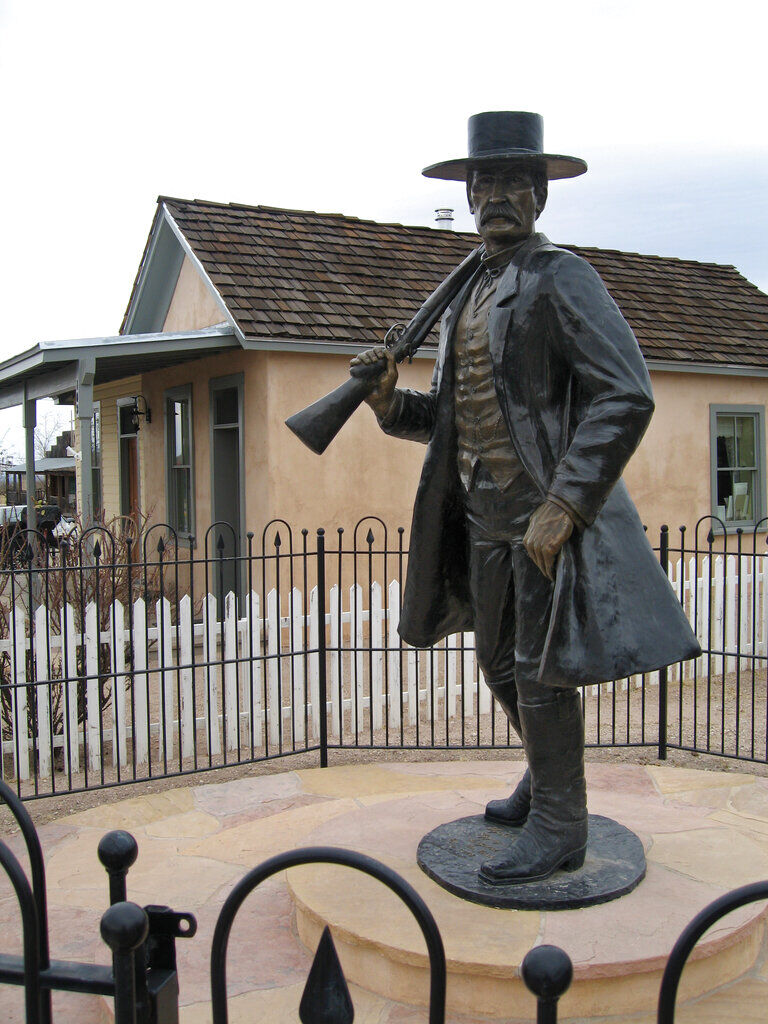
Wyatt Earp statue on Freemont Street

A bronze statue of Wyatt Earp, by Tim Trask, stands on Freemont Street in Tombstone. The San Jose House that Samantha Fallon ran is on the corner of Fremont and Fifth Streets. 

Allen Breed, Associated Press

Still in her 20s, Samantha enjoyed the attention of many of the town’s eligible men, including Tombstone founder Ed Schieffelin. According to Samantha, Ed refused to marry her because she would not settle for just one man in her life. But he was willing to loan her what she needed to complete her boardinghouse.

By June 1880, Samantha’s San Jose House was up and running, one of the first establishments built in Tombstone to accommodate overnight visitors and long-term boarders. The 12-room hotel rarely had a vacant room.

The boardinghouse soon became known as one of the best meeting spots in town. Samantha often hosted fund-raising dinners for the Methodist church and held auctions that advertised for sale an assortment of items. Lace, corsets, socks, and hats were among the articles on the auction block.

Boasting that the son of former U.S. President Ulysses S. Grant, Ulysses S. “Buck” Grant II, sometimes roomed at her establishment, Samantha also housed her share of those who frequented the rougher side of Tombstone.

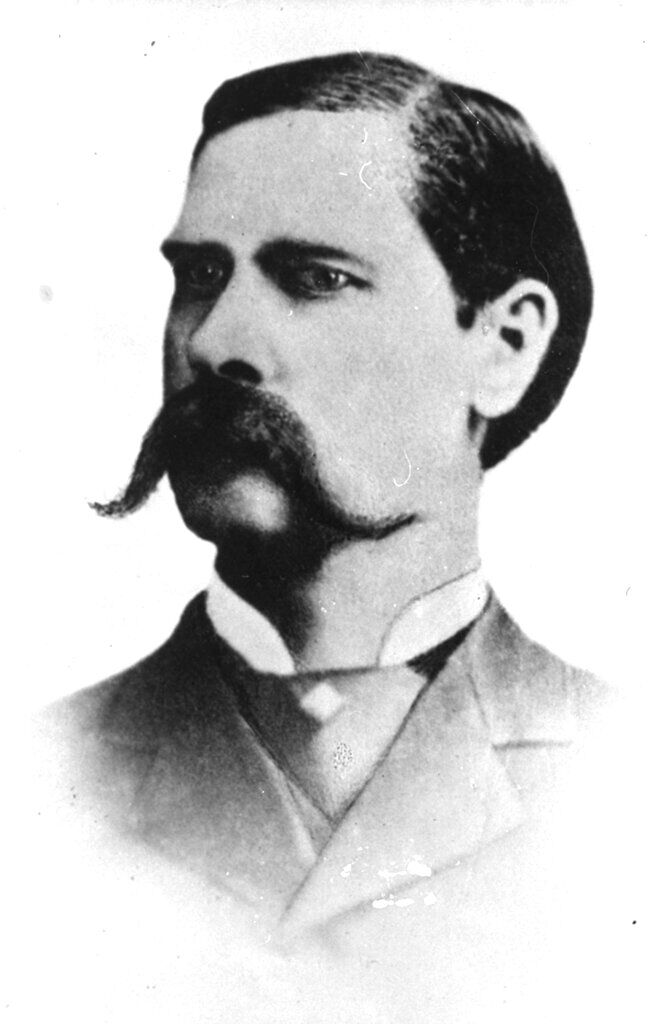
According to lawman Wyatt Earp, he “used to take my prisoners down to the San Jose room house. They had no jail in Tombstone at that time. That was before the county was divided. It was all Pima County and we had to take our prisoners to Tucson. In holding them in Tombstone I used to get a room in the San Jose and put a guard over them.”

Wyatt Earp

U.S. Marshall Wyatt Earp posed for this portrait photo in 1881, during the general period he would have been taking his prisoners to Samantha Fallon's San Jose boarding house to be put into a room with a guard standing by because Tombstone had no jail at that time. 

Associated Press

The bustle of activity at the San Jose House, along with Samantha’s proclivity for a lively social life, led many in town to assume her establishment might actually be a bordello with Samantha another of the local madams, but those rumors were never proven. And when she married local livery stable owner Zachary Hugh Taylor on Dec. 14, 1880, her standing in the community greatly improved.

“The wedding was very quiet,” according to the writeup in the Arizona Weekly Citizen, “only the most intimate friends of the couple being present. Mr. and Mrs. Taylor left immediately after the wedding in a four-in-hand private carriage for Benson, where they took the train for San Francisco and the East.”

In 1882, Samantha added a conservatory at the rear of the San Jose. According to the Tombstone Epitaph, “The flower beds, which are well stocked with choice plants, are tastefully arranged around the sides of the edifice, while the center is occupied by a low fountain — which, if the lady’s botanical efforts are crowned with success, will in the near future ‘gush forth in the midst of roses.’ This is one of the first experiments of the kind ever tried in Tombstone, and Mrs. Taylor deserves much credit for her enterprise and skill in projecting it.”

The exact date Samantha sold the San Jose House is speculative. She claimed she sold the property to a Mrs. Williams in 1909, but a Mrs. Gallen declared she bought the place in 1907. By then, Samantha had left Tombstone and eventually settled in Glendale, California, where she again established herself as a landlady by renting out rooms in her home. When she was hard up for money, she would rent her own bedroom and sleep on a cot in the kitchen.

Samantha died in Glendale March 16, 1931, and is buried at Forest Lawn Memorial Park. She supposedly left behind a manuscript describing her days in Tombstone, detailing the events she witnessed as well as the people she knew who made the town famous and infamous. The manuscript has not been located.

Today, one can still spend the night at the San Jose House. If a woman in a feathery hat passes by your window, give her a nod. She knows things about the town no one will ever uncover.

Along with some of history's more notorious gunslingers, like some of the Clanton gang, are those whose survivors could spin a tale on the headstone.

Johanna Eubank

Western Women: Bessie Kidd Best recruited teachers to Arizona wilderness

Born in Flagstaff on May 25, 1902, Bessie Kidd Best spent almost her entire life in northern Arizona, improving the education of children from diverse backgrounds.

The fifth and youngest child of Robert and Eva Kidd, Bessie was the only member of the family born in Arizona. Her older brother and sisters arrived with their parents from Ohio around the beginning of the 20th century. Her mother died when Bessie was 10, leaving Bessie and her sister Lucille to run the household.

In 1920, Bessie graduated from Northern Arizona Normal School and went on to obtain her teaching certificate in 1922. Her first teaching job was in Winslow.

On June 12, 1923, Bessie married Elihu (Hugh) Best. Her father, serving as justice of the peace at the time, performed the ceremony.

As a married woman, Bessie could no longer teach, as only men and single women were considered for teaching positions. Rural schools, however, were more than willing to hire any teacher who would live in sparse, isolated surroundings. Bessie accepted a position in a one-room school on the Apache Indian Reservation at Whiteriver, teaching 40 children in grades one through eight.

Sharing her time between Arizona and California, where her husband was working, plus giving birth to son Robert Huge Best in 1927, Bessie continued teaching until the position of Coconino County school superintendent became vacant in 1928.

By now, Bessie knew her marriage was faltering (the couple divorced in 1930), and she had to find more stable employment. On the recommendation of friends, she decided to run for the superintendent position.

Borrowing the family car, Bessie set out to canvas the school district territory, all 18,623 square miles, the second largest county in the country. She learned to maneuver rough, rutted roads that ran through dry, barren deserts. She traipsed up and down mountainous trails, logging paths that meandered through forests in which she sometimes lost her way, and canyon depths that often found her wondering where in the world she was. The farthest school in the district was over 200 miles from Flagstaff, but she was determined to visit every school within the county.

She also honed her automotive skills on these bumpy adventures, learning how to repair just about anything that broke or fell off the car. A good amount of bailing wire usually solved the problem. She could change a tire within minutes, and the canteens of water she carried usually quenched the car’s thirst, not her own.

No one was more surprised than Bessie when she won the election.

Starting her new job on Jan. 1, 1929, Bessie oversaw Coconino County’s 19 one-teacher schools, 4 two-teacher schools, 2 four-teacher schools, plus larger schools in Flagstaff and Williams, the only two communities of noticeable size.

Because of climate conditions in northern Arizona, some of the schools were open from March through November while others ran September through May, keeping Bessie on the road throughout the year. She estimated she traveled 10,000 miles annually.

Many of the schools in her district were small, one-room buildings not particularly well-built. Pot-bellied stoves heated the classrooms, bathroom facilities were down a path, and drinking water was hauled from the nearest water source.

Logging site schools were usually located in boxcars that could be moved onto sidings as loggers relocated, sometimes leaving Bessie to wonder where her school went. In her first annual report on the operation of her district, she described one of these boxcar schools that “moved from place to place with the camp. The attendance is large and the car is very crowded. It is hoped another teacher and another car will be added this year.”

School superintendent positions were two-year jobs. Bessie ran for her second term in 1930 and would continue to serve Coconino County for over 40 years, often running unopposed — on both sides of the ticket. Yet even with no adversary, she campaigned “because I want everyone to know I appreciate the office,” she said.

Her own educational goals continued to advance as she earned her bachelor’s degree in 1935 and master’s degree in 1948, all from Flagstaff Normal School (now Northern Arizona University).

But her chief concern was the education of students within her district. She was constantly on the search for good teachers who would brave the wilderness to educate children with limited resources. Without libraries in some of these small communities, she was instrumental in opening the county library system to rural schools.

In 1941, Bessie was appointed to the advisory committee of the statewide school lunch program. She helped get water piped into some of the schools, and eventually, restroom facilities were added. When school buses started appearing in the district, she instituted a two-way radio system between bus drivers and the U.S. Forest Service so that stranded buses in bad weather could be rescued, along with the students.

Bessie also took charge of the county spelling bee program. “The first event was very tense,” she said. “I felt so sorry for the children. I almost cried every time one misspelled a word. I wanted them all to win.”

Proudly boasting that she knew every Arizona governor since statehood, Bessie also worked closely with prominent individuals such as U.S. Senators Carl Hayden and Barry Goldwater, often traveling with them on their political campaigns. She also met with government officials in Washington, D.C., soliciting funds for under-financed schools.

Retiring in 1973, Bessie continued to serve her community until her death on Aug. 3, 1983. She is buried in Flagstaff’s Citizen’s Cemetery.

Over the years, Bessie knew as many as three generations of families within her jurisdiction.

As one reporter noted upon watching her interact with students, “Mrs. Best had gathered the children around her and was telling them a story, in her high-pitched, somewhat nasal voice. They were fascinated, and, obviously, in love for the moment with this grandmotherly, bespectacled lady wearing the brightly-colored dress.”

But Bessie would be the first to say it was not her efforts that made the difference in Flagstaff schools. “Good schools do not happen,” she said, “people working together build them.”

The Redington School northeast of Tucson was founded in 1907. It had no electricity or running water. The small number of students traveled long distances to get to school. Archive photos by Tucson Citizen. Produced by Rick Wiley / Arizona Daily Star

Rick Wiley

Western Women: 'Talk about grit. She had it!'

The Triangle Bar is one of Arizona’s oldest cattle ranches. Located on the old Black Canyon Road in New River, just north of Phoenix, the property started as a stage station in 1879. An old adobe house was still standing when Frank Alkire purchased the property in 1886. Three years later, he brought his new wife, Asenath, to live on the ranch.

Asenath Phelps was born on Aug. 27, 1865, in New Orleans. Still a child when her family moved to St. Louis, she became friends with the neighbor boy, Frank Alkire. Years later, the couple reunited in San Diego and were married on Pacific Beach on April 10, 1889.

Frank and Asenath initially settled in Phoenix until Frank was needed at the Triangle Bar. A city girl, Asenath had no idea how remote her new home would be and the trials she would face in the wilderness, but she dutifully packed up their meager belongings and hopped aboard the buckboard for the long, dusty ride to New River, a trip that required an overnight stay on the trail.

Frank found a quiet spot for the evening and asked Asenath to search for firewood while he tended to the animals. Suddenly, Asenath shouted, “Come quick! I’ve gotten into trouble.” Frank found Asenath trying to wrestle a cholla cactus for firewood, her hands covered in cactus thorns. This time the cactus won, but Asenath would conquer far more during her ranching years.

Arriving at the ranch, Asenath discovered her new home consisted of three rooms with a wide porch and grape vines climbing up the porch posts. The roof was made of cottonwood logs, saguaro ribs, and hay, held together with a mixture of red mud and water. A resident snake, Old Bill, lived in the roof and was allowed to stay as long as it kept the rat population at bay. An ocotillo fence surrounded the yard.

Inside, Asenath eyed a long, well-used table that was big enough to feed all the ranch hands and visitors who usually arrived around dinner time (the stage to Phoenix stopped just outside her door). She quickly decided the timeworn oilcloth and tin dishes would have to go. Spreading a bright red checkered cloth over the rickety table, adding napkins, chinaware, and decent silverware, she went to work cooking for whoever showed up.

Frank wrote about his “Little Lady of the Triangle Ranch” in an unpublished manuscript housed at Tucson’s Arizona History Museum. He described Asenath as “a trim, slim, little figure of a girl,” and often joked about the difficult time she had adapting to Western living. But Asenath was made of studier stock than Frank could imagine. On more than one occasion, she gritted her teeth and did what had to be done to keep the ranch afloat.

An example of Asenath’s tenacity occurred when one of the ranch horses ran into a barbed wire fence, sustaining a massive cut that ran from its chest down its shoulder and foreleg. Frank was set to shoot the horse, but Asenath would have no part of killing such a magnificent animal.

Asking for a bucket of warm water, a sponge, antiseptic, and a long curved needle used to sew grain sacks, she found a skein of heavy embroidery thread in her sewing kit and ordered the horse blindfolded with its forefeet tied. Under her direction, one of the cowhands washed the large cut before holding the big flap of skin against the animal’s chest while Asenath sewed the horse back together.

The horse, seeming to understand what Asenath was doing, stayed fairly quiet during the entire operation. Once stitched, she had the men place a cloth around the horse’s neck and tie the ends to its legs for a bandage.

“Talk about grit,” Frank wrote about his petite wife. “She had it!”

Six weeks later, the horse was in good shape.

On another occasion, a wounded deer pinned Frank to the ground after grinding him into a cholla cactus. Asenath had to shoot the animal before it did dire damage to her husband — the first time she ever used a firearm. She spent the next few hours pulling cactus needles out of Frank’s posterior.

Indians appeared infrequently at the ranch but one day, Asenath looked up to see a band of Apaches approaching, escorted by a cavalry officer who was taking them to Fort McDowell. Asenath stayed back when a fight erupted between one of the men and a woman, but when the man struck the woman with force, Asenath was off the porch in a flash. Boldly separating the feuding couple, she took the woman to the house, bandaged her face, and gave her food before sending her back to her people. The two women did not speak to each other during the entire episode, but as the woman left, Asenath turned to Frank and emphatically stated, “No man could ever do a thing like that to me. I would kill him.” Frank believed her.

Asenath and Frank had five children; two died at an early age.

In 1895 the couple left the Triangle Bar Ranch to live in Phoenix. Asenath embedded herself in the town’s growth. She became director of the Florence Crittenton Home, originally a refuge for sick and destitute women, and helped establish local divisions of the Parent Teachers Association throughout Arizona.

She formed a Food Relief Group for families suffering from the cotton disaster of 1920 and is credited with providing hundreds of meals for those in need. She was a member of the Women’s Club of Phoenix and a leader in supporting laws to protect women and children. She was touted as “one of Arizona’s most notable grand ladies.”

In their later years, Frank asked Asenath if she would like to return to the ranch. She said no but she also admitted that those years on the ranch were the happiest time of her life. “Of course,” Frank said, “we were young then, and life had much to offer.”

On Jan. 3, 1950, Asenath died at age 84. She is buried at Phoenix’s Greenwood Memory Law Cemetery.

The Arizona Daily Star turned 146 years old this March. Its history is a part of Tucson history.

Johanna Eubank

Western Women: Minnie King Platt tended to Navajo health needs

One of 10 children, Minnie King was born April 4, 1912, in Talladega County, Alabama. With so many mouths to feed, money was scarce in the King household and Minnie knew obtaining a higher education would be difficult. When she heard she could enroll at Touro Infirmary, a nonprofit community hospital in New Orleans, for just a few dollars, plus she could earn $5 a day while in training, she entered the medical field, an occupation that would take her to the far reaches of the Arizona desert.

Minnie completed three years of nurses’ training and served for eight years as a private duty nurse before World War II interrupted her career. She joined the Army Nurses Corps and was sent to North Africa and Italy. Her work in North Africa earned her the Bronze Star, and she left the Army as a 2nd lieutenant.

While she was stationed in Italy, Minnie married Army Captain William Platt. Their daughter, Ada Juanita, was born in 1945.

After the war, Minnie worked in the U.S. Marine Hospital in Savannah, Georgia, while furthering her education at the University of Georgia.

When her marriage fell apart, Minnie and her daughter relocated to Nashville, Tennessee. She earned a bachelor of science degree in field health nursing from Nashville’s Peabody College.

On Jan. 1, 1957, Minnie and 12-year-old Ada Juanita arrived in Winslow, Arizona, where Minnie was assigned to work as a field health nurse on the Navajo Reservation.

Field health nursing was initiated in 1928 by the U.S. Indian Service . According to W.W. Peter, who was Navajo Agency director during the 1930s, “A field nurse in the more primitive areas must be a versatile person of great resourcefulness. Her time is spent ‘in the field’ and with us that means desert mostly. She must be able to drive a car of uncertain vintage and vitality over roads that are trails or less. In the dry season she and all she carries gets covered with dust. In the wet season, with mud. She must be able to live with herself as company, for much of her time is spent alone.”

Initially, Minnie worked out of Winslow’s old Public Health Hospital along with nine other employees. But it wasn’t long before most of the staff left or were reassigned, and Minnie was almost solitarily tending to the needs of the Navajo people across hundreds of miles of desert land.

Minnie loved the scenic vistas she and her faithful driver (and probably interpreter), Sam, traversed across the reservation as she visited hogans where the sick and injured waited. With her territory ranging over distances of magnificent but desolate landscapes, she often averaged 60 to 200 miles a day.

If she and Sam had car trouble, they were on their own.

She was once almost trapped by a flash flood, and during a bitter snowstorm, Minnie and Sam were stranded in the tiny community of Leupp (pronounced Loop) about 50 miles south of the Grand Canyon. The Bureau of Indian Affairs had established an Indian boarding school in Leupp in 1902 and during World War II, the now abandoned boarding school was used as an isolation center for Japanese American internees. The camp was closed in 1944.

Tuberculosis, diphtheria, and a multitude of infections awaited Minnie wherever she traveled on the reservation.

One of the worst infections that spread rapidly and continuously across the land was trachoma, an infectious eye disease that results in scarring of the cornea and eventual blindness. It is brought on by poor sanitary conditions, lack of water, and abundant flies.

The infection ran rampant through the Navajo and Hopi reservations, with the only treatments initially available as a pill and an antiseptic solution that temporarily halted the progression of the disease but did not cure it.

Minnie also worked with expectant mothers to ensure they received enough nutrition for their infants.

Yet she similarly learned to appreciate the benefits of native plants. Navajo tea was one of her favorite drinks. Navajo tea is an herbal beverage made by brewing the yellow-flowered plant greenthread which is plucked by its stem to keep the roots intact. The plant is shaken so the seeds will return to the soil and continue the lifecycle. The herb is rinsed and dried for one to two days, then boiled in hot water.

Navajo tea has been used medicinally for centuries to alleviate joint pain, calm upset stomachs, and promote healthy kidney function.

Eventually, Minnie was assigned to run a clinic in Leupp for the Navajo and Hopi people. In the first year of the clinic, 150 children showed up to be treated. Ear infections were the prevailing ailment. The attending doctor performed dozens of ear operations while Minnie handed out hearing aids along with eyeglasses to the children provided by the clinic. She gave the youngsters extensive training in how to use and care for their new devices.

Minnie enjoyed the keen sense of humor of the Navajo people. At one clinic where she was teaching a sex education class, a young man came in wearing a rubber apron. When she asked what the apron was for, the man replied that he was practicing birth control.

During the years, Minnie was active in various organizations in Winslow, including the Women’s Club, the Winslow Historical Society and the American Nurses’ Association.

She served as first aid chair of the local Red Cross chapter in 1961. In 1969, she worked on a committee that organized a senior citizen program to provide recreational activities along with counseling services and information on health and welfare for older individuals.

That same year, she was elected first vice president of the Business and Professional Women’s Club of Winslow. And in 1972, the year she retired from field health services, Minnie was elected Winslow’s Woman of the Year for her continued efforts to provide health care for the Navajos and Hopis.

Ninety-year-old Minnie died on April 9, 2003. She is buried in Winslow’s Desert View Cemetery.

Tucsonan was first black woman to get a pilot's license in U.S.

Throughout her life, Janet Bragg experienced prejudice as a black woman.

But nothing deterred her from the lofty goals she set for herself. Lofty as up in the sky, becoming the first black woman to obtain a pilot’s license in the United States.

Many know Bessie Coleman as the first American black woman to obtain a pilot’s license in 1921, but she had to go to France to do so. Janet Bragg was determined to get her wings on U.S. soil.

The youngest of seven children, Janet Harmon was born March 24, 1907, in the little town of Griffin, Georgia, about 40 miles south of Atlanta. Her parents were of African American and Cherokee descent.

Working as a nurse in Chicago, Illinois, Janet spent her off hours taking courses in airplane mechanics at Chicago’s Aeronautical University (formerly Curtiss Wright School), one of the few schools that admitted black students. “Aviation was not considered to be a suitable pursuit for blacks, who were deemed unable, both mentally and physically, to fly safely,” she said.

She and the other students (all men) proved them wrong. Janet earned her private pilot’s license in 1934 and bought her first airplane that same year.

Black pilots were not allowed to fly out of most airports, which encouraged Janet and the other students to establish their own airfield in Robbins, Illinois, a black community about 20 miles from Chicago.

At the beginning of World War II, Janet applied to join the Women’s Airforce Service Pilots (WASPs), women who ferried planes across the country to wherever they were needed for the war effort. She had no trouble obtaining an interview for the job but as soon as the examiner saw her, she was turned down because of her race.

Undeterred, she applied to join the Army Nurse Corps but was told the quota for black nurses was filled.

She tried to obtain her commercial pilot’s license and easily passed the exam, but the flight examiner refused to give her the certificate. “I’ve never given a colored girl a commercial pilot’s license,” he said. “I don’t intend to now.”

Janet’s next step was to enroll in the Civilian Pilot Training Program at Tuskegee (Alabama) Institute. The examiner again refused to issue her license because of her race and her gender so she headed back to Illinois and finally obtained her commercial license in 1943.

During this time, Janet went into the nursing home business to care for black elders who had nowhere to go. She brought in musicians to play for her patients and invited clergymen to visit. She said she had seen people “living on pads on the floor, with insufficient care . . . often with inadequate food and medical attention. Here they could live in dignity, in pleasant surroundings, eat well, and have good care.”

She married Sumner Bragg in 1951 and the couple expanded Janet’s nursing home business. “We worked hard and were successful,” Janet said, “but most of all it was enriching.”

After the war Janet became involved with Ethiopian students who were sent to the U.S. by the Emperor of Ethiopia, Haille Selassie. She helped them with financial aid as well as immigration issues. She made sure the students were housed in decent homes and stayed on track with their studies. “She was our American mother,” one of her students said.

When Selassie visited the U.S. in 1954, Janet met him in Chicago and he graciously invited her to Ethiopia as his guest. Janet made three trips to visit Selassie and her student friends in Ethiopia. Selassie bestowed upon her the title of Honorary Counsel for Ethiopia in Chicago.

In 1972, Janet and Sumner sold their nursing home business and moved to Tucson. She had given up her pilot’s license in 1965, but she was not yet ready to retire.

She served on the board of a celebrity tennis tournament in 1978 with proceeds benefitting the United Negro College Fund. Media personalities who came to Tucson to compete in the week-long event included comedian Redd Foxx as well as actors Sidney Portier and Rita Moreno.

She lectured across the state, detailing her attempts to obtain a pilot’s license. At a Black Heritage Conference in 1982, she described the indignities she had endured as a black woman.

“It’s sad,” she said, “but back then people did not believe blacks had the mental capacity to fly an aircraft. And for a woman to be a pilot then, why that was even more unheard of.”

She became involved with the Urban League, served on the Arizona board of Habitat for Humanity, and worked with the Adopt a Scholar Program at Pima Community College.

She was instrumental in establishing an exhibit at the Smithsonian Institution’s National Air and Space Museum in Washington, D.C. and was honored at the opening of the exhibit. “Black Wings,” toured the country and made its way to Phoenix in 1990 with Janet its keynote speaker.

“According to recognized aerotechnical principles,” she once said, “the bumblebee cannot fly, because of the shape and weight of its body in relation to its total wing area. But the bumblebee doesn’t know this, so it goes ahead and flies anyway! Surely our bodies were not designed to fly, but our brains were, and we flew, too.”

In 1982, Tucson Mayor Lewis Murphy proclaimed her Outstanding Citizen of Tucson. Two years later, the University of Arizona honored her as the first black woman to receive a commercial pilot’s license in the U.S.

In 1985, she received the Bishop Wright Air Industry Award for her outstanding contribution to aviation. The award is named for the father of Wilbur and Orville Wright.

Janet volunteered at the Pima Air and Space Museum for many years, encouraging students interested in aeronautics to focus their studies on math and science, regardless of their race or their gender. In 1991, she and other black aviators were honored at the museum’s Black Aviators exhibit.

Janet died in 1993 and in 2000, she was inducted into Arizona’s Aviation Hall of Fame.

“There were so many things they said women couldn’t do and blacks couldn’t do,” she once said. “Every defeat to me was a challenge. I always am ready to prove that this bumblebee can fly!”

This is the third of our history quizzes. How much do you know?

Johanna Eubank

Forrestine Hooker was Arizona rancher, children's book author

Throughout her youth, Forrestine Cooper moved with her family from one army post to another. When she was born in Philadelphia on March 8, 1867, her father, Charles Laurence Cooper, was a first lieutenant with the 39th Infantry. Her first foray into the field occurred a year after her birth when Charles was sent to Ship Island, Mississippi.

In 1866, Congress had ordered the formation of black soldier regiments for the regular army, four in the infantry and two cavalry units, the 9th and 10th Cavalries. White officers commanded the Black troops.

In 1871, Charles was assigned to Company A of the 10th U.S. Cavalry and sent to Fort Sill, Indian Territory. By now, Forrestine had a brother, Harry. Her sister, Florence, was born at Fort Sill.

Forrestine wrote of her adventures while traveling with the troops in her book, “Child of the Fighting Tenth: On the Frontier with the Buffalo Soldiers,” animatedly describing countless treks across the plains. She was aware of the toll these crossings took on both her family and the soldiers.

“Buffalo herds were a common sight to my brother, my sister and myself en route with our parents from one frontier garrison to another,” she wrote. “I recollect vividly a buffalo stampede that swept across the prairie towards us ... while the soldiers waited ready to shoot into the herd in case it headed too near our wagons.”

When she was old enough to go to school, Forrestine was sent back to live with relatives in Philadelphia. She reunited with her family at Arizona’s Fort Grant in 1885 after graduating as valedictorian from St. Joseph Business College.

“The (Fort Grant) garrison was located at the base of the Graham Mountains,” she said, “the highest peak of which was Mount Graham towering 10,600 feet above sea level, while the garrison itself was at an elevation of about 7,000 feet. Across a fertile valley facing the garrison was a beautiful range of mountains, the Galiuros, and between the two mountain ranges forming the valley, thousands of cattle grazed as though in an immense, unfenced green pasture.”

Charles Cooper and his men eventually were sent to Camp Bonita in the Chiricahua Mountains. With her brother and sister away at school, Forrestine and her mother relocated to Camp Bonita even though it was considered dangerous territory. Their housing consisted of one room with the walls lined in newspaper, a delightful source of entertainment for Forrestine and her father as they vied to find articles that the other had not read.

“Often,” she said, “I would climb onto a chair to read some fresh item located near the ceiling, and after I had read it aloud, would turn to see my father’s six-foot, two-inch frame flattened on the floor as he answered my challenge by saying. ‘That’s not new. I read that long ago, but here’s something you have missed.’ Then he would triumphantly read an item located at the junction of the wall and floor.”

When Forrestine’s father asked a local rancher for the loan of a milk cow, Forrestine recalled, “(T)he old man agreed promptly, provided I would drive the cow myself, unaided, to the front door of our cabin home.” Forrestine hitched up her horse, named Don, and set off to bring home the cow.

According to Forrestine, “The cow was turned out of the corral and I began to drive her toward the camp, a distance of three miles. Until sunset the cow and I fought. She ducked, dodged, darted, then raced, and Don, getting fractious, frequently raced ahead of her, instead of at her tail. When we reached the mouth of the canyon, she simply climbed the side, and I followed after her, determined to make her go down into camp.”

About this time one of the soldiers saw the cow at the top of the bluff with Forrestine racing behind. He immediately assumed Indians were chasing the girl.

“At once the order was given to saddle up, and the troop started up the steep side of the canyon, fully armed, and prepared to rescue me from the Apaches. I managed just then to make the cow start down, calling to my father not to help.

“So the soldiers and my father watched my struggles until the cow actually was in front of the house, then they took charge of her.”

In April 1886 a neighboring ranch was attacked by warring Apaches. Troops were ordered out leaving Forrestine and her mother alone except for one soldier to protect them.

The next day pony tracks were discovered around the house and the unoccupied troop tents. Charles Cooper immediately sent his wife and daughter back to Fort Grant for safety.

At Fort Grant, Forrestine met Edwin Hooker, the son of Henry Hooker who owned the Sierra Bonita Ranch in the Sulphur Springs Valley, the largest cattle ranch in Arizona Territory at the time.

On May 4, 1886, Forrestine and Edwin were married at Fort Grant.

Forrestine lived on Sierra Bonita Ranch from 1886 until 1903. She was a big part of the ranch’s success as she learned to handle a rope, brand cattle, and eat chuck wagon food with the cowboys when out on the range.

The couple had two children, Forrestine or “Tots” as she was known, born in 1887, and Harry, born in 1888.

One of the many visitors to the Sierra Bonita Ranch was playwright Augustus Thomas who wrote the play, “Arizona,” in 1900. He used Forrestine and her life on the ranch as a model for one of his leading characters.

In 1907, Forrestine and Edwin divorced. She moved to Los Angeles, where she worked as an editor for the Los Angeles Examiner and later worked for the Los Angeles City and County Humane Society for Children. During World War I, she was instrumental in promoting the city’s Soldiers’ and Sailors’ Welfare Bureau.

In her early 50s, Forrestine began a successful writing career as a children’s author. She died in Los Angeles on March 20, 1932, at the age of 65.

Lois Boblett ran boardinghouses in Prescott

Throughout her life, Lois Whitcomb Boblett rarely stayed in one place for long.

When she was born on Feb. 1, 1844, in Milwaukee, her mother was working as a cook at the first hotel in town. By the time Lois was 7 years old, her family was on the move chasing stories of a better life just down the road. They lived in Iowa, Nebraska, and Kansas Territories where Lois met and married gold miner Edward Alexander Boblett in 1860. The following year, Kansas Territory was divided into the territories of Kansas and Colorado.

In March 1864, Lois and Ed, along with Lois’ parents, left Colorado on their way to Arizona. Arriving in Albuquerque, New Mexico, the couple was offered an opportunity to run a hotel and restaurant. They decided to stay since the hotel catered to passengers coming in by stagecoach as well as soldiers traveling through the area — plenty of clientele.

As many as 150 people might file through the doors of the restaurant in a day. Lois and her mother often cooked up to five sheep for the hungry crowd, adding beef and pork to the menu when they could get it. Lois also took on the waitress job.

Charging $1.50 per meal, money poured in and for three months, the Bobletts worked tirelessly.

They had a partner who tended the bar until the day the Bobletts realized the man had stolen all their proceeds. Almost penniless, Lois and Ed left Albuquerque hoping the hills around Prescott would provide better opportunities.

The day after they arrived in Prescott, the couple was approached by a man who asked if they could board nine men who made up the northern delegates of the Arizona Legislature. The southern representatives were housed in the only hotel in town. “(A) fight is on for the capitol,” the man said, “and we want to board where we can talk things over by ourselves.”

The dispute over which city would house the territorial capitol went on for several years with the seat of power moving from Prescott to Tucson and back to Prescott. Not until 1889 was Phoenix selected as the permanent location.

"A Fair Distance" book cover

Lois Boblett’s memoir

“We went to work and set our wagon boxes down on the ground and put a ridge pole up between them,” Lois said, “sewed the wagon sheets together and then put the wagon boxes just as far apart as we could and had the sheets up high enough to turn the rain. Then we sewed sheets in the gable ends and that made a dining room. We fixed a place outside to cook and the next day, we started a boarding house in a tent under a big pine tree, with nine of the first legislators that ever met in Arizona.”

Charging $1 for a meal consisting of bacon, bread, and venison if they could get it, the Bobletts stayed in the hotel business only a short while before finding employment at a sawmill — Ed worked in the mill while Lois and her mother cooked for the workers.

In the spring of 1865, Lois and Ed found a plot of land that suited their plans to farm and raise cattle. Settling about 50 miles outside of Prescott, Lois described the area as “a lovely place, being a little elevation above the surrounding country.”

They dug a well, but Lois quickly discovered she could not even cook beans in the water. After soaking and cooking for hours, “they would rattle on our plates as though they had never been cooked at all.”

Lois and her mother put in a garden but in June, Indians drove off their cattle and wounded Lois’ father. When the Indians raided again, the Bobletts returned to Prescott and began another boardinghouse.

Lois and Ed soon outgrew their small hostel and opened a larger one that included a bowling alley and saloon on one end of the building, but trying to keep their boarders safe from unruly drunken brawlers proved difficult.

“One day, two men got in a fight,” Lois said, “and one was beating the other over the head with an iron pin and the other, in trying to get away, burst down the door and came into our part of the house with blood streaming from his head.”

Another time, “they commenced shooting in the saloon and some of the shots came in our part, into the living room, and all of the yelling and smashing of windows I never heard before or since.”

In the spring of 1866, the Bobletts were again on the move, agreeing to maintain a tollgate road about 40 miles from Prescott on the Mohave Road. The family arrived at their new home that became known as Tollgate during the height of the Hualapai War that lasted from 1865 until 1870.

“We got good wages for keeping the gate,” Lois said, “and all we could make off the travel.”

They built a house out of poles covered by a roof of brush and grass, added portholes to watch for approaching Indians, and built another house nearby to accommodate travelers along the route.

“There were soldiers sent out several times to chase the Indians away,” Lois said, “but they would come back every few weeks, so we had to be on our guard at all times.”

In the fall of 1868, a band of Indians killed Lois’ brother. The Bobletts stayed another year before leaving Arizona after five years of hardship and danger. In November 1869, they boarded a train for California and eventually made their way to Washington Territory.

With no regrets on leaving Arizona, Lois remarked their time in the territory was “the worst move we ever made.”

Lois and Ed had no children of their own but took in two orphans while living in Arizona, and later adopted another boy.

Ed died in 1903, followed by Lois in 1925 at age 81. Throughout her life, Lois kept journals of her travels and trials, but her papers have not survived. However, in 1920, Lois narrated her time in Arizona and the early west. Those memoirs, titled “A Fair Distance,” were published in 2009.

How well do you know Arizona? Here is another quiz to test your knowledge on Arizona history and facts. Video by Pascal Albright / Arizona Daily Star

Pascal Albright

Archaeologist Irene Vickrey excavated ancient site Besh-Ba-Gowah

“In the heart of the Pinal Mountains in Arizona, and the center of what is known as the Apache country, is a little valley of not more than 150 acres in extent,” wrote J.C.Y. Lee in his 1873 report to the Smithsonian Institution. According to Lee, he had “never seen as rough a country, and have no words to adequately describe it.”

Lee was viewing one of the most ancient sites in Arizona — Besh-Ba-Gowah — so named by archaeologist Irene Vickrey during her excavation of the area more than 60 years later in 1935.

Luella Irene Singleton was born April 4, 1910, in Hume, Illinois. Throughout her life she suffered from lung and respiratory issues. After attending the University of Indiana for several years, taking pre-law and archaeology courses, she came west hoping the dry climate would improve her breathing problems.

In 1930, Irene arrived in Globe and found work as a legal stenographer. The following year, she married Globe schoolteacher Parke E. Vickrey who was 24 years her senior. Apparently, the couple was concerned about the differences in their ages as they both lied on their Yavapai County marriage application. Twenty-one-year-old Irene listed her age as 28 while 45-year-old Parke said he was only 38. Regardless of their deception, the marriage was founded on a shared interest in archaeology.

Parke was teaching industrial arts and serving as an athletic coach for Globe High School, but he was an avid archaeology student at the University of Arizona and had already participated in field trips conducted by famed archaeologists Byron Cummings and Emil Haury. Irene also took archaeology courses at the university and joined her husband on summer excavation excursions conducted by these two eminent archaeologists.

In 1935, the city of Globe received Works Project Administration funding to excavate ancient ruins just south of town. Haury appointed Irene to head the Globe project that she named Besh-Ba-Gowah, a loose translation of the Apache words “place of metal.” She was elected to the board of directors for the Gila County Archaeological Society.

Irene Vickrey

Archaeologist Irene Vickrey, who excavated Besh-Ba-Gowah in 1935.

Courtesy of Gila County Historical Museum

From 1935 to 1940, 200 rooms and 350 burial sites were unearthed under Irene’s direction. Even though she was officially in charge of the operation, under federal policy during the Depression, married women could not hold government jobs as it was deemed men needed to work to support their families more than did women. Her title was relegated from foreman to “sponsor supervisor” to work around the regulation.

According to Irene, the site was probably inhabited by ancient cultures because of its abundance of water, good farming land, plenty of timber, and a profusion of game.

She estimated Besh-Ba-Gowah was first occupied around A.D. 550 by the Hohokam people and later by the Salado until around A.D. 1450. Irene and her crew discovered an abundance of pottery and shells along with stone and bone tools, baskets, jewelry and metates or grinding stones. The crew also found remains of corn and beans in large storage jars, along with hoes made from stone, signifying that the Salado farmed the area.

Deer, turkey, jackrabbit and bird skeletons, plus a variety of seeds and walnut hulls peppered the area. Animal skins were fashioned into sandals, and a form of cotton was used for clothing.

Shells were crafted into ornamental objects: beads, rings and pendants. Some were carved to represent animal figures.

The site was on a major trading route through Casa Grandes in Chihuahua, Mexico, to the Salado River near what is now the town of Buenos Aires, Argentina.

Irene estimated about 400 Salado lived at Besh-Ba-Gowah until drought and attacks from other cultures drove them out. It lay abandoned until she and her staff began their excavation.

Irene oversaw the collection and preparation of the materials found. The myriad of artifacts they amassed and recorded is one of the largest single site Southwestern archaeological collections in existence today, and one of the most complex of the known Salado communities.

In 1940, the WPA approved funding to build a museum on the site with Irene serving as curator of the museum project. The first year the museum opened, 4,000 visitors from 46 states and 11 countries stood in awe at the amount of materials amassed by Irene and her team, as well as the number of unearthed rooms.

In 1941, Irene directed a community pageant on the roof of the museum. “Last Days of Besh-Ba-Gowah” depicted life in a Salado village. The program was such a hit that it was performed annually with the proceeds going to the Gila County Archaeology Society.

Years of ancient dust and dirt clogging her lungs finally caught up with Irene, and she was forced to forgo venturing out on extended digs around the state. Yet she remained active in organizations around Globe.

Only 35 years old, Irene's lungs finally gave out on Jan. 19, 1946. She never had a chance to publish her extensive reports that she had meticulously compiled detailing her work on Besh-Ba-Gowah.

Years passed and the site was almost forgotten. In 1953, the Globe City Council approved the site as a city park. Baseball fields and parking lots were built over many of the ancient rooms and burial sites.

In 1981, the city approved restoring what was left of Besh-Ba-Gowah and in 1984, the site was placed on the National Register of Historic Places.

Today, Besh-Ba-Gowah is one of the most popular attractions in the area with the museum a great place to view activities and artifacts of long-ago cultures. Visitors are encouraged to explore the rooms, touch the walls, climb the ladders, and grind corn on ancient metates unearthed at the site.

Hours of operation and directions to Besh-Ba-Gowah can be found at www.globeaz.gov/besh-ba-gowah-archaeological-park-and-museum.

Anthropologist Rodolfo Castillo Lopez, of Mexico’s National Institute of Anthropology and History, is placing five spools of black ribbon on the skull of Padre Eusebio Francisco Kino inside the crypt in Magdalena de Kino, Sonora.

The ribbon is now a third-relic of would-be saint Padre Kino and will be put on prayer cards to promote his canonization by Tucson’s Kino Heritage Society. The unsealing of the crypt was requested by Bishop Edward J. Weisenburger of the Roman Catholic Diocese of Tucson on behalf of the Kino Heritage Society. Video courtesy of Lupita Teran.

Carmen Duarte

Rose Silver was first female attorney for Pima County

“Wit, Wisdom and Strength,” are the words engraved on Rose Silver’s tombstone in a Tucson cemetery. That saying aptly describes the petite woman who became the first female attorney for Pima County, and the woman who dared to defend the notorious criminal, John Dillinger — and win her case.

Rose Sosnowsky was born in Austria on June 10, 1908. Just a few years later, her parents immigrated to the U.S., leaving their daughter in the care of her maternal grandmother. Rose did not see her parents again until she was 10 years old.

Yet she was far from idle during those formative years.

Rose’s grandmother took her to Paris, Russia, Turkey and England. At every destination, Rose went to school. By the time she was reunited with her parents in Detroit, she understood Hebrew, French, Russian and English. Not bad for a 10-year-old.

Rose’s father insisted his daughter obtain the best education possible and expected Rose to achieve the highest grades. He encouraged her to go to law school since that required a 4-year degree as opposed to a 2-year teaching program.

By this time, Rose had met her future husband, James J. Silver, although it would be several years before they married. She enrolled in the University of Detroit while James entered medical school. But when James became ill with tuberculosis, he was advised to go west for his health. Rose bundled him up and arrived in Tucson in August 1927.

James’ health improved rapidly, and the following year, the couple married. Over the years, they had 5 children.

Rose expected to continue her law education at the newly formed University of Arizona School of Law. But when she applied, one of the professor’s informed her, “We don’t want women in the law school.” She was admitted because of her excellent grades, the only woman in her class.

Finally, in about her third year at school, one of her professors lauded her performance. “You think just like a man,” he said, never realizing how demoralizing the comment was.

“As a professional woman,” Rose claimed, “you have to be twice as good and twice as prepared.”

Passing the bar in 1931, Rose quickly realized no one would hire a female attorney. As one reporter admitted, “women lawyers were about as much in demand as day-old tacos.”

One law firm that refused to hire her said it “would have to put you somewhere in a back room where the public wouldn’t see you. The public isn’t going to stand for a woman lawyer.”

She rented space in a building next to a criminal attorney and took any case that walked through the door. Most of her clients were bootleggers who had been caught running stills. The men readily admitted to having stills, but Rose argued the police had entered the defendants’ homes without warrants. The cases were almost always dismissed.

Rose’s claim to fame occurred when John Dillinger sought her help after his arrest in Tucson for the murder of an Ohio couple.

Dillinger had $20,000 on him at the time, and an insurance company claimed the money belonged to them from a bank robbery Dillinger had perpetrated. Rose won the case arguing there was no proof where the money came from.

Grateful for her help, Dillinger paid her fee and gave her his new car since he would not be needing it where he was going.

“I would take the children and their friends around in that car,” Rose said in a 1984 interview. “And pretty soon the upholstery got dirty with mustard and ketchup and whatever you buy for children at the hamburger stands.” She sent the car to an upholsterer to replace the stained seats.

One day, the upholsterer called Rose and told her she had better come and look at what he had found in the car. When she got there, she discovered “the whole back was taken out . . . and it was loaded with all kinds of machine guns and stuff.”

Turning over the ill-gotten loot to the Treasury Department, Rose claimed agents followed her around for the next five years. “They thought maybe I was a moll of Dillinger’s.”

James Silver also turned to the law, and the couple eventually opened their own firm.

With five youngsters of her own, Rose would advocate for anyone who wanted to help ill children. A man who wanted to start a private school for asthmatic children had found a big house that was perfect for his project, but he was told zoning regulations prohibited him from operating a business in a residential neighborhood.

It took extensive research but Rose finally discovered that the house at one time had been used as a boarding house. Arguing the zoning restriction had already been violated, Rose pleaded with the judge, “Make a landmark decision to keep families together, to help cure sick children and you have the power to do it.”

Rose, once again, won her case.

In 1962, Rose was appointed to the staff of the Pima County Attorney’s Office and in 1969 she became the first female Pima County attorney, serving until 1972.

Appointed legal adviser to the Pima County Board of Supervisors in 1973, Rose was offered a salary that was $7,000 less than her male predecessor.

Rose was a popular and avid speaker and readily addressed students along with organizations such as the Urban League, YWCA and the National Organization for Women. She donated her time and voice to recording audiotapes for the blind.

John Silver died in 1975. Rose continued to work as her children set off on their own. She once told a reporter that she never took more than 10 days off from work to have each of her children and when she was so pregnant she “couldn’t walk up the stairs anymore, the judges held court in the patio.” She was named Tucson’s Mother of the Year in 1960.

Rose died December 12, 1994. “For some reason,” Rose once said, my father thought I could move mountains, and he made me move them.”

Western Women: Ida Redbird promoted ancient pottery techniques

Ida Redbird dug the clay she needed for the creation of her pots from the banks of the Gila River. Some say she tasted the gritty sand, and if it was too salty, she discarded it and moved to another location seeking the right consistency of soil she demanded for her work.

Once she was satisfied she had found the correct material, she might spend an entire day sifting the rocky substance to ensure no small stones embedded in the dirt would ruin her pottery.

Ida used a “chupamat,” a large, heavy stone to pound her clay. Adding water, she kneaded the clay to remove any air bubbles and flattened the clay before using a curved paddle to push up the walls of the pot. A small stone or wooden anvil held against the inner wall of the container thinned out the sides as she paddled the outer surface to form the shape she desired.

Sometimes she rolled out a coil of clay and adhered it to the pot’s rim to finish the shape.

Once she was satisfied with the vessel, Ida used red slip (clay pulverized into powder and mixed with water to form a thick, soupy texture) to rub the vessel inside and out. She polished the dried slip with a smooth stone before adding another layer of slip and a coat of shortening or lard over the outside of the pot. She cleaned the pot once again and set in the sun to dry while she prepared a bed of mesquite coals.

After placing the pot on the hot coals, Ida took mesquite bark sap and boiled it to a gummy consistency. Once the pot had cooled, she applied another coat of red slip, picked up a toothpick-sized stick fashioned from a desert shrub and began drawing with the cooked and cooled gooey sap, recreating geometric designs that might date back to the ancient Hohokam people. Or she might create a drawing of her own choosing.

The decorated pot was put back on the coals for one last firing before it was ready to be sold. For all this labor, if she was lucky, Ida might receive 25¢ or 50¢ for an exquisite work of art.

Maricopa potter Ida Redbird was born March 15, 1892, in Laveen, Arizona, on the Gila River Indian Reservation. She attended Phoenix Indian School and served as an interpreter for anthropologist Leslie Spier while he was writing his book, Yuman Tribes of the Gila River, in the 1920s.

But it was her work in revitalizing Maricopa pottery that brought Ida public recognition. She was considered a master potter and was credited with the resurgence of ancient Maricopa pottery techniques.

During the Depression years, Maricopa pottery sold for pennies. Ida and other potters could not afford to travel to larger cities and sell their products for such a minimal sum. Ida tried desperately to promote her own work as well as that of other Maricopa potters. She worked tirelessly to raise the prices on these works of art that took days to produce.

It was a difficult sell until around 1937 when museums and other supporters took up the cause and established the Maricopa Pottery Association with the idea of creating a market for the artistry of the Maricopas and have it sell for justifiable prices. For her outspoken stand and efforts to value Maricopa pottery, Ida was elected the first president of the association.

Ida enjoyed discussing the process of pottery making although she seldom gave herself credit for her own work, consistently lauding other potters in the association. Her expertise in her craft eventually led to a teaching position at Phoenix’s Heard Museum. She remained affiliated with the museum for over 30 years.

Unfortunately, the Maricopa Pottery Association did not last as long as did Ida’s stint with the Heard Museum. The approximately 17 women potters who made up the association were encouraged in their work, but the women had to travel to Phoenix to sell their merchandise, leaving their families to cope on their own. The onset of World War II also impeded sales. The association only lasted a few years.

Ida had married Charley Redbird and as the years passed, many of their children and grandchildren lived with them on the reservation. Charley died in 1945, and Ida continued to support her extended family despite suffering from diabetes, arthritis and failing eyesight.

In 1970, a reporter noted that Ida’s property, which consisted of 20 acres, much of which Ida leased to local farmers, was comprised of a “yard around her two-room adobe home of mud and ocotillo spines ... dotted with chickens, a lean-to shower stall, a water faucet (the only one on the property), the gifts of a refrigerator and a TV set that always were worthless in a household without electricity and gas, and of course, that ever-present tub and washboard.”

On Aug. 10, 1971, the temperature in Phoenix hovered around 100 degrees as 79-year-old Ida finished her wash in the old tub and began working on her pottery. No breeze broke the unrelenting heat as she safely nestled her pots on the hot mesquite coal bed. She stopped to rest for a moment under a tamarisk tree that had shielded her from the blistering sun for many years.

The old tree had probably seen a few more years than Ida and at that moment, one of its branches snapped, falling on the resting woman, and killed her. Prophetically, she had once told her brother, “I might just end my life under that tree.”

Ida Redbird was “one of the very best of the Southwestern Indian potters and worthy of her title as the master potter of the Maricopas,” according to Tom Cain, then curator of the Heard Museum. Arizona State University established a scholarship in her name, and many of her unique pots can still be viewed at the Heard.

RELATED:

Western Women: Mary Adams wrote about harrowing escape from Fort Bowie

Western Women: Mary Adams wrote about harrowing escape from Fort Bowie
For Star subscribers: Travel party endured several attacks as they crossed Arizona to Fort Yuma.

Edna Landin worked tirelessly to restore Tombstone

Edna Landin worked tirelessly to restore Tombstone

Helped raised money to restore the town's stately courthouse, other landmarks.

Nellie Hayward was one of Arizona's first female state legislators

Nellie Hayward was one of Arizona's first female state legislators

She was successful in passing the bill to have the song “Arizona” adopted as the state anthem.

The Tucson history of Margaret Sanger, Planned Parenthood founder

Editor's note: This column by Jan Cleere first appeared in the Star in 2015 as part of the Western Women series. It profiled Margaret Sanger, a Tucson resident for many years, who founded an organization that eventually became Planned Parenthood.

Margaret Sanger Slee first appeared in Tucson in 1934. She was already well known for her sponsorship of birth control, particularly among poor, underprivileged women.

Many believed she was ahead of her time in her crusade to encourage open discussions about sex, procreation and contraception, but in all probability she was the right person for a very tough job.

The years she spent in Tucson became very important to her during times when she faced vilification from the public and press. The town was her haven from those who sought to silence her rhetoric. Yet even in the middle of the desert, she worked tirelessly on women’s health issues.

Margaret Louisa Higgins was born to Irish parents on Sept. 14, 1879, in Corning, New York.

Her mother suffered from tuberculosis, and after giving birth to 11 children, Anne Higgins died at the age of 50. Margaret bore her mother’s proclivity for tuberculosis and endured several bouts of the disease throughout her life.

She wanted to become a doctor, but after her mother’s death, she left school to work as a nurse. In 1902, at the age of 23, she married architect William Sanger.

Shortly after her third child was born in 1910, Margaret took a position at Lillian Wald’s Visiting Nurses Association on the Lower East Side of New York City where immigrants arrived daily with little money, language barriers and limited knowledge of health care.

She was soon speaking out for indigent women through the Socialist Party and wrote for the Socialist newspaper The Call, producing a column entitled “What Every Girl Should Know.”

The Federal Comstock Law, passed in 1873, condemned all contraceptive information and devices as “obscene,” outlawing the use, sale or mailing of anything having to do with contraception. When Margaret’s column was ruled obscene according to the law, The Call ran the title, “What Every Girl Should Know—Nothing; by order of the U.S. Post Office.”

In 1914, she started her own publication, The Woman Rebel, but the Post Office again claimed she was mailing indecent material and confiscated the first issue. Margaret continued to publish the magazine until she was arrested that August.

To avoid prosecution, she fled to Europe, but when her 5-year-old daughter, Peggy, was diagnosed with pneumonia, Margaret returned to the United States.

Peggy Sanger died in November 1915, and public sympathy for Margaret may have played a role in the dismissal of the charges against her.

In 1916, she set out on tour the country espousing her views on birth control. Her appearance started a riot in St. Louis, and officials in Portland, Oregon, threatened to arrest her. Officials in several cities refused to allow her to speak.

She opened the first birth control clinic in New York City in October 1916. A week later, she was arrested, tried and found guilty of dispensing birth control products. She served 30 days in prison.

Margaret formed the American Birth Control League in 1921. Two years later, New York City opened the first physician-run birth-control clinic, providing legal contraceptive counseling to married women.

Margaret and William Sanger divorced in 1921, and she married 3-in-One Oil inventor Noah Slee in 1922. Slee’s affluence afforded Margaret the opportunity to travel extensively, advocating her views on birth control.

In 1934, Margaret and her son, Stuart, headed for Arizona, hoping to cure Stuart’s severe allergies.

Arriving in Tucson, she was not at all impressed with the heat that greeted her. In a letter to a friend, she wailed, “It’s sizzling hot — I drip. Sleep under the stars at night but with bats flying overhead & rattle snakes underneath & spiders watching for their midnight meal.”

She spoke to Tucson organizations advocating her views on birth control and recruited women of wealth and political connections to open a birth-control clinic.

Renting a small house in the barrio district, she and her followers started Clinica para Madres, the Mother’s Clinic. Charging $1 or less per visit, the nurse on duty had little to occupy her for the first three weeks as no one dared venture through the clinic’s doors.

When the Comstock Law was struck down in 1936, the little clinic began to flourish.

Margaret fell in love with Tucson, despite its heat, and whenever she left she missed “... the indescribable Catalinas, on which light and clouds played in never-ending changes of pattern.”

At the beginning of World War II, an emerging movement encouraged women to have more children for the betterment of the country. Margaret was condemned as a communist and anarchist for her views on birth control.

During the war, she and her husband spent much of their time in Tucson. Noah Slee died here in 1943. That same year, her two sons, Stuart and Grant, were sent to war.

When the war ended and her boys safely home, she took off for Europe in a quest to bring birth control out of the dark ages.

But Tucson was where she wanted to be.

She built a red brick home shaped like a fan so she could see the mountains from every window.

One of her granddaughters recalled her grandmother “Mimi” as a woman who “loved champagne, daiquiris, flambéed desserts, and great big salads that she made at the table. ... Her parties in Tucson were fabulous.”

Margaret was nominated for the Nobel Peace Prize in 1952, and served as the first president of the International Planned Parenthood Federation from 1952 until 1959. In 1960, the FDA approved use of the birth-control pill.

At age 83, Margaret moved into a convalescent home in Tucson.

The University of Arizona awarded her an honorary doctor of humanities degree in 1965.

That same year, Japan presented her with one of its highest honors, the Third Order of the Sacred Crown, for her diligence in bringing birth control to its country.

President Lyndon B. Johnson awarded her the Presidential Medal of Freedom shortly before her death on Sept. 6, 1966.

Time Magazine named Margaret Sanger Slee one of the 100 most influential people of the 20th century.

Edna Landin worked tirelessly to restore Tombstone

Few people have heard of Edna Landin, but her presence in Tombstone made a significant difference to the popularity of the town today, even though she did not arrive in Arizona until she was over 50 years old.

Born April 27, 1897, in Cincinnati, Ohio, Edna graduated from the University of Cincinnati with a degree in finance and business administration. She made her mark as the first female credit manager in the wholesale clothing business. She also met her future husband, Thure “Ted” Landin, through her work, and the couple married in 1939.

In 1947, after successful careers in Ohio, Edna and Ted retired to the small community of Warren, Arizona, now a suburb of Bisbee. Two years later, they relocated to Tombstone.

“We were after sunshine,” Edna said, “fresh clear air, distant views and a community small enough so that we might become identified as part of it. The minute we saw Tombstone, we knew how Brigham Young felt when he said, ‘this is the place.’”

Unfortunately, Ted died 2 years after they settled in Tombstone.

With an avid interest in her adopted town, Edna involved herself in community activities. She served on the Tombstone Chamber of Commerce and was selected president of the chamber twice (1952-1955 and 1966-1967). In 1959, she became the first woman elected to the Tombstone City Council, serving for 2 years.

During this time, Edna also became involved with the Tombstone Restoration Commission and was elected president of the commission from 1955 to 1960.

The Tombstone Restoration Commission was organized in 1949 to preserve the town’s buildings, many of which were built prior to 1900. One of the stateliest structures was the old two-story, red-brick courthouse that had been built in 1882 when Tombstone was the seat of government for Cochise County. At one time this Victorian style building housed not only the jail and courtroom but also the town’s sheriff, recorder, treasurer, and board of supervisors.

In 1929 when the county seat was relocated to Bisbee, the courthouse was abandoned and fell into disrepair. Edna began a campaign to raise the capital necessary to save “a shrine to our pioneers who helped in building the West.”

Edna was not content to keep her project on a local level. She started the fundraiser by writing over 12,000 solicitation letters to leaders across the country. She wrote editorials and articles for newspapers, gave speeches, and requested donations from national foundations. She asked Arizona’s leading citizens, including Senators Carl Hayden and Barry Goldwater, to throw their influence toward the project.

In two years, Edna raised $35,000 from 34 states and the Territory of Alaska, as well as donations from England and Sweden, enough money to begin restoration of the first floor of the courthouse, which was finalized in 1959 and included a museum and library.

To assist with the second-floor restoration, she initiated an auction that attracted donations from such notables as movie mogul Cecil B. DeMille and comedian Bob Hope, along with several state governors.

Edna was aware that the Arizona Legislature had recently passed a bill creating a state park system. She encouraged the donation of the Tombstone Courthouse to the newly formed park organization. The Restoration Commission agreed and on Aug. 1, 1959, the Tombstone Courthouse fell under the auspices of the Arizona State Parks Board, becoming the state’s first operational state park.

Watch now: Who lies in Tombstone's Boothill Cemetery?

Watch now: Who lies in Tombstone's Boothill Cemetery?

Along with some of history's more notorious gunslingers, like some of the Clanton gang, are those whose survivors could spin a tale on the headstone.

Urged to run for mayor, Edna refused and threw herself into restoring not just the Tombstone Courthouse but the entire town. Her efforts paid off when the U.S. Department of Interior identified Tombstone as a National Historic District in 1962.

“No city in the world causes more raising of eyebrows when mentioned than Tombstone,” said Edna. “Many people doubt that such a town actually exists.”

To attract more visitors, Edna donated 20 acres of land to build the Cochise Historical Amphitheater that would bring theatrical shows, concerts and historic dramas to the old town.

“Today visitors come to Tombstone because of its wicked past,” she said. “And what do they see? — the Palace Saloon where badmen drank, fought and died; a cemetery where badmen are buried. True there are landmarks and museums, but they have all to do with the past when Tombstone was wild and wicked. But Tombstone has another side. It has played its part in the development of Arizona. It was a great mining town. It has been a rich ranching center and with Fort Huachuca so close it is within the orbit of national interest. It has tremendous and exciting pioneer stories to tell as well as Apache wars. It has felt the influence of our neighbor to the south. There are tales of international intrigue and romance. So where could one find a better region or setting to tell the fabulous pageant-like story of our state?”

Edna set out once again to raise money for the project, but the funds did not materialize as expected, and the amphitheater project had to be abandoned.

Back in 1959, Edna, now boasting the title of “Mrs. Tombstone,” was named Woman of the Year by the Tombstone Business and Professional Women’s Club. The following year she decided to run for a seat in the Arizona House of Representatives. She was defeated but by 1965, she was again serving as president of the Tombstone Chamber of Commerce.

On Nov. 22, 1967, Tombstone celebrated Edna Landin Day, honoring the woman who spent her retirement years working to restore the town to its former glory. She was named honorary mayor and deputy marshal. Landin Park, situated on the land Edna had donated for the amphitheater, was dedicated. Her old friend, Sen. Barry Goldwater, speaking at the celebration, lauded her contributions in rebuilding the town too tough to die. “What you have done will never be forgotten,” he said.

Less than a month later, on Dec. 18, 1967, Edna died at the age of 70. In 2010, she was inducted into Tombstone’s Founder’s Day Hall of Fame, and this past April, Edna was inducted into the Arizona Women’s Hall of Fame.

Lulu Walker was Arizona teacher, principal

When Lulu Smith came to Arizona to teach in 1912, women teachers earned about $82 a month while men garnered around $118. “I came out to Phoenix to a $90-a-month teaching job,” Lulu said in a later interview, “and I thought I was sitting on top of the world.”

However, Arizona’s women teachers, who numbered 757 to 120 male teachers, were soon up in arms over the inequity in salaries. But instead of raising women’s pay, school boards lowered the men’s monthly amount, saving the districts an enormous amount of money. These were the conditions that Lulu encountered as she worked her way up the ladder of Arizona schools: from poorly paid teacher to principal to having a school named in her honor.

Lulu Smith was born in Lupus, Missouri, on Jan. 16, 1889. Within a month of her birth, her mother died, and at the age of 4, her father passed away. An aunt and uncle took her in.

The following year, Lulu and her new family headed by stagecoach to Amarillo, Texas, to run a cattle ranch. In 1902, they relocated to St. Louis, Missouri, where Lulu graduated from what is now the University of Central Missouri in Warrensburg in 1909. Her first teaching job was a few miles away in Eldon, Missouri. A year later, she relocated to Okmulgee, Oklahoma, just south of Tulsa, and taught for a few years before heading west in 1912.

In Phoenix Lulu taught at Adams School and later at Monroe School. Her courses of study included geography, spelling and composition.

By 1917, Lulu’s skills working with students attracted the attention of Flagstaff Normal School (now Northern Arizona University), and she was hired to educate aspiring teachers. But Phoenix missed their popular teacher, and in 1920 when Phoenix’s new Kenilworth Elementary School opened, she was enticed back to serve as principal. She remained principal for 15 years.

Kenilworth School is the oldest school in Maricopa County that is still in operation. Its buildings are listed on the National Register of Historic Places.

During her years at Kenilworth, Lulu continued her own education. She received both her bachelor’s (1926) and master’s (1935) degrees from the University of Arizona.

She may have had an ulterior motive for spending so much time in Tucson. During her 2 years in Flagstaff, Lulu had met faculty member John F. Walker, who eventually became a professor at the University of Arizona. The couple stayed in touch, and in 1936, they married in Phoenix. It may not have been a long courtship, but it was a lasting one.

Lulu packed her bags and headed for Tucson with the assumption she would continue her teaching career. Unfortunately at that time, married women were precluded from teaching in the Tucson School District. Lulu could substitute teach but not hold a permanent position.

“Since I had both elementary and high school certificates,” she said, “I was shuttled around from school to school, teaching every grade from 1-C to senior high English.”

In 1943, Lulu acquired a position at Prince School in the Amphitheater School District, the only district in Tucson that allowed married women to teach full time. Lulu was finally back where she belonged — in front of a class of 4th grade students (her favorite grade). She remained at Prince until she retired in 1957.

A testament to her popularity was noted in 1954 when at the age of 65, Lulu was asked to stay on at Prince School even though teachers were expected to retire at that age. She was so well liked by the students, administrators offered to retain her as an active member of the faculty.

In 1963, Amphitheater built a new school on Roller Coaster Road in Northwest Tucson. While the road is known for its twists and turns, it now claimed not only a new school but a new concept in teaching. The school was named the Lulu Walker Elementary School.

Attending the dedication ceremony for the new school, Lulu felt “a tremendous mixture of humility and unworthiness” in having a school named in her honor. “After 40 years of teaching,” Lulu said, “I wouldn’t trade jobs with anybody.”

The Lulu Walker School was set up differently than other district schools at the time, although the team-teaching approach had been initiated about five years earlier.

Lulu Walker, school, 1964

Construction officials go over the final details in October 1964 before the first phase of Walker Elementary School opens to students in the Amphitheater School District. The school was named for longtime district teacher, Lulu Walker.

Tucson Citizen

Three hundred and twenty students attended classes in one of five large rooms with each of these learning centers having 3 or 4 groups working on different subjects. Each child progressed at their own pace. Teachers requested the time they needed for their classes and were not restricted to a specific time allotment.

Fascinated with this new perception on teaching. Lulu inspected the large classrooms. She had always tried to put herself in the child’s position and was concerned how young first-graders would react to male teachers, a relatively new development in schools. She was pleased to report she found no problems with either the unique teaching concept or the male teachers.

“No matter what kind of building you have or what ‘method’ you follow,” Lulu said, “your first responsibility as a teacher is always to do the very best you can for every child in your charge. This never changes.”

The Lulu Walker School team teaching method attracted educators and administrators from around the world. According to one newspaper report: “Visitors have come to look at the Walker program from seven foreign countries, 24 states outside of Arizona and 21 cities outside of Tucson. Most of them have been favorably impressed.”

After John Walker died in 1953, Lulu remained in their homestead near the university until 1970 when she moved to LaVerne, California. She died June 23, 1986, at the age of 97.

She never wavered in her desire to make a difference in the education of every child who sat in front of her and once remarked that she “wouldn’t trade jobs with anybody. If I had my life to live over, I’d still be a teacher.”

Humorist Bombeck wrote her 'proudest accomplishment' while living in Arizona

Humorist Erma Bombeck wrote syndicated newspaper columns for more than 30 years. She also produced a couple of TV shows, appeared on ABC’s “Good Morning America” for 11 years, gave speeches across the country, and published 15 books, 10 of which made it onto the New York Times bestseller list.

One of those books, according to her husband, educator Bill Bombeck, was her proudest accomplishment.

“I Want to Grow Hair, I Want to Grow Up, I Want to Go to Boise” was published in 1989 after Erma had spent most of the previous three years researching and interviewing children with cancer. Not exactly a humorous topic but Erma learned from these children that even cancer can be funny sometimes.

Erma Louise Fiste was born Feb. 21, 1927, in Dayton, Ohio, and knew almost immediately she wanted to be a writer. Even before she finished junior high school she was working for the local newspaper as a copygirl. After graduating from the University of Dayton, she became a reporter for the Dayton Journal-Herald.

In 1949, Erma married William (Bill) Bombeck, a young man she had met in school. They adopted a daughter before Erma gave birth to two sons.

Once her children were in school and bored with household chores, Erma started writing entertaining anecdotes for the local newspaper, recounting how she coped with stopped up toilets, children who thought she was the maid, and a husband who rarely ventured into the kitchen.

Her career took off when her column, “At Wit’s End,” was picked up for syndication and eventually ended up in hundreds of newspapers across the country.

Erma and Bill moved to Paradise Valley, Arizona, in 1971 after Erma fell in love with the desert climate and amazing sunsets. In a 1992 interview she said: “I tell everyone, where else in this world can you go and have Barry Goldwater, Alice Cooper and Erma Bombeck in the same neighborhood? … Never had I been to a place where I felt I belonged. This was it.”

Another of her neighbors was cartoonist Bil Keane who produced the popular comic strip “The Family Circus.” Erma and Bil collaborated on her book, “Just Wait Till You Have Children of Your Own,” published in 1971.

Erma’s career soared. She made the nation laugh through her columns, books, speaking engagements, and on national television. She won the Mark Twain award for top humorist in the country in 1973, was inducted into the Ohio Women’s Hall of Fame in 1980, and was elected Phoenix Woman of the Year in 1986. In 1978, President Jimmy Carter appointed her to serve on the President’s Advisory Committee on Women and she worked diligently to pass the Equal Rights Amendment.

Humor was Erma’s schtick until the day she was asked to write a book about children with cancer.

Invited to visit Camp Sunrise that sits just outside of Payson and offers children with cancer a chance to meet and interact with kids just like them and share their experiences, Erma was convinced she could not produce a funny book about something as tragic as a child coping with a life-threatening illness. But after talking with the children at the camp, she decided to give it a try.

“There was a need for a book to put in the hands of children who were surviving cancer,” she said. “They needed to know that someone was still living and beating the disease. They needed optimism and they needed someone to give them a voice and say, ‘This is the way I want people to treat me. This is what’s on my mind.’ … I was an instrument for them.”

After completing the first three chapters of the book, Erma gave her work to the children to critique. The kids were kind but frank. They liked what she had written but said, “you’ve just got to make it funnier.”

For most of the next three years, Erma roamed the country talking to children with cancer. According to her biographer, Lynn Hunter Colwell, Erma “learned that with or without a serious illness, kids love to have fun. They want to be treated the same as everyone else, and they thrive on pranks, silliness, and practical jokes. A healthy child might thread rolls of toilet paper through the trees on her best friend’s property. A child with cancer will twist the foot of his artificial leg so it faces the guy sitting behind him on the ski lift.”

According to the kids, if they did not hone and retain their sense of humor, they would not survive the trials they had to endure.

“I Want to Grow Hair, I Want to Grow Up, I Want to Go to Boise” (the title came from a youngster’s three wishes) was met with laughter and tears. Erma assigned all her domestic profits from the book to the American Cancer Society with foreign proceeds going to Eleanor Roosevelt International Cancer Research Fellowships. She received the American Cancer Society Medal of Honor in 1990.

Erma had her own brush with cancer in 1992 when she was diagnosed with breast cancer and underwent surgery. She also suffered from a hereditary kidney disorder and by 1995, she was undergoing dialysis treatments four times a day as she waited for a transplant. She continued to produce her column twice a week and cranked out even more books.

In early April 1995, Erma went to San Francisco to receive a new kidney and all looked well for the funny lady who even treated kidney disease as a humorous platform. But complications occurred and on April 22, 1995, Erma died at the age of 69.

Funeral services were held in Phoenix with TV host Phil Donahue (who was her neighbor in Ohio) and Bil Keane serving as pallbearers. People crammed into St. Thomas the Apostle Catholic Church to hear Bishop Thomas J. O’Brien admit that “If there was ever anyone I wish could return from the dead, it would be Erma. God knows what she would write about that experience.”

Erma is buried in Dayton, Ohio.

Louise Marshall used business acumen to aid many Tucson charities

Louise Foucar was not well when she arrived in Tucson on Dec. 30, 1898.

Much of her life had revolved around health concerns and doctors visits, and she prayed Tucson’s arid climate might resolve some of her debilitating conditions.

Born in Boston on May 31, 1864, Louise was the daughter of well-to-do parents. She traveled extensively, and by the time she arrived in Arizona, she had already lived in several European countries and Mexico. She had acquired an international education, spoke several languages and was a talented artist.

At age 34 she was teaching languages at the University of Denver when she developed heart problems and tuberculosis. Forced to find a less inclement environment, she headed for Tucson.

Louise took classes at the University of Arizona as a graduate student. On the recommendation of one of her instructors, she was hired by the school to teach French, Latin, English, plane geometry and botany. In 1901, she was appointed professor of ancient languages and literature. Louise was the first woman instructor at the university.

Louise also began investing in land and property near the campus, buying up parcels considered too far out of town to be lucrative. But she had no doubt the land would be worth a substantial sum in the ensuing years.

In 1903, Louise resigned from the university to concentrate on her real estate ventures.

While still teaching at the university, Louise met student Tom Marshall who paid his way through school by working as one of the groundskeepers. Their mutual interest in botany drew them together and in 1904, the couple married in El Paso. They were both charter members of the Arizona Audubon Society that was founded in 1908.

Tom and Louise worked together on their growing real estate ventures, although Louise retained financial control of her investments as she felt Tom did not have a practical understanding of money matters. Initially content with this arrangement, Tom developed a keen photographer’s eye and eventually became involved in local politics.

Louise purchased her initial investments with an inheritance from her parents but within a short time, her real estate holdings produced enough income to support her endeavors.

By the 1920s, the Marshalls owned dozens of commercial developments, homes, and rental properties. Completely furnishing her apartments, Louise advertised them as coming with everything “except linen and silver.” In 1922, she built a block of businesses across from the university’s main entrance that was touted as Tucson’s first suburban shopping center.

Louise’s wealthy family had instilled in her the need to give back to the community. As her properties continued to generate substantial income, she created a scholarship fund for university students.

In 1930 Louise established the Marshall Charitable Foundation, the first private, nonprofit organization in Arizona. The initial objectives of the foundation were to provide scholarships for deserving female students as well as offer financial assistance within the community.

According to Patricia Stephenson in her biography of Louise, she “was a hardheaded business woman, but with a strong desire to help others less fortunate. Her ultimate goal was the establishment of a foundation, which, in her words was ‘to carry on our work when we are gone.’”

By the fall of 1930, Louise was violently ill and suspected she was being poisoned by her husband who she believed was having an affair with their housekeeper.

“From that time until he left the house,” Louise said, “I kept a large knife at my bedside to defend myself in case of attack.”

On April 27, 1931, Louise shot Tom Marshall. Taken to the hospital, Tom was operated on twice, but the bullets could not be located. X-rays showed where the bullets should be, but the pictures were read backwards leading doctors to areas of his body where there were no injuries.

On May 17, Tom was was transported to a Los Angeles hospital for further surgery. He died three days later.

On the day Tom died, Louise was charged with first-degree murder. She spent the month of June in jail before being released on July 1.

With a change of venue granted, trial commenced in Nogales, Arizona, on Sept. 14. Louise’s defense team argued that Tom did not die from his bullet wounds but from the deficient care he received afterward. They persuaded Louise to plead guilty by reason of temporary insanity, a rarely used defense at that time. It was also determined that she did have poison in her system.

The trial lasted 10 days before the jury was sequestered. It took the 12-man jury 21 minutes to return a verdict of not guilty.

Exonerated, Louise led a quiet existence the rest of her life although she continued to run her business ventures and the Marshall Foundation (the word “Charitable” was deleted from the Foundation’s name in 1942).

She financed numerous new companies coming into Tucson, supported the YMCA, YWCA, the Arizona Children’s Orphanage, and the Salvation Army among other institutions. During World War II, she loaned one of her storefronts to the Red Cross for its workplace.

Louise, however, always had her eyes on the bottom line. She took on the city of Tucson after the Marshall Foundation bought land and built a facility establishing the Yaqui Community Center that provided recreational, educational, and medical facilities. Louise argued that the city should pay for the electricity, water and phone services used at the center since it was the central gathering place for the Yaqui to discuss community issues. The city agreed to pay the electric bill.

In 1944, Louise turned over all her Pima County property to the Marshall Foundation with the understanding that the income and principal from her properties would be used for educational, charitable and social welfare purposes.

Defying all the odds of her ill health through the years, Louise died at the age of 92 on July 10, 1956.

Today, the Marshall Foundation continues to donate millions of dollars to nonprofit organizations in Tucson and Pima County.

Local artists have brought these new murals to Tucson since the beginning of the year and more are on the way. Video by Jesse Tellez/Arizona Daily Star 2022.

Jesse Tellez

Nellie Hayward was one of Arizona's first female state legislators

Most Arizonans mistakenly believe the song “I Love You Arizona,” composed and performed by Willcox native Rex Allen Jr., is the state anthem.

However, the state’s official ballad, “Arizona,” was written by Margaret Rowe Clifford in 1915 and adopted by the Fourth Arizona State Legislature as the state anthem in 1919 — all due to the efforts of Nellie Abbott Hayward, Cochise County representative to the Arizona House of Representatives, one of the state’s first female legislators.

Born Dec. 2, 1872, in Elgin, Illinois, Elenore Agnes “Nellie” Abbott was the first of nine children born to Lydia and Civil War veteran Abraham Abbott. After high school, she attended business classes until marrying journalist Jeriah Bonham at age 18. Nellie’s only child, daughter Beatrice, was born the following year.

Jeriah moved his family to Oakland, California, working as a streetcar conductor. Nellie joined the entertainment world as a singer and actress. By 1902, the couple were in Arizona. They divorced in Coconino County.

Three years later, Nellie married railroad conductor Jason Hayward in El Paso. When the railroad relocated Jason to Douglas, Nellie found work as a stenographer for Cochise County. She became a charter member of the YWCA, joined the Douglas Chamber of Commerce, and was active in the Episcopal church.

Daughter Beatrice, having acquired her mother’s singing voice, took over as the family entertainer by performing in local church productions until her untimely death from typhoid fever at age 13.

By 1915 Nellie and Jason were living in Phoenix with Nellie serving as Arizona House of Representatives roll clerk. Fluent in Spanish, she was soon translating for the Legislature and in 1918, she became assistant chief clerk of the House, the first woman in the country to be employed in the position.

That same year, she represented Arizona at the National Women’s Suffrage convention in San Francisco.

Encouraged to run for office, Nellie won a position as a state representative from Cochise County. She served on the House enrolling and engrossing committee that proofreads amended measures as well as preparing and delivering bills to the governor for consideration. She eventually chaired the committee.

The following year, Nellie was successful in passing the bill to have the song “Arizona” adopted as the state anthem.

At the same time, she was working to convince Gov. Thomas Campbell to ratify the 19th Amendment to the U.S. Constitution. “Arizona was a leader for suffrage,” Nellie remarked, “and I desire to see the state act promptly now.”

The “Hayward Resolution” supporting the 19th Amendment was introduced to the Legislature by Nellie and the three other female state representatives: Pauline O’Neill, Rose McKay and Anna Westover. It passed unanimously.

Serving as state chair of the National American Woman Suffrage Association as well as the National Woman’s Party, Nellie threw her hat in the ring as a delegate for Arizona Secretary of State in 1920. Of the four Democratic candidates, she came in second.

Shortly after her defeat, Nellie and Jason divorced.

In 1923, she became assistant secretary of the state Senate and continued to work in state agencies for the next 40 years. She remained active with the Democratic party along with her participation in the Phoenix Women’s Club and the Arizona Federation of Women’s Clubs.

In 1929 Nellie owned a house about 5 miles northwest of Phoenix and rented out rooms. In March, she and one of her renters were arrested and charged with maintaining a still in the garage. The garage also contained 70 gallons of rye whiskey and twelve 53-gallon barrels of mash. Nellie claimed no knowledge of the distillery or its operation.

According to an article in the Arizona Daily Star, “Mrs. Nellie A. Hayward, stenographer in the office of the secretary of state, was at liberty under a $5,000 bond today, after having been indicted by the federal grand jury on the charge of possession of a still designed for the manufacture of intoxicants.”

The renter eventually pled guilty to the charges, and Nellie’s name was not mentioned again in connection with the indictment.

In the 1930s, Nellie became interested in Psychiana, a religious movement started by Frank B. Robinson, an Idaho pharmacist. Classed as part of the “New Thought” movement, Robinson promoted spiritual healing along with physical and material wealth. His mainly mail-order religion offered bi-weekly lessons by subscription. Nellie became one of his most ardent followers. In a 1932 letter to Robinson, she said she was on her 4th lesson and credited his teachings with an overall improvement in her being. “I am really not the same person,” she wrote. “I am better mentally, physically and spiritually—better in every way.”

Nellie married for a third time in 1935 to Phoenix chiropractor Ishmael Ircadia but the marriage only lasted a couple of years.

At age 91, Nellie was honored by a group of Democratic women for her contributions serving in the state House of Representatives and her efforts to ratify the suffrage bill. “I was one of the first legislators to wear petticoats,” she said. I was here before Barry Goldwater.”

Recognizing her efforts to have the song “Arizona” endorsed as the state anthem, she signed copies of the sheet music at the event.

Nellie died Oct. 22, 1971 at the age of 97. “To her goes credit for most of the work in drafting the joint resolution of the Arizona House asking Congress to amend the U.S. Constitution to grant suffrage to women,” wrote one reporter.

Nellie led an energetic, productive life. As often as she fell short of her goals, whether it was in her personal choices or during her numerous years in the Legislature, she eagerly sought other avenues to accomplish her dreams and objectives.

Estelle Buehman believed to have started first kindergarten in Arizona territory

Kindergarten was a relatively new concept when teacher Estelle Morehouse arrived in Arizona.

She had honed her skills for the job by attending Kindergarten Normal School in Columbus, Ohio, and favored the Froebel educational method.

German born Fredrich Froebel is considered the inventor of kindergarten and believed “play is the highest expression of human development in childhood for it alone is the free expression of what is in the child’s soul.”

Born in Portland, Michigan, on Sept. 28, 1846, Estelle received her teaching certificate at the age of 15 and taught in Michigan until she headed west in 1880.

Arriving in Globe, Estelle is believed to have started the first kindergarten in the territory.

The following year, she hitched up her skirts and rode a mule 20 miles over the Pinal Mountains before boarding a train into Tucson where she again initiated a kindergarten using the Froebel teaching system.

At age 35 Estelle was probably considered beyond marrying age, but before long she had attracted the attention of one of Tucson’s up and coming businessmen, German-born photographer Henry Buehman. Within a year of arriving in town, Estelle closed her school and returned to Michigan to prepare for her wedding. The couple married Oct. 19, 1882, honeymooned in Canada and returned to Tucson to build one of the most successful photography businesses in the west.

Henry Buehman had opened his first photography studio in Tucson in 1874. By the time he and Estelle married, he was serving as public administrator for Pima County. His involvement with the town eventually led him to hold offices such as industrial commissioner and county assessor before being elected mayor in 1895. But it was his expertise behind the camera that made Henry a valued asset to Tucson.

Estelle and Henry had two sons: Willis was born in 1883 and Albert in 1886.

Both Henry and Estelle were charter members of the First Congregational Church that was organized in 1881. After her marriage, Estelle did not reestablish her kindergarten but became active in the church’s Sunday school. Her involvement with the Women’s Christian Temperance Union lasted throughout her life, and she proudly boasted she never violated her pledge.

She started an athletic club that led to the first YMCA, and along with a group of women opened the “Reading and Recreation Rooms of Tucson” that became forerunner of the Carnegie Free Library financed by philanthropist Andrew Carnegie. Estelle served as president of the reading rooms for several years.

After Willis Buehman went to work for the El Tiro Copper Company, 40 miles outside of Tucson, Estelle planned an excursion to visit her oldest son. She rode by train to Red Rock where she learned the track had been washed out and a flat car was the only way to get to her destination. “The lady sallied forth to board the novel train,” Estelle wrote in a short story she titled, “Trip on a Flat Car.”

She sat “on the board floor at the rear end of the last car,” with her feel dangling over the end.

Fearful of falling off, Estelle was reassured by train officials that she was in no danger.

“Well,” she said, “if I fall off will you stop the train and put me on again?” to which they laughingly agreed.

The entire trip lasted a total of 1½ miles before the flatcar reached the end of the washed-out rails and Estelle boarded a train “with its comfortable wicker seats and breezy windows, in which the short journey to El Tiro was speedily completed.”

Estelle was also an integral part of her husband’s photography business as evidenced by the bulk of paperwork that shows her precise handwriting and ledger entries on the studio’s books. When Henry was away, Estelle ran the studio, and for the last few years of Henry’s life, Estelle handled almost all the studio’s business matters.

According to Estelle’s great-grandson, Ed Hutchins, Estelle and Henry bought 150 acres on the back side of the Catalina Mountains, built a ranch house, and ran about 300 head of cattle on the property. But with the lack of rain in 1895 and 1896, they lost the ranch. Buehman Canyon is named after the ranch.

When Henry died suddenly in 1912, Estelle reported he passed away with his retouching pencil in hand. She eventually sold the photography studio to son Albert for the sum of $10. Albert revived the business and became a successful photographer in his own right.

Shortly before Henry died, Estelle wrote a short history of Tucson. “Old Tucson: A Hop, Skip and Jump History from 1539 Indian Settlement in New and Greater Tucson” was published in 1911 with Henry supplying photographs for the work in which Estelle proclaimed, “Arizona is entitled to the honor of being the earliest European settlement in what is now the United States of America.”

And while she reminisced about the old mule-driven trolley cars that had been replaced by an electric streetcar line, “which goes whizzing by, making one almost imagine himself in New York or San Francisco,” she recognized the need to “(e)ducate the rising generation, then we have men of nerve, character, ability and standing to handle the stirring questions of government, problems of ways and means, and all the perplexing and knotty questions of daily life and toil.”

Although a businesswoman herself, and acknowledging that girls must be educated and trained “to think high, aim at lofty ideals,” she also felt they should “fit themselves to be good home keepers, domestic wives and helpmeets, and careful, intelligent mothers of those intrusted (sic) to their care.”

Estelle also wrote articles about Japan and the Philippines, along with a cookbook that included recipes such as Spanish beef, honey candy, honey and nut sandwiches, and baked dumplings.

Estelle died Jan. 18, 1916. Always involved with the community, she was serving as state superintendent of the Women’s Christian Temperance Union’s Department of Sunday Schools at her death.

In 1946, the First Congregational Church of Tucson dedicated the Estelle M. Buehman Chapel to the woman who had helped establish the church 65 years earlier.

Western Women: Mary Adams wrote about harrowing escape from Fort Bowie

Army wife Mary Adams spent several years in Arizona. She recorded her time at Fort Bowie, leaving an indelible record of a narrow escape she endured as she departed the territory in 1871.

Mary Wildman was born in 1844 in Clarksfield, Ohio. In December 1867, at age 23, she married 2nd Lieutenant John Quincy Adams who had distinguished himself during the Civil War and was on his way to Arizona’s Fort Bowie with the 1st U.S. Cavalry.

Established in 1862 to protect travelers coming through Apache Pass, Fort Bowie was rebuilt in 1868 on a more level 10-acre plot of land. Indian attacks were prevalent over the ensuing years as the Apache warrior Cochise raided nearby settlements, outlying farms and ranches. The 1st Cavalry was needed to reinforce the garrison and troops engaged the Apaches on numerous occasions over the next few years.

Mary and John remained at the fort until 1871 when the 1st Cavalry received orders to report to Oregon. By then, Mary had given birth to a daughter, Marietta, born at Bowie in August 1869.

In February of ‘71, the entourage headed out of the fort, their destination over 350 miles away along the banks of the Colorado River and Fort Yuma before continuing on to San Diego and up the coast to Oregon. They would travel over a desert that offered little shade, scant water and unknown dangers.

Capt. Reuben F. Bernard, commander of the 1st Cavalry, along with his wife, Alice, and 4-year-old son, Harry, accompanied Mary, John, and little Marietta.

“Six mounted and armed soldiers, our escort, were close behind the ambulance,” Mary wrote as the company headed out. “At a little distance four army wagons, containing baggage and two or three discharged soldiers, with the driver, brought up the rear.”

“Our minds were filled with pleasant anticipations as we waved a merry good-bye to friends gathered to bid us Godspeed,” she wrote.

“After the first long, weary day’s ride and we were gathered around the camp-fire, our joy had not diminished, for Arizona was a good place to emigrate from in those days. Happy talk and laughter passed the time, till we were admonished by the lateness of the hour that we must separate for the night. We went to our cozy tents for sleep and rest preparatory for the morrow’s long ride. We did not dream how hard and full of peril it would be!”

“The early morning found us with refreshed minds and bodies and we again started in the same order of march, with song and jest. The morning hours were fast passing, when we were suddenly startled into silence by the sound of shouts and of firearms in the direction of the wagons. We could see nothing, for they were hidden from view by a slight bend in the road. We breathed again when some one said, ‘It is only the men firing at coyotes.’”

“But the relief was only momentary. A soldier came running to us exclaiming, ‘The Indians are surrounding us!’”

“While speaking, he was endeavoring to extract an Indian arrow which had pierced his shoulder,” Mary wrote.

“Mrs. B (Alice Frank Bernard, Captain Bernard’s wife) and I bound the poor fellow’s bleeding wound as well as possible with the meager materials at hand, and making a pillow of shawls and wraps we laid him upon the bottom of the ambulance. Before this was accomplished other men came and reported the rest of their comrades killed.”

“But our danger was not yet over. Several miles farther on, at the foot of the Pecacho mountain (probably Picacho Peak, about 25 miles north of Tucson), was a narrow pass. Our hearts stood still when we realized the possibility that the Indians, mounting the mules they had taken from the wagons and riding through a short-cut, might intercept us at this pass.”

She continued in her writing, “We hastily prepared to start. Lieutenant R (Captain Gerald Russell of the 3rd U.S. Cavalry who was also stationed at Fort Bowie) and my husband still took the lead, but now the soldiers were distributed about the ambulance, two at each side and two at the back, each soldier with one of the men from the wagons on the horse behind him, and in the ambulance the fainting, dying soldier at our feet. Thus we began our mad race for life.”

“How the ambulance swayed and rocked, as the driver urged the horses into a gallop! And how bloodless was every man’s face as he leaned forward in his saddle, with revolver ready in hand, peering behind each rock and bush for a hidden foe! The brave, steady eyes assured us that every one of them would die to defend the women and children.”

“Only God heard the agonizing prayers uttered as we sped along that dreary Arizona road — prayers for deliverance from a horrible death, or if captured, from a more horrible life.”

“As we neared the pass, every eye was strained to catch sight of the dreaded forms; but we passed on and into the open plains unmolested, and our peril was over.”

“That night our little company, gathered around the fire in the stage station, was very quiet. I thought sorrowfully of the three brave men whose bodies lay out in the moonlight, alone and uncared-for; but my heart also overflowed with a joy too solemn for words; for, though we had lost every worldly possession except the clothing we wore, what cared I for such loss! Was not my husband sitting there beside me? And was not a dear little sunny-haired baby sleeping peacefully upon my bosom?” Mary wrote.

Mary looked forward to a more peaceful post in Oregon where she gave birth to another daughter, Charlotte. In 1875, son Harry was born but only lived a few years.

After John retired from the Army in 1896, he and Mary spent their final days in Norwalk, Ohio.

Mary died April 12, 1917, at age 73. She will be remembered for her frank and vivid description of a harrowing ride across the Arizona desert.

Jan Cleere is the author of several historical nonfiction books about the early people of the Southwest. Email her at Jan@JanCleere.com.

Website: www.JanCleere.com.

Sources:

Adams, Mary W. “An Arizona Adventure.” The Midland Monthly, Vol. 1 (January-June 1894). Des Moines: Johnson Brigham, Publisher.

Altshuler, Constance Wynn. Chains of Command: Arizona and the Army, 1856-1875. Tucson: Arizona Historical Society, 1981.

Cozzens, Peter, ed. Eyewitness to the Indian Wars 1865-1890: The Struggle for Apacheria, Volume 1. Mechanicsburg, PA: Stackpole Books, 2001.

“Honored Resident Called by Death.” Norwalk Reflector-Herald. November 12, 1917.

Western Women: Mary Kidder Rak wrote of hardscrabble, colorful ranch life near Douglas

Mary Kidder Rak knew nothing about the cattle business. In fact, she “was terrified when the mildest cow even looked my way.” Yet she spent most of her life chasing after wayward cows, feeding and caring for them, plus all the cooking and cleaning it took to maintain her 22,000-acre Rucker Ranch in the rugged and often unforgiving Chiricahua Mountains.

Born in Boone County, Iowa, on Aug. 4, 1870, Mary Kidder was destined for a life of academia. Graduating from Stanford University in 1901 with a degree in history, she taught in San Francisco schools and eventually became superintendent of the San Francisco Associated Charities that provided relief during the 1906 earthquake.

While still in college Mary met Charles Lukeman Rak, who was studying forestry at the University of California. The couple married in 1917 and headed for Tucson where Charlie went to work for the U.S. Forest Service and Mary taught social science at the University of Arizona.

But Charlie, a native Texan and the son of a cattleman, was eager to return to ranching. In 1919, he and Mary bought what used to be Camp Rucker, an old Army fort (initially called Camp Supply) that was first established in 1878 to ward off raiding Apaches. The fort was abandoned in 1881 and served as a ranch for several owners before the Raks took it over and lived in what used to be the officers’ quarters.

For over 20 years, Mary and Charlie worked the ranch, a hardscrabble job that took every minute of the day and sometimes into the evenings. Not only was Mary the housekeeper and cook, she was on call when extra help was needed around the ranch. If they were shorthanded or Charlie was away on business, Mary abandoned the house for a horse and drove, fed, rounded up and branded cattle. It was tough work.

She had to adapt to the isolation of ranch living since Douglas, the closest town, was over 50 miles away. Even when Charlie encouraged her to make the trip, she balked. “If you don’t go somewhere pretty soon,” he told her, “you will forget how to talk to other women. … By and by all you will be able to do is to ‘moo’ when they speak to you.”

Mary preferred to spend what spare time she had writing about her desert home, describing herself as “a ranchwoman who writes,” although her first book, “A Social Survey of Arizona,” was a compilation of Arizona’s social services.

In 1934, she wrote “A Cowman’s Wife,” describing the land and those ornery cattle she had learned to tolerate and grown to love. She followed this book in 1936 with another about her time on the ranch, “Mountain Cattle.” “Border Patrol” was published in 1938, outlining the history of the early U.S. Immigration and Naturalization Service in the Southwest. “They Guard the Gates: The Way of Life on the American Borders,” was published in 1941.

It was her books about life on the ranch that gained Mary fame. In “A Cowman’s Wife,” she described the amount of work it took just to get ready for the long trip into town on a cold winter day.

“We get up at four o’clock, cook and eat breakfast and do the indispensable chores of milking and feeding horses and chickens. Kettles of water are heated to warm the cockles of the truck’s heart. A hind wheel is jacked up; motor oil is drained and warmed on the back of the stove until the whole house reeks like an engine-room at sea. While I dress in my town-going garments, Charlie pours boiling water into the radiator and warm oil into the crank-case. Then he cranks, cranks, cranks! … Charlie lowers the hind wheel to the ground; then goes inside to warm his half-frozen hands, put on a necktie and his best shoes. We are on our way.”

When she ventured out alone, it was with heart-thumping trepidation that she would not have car trouble before completing the 10-hour round-trip drive to Douglas and back.

On one such excursion in the middle of the summer, she had successfully made it to Douglas, completed her errands, visited friends and was on her way home when a tire blew on one of the loneliest spots along the dirt-packed, rutted byway.

Having dressed in one of her few nice dresses for her outing into town, Mary had also donned a light-weight coat over her outfit to keep the dust at bay. But with the sun blazing overhead and no one to help her change the tire, she knew she would have to tackle the job herself.

“It was a hot day,” she said, “far too hot to wear a linen duster over my dress all the time that strenuous job would take me. I peeled off my dress and hung it on the fender where I could grab it quickly in the happy event of an arrival. Then I set to work.”

The sun was merciless as she removed the punctured tire and patched it. With sweat pouring down her face, she was ready to pump up the tire and replace it on the rim when she heard a car approaching. Fearful that finding a half-naked woman along the side of the road might deter anyone from stopping, “I jumped for my dress and slid it over my head.” A gentleman cowboy stopped to help, and a grateful Mary was soon on her way again.

In 1921, the ranch headquarters burned down and the Raks moved into a small cottage that had previously been used by local cowboys. They sold Rucker Ranch in 1943 and by 1951 they were living on a ranch just outside of Douglas called Hell’s Hip Pocket.

On January 25, 1958, Mary died. Charlie followed her 23 days later. Their ashes were scattered across Rucker Ranch.

In 1970 the ranch was turned over to the U.S. Forest Service.

Mary and Charlie left their estate to the University of Arizona. The Mary Kidder Rak Scholarship assists students in agriculture and home economics.

Western Women: Yndia Smalley Moore helped preserve Arizona history

Yndia Smalley Moore had a knack for telling a great story. She acquired this talent from her father, George Smalley, journalist and editor of Arizona newspapers, including the Tucson Citizen. He regaled his children with outrageous tales of bank robbers, cattle rustlers and murderers who roamed the territory. Her mother, Lydia Roca Smalley, was a Tucson native.

Born in Tucson on June 28, 1902, Yndia spent most of her childhood in the rowdy community of Globe.

“Globe, when I was a little girl,” she said in a 1966 interview, “was a rough, tough mining town. There were streets where we could not go. We took violent death as a matter of fact. … I remember my father reading a letter at breakfast telling of the death of his aunt — back in the Midwest. ‘Who shot her?’ I piped up. It never occurred to me that anyone died a natural death.”

Once, when her parents were away, the maid, swearing Yndia to secrecy, took her to view a public hanging. Yndia thought it was a fun way to spend the afternoon.

“My father told wonderful stories,” she said, “and — probably by the process of osmosis — I just simply soaked up firsthand information about Arizona.”

She was attending Tucson High School when the 1918 influenza epidemic consumed the nation and the world. Forced to stay home as the schools, as well as most of the town, closed down, she entered Northern Arizona University at age 16 and received her state teaching certificate the following year. She taught in a one-room schoolhouse in the mining community of Greaterville in the Santa Rita Mountains before enrolling at the University of Arizona.

In 1926, Yndia and Malcolm Cummings, son of university President Byron Cummings, partnered to open a Mexican themed tearoom they called La Cazuela — the Cooking Pot — on Tucson’s South Sixth Avenue. They headed to Nogales to purchase authentic accoutrements for the restaurant — dishes, chairs and tables. With sawdust on the floor, they served authentic Mexican food by candlelight. The restaurant even had a pet parrot that spoke Spanish.

The Smalley family cook went to work for the restaurant and supposedly created her own version of the Mexican dessert Almendrado, substituting almond-flavoring for lemon in this sweet pudding and lacing it with a heavy hand of bourbon.

The tearoom attracted personalities from all walks of life including authors Sinclair Lewis and John Galsworthy, but it was doomed to failure when bootleggers opened a saloon down the street and took away most of their business.

The cook took her now-famous dessert to El Charro Restaurant.

In 1930, Yndia married Army Col. James P. Moore, a member of then Gen. Dwight D. Eisenhower’s staff, and the couple traveled extensively until John’s death in 1946. Yndia returned to Tucson with her teenage daughter, Dianne, who had been born in Tucson in 1932.

Yndia Smalley Moore

Yndia Smalley Moore was honored as La Doña del Dia during Tucson's five-day birthday celebration in 1975.

Tucson Citizen

She acquired a job with the Tucson Fine Arts Commission, eventually becoming director of what is now the Tucson Museum of Art.

In 1954, she went to work for the Arizona Historical Society Museum, initially called the Arizona Pioneers Historical Society. Within a short period, she was named curator, and five years later, she became executive director of the museum.

“Tucson is destined to become one of the most exciting and valuable research centers of the West,” she said in 1961. “This research center and its archives are considered to be among the finest relating to Southwestern Americans.”

Yndia’s interest in Arizona history prompted her to introduce the idea of establishing a periodical to retain the stories of Arizona historians. She is credited with being involved with the founding of the Journal of Arizona History, formerly known as Arizoniana. Through the years, she contributed her own articles to the publication expounding the history of the territory and the state.

Retiring from the Historical Society in 1964, Yndia was not yet through exploring early Arizona. She became historical editor of the Tucson Citizen, writing a popular weekly column about Tucson’s past. She was also a staff writer for the Magazine Tucson.

She continued to serve on the Arizona Historical Society Board and the Tucson Heritage Foundation as well as being a member of the Tucson Historical Roundtable.

In 1966, long after George Smalley’s death, Yndia gathered up her father’s papers and notes that he had accumulated through his years as a reporter, editor and consummate adventurer and compiled them into a book titled “My Adventures in Arizona: Leaves from a Reporter’s Notebook,” published by the Arizona Pioneers Historical Society.

Because of her unfailing interest in Arizona history and her endeavors to record the diverse richness of the state, Yndia was recognized as La Doña del Dia (Lady of the Day) in 1975 during Tucson’s Bicentennial celebration. The honorary title is given to women who have dedicated their lives to service within their community and to their families.

Hoping she could fill the shoes of La Doña, Yndia placed the gift of a mantilla from Spain on her head and admitted she did not particularly like being the center of attention, but “I will try to behave,” she said.

The Arizona State Senate recognized Yndia’s efforts to preserve Arizona’s history in 1987 by presenting her with the Spirit of Arizona Award. In 1991, the Tucson Young Women’s Christian Association honored her with the Women on the Move Lifetime Achievement Award. In 1994, she was selected to receive the Sharlot Hall Award.

When Yndia died on Jan. 13, 1997, one of her friends acknowledged that even at age 94, Yndia “took the lead; she never followed.” Anthropologist and historian Bernard Fontana called her a “walking encyclopedia of Tucson — not just from reading about it, but from living it. … She had a wonderful sense of place and continuity of past and present.”

Yndia probably knew more about the history of Tucson than any historian of her time and generously shared her knowledge with those who continue to follow in her footsteps.

Western Women: Rose Lee Reed ran houses of ill repute in Arkansas, Bisbee

Born to outlaw parents, Rose Lee Reed stood little chance of a respectable life. By the time she arrived in Arizona, she already had endured disappointments, disasters and regrets.

Born in 1868 in Rich Hill, Missouri, Rose was the daughter of Myra Mabelle Shirley, better known as the lady bandit Belle Starr. Her father was probably the desperado James Reed although some sources credit outlaw Cole Younger as her father.

Belle wanted Rose to be a stage star. But whenever the child appeared on stage she became violently ill, dissolving Belle’s dreams of a lucrative career for her daughter.

Rose was age 6 when Reed died. Belle married horse rustler Sam Starr in 1880 when Rose was 12. At age 18, Rose gave birth to her first child, Mamie, and was persuaded by her mother to give up the baby for adoption.

In 1888, Rose’s younger brother Edwin was charged with robbery. Desperate to earn bail money for her wayward brother but with no marketable skills, Rose went to work in an Arkansas bawdy house.

When Belle Starr was murdered in 1889, Rose began using the name Pearl Starr to capitalize on her mother’s fame and started her own bordello in Fort Smith, Arkansas. Her two-story house was known by the cut glass star surrounded by pearls that she placed in one of the windows.

For almost 20 years, Pearl ran a profitable house of ill repute. She added additional brothels and invested in saloons along with other properties.

She married four times and had three more children. Ruth was born in 1894, Arthur in 1898 although he lived less than a year, and Jennette in 1902.

Since she knew most of the Fort Smith business leaders, Pearl managed to stay out of trouble until 1916 when the town passed ordinances making prostitution illegal. Arrested, Pearl was fined $50 and ordered to spend 10 days in jail. Her attorneys appealed.

That March, the court determined, “By agreement of counsel, it is by the court ordered that defendant to be released from jail upon the condition that she leave the city and that she be re-arrested upon her return to the city.”

Pearl headed for Arizona and landed in the bustling town of Bisbee, which had one of the largest open-pit mining operations in the country during World War I. It was also home to Brewery Gulch, a place that surely attracted Pearl since at one time there were over 40 saloons in the region, and the brothels were said to attract some of the most beautiful and rowdy women in the territory.

Pearl called herself Rosa Reed when she arrived in Bisbee with pregnant daughter Jennette in tow. Jennette’s baby was given up for adoption just as her mother had done with her first child years earlier. At the time, daughter Ruth, an aspiring musician, was attending The Strassberger Music Conservatory in St. Louis, Missouri.

Reprising her usual occupation on Brewery Avenue and investing some of her hard-earned money in a copper mine, Rosa, aka Pearl, was in business again. But Arizona authorities were not as inclined to look the other way on houses of ill repute as were Arkansas officers of the law.

Two years after arriving in Bisbee, in 1918, police arrested Rosa for running a disorderly house in Upper Brewery Gulch. She was fined $50 plus court costs.

She was arrested again in September 1921 for possession of liquor at her boarding house.

“She was held in jail for some time,” reported the Bisbee Daily Review, “before she was able to put up a $200 bond for her appearance.” Her attorney demanded a jury trial.

On Oct. 7, 1921, the following article appeared in the Bisbee Review:

“The jury in the city case against Rosa Reed, charged with a violation of the city ordinance which prohibits one from having intoxicating liquor in a public rooming house, after being out for about two hours, informed the court that they were unable to agree on a verdict and were discharged by Judge Hogan.” Rosa had friends everywhere.

She moved to the Reno Building on Broadway Street and listed herself as a landlady on the 1922 voter rolls.

During this time, she contacted the orphanage that had taken in her first daughter, Mamie. Mamie had been adopted and now used the name Flossie. When Flossie became aware of her birth mother, she contacted Rosa and the two reunited in Bisbee around 1923. Rosa claimed she had never signed the papers giving up her child but that her infamous mother, Belle, wanting a better life for her daughter, had forged Rosa’s signature on the adoption papers.

Bisbee, panorama, 1916

In 1916, Bisbee was attractive to Rose Lee Reed because it was home to Brewery Gulch and over 40 saloons in the region, and the brothels were said to attract some of the most beautiful and rowdy women in the territory.

Library of Congress Prints and Photographs Division

In 1924, Rosa and Jennette moved to Douglas to join daughter Ruth who was living in the border town at the time.

Established as a smelter site for Bisbee’s copper mines, Douglas was threatened with invasion by Mexican revolutionary leader Pancho Villa while Rosa was still living in Bisbee. It is believed that Villa rode his horse into the lobby of the still-standing Gadsden Hotel and that the horse knocked a chip out of one of the steps of the grand staircase that leads to the rooms above. The damaged step can be seen today.

Rosa found work managing the Savoy rooming house on G Avenue, just a few blocks from the fashionable Gadsden Hotel. The Savoy still stands, but its windows and doors are now boarded up.

Less than a year later, on July 5, 1925, Rosa was admitted to the Cochise County Hospital. She died the following day with her cause of death reported as arterial sclerosis. Her daughters decided not to engrave their mother’s tombstone with her tarnished name but instead marked her headstone Rose Pearl Reed.

The three sisters went their separate ways. Jennette married several times before following in her mother’s footsteps as a prostitute in Nevada.

Ruth traveled throughout the Southwest with her music before settling down in Nevada near Jennette.

Upon reconnecting with her mother and learning her history, Mamie, or Flossie, the daughter Pearl gave up at birth, researched and wrote many articles about the family she had never known.

Western Women: Ethel Drachman ran boardinghouses in Phoenix, Tucson

Mose Drachman never knew where he would lay his head at night. His wife, Ethel, had a penchant for renting out most of the rooms in whatever house they were living, including their own bedroom.

Some nights, he was relegated to a mattress on the parlor floor, and on other occasions, he crammed his 6-foot frame onto the living room couch with his feet dangling over the edge.

Little did he realize when this petite attractive young woman danced before his eyes that he would be feeding and housing strangers the rest of his life.

But Ethel had made up her mind she wanted to run a boardinghouse, and Mose knew early in their marriage that if Ethel wanted something, she would find a way to get it.

Born June 7, 1865, in Danville, Virginia, Ethel Morton Edmunds readily admitted her life was ideal on the family’s small Southern estate.

“Until I was 19 years old,” she confessed, “I had never even hung up my own dresses, laced my own shoes and certainly never washed a dish.”

In 1889 she came west to visit her brother who had ranching interests in the Tucson area.

The day her sister-in-law asked her to wash the dishes, Ethel had to confess she did not know how.

“All my life I’d thought what a prize person I was,” she said, “but rubbing against Western life certainly gave me a new sense of values, and I realized I wasn’t good for much of anything.”

The one thing Ethel did excel at was dancing. She was a popular partner at Saturday night parties but realized most of her partners glided across the floor as gracefully as a drunken coyote so she started conducting dance classes at Tucson’s Orndorff Hotel. One of her clients was Mose Drachman, one of 10 children born to Philip and Rosa Drachman, who were among Tucson’s early settlers. Mose had enrolled in Ethel’s class on the pretext he knew nothing about dancing but in reality, as one of his friends acknowledged, “he could cavort like an 1892 Fred Astaire.”

Forgoing dancing for teaching, Ethel was hired by a school in Phoenix as Mose continued his courtship. In December 1897, the couple eloped to Long Beach, California.

According to Mose, “My marriage did not please the rest of my family. We were Jews — not very strict Jews, but they thought I should have married a Jewish girl.” The union, however, blossomed, and the couple settled into their first home.

One night, Mose came home to find strangers in his house. Ethel explained she had rented out a room to get a little ahead on money. She had put the couple in their bedroom and much to Mose’s surprise, he found himself spending the night in their parlor on a mattress. Thus began the journey of Ethel Drachman into becoming one of the most gracious and well-known landladies in Arizona.

Ethel eventually bought the property next door and proceeded to supervise the building of another boardinghouse. Bricklayers, carpenters, plasterers, plumbers and electricians came under Ethel’s scrutiny and woe be the worker who tried to skimp on any part of the house.

Now with two boardinghouses to run, and the births of daughter Rosemary and son Philip, Ethel hired a maid to help with the laundry but preferred to do the cooking herself. In fact, except for her own home, she never built kitchens in her boardinghouses. She grew her own potatoes, beans, onions and carrots.

As Mose’s business interests began to revolve more around the Tucson market, he and Ethel moved to the Old Pueblo shortly before the arrival of son Oliver.

With the proceeds from the sale of her Phoenix houses, Ethel’s Tucson home included an excess of bedrooms, plenty of space for boarders, but only one bathroom.

Daughter Rosemary explained, “A bathroom in those days was a place to do what one had to do in it and leave, not a place to rest, cold-cream one’s face, or read a book.”

Ethel had the stark white stucco house, located on what is now University Boulevard just east of Stone Avenue, enclosed on two sides with screened-in porches that sat among an abundance of rosebushes, ivy and flowering vines. She added palm, pepper, umbrella, peach, apricot and fig trees to the property.

If she was lucky enough to rent out all the bedrooms, she would line up 5 mattresses or cots on the porches for the family to use and enjoy the night air, something Ethel propounded as healthy for everyone.

“I never knew a time when we didn’t have people with us,” Rosemary wrote in her book “Chicken Every Sunday,” which was published in 1943 followed by the movie in 1949 starring Celeste Holm as Ethel and Dan Daily as Mose. The film premiered at Tucson’s Fox Theater.

“We liked having boarders,” Rosemary remembered. “It was a family enterprise with us.”

In the meantime, Mose Drachman ran a successful laundry business along with interests in banking, groceries and retail stores. He served several terms on the Tucson City Council, represented Pima County in the second Arizona Legislature, was named to the University of Arizona Board of Regents and was elected to five consecutive terms on the Tucson Board of Education.

But Ethel was in charge of the boardinghouse. She cooked by instinct and seldom used a recipe. She could take the same food served one night and make it taste so different that her boarders had no idea they were eating the same thing the next night.

When Mose bought a new car and wanted to build a garage for it, thrifty Ethel surprisingly agreed. As the garage went up, so did an attached two-bedroom house that could accommodate additional boarders and bring in enough to pay for the entire project.

Ethel died at her home Sept. 11, 1946, at the age of 81. The boardinghouse stayed in the family until 1969 when son Oliver sold it. People still drive by today to see the boardinghouse that Ethel built so long ago.

Western Women: Louise Boehringer known as 'Mother of the Arizona educational system'

Cora Louise Boehringer was born in 1874 in Morrison, Illinois, where her German immigrant parents had settled shortly after arriving in the United States at the end of the Civil War.

Louise, as she was called, became a persistent advocate for education and school reform.

While still in the Midwest, and after teaching in rural schools for several years, Louise became a director in the Genesee Normal School in Illinois and later served as director of the State Normal School in Cape Girardeau, Missouri. She then accepted the position of supervisor of the new Normal School in Springfield, Missouri.

Louise recognized she was capable of overseeing schools with a great degree of success. Changing her direction from teaching to supervising, she went back to school and received a degree in supervision from Teachers College in New York, as well as a degree from New York’s Columbia University in 1911.

In 1908, Louise had filed a 40-acre homestead claim in Yuma County, and in 1912 she moved permanently onto her ranch in Southwestern Arizona.

The school system in Arizona at the time differed greatly from the Midwestern institutes familiar to Louise. The school year lasted about six months, and a woman teacher’s salary was about $82 a month, compared to a man who earned around $118.

Teachers were not attracted to the low pay along with the lack of school funding. Louise was the perfect candidate to help reform Arizona’s educational system.

In 1913, Louise ran for Yuma County Superintendent of Schools against a man who was accused or dallying with one of the female teachers. Handily winning over her opponent and two other candidates, her election made her the first woman to hold a public office in Arizona. She served in this position for four years.

Louise immediately set out to improve the education of students by adding much needed programs and more modern equipment to poorly run schools across the state. When she was invited to speak at the National Education Association convention in 1913, her achievements in Arizona schools gained national attention.

Hoping to improve the school system at a higher level, Louise ran for State Superintendent of Education in 1916 and had the distinction of being the only candidate who held a university degree. She was defeated but continued to seek this post, running again in 1922 and 1940, but she never gained enough support to attain the position.

Undaunted, Louise set off on a different path of educational achievement. She went back to school to concentrate on writing and journalism, subsequently purchasing the periodical Arizona Teacher in 1917.

She wrote, edited, published and financed this handbook that became the official publication of the Arizona State Teachers Association for over 20 years. She also edited the Arizona Parent-Teacher Bulletin as well as editing the National Altrusian, a publication for women executives.

Louise successfully ran for a seat in the Arizona House of Representatives in 1920, serving two one-year terms.

Chairing the Education Committee, she was instrumental in initiating and developing educational reforms across the state such as establishing the state school board and securing permanent funding for Arizona’s educational system.

She is also credited with securing passage of Bill 170, known as the Nameless Child Bill, that provided financial and educational support for illegitimate children.

According to a 1923 article in the Arizona Daily Star, Bill 170 had been argued before the Legislature for several years but had little support. The bill provided that “every child born in the state of Arizona is a legitimate child, requiring its father, whether wedded to the mother or not, to give it his name and to assume the responsibility of the care and education of his child. The child is also entitled to the rights of the children of the father by a legitimate wife and shall share in the heritance or properties left by its father.”

Louise was instrumental in getting the bill passed through the House of Representatives and then personally delivered it to the Senate floor.

“I went with that bill,” she said, “and I stood over every man in that senate and looked him square in the eye when he was ready for his vote, and it was passed at four o’clock in the morning the last day of the session.”

“Women,” Louise argued, “may think that they can stand about and read nice little discourses on what ought to be done about legislation for women and children, but they won’t ever get anything passed that way. They will have to learn that they must be on the field of battle and fight to get bills passed. After they are passed they will have to be on the ground to protect what they have put through.”

Aware that women needed their own platforms upon which to expound their causes, Louise founded the Yuma chapter of the Business and Professional Women’s Club.

In 1921, she was elected the first state president of the National Federation of Business and Professional Women’s Clubs and also served as national vice president of the organization.

She was President of the Arizona Council of Administrative Women in Education and served as chair of the Arizona State Federation of Women’s Clubs. She founded the Phoenix and Tucson branches of the National League of American Pen Women.

In 1928, incoming President Herbert Hoover appointed Louise to the Arizona State Better Homes Committee that provided communities with information on improving housing conditions. She became director of curriculum for the Department of Education in 1933, a position she held for six years.

At the age of 75, Louise left Arizona for Seattle, Washington, where she died on Sept. 11, 1956.

Known as the “Mother of the Arizona educational system,” Louise was inducted into the Arizona Women’s Hall of Fame in 2008. She saw a need for educational reform and spent her life improving the lives of Arizona’s children. And even though she left the classroom for loftier positions, she once remarked, “There is no finer opportunity in life than that of teaching.”

Western Women: Katharine Cochran witnessed Battle of Cibicue Creek

“Two of the most uneventful, and at the same time eventful, years of my life, were spent at Fort Apache, Arizona,” Army wife Katharine Cochran wrote.

“Uneventful, because we were four or five hundred miles from every body and every thing, got our mail by buckboard once a week, then relapsed into our usual monotonous life, read and re-read our letters, exchanged papers, magazines, etc., with our friends, and discussed the topics of the day (two or three weeks old).”

Born in 1852, Katharine Sadler Madison had married Army Capt. Melville Cochran in 1872. The couple had five children during their travels with the military, four were with them at Fort Apache.

If this passel of children was not enough to keep Katharine occupied, she also faced an uprising at the fort that threatened her entire family.

The August 1881 Battle of Cibicue Creek has been written about by numerous historians but seen through a woman’s eyes, Katharine’s account of the incident that occurred between the soldiers at Fort Apache and White Mountain Apaches, illustrates the dangers military wives and their families faced on the early western frontier. She wrote of the battle in her 1896 book, “Posie; or, From Reveille to Retreat, An Army Story.”

“The valleys for miles around were filled with Indians camping and planting corn,” Katharine noted.

“In August, their ‘Green Corn’ dance occurred, the ceremonies being very interesting. This year, of which I write, they were unusually exciting. There appeared in their midst a Medicine Man (Nockadelcline), who claimed that he could raise the dead — a shrewd rascal, with a power as absolute as if he really was what he claimed to be.

“We could hear the sound of their tom-toms day and night, and although few of them now came into the post, we were well informed of their meetings. Nockadelcline exacted large rewards from them for his services, such as money, blankets and ponies. At last he announced that their dead warriors were alive up to their waists, and that the only way he could complete the resurrection was for all the white people to leave the country.

“The commanding officer of the fort (Colonel Eugene Asa Carr), appreciating the dangerous condition of affairs, sent for Nockadelcline and some of the leading warriors to come in and have a talk, thinking that he could quiet them; but instead of coming, they moved their field of operations to the Cibicue, about 50 miles distant.

“Finally, our gallant colonel decided to go after Nockadelcline and bring him back, a prisoner, to the fort, and in this way, if possible, save the lives and homes of the many settlers throughout the country.

“The colonel started off with the cavalry and scouts, leaving the infantry company to guard the fort. There was not one in the command that left, nor one in the little command that remained behind, who did not have grave apprehensions for the future.”

As an increasing number of Apaches passed through the garrison toward Cibicue Creek, Melville Cochran, now a major and in charge of the fort while Colonel Carr was away, sent a courier to warn the troops, but those at the fort had no idea if the man would make it through. Several days passed before word reached the fort that the colonel and his men were on their way back.

“My dear reader,” Katharine wrote, “can you realize how we all felt! Can you imagine what were the hopes and fears of those wives who had been waiting two days and nights without sleep!”

Carr had found Nockadelcline sequestered at the creek and after arresting him, he and his men started back to the fort only to be confronted by hostile Apaches. In the ensuing battle, Nockadelcline was killed along with his family and a number of Apaches. Seven soldiers perished.

The day after the troops returned, Katharine watched as a multitude of Apaches congregated nearby, setting fire to nearby buildings that housed a goodly supply of grain. “We were now in a perfect state of siege,” she said, “entirely cut off from the rest of the world— the telegraph wires down, the rivers swollen. We did not know whether five hundred or five thousand Indians surrounded us, or whether the couriers had succeeded in getting through with the dispatches asking for aid.”

The exchange of gunfire between the soldiers and Apaches increased throughout the day. Katharine, fearing for her children’s lives (her youngest had been born at Fort Apache just four weeks prior), settled her youngsters in front of the house’s adobe fireplaces, hoping the resilient breastwork would protect them from the fusillade of bullets.

“I commanded a view of the entire fight,” she said, “watched my husband under fire for an hour or more, listened to the whiz of the enemies’ bullets and to the deafening storm from our own men.”

The night raged on. “There was little or no sleep for any one,” continued Katharine. “Every few hours there was a new skirmish.”

After five days under attack, reinforcements arrived.

According to Katharine, “Of all the couriers sent out only one got through. The road was lined with dead bodies for miles; every one had been killed who happened on it those few fatal days. ... In a very few days large bodies of troops began to come in from other parts of the territory, and from New Mexico, and we had nothing more to fear.”

Two weeks after the Cibicue conflict, Major Cochran was ordered to report to Prescott’s Fort Whipple. Katharine bundled up her children and set out for their new assignment.

“Before many days the faint notes of a bugle came floating to our ears,” Katharine wrote, “and we were soon within sight of our new home. That first glimpse of the quarters, the parade ground and the flag, made Whipple Barracks seem most attractive after days of ‘roughing it.’”

The major retired from the military in June 1898. Katharine died in Florida on August 26, 1903. Melville followed her on May 4, 1904.

Both are buried at Arlington National Cemetery, home to heroic soldiers and their stalwart spouses.

Western Women: Sue Summers was integral part of the town of Florence for 40 years

On Oct. 3, 1879, Sue Summers, along with her 16-year-old daughter, June, boarded the train out of San Francisco headed for the small but thriving community of Florence, Arizona.

They expected to meet Sue’s husband, Hiram Bell Summers, when they got off the train in Casa Grande, about 30 miles from Florence and the end of the line for rail travel in the territory at the time.

Hiram had first ventured into Arizona around 1869 searching for gold and precious minerals, but all he had to show for his efforts were a few skirmishes with Apaches and an empty gold pouch. Hiram practiced law in Tucson before settling in Florence.

Born in Philadelphia on Feb. 13, 1835, the family Bible lists Sue’s birth name as Sussanah Heatherington Campbell, although she preferred the name “Sue.” At age 18, she headed to California and settled in Downieville, a bustling gold mining town that had high hopes of becoming the state capital. She taught school until marrying local storekeeper Hiram Summers in 1855. Son Harold was born in Downieville in 1858.

According to family history, after the family moved to Virginia City, Nevada, Sue and baby Harold survived a stagecoach robbery when one of the bandits took sympathy on the anxious mother and her infant.

Through the years, the family relocated between Virginia City and San Francisco. Daughter June was born in San Francisco in 1863 followed by Jessie in 1867. Jessie died in infancy. They were in Virginia City in 1875 when fire destroyed almost the entire town, including the Summers home.

Wherever they lived, Sue taught school and was often lauded for her expert teaching methods. She sometimes served as school principal.

Sue and Hiram had a rocky marriage and even divorced for several years. The divorce may have been what sent Hiram to Arizona but he was back in California in 1879, as newspaper accounts recorded his remarriage to Sue on June 7, just four months before she boarded the train to join him in Florence.

The Southern Pacific Railroad took its passengers south to Los Angeles before heading east across the California desert. Shortly after passing the town of Colton, California, about 50 miles outside of Los Angeles and in the heart of the California desert, the train encountered washed-out rails. Passengers returned to Colton to wait until it was safe to continue their journey.

On the train with Sue and her daughter were several prominent Arizonans including Sallie Davis Hayden with her 2-year-old son Carl. Young Carl would go on to become Arizona’s first U.S. congressman.

Finally arriving in Casa Grande, Sue learned that Hiram had been delayed on court business and would not arrive until the following morning.

“The (Casa Grande) station was not very inviting,” Sue recalled, “but we were hospitably cared for by the proprietors Mr. (Jere) Fryer, afterwards Sheriff of Pinal Co. and Mrs. Fryer, the former famous Pauline Cushman of the Civil War.” (See October 2015 Western Women)

Arriving in Florence the next day, Sue described the town as “an inviting sight with the green trees bordering its avenues and the acequias or irrigation ditches flowing with water.” She delighted in the abundance of fruit trees throughout the community and planted peaches, apricots, figs and pears in her own yard.

She found “dancing the greatest pleasure of the community, impromptu affairs would be gotten up with but little notice — the music always on hand and lively messengers soon brought the little community together and the slogan would be, ‘On with the dance. Let joy be unconfined.’”

Picnics abounded and according to Sue, “(T)here were many beautiful spots on the different ranches under the foliage of the oak trees, and hardly a week passed but some such festivity was arranged.”

Not all was perfect with Florence, as Sue discovered when word reached town a band of Apaches was headed their way. Women and children were taken to the courthouse for protection. Sue was sick at the time, “confined to my bed with lumbago, but I was badly frightened — such was my willpower, that I deliberately rose from my bed and dressed preparatory to seeking the proposed refuge.”

Fortunately, it was a false alarm and Sue confessed, “I found myself a standing joke in the community on my sudden recovery to health. I enjoyed the joke myself, but the willpower I displayed on this occasion proved a good lesson to me in after years in overcoming many obstacles in life.”

Sue involved herself with Florence’s social as well as civic groups. The Sanhara Club provided literature and music, with Sue hosting these events since she owned the only piano in town.

“What troubled me in my early life in Arizona was the universal use of intoxicating liquor,” Sue complained. “Saloon and drinking stations were innumerable — located on the chief streets of Florence where women and children were obliged to pass.” She was active in the temperance movement and relieved when the number of saloons gradually subsided.

Along with other townswomen, Sue saw that the streets were cleaned, street signs erected, a library established, and the beginnings of incorporating the town.

At the time, Florence had separate schools for boys and girls but when the boys’ school collapsed (the children were on summer break), a new stone school was built that housed everyone. After Hiram died in 1895, Sue resumed her teaching career and taught the children of Florence for many years.

By 1920, she was living in Phoenix with daughter June who, by this time, was also widowed. Mother and daughter eventually relocated to California where Sue died Feb. 8, 1929, just one week shy of her 94th birthday.

Sue was an integral part of the town of Florence for over 40 years. Her presence in and contributions to the community left a lasting and valuable influence. At the age of 90, she wrote her reminiscences and remembered how grand were Arizona’s “valleys, deserts, mountains and scenic effects, and I am proud that so many years of my life have been passed in its domain.”

Western Women: Louisa Wetherill spent most of her life living with, learning about Navajos

Born Sept. 2, 1877, in the railroad town of Wells, Nevada, Mary Louise (Louisa) Wade was 2 years old when her family relocated to Mancos Valley, Colorado.

On March 17, 1896, 18-year-old Louisa married 30-year-old rancher John Wetherill. Their son Benjamin was born Dec. 26, 1896, followed by daughter Georgia on Jan. 17, 1898.

Louisa and John made their living running trading posts in Navajo country. Their first store was in Ojo Alamo, New Mexico Territory, followed by another mercantile in Chavez near Thoreau. In 1904, combining inventory from Ojo Alamo and Chavez, they took over a trading post at Pueblo Bonito, about half-way between Thoreau and Farmington. Navajos, Paiutes, and Utes all traded with the Wetherills.

John also ran freight wagons, worked on excavations, and guided expeditions throughout the Southwest, often leaving Louisa alone to run the trading post. She quickly learned the Navajo language and gained the trust of her Native neighbors.

In 1906, Louisa and John headed for Oljato, just north of the Utah/Arizona border in the area now known as The Four Corners. John had convinced the Navajos that a trading post nearby would provide much-needed staples for their people, as well as a place to trade their livestock and wares. Oljato was the first station the Wetherills owned outright.

The couple built their home of adobe, stone, and juniper logs with a dirt roof. Louisa regarded everyone who came to the trading post as her friend. She listened to their stories, sympathized with their grievances, and respected their traditions. The Navajo called her Asthon Sosi — Slim Woman.

Navajo Chief Hoskinini trusted Louisa as he did no other Anglo. She traded fairly and helped tend to the sick if their own medicines did not work. He confided in her and she honored his trust. He considered her his granddaughter.

When he died in 1909, Hoskinini bequeathed all his possessions to Louisa, but she did not feel worthy of keeping his property and distributed it among his family.

Louisa developed an interest in Native herbs and plants collected for medicinal purposes as well as those used for food. With the assistance of medicine man Wolfkiller, she acquired an intense knowledge of these vegetations and eventually accumulated over 300 specimens.

Wolfkiller also taught Louisa Navajo myths, legends, and songs that his grandfather had passed on to him. She translated some of these into English and later, her grandchildren preferred to hear these tales rather than Anglo bedtime stories.

The designs and details of Navajo sand paintings also fascinated Louisa. Drawn on the ground to ward off illness, these intricate paintings made from ground charcoal and pulverized sandstone in colors of red, yellow, and white, were destroyed soon after they had served their purpose. She convinced her Navajo friend Yellow Singer to copy some of these paintings in crayon. The paintings were later reproduced in watercolor by Clyde Coville, a bookkeeper with a knack for trading who lived with the Wetherills for many years.

The Girls Scouts of Southern Arizona ended three days of cookie distribution with their Cookie Drop Friday, January 15, 2021, handing out 6,000 cases - 72,000 boxes - to 57 troops. All told GSSA hope their 2,400 scouts sell 700,000 boxes this year. Kelly Presnell / Arizona Daily Star

In 1909, Navajo and Paiute guides led John Wetherill and a crew of surveyors, archaeologists, and students to the towering arch now known as Rainbow Bridge, one of the world’s largest natural bridges. Indians knew of the 278-foot span, formed by sandstone erosion from waters flowing from Navajo Mountain to the Colorado River, long before John’s group came upon this environmental wonder, but John and his party were credited with its discovery. Even John dismissed the idea he was the first to know of the bridge, admitting Louisa’s Navajo friends had told her about the giant structure at least a year prior.

In the fall of 1910, the Wetherills opened the Kayenta Trading Post and lodge in the heart of Monument Valley in Northern Arizona. The couple entertained visiting notables such as western writer Zane Gray who patterned some of the characters in his books after Louisa and John. Theodore Roosevelt stopped by in 1913 after a mountain lion-hunting excursion at the Grand Canyon.

The influenza epidemic of 1918-1919 hit the Navajo Nation hard, felling both Louisa and John along with hundreds of local inhabitants. As soon as she was back on her feet, Louisa cared for the Navajos who came to the trading post looking for aid against a disease their own medicine could not cure.

Scientific excursions based out of Kayenta abounded during the 1920s and ‘30s. Movie moguls who recognized that the magnificent sandstone peaks and vast desert provided perfect backgrounds for episodic adventures flocked to the Wetherill lodge. Directors John Huston and John Ford stayed with the Wetherills, along with actor Andy Devine. When Zane Gray’s “The Vanishing American” was filmed around Monument Valley and Rainbow Bridge, Louisa served as technical advisor and designer of Native costumes for the film.

In 1924, while continuing to run the post at Kayenta during the summer months, Louisa and John headed about 70 miles south of Tucson to manage La Osa Guest Ranch during the winter. While John escorted archaeologists and tourists around the state, Louisa catered to the needs of a variety of visitors, including the cast and crew who were filming Harold Bell Wright’s novel, “The Son of His Father.”

After La Osa was sold, the Wetherills returned to Kayenta and continued to welcome personalities such as Ansel Adams whose celebrated photographs captured the beauty of the sand dunes and resplendent sunsets.

For over 30 years, Louisa and John ran the Kayenta Trading Post, living and working with the Navajo people. In 1944, 78-year-old John Wetherill died. History books remember him as the man who discovered Rainbow Bridge.

Louisa sold the property and went to live with her son in Skull Valley outside of Prescott. She died Sept. 18, 1945.

Louisa Wetherill spent most of her lifetime among the Navajo people, traded with them, walked and talked with them, studied their language, their art and their society, and deeply cared about them. She is considered one of the first Anglos to understand and preserve their culture.

Photos: Girl Scouts of Southern Arizona Cookie Drop

Girl Scout Cookie Drop

Girl Scout Cookie Drop

Kaycee Livesay, of Troop #247 hands off one of the 300 cases of Girl Scout cookies to John Abbott of Bekins Moving Systems to load into her van at the annual Cookie Drop on January 15, 2021 in Tucson. 2,400 Girl Scouts in Southern Arizona will try to sell nearly 700,000 boxes starting on January 16. Due to the pandemic, Girl Scouts have drive-thru booths, online sales and a partnership with Grubhub for deliveries.

Kelly Presnell / Arizona Daily Star

Girl Scout Cookie Drop

Girl Scout Cookie Drop

Colleen McDonald adds to a stack of Samosas being counted out for a troop to take at the Girls Scouts of Southern Arizona Cookie Drop, Tucson, Ariz., January 15, 2021.

Kelly Presnell / Arizona Daily Star

Girl Scout Cookie Drop

Girl Scout Cookie Drop

CEO Kristen Hernandez pitches in, helping load 280 cases of cookies in Brooke Nicholson's pick-up at the Girls Scouts of Southern Arizona Cookie Drop, Tucson, Ariz., January 15, 2021.

Kelly Presnell / Arizona Daily Star

Girl Scout Cookie Drop

Girl Scout Cookie Drop

Frank Molina from Bekins Moving Systems adds three cases of Tagalongs to walk-up order being filled during the Girls Scouts of Southern Arizona Cookie Drop, Tucson, Ariz., January 15, 2021.

Kelly Presnell / Arizona Daily Star

Girl Scout Cookie Drop

Girl Scout Cookie Drop

John Abbott of Benkins Moving Systems has to go high to help bring a tall stack of Thin Mints down to size at the Girls Scouts of Southern Arizona Cookie Drop, Tucson, Ariz., January 15, 2021.

Kelly Presnell / Arizona Daily Star

Girl Scout Cookie Drop

Girl Scout Cookie Drop

Several hands pitch in to help load a trailer with hundreds of cases of cookies at the Girls Scouts of Southern Arizona Cookie Drop, Tucson, Ariz., January 15, 2021.

Kelly Presnell / Arizona Daily Star

Girl Scout Cookie Drop

Girl Scout Cookie Drop

Yvette-Marie Margaillan tries for the perfect fit in loading 274 cases of cookies on a trailer for Troop #161 at the Cookie Drop for the Girl Scouts of Southern Arizona, January 15, 2021, Tucson, Ariz.

Kelly Presnell / Arizona Daily Star

Related to this collection

Western Women: Sarah Gorby had knack for caring for injured wildlife

Western Women: Sarah Gorby had knack for caring for injured wildlife

For over 40 years, Sarah Gorby cared for the animals of the desert and earned the reputation as a cantankerous individual with a big heart.

Western Women: Alice Dryer wrote of her hard 1860 Fort Yuma life

Western Women: Alice Dryer wrote of her hard 1860 Fort Yuma life

The adobe walls at the Arizona Territory fort “did not keep the heat out, for the walls were so hot on the inside you could scarcely bear your hand on them."

Arizona Daily Star
  • Facebook
  • Twitter
  • Bluesky
  • YouTube
  • Instagram
  • Arizona Daily Star Store
  • This is Tucson
  • Saddlebag Notes
  • Tucson Festival of Books

Sites & Partners

  • E-edition
  • Classifieds
  • Events calendar
  • Careers @ Lee Enterprises
  • Careers @ Gannett
  • Online Features
  • Sponsored Blogs
  • Get Healthy

Services

  • Advertise with us
  • Register
  • Contact us
  • RSS feeds
  • Newsletters
  • Photo reprints
  • Subscriber services
  • Subscription FAQ
  • Licensing
  • Shopping
© Copyright 2026 Arizona Daily Star, PO Box 26887 Tucson, AZ 85726-6887
Terms of Use | Privacy Policy | Advertising Terms of Use | Do Not Sell My Info | Cookie Preferences
Powered by BLOX Content Management System from bloxdigital.com.
  • Notifications
  • Settings
You don't have any notifications.

Get up-to-the-minute news sent straight to your device.

Topics

News Alerts

Breaking News