Stories and legends abound regarding the University of Arizona and its past. The women-only dormitory, Maricopa Hall, is no exception. Some stories about Maricopa Hall might be true, but with the passage of time some myths still linger, regardless of the facts.
THE MYTH OF THE PRESIDENTIAL MANSION
Originally envisioned as the residence for its sixth president, the UA’s Maricopa Hall has a colorful and, as legend has it, a haunting past.
In 1914, Arthur Herbert Wilde, the UA president at the time, proposed, designed and had authorization to build the structure as his place of residence.
The new building was to serve as his private mansion but before he could begin the project, Wilde accepted a position with Boston University.
That is not true, says Steve Gilmore, the UA Associate Director of Housing Assignment Services and Occupancy Management.
Gilmore, who is also familiar with the story of Maricopa once being the president’s residence, is familiar with this and other myths.
The fact is, according to “A Photographic History of the University of Arizona, 1885-1985,” by Phyllis Ball, at the time there was a definite need for more student housing but in his report to the Regents Wilde wrote that there was, “an impending need for a new dormitory…built for a dormitory and not for a family dwelling house,” as other dormitories were constructed on campus.
Wilde continued writing, “Such a dormitory should have an attractive exterior, good general rooms and single rooms for individual students.”
Since it was built, Maricopa Hall has gone through changes as would be expected from a building that old.
There was no mention of building a presidential mansion.
Still, “it’s has been referred to as the crown jewel of UA housing,” Gilmore said.
It is the oldest building that was meant as a residence hall and it still serves that purpose, he said.
It went through an extensive renovation in the late 1980s, Gilmore said.
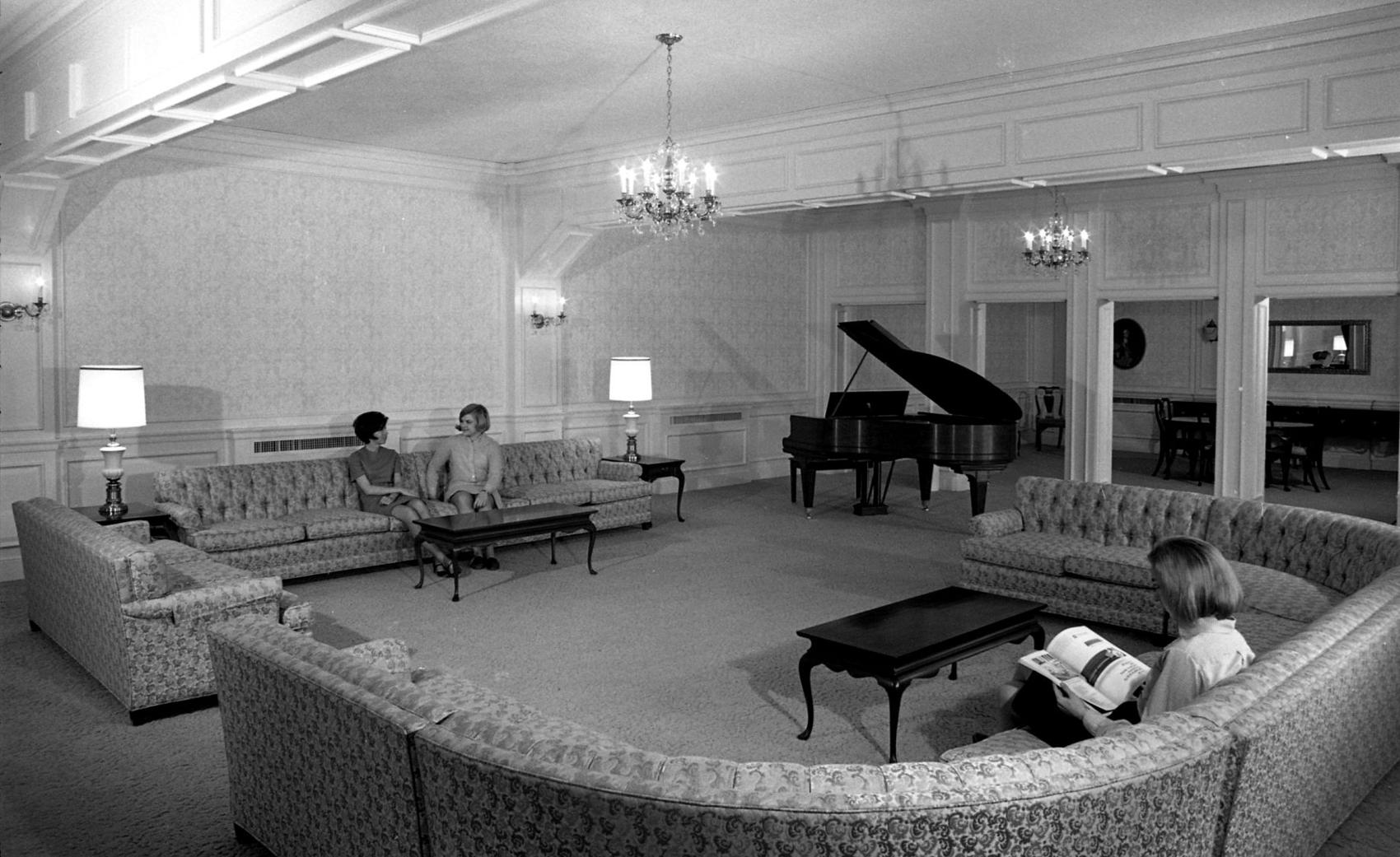
As he recalls, the attempt was made to restore it as much as possible in the classical Queen Anne style of the 19th century.
As far as its designer, the contract was won by the Phoenix firm of Lescher and Kibbey in 1918. However, there a was a problem related to the construction so the Tucson firm of Lyman and Place became supervising architects, Gilmore said.
An extension of that myth is the story of Rufus B. von KleinSmid, who replaced Wilde as president.
Between 1919-1921 at a cost of some $174,187, construction began on the original two-story presidential residence. By 1921, a third floor was added.
It was said that for reasons known only to von KleinSmid, he never moved into the residence.
Most of that is true, construction did begin and end under KleinSmid, but again, it was never meant to be a presidential mansion.
THE MYTH OF THE DUEL IN THE DESERT
According to the website, uofamystery.com, von KleinSmid refused to set foot in the mansion after an experience he would never talk about.
The website alleges two unsubstantiated and unverifiable incidents based on lore, including one before the university was even realized, that may shed some light:
In the 1860s, a bitter rivalry between two dance hall entrepreneurs escalated at a meeting of the Tucson Vigilante Committee in downtown Tucson.
It is said the two women took their horse-drawn wagons and bolted out of town and headed east to the open desert.
The duel in the desert was fatal for one of the women, who was said to have cursed her nemesis as well as the desert area where she lay dying.
It turns out, the altercation took place on what became UA property.
Fast forward to 1919 when it was said a UA student who was engaged, found her fiancé in a compromising position.
Despondent, the woman found her way to the president’s mansion still under construction and was discovered hanging from one of the bathroom ceiling gas pipes on the drafty second floor.
THE PAST SET IN PRESENT DAY
With the passing of time, a lot of historical facts have been misinterpreted, or at the very least, have been embellished probably because it made for a better story.
So, as you can imagine, the UA officially does not comment on stories regarding haunted buildings.
Today, Maricopa Hall, which is located in the historic district on campus just northwest of Old Main at 1031 E. James E. Rogers Way, continues to be the only all-women residence.
Until recently it had sleeping porches for the students but they have been converted so students can now sleep in their own rooms.
Other upgrades have been recently implemented and include new furniture in all of the student rooms plus new flooring, carpeting and light fixtures.
Regardless of its alleged past, the structure remains an elegant piece of architecture with its spacious entryway, its elegant Queen Anne style furniture and a grand piano that still adorns the main salon.