
• Various studies cite the origin of mariachi in the 18th century, although a few claim that it could go back to the 16th century.
• Most musicologists agree that mariachi emerged in Cocula, Jalisco, as a form of adoration of the natives to the Virgin of the Pila. The natives tried to imitate the sounds of the Spanish friars who evangelized them through music.
• Other research says that mariachi emerged in a wide region comprised of the Mexican western states of Jalisco, Michoacán, Colima, Nayarit and some parts of Aguascalientes and Zacatecas in north-central Mexico.
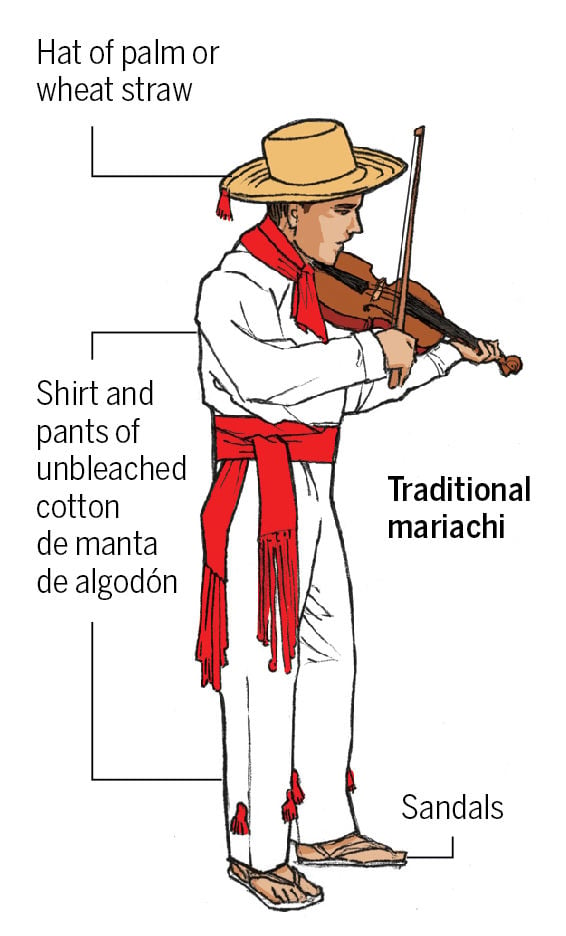
• Until the end of the 19th century, the traditional mariachi was associated with dances in popular and rural festivals, despised by the aristocracy of Mexico which was fascinated at that time with the French and European culture in general.
• The first famous performance of a mariachi among the upper class occurred on a birthday of President Porfirio Díaz in 1905. Two years later, Díaz invited them to play at a party in honor of Elihu Root, secretary of state of the United States, who was visiting Mexico.
• From there, and after the Mexican Revolution, mariachi music arrived in the Mexican capital with widespread acceptance. One of the first famous groups was Mariachi de José and Cirilo Marmolejo.
• In 1936, Lázaro Cárdenas took Mariachi Vargas de Tecalitlán (created by Gaspar Vargas in 1898) with him on a tour of the country as a candidate for the presidency of Mexico. His intention was to unite the country and give strength to the rural sector. It set off a mariachi boom.
• The first recording of a mariachi was that of Concepción "Concho" Andrade and Pablo Becerra, made in Chicago in 1903.