

Skip to main contentSkip to main content
Register for more free articles.
Log in Sign up
Back to homepage
Subscriber Login
Keep reading with a digital access subscription.
Subscribe now
You have permission to edit this collection.
Edit
Arizona Daily Star
74°
  • Sign in
  • Subscribe Now
  • Manage account
  • Logout
    • Manage account
    • e-Newspaper
    • Logout
  • News
    • Sign up for newsletters
    • Local
    • Arizona
    • Business
    • Crime
    • Nation & World
    • Markets & Stocks
    • SaddleBrooke
    • Politics
    • Archives
    • News Tip
  • Arizona Daily Star
    • E-edition
    • E-edition-Tutorial
    • Archives
    • Special Sections
    • Merchandise
    • Circulars
    • Public Notices
    • Readers' Choice Awards
    • Buyer's Edge
  • Obituaries
    • Share Your Story
    • Recent Obituaries
    • Find an Obituary
  • Opinion
    • Submit a Letter
    • Submit guest opinion
    • Letters to the Editor
    • Opinion & Editorials
    • National Columnists
  • Sports
    • Arizona Wildcats
    • Greg Hansen
    • High Schools
    • Roadrunners
  • Lifestyles
    • Events Calendar
    • Arts & Theatre
    • Food & Cooking
    • Movies & TV
    • Movie Listings
    • Music
    • Comics
    • Games
    • Columns
    • Play
    • Home & Gardening
    • Health
    • Get Healthy
    • Parenting
    • Fashion
    • People
    • Pets
    • Travel
    • Faith
    • Retro Tucson
    • History
    • Travel
    • Outdoors & Rec
    • Community Pages
  • Brand Ave. Studios
  • Join the community
    • News tip
    • Share video
  • Buy & Sell
    • Place an Ad
    • Shop Local
    • Jobs
    • Homes
    • Freedom RV AZ
    • Marketplace
    • I Love A Deal
  • Shopping
  • Customer Service
    • Manage My Account
    • Newsletter Sign-Up
    • Subscribe
    • Contact us
  • Mobile Apps
  • Weather: Live Radar
  • Facebook
  • Twitter
  • Bluesky
  • YouTube
  • Pinterest
  • Instagram
© 2026 Lee Enterprises
Terms of Service | Privacy Policy
Arizona Daily Star
News+
Read Today's E-edition
Arizona Daily Star
News+
  • Log In
  • $1 for 3 months
    Subscribe Now
    • Manage account
    • e-Newspaper
    • Logout
  • E-edition
  • News
  • Obituaries
  • Opinion
  • Wildcats
  • Lifestyles
  • Newsletters
  • Comics & Puzzles
  • Buyer's Edge
  • Jobs
  • Freedom RV AZ
  • 74° Clear
Share This
  • Facebook
  • Twitter
  • Bluesky
  • WhatsApp
  • SMS
  • Email

Live

The Latest: Iran threatens UAE ports as war enters its third week

Macho B: death of a rare Arizona jaguar

  • Jun 22, 2010
  • Jun 22, 2010 Updated Mar 2, 2017

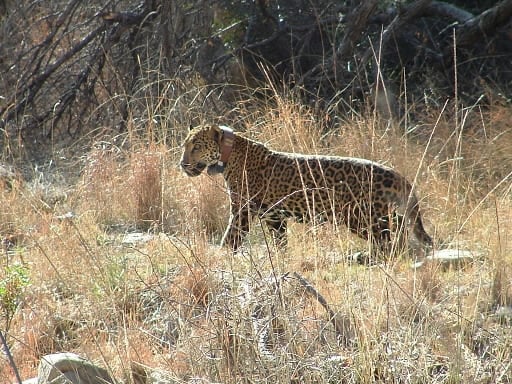
Macho B was the only known wild jaguar in the United States. State game workers twice captured and eventually euthanized the big cat. Much of the official story about their actions fell apart under the Star's scrutiny.

G&F woes preceded jaguar capture

In page after page of testimony, Arizona Game and Fish Department officials portrayed jaguar researcher Emil McCain as a man who manipulated, "played" and led them down a primrose path toward the capture of jaguar Macho B that ended in tragedy.

But in the same testimony, the officials portrayed their department as one that was able to be played because it was plagued by internal problems, personality conflicts and poor communication.

The transcripts show the department failed to deal with the possibility that placing traps in an area frequented by a rare jaguar might result in the cat's capture - a capture that would be risky to the animal's health and possibly illegal under the Endangered Species Act.

These portraits emerge from more than 1,900 pages of transcripts from Game and Fish's internal investigation of the 2009 capture of the last wild jaguar known to live in the United States. The jaguar was euthanized 12 days later.

The investigation won't end until the federal government finishes its criminal investigation of the incident. The Game and Fish Department has put on its website edited versions of the transcripts in response to a public-records request from the Arizona Daily Star.

McCain is described in the transcripts as a personable and knowledgeable naturalist and an effective lion trapper. But he is also described as an egotistical and secretive person who used his knowledge to advance his long-held agenda of getting Macho B collared. McCain has refused all interview requests since March 2009.

McCain was working as a subcontractor to Game and Fish in late 2008, placing snares to catch mountain lions and bears for a state study of those animals' movements near the border.

He knew, as a researcher with the Borderlands Jaguar Detection Project, that Macho B had been photographed in that area. But he selectively gave different officials incomplete pieces of information about where the snares were placed compared to where the jaguar had been photographed, transcripts show.

Game and Fish officials testified McCain didn't tell them that photos had been taken of the jaguar near some of the bear-lion snares five weeks before the Feb. 18 capture, leaving them unaware of the big picture.

Had she known the whole story, she would have ordered the snares removed, testified Chantal "Chasa" O'Brien, the department's research chief. "I think Terry Johnson (the department's endangered species chief) would have written back with why the hell are you trapping (there) for bears and lions?" added Bill Van Pelt, its nongame birds and mammals program manager.

Originally, officials called the Macho B capture accidental. But Van Pelt and Johnson testified that summer that they believed the capture was intentional and suspected McCain as a ringleader - nearly a year before McCain pleaded guilty to violating the Endangered Species Act for his role in the capture. "Emil has been tracking that animal for years now," Van Pelt testified. "And if anyone knew that animal's movement patterns, location of the animal, Emil McCain knew that."

The department itself has maintained from the start that it didn't direct anyone to capture the jaguar and that it had a valid permit for either an accidental or a deliberate capture. But McCain's guilty plea said there was "no authorization to intentionally capture a jaguar," and courts will probably have to settle the question of the capture's legality.

While the collared jaguar was in the wild, Game and Fish officials Van Pelt and Johnson testified, McCain had as much or more control over managing Macho B as they did. For instance, McCain delayed for several days plans to go back into the wild to check out the jaguar after Game and Fish officials first suspected Macho B was ailing.

Game officials also gave McCain and a colleague control over radio data indicating Macho B's movements, so the state agency wouldn't have to release it to the public under the State Public Records Act, officials testified. That left agency officials in the dark about Macho B's whereabouts if they couldn't reach McCain or his colleague Jack Childs, both of the Borderlands Jaguar Detection Project.

But while denying illegality or other wrongdoing, many department officials also found fault in their actions leading up to Macho B's capture. Some examples:

Personality conflicts

At the center of this problem was Terry Johnson, head of its endangered species program. Large cat biologist Ron Thompson testified on Jan. 6, 2010 that he never considered trying to talk with Johnson about the bear-lion study because, "I've taken a tongue lashing from him more than once. So you know, I've kind of just decided not to walk into his office anymore. . .

"I respect Terry for his knowledge. He's forgotten more than I know, but his . . . he's never viewed my comments as you know, an effort to help any situation," said Thompson, who retired in November 2010.

Johnson acknowledged in his July 9, 2009, testimony that "a rotten relationship between me and Bruce Taubert," another Game and Fish official, led to a halt in meetings in which people from various programs in the department would discuss issues in common. Such meetings could have alerted officials about the jaguar's presence in the area of the lion-bear study. Taubert was assistant director of the department's wildlife management division. He retired in 2006.

Johnson said he didn't even learn about the jaguar capture until the day after it happened, and didn't learn about it from his own staff.

In another example of poor communication, research branch chief O'Brien testified that the biologist in charge of the bear-lion study, Kirby Bristow, didn't talk to her much about it, although O'Brien was his supervisor.

no focus on jaguars

Some staffers weren't interested in even talking about jaguars before the capture.

Turf was one reason. The study's organizers had originally planned to research mountain lions as surrogates for how jaguars behave. They dropped that idea after Johnson objected that spending funds on such a study would divert money from programs directly aimed at jaguars.

"It seemed odd that we hadn't been discussing . . . any more of the jaguar stuff," testified biologist Michelle Crabb, who was at the scene when the snared jaguar was spotted. "I think it was just kind of an air that is just not something you talk about . . . it just wasn't something you wanted to acknowledge."

Lack of training

O'Brien testified she had no formal training on the Endangered Species Act and no understanding of its permitting requirements.

No environmental analysis

Officials failed to conduct what should have been a routine environmental analysis of the bear-lion study, which could have altered the project's research methods, Bristow said.

Insufficient protocols

Protocols outlining procedures department biologists would use to handle a captured jaguar were "crappy," said endangered species chief Johnson.

The transcripts also showed remorse among some officials about how the capture turned out or could have been prevented.

Biologist Thompson testified on Aug. 14, 2009, "I mean at some point in time, someone should have acted and we didn't. And I just don't know what part my role was or was not in that. It still bothers me."

On Jan. 6, 2010, he added, "Everybody is remorseful about this thing."

Biologist Bristow testified on Aug. 10, 2009, that he felt a jaguar capture's probability was so low, "it wasn't worth worrying about. It turns out it wasn't as low as we thought."

The story so far

The jaguar known by researchers as Macho B - this country's last known wild jaguar - was captured Feb. 18, 2009, in Santa Cruz County, three miles north of the Mexican border. There were signs - including deep grooves he cut with his paws - that the aged cat struggled in the snare trap before game officials found him.

Macho B was radio-collared and released back into the wild. He roamed before slowing down enough that the Arizona Game and Fish Department recaptured him and had him euthanized March 2 due to what it said was kidney failure.

At first, authorities called the initial capture accidental, occurring during a study of black bear and mountain lion movements. But a few weeks later, research technician Janay Brun told the Arizona Daily Star that she had placed jaguar scat at the trap site two weeks before the capture on orders from Emil McCain, a longtime jaguar researcher. That sparked federal and state investigations.

Investigators have still not said how much, if at all, the initial capture led to Macho B's decline, and courts have not decided if the capture was legal. But McCain pleaded guilty last May to violating the Endangered Species Act for telling Brun to lay down the scat - which could lure a jaguar.

Brun faces an April 12 federal court trial on charges of Endangered Species Act violations.

Arizona Game and Fish biologist Thorry Smith, who was at the scene when the scat was placed and when Macho B was first captured, was fired in 2010 for lying to federal investigators about the capture.

Contact reporter Tony Davis at tdavis@azstarnet.com or 806-7746.
Researcher's status questioned in jaguar case

A researcher who later pleaded guilty to a federal crime in the trapping of jaguar Macho B was working for Arizona Game and Fish at the time of the capture, a state biologist has testified.

Transcripts show that Game and Fish Department biologist Kirby Bristow's 2009 testimony differs markedly from statements made last year by department officials that researcher Emil McCain wasn't working for their agency at the time of the Feb. 18, 2009 capture.

McCain, now 32, of Patagonia, pleaded guilty last May to capturing the jaguar in violation of the U.S. Endangered Species Act. He admitted ordering another researcher to put jaguar scat at the snare site where Macho B was ultimately captured. Jaguars use scents to communicate, and female jaguar feces may attract male jaguars.

McCain was fined $1,000 and put on five years' probation, during which he is forbidden from working on large cat research in the United States.

Bristow ran the research project during which the jaguar was captured, studying black bears and mountain lions near the Mexican border. McCain had worked for that project as a subcontractor in fall 2008; In February 2009 he was back at the scene of the study, opening snares hoping to catch more lions.

The question is: for whom?

Bristow testified twice during an internal Game and Fish investigation of Macho B's capture that in February 2009, McCain was working for the bear-lion project and would have received money from the department under certain conditions. A Game and Fish spokesman, however, said recently that despite Bristow's testimony, there was no contract or agreement between McCain and the department during February 2009.

"We maintain steadfastly that Emil wasn't an agent or working for Game and Fish. That's a statement we would raise our right hand and go before a judge with," Game and Fish spokesman Jim Paxon said.

Paxon said McCain - who has not talked to the press about the jaguar capture since March 31, 2009 - was working for a nonprofit research team, the Borderlands Jaguar Detection Project, at the time of the capture.

McCain's relationship with Game and Fish during the capture has been an issue twice. Last year, the U.S. Interior Department Inspector General's Office wrote a report saying that a "Game and Fish subcontractor" - who wasn't named but matched McCain's description - was under criminal investigation for his role in the capture. In April, Janay Brun, a research technician who at McCain's direction put jaguar scat at the site where Macho B was later captured, will defend herself against criminal charges in part by arguing that she was acting under orders from an agent of the state - again, McCain.

Bristow was one of 16 Game and Fish officials to testify in 2009 and early 2010 in the department's Macho B investigation.

In his testimony, another Game and Fish official, large cat biologist Ron Thompson, who helped McCain get his original subcontract with the state on the bear-lion study, echoed Game and Fish administrators' account that no new contract was signed for McCain.

But Thompson made two other statements in his interviews that suggested McCain was tied to Game and Fish at the time of capture. On July 14, 2009, Thompson testified he told McCain he had an obligation to testify in the state investigation because "as a contractor, he took our money, okay and . . . there are unanswered questions and that kind of thing that he needed ... to be available for." McCain did not testify.

Thompson also recalled that he made inquiries to other Game and Fish officials, at McCain's request, to see if McCain, as a state subcontractor, would be covered under some kind of liability clause with the state for his actions in connection with the jaguar capture.

Thompson said he could never get an answer. He said he warned McCain, "Don't ever think that the state can provide you a lawyer if this thing came down. You need to go get the best person you can get."

Thompson retired in November. "It is not appropriate for us at this time to publicly attempt to interpret or speculate about statements in the transcripts, given that the Janay Brun case is in litigation," department spokesman Tom Cadden, said.

The state probe started after a federal criminal investigation of the capture had begun. Neither investigation is finished.

Game and Fish released the transcripts with some redactions after the Arizona Daily Star requested them under the state Public Records Act.

Macho B - the last jaguar known to live in the wild in the United States - was captured in a Game and Fish snare trap north of the Mexican border and west of Nogales. The capture occurred close to an area where the jaguar had previously been photographed by the Borderlands Jaguar Detection Project, the group McCain helped lead.

The jaguar was collared and released back to the wild.

Game and Fish officials denied the department had any intent to capture the jaguar, although they later fired a department biologist, Thorry Smith, for what they said was lying to federal officials about Smith's role in the capture.

Smith, McCain and Brun, an employee of the nonprofit group, were all at the scene Feb. 4, 2009, when the snare where Macho B was ultimately captured was opened and jaguar scat was placed there.

The state recaptured Macho B soon after he was released, when the radio collar showed his movements slowing dramatically in the wild. The jaguar was then euthanized March 2, 2009, at the Phoenix Zoo.

An attorney representing Brun, Michael Piccarreta, said he will present evidence at trial showing that it was at the Game and Fish Department's request that McCain was opening snares in February 2009 in the area where Macho B was later captured.

"The state has ultimate accountability" for the capture, said Piccarreta.

Brun will go on trial in April in U.S. District Court here on charges of violating the Endangered Species Act.

Contact reporter Tony Davis at tdavis@azstarnet.com or 806-7746.

Dropping 1 Macho B count advised

A federal magistrate says one of two criminal charges filed against jaguar-capture whistle-blower Janay Brun should be dropped, although the charge could be filed again.

Magistrate Thomas Ferraro also said this week that a valid permit existed to capture jaguar Macho B nearly two years ago. But he said that it will take a jury trial to determine if Brun's activities were legally covered by the permit.

Recommended for dismissal was a conspiracy charge alleging that Brun "knowingly and intentionally conspired to harass, harm, pursue, trap, capture and collect without lawful permit a jaguar" in violation of the Endangered Species Act.

Brun also is charged with attempting to "take" a jaguar - a legal term meaning harass, harm, pursue, trap, capture and collect - in violation of that federal law. She's scheduled to go on trial in federal court on April 12.

Ferraro wrote Monday that prosecutors failed to properly allege a conspiracy by Brun, whose attorney had moved to dismiss both charges. A conspiracy charge is an accusation of conspiring to commit an overt act. Brun isn't accused of committing such an act - only of attempting to commit one. But the magistrate urged that the charge be dismissed without prejudice, giving the U.S. Attorney's Office a crack at refiling the charge.

Brun, a private research technician, brought to light the deliberate capture of the last jaguar known to live in the wild in the United States. She told the Arizona Daily Star in 2009 that she had placed female jaguar scat at the snare trap site two weeks before Macho B was captured there on Feb. 18, 2009, north of the U.S.-Mexican border.

Emil McCain, a private biologist and jaguar researcher, pleaded guilty last May to illegal take of an endangered species. He admitted ordering a female - he didn't say whom - to put scat at the trap site.

McCain acknowledged not having a valid permit, but Brun's attorney, Michael Piccarreta, has argued that his client was covered by such a permit.

The Arizona Game and Fish Department had a permit agreement with the U.S. Fish and Wildlife Service, Magistrate Ferraro determined. Piccarreta will argue that Brun was operating under orders from McCain and that McCain, as a subcontractor to Game and Fish, was an agent of the state during the capture. The state denies McCain worked for it at the time.

In his recommendation, Ferraro urged the judge who will handle this case, U.S. District Judge Cindy Jorgenson, to find there was a "relevant permit in effect" during the capture. The permit terms require that a capture of an endangered species have a conservation purpose and that the capture is not reasonably anticipated to result in death or permanent disabling of the animal.

The prosecutors have argued that Brun's activities didn't meet those terms because Macho B died 12 days after its initial capture.

"I can't think of anyone who would say it wasn't for conservation purposes," Piccarreta countered. "If it's not for conservation, you would have to have an alternate theory, such as the jaguar was captured for his pelt."

Both sides have two weeks to object to Ferraro's recommendations. Jorgenson can accept or reject the magistrate's findings.

Piccarreta said it's likely he will not object to the recommendations, although he argues that the entire case should be thrown out.

U.S. Attorney's Office spokesman Manny Tarango said: "The case is progressing like we expected. No way is this case dismissed. We are looking forward to the April 12th trial."

Contact reporter Tony Davis at tdavis@azstarnet.com or 806-7746.

Game and Fish large cat guy's comments on scat match Brun's attorney's line

Sunday's Star ran a story about a legal brief filed by the attorney for jaguar whistleblower Janay Brun that asserted that her admitted use of jaguar scat on Feb. 4, 2009 likely played no role in luring him into the trap two weeks later.

Read through what I'd like to informally call "The Jaguar Papers," and you'll come across one large cat expert's opinion who matches Brun's attorney Michael Piccarreta's views to a T. Ron Thompson, a longtime cat biologist for the Arizona Game and Fish Department, was one of 16 Game and Fish staffers interviewed back in 2009 and early 2010 for a department internal investigation of the capture. The investigation isn't done.

Authorities are waiting for the feds to end their criminal investigation of the same event. Under that investigation, Brun has been charged with two violations of the federal Endangered Species Act. Her trial is April 4. Her cohort and apparent mentor at the scene where the scat was placed, jaguar camera researcher Emil McCain, has pleaded guilty to an ESA violation.

But Game and Fish has posted on its website redacted transcripts of all the interviews in response to the Star's public records request for them.

On page 14 of Thompson's first interview, on July 14, 2009, the biologist was asked by his interviewer "how does that (Brun's) allegation about sound to you from the standpoint from someone experienced in catching big cats?"

The technique of using scat to attract an animal has not been proven scientifically, Thompson replied.

"There has been no, to the best of my knowledge, there has been no study to where they have had cameras and put scat and then they have had other cameras, random camera settings without scat to see if it -- if one detection, use of scat, would result in a higher detection rate or draw to the animal," said Thompson, who by the way helped recruit jaguar biologist Emil McCain to work for the department snaring lions in the bear-lion study in which Macho B was captured nearly two years ago.

Thompson uses the scat on mountain lions because once a lion reaches Thompson's snare site, "I just want them to visually see a scat laying there, because mountain lions do have scat stations. They are usually big ole tall pine trees, for instance, where two canyons come together. They spray it. They leave their scat. So their scent and it's a visual thing too," the biologist testified.

But jaguars don't use scat stations, Thompson continued.

"You know, I have been all over jaguar country in Mexico and we have never found a scat station," Thompson said.

He said that 200 lab samples collected from Mexico and the borderlands region up here had been touted as jaguar scats but turned out not to be when finally analyzed at a University of Arizona lab.

"And with that, for me, therefore, I would discount the use of scat to attract jaguars, that alone, just the fact that there are no scat stations. I just, quite frankly, I don't see where it's that valid."

Emil McCain, who used jaguar scat both at camera and snare sites, felt that the use of scat would give him and his fellow jag researchers a better chance of landing a jaguar photo, Thompson said.

"It's just never been proven . . . Emil perceived it. He just wouldn't believe it. He wouldn't believe the science that he failed to collect a jaguar scat."

In fact, Thompson went on to say that day that he had personally "just flat asked" McCain if the use of scat increased detection rates on his cameras.

"And he said no," Thompson said of McCain, who has declined all requests for interviews from the Star since Brun first told the paper back in March 2009 that McCain had ordered her to place female jaguar scat at the site where Macho B was eventually trapped. "He said the data, the limited data he's got since 2004 indicates it does not increase detection rates."

Defense: Scat wasn't factor in jaguar-snaring

When research technician Janay Brun admitted in 2009 to leaving jaguar scat at the site where jaguar Macho B was later captured, she said she felt she had helped cause the big cat's eventual death.

Jaguars and other cats use scents as a way to communicate, and female jaguar feces may attract male jaguars, experts have said.

"That jaguar meant a lot to me, and the fact that I mindlessly participated in this - it's a regret I'll have for the rest of my life," Brun said in a March 2009 interview with the Arizona Daily Star.

But today, facing criminal charges, Brun is saying quite the opposite through her attorney: that her placement of the jaguar scat likely didn't play much of a role in leading the aged jaguar into a snare trap.

Brun has been charged by federal prosecutors with illegally "taking" a jaguar and conspiracy to take a jaguar, in violation of the Endangered Species Act. She is scheduled for trial April 4.

Last jaguar in U.S. wild

Macho B was the last jaguar known to live in the wild in the United States. Early in 2009 he had been photographed south of Arivaca, near the Mexican border, by remote cameras run by the Borderlands Jaguar Detection Project, a nonprofit organization for which Brun and researcher Emil McCain worked.

On Feb. 4 that year, Arizona Game and Fish Department biologist Thorry Smith and McCain, who had worked as a subcontractor for the department, opened snares in the area. They were trying to capture black bears and mountain lions for a state study of those species' movements near the border.

At the same time - at McCain's request - Brun placed jaguar scat near the camera sites, her defense attorney, Michael Piccarreta, wrote in his motion to dismiss the charges against her, which is pending before a federal magistrate.

Macho B was captured in one of the snares Feb. 18, 2009, collared and released. Game and Fish Department officials said the capture was inadvertent.

But the state soon recaptured the jaguar - because the radio collar showed his movements in the wild were dramatically slowing down - and he was euthanized, dying at the Phoenix Zoo on March 2, 2009.

In his motion to dismiss Brun's charges, Piccarreta wrote that it was the opening of the snares that led directly to Macho B's original capture - not Brun's placement of the jaguar scat.

"Ms. Brun did not believe, as do many in the scientific community, that the placement of the scat would, in fact, attract a jaguar to the camera location," Piccarreta wrote. "It was thought that if the jaguar were in the location, it might notice the scat and slow its travel allowing for a better picture, although the scientific basis was uncertain."

In reply, the U.S. Attorney's Office argued this month that issues such as the scat's effect on the capture are not relevant to the motion to dismiss and must be decided by a jury when Brun goes to trial.

"She is being charged with attempting to take an endangered species," said the U.S. attorney's response to the motion to dismiss. "The act of placing scat at a snare site in and of itself is an attempt to take an endangered species."

Feels responsible

At a federal court hearing last week on the motion to dismiss, Piccarreta said Brun still feels a sense of responsibility for what happened to the jaguar, but legally isn't responsible.

"She feels responsible by being in those events, and relying on McCain and Game and Fish that everything out there was kosher," Piccarreta said.

McCain pleaded guilty last May to capturing the jaguar in violation of the U.S. Endangered Species Act.

Brun, paid $700 to $800 a month by the nonprofit jaguar detection project, played no role in placing the snares or in any other part of Game and Fish's study of bears and lions for which the snares were placed, Piccarreta wrote. "Her duties related solely to the ... cameras."

At the time Brun gave her 2009 interview to the Star, McCain and others said Jaguar Detection Project workers had in the past used female jaguar scat to attract jaguars. In 2004, project workers began placing scat at locations of motion-sensing cameras where they were attempting to photograph jaguars, two former volunteers said.

But in his motion to dismiss Brun's charges, Piccarreta wrote that many research biologists conclude that scat is not an attractant that should be used at snare sites. Indeed, there is no evidence that the scat caused Macho B's capture, or that he had any interest in the scat, Piccarreta wrote.

The jaguar had walked directly through another snare location that had no scat shortly before his capture, but that snare didn't snag the animal because humans had tampered with it, Piccarreta wrote.

It was the decision to use the snares, "not the scat, that captured Macho B, a decision way above Ms. Brun's pay grade but well within numerous other state officials and possibly federal officials' purview," the defense attorney said.

Contact reporter Tony Davis at tdavis@azstarnet.com or 806-7746.

Lawyers argue over motion in Macho B case

Attorneys argued in federal court Wednesday over whether the legality of jaguar Macho B's capture is a question of fact or law.

The dispute is whether settling the capture's legality requires a jury to sort the facts, or if it's a matter of law, for a judge to decide.

The arguments pertain to a motion to dismiss criminal charges against research technician Janay Brun.

After questioning lawyers for Brun and the U.S. Attorney's Office, Federal Magistrate Thomas Ferraro said he would rule later on whether to dismiss two charges against Brun in the February 2009 capture of this country's last known wild jaguar.

Brun has admitted placing female jaguar scat in early February 2009 where a snare trap corralled Macho B two weeks later, but has denied violating the U.S. Endangered Species Act.

"If I can find as a matter of law a permit was issued" authorizing the capture, "ergo, no matter what happened after that, the facts would not support a criminal charge," Ferraro told Michael Piccarreta, Brun's attorney. "Let's assume I agreed with your analysis of these facts. ... My problem is that unless there is an issue of a matter of law, I am constrained."

Piccarreta has argued that the U.S. Fish and Wildlife Service issued the Arizona Game and Fish Department a permit to capture endangered species that covered jaguars.

"If there is a valid permit permitting snaring, there can't be prosecution," he told Ferraro. "The judge has to decide whether the permit authorized Game and Fish to snare trap Macho B."

"I'm not asking you to rule on facts of the cases; when they go to trial we will prove each in spades. If you rule that the state, its employees and agents are permitted to trap an endangered species - if that's true, judge ... their (prosecutors') case is effectively done," Piccarreta said.

Assistant U.S. Attorney Ryan DeJoe said Piccarreta is asking Ferraro to step into a jury's role - which he said is forbidden by court precedent.

Whether a valid permit was issued is a factual question, DeJoe said, since the species covered are listed and the government's rights are spelled out in the permit.

The permit said a Game and Fish employee or agent may in the course of official duties take a protected species "for conservation purposes consistent with the Endangered Species Act" and with a related state-federal agreement, assuming this action is not reasonably anticipated to result in the animal's death, DeJoe said.

"Take that clause in its entirety, and there cannot be a legal determination that Game and Fish had authority to take a jaguar," DeJoe said.

Contact reporter Tony Davis at tdavis@azstarnet.com or 806-7746.

Janay Brun lawyer: Government's permit case 'borders on the absurd'

In a reply to the U.S. government charge that the capture of jaguar Macho B lacked a permit, attorney Michael Piccarreta blasted the argument advanced by federal prosecutors to make their case. His reply was filed late yesterday, or Monday.

In a brief filed Jan. 7, prosecutors said that any capture or "take" of Macho B would have been in violation of the State Game and Fish Department's permit to capture endangered species. That's because the purpose of the permit and the various state-federal agreements that went with it was to conserve and protect wildlife.

"Macho B's deteriorating health and euthanization after the take and subsequent release evidences that his take would not have served these ends and therefore would have been outside the scope of the permit," the U.S. attorney's office statement said.

But the legality of Macho B's capture is shown by the lack of prosecution of state or federal officials for their role in the jaguar capture, Piccarreta wrote in his response to the government's reply. He pointed specifically to the government's actions regarding placement and opening of the snare trap that corralled Macho B, or its decisions to radio-collar, release and recapture the animal.

"If the government truly believed there were no permits in effect regarding Macho B, numerous individuals employed by AZGFD and/or the U.S. Fish and Wildlife Service would similarly face prosecution rather than just the whistleblower who disclosed the truth relating to the underlying events."

The tragic fact that things ended badly for Macho B, or that the state and federal governments may not have handled the capture properly, doesn't mean his capture wasn't legal under the state permit and a cooperative endangered species agreement between the state and feds, Piccarreta argued.

"Members of the AZGFD snare project who had seen Macho B's pictures and were aware of his presence in the area believed that he looked healthy and believed that much important scientific information could be gained from his capture and collaring," Piccarreta wrote. "This is by no means meant to excuse, condone or rationalize the actions of individuals working on the AZGFD snare project, as Ms. Brun had nothing to do with AZGFD's snare project."

The hearing on this case before Federal Magistrate Thomas Ferraro starts 9 a.m. -tomorrow, or Wednesday, at the Evo DeConcini Federal Courthouse on 405 W. Congress St. Ferraro's courtroom is on the sixth floor.

Tech's defense: There was valid permit to take jaguar Macho B

The legality of jaguar Macho B's capture in 2009 is at the heart of a legal dispute over whether charges should be dismissed against a research technician accused of playing a part in snaring the animal.

This week, a federal magistrate will hear defendant Janay Brun's attorney argue that a valid permit existed for the capture and provides "an absolute defense" against the criminal charges she is facing. Defense attorney Michael Piccarreta has filed a motion to dismiss the charges against Brun.

Federal prosecutors, however, are saying there was no legal authority for anyone to capture Macho B - not even state or federal biologists, let alone Brun, who worked independently. Their statement, contained in a Jan. 7 response to Piccarreta's motion, is the first time prosecutors have said explicitly that no valid permit existed for the capture of Macho B, the last jaguar known to live in the wild in the United States.

Prosecutors have accused Brun of illegal "take" of an endangered species and conspiracy to "take" an endangered species. Under federal law, take means to kill, shoot, harm or harass an endangered animal or plant, among other actions. Brun has admitted placing jaguar scat at the Southern Arizona site of the snare trap where Macho B was captured Feb. 18, 2009.

The motion to dismiss the charges against Brun will be argued Wednesday before Federal Magistrate Thomas Ferraro. Brun's trial, repeatedly delayed, is scheduled to start on April 4 in front of U.S. District Judge Cindy Jorgenson.

The question of a permit for the Macho B capture - in essence, the question of whether the capture was legal - has bounced back and forth among state and federal officials and environmental groups since the animal was euthanized March 2, 2009.

That happened 12 days after Arizona Game and Fish Department biologists found the 15-year-old animal caught in a snare trap in an oak woodland canyon near the Mexican border south of Arivaca. The animal was then radio-collared, released into the wild and 12 days later recaptured, hours before it was put to sleep, after its movements in the wild slowed dramatically.

In an interview with the Star in late March 2009, Brun admitted putting the scat at the site where Macho B was captured, saying she did so on orders from her supervisor, biologist and jaguar expert Emil McCain. McCain denied the charges for more than a year until admitting them and pleading guilty in May 2010 to violating the U.S. Endangered Species Act in connection with the jaguar capture.

Last month, Piccarreta wrote in his request for dismissal of Brun's charges that a series of state-federal agreements plus an actual written permit authorized intentional or accidental capture of a jaguar. Among them:

• A 1985 cooperative agreement between the U.S. Fish and Wildlife Service and Game and Fish to develop species conservation programs and projects.

• A 2008-09 work plan saying that a designated Game and Fish employee or agent may take federally protected wildlife for conservation purposes. Piccarreta wrote that McCain was working for Game and Fish during the jaguar capture, which Game and Fish has denied.

• A 2007 federal permit says that a designated Game and Fish employee or agent may take endangered species for conservation purposes consistent with the species act.

• The federal government's Macho B criminal investigative report contains numerous statements from Game and Fish and Wildlife Service officials saying that Game and Fish had a valid permit, Piccarreta wrote. He cited statements from eight state and federal officials interviewed in that investigation.

"None of these … officials ever indicated at anytime that any additional authority of permits … would be required for the lawful capture and collaring of Macho B," Piccarreta wrote.

But in their response, prosecutors argued that Brun's placement of the scat was not authorized by the state or federal government or covered by a permit or agreement. That's because a take of Macho B would not be consistent with the permit's and the state-federal endangered species agreement's purposes to conserve and protect wildlife, the prosecutors said.

"Macho B's deteriorating health and euthanization after the take and subsequent release evidences that his take would not have served these ends," prosecutors wrote.

Shortly after Macho B's death, Arizona Game and Fish and U.S. Fish and Wildlife Service officials said they believed such a permit existed. But the Center for Biological Diversity sued Game and Fish to make sure that no future jaguar captures occurred without a more detailed permit.

In its report on the Macho B case about a year ago, the U.S. Interior Department Inspector General's Office said there was no valid permit. When biologist McCain pleaded guilty to illegal capture of an endangered species in May 2010, he admitted he had no valid jaguar capture permit.

In June 2010, a Fish and Wildlife Service official said the criminal investigation of the Macho B capture revealed unanswered questions about whether it was covered by a valid permit. The service granted Game and Fish a new permit that month, spelling out that future jaguar captures are allowed under certain conditions.

Then, the Center for Biological Diversity dropped its lawsuit against Game and Fish in July 2010 on the grounds that the new permit made irrelevant the question of whether the state had previously had such a permit.

That dismissal "speaks volumes" about whether Game and Fish had the proper permit for Macho B, Jim Paxon, a Game and Fish spokesman, said last week.

"We have maintained all along that we have the appropriate permits," Paxon said Thursday.

But an activist with the Center for Biological Diversity said its agreement to dismiss the suit doesn't make Game and Fish's view about the permit valid.

"It speaks for itself that Game and Fish went ahead and applied for a permit at a time when they were sued for not having had one," the center's Michael Robinson said Friday.

Contact reporter Tony Davis at tdavis@azstarnet.com or 806-7746.

Jaguar whistle-blower now faces conspiracy charge

Federal prosecutors have added another criminal charge against Janay Brun, the research technician who blew the whistle on last year's deliberate capture of jaguar Macho B.

The U.S. Attorney's Office added a charge of conspiracy to "take" a jaguar onto an earlier charge that Brun had illegally taken a jaguar in violation of the Endangered Species Act.

The change drew a protest from Brun's attorney, Michael Piccarreta. He said the new charge sends a bad message to people: " 'Cooperate with the government, but only at your own peril. If you know of some illegal acts, keep your mouth shut.'

"Who in their right mind would come forward to the government after watching what happens to Janay?" Piccarreta asked.

Wyn Hornbuckle, a spokesman for the U.S. Attorney's Office, declined to comment on Piccarreta's statements.

"We're moving forward with the prosecution. We're looking forward to litigating in court. We're not going to litigate in the paper," Hornbuckle said.

In March 2009, Brun, of Arivaca, went public by telling the Arizona Daily Star that veteran jaguar biologist Emil McCain ordered her on Feb. 4 to place jaguar scat at the location near the Mexican border in Arizona where Macho B was trapped two weeks later.

After denying Brun's charges for more than a year, McCain admitted they were true this May 14. He pleaded guilty to the same crime of illegal take that Brun is now facing. He was not charged with conspiracy.

The new charge said Brun conspired "to harass, harm, pursue, trap, capture and collect" a jaguar without a proper permit.

The maximum penalty for Endangered Species Act violators is a year in jail and a $100,000 fine.

Piccarreta said he believed the prosecutors upped the charges against Brun because she refused to accept what he said were the government's terms for a plea agreement: three years' probation, during which Brun couldn't do any large-cat research, including on jaguars, in Arizona.

Piccarreta would not provide the Star with a copy of the government's proposed plea agreement, saying it's not a public document. Hornbuckle would not comment on plea negotiations.

If a plea agreement can't be reached, Piccarreta said, he would argue in a trial that Brun is not guilty under the theory that the government is stopped from prosecuting someone if that person was taking orders from a government official.

McCain had worked as a subcontractor for the Arizona Game and Fish Department shortly before the jaguar capture, trapping mountain lions that were a stated target of the study in which Macho B was captured. While Game and Fish has said McCain was no longer its subcontractor by the time of Macho B's capture, Piccarreta said he doesn't accept that statement at face value.

He would not discuss his evidence but said McCain's words and actions during the time before the capture indicated he was working on Game and Fish matters. "We think that under the law, he will be designated as an agent of the government," Piccarreta said.

Contact reporter Tony Davis at tdavis@azstarnet.com or 806-7746.

Figure in jaguar capture pleads not guilty

The woman who first revealed the capture of the last known jaguar in the United States known as Macho B was deliberate pleaded not guilty on Thursday to federal charges that she violated the Endangered Species Act.

Janay Brun, 38, of Arivaca, was released on her own recognizance after a hearing in a federal magistrate's courtroom in Tucson. Her charges stem from a Feb. 4, 2009 incident in which Brun said she was ordered by biologist Emil McCain to place female jaguar scat at the site where Macho B was snared two weeks later.

She is charged with the illegal take of an endangered species - the charge to which McCain pleaded guilty on May 14.

"What we intend to do is to review all the government reports on this case and discuss this matter with prosecutors," said Michael Picaretta, Brun's attorney. "I want to have a complete discussion of Janay's role in bringing this matter to public attention and the benefits that happened from her cooperation."

A hearing in the case is expected later this month before Magistrate Bernardo Velasco, who approved McCain's guilty plea last week. McCain received five years' probation and was fined $1,000.

On StarNet: Read more environment-related articles at azstarnet.com/news/science/environment

2nd person charged in jaguar snaring

Janay Brun became a defendant Monday in the federal criminal case she instigated.

Prosecutors announced they have charged Brun, 38, of Arivaca, with prohibited take of a jaguar, an endangered species. It's the same charge they leveled at Brun's one-time co-worker, Emil McCain, who admitted his guilt Friday and was sentenced to five years of probation.

Brun's case is different in that it was her revelation to the Arizona Daily Star in April last year that prompted the federal criminal investigation into the capture, recapture and euthanization of the jaguar known as Macho B.

"That jaguar meant a lot to me, and the fact that I mindlessly participated in this - it's a regret I'll have for the rest of my life," she said in the April 2, 2009, article.

Brun faces a maximum of one year in prison and a $100,000 fine if convicted.

Environmentalist Michael Robinson called her treatment unjust.

"Janay should be receiving a medal for the courage to come forward and expose the intentional snaring of Macho B," said Robinson, of the Center for Biological Diversity, which has long tangled in court with state and federal officials over the protection of jaguars.

After Macho B was snared on Feb. 18, 2009, state and federal officials said the capture was the unintentional result of an effort to capture mountain lions and bears in the area between Nogales and Arivaca.

But within six weeks, Brun disclosed in an interview that she had placed the scat of a fertile female jaguar at the site where Macho B was snared. She said she had been hiking Feb. 4 with McCain and Thorry Smith of Arizona Game and Fish, checking motion-sensing cameras for McCain while he and Smith set traps for the bear and mountain lion study.

Brun accused McCain of directing her to put the scat at the eventual snare site - something McCain denied for a year before admitting it was true on Friday. After Brun's comments were published, the U.S. Fish and Wildlife Service announced it was launching a criminal investigation.

McCain was a biologist for the Borderlands Jaguar Detection Project, where Brun also worked, and he had been working as a subcontractor for Arizona Game and Fish, trapping mountain lions for the bear and mountain lion study. Smith was a wildlife technician working on the study who ended up sedating the snared jaguar and putting a tracking collar on it.

Smith told Game and Fish officials last year that after Brun's allegations came to light, he and McCain agreed to cover up the fact that scat had been placed near snare sites. Smith was fired March 19, but the information he provided Game and Fish can't be used against him in court because his cooperation was required by his superiors in the department, and he was not allowed to have an attorney present.

Tucson attorney Michael Piccarreta is defending Brun and expressed optimism Monday that he'll be able to resolve the case positively with federal prosecutors.

"Obviously, her situation is different (than McCain's) in light of the fact that she came forward voluntarily. It's clearly a fact in her favor - that she voluntarily disclosed and cooperated with the government," he said.

Contact reporter Tim Steller at 807-8427 or at tsteller@azstarnet.com

Jaguar trapper guilty

The biologist at the center of the controversy over a jaguar's capture and subsequent death last year admitted Friday in federal court that he tried to snare the animal, known as Macho B.

Emil McCain pleaded guilty to a misdemeanor crime: illegal take of an endangered species. To "take" means to knowingly harass, harm, pursue, trap or kill, in violation of the Federal Endangered Species Act, court records show.

McCain, 31, of Patagonia, was immediately sentenced to five years' probation and fined $1,000.

In the plea agreement, McCain admitted an allegation that he had previously denied - that on Feb. 4, 2009, he told a female co-worker to place jaguar scat at snare sites in an effort to lure and capture the rare jaguar.

Previously, McCain had denied directing the woman, Janay Brun, with whom he worked on the nonprofit Borderlands Jaguar Detection Project, to place scat at the snare sites and said that if she did it, it was at her own initiative.

But Friday, he admitted to placing the scat or directing a woman to place the scat at three snare trap sites in an attempt to capture Macho B, the last known wild jaguar in the United States. He also admitted that he lacked permission to intentionally capture a jaguar.

The jaguar was found in the trap two weeks later by Arizona Game and Fish Department biologists working on what was supposed to have been a study of black bears and mountain lions.

"There was no authorization to intentionally capture a jaguar," McCain wrote in his signed plea agreement.

The aging jaguar was radio-collared by Game and Fish and released, but after it slowed down in the wild, it was recaptured 12 days later and euthanized due to kidney problems.

Under McCain's probation, he cannot be employed by or involved in any large-cat or large-carnivore project or study in the Unites States during that time.

When he leaves the country, he is allowed to be on unsupervised probation. McCain has worked as a biologist in Mexico, Spain and Costa Rica.

"He is done with the federal investigation and he has taken responsibility for whatever part he has in it," said his Tucson attorney, Alfred Donau III.

Encountered Friday afternoon at the federal courthouse in Tucson, McCain declined to talk about the case and walked away from a reporter. He had made his plea to Federal Magistrate Bernardo Velasco.

Until Friday, it was unclear if McCain would face charges. But in a procedure sometimes used by prosecutors, McCain was charged, pleaded guilty and was sentenced all in one day.

The federal government has had a criminal investigation since April 2009 into questions such as whether the Endangered Species Act was violated in the capture of Macho B. The criminal investigation is continuing, said Winn Hornbuckle, a U.S. Attorney's Office spokesman in Phoenix.

In late March 2009, Brun, a research technician with the Jaguar Detection project, alleged in an interview with the Arizona Daily Star that McCain had ordered her to put female scat at the trap site. McCain denied the charge at the time.

But Thornton "Thorry" Smith, then a biologist for Arizona Game and Fish, later told state investigators that McCain said scat had been placed at the sites of remote cameras near the eventual trap site. Originally, Game and Fish said the capture was accidental, occurring as part of its bear-lion study.

In his plea agreement Friday, McCain said he knew there had been recent evidence that a jaguar had appeared in the area of the snares. Photographs had been taken near the capture site in January 2009.

In his testimony to Game and Fish investigators, Smith admitted to lying to federal investigators about his role in the case - for which he was later fired - and concocting with McCain a coverup of the scat placement. But under the terms in which he testified, Smith can't be prosecuted for what he told the state.

Brun may now face prosecution. On Friday, she said she had been told by a U.S. Fish and Wildlife Service investigator that she would receive a summons today to appear in federal court next Thursday in connection with the jaguar case.

Nicholas Chavez, the Wildlife Service's Southwest law enforcement chief, said Brun is probably being summoned to face whatever charges the U.S. Attorney's Office plans to bring against her. U.S. Attorney's Office spokesman Hornbuckle declined to comment.

Brun said she was frustrated that McCain's sentence wasn't stiffer.

Because of Smith's statement about the coverup and because of McCain's involvement in other incidents in which jaguars died, "I don't think he should be allowed to be near any big cat or any animal in any country," said Brun.

In 2003, McCain worked on a jaguar capture in Sonora in which the animal died within a day after his release. McCain and another biologist acknowledged that they lacked proper training or equipment.

Last year, McCain worked in a project in the Mexican state of Yucatan in which two jaguars died shortly after their release from captivity. One died of causes never determined. The other was killed by people in the area, according to an account published by the International Union for Conservation of Nature.

On StarNet: More on the environment is at azstarnet.com/ news/science/environment

Contact reporter Tony Davis at 806-7746 or tdavis@azstarnet.com or Tim Steller at 807-8427 or tsteller@azstarnet.com

'I lied to the feds': Interviews detail jaguar-capture cover-up

A cover-up of how jaguar scat was placed near the site of jaguar Macho B's capture started in spring 2009, in a Sierra Vista meeting between Thorry Smith and Emil McCain that lasted up to four hours.

And it was motivated by fear.

That's Smith's version of how he, a since-fired state biologist, and McCain, a private jaguar researcher, decided not to tell federal investigators the truth about the placement of jaguar scat at remote camera sites. The cameras lay near the area where Macho B was captured in February 2009, in an oak woodland canyon southwest of Tucson near the Mexican border.

Smith found Macho B in the trap while working for the Arizona Game and Fish Department on a study that was supposed to trap only mountain lions and black bears for radio collars.

Game and Fish initially said the jaguar's capture was accidental, but Smith and a private research technician later said they believed it was intentional and that the cat was lured by female jaguar scat placed at or near the trap. The 15- or 16-year-old jaguar, the last known to live in the wild in the United States, had to be euthanized 12 days after the capture.

Smith's account was laid out in transcripts of seven interviews with Arizona Game and Fish Department investigators between July 2009 and January 2010 that the department recently released in redacted form.

McCain didn't return phone calls or reply to an e-mail from the Star seeking his comments on Smith's interviews.

The two concocted a cover story for the feds that no jaguar scat had been placed anywhere in the area of the trap site and that the one piece of scat Smith found was an old one, Smith told Game and Fish investigators.

The department fired Smith on March 19 of this year, partly because he violated written and verbal orders by talking to McCain about the capture despite the U.S. investigation, Game and Fish said.

"This has been killing me. … Well, I lied to the feds about it. Scared to death," Smith told the state investigators last July 14, according to an interview transcript. "You know, Emil and I came up with, this is bad. The department is going to look so bad."

At another point in the same interview, Smith said, "We came up with a story and it's just been eating on me and I just couldn't live with it."

The next day, Smith told Game and Fish interviewers that his cover-up effort was just a moment of weakness and he has regretted it ever since, the transcript says. "That was probably one of the biggest mistakes of my life, clearly, you know."

He said he had talked to federal investigators twice since March 2009.

Smith's interviews were part of an internal Game and Fish investigation of the capture. It has been conducted separately from a federal criminal investigation of Macho B's capture and subsequent death by euthanization and whether it violated the Endangered Species Act. Neither probe is finished.

None of Smith's comments to state investigators can be used against him in a subsequent criminal investigation, Game and Fish interviewers told him in these sessions.

But whether or not he had that protection, he told interviewers on July 14, 2009 that "I was going to come out and tell you guys. I can't lie to you guys."

Smith described one phone conversation that occurred after allegations made by research technician Janay Brun were published in the Arizona Daily Star on April 2, 2009. Brun told the Star that she had put female jaguar scat directly at the eventual Macho B trap site at McCain's orders, which McCain vehemently denied.

Smith also described meeting with McCain over dinner in Sierra Vista on March 31, after Brun's allegations had been reported to Game and Fish but before they were published in the newspaper.

Until that point, Smith said he had believed the capture was accidental and that he was stunned to learn from McCain that female scat had been placed nearby. "My heart just fell through the floor, right there," Smith said in the July 14 transcript.

Before that happened, "I felt clean on this whole thing. I felt fine with this. I felt the department acted in the way it should have," Smith told Game and Fish inspectors later in the same interview.

Brun told the Star just last Thursday that she has now been warned by federal investigators that she could face prosecution for her role in the capture.

Prior to Macho B's capture, McCain, Brun and others working for the non-profit Borderlands Jaguar Detection Project had for several years been getting pictures of the jaguar using remote cameras.

One of the last if not the last known picture taken of the jaguar before he was captured was on Feb. 4, 2009 at a spot 12 miles north of the capture site in the Tumacacori Mountains southwest of Tucson, close to the Mexican border. The capture occurred on Feb. 18.

When a questioner from Game and Fish asked Smith in a second interview last July 15 whose idea it was to make up a cover story, Smith replied that "we were both part of it" and that they were both on the fence, according to the interview transcript.

"I remember saying, you know, I would rather tell the truth. And I remember him saying 'sometimes you can't tell the truth'. I remember him say again, 'well, what do you want to do?' I remember it going back and forth, you know?"

Smith was asked what was causing their dilemma.

"Having the department be in a bad spot. We had our whole foundation that it was an inadvertent capture. Suddenly it's like - it's like when you're a kid in junior high and someone pulls your shorts, you cover up. That was my reaction," Smith said in the transcript.

"Right away, you know, the papers were on us. The public hates us. You know, all these things getting said in the department and then Janay's (Brun's) statement and then Emil the same day coming out with something else. I was just blindsided on all sides. I just caved."

Contact reporter Tony Davis at 806-7746 or tdavis@azstarnet.com

Jaguar whistle-blower faces charges

The woman who said she planted female jaguar scat at the trap where jaguar Macho B was caught last year said she was told Thursday by federal investigators to prepare to face prosecution for her actions in the case.

"They told me to be prepared to be charged for a violation of the Endangered Species Act" and that "now's a good time to get a lawyer," said Janay Brun, 38, of Arivaca.

Brun said investigators told her she could be charged with the "take" of an endangered species. That's a legal term meaning killing, harming or harassing an endangered animal or plant. The jaguar is listed as endangered by the U.S. Fish and Wildlife Service, and Macho B was the last jaguar known to be living in the wild in the United States.

Brun sparked a federal criminal investigation when she told the Arizona Daily Star more than a year ago that she had placed the scat at the eventual Macho B trap site at the direction of Emil McCain. McCain was a biologist for the Borderlands Jaguar Detection Project, where Brun also worked as a research technician.

Until her statement that the jaguar was intentionally lured by the scat, Arizona Game and Fish Department officials had said the capture was accidental, occurring during a state study of black bears and mountain lions, for which McCain was setting snares.

At the time of Brun's allegations, McCain vehemently denied them.

Macho B was captured in a snare trap and radio-collared by Game and Fish biologists on Feb. 18, 2009, then released back into the wild. On March 2, 2009, after he slowed down dramatically, he was recaptured and euthanized at the Phoenix Zoo after veterinarians determined he had kidney failure.

U.S. Fish and Wildlife Service investigators Frank Solis and Ed Myers, with whom Brun said she met on Thursday, did not return calls from the Star seeking comment. Their supervisor, Nicholas Chavez, the service's Southwest law enforcement chief, has said that the case has been turned over to the U.S. Attorney's Office.

Shelley Clemens, head of the U.S. Attorney's Office in Tucson, did not return calls from the Star Thursday seeking comment on the case.

McCain's attorney, Alfred Donau of Tucson, declined on Thursday to discuss the case.

Thornton W. "Thorry" Smith, a former Game and Fish biologist who Brun said was with her and McCain at the time she put out the jaguar scat, has told Game and Fish investigators that Brun's story is false.

But Smith was fired in March 2010 because he admitted to state investigators in interviews that he and McCain tried to cover up the fact that, according to Smith, McCain had planted jaguar scat at camera sites near the Macho B trap site. McCain declined to talk to the Star about Smith's statements.

Brun said Thursday that if she's prosecuted, she still won't regret coming forward with her allegations last year. But there have been times she wonders whether it was worth it to have said anything, particularly if people beyond her aren't held accountable, she said.

Contact reporter Tony Davis at 806-7746 or tdavis@azstarnet.com; follow him on Twitter at tonydavis987

Center for Biological Diversity's notification of intent to sue

Download PDF

G&F rebuts jaguar report

The Arizona Game and Fish Department has issued a point-by-point rebuttal to a federal report critical of the 2009 capture of the last known wild jaguar in the United States.

In a response released last week, Game and Fish said there was "a plethora of material factual and legal errors and omissions of fact" in the scathing Jan. 21 report by the Inspector General's Office of the U.S. Interior Department.

The jaguar, known as Macho B, was captured in Southern Arizona on Feb. 18, 2009, radio-collared and released, then recaptured 12 days later and euthanized because of health problems.

Game and Fish originally said the capture of the endangered predator was accidental, in a trap meant for a mountain lion/bear study.

But a criminal investigation was launched by the U.S. Fish and Wildlife Service's law enforcement arm after a research technician said Macho B was intentionally lured by the scent of female jaguar scat placed at the trap site. The technician said she was told to put the scat there by a biologist working on the lion-bear study as a Game and Fish subcontractor.

The biologist denies that allegation, and Game and Fish now says the biologist wasn't a department subcontractor at the time. However, another biologist, this one a Game and Fish employee, was fired this year for lying to federal investigators about his knowledge of jaguar scat he said was placed near, but not at, the trap site.

In its April 20 response, Game and Fish said the inspector general drew conclusions after interviewing low-level Fish and Wildlife Service officials, but not senior service officials or anyone from Game and Fish. As a result the inspector general published unsubstantiated "findings" involving the capture and death of Macho B before the Fish and Wildlife Service law enforcement staff had finished its criminal investigation and determined whether to file charges, Game and Fish said.

Here are some key issues raised in the Game and Fish response to the inspector general's report:

Legality of the capture

The inspector general said Game and Fish lacked the permit required under the Endangered Species Act to intentionally or inadvertently capture a jaguar. That was although evidence suggests Game and Fish employees knew Macho B had been in the area of the lion-bear study, the inspector general said.

Game and Fish's response said its agreement with the U.S. Fish and Wildlife Service covering endangered species authorized the department to capture endangered species as part of its conservation work. The Arizona department has a broad endangered species permit that authorized capture of endangered species identified in annual work plans, and its work plans mention the jaguar, Game and Fish said.

Blame for the capture

The inspector general wrote that evidence indicates Macho B's first capture was intentional.

But later in the report, Game and Fish said, the inspector general "diluted" that conclusion to say it saw evidence linking a Game and Fish subcontractor and possibly a Game and Fish employee to criminal wrongdoing in Macho B's capture.

Adequacy of the necropsy

The inspector general found that a wildlife service supervisor incorrectly approved a less-than-complete review of Macho B's corpse called a cosmetic necropsy that left the cause of the jaguar's death unclear.

The supervisor, Steve Spangle, didn't understand the difference between the two and didn't know what a necropsy was, the report said.

The inspector general also said its office was asked to examine why a more thorough necropsy wasn't performed. That statement implies, incorrectly, that Game and Fish sought a cosmetic necropsy for purposes of a coverup, the Arizona department said.

Game and Fish said it had always sought a thorough necropsy, and that its request to Spangle to ask the Phoenix Zoo - where the jaguar corpse was kept - to preserve its skin didn't prevent a thorough necropsy. The zoo's supervising veterinarian told Game and Fish the necropsy was a thorough, post-mortem analysis, the department said.

The Arizona department said it can't comment on the inspector general's statement that the necropsy left doubt as to the cause of death because that office denied its Freedom of Information Act request for copies of the necropsy and tissue analysis reports.

The zoo's necropsy report, obtained by the Arizona Daily Star last year, said the central nervous system, sensory organs and skeleton were not examined because of the cosmetic necropsy. Veterinarians at the University of Arizona Veterinary Diagnostic Laboratory, which analyzed Macho B's tissue and reviewed the necropsy, said last year the zoo was wrong not to analyze those organs. Without a complete necropsy, there is no way to determine what actually happened, said Sharon Dial, a UA vet.

The inspector general's report and Game and Fish's response did not say who made the decision not to look at those areas or why they weren't examined.

The U.S. Fish and Wildlife Service's role

The Inspector General's Office said "all information to date" indicates service employees weren't involved in the jaguar's capture or recapture or the planning of the lion-bear study.

But service personnel were well aware of the study and the presence of a jaguar in the study area, Game and Fish said. In 2008, the service approved money for the study, and service employees were involved in discussions to coordinate it with other studies. In addition, service staff discussed the study with Game and Fish and others via e-mail, Game and Fish said.

As for the March 1 recapture, the day before it occurred, Fish and Wildlife Service Regional Director Benjamin Tuggle and Game and Fish Director Larry Voyles agreed the jaguar should be recaptured, Game and Fish said.

Nicholas Chavez, who heads the Fish and Wildlife criminal investigation, said the wildlife service was part of the bear-lion study, but that he otherwise can't comment on what Game and Fish said about the inspector general's report.

A two-day report

• SATURDAY: Game and Fish denies that an outside biologist, now under investigation in Macho B's capture, was working for it at the time.

• TODAY: Other points raised by Game and Fish in defense of its role in the jaguar's capture.

Contact reporter Tony Davis at 806-7746 or tdavis@azstarnet.com

Game & Fish cuts ties with researcher in jaguar case

The Arizona Game and Fish Department has virtually disowned Emil McCain, the biologist and jaguar researcher who has come under investigation for his alleged role in last year's capture of jaguar Macho B.

McCain worked closely with Game and Fish officials before and throughout the time the animal - the last known wild jaguar in the United States - was captured, radio-collared, recaptured 12 days later and then euthanized because of health problems.

But the department said this week that McCain was not working for it as a contractor, subcontractor or a volunteer when Macho B was first captured on Feb. 18, 2009.

The comment came during a response Game and Fish made to an earlier, sharply critical report by the U.S. Interior Department's Inspector General's Office about the jaguar capture.

Environmentalists said Game and Fish is contradicting its past praise of McCain, which came before the law enforcement division of the U.S. Fish and Wildlife Service began its separate criminal investigation about a year ago into the capture.

In its Jan. 21 report, the Inspector General's Office said criminal investigators had compiled evidence linking a Game and Fish subcontractor to criminal wrongdoing in the jaguar capture. The report didn't identify the subcontractor, but its description clearly matched that of McCain.

McCain has been accused by a former colleague, research technician Janay Brun, of telling her to plant female jaguar scat at the site where Macho B was trapped. They were supposed to be conducting just a mountain lion and bear study, and Game and Fish originally said the jaguar capture was accidental.

Brun's accusation - which McCain has denied - was that Macho B was lured by the scent of the scat and the capture was intentional. That sparked the criminal investigation. The Inspector General's Office said Game and Fish lacked the permit needed under the Endangered Species Act to legally capture a jaguar, which Game and Fish denied.

Game and Fish's response of last Tuesday said that, "By Feb. 18, 2009, when Macho B was initially captured, Emil McCain was acting on his own behalf."

This was one of what Game and Fish called "a plethora of material factual and legal errors and omissions of fact" that it said compromises virtually every finding in the inspector general's report.

Game and Fish accused the Inspector General's Office of exceeding its authority by carrying out work that belongs under the U.S. Fish and Wildlife Service's law enforcement branch.

Overall, the report "is neither accurate, objective, nor impartial," Game and Fish wrote. It said that it will seek a review of it by the Integrity Committee of the President's Council on Integrity and Efficiency.

The Inspector General's Office didn't return phone calls and e-mails from the Star about Game and Fish's response.

Nicholas Chavez, who heads the Fish and Wildlife criminal investigation, declined comment on Game and Fish's statement that the inspector general exceeded its authority, saying he doesn't want to hinder the continuing criminal case. He said the investigators have largely finished their interviews, but could be asked to do more if necessary by the U.S. Attorney's Office, which is reviewing the case to see if prosecution is warranted.

Game and Fish also declined to answer Star questions about its written response. "The response … released by the department on April 20 stands on its own," Game and Fish spokesman Bob Miles wrote in an e-mail Friday.

As of mid-November 2008, McCain was working as a subcontractor for Clark's Guide Service on the Game and Fish Department's bear-mountain lion study during which Macho B was later captured, e-mails obtained by the Star from Game and Fish show.

He continued to work on setting and preparing traps for that study at least until Feb. 4, 2009, two weeks before the capture. But the Game and Fish response said Clark's Guide Service submitted a single billing, for services on Dec. 4, 2008.

Tucson environmentalist Sergio Avila said Game and Fish's statement that McCain was no longer a department subcontractor is irrelevant, given its close working relationship with McCain and his colleague Jack Childs of the Borderlands Jaguar Detection Project over the years.

In March 2009, shortly after Macho B's death, the Game and Fish Department wrote, "It is impossible to overstate the extent to which … Jack Childs and Emil McCain, the field arm of the Jaguar Conservation Team, made this capture-and-collaring event possible," Avila noted.

"Whether they were advisers or volunteers or anything, it is clear that they (Childs and McCain) were working on behalf of the department," said Avila, a biologist for the Sky Island Alliance who has worked on jaguar conservation.

Contact reporter Tony Davis at 806-7746 or tdavis@azstarnet.com; follow him on Twitter at tonydavis987

Accounts conflict on how jaguar was trapped

A research technician lied when she said she put jaguar scat at the site where the nation's last known wild jaguar was trapped, said the state biologist who was fired last month for his role in the capture.

But in an interview with the Star on Saturday, the research technician, Janay Brun, stood by her story.

During interviews with the state Game and Fish Department, biologist and wildlife technician Thornton W. "Thorry" Smith said repeatedly that neither he nor the department had intended to capture a jaguar, but that he believed the department had a legal permit for such a capture.

Game and Fish officials have maintained Macho B was accidentally caught in a trap meant to snare bears or mountain lions.

Smith's comments came from a transcript of interviews Game and Fish made public late last week. Smith was interviewed seven times in person and on the phone from July 14, 2009, to Jan. 25, 2010.

In the transcript, the department blacked out Smith's answers to two questions about the potential involvement of other Game and Fish employees in the capture of Macho B. It was one of many redactions the department did, out of what it said was its concern about compromising its ongoing investigation of the capture.

Distance an issue

Smith and Brun do not differ over whether jaguar scat was planted to lure Macho B near the traps. Their disagreement is over whether it was put at the trap or at cameras placed nearby.

The jaguar slowed down the week after his Feb. 18, 2009, capture and radio-collaring in an oak woodland area southwest of Tucson. He was recaptured and euthanized on March 2.

In interview excerpts previously released by Game and Fish, Smith admitted that he lied to federal investigators about whether female jaguar scat was placed at two camera sites near where Macho B was captured. Smith, who was fired on March 19 for not telling the truth, also acknowledged that he and biologist Emil McCain concocted a false story that no scat had been placed where traps were being set, according to excerpts Game and Fish released the day it fired him.

But Smith told Game and Fish investigators July 14 that Brun "just made it up" in late March 2009 when she told the Arizona Daily Star she had baited the trap site with female scat - in the presence of Smith and McCain - to lure the male jaguar, the newly released transcript says.

Smith's was the first of 13 transcripts of Game and Fish employee interviews the department said Friday it will release in the coming weeks in response to a public records request from the Star. It will release edited versions because its investigation won't end until the federal government finishes a separate criminal investigation, the department said.

Blacked out from Smith's interviews:

• His July 14 response to the question, "Are there other department folks that you have any knowledge of being involved in that?," an apparent reference to Macho B's capture.

• His Aug. 4 response to the question, "Are you sacrificing yourself to protect anyone in this?"

Under the conditions set by Game and Fish for the interviews, Smith can't be prosecuted for anything he said, the transcript says.

No SCat at trap site

On March 31, the day after Smith and others at Game and Fish learned of Brun's statements, Smith left a phone message with Brun telling her there was no scat left at the trap site, "and that's the truth as far as I … " His interviewer interrupted Smith at that point in a session on July 15.

Later in the same interview, Smith said that Brun, a research technician for the Borderlands Jaguar Detection Project, had walked with him and McCain past various jaguar snare trap sites and a series of camera sites on Feb. 4, 2009, two weeks before Macho B was found in the trap. But there was no discussion of scat left at the eventual trap site, Smith said.

On Feb. 10, Brun made no mention of the scat when she took Smith to an area south of Arivaca where she knew a male mountain lion was living, Smith said.

Also, nowhere in Smith's interview does he say he believes jaguar scat was placed near the traps to lure Macho B, as Brun has alleged.

But on Aug. 4, 2009, when an interviewer asked Smith if he thought it was clear that McCain intended to capture a jaguar, Smith replied: "I would think. I don't know if he's . . ." Smith said, before the questioner interrupted him.

Later in the interview, Smith's questioner pointed out that McCain had sent out an early e-mail saying he "had already set the snares in the most jag friendly way possible."

In reply, Smith described "jag friendly" to mean that the snare was rigged to put the jaguar on a short leash, adding, "if you had a long leash on that cat, it would just break his arms or he could destroy himself."

In another interview, he said the trap was not "jaguar-specific."

"I did not lie"

On Saturday, Brun, whose allegations triggered the federal criminal investigation, said, "I did not lie about scat at the snare site.

"Thorry and Emil were facing one another, less than a foot apart, working on the last snare of the day, the one that caught Macho B, when Emil told me to place the scat out. … There is no way Thorry could not have heard that unless he went magically deaf for 10 seconds," Brun said.

McCain has already disputed Brun's account.

"It will always be my word versus theirs," Brun said Saturday. "I knew this when I came forward."

It would be easy to dismiss her because she's not affiliated with Game and Fish, and was not part of the study of mountain lions and bears in which Macho B was captured, Brun said. But she said she should be believed because unlike Smith, she hasn't changed her story and "I am not hiding behind some form of immunity; it didn't take me months to come forward."

During Smith's July 15 interview, he said he thought Brun lied about the jaguar scat because she was heartbroken things didn't work out for Macho B, "and she wanted to make sure that no one ever dealt with a jaguar like that again."

He said he thinks Brun, who has recalled seeing Macho B more than a decade ago in the Coyote Mountains southwest of Tucson, "was just infatuated with the animal and she was really tied to it emotionally."

Brun acknowledged she was emotionally attached to Macho B and had followed his trail for a decade.

"I was arrogant in believing I knew him so well I could predict he wouldn't return to the area where the snare sites were located, so soon after his last visit, and therefore wouldn't be captured."

She should have done more to prevent his capture, she said: "I have to live with that for the rest of my life."

Contact reporter Tony Davis at 806-7746 or tdavis@azstarnet.com Follow Tony Davis on Twitter at tonydavis987

Sr. Reporter: Transcript raises doubts about jaguar research (updated)

(Updated with an additional quote from Thorry Smith's interview transcript near the bottom)

Since beginning to research the death of the jaguar Macho B, more than a year ago, I've wondered about the attached journal article. It's called "Evidence of resident jaguars (Panthera onca) in the Southwestern United States and the implications for conservation."

It's authors are Jack Childs, who founded the Borderlands Jaguar Detection Project, and Emil McCain, who was the group's biologist. Last year, McCain's name became familiary because of his role in the capture of Macho B, the only jaguar known to live in the wild in the United States.

When I learned last April that McCain had for years used fertile female jaguar scat to capture better pictures of jaguars, that raised a question for me about this article. You see, this journal piece argues that McCain's camera-trap photos of jaguars show that the animals are resident in the United States. One of the key pieces of evidence: In the pictures, jaguars are seen marking trees with their scent, as if they were trying to communicate with other jaguars.

The problem I saw with this picture is that nowhere in the piece does it mention the use of fertile female jaguar scat from zoos. Other researchers told me the principal use of the scat is to make jaguars stop in front of camera traps, so that the motion-sensing cameras get better pictures. But wouldn't using female scat at the camera sites also tell male jaguars that there is a potential mate around, and therefore make it worthwhile for the males to mark a spot with their scent?

I went so far as to track down one of the peer reviewers who had looked at the piece before it was published. He was nonplussed by my questions and not worried that the possible use of scat had affected the research outcomes.

But then there was this, from Thorry Smith's interview with Arizona Game and Fish for the agency's internal investigation. Talking about Emil McCain, he described McCain pulling a scat out of a bag. "He said -- it's kind of hush hush. And I assumed that wasn't because we were doing our snaring up there it was because he had published a paper in the Journal of Mammalogy and that wasn't in the methods."

(Updated info:) Later in the transcript, Smith takes on the point more directly. He said of McCain "His point in that paper was that there was a male jaguar that may have been residential in the United States. He didn't say that he put female jaguar there maybe to keep him that way. So that might blow that paper out of the water."

And I continue to wonder about the validity of the conclusions of that piece.


Macho B after capture

Macho B after capture
The jaguar Macho B wanders away from the site where he was initially captured and collared in March 2009. Arizona Game and Fish

Jaguar research article

Download PDF

Embattled jaguar has a few things going in its favor

On rare occasion something special happens that rekindles our sense of natural wonder and the wild spirit upon which Americans thrive. I think we are on the cusp of that now with the real possibility of restoring the jaguar as a native species of the U.S.

Jaguars once roamed parts of California, lived in much of Arizona, and were reported north to Colorado, and east to the Ohio Valley and the Appalachian Mountains. Thomas Jefferson included the species among the fauna of western Virginia. Well into the last century, jaguars persisted in the Southwest, including Texas. But they were fiercely hunted, trapped and poisoned, and their natural prey harshly reduced in number.

Sadly, in my lifetime a dozen wild jaguars have been killed in Arizona. These vanguards, part of a small remnant population mostly in nearby Mexico, regained a tiny fraction of the species' former range in the U.S. One beautiful female in Arizona's White Mountains was shot while feeding on elk. The latest was the old-timer named Macho B who roamed south of Tucson for many years. He died after his controversial capture by Arizona Game and Fish researchers.

Year after year, urban sprawl engulfs more of Arizona's open country, our highways see more and more traffic, more land clearing for energy and surface mining is proposed, and growing numbers of people seek recreational access to remote public lands.

So why do I think that there is still hope for the jaguar?

First, the Southwest still has great habitat for jaguars. Consider the large blocks of wild country in Arizona's Sky Island region and its Mogollon Rim country, and in the neighboring mountains of New Mexico. These areas offer abundant natural prey for jaguars, including white-tailed deer, mule deer, peccary, elk and smaller mammals.

Second, Mexico's Naturalia and the Tucson-based Northern Jaguar Project have established a 70-square mile reserve of prime jaguar habitat just 125 miles south of the Arizona border, and progress is being made to control widespread poaching. The time is ripe for a binational program between the U.S. and Mexico that can protect trans-border wildlife while improving cooperative efforts at border security.

Finally, the U.S. Fish & Wildlife Service announced it will prepare a recovery plan for the jaguar and move to protect its habitat. At least the agency is now engaged, and could be convinced to restore the species to its broader historical range in the Southwest.

To support the cause, a group of conservationists will embark April 15 on an eight-day, 325-mile bike ride starting on the Coronado Forest near Nogales. Riders will chat with people about jaguars, give presentations at campgrounds, gain endorsements for jaguar recovery, participate in Tucson's annual All Species Parade, and end with a jaguar rally at the State Capitol in Phoenix on Earth Day, April 22.

Tony Povilitis is a wildlife biologist based in Willcox. He directs Life Net Nature, a nonprofit wildlife research and advocacy group. E-mail him at tpovilitis@lifenetnature.org

Sr. Reporter: What Thorry Smith's jaguar admission means, and might mean

It was late Friday when Arizona Game and Fish sent out a press release that confirmed key details of the Macho B story and added quite a twist: That employee Thorry Smith and contractor Emil McCain had conspired to cover up aspects of the jaguar capture.

The key detail that was confirmed was Janay Brun's contention, which we revealed in April last year (see sidebar) that she had put female jaguar scat at the site where Macho B was later captured. Brun said that Emil McCain, her supervisor, had asked her to put the scat -- taken from fertile females in zoos -- at a variety of spots during a day long hike through a wilderness area.

At the time, McCain denied it and made an allegation we didn't put in the paper -- that he had previously fired Brun for consorting with drug traffickers. McCain had no evidence of that, and Brun denied it, so we didn't publish it.

Now I see his allegation in a different light, because at the same time, McCain apparently agreed with Thorry Smith to go clean up the sites where Brun had put jaguar scat in order to make them conform to an agreed-upon story of what happened.

The new information casts a whole new light on the federal criminal investigation of Macho B's handling. The Interior Department Office of Inspector General's report suggested that someone -- McCain, it appeared -- could be prosecuted criminally. That seems to me more likely now that we see what Smith had to say.

The actions Smith describes certainly seem like they could interest federal prosecutors (not sure if they amount to a crime, though I suppose there could be an evidence-tampering charge), but he has an out, as my colleague Tony Davis reported. Because his employer required Smith to tell all, that material can't be used in a criminal investigation.

So.... is Smith vulnerable to a criminal charge or not? I can certainly imagine a scenario in which prosecutors ask Smith to cooperate in prosecuting McCain, and what they give Smith in return I'm not sure. Maybe they allow him to plead to a misdemeanor. Or maybe they grant him immunity altogether.

And that still leaves open the question of whether Smith and McCain were directed or encouraged by anyone higher up in their organizations or in the jaguar research world in general.

G&F worker is fired for alleged lying, cover-up in jaguar capture

The state fired a worker Friday for lying to federal investigators about the fact that the U.S.'s last known wild jaguar was lured to his capture and for concocting a cover-up story, officials said.

The employee, Thornton W. Smith, 40, said biologist Emil McCain told him he had put jaguar scat at two sites near the area where Macho B was captured a year ago southwest of Tucson, the Arizona Game and Fish Department revealed late Friday.

Smith, a Game and Fish wildlife technician, also said McCain later went to the area where Macho B was captured, removed all traces of jaguar scat and "made it look like our story," the department said.

"Yah. Yah. We (he and McCain) came up with a story, and I just, it's been eating on me, and I just couldn't live with it," the department quoted Smith as telling its internal investigators.

Game and Fish initially said the capture, which was followed days later by the jaguar's death, was accidental.

McCain, reached by the Arizona Daily Star by telephone late Friday afternoon, said "no comment" and hung up. At the time of the jaguar's capture, he was working for a nonprofit group that had a contract with Game and Fish.

Smith couldn't be reached for comment after the department released the information late Friday. Smith's former home phone number is disconnected.

Federal authorities are investigating Macho B's capture and whether it violated the Endangered Species Act.

One federal agency, the U.S. Interior Department's Office of Inspector General, concluded earlier this year that the capture by state workers was intentional and that the evidence points to criminal wrongdoing.

That agency said in January that the evidence against an Arizona Game and Fish Department subcontractor - and possibly a Game and Fish employee - is in the hands of federal prosecutors in Tucson. The inspector general's report does not name individuals who could be liable. However, the description of the Arizona Game and Fish subcontractor matches McCain in several respects.

Smith may be safe from federal criminal prosecution because he talked to the state, Game and Fish said Friday. The department said it never told federal investigators about Smith's statements. It also said it believes that because the state required its employee to "provide complete and factual information," his statements can't be used against him in a criminal prosecution.

Smith was fired partly because he violated written and verbal orders by talking to McCain about the capture despite the U.S. investigation, Game and Fish said.

The firing and revelation of Smith's statements comes almost a year after the U.S. launched its criminal probe into Macho B's Feb. 18, 2009, capture and subsequent release, which was followed by the jaguar's recapture due to health problems and euthanization 12 days later. The captures occurred near the Arizona-Sonora border in a remote canyon south of Arivaca.

Smith and another Game and Fish wildlife technician came upon the snared jaguar in the morning of Feb. 18 as they checked a series of snares that were part of a Game and Fish study. After Smith fired a sedative into the jaguar, the pair went to work freeing his leg from the snare and attaching a collar.

E-mails written in the weeks before the capture showed that McCain, Smith and others were soliciting instructions on how to sedate and otherwise handle a captured jaguar. They also received instructions on how to use the collar in case a jaguar was caught.

Because of the incident, Smith, a 12-year department employee, had been on administrative leave since March 8, 2010. He had been restricted from working on field activities since July 16, 2009. He is the only Game and Fish employee to be disciplined in the case "at this point in the ongoing investigation," the agency said Friday.

Smith's reported statements, as relayed by Game and Fish, amount to confirmation of many of the details that a research technician associated with McCain's group, the Borderlands Jaguar Detection Project, told the Arizona Daily Star nearly a year ago. Janay Brun's statements led directly to the federal criminal investigation.

Brun told the Star McCain had ordered her to place female jaguar scat at the eventual Macho B capture site two weeks before the first capture, to try to lure the male jaguar to that site. She said at the time that Smith was present when this conversation occurred.

Smith's reported statements made no mention of this specific incident. But they did offer additional information that the capture was deliberate.

Smith also said to state investigators that, "We made a different story to protect the department, protect Emil, to protect my association with Emil, about, you know, not leaving jaguar scat, but (tape recording inaudible)," Game and Fish's news release said. "But you know, I can't live with that. You know I did it."

Game and Fish repeated Friday its earlier statements that no agency officials directed anyone to capture a jaguar, "and that the department's actions related to the capture were lawful."

After Macho B's capture, he roamed in the wild for a few days, but had slowed down dramatically a week later for reasons that have never been fully and publicly determined. He was recaptured and euthanized on March 2, after Phoenix Zoo veterinarians concluded he had unrecoverable kidney failure.

A University of Arizona veterinary diagnostic lab later issued a report challenging that conclusion. But the Inspector General's Office reported this year that two other vet labs, at the University of California-Davis and the U.S. Geological Survey, confirmed there was kidney failure. Those reports haven't been publicly released.

Game and Fish said it did not allow Smith to resign Friday rather than be fired. The department said it held off taking action against him until now because it didn't want to hurt the federal probe.

"We made a different story to protect the department, protect Emil, to protect my association with Emil, about, you know, not leaving jaguar scat, but (tape recording inaudible) ... But you know, I can't live with that. You know I did it."

Thornton W. Smith, in a statement to internal investigators

Arizona Daily Star reporter Tim Steller contributed to this report. Contact reporter Tony Davis at 806-7746 or tdavis@azstarnet.com

AZ worker placed on leave over jaguar death

An Arizona Game and Fish Department employee has been put on administrative leave as a result of an internal department investigation into last year's capture and death of the jaguar Macho B, the department said Tuesday.

The department didn't name the employee in its press release because of the continuing state and federal investigations into the jaguar's capture and death and because of "Arizona personnel rules," said Tom Cadden, a department spokesman. For the same reasons, the department isn't providing specific details of the circumstances that led to the employee's leave, Cadden said.

He said the agency felt it was important to release information about the employee being placed on leave, but "what we have to say is limited."

"As the situation evolves, we intend to provide additional information," Cadden said.

He said he doesn't know how long the employee will be placed on leave. The employee will continue drawing pay, the press release said.

But the department has no legal right to withhold the employee's name or details of why the person was put on leave, said an attorney active in First Amendment issues in Arizona.

"There's no personnel exemption under Arizona law" allowing the state to withhold such information, said Phoenix attorney Dan Barr, president of the First Amendment Coalition of Arizona, an advocacy group.

"Given that they just announced one employee is placed on administrative leave, they don't have much of a leg to stand on," Barr said. "They've issued a press release saying they've done this. The state doesn't get to pick and choose what details it provides. People need to know not only the name but why this person was put on leave."

The state's announcement came more than a year after the country's last known wild jaguar was first trapped in a desert canyon southwest of Tucson between Arivaca and the Arizona-Mexico border, then radio-collared and released six hours later. On March 2, 2009, 12 days after his initial capture, Macho B was recaptured and euthanized, after he slowed down dramatically in the wild and authorities diagnosed him with having unrecoverable kidney failure.

The agency's press release said, "The department took this action based on statements made by the employee during the course of the internal investigation."

The employee's statements "were related to the employee's actions taken several weeks after the capture, recapture and euthanization of Macho B," the press release said.

Since last April, the U.S. Fish and Wildlife Service has been conducting a criminal investigation into the events surrounding Macho B's capture and death. The investigation is in the hands of the U.S. Attorney's Office, a federal criminal investigator said.

The investigation that led to this leave was a separate, internal probe by Arizona Game and Fish.

The investigations were triggered in part by allegations by Janay Brun, a former research technician for a non-profit jaguar detection group, that a biologist for the group, Emil McCain, ordered her to place female jaguar scat at the site where Macho B was eventually trapped - two weeks before that capture occurred. McCain of the Borderlands Jaguar Detection Project has denied Brun's allegations.

Contact reporter Tony Davis at 806-7746 or tdavis@azstarnet.com, or Tim Steller at 807-8427 or tsteller@azstarnet.com

Jaguar Macho B captured a year ago

It was a year ago yesterday, Feb. 18 2009, that the jaguar Macho B was found trapped in a leg snare set by the Arizona Game and Fish Department.

A year ago today, endangered species coordinator Terry Johnson announced the capture and collaring at a meeting of the Jaguar Conservation Team (see pdf), and Game and Fish put out a celebratory press release.

The Star's Tony Davis and Brady McCombs wrote a story that began: "Arizona officials have captured and placed a tracking collar on a wild jaguar for the first time ever in the United States, the state wildlife agency said Thursday."

As I look back at the emails between the participants in the capture and the officials tracking the animal, what's striking is how excited and happy everyone was about the capture.

But in retrospect, you can see the problems lurking underneath. Within a few days -- how many, we're still uncertain -- Macho B stopped moving any significant distance. The last real movement I see is a reference to him moving 400 meters in the 24 hours leading up to the evening of Feb. 22.

Then, of course, he was recaptured March 2 and euthanized. The rest is history still unfolding.


Next move in jaguar capture case now up to US Attorney's Office

Federal investigators are weighing whether the evidence gathered in the case of jaguar Macho B merits prosecution of anyone involved in its capture last year, an official said Friday.

The criminal investigation is now under "prosecutorial review" by the U.S. Attorney's Office in Tucson, said Nicholas Chavez, the U.S. Fish and Wildlife Service's law enforcement chief for the Southwest.

"It's an ongoing investigation with coordination and consultation going on between the service and the U.S. Attorney's Office," said Chavez, who declined to comment on specifics.

The U.S. Attorney's Office will not comment on the case because of the ongoing criminal investigation, said Sandra Raynor, a spokeswoman for the office in Tucson.

The Inspector General's Office of the U.S. Interior Department issued a report this week saying that the Feb. 18, 2009, capture of the 15-year-old Macho B was intentional and that evidence gathered in the case points to criminal wrongdoing. It did not name any specific persons as potential suspects.

The jaguar died 12 days after his capture after he slowed down and was recaptured and then euthanized.

The capture by Arizona Game and Fish violated the law, the new report said, in part because the state didn't have a valid permit to capture the jaguar.

Game and Fish responded that it did not order anyone to capture the jaguar and that it believes it had a valid capture permit.

Contact reporter Tony Davis at 806-7746 or tdavis@azstarnet.com

Jaguar's capture broke law, feds say

Last year's capture of the last known wild jaguar in the United States by state workers was intentional - and the evidence points to criminal wrongdoing, a new federal report says.

The evidence against an Arizona Game and Fish Department subcontractor - and possibly a Game and Fish employee - is in the hands of federal prosecutors in Tucson, says the report from the U.S. Interior Department's Office of Inspector General.

Also, Game and Fish lacked permits needed to trap the jaguar, whether the capture was intentional or not, which violates the Endangered Species Act, the report says. The state agency and the U.S. Fish and Wildlife Service had argued since the Feb. 18 capture southwest of Tucson that Game and Fish had appropriate permits.

Ten days after the jaguar's initial capture, officials recaptured the jaguar, Macho B, on March 2 because he was showing signs of decline. Government officials and veterinarians at the Phoenix Zoo concluded the jaguar should be euthanized.

State and federal officials initially said Macho B walked into a snare intended for mountain lions or bears. They launched investigations after a wildlife technician told the Arizona Daily Star she had been directed to put female jaguar scat at the site of the trap two weeks before the capture.

The product of a nine-month investigation, the inspector general's report does not name individuals who could be liable. However, the description of the Arizona Game and Fish subcontractor matches in several respects wildlife biologist Emil McCain.

McCain, who was employed by the Borderlands Jaguar Detection Project, was working as a subcontractor for a Game and Fish contractor, Clark's Guide Service, on a mountain-lion and black-bear study when the jaguar was captured.

McCain was simultaneously working on jaguar research using motion-sensing cameras, as the subcontractor describe in the report was.

And e-mails between McCain and Game and Fish employees show that in the weeks before Macho B's capture, they were making preparations in case Macho B was caught, a detail also repeated in the report.

McCain did not respond to a phone call or an e-mail seeking comment on the report.

It is unclear which of the Arizona Game and Fish employees involved in Macho B's capture was the one cited in the report as possibly involved in criminal wrongdoing.

In a statement issued late Thursday, Game and Fish officials said they stand by their previous position that the department did not direct anyone to capture Macho B initially. Game and Fish "disagrees with any assertion in the report that the department did not have a valid permit," the statement adds.

A U.S. Attorney's Office spokeswoman didn't return a phone call or an e-mail about the criminal investigation's status.

A supervising biologist working for the Fish and Wildlife Service in Phoenix also incorrectly approved a form of necropsy for the jaguar that left doubts about the cause of the animal's death last March, the report says.

Steve Spangle, a supervisor for all endangered-species activities for the service in Arizona, approved what's called a cosmetic necropsy rather than a full necropsy because he didn't know the difference between the two procedures and, in fact, had never heard the term "necropsy," the report says.

Otherwise, the report exonerates the wildlife service, saying there is no evidence suggesting criminal involvement by any service or Interior Department employee. Service employees were not involved in the mountain-lion/black-bear study that resulted in the jaguar's capture, nor in the capture and recapture of Macho B, the report says.

The report also doesn't criticize the service's decision to euthanize Macho B after authorities determined he had irreversible kidney failure. It says that after a University of Arizona Veterinary Diagnostic Laboratory issued a report last March finding no kidney failure in the jaguar's tissues, two other outside reviewers concluded that the animal did have kidney failure. They were the U.S. Geological Survey's wildlife lab in Madison, Wis., and Linda Munson, a specialist on large cats and a professor at the University of California-Davis School of Veterinary Medicine.

The inspector general's probe was launched shortly after the wildlife service's law enforcement officials began a criminal investigation April 1. The request for both investigations came from U.S. Rep. Raúl Grijalva, a Tucson Democrat.

In a statement, Grijalva said Thursday that the wildlife service should work with the Justice Department to take immediate action against Game and Fish. The service also should suspend the state agency's authority to manage any jaguars that may appear in the United States until the problems unearthed by the report are fixed, he said.

Arizona Game and Fish said in its statement Thursday that it is disappointed it was never contacted during the inspector general's investigation.

"The report contains allegations and opinions apparently untested by the IG," Game and Fish said. "Many of those assertions have been previously addressed by the department and present little or no new information."

Game and Fish also said that because the new report is a public version that excludes some information, "it still represents a redacted and therefore incomplete version." The state agency is conducting an internal investigation of the Macho B capture and death but has refused to discuss or release details because of the criminal investigation.

The wildlife service's Spangle said he can't comment on the report, on orders from his superiors. Tom Buckley, a service spokesman, said the service cannot comment on the continuing criminal investigation, and can't answer any questions right now about whether the state's authority over jaguars should be suspended.

"This is a decision for senior managers to make. Nobody at that level has yet seen this (report)," said Buckley.

The report's conclusion exculpating the service cuts two ways, said Michael Robinson of the Tucson-based Center for Biological Diversity, which has long been involved in litigation over jaguar management. The report shows that Fish and Wildlife deferred completely to Arizona Game and Fish in managing jaguars and other endangered species, Robinson said.

"From the very outset, the treatment of the jaguar has badly needed adult supervision," he said.

Macho B was captured last Feb. 18 when he walked into a trap set as part of a Game and Fish study to capture, radio-collar and study black bears and mountain lions along the Mexican border. Looking "healthy and hearty" at the time of his release six hours later, the jaguar slowed dramatically a week later while roaming in the woods and was recaptured March 2. He was flown to Phoenix, where veterinarians with the Phoenix Zoo gave him blood tests, diagnosed him with kidney failure and euthanized him.

The criminal investigation was sparked by allegations made last March by Janay Brun, a former jaguar detection-project technician, that McCain had told her to put female jaguar scat at the same trap site two weeks before the capture. McCain denied the allegation.

However, the inspector general's investigators concluded the capture was deliberate after reviewing more than 90 documents and notes from 38 interviews conducted by wildlife service agents, its report says.

On Thursday, Brun said she feels vindicated by the inspector general report.

The Inspector General's Office was briefed last May by the criminal investigators and given access to all their documents and interviews, the report says.

Evidence suggests that the unnamed subcontractor and Game and Fish employees knew that Macho B was roaming in that area, the report says.

These conclusions confirm conservationists' long-held suspicions that the capture was intentional, said Craig Miller, of Defenders of Wildlife. It was obvious to environmentalists that the jaguar had been in that area for a long time because it had been photographed there at least a decade before, Miller said.

For years, the issue of risks to Macho B had been hotly debated within a two-state Jaguar Conservation Team, "but our concerns were flat-out ignored," Miller said Thursday.

The report also pointed to three key items leading to conclusions that the state didn't have a valid permit to capture the jaguar and that federal officials weren't involved in decision-making in the capture:

• Investigators interviewed a wildlife service coordinator, Marty Tuegel, who works in the Albuquerque office, who told them that the department lacked a proper permit to capture a jaguar under the Endangered Species Act. Tuegel said the state's broader permit for intentional endangered-species captures didn't list jaguars by name and the department hadn't obtained a federal biological opinion needed to carry out an accidental capture of an endangered species.

• The investigators interviewed a second service biologist in Tucson - whom the report doesn't name - who said he knew the subcontractor had placed "camera traps" in the area to photograph Macho B. But that biologist also said neither he nor anyone else in the service's Tucson office was involved in making decisions for these projects.

• The same official had warned state officials in advance of the possibility that a jaguar could be captured during the study. He sent an e-mail Feb. 26, 2008, to Arizona Game and Fish employees Todd Atwood and Terry Johnson, the report says. But his request for a meeting on the subject was rebuffed.

"The biologist said that he was intimidated by Johnson and his attitude that the AZGFD could do whatever it wanted in Arizona," the report says.

Game and Fish did not reply to that account in its Thursday statement.

Game and Fish said the inspector general misunderstood the state's authority under its general Endangered Species Act permit.

Contact reporters Tony Davis at 806-7746 or tdavis@azstarnet.com and Tim Steller at 807-8427 or tsteller@azstarnet.com

OIG report on capture of Macho B

Download PDF

State's capture of jaguar Macho B was intentional, federal investigators conclude

The capture of Macho B, the last known wild jaguar in the United States, was intentional, according to a new investigative report by the Interior Department's Office of Inspector General.

The report says Arizona Game and Fish Department employees meant to capture the jaguar Macho B on Feb. 18 last year, citing evidence gathered as part of an ongoing federal criminal investigation.

The Inspector General investigators reviewed the material gathered by criminal investigators of the Fish and Wildlife Service and concluded there is evidence of criminal wrongdoing by an Arizona Game and Fish employee and an Arizona Game and Fish subcontractor. The document doesn't name them.

That conclusion is important because the game and fish department originally called the capture unintentional and because such "taking" of an endangered species may be a crime under the endangered species act.

The report also concludes that Arizona Game and Fish was aware that Macho B was near a site where department employees were trapping animals in December 2008 and January 2009 and failed to consult with the Fish and Wildlife Service about the jaguar’s presence, as required by federal law.

Finally, the report concludes that a Fish and Wildlife Service supervisor wrongly approved a cosmetic necropsy for the jaguar, instead of a complete necropsy “because he did not know the difference between the two procedures.” That decision meant there ended up being doubt about the cause of the jaguar’s death, the report says.

Ten days after the jaguar's initial capture, officials recaptured Macho B on March 2, 2009, because he was showing signs of decline. Government officials and veterinarians at the Phoenix Zoo concluded the jaguar should be euthanized.

In reversal, feds support jaguar's habitat, recovery

In a sharp reversal of its predecessor's position, the Obama administration announced Tuesday that it will protect the endangered jaguar's prime habitat and develop a jaguar recovery plan.

But with no known jaguars living today in the United States, it's unclear how the federal government will use habitat protection and recovery planning to bring the elusive cat back.

The last known jaguar in this country, 15-year-old Macho B, was euthanized last March after being captured and recaptured in rugged desert country southwest of Tucson.

As they announced the separate but closely related decisions, U.S. Fish and Wildlife Service officials said they had no plans to try to reintroduce the jaguar into the United States, in the footsteps of the agency's decade-old efforts to reintroduce the endangered Mexican wolf.

The agency's Sherry Barrett would not completely rule out reintroduction but said the idea is not a possibility at all unless scientific research during the recovery planning effort shows it's an essential step in protecting the entire jaguar species living south into South America. Barrett is the service's assistant Arizona field supervisor.

The service's decisions came under pressure of a federal judge's deadline for reconsidering earlier decisions not to select critical habitat or prepare the recovery plan for the jaguar. The service set a Jan. 11, 2011, deadline for proposing critical habitat but none for the recovery plan.

The agency is likely to focus heavily on areas where jaguars have most recently been seen in this country: within 40 miles of the Mexican border in Southeastern Arizona and southwestern New Mexico. Since 1996, four confirmed sightings and a possible sighting have occurred there - all but one in Arizona.

In March 2009, U.S. District Judge John Roll had rejected the service's arguments that a recovery plan and critical habitat aren't justified. The wildlife service had argued that the United States occupies the northern edge of the jaguar's range, and that major efforts to help the cat should be focused on Mexico and on Central and South America, where the animal's numbers are larger.

The service's decisions drew mixed reactions Tuesday from conservationists and ranchers. The New Mexico Cattle Growers and the Southern Arizona rancher who photographed two jaguars in this decade disagreed with the new decisions from the service.

The Arizona Cattle Growers did not directly oppose the service's decisions, but its governmental affairs director, Patrick Bray, said, "We are a little bit nervous about moving forward with the jaguar," particularly regarding critical habitat and a recovery plan, as well as any possible reintroduction.

"When you are talking about a recovery plan, you're talking about bringing in this predator in trying to establish population, and all you have to do is look at the Mexican gray wolf recovery program" to understand the problems that can cause, he said.

The Sky Island Alliance, the Defenders of Wildlife and the Center for Biological Diversity all were pleased, saying the service's decisions offered lifelines for an animal that has long lived on the edge of extinction in this country. But author David Brown in Phoenix and conservationist Alan Rabinowitz in New York City spoke against the service's decisions.

The Arizona and New Mexico Game and Fish departments would not comment. Bob Hernbrode, chairman of the Arizona Game and Fish Commission, said he's not intuitively against the decisions, but he needs to know what they'll mean.

"I'm sure the department will be happy to work with them on details," Hernbrode said about the wildlife service. "I'd like to bring this to closure."

Reintroduction will be a central issue in this debate. Environmentalist Michael Robinson of the Center for Biological Diversity said it must be on the table. Without it, U.S. authorities would have to protect Mexican jaguars so they'll come here - over a border wall that many authorities say is a barrier to wildlife, he said.

Bringing jaguars back to this state probably would require reintroduction, but no agency will support or recommend translocation of an animal that will attack livestock, drawing legal trouble, said Brown, co-author of a book on the jaguar.

Ranchers have long been wary of the jaguar because it preys on cattle, although Bray said that the animal relies more on deer than on cattle. Jaguar protection "would impact hunting a lot more than it does us," he said.

If people were truly concerned about protecting the jaguars, "we would be working where the habitat is good and where the jaguar can thrive," in Mexico and points south, said Caren Cowan, director of the New Mexico Cattlegrowers Association.

Protecting jaguar habitat is likely to alienate ranchers and hunters, so they won't report jaguar sightings out of concern that it could increase regulations, said Warner Glenn, a rancher who lives in Southeastern Arizona near the New Mexico border and photographed jaguars in that area in 1996 and 2006.

But Larry Audsley of the Arizona Wildlife Federation said he sees no reason why hunters should be affected by jaguar protection. The service's Barrett agreed, adding that critical habitat regulates federal actions, while hunting is managed by the state.

"Sportsmen do not pose a threat of any kind to the jaguar. If the habitat is kept in good condition and is suitable for jaguars, we'll have jaguars," said Audsley, the federation's Southern Arizona regional director.

It's more relevant to have a decision about a recovery plan because it will guide any actions on critical habitat, said Sergio Avila, a Sky Island Alliance wildlife biologist.

Carrying out the decisions requires first gathering information about the jaguar's behavior and locations, he said.

On StarNet: Find a PDF of the U.S. Fish and Wildlife Service's decisions at azstarnet.com/pdf

Contact reporter Tony Davis at 806-7746 or tdavis@azstarnet.com

Inquiry into jaguar death focusing on anesthetic

A common anesthetic is being eyed by federal investigators as a potential cause of the dramatic slowdown in the country's last known wild jaguar that led to a decision to euthanize him.

Around the time of Macho B's death, state and federal officials also speculated in e-mails that the drug Telazol caused or could have caused his decline or exacerbated pre-existing health problems.

The jaguar was anesthetized with Telazol just after researchers found him in a snare trap on the morning of Feb. 18. He was released into the wild soon afterward. His activity slowed dramatically over the next week. He was later recaptured and euthanized on March 2.

Nationally and globally, Telazol is popular but controversial. The drug, in existence for about 25 years, has been widely used to tranquilize many wildlife varieties at many zoos and veterinary clinics. But zoos in Denver, Omaha, Neb., and Orange County, Calif., have stopped using it. There are few if any reports of it harming jaguars, but there have been several reports of it affecting tigers and lions, which are in the same family. Generally, Telazol's use is discouraged on older cats - Macho B was 15 or 16 - or on animals known to suffer from kidney disease- which Macho B may have had.

Still, "it's one of the most widely used drugs in the country. Tens of thousands of doses are given every day to kitties and dogs, and used in over 200 vertebrate species safely," said Terry Kreeger, a Wyoming state wildlife veterinarian and author of a widely used handbook on wildlife chemical immobilization.

But the veterinarian who tranquilized Macho B for his recapture, Ole Alcumbrac of Lakeside, said he avoids using Telazol on large cats because of concerns about its effects on tigers, African lions and other species dating back 20 years.

The U.S. Fish and Wildlife Service's law enforcement chief for the Southwest said the office is looking into the drug's effects on Macho B as part of its seven-month-old criminal investigation into the animal's capture and death, but provided few details.

Of Telazol, the service's Nicholas Chavez said: "We always have to look into what was used. It's just part of being thorough."

Shortly after Macho B's recapture at midday on March 2, an Arizona Game and Fish Department official wrote in an e-mail that "there has been a question raised as to whether the jaguar may be experiencing side effects from the slow metabolization of a component" of the drug. Metabolization refers to the body's physical and chemical processes that create and use energy and can refer to the breakdown of various components of a drug that has entered the body.

"Metabolization can be particularly slow in older animals and those with any renal problems," wrote the e-mail's author, Chantal O'Brien, Game and Fish's research branch chief. "Side effects include hallucinations and a dissociative state which could affect an animal's movements and should disappear as the animal finishes metabolizing the drug."

The next afternoon, Fish and Wildlife Service official Steve Spangle wrote in an e-mail that "it's likely that the sedative either exacerbated a pre-existing condition or was the sole cause of kidney failure."

Veterinarian Alcumbrac declined to say what anesthetic he used for the recapture, because Game and Fish didn't want him to speak on this matter due to the criminal investigation.

Past reports - none peer- reviewed - link Telazol to symptoms of central-nervous-system disease such as unsteadiness in the rear limbs, disorientation, hyperventilation, hyperactivity and muscle tremors in lions and tigers. Those reports are completely valid, Alcumbrac said. Telazol can also result in prolonged and/or stormy anesthetic recoveries in all species, he said.

These symptoms would get worse for 24 to 48 hours, then improve and disappear in three to 10 days on tigers, said a 1990 report for the American Association of Zoos, Parks and Aquariums.

The same warnings are in literature given to people heading for careers in animal control, zoological and veterinary medicine, research and conservation who take courses on wildlife- capture methods from the national Safe Capture International program, run out of Wisconsin.

Anecdotal reports also suggest these symptoms could occur in mountain lions, leopards, Geoffroy's cats (which live in southern South America) and servals (medium-sized, African wild cats), Safe Capture said.

However, those articles aren't scientific, and their warnings haven't held up in zoo or field use, said Kreeger, who co-authored a paper that has been submitted for publication in a peer-reviewed journal on the drug's effects on tigers. It concluded that tigers are no more likely to die after getting Telazol than any species has been shown to die after getting any drug.

"Yes, there have been and will continue to be some adverse reactions by all wild (cats) to this drug," Kreeger said. "But that doesn't necessarily mean that it shouldn't be used on tigers or jaguars under any circumstances."

Telazol has advantages, veterinarians said. The lengthy duration of its effects allows time to weigh, measure and take blood samples from a tranquilized animal, Kreeger said.

It is cheap and not highly controlled, has a long shelf life and works on a variety of species, said David Jessup, a California Fish and Game Department veterinarian.

But it is not advisable for use on animals with kidney problems because the drug is excreted through the kidneys, several manuals have said. It has a slow recovery period, and its effects aren't reversible.

"I have been anesthetizing wild cats for 30 years, and of all the different combinations of drugs I have used, this is the least desirable for use on cats. We don't use it anymore," said Joe Maynard, who runs the Feline Conservation Center, which breeds endangered cats and other rare animals in Southern California.

"The biggest problem with it is that you can knock a cat down, bring it back and think it is there, and five to 10 hours later the cat goes right back down and is sedated again. The recovery will be unpredictable."

Kreeger said he personally prefers another drug combining two anesthetics, ketamine and medetomidine, on large cats, because it wears off more quickly. But like Telazol, ketamine can damage an animal with kidney problems. Its effects also aren't reversible, although it can be combined with a reversible anesthetic, he said.

State jaguar team provokes reader reactions

The following letters are in response to the Oct. 18 article "Jaguar team ceases work amid disputes, big cat's death."

Star shouldn't have jaguar research data

I would like to request that the Star and its reporters stop trying to be biologists and start doing their job as non-biased journalists. I tried to ignore the explosion of negative publicity when Macho B died because it broke my heart when he died.

Now with the Star crying because it can't get its hands on all the "raw data," I had to say something. Due to the very sensitive nature of jaguar research, some things must be kept out of "everyone's" hands to protect the integrity of the species.

That same data would be as good as a treasure map for the poachers and those in opposition to jaguar conservation, being more detrimental than anything else to these animals.

Let the conservationists and biologists do their job.

Lauren Hohl

Education assistant, Tucson

US recovery programs help at-risk species

Terry Johnson of the Arizona Game and Fish Department presents a false dichotomy between federal programs for endangered wildlife and cooperative conservation among stakeholders by characterizing federal protection as a "regulatory burden of bureaucracy and all of the stuff that comes with it."

As Johnson well knows, U.S. recovery programs have greatly benefited endangered species in Arizona and throughout the country without harsh regulation.

Johnson's argument that "freedom-loving" Americans oppose regulations to protect their wildlife is an insult to patriotic conservationists. The failure of the state's Jaguar Conservation Team, under his watch for more than a decade, is plainly evident. Arizona needs a U.S. recovery program for the jaguar.

If Johnson cannot refrain from bad-mouthing federal programs for endangered species, he should step down from his position at Game and Fish.

Tony Povilitis

Wildlife biologist, Willcox

AGFD does little to preserve the jaguar

After a decade, the Arizona Game and Fish Department and its Jaguar Conservation Team have achieved little more than notoriety over the capture-related death of Macho B.

The department should disband the team and instead support a strong federal recovery plan for the jaguar.

Recovery programs have helped the Sonoran pronghorn, Mexican wolf, the California condor and many other endangered species in Arizona and across the nation.

These programs have broad public support and rarely, if ever, affect ranchers' use of their property.

Terry Johnson, the Game and Fish official who presides over the jaguar team, raises a red herring with his "regulatory burden" argument against a jaguar recovery plan.

His comments promote ignorance and fear and are not at all helpful in bringing people together to conserve the jaguar.

C. Dustin Becker

Biologist and educator, Willcox

Jaguar-tracking data hard to come by from Game and Fish

The Arizona Game and Fish Department paid a nonprofit group about $65,000 to gather information about jaguars in the past five years, but hasn't gotten raw data to show for it.

The Arizona Daily Star has made separate requests under the Arizona Public Records Act for two kinds of information about the behavior of jaguar Macho B in the wild. One is for data indicating the specific locations where the Borderlands Jaguar Detection Project took pictures of the since-deceased Macho B and other jaguars in the wild in Southern Arizona.

The other is for satellite-transmitted data showing when and where Macho B traveled during the 12 days he wore a radio collar in late February and early March following his Feb. 18 capture.

This information is important to help authorities and the public understand where jaguars live and what areas should be protected in their name, according to a critic of the state agency.

In reply, the agency has said two things: originally, that it didn't have such data, and later, that it had already given it to the Star.

In both cases, the Star was seeking precise locations of the jaguar, stated as geographic coordinates, to help with map-making and other purposes. For the radio-tracking data, the paper also sought an electronic chart of the data showing the dates, times and coordinates of where the jaguar had traveled.

The state agency had originally given the Star 18 of the 85 photos that the jaguar detection group had taken of jaguars through 2008. It also sent the paper a map made by the jaguar detection group indicating where the satellite data showed the animal had traveled while collared.

But in explaining why Game and Fish couldn't give the paper the actual radio collar data, the agency's Marty Fabritz wrote the Star last March that, "The keepers of all the data is the BJDP. Borderland Jaguar Detection Program (Project). They are a private entity. . . ."

The data sought by the Star should be public records, if the detection project is supported in whole or in part by Game and Fish, said Dan Barr, a Phoenix attorney for the First Amendment Coalition, a nonprofit group that represents media organizations in Arizona.

"They surely have control over it and can get a copy," Barr said of Game and Fish. "I find it incredible that the state has spent $65,000 for this information, and they're claiming they can't get control of it.

"If the governor said, 'I want a copy of this report right away,' would these people say no?" said Barr, referring to the jaguar detection project.

The jaguar detection project has been photographing jaguars — mainly but not exclusively Macho B — since 2001. It has used remote sensor cameras that record jaguars, other wild animals and, occasionally, people, as they pass by.

The cameras were placed along game trails and near water sources likely to be used by large cats, project founders Jack and Anna Childs wrote in their book, "Ambushed on the Jaguar Trail." By last year, the project had 45 to 50 camera stations in Southern Arizona, said the group's 2008 annual progress report.

Emil McCain, the department's biologist, monitored the radio collar data for Macho B during the period Macho B was in the wild up to the time of the jaguar's recapture on March 2 in the oak woodlands of Southern Arizona near the Mexican border. The jaguar was flown to Phoenix and euthanized about five hours after his recapture after veterinarians concluded that he had kidney failure.

The state agency is one of many agencies and groups that have been listed in the project's annual reports as having helped with the research, the group's 2008 annual report said.

But in that same report, the project said that location names and exact coordinates showing the jaguar's travels are withheld, as requested by Game and Fish and the U.S. Fish and Wildlife Service for the safety of the animals and their habitats. The report also said that any information contained in it is exclusive property of McCain and Jack Childs.

To a leading critic of the agency, the specific location data sought by the Star is important to help understand where the jaguar's most important movement corridors are, and which areas are worth protecting, said Sergio Avila, a biologist for the environmental group Sky Island Alliance.

Avila said department officials "have very good intentions and very wishful thinking, but no science informing their decisions."

In an e-mail to the Star last week, Game and Fish spokesman Bob Miles wrote it's his understanding that the department has already provided the Star location information from the radio collar attached to Macho B and from remote camera traps.

He added: "The information the department does have in its possession that was collected by BJDP has always met the department's need. At any time, the department could obtain the remaining information from BJDP if there developed a need for it."

But on Sept. 23, Fabritz, an ombudsman and executive staff assistant at Game and Fish, wrote the Star that he had prepared a disk containing 18 photos of jaguars, but that: "There was no location data provided with these photos. Apparently there are other photos, but that's all we have received from the BDJP."

In March, both in e-mails to the Star and in internal e-mails, Fabritz said the state agency wasn't required by law to provide the raw tracking data because it didn't have it.

"I think they (the Star) want us to be making docs for them . . . we obviously are not required," Fabritz wrote on March 24.

Jaguar team ceases work amid disputes, big cat's death

The team formed to help the endangered jaguar survive in Arizona and New Mexico has ground to a standstill.

The Arizona-New Mexico Jaguar Conservation Team has struggled for years because of standoffs between environmentalists and ranching interests and perceptions of bias in the team's leadership. But perhaps the knockout blow was the death this year of the last known wild jaguar in the United States.

The team, formed in 1997, has ceased activities altogether, canceling two meetings this year because of the ongoing criminal investigation over the March 2 death of the jaguar known as Macho B.

But long before Feb. 18, when the old jaguar stepped into a snare in the wilderness between Arivaca and Nogales, many participants had left the team, some questioning its commitment to helping an endangered species recover. The perception that it had become all talk and no action was captured by the nickname some use for the group — Jaguar Conversation Team.

"Initially, things seemed very positive," said Tony Povilitis, a conservation biologist from Willcox who joined the team at the start and worked on maps of potential jaguar habitat. "As the years went on, there was more and more resistance to doing the habitat conservation work, to the point where essentially nothing got done."

The frustration was mutual for some people worried that ranchers' rights to use their own property could be curtailed by efforts to protect jaguars' habitat or reintroduce them.

"It had very laudable objectives," said Warren "Bud" Starnes, a policy specialist for the New Mexico Department of Agriculture in Las Cruces. "But the enviros started pressing and pressing and pressing, trying to get maps of habitat. Then they started threatening lawsuits."

Terry Johnson of Arizona Game and Fish, who has chaired the team since its beginning, acknowledged the team's shortcomings in an interview this month. But he said it has had key achievements despite rocky political terrain.

"It's really tough to operate somewhat in the center — not necessarily straight down the middle, but to borrow the best from the left and the best from the right … and try to develop that magic concoction that ultimately works to benefit the jaguar and the people."

Jaguars labeled endangered

The Jaguar Conservation Team was formed to stave off the possible listing of the jaguar as endangered in the United States after two jaguar sightings in 1996 — of Macho B in Southern Arizona's Baboquivari Mountains and another jaguar in southwestern New Mexico's Peloncillo Mountains.

The U.S. government had already listed the jaguar as endangered in Mexico, but it had not dealt with the jaguars seen in Arizona and New Mexico, on the far northern fringe of the largely tropical animal's range.

Povilitis and his students in a University of California-Santa Cruz field program requested that the jaguar be listed as endangered in the United States in the early 1990s, and the U.S. Fish and Wildlife Service proposed the listing in 1994. In 1996, Arizona Game and Fish officials conceived of the conservation team in part to convince the service that listing was unnecessary, Johnson said.

"If you can conserve a species adequately, without it becoming listed federally, then you can save yourself that regulatory burden of bureaucracy and all of the stuff that comes with it," Johnson said.

The Fish and Wildlife Service listed the jaguar as endangered anyway in July 1997, three months after the first conservation team meeting. The service acknowledged the team, but said its voluntary nature meant it could take a long time to reduce the danger of the jaguar becoming extinct. Yet, from that point on, the service deferred to the team as the lead group working toward jaguar protection and recovery.

Johnson and others went to work persuading "stakeholders" — ranchers, environmental groups, government agencies and others — to join the team and pursue "collaborative conservation" rather than regulatory dictates. "There's an immediate negative reaction on the part of any freedom-loving American who does not want to be constrained by government and dictated to by government," Johnson said. "Regulatory approaches tend to feed existing hostilities and keep them alive forever."

The team's first order of business was to establish a dialogue, something Johnson cites as a key accomplishment. Indeed, people from different sides of the issue who would not have known each other otherwise ended up working together, said Wendy Glenn, a Douglas-area rancher who also helps lead the conservationist Malpai Borderlands Group.

It also began with ambitions such as mapping potential jaguar habitat, pursuing agreements with landholders to protect such lands, monitoring jaguar occurrences and educating the public.

The early years brought some successes. In 2001, team member Jack Childs formed the Borderlands Jaguar Detection Project and placed motion-sensing cameras along possible jaguar trails. He captured the first photo of a U.S. jaguar in the wild in December 2001, then got dozens of photos of at least two different jaguars in Southern Arizona.

In 2003, the team's education committee finished a jaguar curriculum for students in grades 4 through 8 and distributed hundreds of copies. That, along with Childs' photos, spread awareness of the jaguar, the top predator in its range and the only roaring cat in the Americas.

Some of the team's activities became mired in talk. The habitat committee produced several maps of potential jaguar habitat in Arizona and New Mexico, using criteria such as vegetation types, human population and the abundance of prey. Povilitis threw himself into this work, he said, but the broader team did not formally accept them.

Ranching interests questioned the validity and use of the maps. One map, said rancher Judy Keeler of Hidalgo County, in New Mexico, laid out corridors for the jaguar to use.

"My house is in one of the corridors. I've never seen a jaguar here," she said.

The discussion of habitat recommendations was set for April 2006 in Lordsburg, N.M. More than 20 representatives of separate Soil and Water Conservation districts in New Mexico showed up, recruited by ag specialist Starnes, and asked for voting privileges. Under the team's structure, only government agencies are allowed to vote, and chairman Johnson said he had to accept them as voting members.

The new voting members helped reject and put off long-discussed recommendations made by the habitat committee.

"These are guys who had not participated before and had votes. We who had been participating all along had no say-so whatsoever," said Shiloh Walkosak, a Tucsonan who had been volunteering with the jaguar detection project.

In the end, the team agreed on a more limited "emphasis area" for jaguar conservation that includes parts of 11 counties in southwestern New Mexico and southeastern Arizona. But even that bothers Starnes, who said he thinks there should be a much more limited area recognized, where jaguars have actually been seen in recent years.

The word "habitat" has largely been set aside, said Michael Robinson of the Tucson-based Center for Biological Diversity, which has sued several times over jaguar protection.

"At every juncture, there was an effort to limit the scope, the scale and impact of any kind of action to preserve jaguar habitat," he said.

Participants also clashed over the issue of whether to try to put a radio collar on a jaguar.

At the same 2006 meeting, the team recommended efforts be made to collar a jaguar to learn where it roams, what it eats, how it interacts with humans and other information.

Walkosak, then an employee of the Reid Park Zoo who worked with its jaguars, argued the risks were too great. The benefits of a radio collar are clear, she said, but with so few jaguars in the United States, she argued the risks of capturing one were too great. "Once the discussion started toward collaring, it (the team) immediately split into two factions," she said.

The split prompted two original members of the scientific advisory committee, Brian Miller and Howard Quigley, to write a letter saying the team was bogged down in political debates and losing focus on the jaguar.

"The 'best available science' must override parochial issues, or recovery will be delayed. As an example, a recovery team could resolve the nine-year-long debate over the jaguar habitat model," they wrote.

Yet three years later, the argument persists. And Johnson and others say in a draft "conservation assessment" for the jaguar, now under review, that the problem may be the opposite. The team, they said, "tends to focus too much on jaguars and not enough on the human dimension on which success of borderlands jaguar conservation depends."

Conservation vs. recovery

The goal of the team listed in its existing "Jaguar Conservation Framework" is simple: "Conserve jaguars in the U.S.-Mexico Borderlands." But "conservation" has become a fudge word, Povilitis argues.

"There was never clear talk about jaguar recovery," he said. "What they were talking about was something else. It was called jaguar conservation, not recovery. … Conservation can be narrowly interpreted, and in this case it was."

Johnson and others say that the best place for jaguar-recovery efforts is in Mexico, where a breeding population lives about 140 miles south of Douglas. If jaguars survive in Mexico, he said, some will likely make their way north of the border.

Sergio Avila, a Mexican-born biologist who lives in Tucson, said the emphasis on recovery in Mexico goes to the heart of the team's problem. The team has never fully accepted the jaguar is an endangered species in the United States, and actions must be taken under federal law to help it recover here, said Avila, of the Sky Island Alliance.

"There should be a recovery plan for the jaguar, and this should be led by the U.S. Fish and Wildlife Service," Avila said.

Indeed, pressure is building for the service to intervene. The Center for Biological Diversity has sued the service, demanding that it establish critical habitat and put a recovery plan in effect. The service is under a court order to make a new decision on these issues by January.

Ranchers would likely oppose the federal government's involvement, rancher Keeler said, citing recent conflict along the Arizona-New Mexico border over the reintroduction of the Mexican gray wolf.

"As the regulations increase, you make more demands on the property owners. In some instances, they could lose the use of their property," she said.

From the time of listing, the service has largely deferred to the conservation team in working to help the jaguar. But leaders of the team said this month their powers to act in defense of jaguars — by, for instance, changing the way certain lands are used — are limited.

The team, Johnson said, "is not an advocacy organization. It's not intended to hound the individual agencies to move forward with those sorts of things. You make people aware, then the agencies are expected to do the right thing."

Enviros sue in jaguar's death

Saying it doesn't want a rerun of jaguar Macho B's ordeal, a Tucson environmental group filed suit Thursday charging that the state Game and Fish Department captured the jaguar without a proper permit.

The Center for Biological Diversity's suit seeks a federal court ruling that the state didn't have the legal authority to capture the jaguar accidentally — which has been the department's position about the capture — or deliberately. That has been alleged by a research technician for a nonprofit group who said she deliberately placed female jaguar scat at a trap site to lure a male.

The question of legal authority to capture Macho B is already part of a broader federal criminal probe of the jaguar's Feb. 18 capture and subsequent recapture and death by euthanasia on March 2. The U.S. Attorney's Office is expected to decide by the end of the year whether the case merits prosecution of anyone.

Center officials, however, said their prime interest is not to seek retribution for Macho B's capture, but to "prevent another jaguar from suffering what Macho B suffered through," said Michael Robinson, an activist for the center in Silver City, N.M.

"With the department's current position in force, they can engage in any number of other activities that may take jaguars," Robinson said. "They've written up documents about what to do if a jaguar is sighted, about who to call to get people out there with the dog team or tranquilizer darts. At any time, someone calls them up and says, 'I just saw a jaguar,' these people can go into action to go take a jaguar because they claim they have legal authority even though they haven't had it."

Officials of Game and Fish and the U.S. Fish and Wildlife Service have said publicly since Macho B's capture that they believed that the state had a valid federal permit to capture the animal. They have not explained that position in detail, and internal memos have raised questions about that authority. On Thursday, officials continued to decline to elaborate on that view, due to the continuing criminal investigation and the new litigation.

"I can't discuss the permit situation given that the investigation is going on. God only knows how long it will be before we hear the results," said Steve Spangle, the chief field supervisor for the service's Arizona offices, based in Phoenix. "All that will come out in the investigation."

In a prepared statement, Game and Fish said it would not comment on pending litigation but wanted to emphasize three points.

First, it "has at all times" operated under a permit issued by the service authorizing take of imperiled species for purposes consistent with conservation objectives.

Second, the department has stopped work since April on its research on large carnivores such as bears and mountain lions that could lead to an inadvertent jaguar capture, Game and Fish said.

Finally, the department has played a prominent role in the conservation of threatened and endangered species in Arizona and has allocated significant resources over the years to the conservation and recovery of listed species, the statement said.

The question of the state's authority under its permit is muddied by the fact that the permit's language is vague.

The permit authorizes Game and Fish to "take any federally listed threatened fish or wildlife for conservation purposes that are consistent with the purposes of the (Endangered Species) Act." Those purposes must be consistent with the act and with a separate conservation agreement between the state and federal agencies.

The state's work plan under that agreement that deals with "endangered cats of the Southwest" does not specifically mention capturing a jaguar. Neither does the permit. The work plan's only mention of the jaguar is that the state should put into effect a bi-state Jaguar Conservation Framework "and its associated conservation strategies for Arizona and New Mexico."

The framework, written in 2007, also says nothing about capturing a jaguar.

It said that when jaguars are found alive in either state, authorities "will make a concerted effort to monitor their movements through the least intrusive but most effective means."

In the center's lawsuit, it said that despite the state's halt of the bear-lion research, "activities that may result in jaguar capture and/or collaring may be resumed at any time without notice to the center or public, and without a valid take permit."

In the immediate days after Macho B's capture and death, Game and Fish and Fish and Wildlife Service officials expressed questions in internal memos and e-mails about whether the state's permit allowed for accidental capture of a jaguar or whether another permit was needed for future captures.

But on March 11, Deputy Game and Fish Director Gary Hovatter wrote that service officials had said in a telephone call that the state permit covers both deliberate and accidental jaguar captures.

"That has been our interpretation for years," wrote Hovatter.

UA vet lab employees under 'gag rule'

Shortly after two of its employees were quoted blasting the state's handling of jaguar Macho B, the University of Arizona's veterinary lab slapped what an ex-employee calls a "gag rule" forbidding employees to talk publicly about findings that the lab makes.

The UA's Veterinary Diagnostic Laboratory's director said he wrote what he called a clarification of the lab's confidentiality policy because of a March 29 Star article titled "Did Macho B Have to Die?" He said he did it to ensure that the lab maintained its professional accreditation.

The article quoted pathologist Sharon Dial and pathology resident Jennifer Johnson as challenging state Game and Fish Department and zoo officials.

The article helped lead to a federal criminal investigation of Macho B's capture and death that continues, nearly six months after the investigation started and more than six months after the jaguar's capture and subsequent death by euthanization.

Despite the story's importance, no law stops public agencies from ordering employees not to talk publicly about their employers' actions, said an attorney who deals with First Amendment issues.

"You have a First Amendment right to talk. But your employer can tell you that we don't want you talking for the agency, and if you do they could do whatever they want, including terminating the person," said Dan Barr, a Phoenix attorney who represents the First Amendment Coalition, a nonprofit group that represents media organizations in Arizona.

The lab's new confidentiality policy says employees can't discuss information about a lab client or its animals that was brought to light by laboratory testing or postmortem examination. The restriction holds even for a report that is released under the state Public Records Act. Vet lab director Gregory Bradley inserted this language three days after the Star's article appeared.

"It's just a clarification. I always thought the policy was clear, but to two people it wasn't clear," Bradley said on Friday, after the Star obtained a copy of the new language through the public-records law.

Bradley pointed to the American Association of Veterinary Laboratory Diagnosticians' requirement that to gain accreditation, veterinary labs "shall have policies and procedures to insure the protection of its clients' confidential information."

The UA vet lab report, based on tissue samples submitted by the zoo, said in March that it found no evidence of kidney failure in the jaguar.

That directly contradicted the zoo's diagnosis that Macho B had unrecoverable kidney failure after it was recaptured on March 2.

Dial questioned the state's decision to euthanize the jaguar — recommended by a zoo veterinarian. She said the state and zoo should have waited up to 48 hours to make sure the animal didn't just have dehydration.

Johnson said at the time that while Macho B may have had acute kidney failure that didn't show up in the tissues, the lack of signs of chronic kidney failure in those tissues probably meant the jaguar didn't have kidney failure when he was captured. That contradicted an earlier statement by Phoenix Zoo veterinarian Dean Rice that the animal probably had kidney failure when he was initially captured that would have killed him within two months. Rice said that the capture probably aggravated the condition.

This week, Johnson, who has since been laid off due to budget cuts, criticized Bradley's action as a "gag rule." She called it shortsighted when applied to cases involving public agencies. The privately run zoo was the lab's client on Macho B, but it had been working for Game and Fish. She is comfortable with having the rule applied to private clients when no public agency is involved, she said.

"My feeling was that I would discuss a report with people because I didn't want them to misinterpret it," Johnson said.

Bradley replied that the accreditation group's confidentiality requirements don't distinguish between public and private parties.

"I don't think we have the option of setting the rules aside. I think the requirement is pretty clear," Bradley said Friday.

Dial said she is comfortable with Bradley's action but doesn't regret her earlier statements.

"At the time I didn't think I was going against any policies he had set. I did what I did because I strongly felt that things weren't handled appropriately by Game and Fish and it needed to be held accountable," Dial said.

After reading the March 29 article, Janay Brun, a research technician for the Borderlands Jaguar Detection Project, sent the Star an e-mail outlining her allegation that Emil McCain, a biologist for the project, had told Brun to place female jaguar scat on Feb. 4 at a trap site. The site, in rugged hills northwest of Nogales, had been set to capture mountain lions and bears for a study, Game and Fish said later. Macho B was captured in that trap on Feb. 18. McCain has denied ordering Brun to put the scat there.

On April 2 — after the Star wrote of Brun's allegations — the U.S. Fish and Wildlife Service launched its criminal investigation.

2 jaguars released in Mexico, but 1 dies

One jaguar died and one survived a historic release into the jungle of Mexico's Yucatan Peninsula — an effort aided by an Arizona veterinarian and at least two Arizona biologists.

The dead jaguar, about 2 years old, was found in the jungle about nine days after her release in late May. Her body was so badly decomposed that officials said it was impossible to determine why she died.

The surviving jaguar, age 5 to 7, is still roaming under the dense canopies of the privately owned nature preserve where she was released. Pictures taken by cameras placed in the area show she is in very good condition — "fat and sassy," said Ole Alcumbrac, a Lakeside, Ariz., veterinarian who helped organize the jaguar release in cooperation with the Mexican government.

Carried out after two years of planning, this was the first release of jaguars from zoos that made use of a wide variety of techniques aimed at preparing the animals to survive in the wild, officials associated with the project said. It was probably one of the first jaguar releases from zoos anywhere.

Alcumbrac and other authorities who worked on the release proclaimed it a success, despite the death. They said the surviving cat's progress showed that jaguars held captive for some time still can survive in the wild. They also raised the possibility that released jaguars could provide breeding stock for areas where the cats have been eliminated.

But the death of the younger jaguar raised questions. Authorities who worked on the project said last week that in retrospect, they weren't sure if she had been ready for release because she was captured at a very young age. In future releases, they said, they are likely to give jaguars more time to get used to the wild before letting them loose.

The jaguars were released into the Calakmul Biosphere Preserve, a 1.8-million-acre area owned by the Nature Conservancy. The jungle is so dense there that it took workers for the project eight hours to hack with machetes about 1.3 miles into the area to hunt for the older jaguar's kill sites.

The effort was run by the Mexican government, but it worked closely with Americans who raised $30,000 to $40,000 for the project and flew to the area. Participants included two Texas Tech University wildlife experts and an official with a wildlife veterinary dental foundation from Colorado. The jaguars got repairs to canine teeth, including a root canal for the younger jaguar, after each animal broke a tooth trying to escape from its cage. After being trained to hunt for prey in the wild, the jaguars were released before Mexican television cameras because the government wanted to make the public aware of problems jaguars face and the importance of protecting them and their habitat.

"This is a way of helping animals get out of jail," Alcumbrac said. "We were able to extend our hands across borders to help wildlife, to establish a model to continue work to help a jaguar or any animal who runs into a human-animal conflict."

The young animal looked healthy when both jaguars were released into the jungle near springs. But it had been captured at an age, as young as six months, when many jaguars are still learning how to survive in the wild and had lived in captivity since then. It could have died from a snakebite or from the stress of its release, Alcumbrac said.

Since this kind of release hadn't been done before, "We didn't know for sure what would happen," said veterinarian Ivonne Cassaigne, who is head of the Mexican unit of Wildlife Health Services, a private, international group of veterinarians and biologists, and a former professor of wildlife conservation medicine. "Yes, the younger one was caught probably too young, but she was perfectly killing the live prey in her rehab process. She didn't like humans to approach her, so she wasn't imprinted, which would have put her forever in the zoo."

She probably was stressed because she hadn't lived enough in the wild to remember normal behavior for survival, Cassaigne said. But on the other hand, the older female had spent more time in captivity and authorities also had many questions about whether she would remember how to behave when back in the wild, she said.

"Predators being reintroduced face many things. Social predators are even more complex. But how could we know for sure what would happen with both of them?" Cassaigne asked.

Delaying the younger cat's releaseto give authorities more time to prepare her, Cassaigne said, could have meant she would never be released.

"Giving her a chance in the wild and learning for future releases definitely was better for the conservation of her species than having her just die in a cage," Cassaigne said.

Both jaguars met all the standards the project established for release of the animals into the wild.

They had passed blood tests. Their release site had plenty of active prey, ranging from monkeys to javelina to deer to birds. The release area was devoid of humans and livestock.

Finally, the animals were killing and eating prey within their enclosures before their release, including wild turkey and chickens, deer and javelina, said Alcumbrac, who is director of Wildlife Health Services.

Still, in the future, Mexican authorities are likely to try a "soft release" to give jaguars more time to adjust to the wild. They would be penned in a one-acre, caged area while awaiting their freedom. By feeding the animal there, it is thought that the jaguar might later have memories of being fed there and return to the caged area if it wants to.

The jaguar death "is not something we like because when we liberate them, we want them to survive," said Fernando Cortes Villavicencio, an official with the Mexican wildlife agency Semarnat, which coordinated the release. "But there are many examples of death of animals when releases are made, especially among carnivores. . . . Here in Mexico, we have a population of jaguars that allow us to do this kind of work and it is a much different situation than in Arizona."

Two environmental groups based in Tucson, the Center for Biological Diversity and the Sky Island Alliance, were far less critical of this effort than they have been of Arizona Game and Fish Department's capture last February of jaguar Macho B, who was euthanized 12 days after his original capture.

Sky Island's David Hodges said he saw "no obvious clues that they had screwed up." Michael Robinson of the center said a "soft release" probably should have been done, but he commends researchers for collaring the animals and trying to learn more about jaguar ecology.

A wildlife technician who played a key role in the Macho B case said she believes the Mexican government took too big a chance with these jaguars.

"The soft release would be the most appropriate way to introduce an animal to a new area. Wildlife rehabbers do it all the time," said Janay Brun, the Arivaca-based employee with the Borderlands Jaguar Detection Project who has accused her fellow detection project official Emil McCain of telling her to leave female jaguar scat at a trap site to lure Macho B — a charge McCain has denied. "The idea to give these animals another chance is fantastic. But it should be done with every benefit given to the animal in advance."

California veterinarian David Jessup, who criticized Macho B's capture, said the Mexican situation is clearly different, in that the government recognized the project's failings and plans softer releases in the future. Arizona Game and Fish has refused to say that it did anything wrong, Jessup said, although it has said it will review its jaguar capture protocols.

It would be asking a lot of the Mexican government to have anticipated that a hard release of the jaguars wouldn't work and to have planned a soft release, he said.

"Nobody has a lot of experience in hard versus soft release with jaguars," Jessup said. "People generally do what is easiest first — let 'em go and see what happens."

But Paula Ponte, a feline veterinarian from Boulder, Colo., who has taken an interest in the fate of jaguars, said the younger cat never stood a chance of surviving in the wild.

"They had no business releasing this cat under the conditions described. She was captured too young to have learned what she needed to know to survive, which includes things like who to be afraid of, what is suitable prey, what makes a secure den," Ponte said. "It was like sending a 10-year-old child out on the streets to survive on his own."

"This is a way of helping animals get out of jail."

Ole Alcumbrac,

who helped organize release

Signs of infection seen in jaguar

To taxidermist Marc Plunkett, the liquid streaming from Macho B's left hip "looked like a volcano of pus coming out."

Plunkett was describing what he saw when he skinned the dead jaguar's body so the hide could be preserved for future displays. To his eye, the fluids pouring through a three-quarter-inch-sized hole in the hip were clear signs of an infection — an infection that until now had not been publicly reported by any agency involved in the death or investigation of Macho B's death.

Plunkett and two outside wildlife medical specialists agreed that such an infection could have been a key to understanding what caused this country's last known wild jaguar to slow down and ultimately stop moving a week after the Arizona Game and Fish Department captured, radio-collared and released him on Feb. 18 south of Arivaca. The animal, age 15 or 16, was recaptured and euthanized March 2 after Phoenix Zoo veterinarians determined he had incurable kidney failure.

But Plunkett and other experts disagree as to whether the hole and the eruption of fluid were caused by a natural infection or by the dart that pierced the jaguar's left rump — a few inches below that hip — with an anesthetic after Game and Fish technicians found the animal in a snare trap.

The story of the hip infection — which is now being investigated by federal officials conducting a criminal probe of Macho B's capture and death — underscores the uncertainties created by an Arizona Game and Fish decision made to do a less-than-complete necropsy after the big cat was killed..

Game and Fish officials made that decision to preserve the jaguar's hide for educational, scientific or religious display, the department said at the time. But the cosmetic necropsy essentially ruled out in-depth analysis that outside veterinarians said could have helped explain his slowdown.

Citing the ongoing U.S. Fish and Wildlife Service's investigation, Arizona Game and Fish officials would not say where Macho B's remains are or whether a full-scale necropsy was done or could still be done.

"The federal investigation is expected to include final necropsy results that will provide factual information on the health of Macho B at the time of death and will be useful in answering many of the questions you've asked. It's best to wait for the final necropsy," Game and Fish said. "They kept grilling me"

Plunkett, 46, runs Wildlife Creations Taxidermy in Camp Verde, a bit more than an hour's drive north of Phoenix along Interstate 17. He said that when Game and Fish first contacted him to do the skinning of Macho B, the plan was to mount it, life-size, for some kind of public display in the future.

"They know my reputation — they knew if they brought it to me, I could at least preserve the skin and get it taken care of," Plunkett said.

In a recent interview, he said that when he removed the skin and looked at the carcass, he saw what he believed was a very serious infection on the animal's left rear hip — "where the ball joint would be." The infected area lay a few inches above the left rump where the animal was darted, he said.

Later in the spring after the animal's hide had been shipped to a Texas company for tanning and returned to Plunkett, he was visited by a Fish and Wildlife Service law-enforcement investigator who asked about the infection and whether it was linked to the capture.

"They kept grilling me to see if that was the wound from the Game and Fish dart," Plunkett said.

" 'No,' I said. The cat is really old. It had an infection in his back hip. That cat was seriously in trouble. But it was a natural infection. It wasn't human- caused," he said. "He's just an old cat. If my dog had this same condition, I'd tell them to put it down."

He said the hide and the carcass showed a mark where it was darted, but it was several inches from the hip and the spot where the infection was located.

Frank Solis, Fish and Wildlife's special agent in charge of the jaguar investigation, said that he is taking Plunkett's story as true, but he wouldn't comment further. "The dart goes pretty deep"

But the possibility that the wound came from the darting of Macho B should not be dismissed, say veterinary pathologist Sharon Dial of the University of Arizona and veterinarian David Jessup of the California Fish and Game Department, who have been critical of Game and Fish's handling of the Macho B case.

While a dart leaves a very small mark in the animal's skin, it can cause an abscess or a necrosis, said Dial of UA's Veterinary Diagnostic Laboratory. And sometimes an infection can start in one place and migrate up or down.

"The dart goes pretty deep. What you see at the surface may not be representative of the entire lesion," said Dial. "If the wound was as extensive as the gentleman said, that may have had more to do with the debilitation, his inability to walk appropriately. It may have kept him from getting water and led to him being dehydrated. It may have made him septic — having a bacterial infection. It means that the kidneys may not function well."

When you dart an animal with a tranquilizer, you create a puncture wound, Jessup said. In the process, you push in a bit of skin and hair and bacteria. When the dart injects forcefully, it damages tissue — it is a perfect medium for bacteria to grow and multiply, he said.

For that reason, Jessup and Dial said the Game and Fish trappers who handled Macho B after the capture should have given him an antibiotic at the spot the cat was darted, to forestall a bacterial infection. They said giving an antibiotic is a common practice after the capture of a large mammal — "especially if you will dart and release the animal into the wild, with no after-care," Dial said.

The Wildlife Conservation Society's 2005 Jaguar Health Program Manual recommends that captured jaguars be given the antibiotic penicillin — especially if a jaguar has a significant trauma from the darting — or has a fractured tooth, which Macho B had. The manual also recommended a topical antibiotic, typically a spray or salve — at the dart site or at any other active skin lesions.

But in his Feb. 20 account of Macho B's capture, Game and Fish wildlife technician Thorry Smith wrote that he sprayed antibiotics — and iodine — primarily on small cuts and abrasions on the cat's left rear leg and to his swollen left forepaw, which was caught in the snare. Smith's account said nothing about antibiotics placed on the dart wound.

In Florida, state government wildlife veterinarian Mark Cunningham said he routinely applies an antibiotic to captured and immobilized Florida panthers.

But Cunningham said he generally would not expect that the darting of an animal in one spot would spread an infection some distance away. "I haven't had a lot of cases with abscesses at dart wounds," he said, noting he is unable to speak to the facts in the Macho B case. Certainty is lacking

Dial and Jessup said they, too, have no way of knowing for sure how much if at all the darting affected Macho B because of the lack of a complete necropsy.

A Phoenix Zoo necropsy report, dated March 2, said the cat's central nervous system and spinal remains were not analyzed due to Game and Fish's desire for the cosmetic necropsy. Analyzing the central nervous system could have shown whether neurological problems contributed to the jaguar's errant behavior, Dial said. And the spinal remains could have provided clues as to whether the darting caused the infection to spread to the hip, said Jennifer Johnson, a veterinarian at the UA diagnostic lab.

The necropsy report did say that "severe subcutaneous emphysema" was present in the cat's left rear leg from the hip down to the hock and found signs that the muscles were atrophying in both hind legs. The emphysema — which indicates air in the body tissue — often indicates that the tissue contains gas-producing bacterial infections, Dial said. But when the Phoenix Zoo sent tissues from Macho B to the vet lab to analyze, it didn't send any from the left rear leg, hip or rump, Johnson and Dial said.

"The bottom line is because a complete necropsy was not done, there is no possibility of finding out what happened," Dial said.

On StarNet: See past stories, slide shows and videos on Macho B at azstarnet.com/ special/jaguar

AZ wanted a jaguar collared despite 2 deaths in Sonora

The two young biologists tried to sedate the snared jaguar with a blow gun. They thrust at it with an improvised jab stick.

The big cat kept charging at them.

Finally, they were able to sedate the jaguar, but it was too late. The old, spotted male, his teeth broken and worn down, died within a day, apparently killed by the stress of the capture and the 100-degree heat.

It was April 2003, deep in the nearly impenetrable thornscrub of the Sierra Madre Mountains in eastern Sonora, 135 miles south of the Arizona border. In the coming years, that ill-fated attempt to capture and put a radio-collar on a jaguar in Mexico helped polarize the debate over whether to capture and collar a jaguar in Arizona.

Macho B, the last known wild jaguar in the United States, was captured on Feb.18 this year; 12 days later he was euthanized.

Arizona Game and Fish officials have said the Mexican jaguar death stemmed from a lack of experience, equipment and training and is no reason not to capture a jaguar here. Still, the similarities between the incidents raise questions about what went wrong in the Mexican capture — and what officials here should have learned about snaring big cats.

The biologists involved in the Mexican capture blamed their supervisor — a prominent researcher and published authority on jaguars — for failing to adequately prepare them for the capture. They also said that supervisor, Carlos Lopez Gonzalez, told them to cover up the death, according to e-mails the Star obtained through public records requests to Arizona Game and Fish.

Biologists disagree

In an interview with the Star last week, Lopez Gonzalez acknowledged that preparations could have been better but denied any kind of cover-up.

The death later divided the young biologists who carried out the capture, American Emil McCain and Mexican Sergio Avila, who both now live in Southern Arizona.

From then until this year's death of Macho B, Arizona wildlife officials and allies argued for capturing a jaguar in order to track its movements and try to protect its habitat.

McCain, now a biologist for the Amado-based Borderlands Jaguar Detection Project, said at a 2006 public meeting, "Radio telemetry has been the best tool in the wildlife research community for the past 35 years."

Many Southern Arizona environmentalists, including Avila, opposed another capture, arguing that the risks were too high for a population so small, and that possible benefits were too uncertain. They cited the 2003 death and another capture-related death in 2002, involving a New Mexico State University student also working in eastern Sonora, as evidence that jaguars in the northern end of their range seem more susceptible to capture-related health problems.

Avila, who now studies jaguars in northern Sonora for the Tucson-based Sky Island Alliance, recalled that he was so horrified by the 2003 event that he blocked out some of the details: "The next day when I saw that animal lying there, lifeless — a muscular 110 lbs. body, a beautiful coat, a jaguar that had roamed for over 10 years, and a collar around his neck — I questioned my own career and the goals of such a study," he said in an e-mail to the Star.

But McCain, who was working on a bear-mountain lion trapping project in which Macho B was captured, and Game and Fish officials have said Arizona can prepare more thoroughly for a capture than researchers did in Mexico. Even after Macho B's death in what Game and Fish said was an accidental capture, authorities were not ready to abandon the quest for a jaguar capture in the name of science and conservation.

Conservationists' support

The research that led to the Sonoran jaguar's 2003 capture and death had its roots in the late 1990s.

That's when Lopez Gonzalez started researching jaguars in Sonora while working on a book — published in 2001 — with David Brown, an Arizona State University adjunct professor and a wildlife biologist for 40 years.

Lopez Gonzalez targeted the rough, steep, canyon-filled eastern Sonora terrain centering on Los Pavos, a 10,000-acre ranch in the thornscrub, 65 miles from the nearest town. His work drew support from 20 conservation groups and environmentalists, including Tucsonan Craig Miller of Defenders of Wildlife. Miller recently said he had long felt that if any hope existed for jaguars to recover north of the border, it had to start with protecting and recovering the far larger population in Sonora.

"We were trying to learn what kind of area in terms of size and what kinds of habitats they were using and how much predation actually does occur," recalled Lopez Gonzalez, a research professor in biology at the Universidad de Queretaro, about 125 miles northwest of Mexico City. "We were also trying to learn how many cattle do they really kill. We felt that only way to learn that was by following the animal around."

When Avila and McCain went to work for Lopez Gonzalez in late 2002, they captured four mountain lions, then captured and collared a female jaguar two days before they caught the male. The female was caught in a deep, shaded canyon, Miller said. The male who died was snaredin an exposed area more vulnerable to the heat.

In e-mails written a few months later, Avila and McCain complained of an inadequate blow gun used to dart and anesthetize captured jaguars.

"The cats were continually charging Emil as he was trying to shoot them with that ridiculously inefficient blow gun at very close range," Emil's father Jim McCain wrote, citing videos of the incident, in an e-mail to Lopez Gonzales.

Avila and McCain also wrote in their e-mails that Lopez Gonzales told them to keep the death quiet and to hide the cat's skin and skull at the ranch. Emil McCain skinned the jaguar, cleaned the skull and buried the body close to the ranch, Avila wrote.

Lopez Gonzalez denied telling the biologists to cover up the death but acknowledged that he didn't want them traveling anywhere with the jaguar corpse, saying he "didn't think he would be looked at very good in the towns."

Lopez Gonzalez said he notified Semarnat, the Mexican environmental agency, of the death, but agency representatives told the Star they could find no information about the 2003 jaguar capture. They referred the paper to Profepa, a federal office for prosecution of environmental violations, but officials there have not responded.

Looking back, he said the training and equipment could have been better but that the bigger problem was a lack of communication between him and McCain and Avila, who were working six hours by car from the closest town.

"We didn't plan for the worst scenario. It had never occurred to me that a fatality could occur," said Lopez Gonzalez, who had worked in five jaguar captures with no fatalities in the 1990s in the Mexican state of Jalisco.

The death, he said, devastated him.

"That very first day I decided I wasn't going to (capture) again," he said. "I needed to learn more, to understand what happened."

Earlier incident

The incident was not without precedent. Less than a year earlier, biologist Octavio Rosas attempted to capture and collar a jaguar in the same area, according to a report Rosas drafted on the incident, obtained from New Mexico State University through a public-records request.

About 6:15 a.m. on June 9 2002, Rosas and another biologist approached one of four snares he had put out to capture jaguars and mountain lions. A jaguar was caught in the trap.

"The jaguar was very aggressive, at times attempting to spring toward us and snarling," Rosas wrote.

Although he hit the animal in the hindquarters with a tranquilizer dart, the jaguar was not fully sedated. It took two more doses before the biologists could approach, and 100 minutes before they could place a collar on the animal and begin trying to release it. The temperature was over 90 degrees.

"At 9:05 a.m., jaguar attempted to stand and flee but fell back," Rosas wrote. "At 9:20 a.m. jaguar made repeated attempts to stand."

The biologists attempted to cool the cat by dousing it with water, but to no effect.

"At 10:17 a.m. jaguar stopped breathing," Rosas wrote.

The incident shocked Rosas' supervisor at the time, Raul Valdez, who chairs New Mexico State's department of fish, wildlife and conservation ecology. From that point on, Rosas was accompanied by a veterinarian when he did captures, and he only captured mountain lions, Valdez said.

Passionate debates

The deaths in Mexico reverberated in the occasional meetings of the Arizona-New Mexico Jaguar Conservation Team, a group of scientists, officials and interested citizens that oversees jaguar management in the United States, which — like Mexico —lists the jaguar as endangered.

The group had discussed capturing and collaring a jaguar before. The idea was touched on in the group's original, 1997 assessment of jaguar conservation. After the Sonoran deaths, the debates grew passionate.

"Once the discussion started toward collaring, it immediately split into two factions," said Shiloh Walkosak, a Tucsonan who was then a Reid Park Zoo employee and volunteer for the Borderlands Jaguar Detection Project.

At a meeting in Willcox in January 2005, the debate even led to a pushing match when a New Mexico agriculture official grew angry with comments by a Center for Biological Diversity representative.

Those supporting capturing a jaguar in the U.S. argued it is the best way to find out where the animal roams, among other information. Arizona Game and Fish official Bill Van Pelt, a leader of the team from its inception, boiled down the purpose of jaguar capture in a February 2005 e-mail: "identify travel corridors and conserve them."

"We will not know what corridors to protect from Mexico or in the U.S. without following a jaguar," he wrote in the e-mail to his boss, endangered species coordinator Terry Johnson. "We need to have people stop saying two out of three jaguars were killed in Sonora or have them give the full story about having inexperienced handlers trying to capture jaguars."

But many environmentalists thought state officials and other capture enthusiasts were turning a blind eye to the risks of capturing a rare jaguar in this arid environment.

Avila said he recounted his story to the conservation team and shared his conclusion that jaguar captures aren't worth the risk, but felt officials weren't receptive. Miller and Walkosak argued that collaring a jaguar would be pointless because officials were unwilling to use the resulting data to protect key habitat.

"There was never a document that expressed what the benefits would be of collaring one jaguar," Avila recalled last week. "Radio collars are useful. But you have to know what you will do with that information."

Team meeting in 2006

Eventually, the issue drove a wedge between Avila and McCain, though both still research jaguars in the U.S.-Mexico borderlands.

At an April, 2006 meeting of the Jaguar Conservation Team in Lordsburg, N.M., McCain spoke in favor of pursuing a capture while Avila spoke against it.

The conservation team, led by Terry Johnson, Arizona Game and Fish's endangered species coordinator, voted to approve pursuing a jaguar capture, upon approval of higher-ups in the state and federal governments.

In a May, 2006 e-mail, Johnson wrote that the Mexico deaths apparently occurred because of poor preparation and lack of training, expertise and adequate equipment.

"In short, the ill-fated attempts bore little to no resemblance to successful capture and collaring efforts that have been carried out throughout the Western Hemisphere" he said.

By February, 2007, Johnson wrote that his hope was to get a capture approved that year and try to carry it out in the winter of 2007-2008. But officials never gave a briefing package to the director of Game and Fish to consider initiating a jaguar capture.

Obviously, any capture of wildlife holds some risk, Game and Fish said last week in a statement to the Star. The conservation team thoroughly discussed the merits of capturing and collaring a jaguar, consulting national experts, the department said.

Using radio telemetry to monitor wildlife has been tested and used worldwide, the department said. It plays a key role in understanding countless species and how best to manage and protect them, particularly large, wide-ranging and elusive animals, the department said, and can cross borders that other methods often cannot.

"When circumstances are appropriate to use this tool, it would be scientifically foolish, if not irresponsible, not to use it," the department said.

Were lessons learned?

Since Macho B's death, environmentalists have said the department did not learn the lessons of the earlier Sonoran jaguar deaths.

For one, there was no veterinarian or anyone with jaguar-capture experience on the scene at Macho B's capture, although the capture team had consulted with veterinarians on what kind of anesthetic to give a jaguar in the event of a capture. Because the trap that snared Macho B had no electronic signal, biologists didn't learn of the capture until three to 14 hours after it occurred.

The captors also used a snare trap even though a risk assessment done for the Jaguar Conservation Team had warned that was the riskiest of three possible methods of capture, instead advocating the use of hounds.

Game and Fish officials have said they did nottake those steps because that was the protocol for deliberate jaguar capture — not for accidental capture.

The Northern Jaguar Project took a different message from the Sonoran deaths. The project, a non-profit group based in Tucson, was in the process of forming at the time of the capture and Lopez Gonzales is a project board member, but Lopez Gonzales and other project officials said that the project was not directly involved in the capture. It was one of 20 conservation groups supporting the research.

At the project's first board meeting in 2003, it decided to support only "non-invasive" research — using cameras to photograph jaguars or dogs to sniff out scat. One reason is that northern jaguars may be more vulnerable to harm from capture than other jaguars, said Lopez Gonzalez, adding, "I don't have enough information to say this for sure."

Living in a more arid environment than most jaguars thriving in moister, more tropical climates, the northern jaguars "could be close to their tolerance limits," Lopez Gonzalez said.

Not all jaguar experts agree. The New Mexico State University professor who supervised Octavio Rosas' jaguar research, Raul Valdez, said, "There's really no reason to think that southern jaguars are different from northern jaguars."

Since then, the jaguar project has set up a 67-square mile reserve in the Los Pavos area, in cooperation with the Mexican group Naturalia, which bought the land in the foothills of the Sierra Madre Mountains. There and on another 64 square miles of private ranchland, the group has put 70 cameras to photograph jaguars.

The jaguar project pays ranchers 5,000 pesos — a little less than $500 — for each jaguar photo taken on their ranch in return for a pledge not to kill jaguars, even if they eat cattle. In two years, ranchers have received $20,000. A rancher there just won an award from the Disney Worldwide Conservation Fund for his work in what's called the Foto Felinos program.

"What we've learned is that there's gotta be another way to do it, to get information, and have community involvement and to build a grass roots support for nature," said Diana Hadley, the jaguar project's board president.

But in the days following Macho B's death — before a criminal investigation into the incident was launched — officials were determined that capturing a jaguar remained necessary.

Steve Spangle, head of the U.S. Fish and Wildlife Service's Arizona office, said at a March 5 press briefing: "When the right opportunity presents itself, we will again seek to collar and monitor a jaguar."

Permit for jaguar's capture questioned

Arizona's Game and Fish Department may have lacked the proper permit to capture a jaguar when Macho B stepped into a snare trap in Southern Arizona's oak woodlands last February.

The big cat was euthanized 12 days later after veterinarians determined he had irreversible kidney failure.

Since the capture, federal and state officials have said unequivocally that the U.S. Fish and Wildlife Service had granted the state a permit to capture a jaguar, one of the rarest animals living in this country.

But a review of state and federal documents and e-mails about the permit issue raises questions as to whether the state actually had that permission.

The records show that there was uncertainty about that question among biologists for the two agencies. Two days after Macho B's capture on Feb. 18, a service biologist wrote that the permit question was "a big oops," in an e-mail obtained by the Star under the federal Freedom of Information Act.

Other documents obtained through the FOIA show that as recently as 2006, Game and Fish had a permit containing clear, explicit approval to capture a jaguar for scientific research. But for reasons not publicly disclosed, the agency had that provision deleted from its general endangered species capture permit, which took effect in 2007.

Nowadays, when Fish and Wildlife Service officials explain how the state has permission to capture a jaguar, they cite three documents: the general endangered species capture permit and two documents outlining programs and plans for managing jaguars (one also mentions other imperiled species).

None of the documents says anything about capturing a jaguar. By contrast, they lay out plans and conditions to capture more than 30 other species. "Absolute authorization"

Fish and Wildlife Service biologist Mike Martinez said the three documents work together to authorize a capture. He declined to elaborate because the service's law enforcement branch is conducting a criminal investigation into Macho B's capture and death. One issue under investigation is whether the state had the proper capture permit.

In April, Arizona Game and Fish spokesman Bob Miles said the same three documents gave permission to "take" a jaguar.

"We had absolute authorization, documentation in place with the Fish and Wildlife Service to do the work that we continue to do on jaguars," he said.

Miles declined last week to say why Game and Fish deleted specific authorization to capture a jaguar, and said the department would comment after the investigation is over.

In his April interview, he said jaguar capture isn't spelled out in the permit "because we had no intention of killing a jaguar." Under the Endangered Species Act, a "take" — an otherwise illegal act requiring a federal permit — can mean killing, harming or harassing an imperiled species.

Nicholas Chavez, the service's special agent in charge of the criminal investigation, also declined to comment. E-mail exchange

The permit came up in an e-mail exchange among Fish and Wildlife Service biologists in Tucson and Albuquerque on Feb. 20, two days after Macho B's capture.

"Uh oh, the AGFD permit with the jaguar language expired in 2006. . . . The new one (good until 2011 . . . ) doesn't include any jaguar language," wrote Erin Fernandez, a biologist in Fish and Wildlife's Tucson office. "Since the capture was incidental to their other authorized activities, are they covered under the permit for future capture?"

In reply, Sarah Rinkevich, service biologist and a University of Arizona graduate student, said she thought the capture may have been covered, based on a state-federal endangered species agreement that is related to the endangered species permit.

"This is a big oops, however," Rinkevich added.

In a follow-up e-mail, Vanessa Martinez, in the service's Albuquerque office, said the federal regulations for endangered species allow any state agency to take an endangered species if there is a state-federal agreement in place, which she believed there was.

But while she thought the regulations left the agencies "covered" legally for an accidental jaguar capture, she still wondered if officials needed to amend the state endangered species permit "to include the jaguar part."

To the director of the environmentalist Center for Biological Diversity, the exchange suggests a breakdown of federal oversight of the jaguar capture and verges on collusion to cover up an illegal capture of endangered species.

Game and Fish officials, instead of saying "Let's investigate whether the taking was illegal," downplayed uncertainties over the permit as "a big oops," said center Director Kieran Suckling. Suggestion of uncertainty

An internal Game and Fish Department e-mail exchange also suggests that agency's officials weren't certain about whether an accidental jaguar capture had been authorized. It, too, was obtained from the service under the Freedom of Information Act.

To legally but accidentally capture an endangered species, a person, company or agency needs what's called an "incidental take permit," allowing that party to harass, harm or kill the species in the course of another action, such as clearing trees for timber production or bulldozing land for a subdivision. Permits authorizing deliberate capture are issued for scientific purposes or to improve a species' chances for propagation or survival.

On March 4, two days after Macho B was euthanized, Game and Fish official Eric Gardner wrote to a colleague that "we also need to talk about amending the permit for future incidental take (and any related follow up actions). Not sure we need to go there soon, but since we can't plan on incidental, we may want to be prepared in case it happens." Gardner is the department's non-game branch chief.

In his e-mail to Terry Johnson, the department's endangered-species coordinator, Gardner wrote that he didn't know if Johnson had electronic or paper documentation for the recapture. If he didn't, Johnson should document a conversation he had had about the recapture with Benjamin Tuggle, the director of the service's Southwest regional office, Gardner wrote.

"I suspect you have this covered, but just don't want something to fall through the cracks," Gardner said.

In a reply that day, Johnson wrote, "I look forward to discussing the incidental take issue and will be happy to assist in requesting authorization for future incidental or intentional capture and collaring." Notice of intent to sue

The Center for Biological Diversity has filed a notice of intent to sue over the permit issue. It noted Game and Fish's claim that the capture was accidental. The department's Johnson wrote in a report in late February that "incidental capture and collaring of the jaguar has been authorized by the U.S. Fish and Wildlife Service since 1998."

The center's requests for a copy of an incidental-take permit have not produced the document, the notice said.

"Unless and until such documents are produced, the center must conclude that AZGFD was not permitted to incidentally take jaguars in connection with the black bear/mountain lion study," the notice said. Game and Fish's response

On its Web site, Game and Fish posted a statement responding to the lawsuit notice, pointing out that on April 1, the center asked the U.S. Fish and Wildlife Service to investigate Macho B's capture and death.

"That investigation is now being conducted," the statement says. "Only the Center for Biological Diversity can now explain why they have issued a notice of intent to sue the Game and Fish Department prior to the conclusion of the investigation they called for and supported in April. While the department is still reviewing the notice, our initial read does not indicate any substantive difference in the allegations in the notice and those issues that are part of the ongoing investigation."

In reply, center Executive Director Suckling said the service's investigation is criminal, while the center's lawsuit will be civil, aimed not at prosecution but at preventing future jaguar captures without proper permits.

State may have lacked proper permits to capture Macho B

Arizona’s Game and Fish Department may have lacked the proper permit to capture a jaguar when Macho B stepped into a snare trap in Southern Arizona’s oak woodlands last February.

The big cat was euthanized 12 days later, after veterinarians determined he had irreversible kidney failure.

Since the capture, federal and state officials have said unequivocally that the U.S. Fish and Wildlife Service had granted the state a permit to capture a jaguar, one of the rarest animals living in this country.

But a review of state and federal documents and e-mails about the permit issue raises questions as to whether the state actually had that permission.

Read more in Sunday's Arizona Daily Star

Second Macho B inquiry sought

U.S. Rep. Raúl Grijalva, who has successfully requested a federal investigation of the jaguar Macho B's death, is seeking a second one.

In a letter Thursday, the Tucson Democrat asked the Interior Department's Office of Inspector General to investigate the case "to identify lessons that might be learned to avoid such an unfortunate event from occurring in the future."

Grijalva listed several reasons for wanting a second investigation on top of one by the U.S. Fish and Wildlife Service that started in early April, also at his request. He expressed concern, for instance, that potential conflicts of interest by agencies involved with Macho B's capture and death "may not allow for a truly objective investigation" by the service. That was an apparent reference to service officials' upfront support for the Feb. 18 capture of the jaguar and his euthanization on March 2.

Public trust and transparency in the processes by which endangered species are managed must be preserved, he said.

"Specifically, it appears that at all levels and at every stage of this process, mistakes were made, and decisions taken that may not have been in the best interest of the animal," the letter said. "Serious allegations have been made about the agencies' and federal and state employees' roles in this matter. …"

While the Inspector General's Office didn't immediately respond to Grijalva's letter, the wildlife service's top law enforcement official in the Southwest bristled at its concern that the agency's investigation may not be objective.

"My policies do not hinder me from investigating anybody within the Fish and Wildlife Service or the Game and Fish Department or any other government agency if there is a specific violation of the statutes we enforce. The ESA is one of those," said Nicholas Chavez, who is in charge of the service's law enforcement activities in the Southwest, in a reference to the federal Endangered Species Act.

"We want it known that the office of law enforcement is thoroughly looking at every aspect of this case," Chavez said Thursday. "Every aspect means just that — every aspect."

The jaguar was caught in a snare trap near the Mexican border on Feb. 18 in what Arizona Game and Fish officials said at the time was an inadvertent capture done as part of a study to capture and radio collar black bears and mountain lions. The jaguar appeared healthy at the time it was captured and collared. But by Feb. 28, its movements had slowed and it was recaptured two days later about five miles from the original capture site.

About five hours after the recapture, the jaguar was euthanized at the recommendation of Phoenix Zoo veterinarians who said that blood tests showed it had irreversible kidney failure.

Since that time, however, various reports, witnesses and outside veterinarians have said, alleged or strongly implied that the capture was deliberate, that the state failed to properly prepare for a jaguar capture, that the jaguar's tissue samples showed no sign of kidney failure and that Macho B's euthanization was premature. Game and fish and wildlife service officials defended their actions and denied any wrongdoing.

Grijalva wrote that his ultimate goal for an inspector general's investigation is to:

• Reveal the facts of the animal's capture.

• Determine whether there may have been federal or state agency wrongdoing or perhaps wrongdoing by individuals representing the agencies involved in the case.

• Determine how various jaguar capture guidelines and protocols development by a multi-agency Jaguar Conservation Team went wrong in this case and where they can be improved.

Kieran Suckling, director of the environmentalist Center for Biological Diversity, said he would like to see an inspector general's investigation because the state and federal agencies' worst failings in this case were rampant negligence, which is terrible but not criminal, whereas the wildlife service investigation is dealing only with potential violations of federal law. Suckling's group had also requested the service's investigation last month.

"We're not going to save the jaguar by simply prosecuting criminals," Suckling said. "We have to expose and reform a long history of negligent policy and that is what the inspector general can get at and law enforcement cannot."

Game and Fish, which has declined to comment on any Macho B-related issues since the wildlife service investigation began, did not respond to requests from the Star to comment on the request for an inspector general's investigation.

State steps aside in jaguar inquiry

The Arizona Attorney General's Office no longer is actively investigating the Feb. 18 capture and subsequent euthanization of an endangered jaguar.

The state office stopped its investigation soon after the U.S. Fish and Wildlife Service announced April 2 it would launch its own criminal investigation of the jaguar capture, said Anne Hilby, spokeswoman for the Attorney General's Office.

"So we don't have two agencies doing the same work, we've essentially turned it over to them," Hilby said.

The decision bothered leaders of two environmental groups that have sued the U.S. Fish and Wildlife Service over its policies on the endangered jaguar.

Eva Sargent, Southwest director of Defenders of Wildlife, said the service is not independent enough to be the only agency investigating the capture and subsequent euthanization of the jaguar, known as Macho B.

"We're really disappointed that the Arizona attorney general dropped out because they seemed like a disinterested party," Sargent said.

Kieran Suckling, executive director of the Center for Biological Diversity, said that while the law-enforcement branch of the service may do a good investigation, it could also become too focused on whether criminal violations occurred, ignoring significant bureaucratic errors.

In a written statement about the attorney general's decision, Arizona Game and Fish did not object to it.

"The Arizona Game and Fish Department welcomes and is fully cooperating with all federal and state investigations," the statement said in part (see box for complete statement).

Two Game and Fish biologists found Macho B captured in a snare in a remote area northwest of Nogales, Ariz., on Feb. 18. The snares were set as part of a Game and Fish study of bears and mountain lions in the Arizona-Mexico border region.

The biologists checking the snares found the jaguar, sedated him and put a radio collar on him before allowing him to walk away about six hours later. Members of the Borderlands Jaguar Detection Project tracked Macho B — the only known wild jaguar in the United States — by Internet. Several days after the capture, the jaguar stopped moving much, and on March 1 a team went looking for him to evaluate his condition.

On March 2, the team was able to recapture Macho B, who was in much worse condition than when initially captured. They flew him to the Phoenix Zoo, where he was determined to have suffered kidney failure and was euthanized.

On March 31, Arizona Game and Fish announced it would investigate the capture. But the next day, April 1, citing new information, the department announced the Attorney General's Office had agreed to take over the investigation.

The day after that, April 2, the U.S. Fish and Wildlife Service announced its own criminal investigation. That inquiry is looking into all aspects of the incident from events preceding the capture, to the decision to euthanize and whether appropriate permits were in order, said Nicholas Chavez, the special agent in charge of the Fish and Wildlife Service's Southwest law-enforcement office in Albuquerque.

The service's investigation is the top priority for the federal agents pursuing it, he said.

"This will be their main investigation," Chavez said.

The Attorney General's Office will wait to see what the Fish and Wildlife Service inquiry turns up before deciding whether to continue its own investigation, Hilby said.

"If there were unanswered questions, we'd continue," she said.

Arizona Game and Fish statement

At the request of the Arizona Game and Fish Department, the Arizona Attorney General's Office agreed on April 1 to independently conduct a review of the facts and circumstances related to the initial capture of the jaguar known as Macho B. The following day, April 2, the U.S. Fish and Wildlife Service announced that it had also begun a federal investigation.

Subsequently, the Department was informed that the USFWS and the Arizona Attorney General's Office had talked and the Attorney General's Office deferred to the USFWS, satisfied with the level of investigation intended by the USFWS, although the state's investigation would remain open pending the outcome of the federal investigation.

The Arizona Game and Fish Department welcomes and is fully cooperating with all federal and state investigations.

In the event any federal or state investigation reveals any inappropriate conduct or actions, the Arizona Game and Fish Commission and Department will take appropriate measures.

Arizona leaves investigation of jaguar's capture, death to feds

The Arizona Attorney General’s Office no longer is actively investigating the Feb. 18 capture and subsequent euthanization of an endangered jaguar.

The state office stopped its investigation soon after the U.S. Fish and Wildlife Service announced April 2 it would launch its own criminal investigation of the jaguar capture, said Anne Hilby, spokeswoman for the attorney general’s office.

“So we don’t have two agencies doing the same work, we’ve essentially turned it over to them,” Hilby said.

The decision bothered Eva Sargent, southwest director of Defenders of Wildlife, which has sued the Fish and Wildlife Service over its policy on the endangered jaguar. She said the service is not independent enough to be the only agency investigating the capture and subsequent euthanization of the jaguar, known as Macho B.

“We’re really disappointed that the Arizona Attorney General dropped out because they seemed like a disinterested party,” Sargent said.

Two Arizona Game and Fish biologists found Macho B captured in a snare in a remote area northwest of Nogales, Ariz. on Feb. 18. The snares were set as part of a Game and Fish study of bears and mountain lions in the Arizona-Mexico border region.

The biologists checking the snares found the jaguar, sedated him and put a radio collar on him before allowing him to walk away about six hours later. Members of the Borderlands Jaguar Detection Project tracked Macho B by Internet. Several days after the capture, the jaguar stopped moving much, and on March 1 a team went looking for him to evaluate his condition.

On March 2, the team was able to recapture Macho B, who was in much worse condition than when initially captured. They flew him to the Phoenix Zoo, where he was determined to have suffered kidney failure and was euthanized.

On March 31, Arizona Game and Fish announced it would investigate the capture. But the next day, April 1, citing new information, the department announced the Attorney General’s Office had agreed to take over the investigation.

The day after that, April 2, the U.S. Fish and Wildlife Service announced its own criminal investigation. That inquiry is looking into all aspects of the incident from events looking up to the capture, to the decision to euthanize and whether appropriate permits were in order, said Nicholas Chavez, the special agent in charge of the Fish and Wildlife Service’s southwest law-enforcement office in Albuquerque.

The service’s investigation is the top priority for the federal agents pursuing it, he said.

“This will be their main investigation,” Chavez said.

In a written statement about the Attorney General’s decision, Arizona Game and Fish did not object to it.

“The Arizona Game and Fish Department welcomes and is fully cooperating with all federal and state investigations,” the statement said in part (see box for complete statement).

The attorney general’s office will wait to see what the Fish and Wildlife Service inquiry turns up before deciding whether to continue its own investigation, Hilby said.

“If there were unanswered questions, we’d continue,” she said.

Worker in jaguar capture cited earlier

The biologist at the center of the controversy over the capture of a jaguar in Southern Arizona once was fired from a wildlife research job after being cited for hunting with another person's license.

A Montana game warden cited Emil McCain in 2001 after he killed a deer, then used another person's tag on it. McCain, then 23, paid a $200 fine and did not fight the citation.

McCain's supervisor on a mountain-lion research project in Yellowstone National Park subsequently fired McCain because of the violation.

"We were working in a national park, and my project was on the up-and-up," said Toni Ruth, the wildlife biologist who led the study. "I didn't want any question about how we were operating and who was working on the project."

McCain's citation and firing is significant now because his credibility is key to two investigations being carried out by the Arizona Attorney General's Office and the U.S. Fish and Wildlife Service. The investigations center on the Feb. 18 capture of Macho B, the only wild jaguar known to be living in the United States, and his death by euthanization March 2.

Jaguars are an endangered species in the United States, and only four have been confirmed in Southern Arizona and New Mexico since 1996. Macho B was the only jaguar frequently photographed in recent years by cameras placed throughout Southern Arizona by McCain and others as part of the Borderlands Jaguar Detection Project.

While he worked for that project in recent months, McCain also did some work for Arizona Game and Fish. He helped Game and Fish employees who were working on a study of mountain lions and bears near the Arizona-Mexico border.

McCain said in an e-mail, obtained by the Arizona Daily Star through a public records request, that Arizona Game and Fish would pay him for catching mountain lions as part of the study.

"i just got my contract from AZGFD," he wrote to Game and Fish biologist Thorry Smith Feb. 12. "they will pay me on a per lion basis. not sure how that will work, but i am sure i can catch lots of lions. it is just a matter of where."

Game and Fish spokesman Bob Miles said early this month that McCain was a "vendor of services" to Arizona Game and Fish, but he declined to be more specific. On Friday, Miles reiterated the department's position that it will not comment on anything related to the jaguar capture now in order to preserve the integrity of the ongoing investigations.

Some of the controversy surrounding Macho B's capture is over whether it was intentional or an inadvertent part of the mountain lion and bear study, as Arizona Game and Fish originally maintained.

In e-mails sent during the weeks before Macho B was captured, McCain, Game and Fish employees and others made preparations to capture a jaguar, whose footprints McCain said he saw in the area where snares were set for the mountain lion/bear study. In the e-mails, McCain and others prepared a radio collar for placement on a jaguar, settled on a sedative and a dosage and discussed other details. But he also said in an e-mail that the group's intent was not to capture a jaguar.

A then-co-worker at the Borderlands Jaguar Detection Project, Janay Brun, offered other evidence of intent. She told the Arizona Daily Star for an April 2 story that on Feb. 4 — two weeks before Macho B's capture — she had accompanied McCain and Smith, walking a daylong round in remote mountains between Nogales and Arivaca.

Brun was servicing motion-sensing cameras that the project had put out while McCain and Smith focused on the snares used in mountain lion and bear study, she said. During the hike, Brun placed the scat of a female jaguar, obtained from the Phoenix Zoo, at some camera sites — a practice the project had used in order to get jaguars to stop in front of the cameras.

McCain told her to put some scat at one of the snare sites, Brun said, and she did, though she later came to regret it. That was the site where Macho B was captured two weeks later, Brun said.

McCain said he knew nothing of Brun's having put scat at the snare site and did not tell her to do so. Smith, the only other person present, has not spoken publicly on the matter and has not responded to requests for comment from the Arizona Daily Star.

McCain did not respond to the Star's phone and e-mail requests Thursday for comment.

McCain's 2001 interaction with Montana's Fish, Wildlife & Parks department began when warden Randy Wuertz went to inspect McCain's falconry equipment, Wuertz said from Montana in a recent telephone interview. At that time, Wuertz said, McCain was interested in hunting during Montana's upcoming season, but Wuertz said he would be ineligible for an in-state license because he would not have lived in the state long enough — six months. All the out-of-state licenses had been awarded by that point, Wuertz said, so McCain would not be able to legally hunt.

"He didn't qualify (for an in-state license) 'til shortly after the general hunting season was over," Wuertz said. "He was disappointed."

After the hunting season ended, Wuertz said, "one of his co-workers dropped a dime on him, so to speak." The co-worker told Wuertz that McCain had asked a Montana resident to buy a hunting license and let McCain use it. Wuertz was told that McCain had shot a buck using that license.

"I confronted Emil at his place one evening after work. He at first denied it, but I put a little pressure on him and he confessed to it," Wuertz said.

Not long after, Wuertz said, he received a call from the woman who ran the study where McCain was working.

That woman, Toni Ruth, said this week that other employees, not McCain, told her about McCain's citation. Her opinion, she said, was, "This cannot fly and we cannot have this." So she fired him.

"I didn't want any question about our project," she said.

Wuertz, who is now retired, said the violation McCain was cited for is not uncommon but is serious. Asked if it compares to a speeding ticket among driving violations, Wuertz said "It's more like reckless driving. It's a deliberate violation."

He added, "If you're going to be a wildlife professional, it's kind of a foolish thing to do."

Jaguar's capture flawed, some say

The State Game and Fish employees who captured Macho B Feb. 18 used the simplest existing protocol for handling the wild cat, not a more complete one that could have better protected the nation's last known wild jaguar.

Using the more extensive jaguar-capture protocol may have improved Macho B's chances for survival, said three out-of-state veterinarians who reviewed the case for the Star. After slowing down and showing other signs of health trouble, the jaguar was recaptured March 2 and euthanized that day at the Phoenix Zoo.

The protocol used was for an inadvertent capture, while the more complete protocol is for an intentional capture.

Game and Fish said the jaguar's capture was inadvertent and happened during a study of mountain lions and bears, although a researcher on the project later said she had placed female jaguar scat at the snare in an apparent effort to attract Macho B. The protocol the state uses for an inadvertent capture says a captured jaguar should be treated at the scene and released, or taken to a veterinarian experienced in working with large or wild animals.

A more complete capture protocol was prepared in 2007 for the Jaguar Conservation Team, an Arizona-New Mexico-based group of agency officials formed to lead U.S. Fish and Wildlife Service efforts to protect the endangered jaguar. That protocol, which the state didn't follow, includes these steps:

• Two teams are formed to prepare for the capture, one for risk assessment and one for the capture itself.

• Researchers should consider monitoring the traps electronically to minimize the time a jaguar would be caught in the trap. A risk assessment prepared for the same team two years earlier said electronic monitoring should definitely be done.

• A licensed veterinarian with recent experience treating wild cats is on the scene, along with a biologist who had recently captured a jaguar and an assistant.

• Blood is drawn to perform disease analysis at the time of capture.

Capture methods compared

The University of California-Davis uses many of the same tools for capturing mountain lions that the 2007 jaguar protocol recommends for deliberate jaguar capture, said Walter Boyce, a professor, wildlife veterinarian and biologist who heads the university's Wildlife Health Center.

Those steps include having vets at the scene, electronic monitoring of all of its trap sites and taking blood samples for health analysis.

"They should have been doing all those things for mountain lions, much less jaguars," Boyce said. "It boils down to doing the highest level of care and preparation for the animal, to minimize the chance of something going wrong, to be prepared as possible if something does."

However, a wildlife biologist who participated in the recapture of Macho B and has captured more than 100 wild cats, including jaguars, said the state's methods were fine.

"The way they were handling the snares for pumas, bears and jaguar was perfectly normal," said Brian Jansen, who has undergraduate and master's degrees in biology from the University of Arizona. He was on hand for Macho B's recapture March 2 at the request of Game and Fish.

In response to questions about the protocol used in Macho B's capture, Arizona Game and Fish issued a statement saying it would not comment because investigations into the capture, recapture and euthanization of Macho B are ongoing. (The full statement accompanies this story.) However, some Game and Fish employees were interviewed about the capture before the investigations were announced.

Capture not intended

The question of which protocol should have been used hinges largely on the question of whether Macho B's capture was intentional.

The answer centers on Emil McCain, a biologist for the Borderlands Jaguar Detection Project who also has done some work for Arizona Game and Fish.

McCain has repeatedly said they were not trying to capture a jaguar. So have state officials. They said the project was targeted at capturing and radio-collaring black bears and mountain lions along the Mexican border, and indeed some of them had been collared.

But interviews and public records related to the capture suggest otherwise. In 2007, during a conference in Tucson, McCain and Blake Henke began discussing using a radio collar sold by Henke's company, North Star Science and Technology, on a jaguar, Henke said.

At the time, Henke said, McCain specifically mentioned Macho B as the jaguar the collar would be for.

"From my understanding, while they had seen some others, they didn't think they were residents," Henke said. "They were pretty sure he was resident."

E-mails obtained under a public-records request show that McCain, Henke and Game and Fish officials were preparing to capture a jaguar in the weeks before Feb. 18. A Feb. 13 e-mail from McCain to Henke said "there is fresh jaguar sign" in the area where traps were set for bears and mountain lions.

Janay Brun, a tracker for the Borderlands Jaguar Detection Project, said that on Feb. 4 she placed female jaguar scat at the trap where Macho B would be caught two weeks later to try to lure a jaguar. Brun said project biologist McCain ordered her to place the scat, although he has denied that.

The Arizona Attorney General's Office and the U.S. Fish and Wildlife Service opened investigations into the capture after evidence emerged of possible efforts to lure a jaguar to a trap.

Lack of monitoring

A key problem with the capture, three California veterinarians said, was the lack of electronic monitoring of the snares.

The jaguar was discovered in the trap at 9 a.m. Feb. 18 by two biologist-technicians employed by Game and Fish. Because photos had indicated that Macho B generally moved at night, Game and Fish officials said shortly after the capture that the animal had likely been trapped for three to 14 hours.

It was "absolutely inexcusable" for the state to not have electric monitoring of the snare traps in a protocol intended for the only jaguar known to live in the United States, said Winston Vickers of the University of California-Davis.

The amount of equipment needed for such monitoring is minimal, he said. Electronic monitors send a radio signal that sets off an alarm.

When using snares on big animals that are likely to injure themselves, such as bears, mountain lions and jaguars, it is standard to use radio transmitters that alert researchers to a capture, said David Jessup a senior wildlife veterinarian for the California Game and Fish Department.

"Allowing a bear or cougar to struggle for 12 hours isn't, in my opinion, professionally acceptable," Jessup said.

But biologist Jansen noted that electronic monitoring could be difficult in the terrain where Macho B was wandering — full of canyons and overhangs that might prevent an electronic signal from escaping.

"Transmitters like these collars, they don't have very much range," he said. "Most snare sites are in canyon bottoms. Unless you are in a canyon with a snare, you won't be able to hear the monitor."

Electronic monitoring of traps is done only if there is a particular need to be concerned about an animal in a trap, Jansen said — for instance, if it is going to be particularly cold.

The low reached 30 degrees in nearby Nogales the night of Macho B's capture, and the cat had a body temperature of 94.8 degrees when encountered. Normal for a jaguar is 98.6 to 103.1.

Arizona Game and Fish doesn't typically put alarms on traps because they are costly, said Chantal O'Brien, chief of the department's research branch.

Vet might have helped

Macho B's chances might have been better, the California veterinarians said, had a veterinarian been on the scene — as required by the protocol for intentional captures.

Such captures are stressful and potentially traumatic to an animal, so a vet is especially important when capturing an endangered species, Jessup said.

"A vet on the scene can give an animal fluids, help it get warm faster if needed, determine what condition the guy is in and give an idea how critical the follow-up needed to be," Jessup said. "He could give it antibiotics if needed and treat a wound."

In Brazil, authorities require that a veterinarian be present for any effort to capture a jaguar, said Eric Gese, a research biologist for the USDA's National Wildlife Research Center in Logan, Utah.

Gese trapped and radio-collared 10 jaguars while working in southern Brazil, he said. He also served on the Jaguar Conservation Team's scientific advisory team.

But Jansen — a capture and research assistant adviser for the non-profit Felidae Conservation Fund, which specializes in protecting large cats, as well as a Ph.D graduate research assistant at South Dakota State University — took issue with the idea that a vet on the scene is necessary, even for an intentional capture.

"I've caught jaguars in Belize, and we didn't have vets on the scene. We had volunteer vets in Peru for jaguar and puma captures."

The biologist-technicians who found Macho B in the trap site were trained in immobilizing and anesthetizing a jaguar and had the jaguar protocols with them, said Bill Van Pelt, the department's birds and mammals program manager.

"Pretty inexcusable"

If a veterinarian had been present at Macho B's capture as recommended by the intentional-capture protocol, a blood for disease analysis would have been required . But researchers only drew blood in a method used for genetic analysis.

"The failure to collect blood at large mammal captures anywhere in the U.S. is pretty inexcusable from an animal health, human health, and research perspective," wildlife veterinarian Boyce said. "It should be done, whenever you have an animal in hand."

Arizona Game and Fish's failure to draw blood for health analysis in Macho B's initial capture became an issue after his death March 2. That day, medical officials drew blood for thorough testing and concluded the jaguar had kidney disease, a conclusion that has since been disputed. If blood were drawn for health analysis at the initial capture, Feb. 18, researchers might have known whether Macho B had pre-existing problems, or whether they were brought on by the capture and collaring.

Biologist Gese said that when he researches jaguars in Brazil, he doesn't do blood work for health screening. That's partly because of the logistics of storing and shipping blood samples due to the remoteness of research areas. But Gese also said that a blood sample taken right after a capture is often skewed by that event and not necessarily reflective of the animal's health.

"It is a snapshot in time. It doesn't tell you how the animal is progressing," said Gese, who is also an assistant professor of ecology and wildlife resources at Utah State University.

Snare-trapping stopped

After Macho B's capture, the state halted snare trapping for the bear-lion project because officials wanted to review the jaguar protocols, said Terry Johnson, Game and Fish's endangered-species coordinator.

The state resumed trapping on March 23 only in the Huachuca Mountains — well east of where Macho B was captured. It halted trapping there two days later, but in that period captured, collared and released one male bear.

As Game and Fish and the Jaguar Conservation Team consider whether to revise the jaguar-capture guidelines, Johnson said opinions like those of the California veterinarians will be considered. However, in mid-March he lashed out at "second-guessing" by critics of how the department handled the capture.

"These folks hammering us on all this stuff, alleging all kinds of crap, well, we make judgment calls like these every single day," Johnson said in a telephone interview. "Ninety eight to 99 percent of these judgments, decisions and actions turn out right, you get the information you want and no animal is harmed. Then something goes wrong, and everyone is second-guessing everything."

Arizona Game and Fish caught Macho B in a snare trap, even though a risk assessment done four years ago found that using snares was by far the riskiest of three possible jaguar capture methods.

The report concluded that using hounds to trap a jaguar would be less risky and more effective than using snares and that a third method called box traps also offered more positives than negatives. The snare method had more negatives than positives, said the report, prepared for the Arizona-New Mexico Jaguar Conservation Team, a group of government agency officials who work in a voluntary partnership with ranchers, environmentalists and other private individuals on jaguar conservation issues.

The risk assessment wasn't followed in the trapping of Macho B, because it was meant primarily for use in deliberate jaguar captures. Macho B was captured accidentally during a study of bears and mountain lions, Game and Fish officials said after Macho B's March 2 death. A Game and Fish official said at the time that both snares and hounds have risks.

"Pursuit by hounds has led to tired animals and can result in exhausted animals. It tends to be a much more extensive form of capture than leg-hold snares. You have to have dogs, dog handlers, horses and mules when pursuing an animal. We have to consider the cost and the safety for dogs and handlers," said Chantal O'Brien, Game and Fish's research branch chief. "With animals we are capturing, we had high success rates, and it was cheaper for snares."

After Macho B's death, the state halted all snare-trapping activities for the bear-lion project because officials wanted to review the jaguar protocols , said Terry Johnson, Game and Fish's endangered-species coordinator. Since then, bear trapping has resumed in some parts of Southern Arizona, but not in the mountains northwest of Nogales where Macho B was captured.

Snares do work, some wildlife veterinarians said, but are risky and should be used sparingly.

"The potential for injury with a snare is greater than any other method you might use to catch an animal," said Walter Boyce, a wildlife veterinarian, biologist and professor at the University of California-Davis. "The longer an animal is restrained, the more stressed it will be. You should want to get an animal out of a snare as soon as possible."

A photograph of Macho B shows a snare that appears to be tightly constricting the animal's leg, and to have that there for hours is inappropriate, he said.

Macho B ended up with the snare anchor wrapped around a tree and his paw elevated above his body. Such a situation can dramatically increase the chances of serious injury, said Winston Vickers, a UC-Davis veterinarian who works with Boyce in collaring and monitoring mountain lions.

the protocol

The three-page "Jaguar Handling Protocol" put together by the Arizona-New Mexico Jaguar Conservation Team is much less detailed than the 10-page "Jaguar Capture Guidelines" issued by the same group for an intentional capture.

The main instructions in the protocol for an inadvertent capture are in this paragraph:

"If necessary, jaguars that are handled will be anesthetized, processed and released on site. Processing includes taking standard physical measurements (weight, length, girth, pad sizes, skull and tooth dimensions); estimating age; assessing physical condition; taking blood samples for genetics evaluation, assessing physical parameters and parasites/disease testing; photographing natural spot patterns; ear-tagging and radio collaring. Recommended anesthesia is Telazol at a dose of 5 mg/kg (2.3 mg/lb) . . . administered by experienced personnel only, with a jab stick or dart from a dart pistol or dart rifle (long range only). Round plastic ear-tags may be applied and should be numbered and non-protruding."

Feds agree to look at jaguar's capture

The U.S. Fish and Wildlife Service will open a criminal investigation into the circumstances surrounding the capture and euthanization of the jaguar Macho B, service officials said Thursday.

The federal agency, legally responsible for protecting endangered species such as the jaguar, said it would look into "all aspects of the incident" involving Macho B's capture and death. It said the decision to investigate — previously sought by a congressman and two environmental groups — was based on "new information received in the last 48 hours that called into question the circumstances of the initial capture."

The announcement came after the Arizona Daily Star published an article raising the possibility that the Feb. 18 capture of Macho B was deliberate and not accidental, as State Game and Fish officials had said. In an interview, Janay Brun, a field technician for a non-profit jaguar research group, said she was told on Feb. 4 by a biologist for the group, Emil McCain, to place female jaguar scat at the snare trap site where Macho B was later captured. McCain has denied Brun's allegation.

A service spokesman said "I can't say that it is one specific thing" that triggered the investigation.

"It is the circumstances around the trapping of the jaguar in general," said spokesman Jose Viramontes in Albuquerque.

The federal investigation had been sought by U.S. Rep. Raul Grijalva, of Tucson, and environmental groups the Center for Biological Diversity and the Defenders of Wildlife. The center and Grijalva said that they didn't want the Game and Fish Department to investigate itself.

In a letter to the service this week, Grijalva asked for a probe into:

• Whether the capture was legal, and whether it was intentional or unintentional.

• The status of state and scientist guidelines for capturing and handling jaguars, and how Game and Fish and the contractors carried out the protocol.

• Factors leading to the jaguar's recapture on March 2, the recapture itself and its propriety.

• Macho B's health before its euthanization and whether the animal should have gotten more time before being euthanized.

• Why a more thorough autopsy was not performed, instead of what was called a cosmetic necropsy that was designed to preserve the jaguar's hide so it could be used for scientific, educational or religious purposes.

• The Fish and Wildlife Service's involvement in decision-making in the capture and death.

Viramontes would not comment on what items will be covered in the federal investigation.

The service's entry into this case came two days after Game and Fish announced it was investigating Macho B's capture — also based on unstated "new information."

On Thursday, the state agency said it welcomes the federal investigation and will fully cooperate with it. On Wednesday, Game and Fish said the state investigation would be led by the Arizona Attorney General's office. The service said Thursday that it would investigate in concert with the Attorney General.

"We will not speculate on its outcome," Game and Fish said in a statement. "In the event this investigation reveals any inappropriate conduct or actions, the Arizona Game and Fish Commission and department will take appropriate measures. The Department and commission did not authorize or condone the intentional initial capture of this jaguar."

In an interview, Brun was pleased at the service's decision to investigate.

"I think that there is responsibility that needs to be taken for mistakes that were made, if any were made. I think there was a lot that seems to have been left out and a lot that wasn't done by the book. I think it is fantastic that they are investigating so hopefully something like this won't happen again," said Brun, an Arivaca resident who is out of state on family matters.

Bob Hernbrode, the Tucsonan who chairs the Game and Fish Commission, declined to comment in detail because of the ongoing investigations.

"I'm not going to make any judgments till we hear from the investigation," he said.

He noted that he initially defended the commission at a press briefing held by state and federal officials in Tucson, three days after the jaguar's death. But that was before information emerged suggesting the capture of the jaguar was intentional.

"This stuff is as painful to me as it is to anyone. I guarantee you we will follow through whatever happens," he said.

"This stuff is as painful to me as it is to anyone. I guarantee you we will follow through whatever happens."

Bob Hernbrode, chairman of the state Game and Fish Commission

Readers criticize agency in Macho B's death

The following letters are in response to the March 29 article "Did Macho B have to die?"

Learn to leave wildlife alone

Evidence seems to point out that, no, Macho B did not have to die. It seems to me that officials were far too eager to obtain a "specimen" of the last of his kind in the United States.

They probably did not want to lose track of Macho B in the wild. He may have even lived much longer that way. We will never know.

But alas, just as his predecessors before him, poor Macho B was worth more to them dead then alive.

He will probably be stuffed and set in an exhibit somewhere along with other, just as dead, animals.

What is additionally so tragic is that so many of his kind were here before us and now are not.

People should learn to live and let live.

Linda Dills

Tucson

Macho B a tragic loss

I was saddened to read the story about Macho B in the paper today. I would have expected the Phoenix Zoo vets to have tried hydration for more than just a few hours before deciding upon euthanization. When my 11-year-old cat gets dehydrated as a result of illness, her lab tests are far from normal. I expected more from Game and Fish and the Phoenix Zoo. What a tragic loss.

Gayle Sette

Retired, Tucson

Game and Fish owes the public an apology

I am just sickened and appalled at this whole situation. "Accidentally" capturing and collaring this beautiful wild cat was bad enough. Recapturing him and then deciding to euthanize him because he wasn't behaving the way he did before he was captured is inexcusable. The final outrage was in not performing proper autopsy because they didn't want to damage his coat. Instead, they turned his body over to a taxidermist to skin Macho B.

Researchers have been studying these cats for years without harming any of them. I think they owe the public a better answer and assurances that this will never happen again.

Regina Watkins

Network systems analyst, Tucson

Shame on officials

I was saddened and angry to read of Arizona Game and Fish's arrogant treatment of the jaguar when the story of his capture and subsequent euthanasia was first published.

Now to my further horror, there is evidence that magnificent cat had to suffer their intrusive procedures and die in captivity for no reason whatsoever.

Macho B was an important part of our fragile ecosystem and I believe that Game and Fish's part in eradicating this rare treasure is shameful.

Jan Peddy

Tucson

I baited jaguar trap, research worker says

A trap the state says inadvertently snared the last known wild jaguar in the United States actually was baited with female jaguar scat, a member of the Borderlands Jaguar Detection Project says.

Janay Brun told the Star that on Feb. 4 she put the scat at the site of the trap that two weeks later snared the male jaguar, known as Macho B. He was released but recaptured 12 days later, on March 2, because he showed signs of poor health. He was euthanized that afternoon.

Brun, 37, said she spoke to the Star because she thinks she helped cause the death of Macho B. "That jaguar meant a lot to me, and the fact that I mindlessly participated in this — it's a regret I'll have for the rest of my life."

She said she put the scat out in the presence of a state Game and Fish employee and Emil McCain, a biologist for the project. Brun alleges that McCain told her to place the scat at the site.

In two interviews with the Star this week, McCain vehemently denied her allegations. On Tuesday, he said Brun was fired from the project within the last month and was "completely unreliable in the past and untrustworthy." On Wednesday, he said the project ran out of money to pay her and that he was waiting to meet with Brun to tell her that.

The Star is not naming the Game and Fish employee Brun says was present when the scat was placed because it has not been able to reach the person.

The state Attorney General's Office has taken over an investigation of the circumstances of the jaguar's capture from Arizona Game and Fish. The game department, which announced the investigation Tuesday night, would not elaborate.

Project workers have used female jaguar scat to attract jaguars, McCain and others said this week. In 2004, the project began placing scat at locations of motion-sensing cameras where they were attempting to photograph jaguars, two former volunteers said. Jaguars and other cats use scents as a way to communicate, and female jaguar feces may attract male jaguars.

The borderlands jaguar project obtained female jaguar scat from the Phoenix Zoo in November and December of last year and from the Reid Park Zoo on Feb. 18 of this year, officials of both zoos told the Star this week. They said they understood the scat would be used to attract jaguars to cameras, not snares.

On Dec. 10 of last year, in an e-mail exchange forwarded by Brun, McCain sent her an e-mail saying he "just got a package of female … jag scat. Am thinking about placing it under a certain tree. You concur?"

"Si," Brun replied in an e-mail nearly an hour later.

Brun, of Arivaca, is out of state taking care of a family matter. But she said by phone and e-mail that she is speaking up because of the guilt she feels over the death of Macho B, whom she had been studying since she accidentally saw him in 1999.

"I felt guilty as all hell that I never questioned Emil enough, that I didn't go back and set the snares off or do something to get them out of there," said Brun, who has been a paid, part-time field technician for the jaguar detection project.

McCain denied having told Brun to place jaguar scat at the snare site and said he didn't know that she had done it.

"I'm extremely shocked that she would have said that or put scat in that snare," McCain said. "That snare was obviously for mountain lion and bear purposes, not for jaguar research." Preparing for capture

E-mails obtained through public-records requests to Arizona Game and Fish and the U.S. Fish and Wildlife Service make clear that in the two weeks before Macho B was captured, McCain and others were preparing to capture a jaguar, even though subsequently officials emphasized the capture was inadvertent.

On Feb. 3, the Game and Fish employee and McCain received e-mails from veterinarians Roberto Aguilar and Sharon Deem suggesting what dosages of which drugs to use to sedate a jaguar.

McCain followed up on Feb. 5 with an e-mail to Deem and the unnamed Game and Fish employee clarifying that the employee "is not trying to catch a jaguar, but he is working on a mountain lion and black bear study in an area where he may inadvertently encounter a jaguar."

On Feb. 13, McCain wrote an e-mail to Blake Henke of North Star Science and Technology, who provided the radio collar that five days later was placed on Macho B.

"I wanted to thank you for getting the donated jaguar collar back to me so quickly," McCain wrote. "I also wanted you to know that we have again started trapping, and that there is fresh jaguar sign in the area."

On Feb. 16, McCain wrote to the Game and Fish employee and Henke: "At this point I think that for the week long trapping periods in the area where we may capture a jag, I think we should leave that collar (turned) on. Especailly (sic) given the remmoteness (sic) of the area, the lack of internet or phone access and the once in a lifetime change (sic) to collar a AZ jag, I think it is prudent to be 100% sure the collar is on." Naive about traps

As Brun described the scent-baiting event, it occurred on a cold evening, after she, McCain and the Arizona Game and Fish employee had spent most of the day hiking in rugged hills northwest of Nogales, Ariz. The trio checked sites where the borderlands project had set camera traps to photograph passing jaguars and where Game and Fish had set snares for the mountain lion and bear project, Brun said.

"Emil said to me, 'Janay, put the scat over there,' " Brun recalled, referring to the area of the snare trap. "I was very naive about what the traps were. We'd used the scat before at the (camera) traps for two months in Macho B's territory last year and no jaguars had showed up. I didn't think he would be back in the area."

Photos of the jaguar taken on Jan. 21 had shown Macho B about 12 miles north of the eventual trap site, Brun and McCain said. A photo taken earlier that month had shown Macho B south of and much closer to the trap site.

On Feb. 21, three days after Macho B's capture, she said she went to the capture site and saw what she later described as a tree with jaguar claw and tooth marks running up and down it.

"They told the story of how he tried to climb the tree to pull the cable off his paw, only to be pulled down to the ground by the same cable," Brun wrote in an e-mail to the Star, describing the braided, metal cable that is used to snare an animal by a limb. "I found pieces of his claws, including a tip, embedded in the bark. The 'padding' on the cable was electrical tape. This is done to ensure that the cable does not slice through the animal's skin, bone, ligaments and joints as it fights to get free. The loop of the cable remained taut against his paw, cutting off circulation."

In his interview on Tuesday, McCain said Brun had "done a very dirty trick here to make this information public without talking about it first."

"This particular individual has been completely unreliable in the past and untrustworthy," McCain said.

Brun has worked as a volunteer and paid employee for the borderlands project since 2001. But McCain said the project fired Brun sometime in the past month.

Brun said she had no knowledge of having been fired. She provided the Star an e-mail exchange between McCain and her from March 19 and 20 in which he had asked her to go with him to Sonora for 10 days in April to set up to 20 cameras, presumably to photograph wildlife.

Brun was described as "an excellent tracker, putting in countless hours in the field each month," in the book "Ambushed on the Jaguar Trail," an account written by Jack Childs and his wife, Anna. He is co-founder and project coordinator for the Borderlands Jaguar Detection Project. He and Anna, also a co-founder of the group, have been photographing jaguars in Southern Arizona since first catching Macho B on camera in 1996.

Jack Childs, of Amado, said he knew nothing of Brun's allegations until being told of them by a reporter. He declined to comment on them.

In their book, the Childs also thanked biologist McCain, and said, "His bulldog tenacity, tracking ability and vast knowledge of the wild critters of the region elevate the status of the project far beyond our expectations."

Brun was also described as "reliable, totally honest and very trustworthy" by a federal biologist for whom she had worked as an unpaid intern at Buenos Aires National Wildlife Refuge in 2001. Brun spent a year working for the refuge, surveying, releasing and tracking endangered masked bobwhite birds — "she was my right-hand person," recalled Mary Hunnicutt, a U.S. Fish and Wildlife Service biologist.

For years, many jaguar researchers and other wildlife biologists had wanted to capture a jaguar to learn more about its movements and other behavior, particularly because of concerns that a planned fence along the U.S.-Mexican border would disrupt its movements.

McCain was among the leading advocates of capture. Some environmental groups such as the Sky Island Alliance and Center for Biological Diversity have questioned or opposed capture on the grounds that its risks to the rare animal outweighed the benefits.

But from the moment that Game and Fish officials announced the Macho B capture, they have stuck to their account that the capture was accidental. They have said repeatedly that that trap and others in the area were set to trap black bears and mountain lions to study their movement patterns and migration corridors.

"While we didn't set out to collar a jaguar as part of the mountain lion and bear research project, we took advantage of an important opportunity," said Terry Johnson, endangered species coordinator for the Arizona Game and Fish Department on Feb. 19, the day the state announced the capture.

The research project began using female jaguar scat obtained from the Reid Park Zoo in 2004, said two former volunteers for the group, Shiloh Walkosak and Sergio Avila.

Arizona is at the northern edge of the range of jaguars. In a paper published in the Journal of Mammalogy last year, Childs and McCain said the project "provides valuable new information" on the distribution, travel patterns, longevity and activity of jaguars in the borderlands.

Walkosak, a former Reid Park zookeeper and volunteer with the jaguar project, said she supplied McCain and the project with female jaguar scat that she collected when the zoo's jaguars were in their fertile periods.

"Using the scat was an ongoing part of the project up till when I left the zoo" in late 2006, she said. "We would give him (McCain) maybe the equivalent of one bowel movement for a large cat. He would use that for a very long period of time. He was literally putting a small smear on a rock in front of the camera."

Walkosak and Avila, who now researches jaguars for the Sky Island Alliance, said the project got more photos of jaguars when they began using female jaguar scat.

He and other project workers "used jaguar scat in 2004," Avila said. "That same year, as a result of this, we obtained four photographs of jaguars."

Said Walkosak: "Afterwards we consistently got photographs whenever that (scat) scent was used."

Reid Park Zoo administrator Susan Basford confirmed Walkosak's account, and Phoenix Zoo president Bert Castro acknowledged the zoo provided scat for photo sites last year.

Earlier this year, the zoo agreed to resume supplying jaguar scat to McCain and the project for use in attracting jaguars to the cameras, Basford said. McCain requested the scat to place at camera sites, not snares, she said.

New details trigger call for federal investigation into jaguar capture

New information about the Feb. 18 capture and subsequent death of Macho B has prompted an investigation by Arizona's Attorney General.

U.S. Rep. Raul Grijalva has asked that the U.S. Fish and Wildlife Service also probe the capture, recapture and euthanization of the jaguar. Game and Fish said Wednesday evening — after earlier announcing the state investigation — that the federal agency had agreed to investigate. The federal service had not confirmed that as of press time Wednesday.

Arizona Game and Fish has declined to disclose what information it has received or whether the information is related to allegations from Janay Brun, a field technician for the Borderlands Jaguar Detection Project. She said this week that she was told by a project biologist at the site where Macho B was captured to leave female jaguar scat there on Feb. 4, two weeks earlier.

"This agency is committed to a thorough review of all facts and circumstances related to the original capture," said Game and Fish Director Larry Voyles in announcing the state investigation. Bob Miles, the chief spokesman for Arizona Game and Fish, said the department has received Brun's statement, but he would not say what connection, if any, it has to the investigation.

He would not comment on Brun's allegations or say whether Game and Fish is looking into whether the capture was intentional.

On Wednesday afternoon, Grijalva, of Tucson, and the environmental group the Center for Biological Diversity issued statements calling for a federal investigation of Macho B's capture and death. Because Game and Fish captured the animal and was the lead agency in the recapture and subsequent euthanization of Macho B, Grijalva and center director Kieran Suckling said it is not adequate or appropriate for Game and Fish to investigate its own activities.

"Arizona Game and Fish Department has made it abundantly clear that they would not change any aspect of their actions previous, during and after the capture," Grijalva said in a letter sent Tuesday to Rowan W. Gould, the service's acting director. "As such, it is prudent for your agency to base decisions on this matter that bear from your own examination of facts."

Suckling said that Game and Fish has a severe conflict of interest.

Our view: Macho B roamed here, and others may range into Arizona as well

A federal judge has ordered the U.S. Fish and Wildlife Service to reverse its decision not to designate critical habitat and develop a recovery plan in the United States for the endangered jaguar.

The agency's refusal to provide a safe habitat and a recovery plan for the species made no sense, and we're glad U.S. District Judge John Roll recognized that.

Also on Tuesday, the State Game and Fish Department ordered a formal investigation into the trapping in February of a jaguar known as Macho B, who was euthanized two weeks later, the Star's Tony Davis reported.

A recovery plan for the jaguar was abandoned by The U.S. Department of Interior in January 2008, which said too few of the cats had been spotted to warrant it. Fish and Wildlife's regional director in Albuquerque had recommended that decision, saying "preparation of a recovery plan will not contribute to the conservation of the jaguar," according to the Associated Press.

Roll's decision was a victory for jaguars who may roam from Mexico into Southern Arizona, and for environmentalists. Defenders of Wildlife and the Center for Biological Diversity had sued the U.S. Fish and Wildlife Service for its refusal to provide habitat and a recovery plan to bring the species back from the endangered list.

Michael Robinson, a spokesman for the Center for Biological Diversity, told the Associated Press that "denying the jaguar protection because it is overly endangered is an oxymoron. That was the essence of the government's plan, that there are so few jaguars that they don't need a recovery plan. And the judge saw right through that."

The largest cats native to the Western hemisphere live primarily in Mexico and South America. But they're known to range into Southern Arizona.

Four individual U.S. jaguars have been sighted since 1996, two each in Southern Arizona and southwest New Mexico. No jaguars are known to live in these areas today.

But one who did was Macho B. He was snared in February in the oak woodlands of Southern Arizona by a research project that was tracking the movements of mountain lions and bears.

Macho B, who was 16 to 18 years old, was fitted with a radio collar and released. Researchers tracking his movements by satellite data noticed he appeared ill, recaptured him and took him the Phoenix Zoo, where he was euthanized the same day, March 2.

Some critics have charged that the big cat was put down too quickly. Two outside laboratories are studying tissue and their conclusions will be reviewed by Linda Munson, a specialist on large cats and a professor at the University of California-Davis School of Veterinary Medicine.

The State Game and Fish Department ordered an investigation Monday after receiving what it said was new information about Macho B's capture, Davis reported.

In his ruling Tuesday, Roll said the federal agency did not use the best scientific evidence available in deciding that critical habitat for the jaguar was "not prudent."

He also cited inconsistency with the Endangered Species Act's statutory mandate and Fish and Wildlife regulations in striking down the agency's decision, according to the AP.

Roll ordered Fish and Wildlife to review his ruling and make a decision by Jan. 8 — that's in nine months — on designating critical habitat and preparing a recovery plan.

Fish and Wildlife argued that no area in the U.S. was critical for the species' survival and that the area used by jaguars in the U.S. represented less than 1 percent of the jaguar's total range, according to AP.

That's debatable, of course. And protecting any area known to have been home to the jaguar, whether it's now believed to be in use or not, is the more prudent path.

Macho B was known to have crossed the border from Mexico into Southern Arizona for more than 12 years; he was first videotaped here in 1996.

The trapping and subsequent death of Macho B would not have occurred if researchers had respected his known range and chosen not to put traps in his path.

We hope Fish and Wildlife will come back to the judge with a plan that recognizes that jaguars do roam, and that protects the pathways they're likely to use in Southern Arizona.

Ariz. Game and Fish investigating jaguar capture

The State Game and Fish Department has ordered a formal investigation into the Feb. 18 capture of a jaguar after receiving what it said was new information concerning events surrounding that capture.

In a press release issued late Tuesday, Larry Voyles, the department’s director, announced the investigation into the capture of the jaguar known as Macho B. Game and Fish officials have said that Macho B was captured inadvertently as part of a bear-mountain lion research project southwest of Tucson. The jaguar was recaptured on March 2nd after his movements slowed dramatically, according to Game and Fish satellite tracking data.

He was euthanized at the Phoenix Zoo later that day after zoo officials determined he had irreversible kidney failure -- a diagnosis that has since come into question, due to a University of Arizona veterinary diagnostic laboratory report that said its examination of tissue samples found no sign of kidney failure. Two other outside reviews of the tissue samples are also due to be conducted.

“This agency is committed to a thorough review of all facts and circumstances related to the original capture,” said Voyles in Tuesday’s press release announcing the investigation. “The department’s investigative protocol requires careful protection of relevant information pending an outcome, but once the process concludes, we will disclose information to the extent allowable by law.”

The department has told the U.S. Fish and Wildlife Service of the latest information.

"The department has briefed me on the information it received today, and we fully support the department’s decision to investigate this matter,” Dr. Benjamin Tuggle, regional director of the U.S. Fish and Wildlife Service’s southwest region, was quoted as saying in the Game and Fish press release.

Judge orders jaguar recovery plan by Jan. 8

A U.S. Fish and Wildlife Service decision not to designate critical habitat and develop a recovery plan for the endangered jaguar was based on incorrect criteria, a federal judge ruled on Tuesday.

In a decision favoring environmentalists, U.S. District Judge John Roll said the agency did not use the best scientific evidence available in deciding that critical habitat for the jaguar was "not prudent."

He also cited inconsistency with the Endangered Species Act's statutory mandate, Fish and Wildlife's own regulations and relevant case law in striking down the agency's decision.

Roll ordered Fish and Wildlife to review his ruling and make a decision by Jan. 8 on designating critical habitat and preparing a recovery plan.

The ruling is a victory for Defenders of Wildlife and the Center for Biological Diversity.

The largest cats native to the Western hemisphere live primarily in Mexico and South America. But they're known to roam in Southern Arizona and New Mexico, and one was captured for the first time southeast of Tucson last month.

The jaguar was listed as endangered in the United States in 1997, but Fish and Wildlife found that critical habitat was "not prudent," contending that its main threat in the United States was from being hunted.

Critical habitat designations afford endangered species vital living space protections and recovery plans offer a pathway to a rebound from likely extinction.

Despite a 2003 challenge from the Center for Biological Diversity, the agency reaffirmed its decision in 2006, contending that only four or five male jaguars had been in Arizona and New Mexico in the past 10 years. They said the cats only sporadically hunted in the area.

The Interior Department abandoned efforts to develop a recovery plan in January 2008, saying too few of the cats had been spotted to warrant it. Fish and Wildlife's regional director in Albuquerque had recommended that decision, saying "preparation of a recovery plan will not contribute to the conservation of the jaguar."

"Denying the jaguar protection because it is overly endangered is an oxymoron," said Michael Robinson, a spokesman for the Center for Biological Diversity. "That was the essence of the government's plan, that there are so few jaguars that they don't need a recovery plan. And the judge saw right through that."

He added: "This decision is a lifeboat to a beautiful but highly imperiled animal."

"We're still digesting and reviewing the judge's decision whether to designate critical habitat or develop a recovery plan for the jaguar," Fish and Wildlife spokesman Jeff Humphrey said. "The court recognized that this was going to be a difficult determination and therefore gave us nine months."

Humphrey added, "He just said go back and decide again.

Fish and Wildlife insisted that no area in the U.S. was critical for the species' survival and that the area occupied by jaguars in the U.S. represented less than 1 percent of its total range. It said its conservation depends on efforts in Mexico, Central and South America.

The jaguar caught last month was outfitted with a satellite tracking collar, but it became ill less than two weeks later and was euthanized because of symptoms of kidney failure. Some scientists have challenged that diagnosis, suggesting the animal was extremely dehydrated and should have been kept alive longer.

On StarNet: Reid Park Zoo jaguars are the same species as the recently deceased wild jaguar, Macho B. Zoo curator Scott Barton explains what life is like for jaguars at  go.azstarnet.com/jaguars

Jaguar may have experienced 'capture myopathy'

When Macho B's decline became apparent, some researchers began to wonder whether the country's only known wild jaguar had something called "capture myopathy."

The sometimes-fatal disorder can occur, as the name implies, when animals are captured. The combination of stress, fear and exertion damages muscle tissue and can harm organs.

"Department personnel suspected capture myopathy/renal failure," U.S. Fish and Wildlife Service spokesman Jeff Humphrey wrote in a briefing document prepared for the service's regional director and obtained by the Star through a public-records request.

But the sort of necropsy performed by veterinarians at the Phoenix Zoo did not provide enough information to determine whether he had the disorder, two outside veterinarians said.

Some elements of Macho B's case suggest capture myopathy may have occurred. The necropsy report indicated some muscles had atrophied, which can be a sign of myopathy.

Also, Macho B's paw that was caught in the snare was quite swollen, and if that prevented the jaguar from going after food or water, it would be considered a form of capture myopathy.

In a statement released on Friday, Game and Fish noted that a written account of the Feb. 18 capture said the jaguar "didn't limp as he left."

The author of that account, Game and Fish wildlife technician and biologist Thorry Smith, said snared cougars seldom move more than a fraction of a mile for a day or more on swollen, snared feet. But Macho B traveled three miles in the first three hours of his capture.

He slowed after that, however — particularly in his last few days in the wild. He was recaptured shortly after noon on March 2 only five miles from the original capture site and euthanized late that afternoon. Still, satellite tracking data indicate that the jaguar was close to water throughout his final 12 days and made frequent visits to water sources, Game and Fish's statement said.

At a press briefing on March 6, a Phoenix Zoo veterinarian said capture myopathy wasn't a factor in the illness that led the zoo to euthanize Macho B.

"Capture myopathy in the zoo world is a daily event, especially in hoof stock like antelopes and some of these fragile little guys. It does not cause renal failure. This cat had renal failure. Capture myopathy is an acute syndrome, a deadly syndrome. That was not the case here," said Dean Rice, the zoo's executive vice president and head veterinarian.

It's true that capture myopathy is not as common among predators such as jaguars, as prey species, said David Jessup, senior wildlife veterinarian for California Fish and Game.

"Mountain lions and bobcats who are caught in snares most of the time will struggle for a few minutes, then will hunker down and wait," Jessup said. "It's very uncommon for them to panic for a prolonged period of time."

But myopathy could come into play if a captured cat struggled for long in the snare, Jessup said.

When Arizona Game and Fish employees arrived at the site of Macho B's capture Feb. 18, the cat was in a "quiet state," wildlife technician Thorry Smith reported.

But that was probably not the case throughout his capture, which Game and Fish estimates lasted between three and 14 hours. The tree where Macho B was trapped was covered with dozens of deep scratches last week, up to a height of about seven feet. Roots within about eight feet of the tree also showed deep scratches.

But even those scratches are not enough evidence to show that the jaguar's struggle could have caused myopathy, leading to his death, Jessup said in an e-mail. And the fact that the broader site did not appear "torn up" suggests the jaguar did not make much of a struggle.

Did jaguar Macho B have to die?

Macho B may not have had chronic kidney failure after all.

Tissue samples from the last known wild jaguar in the United States showed no sign of kidney disease, the diagnosis Phoenix Zoo veterinarians made in deciding to euthanize him.

A pathologist at the UA's Veterinary Diagnostic Laboratory, which reviewed the tissue samples, said authorities may have moved too fast to euthanize the animal early this month. Bloodwork state Game and Fish officials said showed "off the charts" kidney failure could actually have indicated dehydration, said Sharon Dial of the veterinary lab.

The zoo should have kept the animal on intravenous fluids for 24 to 48 hours before euthanizing it, Dial said. State Game and Fish officials and U.S. Fish and Wildlife Service officials agreed to euthanize the animal about five hours after he first got fluids. Zoo officials made the recommendation based on blood test results.

Dial said it is unproven "dogma" among some medical experts that blood levels alone can be used to "make a definitive statement that this animal will not survive." The zoo didn't have enough information to determine whether the jaguar researchers named Macho B needed to be euthanized, she said.

"Nothing is absolute. There is nothing to say that he absolutely would have recovered, but I can say by looking at the kidneys that there is no structural reason why he would not have," Dial said last week. "I've looked at a lot of cat kidneys, not jaguar kidneys. For a supposed 15-year-old cat, he had damned good looking kidneys."

It's possible Macho B had short-term, acute kidney failure that didn't show up in the tissues, another lab pathologist said. But the lack of signs of chronic kidney failure in those tissues probably means the jaguar didn't have kidney failure at the time he was captured in mid-February, said pathology resident Jennifer Johnson.

"Animals with chronic renal failure usually don't have their coats in good shape," Johnson said "They start to develop muscle wasting or atrophy. They do not look healthy and hearty."

Shortly after the jaguar's death, Phoenix Zoo veterinarian Dean Rice said the animal probably had kidney failure when he was initially captured that would have killed him within two months — although the capture probably aggravated the condition.

Snared accidentally

Macho B's death came 12 days after its original capture in the oak woodlands of Southern Arizona, near the Mexican border. Officials said the jaguar was snared accidentally by a research project tracking the movements of mountain lions and bears. He was fitted with a radio collar and released. But researchers tracking its movements by satellite data noticed he had slowed down significantly, had an abnormal gait and had lost weight. They recaptured it March 2 and took it to the Phoenix Zoo, where it was euthanized later that day.

A UA lab-produced report on the jaguar's tissue samples, which the Star obtained through a public-records request, is the first of three outside reviews of the case.

A federal wildlife lab in Madison, Wis., is analyzing the tissue samples. Both labs' conclusions and the tissues will go to Linda Munson, a specialist on large cats and a professor at the University of California-Davis School of Veterinary Medicine. She has agreed to review the data at no charge to the state.

"We encourage a full review of each and every part of the data, so we can provide the most complete review of what took place," said Terry Johnson, Game and Fish's endangered-species coordinator.

Once all that is done, Game and Fish will post all the findings on its Web site, officials said.

The UA report's author, lab director Gregory Bradley, declined to discuss its contents, saying the work was done for the zoo and is considered confidential. But pathologists who examined the tissue samples did talk, prompting a statement of outrage from Game and Fish.

Until all three reports are in, it is "unproductive and potentially irresponsible" to discuss one piece of the findings individually, Game and Fish said in a statement sent to the Star..

"It is outrageous, unprofessional and speculative of individuals from the Arizona Veterinary Diagnostic Lab not leading the case to comment and offer opinions based on very incomplete information. Those individuals from the vet diagnostic lab had no involvement with the evaluation and treatment of Macho B when he was alive, and so their comments are not valid or appropriate," the Game and Fish statement said.

Phoenix Zoo officials referred questions about Macho B's death to Arizona Game and Fish, which defended the zoo veterinarians' recommendation to euthanize the cat.

"We recognize that in veterinary medicine, there are almost as many opinions as there are doctors and attorneys," Terry Johnson said. "In this case, you've got the guys in the room up to their elbows in data on this animal. We asked them to give their best professional opinion."

Truth versus opinion

Sorting truth from opinion will be difficult because officials chose to perform a "cosmetic" necropsy rather than a full one, outside experts said. The zoo conducted the less invasive procedure at the request of the wildlife service and the Game and Fish Department to leave the skin intact for an as-yet-undecided future use, Terry Johnson said. In a cosmetic necropsy, authorities make careful incisions so the skin can be salvaged, he said.

Arizona Game and Fish is considering using the hide to create a "live mount" of Macho B to be exhibited for educational purposes, according to an e-mail from U.S. Fish and Wildlife Service supervisor Steve Spangle, obtained through a public records request.

Mark Plunkett, a taxidermist in the Verde Valley, skinned Macho B's carcass and sent the hide to a tanner to insure its preservation for storage and for any future use, Johnson said. Once the analysis of Macho B's death is complete, the department will work with the Fish and Wildlife Service to decide how to permanently archive the skin and other remains, he said.

Preserving the jaguar's body for use had trade-offs. A complete organ-system by organ-system necropsy would likely have provided better evidence about what led to its death, said David Jessup, a senior wildlife veterinarian for California Fish and Game. Tissue samples of the brain and spinal cord were not taken, for example, and they might have explained the jaguar's unusual movements in the days before he was recaptured March 2.

Oldest known wild jaguar

Macho B was the only one of four jaguars that have been photographed in Southern Arizona and southwest New Mexico since 1996 that was known to be still living in the wild. He was also the oldest known wild jaguar anywhere. At the time of its capture, state officials pegged its age at 15 to 16. The vet lab said the cat was 16 to 18.

The UA report offered these conclusions about the jaguar's tissues:

• The tissues examined didn't indicate significant kidney disease.

• A small area in one section of kidney tissue showed papillary necrosis — a kidney disorder in which all or part of collecting ducts entering the kidney die. That, along with the presence of mineral and salt deposits in the kidney's inner section, suggest "there was a degree of dehydration."

• The papillary necrosis and the mineral buildup suggest the animal had pre-renal azotemia, a condition in which blood doesn't flow through the kidneys and nitrogen-based wastes build up inside them.

• Sections of the kidneys known as tubules, an area where waste materials are concentrated into urine, showed mild to moderate dilation — a sign that cells there were farther apart than normal. But the dilation was probably brought about by intravenous fluids the cat had been receiving for five hours before its death, and wasn't significant.

Dial acknowledged that she didn't know how feasible it would be to keep a wild animal such as a jaguar on IV fluids for an extended period because it would not stay quiet and would become agitated under those circumstances.

"If he'd been a domestic cat, I don't think he would have been euthanized," she said.

As evidence that cats can survive acute renal failure, she pointed to a study published last year in the Journal of American Veterinary Medicine. It found that more than half of 32 domestic cats treated for acute renal failure at a New York City veterinary hospital over seven years survived. These cats' initial bloodwork showed average values slightly lower on key indicators than what Macho B had, but some of the cats had sharply higher values than the jaguar did.

The cats' survival rate depended to a large extent on their urine concentrations — the higher, the better their chances of survival, the study showed. Macho B's urine concentration was low, according to a urinalysis conducted shortly after his death. But many veterinarians say urinalyses conducted on cats with large amounts of IV fluid in them are not accurate because the fluids dilute urine concentrations.

Some vets less critical

Some veterinarians who examined the lab report and necropsy at the Star's request didn't disagree with Dial and Johnson, but were less critical of the agencies' decision to euthanize the jaguar.

"It might have been nice if we could have kept it alive a little longer so that fluids could have worked. But the fact that the cat hadn't moved for awhile makes me think that something was going on and we don't know what that was — it could be a central nervous system problem or problems in other locations," said Lawrence McGill, a veterinary pathologist in Salt Lake City who is a spokesman for the American College of Veterinary Pathologists.

Ladan Mohammad-Zadeh, a Tucson veterinarian specializing in intensive care, said after reading the reports that she didn't consider Macho B's condition irreversible but she didn't want to second-guess the decision to euthanize. She said she believed the cat had acute kidney failure because the bloodwork showed extremely high levels on a number of crucial indicators, including phosphorous and potassium.

It can take a few days from the time of injury to the kidneys before the problems show up in tissues, said Mohammad-Zadeh, of Southern Arizona Veterinary Specialty and Emergency Center. The only way authorities could have known if the cat's problems were treatable would be to keep it on fluids for several days, she said.

Veterinarian Jessup, of the California Department of Fish and Game, said he doubted the zoo's euthanasia recommendation was based solely on the bloodwork because vets seldom make recommendations only on those numbers.

"If this were the only problem, more aggressive fluid therapy, anti-inflammatory drugs and other medications might have helped. … I strongly suspect the animal was non-responsive or poorly responsive," he said, and that there is more information in other medical records at the zoo that contained a full rationale for euthanasia.

But in any case, said Dial, of the UA veterinary diagnostic lab, a full necropsy would have been best for a full understanding.

"The lack of total transparency in the handling of the case will not allow full understanding of what could have been done better" she said. "It is important to learn from every experience, to come together and improve the understanding of everyone involved so that there is no repeating of past mistakes."

"We recognize that in veterinary medicine, there are almost as many opinions as there are doctors and attorneys. In this case, you've got the guys in the room up to their elbows in data on this animal. We asked them to give their best professional opinion."

Terry Johnson, Game and Fish's endangered-species coordinator

Jaguar court fight centers on habitat

A legal conflict over federal protection of the endangered jaguar boils down to where to push the hardest to save this embattled species.

Is the United States a key area for protecting the jaguar's habitat and bringing back its population? Or are conservation efforts better focused in the deserts and tropics of Latin America, south from northern Mexico into Brazil and Venezuela?

Attorneys for two environmentalists and the federal government argued the fine points of this debate on Monday before a federal judge in Tucson, using maps, studies, centuries of history and legal precedents to make their cases.

Defenders of Wildlife and the Center for Biological Diversity are suing the U.S. Fish and Wildlife Service for its refusal to declare prime habitat for the jaguar and to prepare a recovery plan to bring the species back from the endangered list.

Under federal law, both actions are usually required for endangered species. The service can opt out of either measure if it concludes they will not help conservation of the species.

U.S. District Judge John Roll did not say when he'll issue a ruling.

That the jaguar is not a fixture in this country today is hardly in dispute. Four individual U.S. jaguars have been confirmed to exist since 1996 — two each in Southern Arizona and southwest New Mexico. With the recent death of aging Macho B, who was caught in a trap then released with a tracking device in Southern Arizona, no jaguars are known to live in this country today.

But look at the jaguar's history in this country, attorneys for the two environmental groups said. They posted a map showing the jaguar's historical range dating back to the 19th century and beyond stretched into California, up to the Grand Canyon and east into Texas and Louisiana.

"There haven't been jaguars breeding recently because jaguars have been extirpated since then, not because of a lack of suitable habitat," said John Buse, an attorney for the center. "There was a very rigorous, carefully planned extermination process" to eliminate jaguars as threats to livestock, he said.

But Justice Department attorney Brett Grosko cited studies done of the jaguar in 2002 and 2005 that concluded that most if not all of the key conservation areas for the cat lay south of the Mexican border. The U.S. area that jaguars now frequent is a fraction of the cat's entire range, he said.

The court has to look at areas that are essential to conservation of jaguars as a species, not just potential habitat or suitable habitat, he said.

"When you look at the species as a whole, there's simply no area that meets the definition of critical habitat," Grosko said. "The area where jaguars now live in the U.S. is not enough to bring about recovery of the species."

But there's no substitute for a recovery plan to bring the jaguar off the endangered list, said Brian Segee, an attorney for Defenders.

"The recovery plan is the only part of the Endangered Species Act with a vision and a road map for taking a species off the list," he said.

Because the United States can't dictate to other governments how to protect the jaguar and its habitat, however, there's no way a recovery plan can bring back the jaguar species as a whole, Grosko countered.

The center's Buse, however, said that a recovery plan has no legal authority even in the United States -— it's simply a plan guiding future actions.

Legacy of Macho B is protection for his kind

Macho B lived a long and magnificent life in a vast and magnificent wilderness. His presence will be missed greatly. But we need to remember one thing. In his final days, he placed his foot into a snare and gave us a great gift, a gift that will help us to ensure a future for his kind, and quite possibly his offspring, in Southern Arizona, New Mexico and northern Mexico.

His capture drew international attention to this unique and valuable treasure of the Sierra Madre Mountains of northern Sonora, Mexico and the Sky Islands of Arizona and New Mexico.

He gave us his valuable DNA, a first for modern science, which will give us genetic information about his origin, his relatedness to other jaguars and thus the viability of borderlands jaguars. Macho B has completed his work for the conservation of borderlands jaguars. His death is terribly sad. But it is now up to us to cherish and learn from Macho B's gift, and we must work hard toward conservation for the continued presence of his kind in our wild country.

Macho B was the oldest known wild jaguar in history and that is a clear testament to the habitat quality here in Southern Arizona. The fact that this jaguar was able to survive in this habitat longer than any other jaguar in any other habitat not only confirms that jaguars can indeed thrive here, but also that a huge network of public and private lands is currently being managed in a healthy and sustainable way.

But that landscape and that collaborative conservation network is fragile, and we must do everything in our power to maintain that habitat for this magnificent cat.

Macho B roamed over large portions of southern Arizona for 15 or 16 years, yet to the best of our knowledge, he was only ever seen twice. It remains unknown how many other jaguars may remain unseen within or partially within Arizona and New Mexico.

So far the Borderlands Jaguar Detection Project has only surveyed 12 percent of the potential habitat in Arizona, and there is more in New Mexico.

One important aspect of big-cat biology is territoriality, especially in adult males. We know Macho B was a territorial male from the videos we obtained of him exhibiting three different territorial scent-marking behaviors. When a jaguar's territory becomes empty, it is often filled by another younger male.

It is quite possible that another jaguar will take over Macho B's territory. However, with no confirmed reproduction in the U.S. since the 1920s, the jaguar presence here is entirely dependent upon dispersal from northern Mexico. That means we must maintain habitat connectivity across the border and insure their safety in northern Mexico. We clearly have a lot of work to do.

Macho B has become an international ambassador for jaguar conservation. As we grieve the great cat's very unfortunate death, we must not place blame or let this divide us. He has pulled many diverse sources together for a common goal. On his behalf, I urge us all to keep that momentum moving forward, beyond political interests and international boundaries and beyond the life-span of one individual.

I am comforted by the fact that his last sights and conscious thoughts where high on a mountain overlooking his favorite haunts. May his spirit roam there forever, and may his descendants as well.

The 'why and how' of Macho B's capture

We have been impressed by the passionate public reaction to the recent capture, radio-collaring, and unfortunate death of the jaguar Macho B.

Arizonans are genuinely interested in the great diversity of wildlife found in our state, and it is understandable that many citizens reacted emotionally to the loss of this magnificent animal.

The professionals at the Arizona Game and Fish Department, Phoenix Zoo and the U.S. Fish and Wildlife Service share a strong passion for all things wild.It is that passion that first brought us into our professions.

Trained wildlife managers realize the necessity of basing conservation decisions on sound scientific data. We need to know what habitats jaguars use, the size of their home ranges, and their cross-border movements.

It is often necessary to take a "hands on" approach to the study of wildlife. Much of what we know about native wildlife was acquired by early naturalists such as John James Audubon, who purposely killed specimens to identify them and learn about their habitats. More recently, the Bird Banding Laboratory at Patuxent, Md., has recorded more than 51 million banding efforts; banding continues at a rate of more than 1 million birds a year and provides knowledge of migration patterns and habitat use.

Biologists worldwide have trapped and collared numerous big-game animals and other wildlife.

These efforts have provided priceless data. They have also resulted in animal deaths.

Biologists are never casual about these outcomes, but recognize them as essential to ensuring a sustainable wildlife future. The Endangered Species Act recognizes this and allows the taking of individuals when such taking contributes to the greater good of the entire species.

The loss of Macho B has touched many of us. We recognize that the natural human response is to second-guess and that others may have an honest difference of opinion.

The Game and Fish Department, Phoenix Zoo and the Fish and Wildlife Service have sought expert assistance and are actively examining and evaluating the decisions made and actions taken regarding the jaguar.

The facts are these:

• According to one of the attending veterinarians, Dean Rice of the Phoenix Zoo, Macho B's likely pre- existing kidney failure would have been fatal within two months.

• The field team had no way to identify the animal as Macho B, or to determine the age of the animal precisely in the field.

• Administration of sedative at capture may have worsened the pre-existing condition, but there were no alternatives to handling a wild jaguar in the field.

• Once sedated, the potential benefits to the whole species of applying the collar far outweighed the negligible additional risk to the individual jaguar.

• A deliberate, scientifically designed capture and handling procedure was faithfully followed. The department was diligent in monitoring the radio signals and acted decisively and swiftly when it suspected the animal was in distress two weeks after the initial capture.

Unfortunately, the short data-gathering opportunity kept us from learning much about Macho B's movements. What we do know is that in the last 15 years, at least four jaguars have made their way to Arizona from a core population in Mexico. We expect that others will come, and we hope to learn more from them when they do.

Humans could have left Macho B wild

Macho B crossed borders for more than a dozen years. Despite our best efforts at constructing barriers and disrupting his natural inclinations, the magnificent male jaguar defied our political borders to roam the wilds of Southern Arizona for a good portion of his 15 or 16 years on this planet.

What did Macho B teach us between the time he was first videotaped by hunter Jack Childs on Aug. 31, 1996, and March 2, 2009, when he was killed at the Phoenix Zoo?

We learned that someone could choose to use ancient skills such as tracking and bush knowledge to understand the ways of jaguars and set up remote motion-triggered cameras in just the right places to watch their lives more closely. Jack and Anna Childs devoted their lives to this effort, and to these great cats — the Americas' only roaring cat and one of the top predators in our hemisphere. They even traveled to Brazil to learn more about tracking jaguars.

Using these non-invasive tools, the Childs, Emil McCain, a field biologist with the Borderlands Jaguar Detection Project, and numerous volunteers spent more than 12 years quietly observing and recording the jaguars that ventured into Arizona from their more southern homelands in Mexico. Macho B was the star. He was photographed more than 80 times.

And Macho B provided us with a wealth of information: He was at least 15 or 16 years old; his home range was at least 525 square miles; he was part of a population of jaguars that prowl southern Arizona up to 50 miles north of the border in every month of the year; he used a wide range of habitats and elevations; and he was nearly strictly nocturnal.

Macho B also taught us that we were on the right track for conservation in Southern Arizona. Why else would he have chosen to roam for so many years in the landscapes south and west of Tucson? These landscapes are still large and unfragmented, a combination of protected federal land and ranch lands.

But last year Arizona Game and Fish embarked on a mountain lion and black bear study that encompassed the known Arizona range of this very well-documented jaguar. By their own accounting, the department had all the information it needed to make informed decisions concerning the presence of jaguars in the area, including the fact that several months before the Feb. 18 snaring of Macho B, the jaguar was photographed near the areas where snares were set.

So, it was known that an endangered animal was highly likely to walk into one of the many snares put out to capture mountain lions and black bears. Knowing that the risks from capture and drugs were even greater to an older animal, knowing we had this incredibly special jaguar sharing with us so much, we have to ask, why did the team not determine that the risk was too great, and choose to let Macho B reach the end of his long life in the wild, without confusion and fear?

And so the final lesson Macho B taught us, with his death, is that we humans cannot choose to leave one last thing wild, for either its sake or ours. Crossing the line between wild Macho B and us, we had to reach out and grab him, manipulate him, drug him, collar him and, in the end, kill him.

Where there was once a quiet communication between species, slow and fruitful, now there is only silence.

On StarNet: Field biologist Emil B. McCain writes in a guest opinion about Macho B's contribution to science. azstarnet.com/opinion

Death won't stop jaguar captures

Authorities plan to re-evaluate how they capture jaguars in light of this week's death of Macho B, but they won't let that death stop them from trying to capture another of the big cats.

On Thursday, three days after Macho B was put down because of advanced kidney failure following his capture and recapture, a U.S. Fish and Wildlife Service official said that "when the right opportunity presents itself, we will again seek to collar and monitor a jaguar."

"Whether capturing and handling birds, fish or jaguar, we acknowledge that there are risks to individual animals," the service's Steve Spangle said at an agency press briefing in Tucson on Macho B's death. "We weigh those risks against the benefit that research-acquired knowledge can provide to the survival of the whole species. We need to acquire data to inform wise management decisions for jaguars."

But environmentalists, who held a memorial for the animal right after the news briefing, said it makes no sense to try to capture another jaguar when there is still no recovery plan for the embattled species. The service has refused to do a recovery plan, but environmentalists have filed a lawsuit challenging the decision.

"The price for this research and our need to know more is already too high," said Sergio Avila, a Sky Island Alliance biologist. "At some point, dignity and respect has to play a bigger role, just as we would expect our elders to be treated. It's not up to agency personnel to call this; it's up to the law, and the law requires a recovery plan for the species."

At the briefing, Spangle — along with a veterinarian who examined the jaguar before its euthanization, a Arizona Game and Fish Department biologist and a Game and Fish commissioner — defended the state agency's performance when handling Macho B and said its critics are wrong. Macho B, age 15 or 16, was the oldest jaguar known in the wild and the last jaguar known to be living in the United States.

The Game and Fish Department is having a jaguar advisory team of scientists review its protocols for capturing the cat "to see if it needs tweaking," said Bill Van Pelt, the department's non-game birds and mammals program manager. He said the scientists have leeway to recommend if the department should hold off on future captures. But he and Spangle emphasized that the jaguar died as a result of the kidney failure and not the capture.

Dr. Dean Rice, a veterinarian who treated Macho B, has said that the capture could have contributed to or sped up the cat's death. But he said at the briefing that the animal would have died "in a matter of time, the next two months for sure," without capture, because of its kidney failure.

At the memorial, a Center for Biological Diversity official said that the animal will not have died in vain if his death leads the Fish and Wildlife Service to produce a recovery plan. Center for Biological Diversity officials turned over to the service dozens of e-mails from its members supporting a plan.

"A recovery plan will ensure that behavioral and habitat information from capturing and radio-collaring jaguars will help recover jaguars and protect their homes," said member Laura Herndon of Burbank, Calif. "Recovery plans are road maps for bringing endangered species from the brink of extinction to a secure existence. For jaguars, that means more than just a handful of animals in a tiny portion of their original range."

About 60 people attended the memorial rally, held along the Santa Cruz River near Downtown and across the street from the Fish and Wildlife Service Tucson office, where the press briefing occurred.

"We need to ensure that jaguars can come back and to protect any other jaguars still there," said the center's Michael Robinson.

In an e-mail to a center member Thursday, Game and Fish said it "fully supports" a recovery plan and hinted that with a new federal administration in office, "more recovery plans may be developed more quickly."

But in discussion with center officials after the rally, the service's Spangle said the agency isn't changing its stance.

"Our position is in the courts, and that's our position," said Spangle, referring to an upcoming March 23 hearing over the recovery plan lawsuit. "We believe there are other tools to protect the jaguar besides regulation."

on starnet

In 1976, a mysterious animal was blamed for killing up to 50 dogs in the city's northwest area. Witnesses said it was a large black cat, and many believed it to be a jaguar. Read about this is Tales From the Morgue at go.azstarnet.com/bigblackcat

Agencies criticized over jaguar's death

The following letters are in response to the March 3 article "Officials euthanize AZ jaguar; he was ill."

Jaguar's capture, killing was appalling

As one who has been part of the effort to monitor and research jaguars in Southern Arizona and to educate the public about the presence of these amazing big cats, I am saddened and outraged by the capture and killing of Macho B.

Arizona Game and Fish and its allies on the Jaguar Conservation Team have been pressing for at least two years to capture and radio-collar the one jaguar we know to be a permanent resident. "Macho B" has been around for more than a decade, and some of us opposed the capture-and-collar plan of our sole resident on the grounds that it was too risky and that there really was never a plan in place as to what scientific value might justify that risk. Now the jaguar has been captured, stressed, drugged, radio-collared, drugged again, recaptured and killed.

I can't help but wonder which bureaucrat with a big-game-hunter mentality will get the trophy.

Albert Vetere Lannon

Picture Rocks

Wild creatures are worth more

Despite the constant drumbeat of bad news on the economy and worries for employment and family, what brought me to tears this morning was the word that Macho B was dead.

Instead of a natural death in the oak woodlands of Southern Arizona, he died in captivity, the antithesis of his life. It may have been the humane thing, that he end his life as many of us end ours — in a sterile, clinical setting. And as a scientist, I understand the need to gather information, which in this case may have triggered his sudden decline.

Yet I resent that science had to be brought to bear on an issue that seems so obvious. A wild, exotic, beautiful thing like a jaguar roaming our wild lands is worth more than development, ranching, mining or homeland security can ever provide.

Roger Barthelson

Research biologist, Tucson

State, federal agencies have done a disservice

The responsibility for the death of Macho B lies directly in the lap of Arizona Game and Fish and the U.S. Fish and Wildlife Service. Arizona Game and Fish has had a long history of carrying out anti-predator programs (witness their recent support of the predator shoot-em-up at Globe). The U.S. Fish and Wildlife Service has also failed to develop a long-term recovery plan for the jaguar in the United States.

The construction of pedestrian fencing along the border in the past year by Homeland Security has contributed to the fragmentation of jaguar's and other species' habitat. Promised funds from Homeland Security to mitigate adverse impacts to the jaguar and other species have not materialized and likely will not. I wonder if Jack Childs will have any more jaguars to photograph.

Shame on you Arizona Game and Fish and U.S. Fish and Wildlife.

Peter L. Steere

Environmentalist, Sells

Let nature take its course

As a native of Tucson, I was disturbed to read this article.

Since when does the Game and Fish Department choose who lives and who dies in the animal kingdom based on the animal's health — rabies and infectious disease aside? Why not let nature take its course?

Laura Caywood Barker

Williamsburg, Va.

Someone must be held responsible

The sad destruction of the magnificent jaguar, Macho B, by the Game and Fish Department is another example of unnecessary and incompetent government interference in the lives of people, wildlife and the environment.

I hope someone will be held accountable and suffer punishment because a private citizen found responsible for contributing to the demise of the cat would have had the book thrown at him.

Edward A Marue

Management consultant, Tucson

Captured jaguar 1st in US to get collar for tracking

Arizona officials have captured and placed a tracking collar on a wild jaguar for the first time ever in the United States, the state wildlife agency said Thursday.

The male cat was captured Wednesday southwest of Tucson during a research study concerning mountain lions and black bears. The location of the capture was not released.

While individual jaguars have been photographed sporadically along the Mexican border the past few years, the capture occurred outside the area where the last known photograph of a jaguar was taken in January, state Game and Fish officials said in a press release.

The jaguar was fitted with a satellite tracking collar and then released. The collar will provide biologists with location points every three hours, the press release said. Early tracking indicates the cat is doing well and has already traveled more than three miles from the capture site, the release said.

The jaguar weighs 118 pounds with a thick and solid build, the department said. Field biologists said the cat appeared healthy and hardy.

Game and Fish officials could not be reached Thursday night to answer questions about the capture.

The data produced by the collar will shed light on a little-studied population segment of this species that uses Southern Arizona and New Mexico as the northern extent of its range.

The jaguar has been listed as an endangered species by the federal government since 1997, the year after a Douglas-area rancher spotted the first one seen in the United States for many years.

"While we didn't set out to collar a jaguar as part of the mountain lion and bear research project, we took advantage of an important opportunity," Terry Johnson, endangered species coordinator for the Arizona Game and Fish Department, said in the news release. "More than 10 years ago, Game and Fish attempted to collar a jaguar with no success. Since then, we've established handling protocols in case we inadvertently captured a jaguar in the course of one of our other wildlife management activities."

The capture didn't surprise Jack L. Childs, project coordinator for the Borderlands Jaguar Detection Project, based in Amado. Using remote-sensing cameras, the group has taken 26 photographs of jaguars in the wilds of Southern Arizona.

"We've known we've had jaguars for 100 years in Arizona and we've been documenting it for the past 10 years. This just kind of further verifies that we do have jaguars down here," Childs said.

The study on habitat connectivity for mountain lions and black bears that produced the accidental capture of the jaguar was intended, in part, to analyze the effects of new border fencing on the two large animals, he said.

With this jaguar collared, officials now have a great opportunity to analyze the effects of the fencing. As long as the jaguar remains alive and the collar continues to work, they'll be able to follow the movements of the cat for about two years, he said.

The capture was announced at Thursday's meeting of the Jaguar Conservation Team, a group of scientists, agency officials, private individuals and conservationists seeking to map out an effort to improve the future of the animal in the borderlands area.

Michael Robinson, an environmentalist on the team, said he was happy the jaguar sustained no injuries.

Jaguar ill before 1st capture

The jaguar that was euthanized Monday due to kidney failure clearly had suffered from the disease before his Feb. 18 capture, but the stress of the trapping probably aggravated Macho B's problems, a veterinarian who treated the cat said Wednesday.

"I'm sure the kidneys were going bad for some time. Kidneys don't go bad at the snap of a finger," said Dr. Dean Rice, the Phoenix Zoo's executive vice president. "All they are is filters. As we get older, they don't filter as well."

But the sedative that Arizona Game and Fish researchers gave the cat at the time of capture probably took a toll, Rice said, and the act of trapping and getting him out of the trap may have done so as well.

On Monday, after the jaguar had been recaptured southwest of Tucson, Rice met the animal at a National Guard heliport in Phoenix. Then he rode with the jaguar to the zoo in the back of a Game and Fish truck, a trip that took less than 10 minutes. There, the cat lay in a crate, with a tube in his windpipe allowing him to take in both fluids and anesthetic gases.

If you sedate someone with drugs and the kidneys aren't working, whether it's a human or an animal, the sedative can have a negative effect, Rice said. "My guess is that sedation probably aggravated his kidneys."

How long the jaguar had kidney problems was supposed to have been determined this week from tests of blood samples that researchers for the Game and Fish Department took at the time of capture, in a wooded area southwest of Tucson.

But on Wednesday, the department announced that the blood samples weren't taken in a way that they could be used to analyze health — only DNA can be determined, the department said.

The researchers froze the cat's blood samples for use in DNA analysis, Rice explained.

That was the sampling method approved a few years ago as part of a capture protocol developed by an advisory team of jaguar experts, a department statement said.

Now, authorities hope to get such information in two or three weeks from an analysis of the dead cat's tissue samples. The zoo sent samples of organs such as the adrenal glands, the heart, the liver and the kidneys on Tuesday to the Arizona Veterinary Diagnostic Lab at the University of Arizona.

The failure to get usable blood work triggered concerns from a New Mexico environmentalist and a Willcox biologist whose petition got the jaguar listed as an endangered species in 1997.

"Frankly, I think that obviously was an oversight, in retrospect, of course," said Tony Povilitis, a Willcox-based conservation biologist who runs a small conservation group called Lifenet. "It reflects the narrow approach being used for jaguar conservation. They are so focused on getting a satellite collar on this animal that they were not recognizing they needed more information about his health. . . . We're going to somehow rescue jaguars by doing these kinds of studies instead of getting on with the real work of jaguar recovery."

But a researcher on the team that advised Game and Fish on capturing jaguars said he couldn't second-guess the department. Howard Quigley, a wildlife ecologist, said he wasn't surprised that state researchers couldn't use the blood samples to map the jaguar's health because "they weren't prepared for jaguar capture, this being an inadvertent capture, despite the fact that it was in an area where you might potentially catch a jaguar."

"It was an unplanned, untargeted animal. It's unfortunate they didn't have some of the collection tools, but I wouldn't second-guess them," said Quigley, who is with the Panthera Foundation, a New York City-based conservation group.

"I don't have enough details about the incident to judge the on-the-ground preparations for capture of a jaguar."

The environmentalist Center for Biological Diversity on Wednesday called for an independent scientific review by a federally appointed recovery team to determine whether the capture and handling of the jaguar properly accounted for his age and the possibility that he would be more vulnerable to health problems. The review would determine if authorities need to adjust capture methods or whether capture is an acceptable risk, said Michael Robinson, an activist with the center.

This capture wasn't the kind that would have occurred had the federal government done a recovery plan for the jaguar, said Robinson, whose group has sued the U.S. Fish and Wildlife Service to force it to prepare such a plan.

"A recovery plan would look at the broader picture — everything from the health of individual cats to the question of the range they need to be considered to be recovered," said Robinson, of Silver City, N.M.

Macho B was captured inadvertently during a research project aimed at capturing mountain lions and black bears, Game and Fish officials have said. He seemed healthy and hardy at the time, officials said. The cat, age 15 or 16, was the last jaguar known to be living in the wild in the United States, officials have said, and was radio-collared to give officials satellite-transmitted data on his movements.

But he was recaptured and flown to the zoo on Monday after officials noted he had slowed down and reduced his foraging. Since the original capture, the jaguar's weight had dropped from 118 to 99.5 pounds, Rice said Wednesday.

Overall, Rice declined to criticize the department. He said that given the rough terrain where the animal was captured, it was admirable that researchers made the efforts they did to take blood samples. He also noted that the cat looked good and that the researchers didn't suspect any problems at the time.

"I'm glad they collared him," Rice said. Otherwise, "he would have just gone off and died somewhere on his own."

Memorial for Macho B

A memorial service for Macho B — and a plea for better protection for his fellow jaguars — will be held from noon to 1 p.m. today outside the offices of the U.S. Fish and Wildlife Service, 201 N. Bonita Ave., Suite 141, in Tucson.

In a news release, Michael Robinson of the Center for Biological Diversity said: "Macho B epitomized the majestic but fragile nature of our Southwestern ecosystems. By speaking out for Macho after he is gone, we fervently hope that our mountains and deserts can still be home to his kin for decades and centuries into the future." The group is organizing the event.

The public is invited to attend.

Kidney problems in Tucson jaguar likely preceded capture, doc says

The jaguar that was euthanized Monday due to kidney failure clearly had suffered from the disease before his Feb. 18 capture, but the stress of the capture probably aggravated Macho B’s problems, a veterinarian who treated the cat said today.

“I’m sure kidneys were going bad for some time. Kidneys don’t go bad at the snap of a finger,” said Dr. Dean Rice, the Phoenix Zoo’s executive vice president. “All they are is filters. As we get older, they don’t filter as well.”

But the sedative that Game and Fish researchers gave the cat at the time of capture, along with other stresses associated with capture, probably took a toll on the cat, according to Rice.

“Any medications, any drugs we take, no matter whether you are human or animal . . . if you give them sedation and the kidneys are not working,” the sedative can have a negative effect, he said.

Macho B was captured inadvertently two weeks ago southwest of Tucson, during a research project aimed at capturing mountain lions and black bears, Game and Fish officials said. He seemed healthy and hardy at the time, officials said.

The cat, age 15 to 16, was the last jaguar known to be living in the wild in the United States, officials have said.

But over the past weekend the cat had slowed in its movements and reduced its foraging. He was recaptured on Monday, flown by helicopter to Phoenix and taken to the zoo where a blood test found he had advanced kidney failure.

At the time of Macho B’s death, state and federal wildlife officials had said they hoped that blood samples taken of the cat back on its Feb. 18 capture would show how serious were the kidney problems then. Kidney failure is common in aging cats, the Game and Fish Department said today in a news release.

But it turned out that the blood samples were not taken in a way so they could be used to analyze the cat’s health — only to analyze its DNA, Game and Fish said in the news release. That was the sampling method previously approved as part of a capture protocol developed by leading jaguar experts, the department said.

Now, authorities are counting on an analysis of tissue samples of the dead jaguar to provide clues to how long the cat had kidney problems. The zoo sent the samples on Tuesday to the Arizona Veterinary Diagnostic Lab at the University of Arizona in Tucson.

Some environmentalists have been critical of the department’s handling of the capture, and expressed concerns that the stress of capture could have led to his death.

Rice declined to criticize the department.

“I’m glad they collared him,” Rice said. Otherwise, “he would have just gone off and died somewhere on his own,” Rice said.

Memorial service

A memorial service for the jaguar Macho B, and a plea for better protection for his fellow jaguars, will be held from noon to 1:00 p.m. Thursday outside the offices of the U.S. Fish and Wildlife Service, 201 N. Bonita Ave., Suite 141, in Tucson.

“Macho B epitomized the majestic but fragile nature of our southwestern ecosystems. By speaking out for Macho after he is gone, we fervently hope that our mountains and deserts can still be home to his kin for decades and centuries into the future,” Michael Robinson of the Center for Biological Diversity said in a news release. The group is organizing the event.

Officials euthanize AZ jaguar; he was ill

The only jaguar known to still be living in the wild in this country was euthanized late Monday afternoon after being recaptured and found to have advanced kidney failure, state officials said.

The cat, known as Macho B, age 15 or 16, was euthanized at the Phoenix Zoo a few hours after he had been captured Monday afternoon in Southern Arizona's oak woodlands. That recapture had occurred 12 days after the state Game and Fish Department had first captured the animal inadvertently in an undisclosed area southwest of Tucson as part of an effort to catch and study mountain lions and bears.

Stress from the original capture could have contributed to the kidney failure, a federal agency spokesman said late Monday. A Game and Fish official would not comment on that possibility until the results of blood tests taken on the animal at the time of the first capture are reviewed.

The jaguar looked healthy and hardy at the time he was caught on Feb. 18, in an oak woodland area within 20 miles of the U.S.-Mexican border. Biologists put a radio collar on him, allowing his movements to be tracked by satellite, and they said they had been getting excellent data that helped them understand more about a jaguar's activities.

But by last weekend, data from the collar showed reduced movements and less foraging for food. At the time he was recaptured — five miles from the original capture site — biologists noted that the animal had lost weight and was exhibiting an abnormal gait, the Game and Fish Department said in a news release.

Today, results from blood tests made after the first capture should show if he had kidney failure then.

"It is our understanding that renal failure is manifest in older cats, as well as cats who have been put under stress that would be a result from a capture or being caught in a leg snare," said Jeff Humphrey, a U.S. Fish and Wildlife Service spokesman.

Bill Van Pelt, Game and Fish's non-game birds and mammals program manager, said: "I'm going to wait to see what the results are from the blood at the time of capture. I don't like to speculate; I like to have information. It was definitely the oldest jaguar ever collared, and it is not too uncommon even in captivity for a cat of this age to have kidney issues — a jaguar, tiger or lion."

The jaguar was euthanized at about 5:15 p.m. at the Phoenix Zoo, where he was taken after being flown from the capture site by helicopter. The zoo's veterinarian, Dr. Dean Rice, and Dr. Ole Alcumbrec, a veterinarian whom Game and Fish often hires on contract, concluded from blood tests that the jaguar had extreme kidney failure, Van Pelt said. Van Pelt added that the readings of kidney failure were "off the charts."

Macho B's death was incredibly sad, said a biologist for an environmental group that had opposed the capture of jaguars.

"We can say that the nation has lost one more treasure, and it is a big loss," said Sergio Avila, coordinator of the Sky Island Alliance's Northern Mexico program. "We supported the use of non-invasive techniques. . . . We need more information on what the process was and what went wrong. What did we learn from this? Many people talked about the risks of trapping. We need to know how this happened and what was so much worth learning."

Michael Robinson of the Center for Biological Diversity said the group would not be "pointing fingers; we want more information," but he called the death terrible news.

"Macho B was one of a kind, having lived in the U.S. 13 years at least," said Robinson, referring to the time when the cat was first photographed. "It's a sad thing to us that he may never have gotten a mate or have kittens in the U.S., because there were no actions taken to recover the species and there is no evidence that he had a mate."

Van Pelt, who has been involved with tracking Macho B for 13 years, said the cat was like a family friend.

"You know, like someone whom at Christmastime you exchange pictures with once a year, and as the years go by, you see how things change with them. For this animal, I'd be getting these pictures to see how it was doing. It is sad, but I also think it demonstrates the importance of maintaining open space and connectivity of habitats, not only for jaguars but for all wildlife species."

Jack Childs, who had photographed Macho B more than 60 times, said this was the only one of four jaguars confirmed to have been in the United States since 1996 that was known to still be living here. One jaguar, known as Macho A, has not been seen since it was last photographed in 2004. Two others, spotted in far Southeastern Arizona and southwestern New Mexico in 1996 and 2006, respectively, have not been seen since those occasions, said Childs, project coordinator for the Borderlands Jaguar Detection Project, based in Amado.

"You've got to realize, we've only surveyed about 15 percent of potential jaguar habitat in Arizona," Childs said.

Childs, who had been receiving the satellite data on a computer at his home and sending the information to Game and Fish, said he was saddened at the jaguar's death and felt it was unfortunate that he had been accidentally captured at such an advanced age. But he commended Game and Fish for its efforts to "do right with the animal and make sure he had a good chance of surviving the capture at his old age."

"They've monitored him 24 hours a day since then to make sure that he was doing fine. Since they discovered he wasn't, they did a lot of effort to rectify his condition," Childs said.

Jaguar caught near Tucson euthanized

A jaguar collared near Tucson last month was recaptured today and sent to the Phoenix zoo for medical treatment, officials said. It was put down late today, officials say.

Wildlife officials said in a news release earlier today that the health of the animal was in jeopardy. Late today officials said the cat had experienced kidney failure.

The cat, known as Macho B, had garnered a lot of media attention since word of its capture and collaring spread across the state and country.

A wildlife veterinarian on Sunday was sent by the state to locate the jaguar to assess its condition. Data immediately after the cat’s capture indicated that the animal was doing well.

It was initially traveling more than three miles a day. However, more recent data showed it cutting back on its movements and a reduced amount of foraging over the past three days.

Officials said it was not immediately known if the capture of the jaguar was a factor in its kidney failure.

Veterinarians on Monday determined the cat was in severe and unrecoverable kidney failure.

State game and fish says the decision was made in consultations between the Arizona Game and Fish Department, the U.S. Fish and Wildlife Service and the Phoenix Zoo.

The cat was brought to the Phoenix Zoo earlier Monday after a game and fish team recaptured it.

Zoo veterinarians conducted lab work and physical exams to evaluate the animal and discovered the source of the cats deteriorating condition.

Deputy Director of the Arizona Game and Fish Department Gary Hovatter says it’s an “unfortunate and disappointing situation.”

Enviros, US at odds over jaguar info

Beautiful, elusive and secretive, the sleek jaguar has been a ghostlike presence in Arizona, captured only on environmentalists' tracking cameras over the past dozen years.

Until now.

On Feb. 18, a jaguar nicknamed Macho B that has been documented by tracking cameras since 1996 was inadvertently snared by an Arizona Game and Fish Department trap. The trap was being used to track bear and mountain lion movements in oak woodland about 4,000 feet high southwest of Tucson.

Arizona and New Mexico are on the far northern edge of the animals' range. Their primary home is Central and South America, especially the Amazon. Federal and state experts contend that the jaguars that come into Southern Arizona originate from a colony of perhaps 70 to 100 cats about 130 miles south of the border in the Mexican state of Sonora.

After the capture, state biologists placed a collar with GPS satellite-tracking capabilities on the sedated animal and then released him.

Because the collar signals location information every three hours and also is programmed to signal when the border is crossed, government scientists and environmentalists agree that it's likely to provide a wealth of data.

But the U.S. Fish and Wildlife Service and the Center for Biological Diversity, on opposite sides of a lawsuit scheduled for federal trial later this month over the jaguar, disagree over what good the new information will do.

The environmentalists want the government to take further steps to protect the animal and assure its survival.

"Clearly, we're going to get new and valuable information" from the collar, said Michael Robinson, a conservation advocate with the Center for Biological Diversity. "The sad thing is that under current policy, there are no plans to use any information for the purposes of recovery or conservation."

"We're very supportive of the capture and think it's going to provide great information," said Erin Fernandez of Fish and Wildlife's ecological services office in Tucson.

Fish and Wildlife, which did not originally list the magnificent cat as endangered when the Endangered Species Act took effect in 1973, has never designated critical habitat or produced a recovery plan for the jaguar.

That prompted the Center for Biological Diversity to sue the agency in the case that is to start March 23.

"The opportunity to put a satellite collar on it will give us a tremendous amount of additional data that can strengthen our consultation for jaguars (with other federal agencies, such as on proposed Border Patrol or Forest Service projects). But it doesn't change our stand on critical habitat or a recovery plan," added Jeff Humphrey, Phoenix spokesman for Fish and Wildlife.

That decision was based on the belief that the area where jaguars occurred in the United States was but a very small part of its range. "The conservation of the species is going to depend entirely on Mexico, Central America and South America," Humphrey said.

In 1979, Fish and Wildlife listed the animal as endangered only in foreign countries. It took another 18 years to extend that protection within the United States.

Robinson said there was no domestic listing initially because all jaguars in the country were thought to have been exterminated, with strong federal support, because of their historic livestock predation.

Humphrey said the GPS collar will help answer whether the jaguar goes back and forth to Mexico. "It's going to fill in those information gaps," he said.

Macho B, thought to be 15 or 16 years old, is one of four jaguars caught on cameras over several years. But other than the photos, the cats had essentially been apparitions in Arizona and New Mexico.

But Robinson said that historically, jaguars extended from the East to the West coasts, as far north as the Grand Canyon, the San Francisco Bay Area, the Appalachian Mountains and possibly into Colorado. Their progenitor evolved in North America and migrated south, he said.

Jaguars are the biggest cat found in North or South America. "They're very cryptic animals, they're secretive," Robinson said. "There are a handful of them that are in our mountains."

Because they are so elusive, hard estimates of total numbers of jaguars are difficult to come by.

"I have heard anywhere from 5,000 to 15,000," said Bill Van Pelt, non-game bird and mammal program manager for the Arizona Game and Fish Department. "Of all the large cats, jaguars are the least studied. So it's hard to estimate population sizes."

"Macho B for the past 13 years has spent a considerable amount of time in the United States," Van Pelt said.

The jaguar's spotting patterns are as unique as a person's fingerprints, Van Pelt said, and Macho B watchers have identified two spots, or rosettes, by which they say they're able to identify that particular animal: "The Betty Boop and the Pinocchio spots."

Van Pelt said the tracking collar's GPS positions will show how the animal traverses mountains and roads and what time of day it travels. The information also will lead scientists to look for its prey by reviewing predation that has occurred in an area the animal just frequented. They believe it also may lead to another jaguar.

"By getting a collar on this animal, this is going to unlock some of the mysteries that we've had about this animal for the last 13 years," Van Pelt said.

GPS collar tracking secretive jaguar's movements

Beautiful, elusive and secretive, the sleek jaguar has been a ghostlike presence in Arizona, captured only on environmentalists’ tracking cameras over the past dozen years.

Until now.

On Feb. 18, a jaguar nicknamed Macho B that has been documented by tracking cameras since 1996 was inadvertently snared by an Arizona Game and Fish Department trap. The trap was being used to track bear and mountain lion movements in oak woodland about 4,000 feet high southwest of Tucson.

Arizona and New Mexico are on the far northern edge of the animals’ range. Its primary home is central and South America, especially the Amazon. Federal and state experts contend that the jaguars that come into southern Arizona originate from a colony of perhaps 70 to 100 cats about 130 miles south of the border in the Mexican state of Sonora.

After the capture, state biologists placed a collar with GPS satellite-tracking capabilities on the sedated animal and then released him.

Because the collar signals location information every three hours and also is programmed to signal when the border is crossed, government scientists and environmentalists agree that it’s likely to provide a wealth of data.

But the U.S. Fish and Wildlife Service and the Center for Biological Diversity, on opposite sides of a lawsuit scheduled for federal trial later this month over the jaguar, disagree over what good the new information will do.

The environmentalists want the government to take further steps to protect the animal and assure its survival.

“Clearly, we’re going to get new and valuable information” from the collar, said Michael Robinson, a conservation advocate with the Center for Biological Diversity. “The sad thing is that under current policy, there are no plans to use any information for the purposes of recovery or conservation.”

“We’re very supportive of the capture and think it’s going to provide great information,” said Erin Fernandez of Fish and Wildlife’s ecological services office in Tucson.

Fish and Wildlife, which did not originally list the magnificent cat as endangered when the Endangered Species Act took effect in 1973, has never designated critical habitat or produced a recovery plan for the jaguar.

That prompted the Center for Biological Diversity to sue the agency in the case that is to start March 23.

“The opportunity to put a satellite collar on it will give us a tremendous amount of additional data that can strengthen our consultation for jaguars (with other federal agencies, such as on proposed Border Patrol or Forest Service projects). But it doesn’t change our stand on critical habitat or a recovery plan,” added Jeff Humphrey, Phoenix spokesman for Fish and Wildlife.

That decision was based on the belief that the area where jaguars occurred in the United States was but a very small part of its range. “The conservation of the species is going to depend entirely on Mexico, Central America and South America,” Humphrey said.

In 1979, Fish and Wildlife listed the animal as endangered only in foreign countries. It took another 18 years to extend that protection within the United States.

Robinson said there was no domestic listing initially because all jaguars in the country had been thought exterminated, with strong federal support, because of their historic livestock predation.

Humphrey said the GPS collar will help answer whether the jaguar goes back and forth to Mexico. “It’s going to fill in those information gaps,” he said.

Macho B, thought to be 15 or 16 years old, is one of four jaguars caught on cameras over several years. But other than the photos, they had essentially been apparitions in Arizona and New Mexico.

But Robinson said that historically, jaguars extended from east to west coast, as far north as the Grand Canyon, San Francisco Bay area, the Appalachian Mountains and possibly into Colorado. Their progenitor evolved in North America and migrated south, he said. Jaguars are the biggest cat found in North or South America. “They’re very cryptic animals, they’re secretive,” Robinson said. “There are a handful of them that are in our mountains.”

Because they are so elusive, hard estimates of total numbers of jaguars are difficult to come by.

“I have heard anywhere from 5,000 to 15,000,” said Bill Van Pelt, nongame bird and mammal program manager for the Arizona Game and Fish Department. “Of all the large cats, jaguars are the least studied. So it’s hard to estimate population sizes.”

“Macho B for the past 13 years has spent a considerable amount of time in the United States,” Van Pelt said.

The jaguar’s spotting patterns are as unique as a person’s fingerprints, Van Pelt said, and Macho B-watchers have identified two spots, or rosettes, by which they say they’re able to identify that particular animal: “The Betty Boop and the Pinocchio spots.”

Van Pelt said the tracking collar’s GPS positions will show how the animal traverses mountains and roads and what time of day it travels. The information also will lead scientists to look for its prey by reviewing predation that has occurred in an area the animal just frequented. They believe it also may lead to another jaguar.

“By getting a collar on this animal, this is going to unlock some of the mysteries that we’ve had about this animal for the last 13 years,” Van Pelt said.

Jaguar's capture hailed as info boon

The capture and collaring of a jaguar for satellite tracking will give authorities the best information they've ever had on how the rare cat behaves in this country, a state official said Friday.

Two days after the first capture of a jaguar in the United States, Arizona Game and Fish officials said the animal had traveled three or four miles in the first three hours after its release from a snare trap that day.

On Friday afternoon, data from the collar showed the cat was still roughly in the same area, after probably spending most of the day under an overhang of a rocky slope, said Terry Johnson, endangered-species coordinator for the state Game and Fish Department.

The jaguar, age 15 to 16, has been dubbed "Macho B" by scientists for some time. It appears to be the oldest known jaguar documented in the United States, Johnson said. It was first photographed in Arizona in 1996 by Jack L. Childs, now project coordinator of the non-profit Jaguar Border Detection Project, based in Amado. It has been photographed repeatedly since then. Data from the tracking collar will provide specifics about where the jaguar goes, rests and forages, including any crossings of the Mexican border, Johnson said.

A benefit from the collar will be to learn how a planned border fence would affect the jaguar, authorities said. Data also will help authorities decide how to manage jaguar populations and handle land-management plans for federal agencies, Johnson said. It will help the federal government review new projects' effects on endangered species.

But an environmentalist on Friday sharply criticized the jaguar capture on the grounds that it could have risked the safety of one of only four jaguars confirmed to be living in the Southwest — and in the entire country — since 1996.

Matt Skroch, former director of the Sky Island Alliance, questioned the sincerity of Game and Fish's statement that the jaguar was captured accidentally during a broader study of black bears and mountain lions.

"I'm pretty perturbed this has occurred, and surprised," Skroch said.

Whether to capture a jaguar has been hotly debated by scientists and activists for some time. But Johnson said this capture was clearly accidental and that the researchers also have trapped eight black bears and three mountain lions in the area since last May. The lion-bear project is a long-planned research effort, aimed at gaining information about bear populations, the border fence's effects and wildlife corridors, he said.

"The jaguar is a species we hoped to learn about by inference," Johnson said. "We were trapping lions and bears, and we prepared for the possibility of capturing a jaguar."

Environmentalists from the Center for Biological Diversity said Friday that they're not upset at the capture, but they said it will do little good if the federal government doesn't reverse course and agree to do a recovery plan and designate critical habitat for the jaguar, which is listed as endangered. The U.S. Fish and Wildlife Service's refusal to do either has prompted a center lawsuit that has a U.S. District Court hearing in Tucson scheduled for March 23.

"It is ironic that these agencies are refusing to conserve jaguars but yet are investing time and money in radio-tracking projects," said Kieran Suckling, the center's director. "It's a bit cynical to spend time on a project like this if you don't have political willpower to build a jaguar population in the U.S."

The animal was discovered by researchers at about 9 a.m. Wednesday inside a snare trap in oak woodland and desert grassland at about 4,000 feet elevation in an area southwest of Tucson, Johnson said. The department has refused to give more specific information about the location, except that it is within a day or two's trek for the animal from the Mexican border.

"We don't want to attract a lot of people to come down and photograph it," Johnson said. "There's worldwide interest in this thing. This animal is sitting right on top of the border-wall issue — that's huge enough to swallow a whale. Loving it to death is entirely possible."

The animal was given an anesthetic so researchers could approach it and put the radio collar on it. The animal was kept in captivity for six hours — the time for the anesthetic to wear off — before its release.

The collar is programmed to transmit information about the animal's whereabouts every three hours. The collar is programmed to give off a signal if the cat crosses the Mexican border. Although Macho B has been tracked crossing the border by dogs, these data will give researchers far better information on its border crossings, Johnson said. The collar's battery is expected to last up to two years.

Fish and Wildlife Service officials would not comment on the recovery-plan issue Friday due to the pending litigation.

Recovery plans are generally required for endangered species such as the jaguar, but the service has said in the past that the cat should be exempt from the requirement because this country contains a small fraction of the jaguar's population and habitat. The vast majority of the jaguar's range lies south of this country, the service has said.

Related to this collection

New permit allows jaguar captures

Fewer than 18 months after jaguar Macho B's death following a capture in the wild, federal officials have set the stage for future jaguar capt…

Did photo in Tucson capture tail of ocelot or jaguar?

Did photo in Tucson capture tail of ocelot or jaguar?

Arizona Game and Fish officials are analyzing a recent trail camera photo of either a jaguar or ocelot sighted southeast of Tucson.

New jaguar photographed in Southern Arizona; third seen here since '11

New jaguar photographed in Southern Arizona; third seen here since '11

Third jaguar identified in region since 2012.

Arizona Daily Star
  • Facebook
  • Twitter
  • Bluesky
  • YouTube
  • Instagram
  • Arizona Daily Star Store
  • This is Tucson
  • Saddlebag Notes
  • Tucson Festival of Books

Sites & Partners

  • E-edition
  • Classifieds
  • Events calendar
  • Careers @ Lee Enterprises
  • Careers @ Gannett
  • Online Features
  • Sponsored Blogs
  • Get Healthy

Services

  • Advertise with us
  • Register
  • Contact us
  • RSS feeds
  • Newsletters
  • Photo reprints
  • Subscriber services
  • Subscription FAQ
  • Licensing
  • Shopping
© Copyright 2026 Arizona Daily Star, PO Box 26887 Tucson, AZ 85726-6887
Terms of Use | Privacy Policy | Advertising Terms of Use | Do Not Sell My Info | Cookie Preferences
Powered by BLOX Content Management System from bloxdigital.com.
  • Notifications
  • Settings
You don't have any notifications.

Get up-to-the-minute news sent straight to your device.

Topics

News Alerts

Breaking News