CAPE CANAVERAL, Fla. — NASA on Wednesday showed off its first asteroid samples delivered last month by a spacecraft — a jumble of black dust and rubble that's the most ever returned to Earth.
Scientists are still not sure how much was grabbed from the carbon-rich asteroid named Bennu, almost 60 million miles away. That’s because the main sample chamber has yet to be opened, officials said during an event at Johnson Space Center in Houston.
“It’s been going slow and meticulous, but the science is already starting,” said the mission’s lead scientist, Dante Lauretta of the University of Arizona.

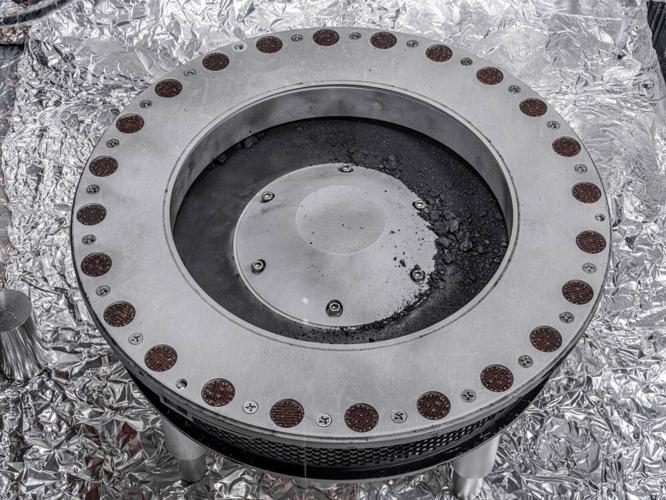
The outside of the Osiris-Rex sample collector shows material from asteroid Bennu at middle right on Wednesday. Scientists found evidence of both carbon and water in initial analysis of the material. The bulk of the sample is located inside.
NASA’s Osiris-Rex spacecraft collected the samples three years ago from the surface of Bennu and then dropped them off sealed in a capsule during a flyby of Earth last month. Scientists anticipated getting a cupful of rocks, far more than the teaspoon or so that Japan brought back from a pair of missions years ago.
People are also reading…
Black dust and particles were scattered around the outside edge of the internal sample chamber, according to Lauretta. He said there’s still “a whole treasure chest of extraterrestrial material” to be studied. The samples are priceless, the preserved building blocks from the dawn of the solar system.
No one at Wednesday’s celebration at Johnson got to see any of the samples firsthand — just photos and video. The asteroid pieces were behind locked doors in a new lab at the space center, accessible only to scientists in protective gear.
Besides carbon, the asteroid rubble holds water in the form of water-bearing clay minerals, Lauretta and others pointed out.

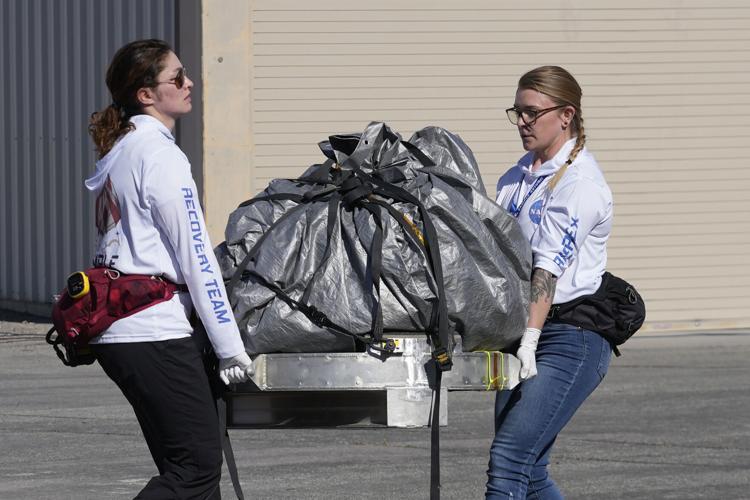
Recovery team members carry a capsule containing NASA's first asteroid samples to a temporary clean room Sept. 24 at Dugway Proving Ground in Utah.
“That is how we think water got to the Earth,” he said. "Minerals like we’re seeing from Bennu landed on Earth 4 billion years ago to 4.5 billion years ago, making our world habitable.”
That was one of the primary reasons for the $1 billion, seven-year mission: to help learn how the solar system — and Earth in particular — formed. “You can't get more exciting than that,” said NASA Administrator Bill Nelson.
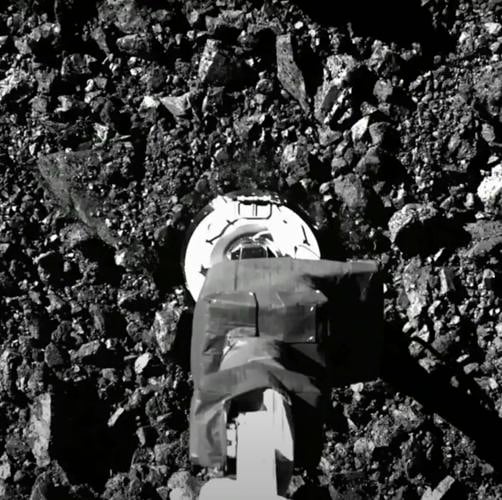
Back in 2020, Lauretta and his team lost some of their haul when the lid on the sample container jammed a few days after the spacecraft collected the material. It vacuumed up so many pieces from Bennu that small rocks got lodged under the lid and prevented it from closing, sending pieces floating off into space.
That's why scientists did not have a precise measurement of what was coming back; they estimated 250 grams, or about a cupful, ahead of the Sept. 24 landing in the Utah desert. They won't have a good count until the container is opened, within two weeks or so.

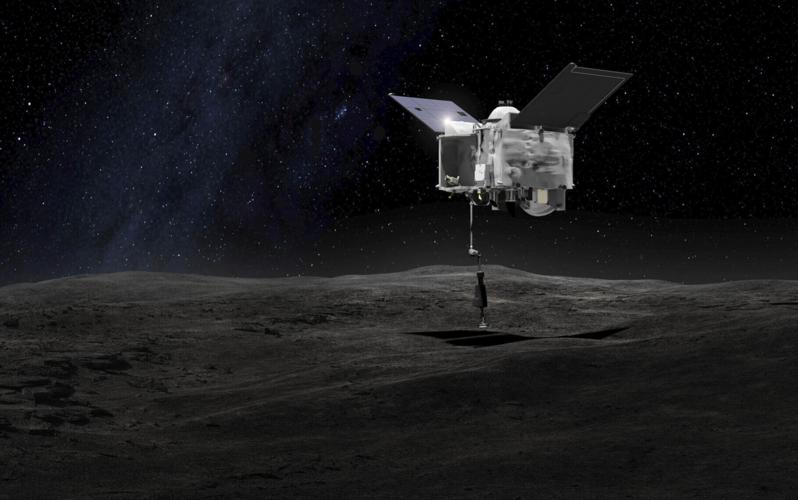
An artist's rendering depicts the OSIRIS-REx spacecraft contacting the asteroid Bennu with the Touch-And-Go Sample Arm Mechanism.
Much of the material shown Wednesday was overflow from when the lid was stuck open, before everything could be sealed inside the return capsule.

The Osiris-Rex spacecraft touches the surface of asteroid Bennu on Oct. 20, 2020. NASA showed off the samples brought to Earth in September from the asteroid on Wednesday.
“We have a bounty of sample on our hands already and we're not even inside” the main sample container, said NASA astromaterials curator Francis McCubbin.
Once the samples are archived, the team will dole out particles to researchers around the world, while saving a fair amount for future analysis when better technology should be available.
NASA has another asteroid-chasing spacecraft on a Florida launch pad, ready to blast off later this week. The destination will be a rare asteroid made of metal named Psyche. No samples will be coming back.
Today in history: Oct. 11
1779: Casimir Pulaski

In 1779, Polish nobleman Casimir Pulaski, fighting for American independence, died two days after being wounded during the Revolutionary War Battle of Savannah, Georgia.
1884: Eleanor Roosevelt

In 1884, American first lady Eleanor Roosevelt was born in New York City.
1968: Apollo 7

In 1968, Apollo 7, the first manned Apollo mission, was launched with astronauts Wally Schirra (shih-RAH’), Donn Fulton Eisele and R. Walter Cunningham aboard.
1986: Ronald Reagan and Mikhail Gorbachev

In 1986, President Ronald Reagan and Soviet leader Mikhail S. Gorbachev opened two days of talks in Reykjavik, Iceland, concerning arms control and human rights.
1991: Anita Hill

In 1991, testifying before the Senate Judiciary Committee, Anita Hill accused Supreme Court nominee Clarence Thomas of sexually harassing her; Thomas re-appeared before the panel to denounce the proceedings as a “high-tech lynching.”
2001: George W. Bush

In 2001, in his first prime-time news conference since taking office, President George W. Bush said “it may take a year or two” to track down Osama bin Laden and his terrorist network in Afghanistan, but he asserted that after a five-day aerial bombardment, “we’ve got them on the run.”
2002: Jimmy Carter

In 2002, former President Jimmy Carter was named the recipient of the Nobel Peace Prize.
2006: Adam Yehiye Gadahn

In 2006, the charge of treason was used for the first time in the U.S. war on terrorism, filed against Adam Yehiye Gadahn (ah-DAHM’ YEH’-heh-yuh guh-DAHN’), also known as “Azzam the American,” who’d appeared in propaganda videos for al-Qaida. (Gadahn was killed by a U.S. drone strike in Pakistan in Jan. 2015.)
2014: Kennedy International Airport

In 2014, customs and health officials began taking the temperatures of passengers arriving at New York’s Kennedy International Airport from three West African countries in a stepped-up screening effort meant to prevent the spread of the Ebola virus.
2020: The Los Angeles Lakers

In 2020, the Los Angeles Lakers beat the Miami Heat 106-93 to win the NBA finals in six games; LeBron James scored 28 points as the NBA wrapped up a season that sent players to a “bubble” at Walt Disney World in Florida for three months because of the pandemic.
2022: NASA

In 2022, NASA announced that a spacecraft that plowed into a small, harmless asteroid millions of miles away succeeded in shifting its orbit, a test aimed at fending off any more dangerous asteroids in the future.