DUBAI, United Arab Emirates — Iran fired on commercial ships Wednesday and targeted Dubai International Airport, escalating a campaign of bottling up the oil-rich Persian Gulf as global energy concerns mounted and American and Israeli airstrikes pounded the Islamic Republic.
Iran's response to the surprise Israeli and U.S. bombardment that started 12 days ago has upended trade routes, choked supplies of fuel and fertilizer coming out of the Gulf and threatened air traffic through one of the world's most-traveled regions. Both sides have dug in, hoping to outlast the other.
Also on Wednesday, the Pentagon told Congress that the first week of the Iran war cost $11.3 billion, according to a person familiar with the situation.

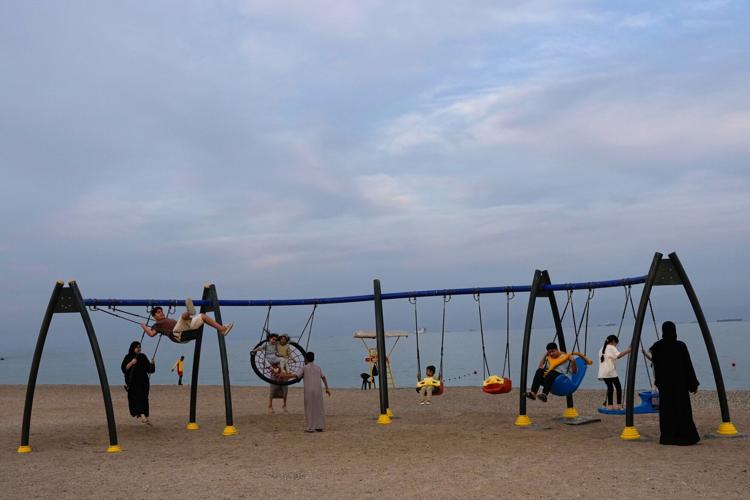
Children and adults play on swings on the beach as oil tankers and cargo ships line up in the Strait of Hormuz on Wednesday near Khor Fakkan, United Arab Emirates.
An Israeli intelligence assessment, meanwhile, found Iran's new supreme leader, Ayatollah Mojtaba Khamenei, was wounded at the start of the war — on the day when his father and predecessor, Ayatollah Ali Khamenei, was killed in an Israeli airstrike.
People are also reading…
An Israeli intelligence official and a reservist with knowledge of the assessment spoke on condition of anonymity because they were not authorized to discuss the matter with the media. They gave no details on the nature of the injuries.
The 56-year-old, whose wife was also killed in the Israeli strike, has not been seen since becoming supreme leader on Monday. Yousef Pezeshkian, the son of Iranian President Masoud Pezeshkian, wrote on social media that he had heard Mojtaba was wounded but that friends said “he is healthy and there is no problem.”
In Tehran late Wednesday, witnesses said they heard loud airstrikes, explosions and heavy fire by anti-aircraft batteries. They could also hear the buzzing of drones overhead. A person driving to Tehran described overcast skies as smoke from bomb and missile blasts mingled in the air that smelled of burnt powder and gasoline. They spoke on condition of anonymity for fear of reprisal.
Tehran mourns four slain top commanders as crowds vow revenge and chant “Death to America, Death to Israel” amid ongoing Iran US Israel war
The fallout across the Middle East widened as Israel struck what it said were targets connected to Iran-backed Hezbollah militants in Lebanon. The U.N. refugee agency said at least 759,000 people have been internally displaced in Lebanon, while more than 92,000 others have crossed into neighboring Syria.
Elsewhere, two Iranian drones hit near the Dubai airport, home to the long-haul carrier Emirates and the world’s busiest for international travel. Four people were wounded but flights continued, the Dubai Media Office said.
At Oman’s Port of Salalah, firefighters battled a blaze Wednesday at fuel storage tanks after days of Iranian attacks, according to the Oman News Agency.
The U.N. Security Council voted Wednesday to approve a resolution demanding a halt to Iran’s “egregious attacks” on its Gulf neighbors.
“The international community is resolute in rejecting these Iranian attacks against sovereign countries that are threatening the stability of the peoples, especially in a region of strategic importance to the global economy, energy, security, and security of global trade," said Bahrain’s U.N. ambassador, Jamal Alrowaiei.
The 13-0 vote in the U.N.’s most powerful body reflects Iran's isolated position as it has aggressively responded to Israeli and U.S. strikes. China and Russia — two Iranian allies — abstained from the vote.

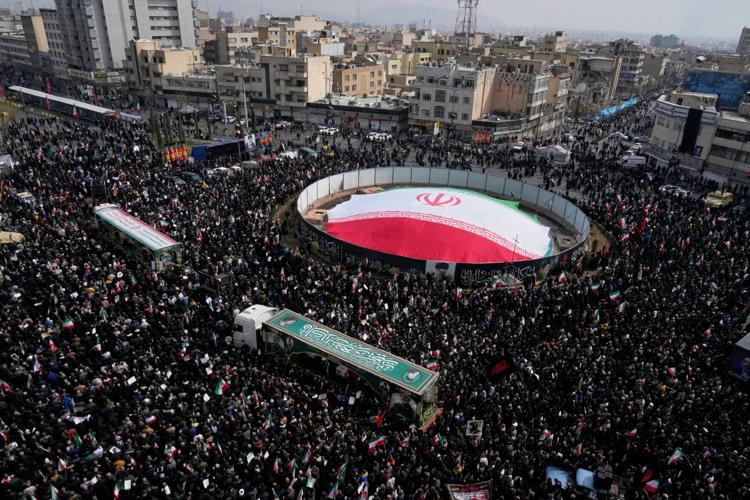
Mourners attend the funeral procession for senior Iranian military officials and some civilians killed during the U.S.-Israel campaign Wednesday in Tehran, Iran.
Their U.N. ambassadors called the proposal “extremely unbalanced” in not mentioning the strikes against Tehran that began the war.
Russia’s U.N. ambassador, Vassily Nebenzia, said it might leave the impression that Iran, “on its own volition and out of malice, conducted an unprovoked attack on Arab states.” Iranian U.N. Ambassador Amir Saeid Iravani said the resolution “deliberately ignores the root causes of the current crisis.”
Iran has effectively stopped cargo traffic through the narrow Strait of Hormuz, through which a fifth of all traded oil passes. It has also targeted oil fields and refineries in Gulf Arab nations, aiming at generating enough global economic pain to pressure the United States and Israel to end their strikes.

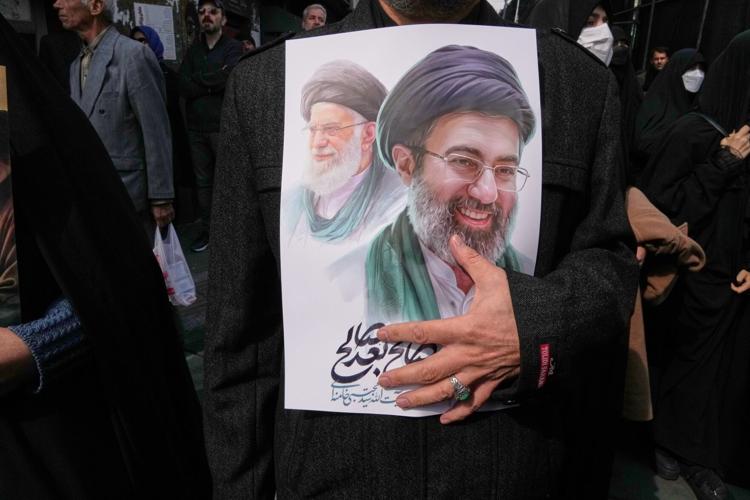
A mourner holds a poster depicting Ayatollah Mojtaba Khamenei, right, the successor to his late father Ayatollah Ali Khamenei, left, as supreme leader, during the funeral procession for senior Iranian military officials and civilians killed during the U.S.-Israel campaign Wednesday in Tehran, Iran.
At least 12 incidents involving vessels around the strait have been confirmed since fighting began, according to two global trackers, and at least seven mariners have been killed.
A projectile hit a Thai cargo ship off the coast of Oman in the Strait of Hormuz, setting it ablaze. Authorities are searching for three missing crew members from the Mayuree Naree after 20 were rescued by the Omani navy, according to Thailand’s Marine Department.
The United States pledged to keep the strait open and led intense airstrikes targeting Iran's navy and the port city of Bandar Abbas. The U.S. military said Tuesday it destroyed 16 Iranian minelayers near the strait.
Some tankers, believed linked to Iran, continue to get through the strait, making so-called “dark” transits — meaning they aren’t turning on trackers that show where they are. Vessels carrying sanctioned Iranian crude often turn off their trackers.
The commodity-tracking firm Kpler said Iran restarted crude exports through its Jask oil terminal on the Gulf of Oman. A tanker loaded roughly 2 million barrels at Jask on March 7, it said.

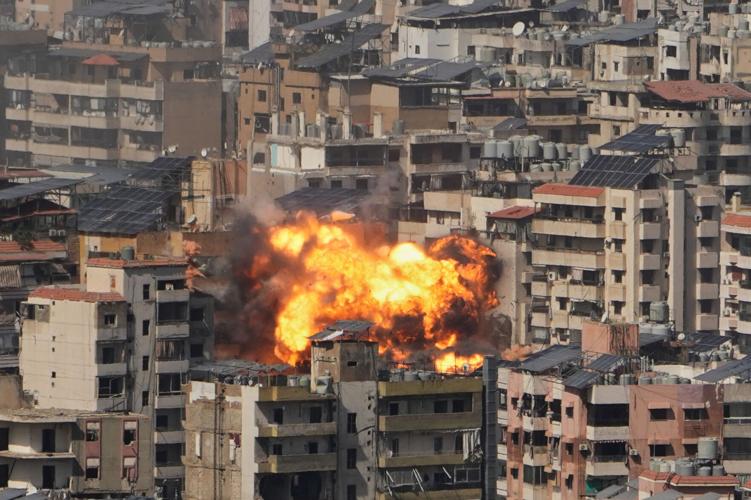
Flames rise from an Israeli airstrike Wednesday in Dahiyeh, Beirut's southern suburbs.
Oil prices remained well below Monday’s peaks but the price of Brent crude, the international standard, was still up some 20% Wednesday from when the war began. Consumers around the world are already feeling the pain at the pump.
The International Energy Agency agreed Wednesday to release the largest volume of emergency oil reserves in its history, in a bid to counter the war’s impact on energy markets.
The Paris-based organization said it will make 400 million barrels of oil available from its member countries’ emergency reserves, more than twice the amount they released four years ago in response to Russia’s invasion of Ukraine.
That could replace supplies currently off the market for roughly three weeks, said Bruce Bullock, director of Maguire Energy Institute at Southern Methodist University.
While visiting Ohio on Wednesday, U.S. President Donald Trump told Cincinnati television station WKRC that he will tap the U.S. Strategic Petroleum Reserve to try to curtail rising gas prices by releasing 172 million barrels.
Photos from Iran, Israel and Lebanon in the 2nd week of the Iran war

Smoke rise from an Israeli airstrike in Dahiyeh, Beirut's southern suburbs, at sunset in Beirut, Lebanon, Tuesday, March 10, 2026. (AP Photo/Bilal Hussein)

A boy runs inside cement pipe turned into a bomb shelter as air raid sirens warn of incoming Iranian missile strike in Michmoret, Israel, Tuesday, March 10, 2026. (AP Photo/Ariel Schalit)

Smoke rise from an Israeli airstrike in Dahiyeh, Beirut's southern suburbs, Monday, March 9, 2026. (AP Photo/Hassan Ammar)

A man passes in front of a destroyed building that housed a branch of Al-Qard Al-Hassan, a non-bank financial institution run by Hezbollah, which was hit by an Israeli airstrike in Dahiyeh, Beirut's southern suburbs, Lebanon, Tuesday, March 10, 2026. (AP Photo/Hussein Malla)

People walk past closed shops at the nearly empty traditional main bazaar in Tehran, Iran, Tuesday, March 10, 2026. (AP Photo/Vahid Salemi)

Motorbikes drive past a billboard depicting Iran’s late Supreme Leader Ayatollah Ali Khamenei, center, handing the country’s flag to his son and successor Ayatollah Mojtaba Khamenei, right, as the late revolutionary founder Ayatollah Ruhollah Khomeini stands at left, in a square in downtown Tehran, Iran, Tuesday, March 10, 2026. (AP Photo/Vahid Salemi)

Flames rise after an Israeli airstrike in Dahiyeh Beirut's southern suburbs, Monday, March 9, 2026. (AP Photo/Hassan Ammar)

A man holds a poster of Ayatollah Mojtaba Khamenei, the successor to his late father Ayatollah Ali Khamenei as supreme leader, during a rally to support him in Tehran, Iran, Monday, March 9, 2026. (AP Photo/Vahid Salemi)

People wave Iranian flags as they hold posters of the late Supreme Leader Ayatollah Ali Khamenei, showing him at different ages, during a rally to support his son Ayatollah Mojtaba Khamenei, who succeeds his father as the new supreme leader, in Tehran, Iran, Monday, March 9, 2026. (AP Photo/Vahid Salemi)

People gather in a rally to support Ayatollah Mojtaba Khamenei, the successor to his late father Ayatollah Ali Khamenei as supreme leader, in Tehran, Iran, Monday, March 9, 2026. (AP Photo/Vahid Salemi)

The coffin of Mehdi Hosseini, a man killed in a U.S.-Israeli strike, is carried for burial at Behesht-e Zahra cemetery in Tehran, Iran, Monday, March 9, 2026. (AP Photo/Vahid Salemi)

A girl displaced by Israeli airstrikes, looks on at a school used as a shelter in Beirut, Lebanon, Monday, March 9, 2026. (AP Photo/Hassan Ammar)

Relatives mourn over the flag draped coffin of Mehdi Hosseini who was killed in a U.S.-Israeli strike during his burial ceremony at Behesht-e Zahra cemetery in Tehran, Iran, Monday, March 9, 2026. (AP Photo/Vahid Salemi)

Israeli security forces and ZAKA rescue service members carry the body of a man killed in an Iranian missile strike in Yehud, Israel, Monday, March 9, 2026. (AP Photo/Ohad Zwigenberg)

Two women from the Iranian Red Crescent Society stand as a thick plume of smoke from a U.S.-Israeli strike on an oil storage facility late Saturday rises in the sky in Tehran, Iran, Sunday, March 8, 2026. (AP Photo/Vahid Salemi)

A woman walks past a cordoned-off area damaged during an Iranian strike in Tel Aviv, Israel, Sunday, March 8, 2026. (AP Photo/Ohad Zwigenberg)

Mourners carry the bodies of Hezbollah fighters who were killed by Israeli airstrikes during their funeral procession in Khraibeh village, eastern Lebanon, Sunday, March 8, 2026. (AP Photo/Bilal Hussein)

Residents look on and take pictures as flames and smoke rise from an oil storage facility struck as attacks hit the city during the U.S.–Israeli military campaign in Tehran, Iran, Saturday, March 7, 2026. (Alireza Sotakbar/ISNA via AP)