Arizona will take nearly a $3 trillion total economic hit and lose millions of jobs that would have come to the state by 2060 if Central Arizona Project deliveries are halted by the federal government, a new report from the project's governing agency says.
A CAP consultant's report said the state's total economic output would by 2060 be 11% to 14% lower than it otherwise would have been, under two proposed federal alternatives for managing the Colorado River. At worst, the state's total jobs would shrink by 7.9% if the project's supplies were eliminated, the report said.
In addition, the state would see substantial declines in population and housing growth by then with massive CAP cuts, compared to what would have happened without them, said the report.
People are also reading…
The three-county agency that runs the CAP's canal system, stretching from Lake Havasu on the Colorado River to just south of Tucson, commissioned this report from the consulting firm WestWater Research, based in Boise, Idaho. The agency, known as the Central Arizona Water Conservation District, has managed daily operations for CAP since it was under construction in the 1970s.
CAP submitted this report as part of its comments sharply criticizing the U.S. Bureau of Reclamation's draft environmental impact statement on proposed alternatives aimed at curbing excessive water use by cities and farms in the seven-state Colorado River Basin. It comes out shortly after project officials released a video warning that such cuts would "flatten" Arizona's economy.
At the time the video came out, some outside water experts said it oversimplified and overestimated the impacts of CAP cuts, in part because the state and local governments have already stored huge amounts of CAP water underground to prepare for such emergencies.
But the new report says those supplies will eventually be exhausted, forcing many cities to return to groundwater pumping, and that some shortages of groundwater supplies themselves also could begin in some regions as soon as the early 2030s.
And while many observers have already warned that the replacement supplies for CAP would eventually run out, this report places that day of reckoning at a much earlier date than most others have projected.
Foundation of Arizona's economy

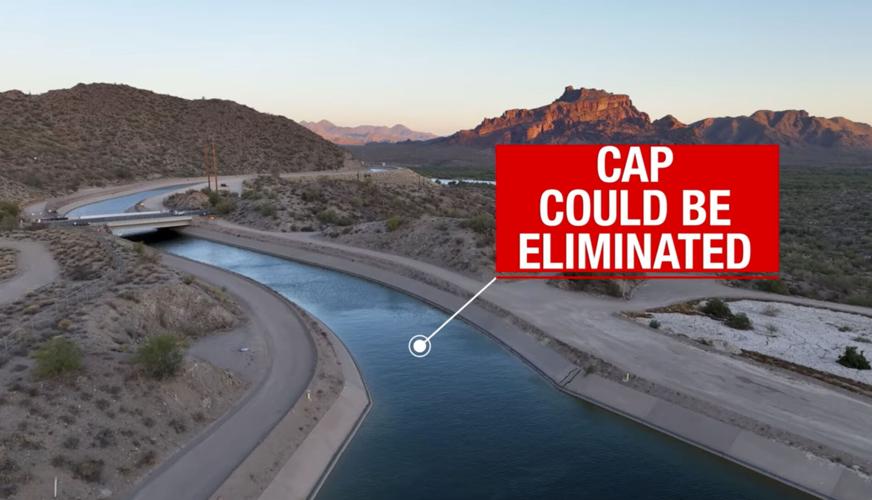
This screenshot from the Central Arizona Project’s new video refers to the fact that under the most extreme cut being considered by the federal government, CAP's deliveries of water from the Colorado River could be cut by 98%.
The report spelled out what many Arizona politicians and other leaders have said for decades: that the $4 billion CAP is the foundation of Arizona's economy.
The report concluded, as many have long said, the project was instrumental in sparking the rapid population and economic growth that became an Arizona trademark since CAP's congressional authorization in 1968. Many have celebrated this for making a Phoenix-to-Tucson megalopolis possible in an arid environment and for building prosperity. But others say the project unwisely encouraged seemingly limitless development in an arid state that wasn't meant to accommodate so much of it.
The CAP started delivering water to the Phoenix area in 1985, to Pinal County farmers in 1986 and to the Tucson area in 1992. But CAP deliveries to Tucson were halted in 1994 because the water quality of those early deliveries was poor, producing foul-tasting water that corroded plumbing fixtures and appliances in many homes, and the project didn't resume sending water to this area until 2001.
Overall, "Central Arizona's economic expansion over the past four decades was built on reliable water supply, particularly Colorado River water delivered through the CAP. This infrastructure enabled the region to transition from depleting groundwater reserves to a more sustainable mix of surface water sources," the report said.
"Sustaining continued growth requires availability of both CAP water and groundwater to meet long-term urban, agricultural, and industrial needs."
Since 1985, the three counties served by CAP (Maricopa, Pinal and Pima) grew from 2.5 million residents to 6.3 million in 2024, a 148% increase, the report said, citing U.S. Census Bureau statistics. That has been accompanied by corresponding job growth, with the jobs concentrated in health care, technology, professional services and manufacturing, the report said.
By 2023, the combined gross domestic product in the three counties reached $460 billion, representing 88% of Arizona's statewide total GDP, the report said.
But the report said the economy would increasingly feel the effects of massive CAP cuts, stemming from their cascading effects. First, deliveries of new CAP water would stop and be replaced by older CAP supplies that cities such as Tucson and Phoenix have stored underground. The cities would also be able to pump out additional stored river water recharged into the aquifer by the state-run Arizona Water Bank.
All those stored, underground CAP supplies offer public water utilities and private water companies long-term storage credits, which allow the water providers to pump groundwater elsewhere if necessary to access groundwater supplies as guaranteed by the credits.
Then, as those supplies were exhausted over time, many cities would have to return to pumping native, non-renewable groundwater, and in some cases, even those supplies would either run out or be legally inaccessible under current Arizona water law and rules.
The report didn't try to pinpoint specific effects on the three major urban regions in the CAP service area — Pima, Maricopa and Pinal counties.
The Star asked Tucson Water officials and city of Tucson officials in general, last Wednesday, to review and comment on the report. On Friday, Andrew Squire, a Tucson City Hall spokesman, said city leaders haven't had the opportunity to review the report yet, and it may be a week before they do.
But Kathy Jacobs, a longtime University of Arizona climate scientist and a former top Arizona Department of Water Resources official, told the Star she believes Tucson's economic outlook under massive CAP cuts would be better than for other parts of the CAP service area because of its very large aquifer. A large amount of Avra Valley farmland that Tucson bought in the 1970s hasn't been pumped much at all since then, other than the areas where Tucson Water has recharged CAP supplies for more than two decades.
"Our groundwater allocation is the largest in the state, primarily because of retired farmland," said Jacobs, referring to the amount of groundwater that the water agency allows Tucson to pump. "I do think we will experience fewer direct shortages than the Phoenix Active Management Area. We have larger volumes of water in storage.
"But our economy is linked to the Phoenix economy. Their engine has driven our engine to a degree," said Jacobs, who worked more than 30 years for ADWR before leaving her job as director of its Tucson Active Management Area in 2003. She is director of UA's Center for Climate Adaptation Science and Solutions.
Overall, "There will definitely be impacts, especially in the price of water," she said.
The possible scenarios
The new report based its findings on how CAP supplies would be affected and the resulting broader impacts under three scenarios for possible CAP cuts, including a baseline alternative where CAP supplies would stay about the same as they are today.
A second scenario is if the Bureau of Reclamation cuts CAP supplies by 77% — a proposed cut now under active consideration and perhaps most likely to be adopted if the seven river basin states can't reach agreement on how to do the cuts themselves.
The third scenario involves cutting CAP to zero. One of the bureau's alternatives for the river would cut CAP by 98%, CAP officials have said, and the bureau's environmental report also raises the possibility of cutting all CAP deliveries if that's needed to prevent Lakes Mead and Powell from falling to "dead pool" levels, in which no water could be removed from them.
Then, the report's authors used computer models to project how those cuts would affect the availability of water supplies in general, water pricing, the replacement costs of water, water markets, housing construction, population growth and direct and indirect impacts on the overall economy.
Shortages, price hikes, economic losses
Here are some of the report's specific findings:
- Municipal shortages. Under the baseline scenario in which CAP gets 70% of its normal supplies, all legally available municipal groundwater supplies and long-term storage credits would last until 2048, after which at least some municipal water shortages would begin.

A screenshot from a new Central Arizona Project video warning about the big cuts in water deliveries it might face.
If CAP is cut 70%, some municipal shortages would begin as soon as 2032. Under a 100% cut of CAP supplies, some municipal shortages would start in 2030 and expand over time, as backup supplies are exhausted.
By 2060, under the 77% and 100% CAP cuts, alternative municipal water supplies would have been drawn down enough that municipal supplies would run 26% to 34% short of total demand from local residents and businesses.
Tribal shortages would be felt most directly on the tribes' ability to store their surplus CAP supplies underground, and then sell long-term storage credits to cities, private water companies and other users. Those credits now enable the other users to pump groundwater elsewhere to meet their needs.
With a 77% cut in CAP supplies, tribal holdings of long-term storage credits would drop from 40,000 acre-feet worth today to 150 acre-feet. Under a 100% CAP cut, the tribal long-term credits would drop to zero.
- Water markets and prices. As shortages occur first in CAP supplies and later in stored supplies, and then as native groundwater supplies worsen, water prices will soar.
The report looked at shortage impacts on prices of both long-term water storage credits and of alternative water supplies. Currently, long-term storage credits are sold to cities and other buyers for about $500 an acre-foot, with an acre-foot representing enough water to serve up to four Tucson-area households per year.
If CAP supplies are cut 77%, the price of those credits would hit $1,550 per acre-foot. If CAP is entirely cut, the credits would cost $12,840 an acre-foot.
The report also looked at the cost of producing alternative water supplies, such as desalinated water. Removing salts from brackish groundwater deposits known to exist across Arizona has estimated costs of $1,100 to $2,200 per acre-foot, the report said. Desalinating Gulf of California seawater would cost $2,400 to $2,700 per acre-foot. The existing desal plant in Carlsbad, California, near San Diego, costs $3,050 per acre-foot, and the tab is expected to hit $3,650 this year due to new environmental upgrades. Another desal plant serving Santa Barbara is costing a local water district there $3,200 an acre-foot.
"Critically, these costs do not include the conveyance or exchange arrangements that would be required to deliver water to Central Arizona from coastal facilities. When conveyance costs are considered, delivered costs for seawater desalination or other imported water would likely range from $3,500 to $5,000 per acre-foot," the report said.
Finally, the report didn't see treating wastewater for drinking as a major fix for replacing disappearing CAP supplies, saying, "Local reuse programs, while valuable, cannot generate supplies at the scale required to offset a near-total reduction in CAP deliveries."
- Direct economic impacts. The report analyzed the costs of losing so much groundwater that would have to be pumped and couldn't be replaced because it's non-renewable, concluding it has the same value and pricing as long-term storage credits. They're similar because Arizona's regulations treats them as "functionally interchangeable" when it comes to meeting state regulations requiring the proof of assured, 100-year water supplies for allowing new subdivisions to be built using groundwater.
Tribal CAP water losses cause the same economic losses as the loss of groundwater resources cost cities, the report said, because the tribes' main use and benefit from CAP water is through the sale of the same kinds of long-term storage credits, at the same price.
Overall, losses of groundwater would total $10.8 billion by 2060 if CAP supplies are cut 77%, and $167.8 billion by 2060 if CAP supplies are wiped out. Tribal water losses would total $7.4 billion and $64.1 billion, respectively, under the same two scenarios.
Consumers would suffer losses of $38.5 billion and $64.1 billion, respectively, under the same two scenarios, in losses of economic well-being because they can't get all the water they would prefer to consume, the report said. Businesses would lose $308 million and $462 million, respectively, under the two scenarios. Another $467 million and $550 million, respectively, would be lost under the two scenarios due to "foregone development," or residential and commercial construction that couldn't occur due to a lack of water.
'Likely understates the total costs'
Yet the report said it probably understates total costs of CAP cuts to Arizona's economy because its researchers didn't try to determine the costs of other impacts of CAP due to what it said were "data limitations" and "methodological complexity."
First on the list of unstudied economic costs was that of land subsidence, a geologic phenomenon that occurs when land slowly sinks due to the compaction of aquifers whose groundwater supplies are depleted.
"Renewed large-scale groundwater extraction to replace lost CAP supplies could accelerate subsidence, damaging roads, canals, building foundations, and other infrastructure," the report said.
But, "quantifying potential subsidence impacts in Central Arizona would require detailed geologic and hydrogeologic study beyond the scope of this analysis."
The report also didn't analyze the higher energy costs that would occur if water providers had to drill deeper into aquifers to reach groundwater, or the costs of new infrastructure such as wells, water treatment plants and pipelines that would be needed to make use of the groundwater needed to replace CAP supplies. While it did discuss the costs of obtaining alternative water supplies such as desalinated water, the report didn't incorporate those costs into its economic analysis.
"These unquantified impacts reinforce the conclusion that the total economic impact estimates presented in this report represent a conservative, lower-bound estimate of the true economic consequences of severely reduced CAP deliveries," the report said.
Contact Tony Davis at 520-349-0350 or tdavis@tucson.com. Follow Davis on Twitter@tonydavis987.

Tony Davis
Reporter


 Worst CAP cuts will 'flatten' Arizona's economy, agency says