From a judge ruling that Donald Trump committed fraud for years in building is empire, to Sen. Dianne Feinstein of California's death at age 90, here are the week's top national stories.
Judge rules Donald Trump defrauded banks, insurers as he built real estate empire
NEW YORK (AP) — A judge has ruled that Donald Trump committed fraud for years while building the real estate empire that catapulted him to fame and the White House.
Judge Arthur Engoron, ruling Tuesday in a civil lawsuit brought by New York’s attorney general, found that the former president and his company deceived banks, insurers and others by massively overvaluing his assets and exaggerating his net worth on paperwork used in making deals and securing financing.
The decision, days before the start of a non-jury trial in Attorney General Letitia James’ lawsuit, is the strongest repudiation yet of Trump’s carefully coiffed image as a wealthy and shrewd real estate mogul turned political powerhouse.
Beyond mere bragging about his riches, Trump, his company and key executives repeatedly lied about them on his annual financial statements, reaping rewards such as favorable loan terms and lower insurance premiums, Engoron found.
Those tactics crossed a line and violated the law, the judge said, rejecting Trump’s contention that a disclaimer on the financial statements absolved him of any wrongdoing.
Manhattan prosecutors had looked into bringing a criminal case over the same conduct but declined to do so, leaving James to sue Trump and seek penalties that could disrupt his and his family’s ability to do business in the state.
Get the full story, with updates, here:
Photos: Trump fans gather outside Georgia jail to show support ahead of his surrender
A vehicle and trailer drive by the Fulton County Jail, Thursday, Aug. 24, 2023, in Atlanta. Trump is charged alongside others, who are accused by Fulton County District Attorney Fani Willis of scheming to subvert the will of Georgia voters to keep the Republican president in the White House after he lost to Democrat Joe Biden. (AP Photo/Mike Stewart)
Mike Stewart
Malcolm Davis walks up the street in front of the Fulton County Jail in Atlanta on Thursday, Aug. 24, 2023. (AP Photo/Ben Gray)
Ben Gray
Supporters of former President Donald Trump and journalists gather near the Fulton County Jail in Atlanta on Thursday, Aug. 24, 2023. (AP Photo/Ben Gray)
Ben Gray
A vehicle and trailer drive by the Fulton County Jail, Thursday, Aug. 24, 2023, in Atlanta. Former President Trump is charged alongside others, who are accused by Fulton County District Attorney Fani Willis of scheming to subvert the will of Georgia voters to keep the Republican president in the White House after he lost to Democrat Joe Biden. (AP Photo/Mike Stewart)
Mike Stewart
An official stands guard in front of the Fulton County Jail in Atlanta on Thursday, Aug. 24, 2023. (AP Photo/Ben Gray)
Ben Gray
Former President Donald Trump's supporters gather outside of the Fulton County Jail as authorities put up barricades outside, Thursday, Aug. 24, 2023, in Atlanta. (AP Photo/Brynn Anderson)
Brynn Anderson
Former President Donald Trump's supporters gather outside of the Fulton County Jail, Thursday, Aug. 24, 2023, in Atlanta. (AP Photo/Brynn Anderson)
Brynn Anderson
Authorities put up barricades outside of the Fulton County Jail, Thursday, Aug. 24, 2023, in Atlanta. (AP Photo/Brynn Anderson)
Brynn Anderson
Former President Donald Trump's supporters gather outside of the Fulton County Jail, Thursday, Aug. 24, 2023, in Atlanta. (AP Photo/Brynn Anderson)
Brynn Anderson
Former President Donald Trump's supporters gather outside of the Fulton County Jail, Thursday, Aug. 24, 2023, in Atlanta. (AP Photo/Brynn Anderson)
Brynn Anderson
Authorities put up barricades outside of the Fulton County Jail, Thursday, Aug. 24, 2023, in Atlanta. (AP Photo/Brynn Anderson)
Brynn Anderson
Former President Donald Trump's supporters gather outside of the Fulton County Jail as authorities put up barricades outside, Thursday, Aug. 24, 2023, in Atlanta. (AP Photo/Brynn Anderson)
Brynn Anderson
Officials set up barriers in front of the Fulton County jail as supporters of former President Donald Trump gather, Thursday, Aug. 24, 2023. (AP Photo/Ben Gray)
Ben Gray
Former President Donald Trump's supporters gather outside of the Fulton County Jail, Thursday, Aug. 24, 2023, in Atlanta. (AP Photo/Brynn Anderson)
Brynn Anderson
Former President Donald Trump's supporters gather outside of the Fulton County Jail, Thursday, Aug. 24, 2023, in Atlanta. (AP Photo/Brynn Anderson)
Brynn Anderson
A Fulton County Jail signs points to where the jail is located, Thursday, Aug. 24, 2023, in Atlanta. (AP Photo/Brynn Anderson)
Brynn Anderson
Protester Laurie Arbeiter talks with supporters of former President Donald Trump at the Fulton County Jail, Thursday, Aug. 24, 2023, in Atlanta. (AP Photo/Brynn Anderson)
Brynn Anderson
A supporter of former President Donald Trump yells at the media outside of the Fulton County Jail, Thursday, Aug. 24, 2023, in Atlanta. (AP Photo/Brynn Anderson)
Brynn Anderson
Protester Laurie Arbeiter holds up a sign at the Fulton County Jail, Thursday, Aug. 24, 2023, in Atlanta. (AP Photo/Brynn Anderson)
Brynn Anderson
Laurie Arbeiter came from New York City to be at the Fulton County Jail in Atlanta on Thursday, Aug. 24, 2023. Dozens of Trump supporters gathered outside the jail where former President Donald Trump is expected to turn himself in on charges related to his efforts to remain in power after his 2020 election loss. (AP Photo/Ben Gray)
Ben Gray
Domenic Santana, with Republicans Against Trump, talks to journalists in front of the Fulton County Jail in Atlanta on Thursday, Aug. 24, 2023. (AP Photo/Ben Gray)
Ben Gray
Supporters of former President Donald Trump and journalists gather in front of the Fulton County Jail in Atlanta on Thursday, Aug. 24, 2023. (AP Photo/Ben Gray)
Ben Gray
An official stands guard in front of the Fulton County Jail in Atlanta on Thursday, Aug. 24, 2023. (AP Photo/Ben Gray)
Ben Gray
Domenic Santana, with Republicans Against Trump, talks to journalists in front of the Fulton County Jail in Atlanta on Thursday, Aug. 24, 2023. (AP Photo/Ben Gray)
Ben Gray
Dianne Feinstein, centrist Democrat who served as California senator since 1992, dies at 90
WASHINGTON — U.S. Sen. Dianne Feinstein of California, a centrist Democrat who was elected to the Senate in 1992 in the "Year of the Woman" and broke gender barriers throughout her long career in local and national politics, has died. She was 90.
Three people familiar with the situation confirmed her death to The Associated Press on Friday.
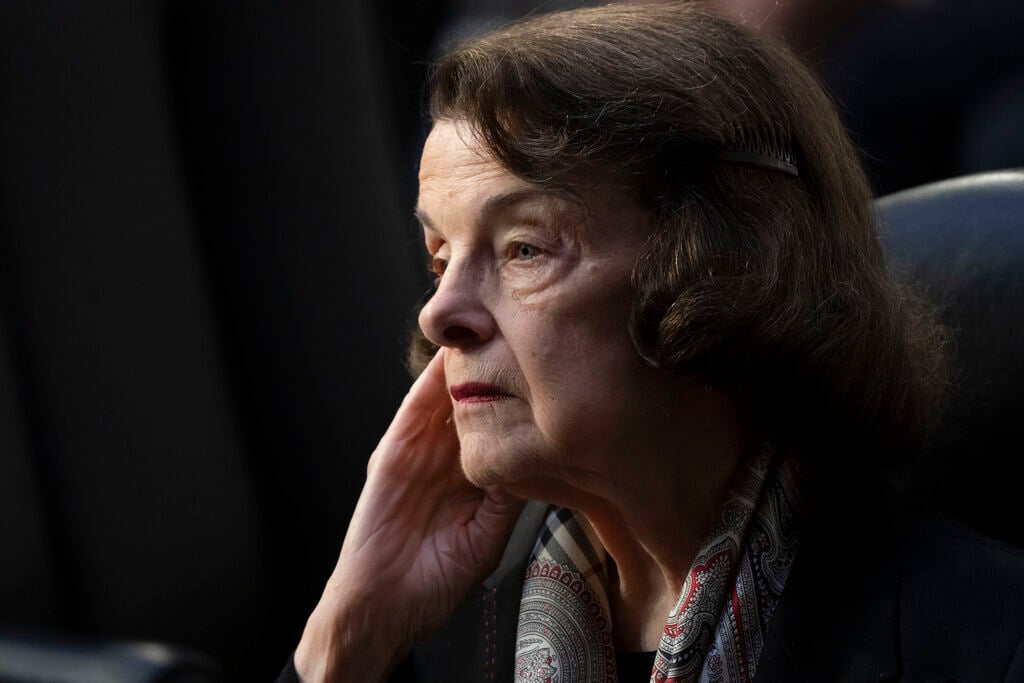
Sen. Dianne Feinstein, D-Calif., listens as the Senate Judiciary Committee begins debate on Ketanji Brown Jackson’s nomination for the Supreme Court, in Washington, April 4, 2022.
J. Scott Applewhite, Associated Press
Feinstein, the oldest sitting U.S. senator, was a passionate advocate for liberal priorities important to her state -- including environmental protection, reproductive rights and gun control -- but was also known as a pragmatic lawmaker who reached out to Republicans and sought middle ground.
She was elected to the San Francisco Board of Supervisors in 1969 and became its first female president in 1978, the same year Mayor George Moscone was gunned down alongside Supervisor Harvey Milk at City Hall by Dan White, a disgruntled former supervisor. Feinstein found Milk's body.
After Moscone's death, Feinstein became San Francisco's first female mayor. In the Senate, she was one of California's first two female senators, the first woman to head the Senate Intelligence Committee and the first woman to serve as the Judiciary committee's top Democrat.
Photos: Sen. Dianne Feinstein through the years
Supervisor Dianne Feinstein holds a news conference at her San Francisco home, Sept. 17, 1971 to announce she is a candidate for mayor of San Francisco. Asked how she rated her chances against incumbent Joseph L. Alioto, she replied with one word: "Good." She told the news conference that leadership will be the campaign's key issue. (AP Photo/Richard Drew)
Richard Drew
Dianne Feinstein, 38-year-old President of the City-County Board of Supervisors and candidate for mayor of San Francisco, prepares to cast her ballot in San Francisco on Nov. 2, 1971. The city’s registrar of voters has predicted a 75 percent turnout for the election in which Mayor Joseph L. Alioto seeks another term in office. (AP Photo/Sal Veder)
Sal Veder
Acting Mayor Dianne Feinstein with Police Chief Charles Gain at left, addresses the more than 25,000 people jammed around San Francisco's City Hall, Nov. 28, 1978 as city residents staged a spontaneous memorial service for slain officials Mayor George Moscone and Supervisor Harvey Milk. Man at right is not identified. (AP Photo)
Anonymous
Dianne Feinstein elected to finish out the term of the late San Francisco Mayor George R. Moscone, addresses the Board of Supervisors following her election in San Francisco Monday, Dec. 5, 1978. (AP Photo/Sal Veder)
Sal Veder
Mayor of San Francisco Dianne Feinstein is shown in her office, Dec. 11, 1978. (AP Photo)
STF
Mayor of San Francisco Dianne Feinstein speaks in Washington, D.C., March 13, 1979. (AP Photo/John Duricka)
John Duricka
Rep. Abner J. Mikva (D-Ill.), and San Francisco Mayor Dianne Feinstein hold a Capitol Hill news conference in Washington, Jan. 25, 1979 to promote presidential and congressional action for strong handgun control. (AP Photo/John Duricka)
John Duricka
San Francisco Mayor Dianne Feinstein carries a candle as she lead an estimated 15,000 marchers also carrying candles during a march in memory of slain Mayor George Moscone and Supervisor Harvey Milk in San Francisco, Nov. 28, 1979. In the background is a sign that says "Gay Love is Gay Power." (AP Photo/Paul Sakuma)
Paul Sakuma
Mayor Dianne Feinstein leaves the voting booth in San Francisco, Dec. 11, 1979, after casting her ballot in the run-off election for mayor. The mayor faces Supervisor Quentin Kopp in the runoff as she attempts to become the first woman elected to the city's highest office. (AP Photo/Jim Palmer)
Jim Palmer
Diane Feinstein with Pope John Paul II in Vatican City, Sept. 8, 1982. (AP Photo)
ASSOCIATED PRESS
Chinese Premier Zhao Ziyang escorts San Francisco Mayor Dianne Feinstein in the Zeguangge, Pavilion of Purple Light, where they met in Peking, Saturday, Nov. 10, 1984. (AP Photo/Neal Ulevich)
Neal Ulevich
San Francisco Mayor Dianne Feinstein, right, and Mayor Richard Berkley of Kansas City, Mo. appear before the Senate Judiciary Committee at Capitol Hill in Washington, Monday, August 16, 1982 which is holding hearings on antitrust problems which professional sports teams. (AP Photo/Scott Stewart)
Scott Stewart
Democratic Senate candidates Barbara Boxer, left, and Dianne Feinstein raise their arms in victory and wave to supporters at an election rally in San Francisco, Tuesday, Nov. 4, 1992. The two women claimed victory over their Republican male rivals, Bruce Herschensohn and Sen. John Seymour. (AP Photo/Alan Greth)
Alan Greth
Former San Francisco Mayor Dianne Feinstein, left, and Rep. Barbara Boxer raise their hands in victory during an appearance at the airport in Burbank, California, Wednesday, June 3, 1992. The two women won the Democratic nominations for the two California U.S. Senate seats. (AP Photo/Paul Sakuma)
Paul Sakuma
Walter Mondale gestures to supporters as he is greeted by San Francisco Mayor Dianne Feinstein outside her home as she arrived to attend a fund-raiser reception in San Francisco, Wednesday, Sept. 19, 1984. Mondale had been in San Francisco for an after noon rally where he picked up the endorsement of the Sierra Club. (AP Photo/Lana Harris)
Lana Harris
Sen. Dianne Feinstein, D-Calif., reacts after the Defense Base Closure and Realignment Commission announced on Capitol Hill in Washington, Friday, June 25, 1993, that the shipyard in Long Beach in Calif., would remain open. Sen. Barbara Boxer, D-Calif., is at right. (AP Photo/Stephen R. Brown)
Stephen R. Brown
California Senator Dianne Feinstein and Roland J. Johnson, assistant director of the San Diego district for the Immigration and Naturalization Service, tour the San Ysidro Border Crossing in San Diego, Wednesday, July 7, 1993. Feinstein has proposed a $1.00 fee for crossing the border. (AP Photo/Lenny Ignelzi)
Lenny Ignelzi
U.S. Senator Dianne Feinstein gestures to friends on Thursday, Oct. 27, 1994 at the San Francisco Fire Department’s fireboat berth during a demonstration of equipment used to supply emergency drinking water to Rwandan refugee camps. Feinstein was instrumental in getting the equipment, credited with saving nearly 150,000 lives in Rwanda, shipped to the war-torn African nation. (AP Photo/Dwayne Newton)
Dwayne Newton
Sen. Dianne Feinstein, D-Calif., arrives at a Democratic election party in San Francisco, Tuesday, Nov. 7, 2006. (AP Photo/Paul Sakuma)
PAUL SAKUMA
Senator Dianne Feinstein, D-Calif., left, discusses re-introduction of legislation to expand a nationwide Amber Alert communication system to help find abducted children. Left to right are Feinstein, Sen. Patrick Leahy, D-Vt., Sen. Orrin, R-Utah, and Sen. Debbie Stabenow, D-Mich. Sens. Kay Bailey Hutchison and Feinstein said Tuesday they would try again to create a nationwide Amber Alert network to help track down suspected child abductors.(AP Photo/Dennis Cook)
DENNIS COOK
** FILE ** In this July 17, 2008, file photo, Sen. Dianne Feinstein, D-Calif., left, President Bush, center, and Gov. Arnold Schwarzenegger, R-Calif., speak about the California wildfires in Redding, Calif. Firefighting costs have soared since a firestorm in Southern California in 2003. Schwarzenegger cited the expense as a factor when he deferred wages for state workers and laid off others recently as he contends with an overall budget shortfall. (AP Photo/Evan Vucci)
Evan Vucci
Sen. Dianne Feinstein, D-Calif., center, flanked by Sen. Christopher Coons, D-Del., left, and Senate Judiciary Committee Chairman Sen. Patrick Leahy, D-VT., right, take part in news conference on Capitol Hill in Washington, Thursday, Nov. 10, 2011, to discuss Judiciary Committee action on legislation to repeal the Defense of Marriage Act. Feinstein is the lead sponsor of the Respect for Marriage Act. (AP Photo/Pablo Martinez Monsivais)
Pablo Martinez Monsivais
Senate Intelligence Committee Chair Sen. Dianne Feinstein, D-Calif. walks to a closed-door briefing with intelligence officials, Wednesday, June 4, 2014, on Capitol Hill in Washington. (AP Photo/J. Scott Applewhite)
J. Scott Applewhite
Senate Intelligence Committee Chair Sen. Dianne Feinstein, D-Calif. is surrounded by reporters on Capitol Hill in Washington, Tuesday, Dec. 9, 2014, as she leaves the Senate chamber after releasing a report on the CIA's harsh interrogation techniques at secret overseas facilities. Feinstein branded the findings a "stain on the nation's history." (AP Photo/J. Scott Applewhite)
J. Scott Applewhite
Sen. Dianne Feinstein, D-Calif., attends a signing ceremony for a federal grant for the "regional connector transit corridor" in Los Angeles Thursday, Feb. 20, 2014. The light rail public transit system in Los Angeles is getting $670 million to solve one of its most vexing design deficiencies: Train riders who want to travel from one side of downtown and out the other must transfer twice. The "regional connector," as the Los Angeles County Metropolitan Transportation Authority calls it, will tie together three existing light rail lines with a new tunnel and three new stations. Major construction should begin later this year, with an estimated cost of $1.4 billion. It will be opened in 2020. (AP Photo/Damian Dovarganes)
Damian Dovarganes
Sen. Dianne Feinstein, D-Calif., waves after speaking at a news conference about health care at the UCSF Benioff Children's Hospital Friday, July 7, 2017, in San Francisco. Feinstein addressed how Medicaid cuts in the Senate Republican health care bill would devastate care for children. (AP Photo/Eric Risberg)
Eric Risberg
Vice President Mike Pence administers a ceremonial Senate oath during a mock swearing-in ceremony to Sen. Dianne Feinstein, D-Calif., accompanied by her husband Richard Blum, Thursday, Jan. 3, 2019, in the Old Senate Chamber on Capitol Hill in Washington. (AP Photo/Manuel Balce Ceneta)
Manuel Balce Ceneta
Sen. Dianne Feinstein, D-Calif.,Sen. Dianne Feinstein, D-Calif., walks at the Capitol in Washington, Tuesday, Jan. 21, 2020. (AP Photo/J. Scott Applewhite)
J. Scott Applewhite
Actress and activist Angelina Jolie, center, is joined from left by Sen. Shelley Moore Capito, R-W.Va., Sen. Dianne Feinstein, D-Calif., Sen. Lisa Murkowski, R-Alaska, Sen. Joni Ernst, R-Iowa, and Sen. Susan Collins, R-Maine, at a news conference to announce a bipartisan update to the Violence Against Women Act, at the Capitol in Washington, Wednesday, Feb. 9, 2022. (AP Photo/J. Scott Applewhite)
J. Scott Applewhite
FILE - Sen. Dianne Feinstein, D-Calif., arrives for the Senate Democratic Caucus leadership election at the Capitol in Washington, Thursday, Dec. 8, 2022. Feinstein's months-long absence from the Senate has become a growing problem for Democrats. Feinstein's vote is critical to confirm President Joe Biden's nominees to the federal courts, but Feinstein is away from the Senate indefinitely as she recovers from the shingles. (AP Photo/J. Scott Applewhite, File)
J. Scott Applewhite
Sen. Dick Durbin, D-Ill., left, talks with Sen. Dianne Feinstein, D-Calif., right, before a Senate Judiciary Committee business meeting, Thursday, Feb. 16, 2023, on Capitol Hill in Washington. (AP Photo/Mariam Zuhaib)
Mariam Zuhaib
Sen. Dianne Feinstein, D-Calif., walks through a Senate corridor after telling her Democratic colleagues that she will not seek reelection in 2024, at the Capitol in Washington, Tuesday, Feb. 14, 2023. (AP Photo/J. Scott Applewhite)
J. Scott Applewhite
Although Feinstein was not always embraced by the feminist movement, her experiences colored her outlook through her five decades in politics.
"I recognize that women have had to fight for everything they have gotten, every right," she told The Associated Press in 2005, as the Judiciary Committee prepared to hold hearings on President George W. Bush's nomination of John Roberts to replace Sandra Day O'Connor on the Supreme Court.
"So I must tell you, I try to look out for women's rights. I also try to solve problems as I perceive them, with legislation, and reaching out where I can, and working across the aisle," she said.
Her tendency for bipartisanship helped her notch legislative wins throughout her career. But it also proved to be a liability in her later years in Congress, as her state became more liberal and as the Senate and the electorate became increasingly polarized.
A fierce debater who did not suffer fools, the California senator was long known for her verbal zingers and sharp comebacks when challenged on the issues about which she was most fervent. But she lost that edge in her later years in the Senate, as her health visibly declined and she often became confused when answering questions or speaking publicly. In February 2023, she said she would not run for a sixth term the next year. And within weeks of that announcement, she was absent for the Senate for more than two months as she recovered from a bout of shingles.
FILE - The Senate Judiciary Committee's ranking member Sen. Dianne Feinstein, D-Calif. returns on Capitol Hill in Washington, March 22, 2017, to hear testimony from Supreme Court Justice nominee Neil Gorsuch.
Susan Walsh, Associated Press
Amid the concerns about her health, Feinstein stepped down as the top Democrat on the Judiciary panel after the 2020 elections, just as her party was about to take the majority. In 2023, she said she would not serve as the Senate president pro tempore, or the most senior member of the majority party, even though she was in line to do so. The president pro tempore opens the Senate every day and holds other ceremonial duties.
One of Feinstein's most significant legislative accomplishments was early in her career, when the Senate approved her amendment to ban manufacturing and sales of certain types of assault weapons as part of a crime bill that President Bill Clinton signed into law in 1994. Though the assault weapons ban expired 10 years later and was never renewed or replaced, it was a poignant win after her career had been significantly shaped by gun violence.
Feinstein remembered finding Milk's body, her finger slipping into a bullet hole as she felt for a pulse. It was a story she would retell often in the years ahead as she pushed for stricter gun control measures.
She had little patience for Republicans and others who opposed her on that issue, though she was often challenged. In 1993, during debate on the assault weapons ban, Sen. Larry Craig, R-Idaho, accused her of having an insufficient knowledge of guns and the gun control issue.
FILE - Sen. Dianne Feinstein, D-Calif., left, accompanied by Sen. Paul Simon, D-Ill., holds an AR-15 assault-style rifle with a collapsible stock during a Capitol Hill news conference Friday March 22, 1996, after the House voted to repeal the two-year-old assault-style firearms ban.
John Duricka, Associated Press
Feinstein spoke fiercely of the violence she'd lived through in San Francisco and retorted: ''Senator, I know something about what firearms can do."
Two decades later, after 20 children and six educators were killed in a horrific school shooting in Newtown, Connecticut, first-term Republican Sen. Ted Cruz of Texas similarly challenged Feinstein during debate on legislation that would have permanently banned the weapons.
"I'm not a sixth grader," Feinstein snapped back at the much younger Cruz -- a moment that later went viral. She added: "It's fine you want to lecture me on the Constitution. I appreciate it. Just know I've been here a long time."
Feinstein became mayor of San Francisco after the 1978 slayings of Moscone and Milk, leading the city during one of the most turbulent periods in its history. Even her critics credited Feinstein with a calming influence, and she won reelection on her own to two four-year terms.
FILE — San Francisco Mayor Dianne Feinstein carries a candle as she leads an estimated 15,000 marchers also carrying candles during a march in memory of slain Mayor George Moscone and Supervisor Harvey Milk in San Francisco, Nov. 28, 1979.
Paul Sakuma, Associated Press
With her success and growing recognition statewide came visibility on the national political stage.
In 1984, Feinstein was viewed as a vice presidential possibility for Walter Mondale but faced questions about the business dealings of her husband, Richard Blum. In 1990, she used news footage of her announcement of the assassinations of Moscone and Milk in a television ad that helped her win the Democratic nomination for California governor, making her the first female major-party gubernatorial nominee in the state's history.
Dianne Feinstein elected to finish out the term of the late San Francisco Mayor George R. Moscone, addresses the Board of Supervisors following her election in San Francisco Monday, Dec. 5, 1978.
Sal Veder, Associated Press
Although she narrowly lost the general election to Republican Pete Wilson, the stage was set for her election to the Senate two years later to fill the Senate seat Wilson had vacated to run for governor.
Feinstein campaigned jointly with Barbara Boxer, who was running for the state's other U.S. Senate seat, and both won, benefiting from positive news coverage and excitement over their historic race. California had never had a female U.S. senator, and female candidates and voters had been galvanized by the Supreme Court hearings in which the all-male Senate Judiciary Committee questioned Anita Hill about her sexual harassment allegations against nominee Clarence Thomas.
Feinstein was appointed to the Judiciary panel and eventually the Senate Intelligence Committee, becoming the chairperson in 2009. She was the first woman to lead the intelligence panel, a high-profile perch that gave her a central oversight role over U.S. intelligence controversies, setbacks and triumphs, from the killing of Osama bin Laden to leaks about National Security Agency surveillance.
Under Feinstein's leadership, the intelligence committee conducted a wide-ranging, five-year investigation into CIA interrogation techniques during President George W. Bush's administration, including waterboarding of terrorism suspects at secret overseas prisons. The resulting 6,300-page "torture report" concluded among other things that waterboarding and other "enhanced interrogation techniques" did not provide key evidence in the hunt for bin Laden. A 525-page executive summary was released in late 2014, but the rest of the report has remained classified.
The Senate investigation was full of intrigue at the time, including documents that mysteriously disappeared and accusations traded between the Senate and the CIA that the other was stealing information. The drama was captured in a 2019 movie about the investigation called "The Report," and actor Annette Bening was nominated for a Golden Globe for her portrayal of Feinstein.
In the years since, Feinstein has continued to push aggressively for eventual declassification of the report.
"It's my very strong belief that one day this report should be declassified," Feinstein said. "This must be a lesson learned: that torture doesn't work."
Feinstein sometimes frustrated liberals by adopting moderate or hawkish positions that put her at odds with the left wing of the Democratic Party, as well as with the more liberal Boxer, who retired from the Senate in 2017. Feinstein defended the Obama administration's expansive collection of Americans' phone and email records as necessary for protecting the country, for example, even as other Democratic senators voiced protests. "It's called protecting America," Feinstein said then.
That tension escalated during Donald Trump's presidency, when many Democrats had little appetite for compromise. Feinstein become the top Democrat on the Judiciary panel in 2016 and led her party's messaging through three Supreme Court nominations -- a role that angered liberal advocacy groups that wanted to see a more aggressive partisan in charge.
Feinstein closed out confirmation hearings for Justice Amy Coney Barrett with an embrace of Senate Judiciary Committee Chair Lindsey Graham, R-S.C., and a public thanks to him for a job well done. "This has been one of the best set of hearings that I've participated in," Feinstein said at the end of the hearing.
Liberal advocacy groups that had fiercely opposed Barrett's nomination to replace the late liberal icon Justice Ruth Bader Ginsburg were furious and called for her to step down from the committee leadership.
A month later, Feinstein announced she would remain on the committee but step down as the top Democrat. The senator, then 87 years old, did not say why. In a statement, she said she would "continue to do my utmost to bring about positive change in the coming years."
Feinstein was born on June 22, 1933. Her father, Leon Goldman, was a prominent surgeon and medical school professor in San Francisco, but her mother was an abusive woman with a violent temper that was often directed at Feinstein and her two younger sisters.
Feinstein graduated from Stanford University in 1955, with a bachelor's degree in history. She married young and was a divorced single mother of her daughter, Katherine, in 1960, at a time when such a status was still unusual.
In 1961, Feinstein was appointed by then-Gov. Pat Brown to the women's parole board, on which she served before running for the San Francisco Board of Supervisors. Typical of the era, much of the early coverage of her entrance into public life focused on her appearance, and she was invariably described as stunning, tall, slender and raven-haired.
Feinstein's second husband, Bert Feinstein, was 19 years older than she, but she described the marriage as "a 10" and kept his name even after his death from cancer in 1978. In 1980, she married investment banker Richard Blum, and thanks to his wealth, she was one of the richest members of the Senate. He died in February 2022.
In addition to her daughter, Feinstein has a granddaughter, Eileen, and three stepchildren.
Photos: Sen. Dianne Feinstein through the years
Supervisor Dianne Feinstein holds a news conference at her San Francisco home, Sept. 17, 1971 to announce she is a candidate for mayor of San Francisco. Asked how she rated her chances against incumbent Joseph L. Alioto, she replied with one word: "Good." She told the news conference that leadership will be the campaign's key issue. (AP Photo/Richard Drew)
Richard Drew
Dianne Feinstein, 38-year-old President of the City-County Board of Supervisors and candidate for mayor of San Francisco, prepares to cast her ballot in San Francisco on Nov. 2, 1971. The city’s registrar of voters has predicted a 75 percent turnout for the election in which Mayor Joseph L. Alioto seeks another term in office. (AP Photo/Sal Veder)
Sal Veder
Acting Mayor Dianne Feinstein with Police Chief Charles Gain at left, addresses the more than 25,000 people jammed around San Francisco's City Hall, Nov. 28, 1978 as city residents staged a spontaneous memorial service for slain officials Mayor George Moscone and Supervisor Harvey Milk. Man at right is not identified. (AP Photo)
Anonymous
Dianne Feinstein elected to finish out the term of the late San Francisco Mayor George R. Moscone, addresses the Board of Supervisors following her election in San Francisco Monday, Dec. 5, 1978. (AP Photo/Sal Veder)
Sal Veder
Mayor of San Francisco Dianne Feinstein is shown in her office, Dec. 11, 1978. (AP Photo)
STF
Mayor of San Francisco Dianne Feinstein speaks in Washington, D.C., March 13, 1979. (AP Photo/John Duricka)
John Duricka
Rep. Abner J. Mikva (D-Ill.), and San Francisco Mayor Dianne Feinstein hold a Capitol Hill news conference in Washington, Jan. 25, 1979 to promote presidential and congressional action for strong handgun control. (AP Photo/John Duricka)
John Duricka
San Francisco Mayor Dianne Feinstein carries a candle as she lead an estimated 15,000 marchers also carrying candles during a march in memory of slain Mayor George Moscone and Supervisor Harvey Milk in San Francisco, Nov. 28, 1979. In the background is a sign that says "Gay Love is Gay Power." (AP Photo/Paul Sakuma)
Paul Sakuma
Mayor Dianne Feinstein leaves the voting booth in San Francisco, Dec. 11, 1979, after casting her ballot in the run-off election for mayor. The mayor faces Supervisor Quentin Kopp in the runoff as she attempts to become the first woman elected to the city's highest office. (AP Photo/Jim Palmer)
Jim Palmer
Diane Feinstein with Pope John Paul II in Vatican City, Sept. 8, 1982. (AP Photo)
ASSOCIATED PRESS
Chinese Premier Zhao Ziyang escorts San Francisco Mayor Dianne Feinstein in the Zeguangge, Pavilion of Purple Light, where they met in Peking, Saturday, Nov. 10, 1984. (AP Photo/Neal Ulevich)
Neal Ulevich
San Francisco Mayor Dianne Feinstein, right, and Mayor Richard Berkley of Kansas City, Mo. appear before the Senate Judiciary Committee at Capitol Hill in Washington, Monday, August 16, 1982 which is holding hearings on antitrust problems which professional sports teams. (AP Photo/Scott Stewart)
Scott Stewart
Democratic Senate candidates Barbara Boxer, left, and Dianne Feinstein raise their arms in victory and wave to supporters at an election rally in San Francisco, Tuesday, Nov. 4, 1992. The two women claimed victory over their Republican male rivals, Bruce Herschensohn and Sen. John Seymour. (AP Photo/Alan Greth)
Alan Greth
Former San Francisco Mayor Dianne Feinstein, left, and Rep. Barbara Boxer raise their hands in victory during an appearance at the airport in Burbank, California, Wednesday, June 3, 1992. The two women won the Democratic nominations for the two California U.S. Senate seats. (AP Photo/Paul Sakuma)
Paul Sakuma
Walter Mondale gestures to supporters as he is greeted by San Francisco Mayor Dianne Feinstein outside her home as she arrived to attend a fund-raiser reception in San Francisco, Wednesday, Sept. 19, 1984. Mondale had been in San Francisco for an after noon rally where he picked up the endorsement of the Sierra Club. (AP Photo/Lana Harris)
Lana Harris
Sen. Dianne Feinstein, D-Calif., reacts after the Defense Base Closure and Realignment Commission announced on Capitol Hill in Washington, Friday, June 25, 1993, that the shipyard in Long Beach in Calif., would remain open. Sen. Barbara Boxer, D-Calif., is at right. (AP Photo/Stephen R. Brown)
Stephen R. Brown
California Senator Dianne Feinstein and Roland J. Johnson, assistant director of the San Diego district for the Immigration and Naturalization Service, tour the San Ysidro Border Crossing in San Diego, Wednesday, July 7, 1993. Feinstein has proposed a $1.00 fee for crossing the border. (AP Photo/Lenny Ignelzi)
Lenny Ignelzi
U.S. Senator Dianne Feinstein gestures to friends on Thursday, Oct. 27, 1994 at the San Francisco Fire Department’s fireboat berth during a demonstration of equipment used to supply emergency drinking water to Rwandan refugee camps. Feinstein was instrumental in getting the equipment, credited with saving nearly 150,000 lives in Rwanda, shipped to the war-torn African nation. (AP Photo/Dwayne Newton)
Dwayne Newton
Sen. Dianne Feinstein, D-Calif., arrives at a Democratic election party in San Francisco, Tuesday, Nov. 7, 2006. (AP Photo/Paul Sakuma)
PAUL SAKUMA
Senator Dianne Feinstein, D-Calif., left, discusses re-introduction of legislation to expand a nationwide Amber Alert communication system to help find abducted children. Left to right are Feinstein, Sen. Patrick Leahy, D-Vt., Sen. Orrin, R-Utah, and Sen. Debbie Stabenow, D-Mich. Sens. Kay Bailey Hutchison and Feinstein said Tuesday they would try again to create a nationwide Amber Alert network to help track down suspected child abductors.(AP Photo/Dennis Cook)
DENNIS COOK
** FILE ** In this July 17, 2008, file photo, Sen. Dianne Feinstein, D-Calif., left, President Bush, center, and Gov. Arnold Schwarzenegger, R-Calif., speak about the California wildfires in Redding, Calif. Firefighting costs have soared since a firestorm in Southern California in 2003. Schwarzenegger cited the expense as a factor when he deferred wages for state workers and laid off others recently as he contends with an overall budget shortfall. (AP Photo/Evan Vucci)
Evan Vucci
Sen. Dianne Feinstein, D-Calif., center, flanked by Sen. Christopher Coons, D-Del., left, and Senate Judiciary Committee Chairman Sen. Patrick Leahy, D-VT., right, take part in news conference on Capitol Hill in Washington, Thursday, Nov. 10, 2011, to discuss Judiciary Committee action on legislation to repeal the Defense of Marriage Act. Feinstein is the lead sponsor of the Respect for Marriage Act. (AP Photo/Pablo Martinez Monsivais)
Pablo Martinez Monsivais
Senate Intelligence Committee Chair Sen. Dianne Feinstein, D-Calif. walks to a closed-door briefing with intelligence officials, Wednesday, June 4, 2014, on Capitol Hill in Washington. (AP Photo/J. Scott Applewhite)
J. Scott Applewhite
Senate Intelligence Committee Chair Sen. Dianne Feinstein, D-Calif. is surrounded by reporters on Capitol Hill in Washington, Tuesday, Dec. 9, 2014, as she leaves the Senate chamber after releasing a report on the CIA's harsh interrogation techniques at secret overseas facilities. Feinstein branded the findings a "stain on the nation's history." (AP Photo/J. Scott Applewhite)
J. Scott Applewhite
Sen. Dianne Feinstein, D-Calif., attends a signing ceremony for a federal grant for the "regional connector transit corridor" in Los Angeles Thursday, Feb. 20, 2014. The light rail public transit system in Los Angeles is getting $670 million to solve one of its most vexing design deficiencies: Train riders who want to travel from one side of downtown and out the other must transfer twice. The "regional connector," as the Los Angeles County Metropolitan Transportation Authority calls it, will tie together three existing light rail lines with a new tunnel and three new stations. Major construction should begin later this year, with an estimated cost of $1.4 billion. It will be opened in 2020. (AP Photo/Damian Dovarganes)
Damian Dovarganes
Sen. Dianne Feinstein, D-Calif., waves after speaking at a news conference about health care at the UCSF Benioff Children's Hospital Friday, July 7, 2017, in San Francisco. Feinstein addressed how Medicaid cuts in the Senate Republican health care bill would devastate care for children. (AP Photo/Eric Risberg)
Eric Risberg
Vice President Mike Pence administers a ceremonial Senate oath during a mock swearing-in ceremony to Sen. Dianne Feinstein, D-Calif., accompanied by her husband Richard Blum, Thursday, Jan. 3, 2019, in the Old Senate Chamber on Capitol Hill in Washington. (AP Photo/Manuel Balce Ceneta)
Manuel Balce Ceneta
Sen. Dianne Feinstein, D-Calif.,Sen. Dianne Feinstein, D-Calif., walks at the Capitol in Washington, Tuesday, Jan. 21, 2020. (AP Photo/J. Scott Applewhite)
J. Scott Applewhite
Actress and activist Angelina Jolie, center, is joined from left by Sen. Shelley Moore Capito, R-W.Va., Sen. Dianne Feinstein, D-Calif., Sen. Lisa Murkowski, R-Alaska, Sen. Joni Ernst, R-Iowa, and Sen. Susan Collins, R-Maine, at a news conference to announce a bipartisan update to the Violence Against Women Act, at the Capitol in Washington, Wednesday, Feb. 9, 2022. (AP Photo/J. Scott Applewhite)
J. Scott Applewhite
FILE - Sen. Dianne Feinstein, D-Calif., arrives for the Senate Democratic Caucus leadership election at the Capitol in Washington, Thursday, Dec. 8, 2022. Feinstein's months-long absence from the Senate has become a growing problem for Democrats. Feinstein's vote is critical to confirm President Joe Biden's nominees to the federal courts, but Feinstein is away from the Senate indefinitely as she recovers from the shingles. (AP Photo/J. Scott Applewhite, File)
J. Scott Applewhite
Sen. Dick Durbin, D-Ill., left, talks with Sen. Dianne Feinstein, D-Calif., right, before a Senate Judiciary Committee business meeting, Thursday, Feb. 16, 2023, on Capitol Hill in Washington. (AP Photo/Mariam Zuhaib)
Mariam Zuhaib
Sen. Dianne Feinstein, D-Calif., walks through a Senate corridor after telling her Democratic colleagues that she will not seek reelection in 2024, at the Capitol in Washington, Tuesday, Feb. 14, 2023. (AP Photo/J. Scott Applewhite)
J. Scott Applewhite
Photos: Notable Deaths in 2023
Jimmy Buffett
Singer-songwriter Jimmy Buffett, who popularized beach bum soft rock with the escapist Caribbean-flavored song “Margaritaville” and turned that celebration of loafing into a billion-dollar empire of restaurants, resorts and frozen concoctions, died Sept. 1, 2023. He was 76. “Margaritaville,” released on Feb. 14, 1977, quickly took on a life of its own, becoming a state of mind for those ”wastin’ away,” an excuse for a life of low-key fun and escapism for those “growing older, but not up.” The song is the unhurried portrait of a loafer on his front porch, watching tourists sunbathe while a pot of shrimp is beginning to boil. The singer has a new tattoo, a likely hangover and regrets over a lost love. Somewhere, irritatingly, there is a misplaced salt shaker.
AP file, 2010
Tina Turner
Tina Turner, the unstoppable singer and stage performer who teamed with husband Ike Turner for a dynamic run of hit records and live shows in the 1960s and '70s and survived her horrifying marriage to triumph in middle age with the chart-topping "What's Love Got to Do With It," died May 24, 2023, at 83. Few stars traveled so far — she was born Anna Mae Bullock in a segregated Tennessee hospital and spent her latter years on a 260,000 square foot estate on Lake Zurich — and overcame so much. Her trademarks included a growling contralto that might smolder or explode, her bold smile and strong cheekbones, her palette of wigs and the muscular, quick-stepping legs she did not shy from showing off. She sold more than 150 million records worldwide, won 12 Grammys, was voted along with Ike into the Rock and Roll Hall of Fame in 1991 (and on her own in 2021 ) and was honored at the Kennedy Center in 2005. Her life became the basis for a film, a Broadway musical and an HBO documentary in 2021 that she called her public farewell.
AP file, 2009
Tony Bennett
Tony Bennett, the eminent and timeless stylist whose devotion to classic American songs and knack for creating new standards such as "I Left My Heart In San Francisco" graced a decadeslong career that brought him admirers from Frank Sinatra to Lady Gaga, died July 21, 2023. He was 96, just two weeks short of his birthday. The last of the great saloon singers of the mid-20th century, Bennett often said his lifelong ambition was to create "a hit catalog rather than hit records." He released more than 70 albums, bringing him 19 competitive Grammys — all but two after he reached his 60s — and enjoyed deep and lasting affection from fans and fellow artists.
AP file, 2006
Bob Barker
Bob Barker, the enduring, dapper game show host who became a household name over a half century of hosting “Truth or Consequences” and “The Price Is Right,” died Aug. 26, 2023. He was 99. Barker retired in June 2007, thanking his studio audience “for inviting me into your home for more than 50 years.” He started that marathon run in 1956 on “Truth or Consequences,” where he remained for 18 years. He began hosting a revived version of “The Price Is Right” on CBS in 1972. It would become TV’s longest-running game show. He was also an animal rights activist.
AP file, 2007
Raquel Welch
Raquel Welch, whose emergence from the sea in a skimpy, furry bikini in the film “One Million Years B.C.” would propel her to international sex symbol status throughout the 1960s and '70s, died Feb. 15, 2023. She was 82. Welch’s breakthrough came in 1966's campy prehistoric flick “One Million Years B.C.,” despite having a grand total of three lines. Clad in a brown doeskin bikini, she successfully evaded pterodactyls but not the notice of the public.
AP file, 1982
Lisa Marie Presley
Lisa Marie Presley, the only child of Elvis Presley and a singer-songwriter dedicated to her father’s legacy, died Jan. 12, 2023. She was 54. Presley shared her father's brooding charisma — the hooded eyes, the insolent smile, the low, sultry voice — and followed him professionally, releasing her own rock albums in the 2000s.
AP file, 2012
Jim Brown
Pro Football Hall of Famer Jim Brown, the unstoppable running back who retired at the peak of his brilliant career to become an actor as well as a prominent civil rights advocate during the 1960s, died May 18, 2023. He was 87. One of the greatest players in football history and one of the game’s first superstars, Brown was chosen the NFL’s Most Valuable Player in 1965 and shattered the league’s record books in a short career spanning 1957-65. Brown led the Cleveland Browns to their last NFL title in 1964 before retiring in his prime after the ’65 season to become an actor. He appeared in more than 30 films, including “Any Given Sunday” and “The Dirty Dozen.” When he finished playing, Brown became a prominent leader in the Black power movement during the civil rights struggles of the 1960s.
AP file, 1965
Harry Belafonte
Harry Belafonte, the civil rights and entertainment giant who began as a groundbreaking actor and singer and became an activist, humanitarian and conscience of the world, died April 25, 2023. He was 96. With his glowing, handsome face and silky-husky voice, Belafonte was one of the first Black performers to gain a wide following on film and to sell a million records as a singer; many still know him for his signature hit “Banana Boat Song (Day-O),” and its call of “Day-O! Daaaaay-O.” But he forged a greater legacy once he scaled back his performing career in the 1960s and lived out his hero Paul Robeson’s decree that artists are “gatekeepers of truth.”
AP file, 2011
Sinéad O’Connor
Sinéad O’Connor, the gifted Irish singer-songwriter who became a superstar in her mid-20s and was known as much for her private struggles and provocative actions as for her fierce and expressive music, died July 26, 2023, at age 56. Recognizable by her shaved head and with a multi-octave mezzo soprano of extraordinary emotional range, O’Connor began her career singing on the streets of Dublin and soon rose to international fame. She was a star from her 1987 debut album, “The Lion and the Cobra,” and became a sensation in 1990 with her cover of Prince’s ballad “Nothing Compares 2 U,” a seething, shattering performance that topped charts from Europe to Australia and was heightened by a promotional video featuring the gray-eyed O’Connor in intense close-up.
AP file, 2014
David Crosby
David Crosby, the brash rock musician who evolved from a baby-faced harmony singer with the Byrds to a mustachioed hippie superstar and an ongoing troubadour in Crosby, Stills, Nash & (sometimes) Young, died Jan. 18, 2023, at age 81. While he only wrote a handful of widely known songs, the witty and ever opinionated Crosby was on the front lines of the cultural revolution of the ’60s and ’70s — whether triumphing with Stephen Stills, Graham Nash and Neil Young on stage at Woodstock, testifying on behalf of a hirsute generation in his anthem “Almost Cut My Hair” or mourning the assassination of Robert Kennedy in “Long Time Gone.”
AP file, 2017
Paul Reubens
Paul Reubens, the actor and comedian whose character Pee-wee Herman became a cultural phenomenon through films and TV shows, died July 30, 2023, at age 70. Reubens died after a six-year struggle with cancer that he did not make public, his publicist said in a statement.
AP file, 2009
Lance Reddick
Lance Reddick, a character actor who specialized in intense, icy and possibly sinister authority figures on TV and film, including “The Wire,” "Fringe” and the "John Wick” franchise, died March 17, 2023. He was 60. Reddick was often put in a suit or a crisp uniform during his career, playing tall, taciturn and elegant men of distinction. He was best known for his role as straight-laced Lt. Cedric Daniels on the hit HBO series “The Wire,” where his character was agonizingly trapped in the messy politics of the Baltimore police department.
AP file, 2013
Richard Belzer
Richard Belzer, the longtime stand-up comedian who became one of TV's most indelible detectives as John Munch in "Homicide: Life on the Street" and “Law & Order: SVU,” died Feb. 19, 2023. He was 78. For more than two decades and across 10 series — even including appearances on “30 Rock” and “Arrested Development” — Belzer played the wise-cracking, acerbic homicide detective prone to conspiracy theories. Belzer first played Munch on a 1993 episode of “Homicide” and last played him in 2016 on “Law & Order: SVU.”
AP file, 2013
Mark Margolis
Mark Margolis, who had a breakout role as a mobster in “Scarface” but became best known decades later for his indelible, fearsome portrayal of a vindictive former drug kingpin in TV's “Breaking Bad," died Aug. 3, 2023. He was 83. Margolis was nominated for an Emmy in 2012 for outstanding guest actor in “Breaking Bad” as Hector “Tio” Salamanca, the murderous elderly don who was unable to speak following a stroke. But this actor did not need dialogue; he communicated via facial expressions and the sometimes menacing use of a barhop bell taped to his wheelchair.
AP file, 2014
Angus Cloud
Angus Cloud, the actor who starred as the drug dealer Fezco “Fez” O'Neill on the HBO series “Euphoria,” died July 31, 2023. He was 25. Cloud hadn’t acted before he was cast in “Euphoria.” He was walking down the street in New York when casting scout Eléonore Hendricks noticed him. Cloud was resistant at first, suspecting a scam. Then casting director Jennifer Venditti met with him and series creator Sam Levinson eventually made him a co-star in the series alongside Zendaya for its first two seasons.
AP file, 2019
Clarence Avant
Clarence Avant, the judicious manager, entrepreneur, facilitator and adviser who helped launch or guide the careers of Quincy Jones, Bill Withers and many others and came to be known as the "Black Godfather" of music and beyond, died Aug. 13, 2023. He was 92.
AP file, 2019
Cindy Williams
Cindy Williams, who was among the most recognizable stars in America in the 1970s and 1980s for her role as Shirley opposite Penny Marshall's Laverne on the beloved sitcom "Laverne & Shirley," died Jan. 25, 2023. She was 75. Williams played the straitlaced Shirley Feeney to Marshall's more libertine Laverne DeFazio on the show about a pair of blue-collar roommates who toiled on the assembly line of a Milwaukee brewery in the 1950s and 1960s.
AP file, 2012
Alan Arkin
Alan Arkin, the wry character actor who demonstrated his versatility in everything from farcical comedy to chilling drama as he received four Academy Award nominations and won an Oscar in 2007 for "Little Miss Sunshine," has died. He was 89. A member of Chicago's famed Second City comedy troupe, Arkin was an immediate success in movies with the Cold War spoof "The Russians Are Coming, The Russians Are Coming" and peaked late in life with his win as best supporting actor for the surprise 2006 hit "Little Miss Sunshine.”
AP file, 2011
Gordon Lightfoot
Gordon Lightfoot, the folk singer-songwriter known for “If You Could Read My Mind" and "Sundown” and for songs that told tales of Canadian identity, died May 1, 2023. He was 84. One of the most renowned voices to emerge from Toronto’s Yorkville folk club scene in the 1960s, Lightfoot recorded 20 studio albums and penned hundreds of songs, including “Carefree Highway," “Early Morning Rain” and “The Wreck of the Edmund Fitzgerald."
AP file, 2012
Jeff Beck
Jeff Beck, a guitar virtuoso who pushed the boundaries of blues, jazz and rock ‘n’ roll, influencing generations of shredders along the way and becoming known as the guitar player’s guitar player, died Jan. 10, 2023. He was 78. Beck was among the rock-guitarist pantheon from the late ’60s that included Eric Clapton, Jimmy Page and Jimi Hendrix. Beck won eight Grammy Awards and was inducted into the Rock and Roll Hall of Fame twice — once with the Yardbirds in 1992 and again as a solo artist in 2009.
AP file, 2010
Bobby Caldwell
Bobby Caldwell, a soulful R&B singer and songwriter who had a major hit in 1978 with “What You Won't Do for Love” and a voice and musical style adored by generations of his fellow artists, died March 14, 2023. He was 71. The smooth soul jam “What You Won't Do for Love” went to No. 9 on the Billboard Hot 100 and No. 6 on what was then called the Hot Selling Soul Singles chart. It became a long-term standard and career-defining hit for Caldwell, who also wrote the song.
AP file, 2013
Gary Rossington
Gary Rossington, Lynyrd Skynyrd’s last surviving original member who also helped to found the group, died March 5, 2023, at age 71. According to Rolling Stone, it was during a fateful Little League game, Ronnie Van Zant hit a line drive into the shoulder blades of opposing player Bob Burns and met his future bandmates. Rossington, Burns, Van Zant, and guitarist Allen Collins gathered that afternoon at Burns’ Jacksonville home to jam the Rolling Stone’s “Time Is on My Side.”
AP file, 2017
Wayne Shorter
Wayne Shorter, an influential jazz innovator whose lyrical, complex jazz compositions and pioneering saxophone playing sounded through more than half a century of American music, died March 2, 2023. He was 89.
AP file, 2013
Jerry Springer
Jerry Springer, the onetime mayor and news anchor whose namesake TV show featured a three-ring circus of dysfunctional families willing to bare all on weekday afternoons including brawls, obscenities and blurred images of nudity, died April 27, 2023, at age 79. At its peak, “The Jerry Springer Show” was a ratings powerhouse and a U.S. cultural pariah, synonymous with lurid drama. Known for chair-throwing and bleep-filled arguments, the daytime talk show was a favorite American guilty pleasure over its 27-year run, at one point topping Oprah Winfrey’s show.
AP file, 2010
Jacklyn Zeman
Jacklyn Zeman, who became one of the most recognizable actors on daytime television during 45 years of playing nurse Bobbie Spencer on ABC’s “General Hospital,” died May 10, 2023. She was 70. Zeman joined “General Hospital” in 1977 as Barbara Jean, who went by Bobbie, and was the feisty younger sister of Anthony Geary’s Luke Spencer.
AP file, 2016
John Beasley
John Beasley, the veteran character actor who played a kindly school bus driver on the TV drama “Everwood” and appeared in dozens of films dating back to the 1980s, died May 30, 2023. He was 79. Beasley played an assistant coach in the 1993 football film “Rudy” and a retired preacher in 1997's “The Apostle,” co-starring and directed by Robert Duvall.
AP file, 2017
Michael Lerner
Michael Lerner, the Brooklyn-born character actor who played a myriad of imposing figures in his 60 years in the business, including monologuing movie mogul Jack Lipnick in “Barton Fink,” the crooked club owner Bugsy Calhoun in “Harlem Nights” and an angry publishing executive in “Elf” died April 8, 2023. He was 81.
AP file, 2012
Tom Sizemore
Tom Sizemore, the “Saving Private Ryan” actor whose bright 1990s star burned out under the weight of his own domestic violence and drug convictions, died March3, 2023, at age 61. Sizemore became a star with acclaimed appearances in “Natural Born Killers” and the cult-classic crime thriller “Heat.”
AP file, 2013
Charles Kimbrough
Charles Kimbrough, a Tony- and Emmy-nominated actor who played a straight-laced news anchor opposite Candice Bergen on “Murphy Brown,” died Jan. 11, 2023. He was 86. Kimbrough played newsman Jim Dial across the 10 seasons of CBS hit sitcom “Murphy Brown" between 1988 and 1998, earning an Emmy nomination in 1990 for outstanding supporting actor in a comedy series. He reprised the role for three episodes in the 2018 reboot.
AP file, 2008
Julian Sands
Actor Julian Sands, who starred in several Oscar-nominated films in the late 1980s and '90s including “A Room With a View” and “Leaving Las Vegas,” was found dead on a Southern California mountain in June 2023, five months after he disappeared while hiking. He was 65. Sands, who was born, raised and began acting in England, worked constantly in film and television, amassing more than 150 credits in a 40-year career. During a 10-year span from 1985 to 1995, he played major roles in a series of acclaimed films.
AP file, 2019
Cynthia Weil
Cynthia Weil, a Grammy-winning lyricist of notable range and endurance who enjoyed a decades-long partnership with husband Barry Mann and helped write "You've Lost That Lovin' Feeling," "On Broadway," "Walking in the Rain" and dozens of other hits, died June 1, 2023, at age 82.
AP file, 2010
Sheldon Harnick
Tony- and Grammy Award-winning lyricist Sheldon Harnick, who with composer Jerry Bock made up the premier musical-theater songwriting duos of the 1950s and 1960s with shows such as "Fiddler on the Roof," "Fiorello!" and "The Apple Tree," died June 23, 2023. He was 99.
AP file, 2016
Barrett Strong
Barrett Strong, one of Motown’s founding artists and most gifted songwriters who sang lead on the company’s breakthrough single “Money (That’s What I Want)” and later collaborated with Norman Whitfield on such classics as “I Heard It Through the Grapevine,” “War” and “Papa Was a Rollin' Stone,” died Jan. 29, 2023. He was 81.
AP file, 2004
Willis Reed
Willis Reed, who dramatically emerged from the locker room minutes before Game 7 of the 1970 NBA Finals to spark the New York Knicks to their first championship and create one of sports’ most enduring examples of playing through pain, died March 21, 2023. He was 80.
AP file, 1970
Tim McCarver
Tim McCarver, the All-Star catcher and Hall of Fame broadcaster who during 60 years in baseball won two World Series titles with the St. Louis Cardinals and had a long run as one of the country's most recognized, incisive and talkative television commentators, died Feb. 16, 2023. He was 81.
AP file, 2003
Billy Packer
Billy Packer (left), an Emmy award-winning college basketball broadcaster who covered 34 Final Fours for NBC and CBS, died Jan. 26, 2023. He was 82. Packer’s broadcasting career coincided with the growth of college basketball. He worked as analyst or color commentator on every Final Four from 1975 to 2008. He received a Sports Emmy for Outstanding Sports Personality, Studio and Sports Analyst in 1993.
AP file, 2006
The Iron Sheik
The Iron Sheik, a former pro wrestler who relished playing a burly, bombastic villain in 1980s battles with some of the sport's biggest stars and later became a popular Twitter personality, died June 7, 2023. He was 81. During his pro wrestling career, he donned curled boots and used the “Camel Clutch” as his finishing move during individual and tag team clashes in which he played the role of an anti-American heel for the WWF, which later became the WWE.
AP file, 2009
Treat Williams
Actor Treat Williams, whose nearly 50-year career included starring roles in the TV series “Everwood” and the movie “Hair,” died June 12, 2023, after a motorcycle crash in Vermont. He was 71. He was nominated for a Golden Globe Award for his role as hippie leader George Berger in the 1979 movie version of the hit musical “Hair.”
AP file, 2018
Bill Richardson
Bill Richardson, a two-term Democratic governor of New Mexico and an American ambassador to the United Nations who dedicated his post-political career to working to secure the release of Americans detained by foreign adversaries, died Sept. 2, 2023. He was 75.
AP file, 2021
Daniel Ellsberg
Daniel Ellsberg, the history-making whistleblower who by leaking the Pentagon Papers revealed longtime government doubts and deceit about the Vietnam War and inspired acts of retaliation by President Richard Nixon that helped lead to his resignation, died June 16, 2023. He was 92.
AP file, 1973
Pat Robertson
Pat Robertson, a religious broadcaster who turned a tiny Virginia station into the global Christian Broadcasting Network, tried a run for president and helped make religion central to Republican Party politics in America through his Christian Coalition, died June 8, 2023. He was 93. For more than a half-century, Robertson was a familiar presence in American living rooms, known for his “700 Club” television show, and in later years, his televised pronouncements of God’s judgment, blaming natural disasters on everything from homosexuality to the teaching of evolution.
AP file, 2015
Robert Blake
Robert Blake, the Emmy award-winning performer who went from acclaim for his acting to notoriety when he was tried and acquitted in the killing of his wife, died March 9, 2023, at age 89. Blake, star of the 1970s TV show, "Baretta," never recovered from the long ordeal which began with the shooting death of his wife, Bonny Lee Bakley, outside a Studio City restaurant on May 4, 2001. The story of their strange marriage, the child it produced and its violent end was a Hollywood tragedy played out in court. Blake portrayed real-life murderer Perry Smith in the movie of Truman Capote's true crime best seller "In Cold Blood."
AP file, 1977
Ted Kaczynski
Theodore “Ted” Kaczynski, the Harvard-educated mathematician who retreated to a dingy shack in the Montana wilderness and ran a 17-year bombing campaign that killed three people and injured 23 others, died June 10, 2023. He was 81. Branded the “Unabomber” by the FBI, Kaczynski died by suicide at the federal prison medical center in Butner, North Carolina.
AP file, 1996
Lloyd Morrisett
Lloyd Morrisett, the co-creator of the beloved children's education TV series “Sesame Street,” which uses empathy and fuzzy monsters like Abby Cadabby, Elmo and Cookie Monster to charm and teach generations around the world, died Jan. 15, 2023. He was 93.
AP file, 2019
Chaim Topol
Chaim Topol, a leading Israeli actor who charmed generations of theatergoers and movie-watchers with his portrayal of Tevye, the long-suffering and charismatic milkman in “Fiddler on the Roof,” died March 8, 2023, at age 87. A recipient of two Golden Globe awards and nominee for both an Academy Award and a Tony Award, Topol long has ranked among Israel’s most decorated actors.
AP file, 2015
Len Goodman
Len Goodman, a long-serving judge on “Dancing with the Stars” and “Strictly Come Dancing" who helped revive interest in ballroom dancing on both sides of the Atlantic, died April 22, 2023. He was 78.
AP file, 2007
Burt Bacharach
Burt Bacharach, the singularly gifted and popular composer who delighted millions with the quirky arrangements and unforgettable melodies of "Walk on By," "Do You Know the Way to San Jose" and dozens of other hits, died Feb. 8, 2023. The Grammy, Oscar and Tony-winning composer was 94. Over the past 70 years, only Lennon-McCartney, Carole King and a handful of others rivaled his genius for instantly catchy songs that remained performed, played and hummed long after they were written. He had a run of top 10 hits from the 1950s into the 21st century, and his music was heard everywhere from movie soundtracks and radios to home stereo systems and iPods, whether “Alfie” and “I Say a Little Prayer” or “I’ll Never Fall in Love Again” and “This Guy’s in Love with You.”
AP file, 1979
Stella Stevens
Stella Stevens, a prominent leading lady in 1960s and 70s comedies perhaps best known for playing the object of Jerry Lewis’s affection in “The Nutty Professor,” died Feb. 17, 2023. She was 84. She was a prolific actor in television and film up through the 1990s, officially retiring in 2010.
AP file, 1968
Barry Humphries
Tony Award-winning comedian Barry Humphries, internationally renowned for his garish stage persona Dame Edna Everage, a condescending and imperfectly-veiled snob whose evolving character has delighted audiences over seven decades, died April 22, 2023. He was 89.
AP file, 2013
Annie Wersching
Actor Annie Wersching, best known for playing FBI agent Renee Walker in the series “24" and providing the voice for Tess in the video game “The Last of Us,” died Jan. 29, 2023. She was 45. Her first credit was in “Star Trek: Enterprise,” and she would go on to have recurring roles in the seventh and eighth seasons of “24,” “Bosch," “The Vampire Diaries,” Marvel's “Runaways,” “The Rookie" and, most recently, the second season of “Star Trek: Picard” as the Borg Queen.
AP file, 2010
Dave Hollis
Dave Hollis, who left his post as a Disney executive to help his wife run a successful lifestyle empire, died Feb. 12, 2023. He was 47. Hollis worked for Disney for 17 years and had been head of distribution for the company for seven years when he left in 2018 to join his wife's venture. The parents of four moved from Los Angeles to the Austin area, collaborated on livestreams, podcasts and organized life-affirming conferences. In their podcast, “Rise Together,” they focused on marriage.
AP file, 2015
Christine King Farris
Christine King Farris, the last living sibling of the Rev. Martin Luther King Jr., died June 29, 2023. She was 95. For decades after her brother's assassination in 1968, Farris worked along with his widow, Coretta Scott King, to preserve and promote his legacy. But unlike her high-profile sister-in-law, Farris' activism — and grief — was often behind the scenes.
AP file, 2015
David Jude Jolicoeur
David Jude Jolicoeur, known widely as Trugoy the Dove and one of the founding members of the Long Island hip-hop trio De La Soul, died Feb. 12, 2023. He was 54. De La Soul’s debut studio album “3 Feet High and Rising,” produced by Prince Paul, was released in 1989 by Tommy Boy Records and praised for being a more light-hearted and positive counterpart to more charged rap offerings. De La Soul signaled the beginning of alternative hip-hop.
AP file, 2015
Robbie Knievel
Robbie Knievel, an American stunt performer who set records with daredevil motorcycle jumps following the tire tracks of his thrill-seeking father — including at Caesars Palace in Las Vegas in 1989 and a Grand Canyon chasm a decade later — died Jan. 13, 2023. He was 60.
AP file, 2000
Gina Lollobrigida
Italian film legend Gina Lollobrigida, who achieved international stardom during the 1950s and was dubbed “the most beautiful woman in the world” after the title of one of her movies, died Jan. 16, 2023. She was 95. Besides “The World’s Most Beautiful Woman” in 1955, career highlights included Golden Globe-winner “Come September,” with Rock Hudson; “Trapeze;” “Beat the Devil,” a 1953 John Huston film starring Humphrey Bogart and Jennifer Jones; and “Buona Sera, Mrs. Campbell.”
AP file, 1950s
Lynette Hardaway ("Diamond")
Lynette Hardaway, an ardent supporter of former President Donald Trump and one half of the conservative political commentary duo Diamond and Silk, died Jan. 9, 2023. She was 51. Hardaway (pictured at left), known by the moniker “Diamond,” carved out a unique role as a Black woman who loudly backed Trump and right-wing policies.
AP file, 2018
Adam Rich
Adam Rich, the child actor with a pageboy mop-top who charmed TV audiences as “America’s little brother” on “Eight is Enough,” died Jan. 7, 2023. He was 54. Rich had a limited acting career after starring at age 8 as Nicholas Bradford, the youngest of eight children, on the ABC hit dramedy that ran from from 1977 to 1981.
AP file, 2002
Bobby Hull
Hall of Fame forward Bobby Hull, who helped the Chicago Blackhawks win the 1961 Stanley Cup Final, has died. Hull was 84. The two-time MVP was one of the most prolific scorers in NHL history, leading the league in goals seven times. Nicknamed “The Golden Jet” for his speed and blond hair, he posted 13 consecutive seasons with 30 goals or more from 1959-72.
AP file, 2019
Charles White
Charles White, the Southern California tailback who won the Heisman Trophy in 1979, died Jan. 11, 2023. He was 64. A two-time All-American and Los Angeles native, White won a national title in 1978 before claiming the Heisman in the following season, when he captained the Trojans and led the nation in yards rushing.
AP file, 1979
Robbie Robertson
Robbie Robertson, The Band’s lead guitarist and songwriter who in such classics as “The Weight” and “Up on Cripple Creek” mined American music and folklore and helped reshape contemporary rock, died Aug. 9, 2023, at 80. The Canadian-born Robertson was a high school dropout and one-man melting pot — part-Jewish, part-Mohawk and Cayuga — who fell in love with the seemingly limitless sounds and byways of his adopted country and wrote out of a sense of amazement and discovery at a time when the Vietnam War had alienated millions of young Americans.
AP file, 2015
Ron Cephas Jones
Ron Cephas Jones, a veteran stage actor who won two Emmy Awards for his role as a long-lost father who finds redemption on the NBC television drama series “This Is Us,” died Aug. 19, 2023, at age 66.
AP file, 2019
Samuel “Joe” Wurzelbacher
Samuel “Joe” Wurzelbacher, who was thrust into the political spotlight as “Joe the Plumber” after questioning Barack Obama about his economic proposals during the 2008 presidential campaign, and who later forayed into politics himself, died Aug. 27, 2023. He was 49.
AP file, 2008
Mohamed Al Fayed
Mohamed Al Fayed, the flamboyant Egypt-born businessman whose son was killed in a car crash with Princess Diana, died Aug. 30, 2023. He was 94. Al Fayed, the longtime owner of Harrods department store and the Fulham Football Club, was devastated by the death of son Dodi Fayed in the car crash in Paris with Diana 26 years ago. He spent years mourning the loss and fighting the British establishment he blamed for their deaths.
AP file, 2016
Jerry Richardson
Jerry Richardson, the Carolina Panthers founder and for years one of the NFL’s most influential owners until a scandal forced him to sell the team, died March 1, 2023. He was 86.
AP file, 2013
Sister André
Lucile Randon, a French nun known as Sister André and believed to be the world's oldest person, died Jan. 17, 2023, at age 118. She was born in the town of Ales, southern France, on Feb. 11, 1904. She was also one of the world’s oldest survivors of COVID-19.
AP file, 2022
Tatjana Patitz
Tatjana Patitz, one of an elite group of famed supermodels who graced magazine covers in the 1980s and ’90s and appeared in George Michael's “Freedom! '90” music video, died at age 56.
AP file, 2006
Russell Banks
Russell Banks, an award-winning fiction writer who rooted such novels as “Affliction” and “The Sweet Hereafter” in the wintry, rural communities of his native Northeast and imagined the dreams and downfalls of everyone from modern blue-collar workers to the radical abolitionist John Brown in “Cloudsplitter," died Jan. 7, 2023. He was 82.
AP file, 2004
Cardinal George Pell
Cardinal George Pell, a onetime financial adviser to Pope Francis who spent 404 days in solitary confinement in his native Australia on child sex abuse charges before his convictions were overturned, died Jan. 10, 2023. He was 81.
AP file, 2018
Ken Block
Ken Block, a motorsports icon known for his stunt driving and for co-founding the action sports apparel brand DC Shoes, died Jan. 2, 2023, in a snowmobiling accident near his home in Utah. Block rose to fame as a rally car driver and in 2005 was awarded Rally America's Rookie of the Year honors.
AP file, 2013
Walter Cunningham
Walter Cunningham, the last surviving astronaut from the first successful crewed space mission in NASA's Apollo program, died Jan. 3, 2023. He was 90. Cunningham was one of three astronauts aboard the 1968 Apollo 7 mission, an 11-day spaceflight that beamed live television broadcasts as they orbited Earth, paving the way for the moon landing less than a year later.
AP file, 2014
Anton Walkes
Professional soccer player Anton Walkes died Jan. 18, 2023, from injuries he sustained in a boat crash off the coast of Miami. He was 25. Walkes began his career with English Premier League club Tottenham and also played for Portsmouth before signing with Atlanta United in MLS. He joined Charlotte for the club’s debut MLS season in 2022.
AP file, 2017
Pat Schroeder
Former U.S. Rep. Pat Schroeder, a pioneer for women’s and family rights in Congress, died March 13, 2023. She was 82. Schroeder took on the powerful elite with her rapier wit and antics for 24 years, shaking up stodgy government institutions by forcing them to acknowledge that women had a role in government. She was elected to Congress in Colorado in 1972 and won easy reelection 11 times from her safe district in Denver.
AP file, 1999
Seymour Stein
Seymour Stein, the brash, prescient and highly successful founder of Sire Records who helped launched the careers of Madonna, Talking Heads and many others, died April 2, 2023, at age 80. Stein helped found the Rock and Roll Hall of Fame Foundation and was himself inducted into the Rock Hall in 2005.
AP file, 2005
Klaus Teuber
Klaus Teuber, creator of the hugely popular Catan board game in which players compete to build settlements on a fictional island, died April 1, 2023. He was 70. The board game, originally called The Settlers of Catan when introduced in 1995 and based on a set of hexagonal tiles, has sold tens of millions of copies and is available in more than 40 languages.
AP file, 1995
Ginnie Newhart
Ginnie Newhart, who was married to comedy legend Bob Newhart for six decades and inspired the classic ending of his “Newhart” series, died April 23, 2023. She was 82.
AP file, 1985
Vida Blue
Vida Blue, a hard-throwing left-hander who became one of baseball’s biggest draws in the early 1970s and helped lead the brash A’s to three straight World Series titles before his career was derailed by drug problems, died May 6, 2023. He was 73.
AP file, 1976
Martin Amis
British novelist Martin Amis, who brought a rock ‘n’ roll sensibility to his stories and lifestyle, died May 20, 2023. He was 73. Amis was a leading voice among a generation of writers that included his good friend, the late Christopher Hitchens, Ian McEwan and Salman Rushdie. Among his best-known works were “Money,” a satire about consumerism in London, “The Information” and “London Fields,” along with his 2000 memoir, “Experience."
AP file, 2012
Doyle Brunson
Doyle Brunson, one of the most influential poker players of all time and a two-time world champion, died May 14, 2023. He was 89. Brunson, called the Godfather of Poker and also known as “Texas Dolly,” won 10 World Series of Poker tournaments — second only to Phil Hellmuth's 16. He also captured world championships in 1976 and 1977 and was inducted into the Poker Hall of Fame in 1988.
AP file, 2011
Hodding Carter III
Hodding Carter III, a Mississippi journalist and civil rights activist who as U.S. State Department spokesman informed Americans about the Iran hostage crisis and later won awards for his televised documentaries, died May 11, 2023. He was 88.
AP file, 2003
Ray Stevenson
Ray Stevenson, who played the villainous British governor in “RRR,” an Asgardian warrior in the “Thor” films, and a member of the 13th Legion in HBO’s “Rome,” died May 21, 2023. He was 58. He made his film debut in Paul Greengrass’s 1998 film “The Theory of Flight.” In 2004, he appeared in Antoine Fuqua’s “King Arthur” as a knight of the round table and several years later played the lead in the pre-Disney Marvel adaptation “Punisher: War Zone." Though “Punisher” was not the best-reviewed film, he'd get another taste of Marvel in the first three "Thor” films, in which he played Volstagg. Other prominent film roles included the “Divergent” trilogy, “G.I. Joe: Retaliation” and “The Transporter: Refueled.”
AP file, 2017
Astrud Gilberto
Astrud Gilberto, the Brazilian singer, songwriter and entertainer whose off-hand, English-language cameo on “The Girl from Ipanema” made her a worldwide voice of bossa nova, died June 5, 2023, at age 83.
AP file, 1981
Tori Bowie
U.S. Olympic champion sprinter Tori Bowie died May 2, 2023, from complications of childbirth, according to an autopsy report. At the 2016 Rio Olympics, Bowie won silver in the 100 and bronze in the 200. She then ran the anchor leg on a 4x100 team with Tianna Bartoletta, Allyson Felix and English Gardner to take gold.
AP file, 2017
Silvio Berlusconi
Silvio Berlusconi, the boastful billionaire media mogul who was Italy's longest-serving premier despite scandals over his sex-fueled parties and allegations of corruption, died June 12, 2023. He was 86. A onetime cruise ship crooner, Berlusconi used his television networks and immense wealth to launch his long political career, inspiring both loyalty and loathing.
AP file, 2021
John Goodenough
John Goodenough, who shared the 2019 Nobel Prize in chemistry for his work developing the lithium-ion battery that transformed technology with rechargeable power for devices ranging from cellphones, computers, and pacemakers to electric cars, died June 25, 2023, at age 100.
AP file, 2019
Coco Lee
Coco Lee, a Hong Kong-born singer and songwriter who had a highly successful career in Asia, has died by suicide July 5, 2023. She was 48. She was the first Chinese singer to break into the American market, and her English song “Do You Want My Love” charted at #4 on Billboard's Hot Dance Breakouts chart in December 1999.
If you or someone you know exhibits warning signs of suicide, call 1-800-273-TALK, text 741741 or visit suicidepreventionlifeline.org.
AP file, 2005
Jane Birkin
Actor and singer Jane Birkin, who made France her home and charmed the country with her English grace, natural style and social activism, died July 16, 2023, at age 76. The London-born star and fashion icon was known for her musical and romantic relationship with French singer Serge Gainsbourg. Their songs notably included the steamy “Je t’aime moi non plus" ("I Love You, Me Neither"). Birkin's ethereal, British-accented singing voice interlaced with his gruff baritone in the 1969 duet that helped make her famous and was forbidden in Italy after being denounced in the Vatican newspaper.
AP file, 2021
William Friedkin
William Friedkin, the generation-defining director who brought a visceral realism to 1970s hits “The French Connection” and “The Exorcist" and was quickly anointed one of Hollywood's top directors when he was only in his 30s, died Aug. 7, 2023. He was 87. Friedkin won the best director Oscar for “The French Connection.”
AP file, 2011
Steve Harwell
Steve Harwell, the longtime frontman of the Grammy-nominated pop rock band Smash Mouth died Sept. 4, 2023. He was 56. Smash Mouth was known for hits including “All Star” and “Then The Morning Comes."
AP file, 2008
Michael McGrath
Michael McGrath, a Broadway character actor who shined in zany, feel-good musicals and won a Tony Award for “Nice Work If You Can Get It,” died Sept. 14, 2023. He was 65. McGrath was in over a dozen Broadway shows including “Plaza Suite,” “She Loves Me,” “Tootsie" and “Spamalot” as well as on television as the sidekick to Martin Short on “The Martin Short Show.”
AP file, 2012
Fernando Botero
Renowned Colombian painter and sculptor Fernando Botero, whose depictions of people and objects in plump, exaggerated forms became emblems of Colombian art around the world, died Sept. 15, 2023. He was 91.
AP file, 2013
David McCallum
Actor David McCallum, who became a teen heartthrob in the hit series "The Man From U.N.C.L.E." in the 1960s and was the eccentric medical examiner in the popular "NCIS" 40 years later, died Sept. 25, 2023. He was 90. McCallum’s work with “U.N.C.L.E.” brought him two Emmy nominations, and he got a third as an educator struggling with alcoholism in a 1969 Hallmark Hall of Fame drama called “Teacher, Teacher.” McCallum returned to television in 2003 in another series with an agency known by its initials — CBS’ “NCIS.”
AP file, 1975
Brooks Robinson
Hall of Fame third baseman Brooks Robinson, whose deft glovework and folksy manner made him one of the most beloved and accomplished athletes in Baltimore history, died Sept. 26, 2023. He was 86. Coming of age before the free agent era, Robinson spent his entire 23-year career with the Orioles. He almost single-handedly helped Baltimore defeat Cincinnati in the 1970 World Series and homered in Game 1 of the Orioles' 1966 sweep of the Los Angeles Dodgers for their first crown. Robinson participated in 18 All-Star Games, won 16 consecutive Gold Gloves and earned the 1964 AL Most Valuable Player award after batting .318 with 28 home runs and a league-leading 118 RBIs.
AP file, 2007
Michael Gambon
Veteran actor Michael Gambon, who was known to many for his portrayal of Hogwarts headmaster Albus Dumbledore in six of the eight “Harry Potter” films, died Sept. 28, 2023. He was 82. No matter what role he took on in a career that lasted more than five decades, Gambon was always instantly recognizable by the deep and drawling tones of his voice. He was cast as the much-loved Dumbledore after the death of his predecessor, Richard Harris, in 2002.
AP file, 2011
Dianne Feinstein
U.S. Sen. Dianne Feinstein of California, a centrist Democrat and champion of liberal causes who was elected to the Senate in 1992 and broke gender barriers throughout her long career in local and national politics, died Sept. 29, 2023. She was 90. Feinstein, the oldest sitting U.S. senator, was a passionate advocate for liberal priorities important to her state — including environmental protection, reproductive rights and gun control — but was also known as a pragmatic lawmaker who reached out to Republicans and sought middle ground.
AP file, 2011
Tim Wakefield
Tim Wakefield, the knuckleballing workhorse of the Red Sox pitching staff who bounced back after giving up a season-ending home run to the Yankees in the 2003 playoffs to help Boston win its curse-busting World Series title the following year, died Oct. 1, 2023. He was 57.
AP file, 2009
Dick Butkus
Dick Butkus, a middle linebacker for the Chicago Bears whose speed and ferocity set the standards for the position in the modern era, died Oct. 5, 2023. He was 80. Butkus was a first-team All-Pro five times and made the Pro Bowl in eight of his nine seasons before a knee injury forced him to retire at 31. He was the quintessential Monster of the Midway and was elected to the Pro Football Hall of Fame in 1979, his first year of eligibility. Trading on his image as the toughest guy in the room, Butkus enjoyed a long second career as a sports broadcaster, an actor in movies and TV series, and a sought-after pitchman for products ranging from antifreeze to beer.
AP file, 2019
Michael Chiarello
Michael Chiarello, a chef known for his Italian-inspired Californian restaurants who won an Emmy Award for best host for “Easy Entertaining With Michael Chiarello" and appeared on Bravo’s “Top Chef” and “Top Chef Masters,” died Oct. 6, 2023. He was 61.
AP file, 2013
Louise Glück
Nobel laureate Louise Glück, a poet of unblinking candor and perception who wove classical allusions, philosophical reveries, bittersweet memories and humorous asides into indelible portraits of a fallen and heartrending world, died Oct. 13, 2023, at age 80.
AP file, 2016
Suzanne Somers
Suzanne Somers, the effervescent blonde actor known for playing Chrissy Snow on the television show “Three’s Company” and who became an entrepreneur and New York Times best-selling author, died Oct. 15, 2023. She was 76. Somers appeared in many television shows in the 1970s, including “The Rockford Files,” “Magnum Force” and “The Six Million Dollar Man,” but her most famous part came with “Three’s Company,” which aired on ABC from 1977 to 1984 — though her participation ended in 1981.
AP file, 2007
Piper Laurie
Piper Laurie, the strong-willed, Oscar-nominated actor who performed in acclaimed roles despite at one point abandoning acting altogether in search of a “more meaningful” life, died Oct. 14, 2023. She was 91. Laurie arrived in Hollywood in 1949 as Rosetta Jacobs and was quickly given a string of starring roles with Ronald Reagan, Rock Hudson and Tony Curtis, among others. She went on to receive Academy Award nominations for three distinct films: The 1961 poolroom drama “The Hustler”; the film version of Stephen King’s horror classic “Carrie,” in 1976; and the romantic drama “Children of a Lesser God,” in 1986. She also appeared in several acclaimed roles on television and the stage, including in David Lynch’s “Twin Peaks” in the 1990s as the villainous Catherine Martell.
AP file, 2009
We carry DNA from extinct cousins like Neanderthals. Science is now revealing their genetic legacy
Neanderthals live on within us.
These ancient human cousins, and others called Denisovans, once lived alongside our early Homo sapiens ancestors. They mingled and had children. So some of who they were never went away — it's in our genes. And science is starting to reveal just how much that shapes us.
Using the new and rapidly improving ability to piece together fragments of ancient DNA, scientists are finding that traits inherited from our ancient cousins are still with us now, affecting our fertility, our immune systems, even how our bodies handled the COVID-19 virus.
People walk past the faces of human ancestors as they visit the exhibits inside the Smithsonian Hall of Human Origins, Thursday, July 20, 2023, at the Smithsonian Museum of Natural History in Washington.
Jacquelyn Martin, Associated Press
"We're now carrying the genetic legacies and learning about what that means for our bodies and our health," said Mary Prendergast, a Rice University archeologist.
In the past few months alone, researchers have linked Neanderthal DNA to a serious hand disease, the shape of people's noses and various other human traits. They even inserted a gene carried by Neanderthals and Denisovans into mice to investigate its effects on biology, and found it gave them larger heads and an extra rib.
Much of the human journey remains a mystery. But Dr. Hugo Zeberg of the Karolinska Insitute in Sweden said new technologies, research and collaborations are helping scientists begin to answer the basic but cosmic questions: "Who are we? Where did we come from?"
And the answers point to a profound reality: We have far more in common with our extinct cousins than we ever thought.
***
A boy pats the head of a sculpture of a Neanderthal boy, inside the Smithsonian Hall of Human Origins, Thursday, July 20, 2023, at the Smithsonian Museum of Natural History in Washington.
Jacquelyn Martin, Associated Press
NEANDERTHALS WITHIN US
Until recently, the genetic legacy from ancient humans was invisible because scientists were limited to what they could glean from the shape and size of bones. But there has been a steady stream of discoveries from ancient DNA, an area of study pioneered by Nobel Prize winner Svante Paabo who first pieced together a Neanderthal genome.
Advances in finding and interpreting ancient DNA have allowed them to see things like genetic changes over time to better adapt to environments or through random chance.
It's even possible to figure out how much genetic material people from different regions carry from the ancient relatives our predecessors encountered.
Research shows some African populations have almost no Neanderthal DNA, while those from European or Asian backgrounds have 1% to 2%. Denisovan DNA is barely detectable in most parts of the world but makes up 4% to 6% of the DNA of people in Melanesia, which extends from New Guinea to the Fiji Islands.
That may not sound like much, but it adds up: Even though only 100,000 Neanderthals ever lived, "half of the Neanderthal genome is still around, in small pieces scattered around modern humans," said Zeberg, who collaborates closely with Paabo.
It's also enough to affect us in very real ways. Scientists don't yet know the full extent, but they're learning it can be both helpful and harmful.
People visit exhibits inside the Smithsonian Hall of Human Origins, Thursday, July 20, 2023, at the Smithsonian Museum of Natural History in Washington.
Jacquelyn Martin, Associated Press
For example, Neanderthal DNA has been linked to auto-immune diseases like Graves' disease and rheumatoid arthritis. When Homo sapiens came out of Africa, they had no immunity to diseases in Europe and Asia, but Neanderthals and Denisovans already living there did.
"By interbreeding with them, we got a quick fix to our immune systems, which was good news 50,000 years ago," said Chris Stringer, a human evolution researcher at the Natural History Museum in London. "The result today is, for some people, that our immune systems are oversensitive, and sometimes they turn on themselves."
Similarly, a gene associated with blood clotting believed to be passed down from Neanderthals in Eurasia may have been helpful in the "rough and tumble world of the Pleistocene," said Rick Potts, director of the human origins program at the Smithsonian Institution. But today it can raise the risk of stroke for older adults. "For every benefit," he said, "there are costs in evolution."
In 2020, research by Zeberg and Paabo found that a major genetic risk factor for severe COVID-19 is inherited from Neanderthals. "We compared it to the Neanderthal genome and it was a perfect match," Zeberg said. "I kind of fell off my chair."
The next year, they found a set of DNA variants along a single chromosome inherited from Neanderthals had the opposite effect: protecting people from severe COVID.
The list goes on: Research has linked Neanderthal genetic variants to skin and hair color, behavioral traits, skull shape and Type 2 diabetes. One study found that people who report feeling more pain than others are likely to carry a Neanderthal pain receptor. Another found that a third of women in Europe inherited a Neanderthal receptor for the hormone progesterone, which is associated with increased fertility and fewer miscarriages.
Much less is known about our genetic legacy from Denisovans – although some research has linked genes from them to fat metabolism and better adaptation to high altitudes. Maanasa Raghavan, a human genetics expert at the University of Chicago, said a stretch of Denisovan DNA has been found in Tibetans, who continue to live and thrive in low-oxygen environments today.
Scientists have even found evidence of "ghost populations" — groups whose fossils have yet to be discovered — within modern humans' genetic code.
***
An exhibit of early human species, whose faces have been recreated, are seen inside the Smithsonian Hall of Human Origins, Thursday, July 20, 2023, at the Smithsonian Museum of Natural History in Washington.
Jacquelyn Martin, Associated Press
SO WHY DID WE SURVIVE?
In the past, the tale of modern humans' survival "was always told as some success story, almost like a hero's story," in which Homo sapiens rose above the rest of the natural world and overcame the "insufficiencies" of their cousins, Potts said.
"Well, that simply is just not the correct story."
Neanderthals and Denisovans had already existed for thousands of years by the time Homo sapiens left Africa. Scientists used to think we won out because we had more complex behavior and superior technology. But recent research shows that Neanderthals talked, cooked with fire, made art objects, had sophisticated tools and hunting behavior, and even wore makeup and jewelry.
Several theories now tie our survival to our ability to travel far and wide.
"We spread all over the world, much more than these other forms did," Zeberg said.
While Neanderthals were specially adapted to cold climates, Potts said, Homo sapiens were able to disperse to all different kinds of climates after emerging in tropical Africa. "We are so adaptable, culturally adaptable, to so many places in the world," he said.
Meanwhile, Neanderthals and Denisovans faced harsh conditions in the north, like repeated ice ages and ice sheets that likely trapped them in small areas, said Eleanor Scerri, an archeologist at Germany's Max Planck Institute for Geoanthropology. They lived in smaller populations with a greater risk of genetic collapse.
Plus, we had nimble, efficient bodies, Prendergast said. It takes a lot more calories to feed stocky Neanderthals than comparatively skinny Homo sapiens, so Neanderthals had more trouble getting by, and moving around, especially when food got scarce.
Janet Young, curator of physical anthropology at the Canadian Museum of History, pointed to another intriguing hypothesis – which anthropologist Pat Shipman shared in one of her books –- that dogs played a big part in our survival. Researchers found the skulls of domesticated dogs in Homo sapiens sites much further back in time than anyone had found before. Scientists believe dogs made hunting easier.
By around 30,000 years ago, all the other kinds of hominins on Earth had died off, leaving Homo sapiens as the last humans standing.
***
People visit the exhibits inside the Smithsonian Hall of Human Origins, Thursday, July 20, 2023, at the Smithsonian Museum of Natural History in Washington. DNA research has found that our Homo sapiens ancestors mated with Neanderthals and Denisovans long ago.
Jacquelyn Martin, Associated Press
'INTERACTION AND MIXTURE'
Still, every new scientific revelation points to how much we owe our ancient cousins.
Human evolution was not about "survival of the fittest and extinction," said John Hawks, a paleoanthropologist at the University of Wisconsin-Madison. It's about "interaction and mixture."
Researchers expect to learn more as science continues to advance, allowing them to extract information from ever-tinier traces of ancient lives. Even when fossils aren't available, scientists today can capture DNA from soil and sediment where archaic humans once lived.
And there are less-explored places in the world where they hope to learn more. Zeberg said "biobanks" that collect biological samples will likely be established in more countries.
As they delve deeper into humanity's genetic legacy, scientists expect to find even more evidence of how much we mixed with our ancient cousins and all they left us.
"Perhaps," Zeberg said, "we should not see them as so different."
***
How weather has shaped human history
How weather has shaped human history
Weather has influenced significant events thorughout human history, whether forced migration or the course of a war.
Sometimes these events are tied to climate change, other times they represent anomalies that affected the future of air travel or launched eras of famine and disease. In the forthcoming list, Stacker examines dozens of ways weather has shaped human history, drawing on historical documents, newspaper articles, first-person accounts, and documented weather events.
Chinese scientist Shen Kuo was the first person to study climate. In his 1088 “Dream Pool Essays,” he ponders climate change after finding petrified bamboo in a habitat that wouldn't support such growth in his lifetime. Since then, inventions and technological advances have allowed people to track the weather over time and, in some instances, even control it.
Around 1602, Galileo was the first to conceptualize a thermometer that could quantify temperature, allowing people to track changes in heat. The air conditioner made its first appearance in 1902; and in 1974 the Senate Committee on Foreign Relations held a classified briefing on the results of Operation Popeye, a five-year cloud-seeding experiment designed to lengthen Vietnam's monsoon season, destabilize enemy forces there, and allow the U.S. to win the war.
But far more often than humanity seeks to control the weather, the weather does the controlling.
While weather refers to short-term atmospheric conditions (think of a forecast for how sunny and warm it will be next week), climate refers to long-term changes in overall weather trends over time (decades or hundreds of years). The two are impacted by each other. Climate change affects the severity and frequency of weather events, and the costs of extreme weather events rise as the effects of climate change become more apparent. With increased technology allowing for the tracking of weather trends over time and the anticipation and identification of potential weather hazards, people have been able to avert and prepare for some of nature's wildest expressions.
Keep reading to find out what event kicked off the Salem Witch Trials, a new clue in the JFK assassination, and how a heavy storm thwarted the end of the Iran hostage crisis in 1980.
There is no greater decider of human history than climate change, due to its long-term effect on weather conditions. The first and only example in this gallery of sustained climate change is here: it initiated the dispersal of people from Africa into other parts of the world.
Using modern-day computer modeling, scientists have discovered that humanity's earliest push out of Africa and into other reaches of the planet was most likely due to changing long-term weather patterns. In a September 2016 report in Nature, authors Axel Timmermann and Tobias Friedrich explore how strengthened monsoonal climates and wet conditions throughout the Arabian and Sinai peninsulas created clear migration paths laden with natural resources that opened and closed at different points in history—and that line up perfectly with evidence of human dispersal. Other migration patterns, such as those into north Asia, similarly line up with decreasing amounts of glaciers roughly 20,000 years ago.
Internet Archive Book Images // Flickr
541: Drought leads to first recorded bubonic plague
The first recorded bubonic plague epidemic arrived in the mid-sixth century and resulted in an estimated 25 million deaths (50 million, when you include its two centuries of recurrence), accounting for roughly half of all people living at the time in the Roman Empire and toppling balances of power across the globe.
Scientists point to a period of extreme droughts and colder temperatures in Africa during the 530s as the bubonic plague's cause. The lack of rain destroyed crops, which in turn depleted the population of small rodents that fed on those plants. The reduced number of these small rodents affected animals higher up the food chain, and populations of larger animals took longer than the vegetation to spring back when high levels of rain ended the drought; this lack of predators led small rodents to then populate in high numbers.
The influx of rodents infested East Africa and inevitably found their way to merchant ships bound for Europe and elsewhere. Many rats, gerbils, and mice also had fleas, which can carry a bacterium called Yersinia pestis. When rodent flea hosts died, the tiny bugs hopped to human hosts, infecting millions. Today, the plague still exists—but it's easy to treat with antibiotics.
Public Domain // Wikimedia Commons
900: Drought spells the end for Mayan civilization
During its peak around 800 AD, the Mayan civilization was responsible for awe-inspiring stone temples, almost four dozen cities, highly advanced astronomical observatories, and advances in mathematics and calendar-keeping that were far ahead of its time. Mayans also practiced slash-and-burn agriculture, which involves clear-cutting forests to grow land, then burning the vegetation that remains and moving onto a new plot. This method led to extreme deforestation in the Yucatan peninsula, a region that depended on root systems to maintain water tables after rainfall, its chief water source.
In a study published in Science in 2018, researchers found that, over 200 years, rainfall in the Yucatan peninsula dropped by as much as 70%. The extreme drought would have devastated any agriculture, turned dirt to desert, and made it impossible to survive if people stayed in their cities. The drought, combined with warfare, civil unrest, and other conflicts, spelled the end of the Mayan civilization. The Mayans themselves left behind a clue of how dire things had become. Among the ruins that thousands of tourists flock to each year are many carved stones in the shape of “Chaac,” the rain god of the Mayan culture.
Daniel Schwen // Wikimedia Commons
1274: Kublai Khan and the Kamikaze
The weather thwarted Mongol fleets attempting to attack Japan in 1274 and 1281.
Genghis Khan's grandson Kublai Khan led both conquests, each of which was comprised of more than 4,000 ships with an army of 140,000 men, representing the largest-scale attempt of a naval invasion at that time (usurped only by the D-Day invasion in Normandy in 1944). Each attempt to overtake Japan failed epically because of typhoons, which the Japanese called “kamikaze,” or “divine wind.”
One of the ships from the 13th-century invasions was discovered in 2015 at the bottom of the ocean off the southern coast of Japan.
Araniko // Wikimedia Commons
1315: Extreme weather spawns the Great Famine of 1315-1317
Harsh winters, unseasonably cold summers, and heavy rains blanketed Europe between 1315 and 1317, decimating agriculture and spreading disease that was exacerbated by malnutrition from reduced access to fresh food. The Great Famine was marked by an extremely wet spring and summer that destroyed crops, prevented grain from ripening, and caused the price of salt—the only way to cure meat at the time—to skyrocket as brine could not properly evaporate. Bread became a luxury only afforded by the wealthy. Millions died in the years that followed from starvation, rampant disease, infanticide, and even cannibalism. Agriculture in the region wasn't righted for a full decade, and the famine had dire consequences on European society, government, and the church.
Some blame the abnormal weather patterns on a massive volcanic eruption at Mount Tarawera in New Zealand in 1315 that lasted for five years. Ash from the eruption would have wreaked havoc on temperature patterns around the globe.
Charles Blomfield // Wikimedia Commons
1588: The wind flubs the Spanish Armada's attack on England
In 1588, King Philip of Spain sent the Spanish Armada to invade England. Dropping anchor for the night, the fleet discovered unmanned, burning English ships floating toward them in the pitch black. The wind proved favorable for the English, who sent the ships they'd torched directly toward the Spanish—many of whom cut their anchor lines to get away.
Later, while traveling into the North Sea, the English were low on gunpowder and took harbor along the English coast. Unable to sail into the wind, through the English ships and on to Spain, the Spanish fleet continued north around Scotland. But with low food and water rations and many injured and sick sailors, the Spanish fleet resorted to starvation rations before running head-on into a heavy storm. Typically, ships would drop anchor to wait out the storm; however, many of the Spanish ships were traveling now without their anchors. Twenty-six of them smashed into the rocky Irish coast, killing close to 6,000 Spanish sailors and sparing England.
Tiziano Vecelli // Wikimedia Commons
1601: Volcanic eruption in Peru causes famine during Russia's “Time of Troubles”
Before its eruption, the Huaynaputina volcano was thought to be a low Peruvian ridge. The deceptive crater packed a serious punch, spewing more than 7 cubic miles of ash and lava and causing a famine in Russia from 1601 to 1603 during the country's “Time of Troubles.” 1601 became the coldest year in six centuries, and its effects on agriculture and health contributed to the deaths of 2 million people—a full one-third of the country's population.
Sergei Vasilyevich Ivanov // Wikimedia Commons
1692: Mini ice age instigates the Salem Witch Trials
The famous Salem Witch Trials between 1692 and 1693 ultimately resulted in more than 200 people being accused of practicing witchcraft and 20 people being put to death. Causes for the hysteria have been attributed to everything from socioeconomic issues in Salem to cold weather, which does overlap with periods of witch hunts throughout history.
The little ice age theory, laid out in 2004 by a graduate student at Harvard, contends that people thought witches could control the weather (and therefore could destroy food accessibility). Indeed, lower temperatures throughout the U.S. and Europe during a 400-year “little ice age” between the 1500s and 1800s also correspond to an uptick in accusations of witchcraft. The coldest period of this miniature ice age came between 1680 and 1730 and would have caused extensive hardship. Several diaries and even church sermons from this time suggest the bad weather helped to inspire the allegations.
Baker, Joseph E // Wikimedia Commons
1776: Fog saves the American Revolution
By the summer of 1776, Britain had increased its troop strength on Staten Island to more than 30,000 in a battle against Gen. George Washington's 19,000-man army for control of New York City. Half of the revolutionaries remained in Manhattan while Washington moved the rest out to Brooklyn and Queens, where British soldiers began their attack on Aug. 27. Americans stealthily made their way across the East River to Manhattan, totally undetected by the British soldiers just a few hundred yards away because of a dense fog cover.
Historians widely agree that Washington would have surely been captured and hung as a traitor while his army was overrun had it not been for that fog. Instead, the American Revolution ended in victory for the new colonies and the Treaty of Paris, which officially made the United States an independent nation.
James Charles Armytage // Wikimedia Commons
1789: The witch trials' 'little ice age' also spurs the French Revolution
The same miniature ice age that contributed to accusations of witchcraft in Salem, Massachusetts, and throughout Europe also contributed to rising discontent in France. Colder temperatures throughout Europe and the United States, along with a 1783 volcanic eruption in Iceland and a band of warm ocean water in the central Pacific Ocean, resulted in widespread crop failures and drought across Europe.
In France, people were already strapped by taxes, which had been raised to support the American Revolution against the British Empire. The economic downturn and ravaged agriculture came to a head in 1788, when very heavy rains and hailstorms destroyed that year's grain harvest and decimated crops. The upheaval led straight to the storming of the Bastille—Paris' armory and political prison that served as a symbol of the monarchy's corruption—in 1789.
Jean-Pierre Houël // Wikimedia Commons
1800: Slave revolt is squashed by storms
Enslaved blacksmith Gabriel (known as Gabriel Prosser, with the last name of enslaver Thomas Prosser) was a literate blacksmith born into slavery in 1776 at a tobacco plantation in Henrico County, Virginia, called Brookfield. Gabriel planned a thousands-strong slave revolt for Aug. 30, 1800. His plan was to lead the enslaved individuals to Richmond, take over the city's armory, and free everyone. Heavy rains caused a postponement of the revolt, which gave suspicious enslavers a chance to ply information about Gabriel's plans and warn Virginia Gov. James Monroe, who sent in the state militia.
Gabriel was captured in Norfolk, where he had fled; he was turned in by a fellow enslaved man who did not receive the entire reward promised by the state. Gabriel would not submit to questioning in Richmond and was hanged along with his two brothers and 23 fellow enslaved people.
Eyre Crowe // Wikimedia Commons
1812: Russian winter bests Napoleon
Russian winters are known for being fierce and have overwhelmed a number of armies over the years (two of which are featured in this gallery). One of the most famous instances of that unforgiving weather came in 1812 when Napoleon rounded up over 600,000 men to invade Russia so the country could be absorbed into his empire. Frigid temperatures hitting -22 degrees Fahrenheit blew after Napoleon’s men had already taken Moscow, killing upwards of 50,000 horses in one day. Only 25% of his soldiers made it out of the cold and back to France, marking a turn in Napoleon’s empire and the rise of Russia in Europe.
Napoleon’s final defeat came three years later in the Battle of Waterloo when heavy rains created excessive mud that wreaked havoc with the French emperor’s cannonballs and other offensive attempts.
B. Villevalde // Wikimedia Commons
1813: Tecumseh killed in the fog in the Battle of the Thames
Shawnee war chief, field commander, and leader Tecumseh was born around 1768 in Ohio. He organized a Pan-Indian federation intended to bring indigenous communities throughout the Great Lakes and Mississippi Valley together in preserving their cultures and rights against encroaching settlers. He also fought tirelessly for his people, traveling as far south as the Gulf of Mexico and north into Canada to promote his ideas. His territory of 100,000 people was up against 7 million settlers in the United States, but Tecumseh’s work nevertheless had people worried. He fought with the British in the War of 1812 against the United States, successfully taking over Detroit and overrunning enemy forts.
Tecumseh and 600 other warriors fought for six days in Moraviantown in what is now known as the Battle of the Thames, finally hiding in some swamps as the intense fog rolled in. More fighting ensued in low visibility, and Tecumseh was never seen again. He was presumably killed or captured, but the fog covered up what happened—and contributed to the United States’ consolidation of control over native lands throughout the Midwest and Northwest.
William Emmons // Wikimedia Commons
1816: 'The Year Without a Summer' creates America's Heartland
Climate abnormalities in 1816 dropped the global temperature by 0.7 to 1.3 degrees Fahrenheit, wreaking havoc on crops across the Northern Hemisphere and creating massive food shortages. In addition to being on the tail end of the tiny ice age that had already caused so much global upheaval, a 10-day eruption of Mount Tambora in what is now Indonesia in 1815 shot high volumes of volcanic ash out into the upper atmosphere, carried everywhere by the jet stream and causing even colder weather.
Without a way to make ends meet, thousands of Americans left New England in 1816 and headed into the Northwest Territory (now the Midwest) and what is now western and central New York. In this way, “The Year Without a Summer” inspired the push west: Indiana became a state this year, followed by Illinois in 1818.
NASA // Wikimedia Commons
1876: Famines form the 'Third World'
The term “Third World” was created during the Cold War to refer to development gaps across the globe due to income disparities and access. Many of these differences were most acutely shaped in the last quarter of the 1800s, particularly in 1876 when famines caused by El Niño drought brought utter destruction to crops in India's Deccan Plateau, across China, and in Brazil, Ethiopia, and other parts of the world.
Willoughby Wallace Hooper // Wikimedia Commons
1893: Weather inspires painting of 'The Scream'
One of the most famous pieces of art in the world may have been inspired by a bizarre weather event. A 2018 report published in the Bulletin of the American Meteorological Society posits that Edvard Munch's skies depicted in his 1893 painting "The Scream" may actually be showing nacreous clouds, unusual and odd-looking formations that stretch across the sky and are filled with dark and varying colors just like those Munch painted.
National Gallery of Norway // Wikimedia Commons
1903: Wind leads to an undocumented first flight
There's a reason no one from the press was around to see the Wright brothers embark on the first airplane ride in 1903.
Nine days earlier, on Dec. 8, members of the media, Congress, and many others showed up to watch aviator Samuel P. Langley show off his heavier-than-air flying machine, which was pulled—along with its pilot, Charles Manley—onto a houseboat on the Potomac River and directed into the wind. The pins were released, which should have allowed a catapult to launch the apparatus into the air. Instead, a burst of wind caused the platform to buckle, the machine's wings to break, and the entire aircraft to fall into the river. It was the second day in a row of failures for Langley's great experiment, taking the proverbial air out of the otherwise rising excitement around air travel.
National Archives and Records Administration // Wikimedia Commons
1912: The Titanic sinks
There are a number of well-documented reasons for the sinking of the ill-fated Titanic and subsequent casualties numbering 1,503: an insufficient number of life vests or life rafts, too much speed, an utter dismissal of a whopping six ice warnings the day of the fateful crash, and course deviation for the sake of reaching New York sooner (just to name a few).
But nothing affected it so much as the weather.
After days of mild weather, the final night of the Titanic's voyage was met with a cold front that dropped temperatures to around freezing just as the ship came into an Arctic high-pressure zone. There was no moon out, cutting visibility down significantly as a northwest burst of air behind the cold front pushed record tides—and a field of ice—toward the Titanic. The ocean where the crash occurred was estimated to be 28 degrees that night, with its freezing point lowered because of the ocean's salt content.
Willy Stöwer // Wikimedia Commons
1930s: The Dust Bowl
The hazards of unsustainable agriculture weren't only learned by the Mayans; the Dust Bowl of the 1930s also brought lessons in what happens when biodynamic farming principles go unfollowed.
In the Great Plains, native grasses are essential for trapping moisture and keeping soil from eroding. Their deep root systems preserve water tables and help with percolation and habitat. But settlers there employed deep-plowing and dryland farming methods that lent themselves to wind erosion, which was exacerbated by tremendous droughts in 1934, 1936, and from 1939 to 1940. As the plains turned to desert, the wind came along and swept eroded, dead soil up into the air as dust, blotting out the daylight and causing respiratory distress for thousands. Many families plunged into poverty and were forced to leave their family farms—only to discover that the Great Depression made economic advancement unlikely no matter where one fled to.
NOAA George E. Marsh Album // Wikimedia Commons
1937: The Hindenburg explosion changes air travel
Airships like the Hindenburg were seen in the 1920s and 1930s as the future of air travel. That changed in 1937 when the Hindenburg exploded above Lakehurst, New Jersey. The dirigible was circling the airport there while waiting out the rain that had moved in. Floating among the rain clouds created a negative charge on the airship's cotton canvas skin. No sooner were the Hindenburg's lines dropped for docking than they created a ground for the electrical charge and metal frame of the airship, producing a spark that connected with leaking hydrogen. The Hindenburg began burning 200 feet over the airfield, falling to the ground in less than 40 seconds.
Arthur Cofod Jr. // Wikimedia Commons
1940: A storm cloud saves Allied soldiers trapped near Dunkirk
With Axis forces closing in on them in the early part of World War II, around 330,000 Allied soldiers were stuck on English Channel beaches near Dunkirk. With the German Air Force nearby, the much smaller Royal Air Force had no hope of pulling off a successful rescue mission. Then, a storm cloud blew in and sent heavy rain into the area, grounding the German planes that had already killed many Allied soldiers along the beaches.
The English Channel—regularly subjected to strong winds—next turned unusually calm and was cloaked in a dense mist, allowing the Allied members of the military and even nearby residents to chart the Channel and rescue soldiers between May 26 and June 4, 1940, in what was called “Operation Dynamo.”
Puttnam and Malindine // Wikimedia Commons
1941: Winter breaks apart Hitler's two-front war
Hitler sent 3 million of his troops to the Soviet Union on June 22, 1941, in a surprise attack designed to take the region over in fewer than three months. But soldiers were still there when Russia's frigid winter set in, and the troops were desperately low on winter gear like gloves, hats, long johns, and coats. Clothing rationing over the two years prior meant there was little to send in from Germany, and almost nothing could be stolen from the invaded Russians and Poles.
German troops succumbed to the weather, losing eyelids, limbs, noses, and even hair to the heavy frosts. The forces were severely weakened. The troops precariously arrived in Moscow in early December, only to be stopped by Soviet counterattacks and forced to embark on a desperately slow retreat. Ultimately the Germans were able to restore some of their might; operations ceased by 1942. The takeover, coined Barbarossa, had ultimately not succeeded, and Nazi Germany's two-front war was beginning to lose steam.
Wilhelm Gierse // Wikimedia Commons
1944: D-Day
In order to successfully pull off the initially planned invasion of France on June 5, 1944, General Dwight D. Eisenhower needed certain very important weather events to happen at the same time: low tide so soldiers could see and dismantle mines placed in the water by the Germans, a full moon without cloud cover to help with visibilities, and little wind.
Eisenhower got no such weather report from weather forecasts, and all but one of his meteorologist teams thought June 5 would not work. The general considered postponing the invasion by two weeks to the next proper alignment of the moon and tides, but one meteorologist—Group Capt. James Stagg—advised postponing things by just one day. Eisenhower listened, famously saying “OK, we'll go,” and the invasion of Normandy happened on June 6. Allies had also cracked the Enigma code of the Germans, allowing them to discover the Axis forces anticipated bad weather June 6 and therefore did not expect an attack from the Allies. The D-Day invasion stands as a major turning point in World War II and a direct line to the liberation of France and the defeat of Germany by the following year.
Robert F. Sargent // Wikimedia Commons
1945: Kokura gets spared—twice
Sunshine over Hiroshima on Aug. 6, 1945, meant the skies were clear for the first nuclear weapon ever to be used in war to be dropped from overhead, killing 146,000 people over the course of the next four months and sparing Hiroshima's back-up target of Kokura.
Kokura dodged tragedy again just days later, when the second nuclear weapon was already loaded in a B-29 destined for the town but not dropped because of overcast skies, drifting smoke, and obscured visibility from coal tar being intentionally burned by the Yahata Steel Works. Low on fuel after several passes over the town, the bomb ended up being dropped over the backup city of Nagasaki on Aug. 9., where upwards of 80,000 people were killed.
George Robert Caron and Charles Levy // Wikimedia Commons
1948: Air inversion in Donora, Pennsylvania
The Clean Air Act—among the most comprehensive air-quality bills throughout the world—was passed in 1963, following the 1955 signing of the Air Pollution Control Act. But the beginnings of such legislation came from Donora, Pennsylvania, where an “air inversion” in 1948 goes down in history as one of the worst air pollution disasters in the United States. It caused breathing issues for more than 40% of the 14,000-person population in the mill town.
Donora was home to U.S. Steel's Donora Zinc Works and American Steel & Wire plant, which together released high emissions of sulfur dioxide, fluorine, nitrogen dioxide, hydrogen fluoride, and other toxic gases into the air. On Oct. 27, 1948, that air got trapped by an inversion of warmer air containing the airborne toxins in cold air across the valley town. The fog quickly became a yellow smog that stayed heavy in the air for five days until heavy rains came and broke the spell.
All told, 20 Donorans died by November—and another 50 died from respiratory illnesses a month later. The deaths directly resulted in new pushes for clean air laws in Pennsylvania and throughout the United States.
UCLA Library // Wikimedia Commons
1963: Sunny skies clear the way for JFK's assassination
The young president notoriously hated traveling in vehicles with “bubble tops,” preferring closer interactions with his constituents. Light rain fell on the morning of Nov. 22, 1963, when Kennedy was scheduled to be in a motorcade through Dallas, so the plexiglass bubble top had been placed on the convertible.
When the sun came out, the plexiglass was removed. To this day, there is speculation about who is ultimately responsible for Kennedy's assassination. However, it is all but certain that no bullet would have reached the president if the bubble top had remained on the convertible.
Victor Hugo King // Wikimedia Commons
1977: Tenerife Air Disaster
Heavy fog on March 27, 1977, and the runway tragedy it caused led to mandated Crew Resource Management training following what remains the world's deadliest on-ground aircraft crashes. Boeing 747s KLM Flight 4805 and Pan Am Flight 1736 collided on the runway of present-day Tenerife North Airport on Spain's island of Tenerife due to highly reduced visibility and poor communication, killing 583 people.
President Jimmy Carter ordered Operation Eagle Claw on April 24, 1980, to rescue 52 hostages from the U.S. embassy in Tehran and effectively end the Iran hostage crisis. During the operation, three of eight helicopters malfunctioned and six others got caught in a violent sand and dust storm (called a haboob), which contributed to pilot fatigue, mass confusion, and a dramatic slowing of the helicopters. The mission was called off. During the retreat, another helicopter smashed into a transport plane, killing eight soldiers. It would be another 270 days before the hostages were freed.
Carter attributed his loss to Ronald Reagan in the 1980 U.S. presidential election to the failure of Operation Eagle Claw.
Unknown // Wikimedia Commons
1986: The Challenger disaster
Lousy weather and some technical issues on the morning of Jan. 22, 1986, delayed the takeoff of space shuttle Challenger by six days. On the morning of Jan. 28—just 73 seconds after takeoff—the shuttle broke apart and exploded, killing all seven of its crew members.
Upon review of the video footage from the disaster, technicians and engineers discovered hot gas spilling from a broken rubber O-ring meant to seal the Challenger’s booster rocket joint. The O-ring’s malfunction was directly due to the record-low temperature on that day of just 26 degrees Fahrenheit; documentation shows a recommendation against launching a shuttle in temperatures below 53 degrees Fahrenheit.
On board were astronauts Gregory Jarvis, Ronald McNair, Ellison Onizuka, Judith Resnik, Francis Scobee, Michael J. Smith, and teacher Christa McAuliffe, who would have been the first civilian to travel to space.
NASA // Wikimedia Commons
A Black student’s family sues Texas officials over his suspension for his hairstyle
HOUSTON (AP) — The family of a Black high school student in Texas on Saturday filed a federal civil rights lawsuit against the state's governor and attorney general over his ongoing suspension by his school district for his hairstyle.
Darryl George, 17, a junior at Barbers Hill High School in Mont Belvieu, has been serving an in-school suspension since Aug. 31 at the Houston-area school. School officials say his dreadlocks fall below his eyebrows and ear lobes and violate the district’s dress code.
George’s mother, Darresha George, and the family’s attorney deny the teenager’s hairstyle violates the dress code, saying his hair is neatly tied in twisted dreadlocks on top of his head.
Darryl George, left, a 17-year-old junior, and his mother Darresha George, talk with reporters Monday before going to Barbers Hill High School in in Mont Belvieu, Texas, after Darryl served a 5-day in-school suspension for not cutting his hair.
Michael Wyke, Associated Press
The lawsuit accuses Gov. Greg Abbott and Attorney General Ken Paxton of failing to enforce the CROWN Act, a new state law outlawing racial discrimination based on hairstyles. Darryl George's supporters allege the ongoing suspension by the Barbers Hill Independent School District violates the law, which took effect Sept. 1.
The lawsuit alleges Abbott and Paxton, in their official duties, have failed to protect Darryl George's constitutional rights against discrimination and against violations of his freedom of speech and expression. Darryl George “should be permitted to wear his hair in the manner in which he wears it ... because the so-called neutral grooming policy has no close association with learning or safety and when applied, disproportionately impacts Black males,” according to the lawsuit.
The lawsuit, filed in Houston federal court by Darryl George’s mother, is the latest legal action taken related to the suspension.
On Tuesday, Darresha George and her attorney filed a formal complaint with the Texas Education Agency, alleging Darryl George is being harassed and mistreated by school district officials over his hair and that his in-school suspension is in violation of the CROWN Act.
They allege that during his suspension, Darryl George is forced to sit for eight hours on a stool and that he’s being denied the hot free lunch he’s qualified to receive. The agency is investigating the complaint.
Darresha George said she was recently hospitalized after a series of panic and anxiety attacks brought on from stress related to her son’s suspension.
On Wednesday, the school district filed its own lawsuit in state court asking a judge to clarify whether its dress code restrictions limiting student hair length for boys violates the CROWN Act.
Barbers Hill Superintendent Greg Poole has said he believes the dress code is legal and that it teaches students to conform as a sacrifice benefiting everyone.
The school district said it would not enhance the current punishment against Darryl George while it waits for a ruling on its lawsuit.
The CROWN Act, an acronym for “Create a Respectful and Open World for Natural Hair,” is intended to prohibit race-based hair discrimination and bars employers and schools from penalizing people because of hair texture or protective hairstyles including Afros, braids, dreadlocks, twists or Bantu knots. Texas is one of 24 states that have enacted a version of the act.
A federal version of it passed in the U.S. House last year, but was not successful in the Senate.
Darryl George’s school previously clashed with two other Black male students over the dress code.
Barbers Hill officials told cousins De’Andre Arnold and Kaden Bradford they had to cut their dreadlocks in 2020. The two students’ families sued the school district in May 2020, and a federal judge later ruled the district’s hair policy was discriminatory. Their case, which garnered national attention and remains pending, helped spur Texas lawmakers to approve the state’s CROWN Act law. Both students withdrew from the school, with Bradford returning after the judge’s ruling.
Amazon sued by FTC and 17 states over allegations it inflates online prices and overcharges sellers
Amazon is being sued by U.S. regulators and and 17 states over allegations that the company abuses its position in the marketplace to inflate prices on other platforms, overcharge sellers and stifle competition.
The lawsuit, filed Tuesday in U.S. District Court for the Western District of Washington, is the result of a years-long investigation into Amazon's businesses and one of the most significant legal challenges brought against the company in its nearly 30-year history.
According to a news release sent by the agency, the Federal Trade Commission and states that joined the lawsuit are asking the court to issue a permanent injunction court that they say would prohibit Amazon from engaging in its unlawful conduct and loosen its "monopolistic control to restore competition."
They allege the company engages in anti-competitive practices through anti-discounting measures that deter sellers from offering lower prices for products on non-Amazon sites, mirroring allegations made in a separate lawsuit last year by the state of California. The complaint says Amazon can bury listings that are offered at lower prices on other sites.
FILE - An Amazon company logo marks the facade of a building in Schoenefeld near Berlin, March 18, 2022.
Michael Sohn, Associated Press
The complaint also says the company degrades the customer experience by replacing relevant search results with paid advertisements, biasing its own brands over other products it knows to be of a better quality and charging heavy fees that forces sellers to pay nearly half of their total revenues to Amazon.
"The complaint sets forth detailed allegations noting how Amazon is now exploiting its monopoly power to enrich itself while raising prices and degrading service for the tens of millions of American families who shop on its platform and the hundreds of thousands of businesses that rely on Amazon to reach them," FTC Chairman Lina Khan said in a prepared statement.
Many had wondered whether the agency would seek to a forced break-up of the retail giant, which is also dominant in cloud computing and has a growing presence in other sectors like groceries and health care. In a briefing with reporters, Khan dodged questions of whether that will happen.
"At this stage, the focus is more on liability," she said.
Some estimates show Amazon controls about 40% of the e-commerce market. A majority of the sales on its platform are facilitated by independent sellers consisting of small and medium-sized businesses and individuals. In return for the access it provides to its platform, Amazon rakes in billions through referral fees and other services like advertising, which makes products sold by sellers more visible on the platform.
The vast majority of third-party merchants also use the company's fulfillment service to store inventory and ship items to customers. Amazon has been consistently raising fees for those reliant on the program and more recently imposed - and then abandoned- another fee on some who don't, a move that was blasted by the company's critics.
Last quarter, Amazon reported $32.3 billion in revenue from third-party services. According to the anti-monopoly organization Institute for Local Self-Reliance, the fees cost U.S. sellers 45% of their revenue in the first half of this year - up from 35% in 2020 and 19% in 2014.
Amazon has also long faced allegations of undercutting businesses that sell on its platform by assessing merchant data and creating its own competing product that it then boosts on the site. In August, the company said it was eliminating some in-house brands that weren't resonating with customers and would relaunch some items under existing brands like Amazon Basics and Amazon Essentials. Booksellers and authors have also been urging the Department of Justice to investigate what they've called Amazon's "monopoly power over the market for books and ideas."
Amazon did not immediately respond to a request for comment Tuesday.
Amazon
Associated Press
If successful, a court case could be a big boost for the FTC's Khan, a Big Tech critic who gained prominence as a Yale law student in 2017 for her scholarly work "Amazon's Antitrust Paradox." In 2021, Amazon had sought to get her recused from agency probes against the company because of her earlier criticism.
Under Khan's watch, the FTC has aggressively attempted to blunt Big Tech's influence but has been unsuccessful recently in some of the most high-profile cases, including its bid to block Microsoft's takeover of the video game maker Activision Blizzard and Meta's acquisition of the virtual reality startup Within Unlimited. The agency is currently in the middle of a protracted lawsuit against Facebook parent Meta, which it alleges to have engaged in monopolistic behavior. The Justice Department is also challenging Google's market power in court.
Some of the agency's allegations in the Amazon case mirrors those made in a separate lawsuit last year by the state of California. A similar case filed by the District of Columbia was thrown out by a federal judge earlier last year and is currently under appeal.
The federal complaint follows other actions the FTC has taken against Amazon in the past few months. In June, the agency sued the company, alleging it was using deceptive practices to enroll consumers into Amazon Prime and making it challenging for them to cancel their subscriptions. Amazon disputes the allegations.
In late May, the company agreed to pay a $25 million civil penalty to settle allegations that it violated a child privacy law and misled parents about data deletion practices on its popular voice assistant Alexa.
The Fastest Growing Industry in Every State
The Fastest Growing Industry in Every State
Photo Credit: Pressmaster / Shutterstock
Economic pundits are increasingly predicting that the U.S. is headed toward recession–if the economy is not in one already. Unemployment remains at historic lows, but heightened inflation over the last year has increased the cost of nearly everything for businesses and consumers alike. With the U.S. Federal Reserve hiking interest rates to slow inflation, most experts forecast slower or negative GDP growth this year.
A potential recession could mark the end of a decade-plus of upward GDP growth. In the Great Recession, GDP bottomed out at $18.4 trillion in the second quarter of 2009. Since then, inflation-adjusted GDP has grown by more than 30% overall to $23.9 trillion, even after the COVID-19 pandemic.
Shutterstock
US GDP recovered quickly following the start of the pandemic
While COVID-19 was unquestionably a severe shock, the pandemic only temporarily disrupted the economy’s overall growth trajectory. The pandemic sent GDP from nearly $23 trillion in adjusted dollars in the first quarter of 2020 to $20.9 trillion in the second. But the economy proved resilient and bounced back quickly. GDP climbed back above $23 trillion by the first quarter of 2021 and topped $24 trillion in the last quarter of the year before falling slightly at the beginning of 2022.
The information sector experienced the greatest change in economic output over the past five years
One factor in the U.S. economy’s strong growth in recent years, even in the wake of the pandemic, has been an explosion of activity in the information sector. Powered by a wave of tech and media startups and continued growth among established players like Apple, Amazon, and Google, the industry has experienced 50% growth over the last five years and now is responsible for $1.3 trillion of GDP annually.
Other sectors that have performed well are those that offer services to other businesses. These growing fields include management of companies and enterprises (+35.4% real GDP growth), administrative and support and waste management and remediation services (+29.3%), and professional, scientific, and technical services (+27.2%).
Western states saw the largest increase in GDP over the past five years
In light of these industry trends, the states that have seen the largest increases in GDP growth are found mostly in the western United States. Washington (+27.5% real GDP growth), Utah (+25.5%), and California (+22.3%) have large and fast-growing information sectors that have boosted their economy in recent years. Other prospering states like Florida (+17.7%) and Texas (+17%) can credit more of their success to growth in the management industry.
But each state’s economy looks different in terms of growth trajectory and key industries. A total of 48 states have experienced GDP growth over the last five years, and the industries leading that growth vary substantially across locations.
The data used in this analysis is from the U.S. Bureau of Economic Analysis’s Gross Domestic Product data. To determine the fastest growing industry in every state, researchers at Filterbuy identified the industry with the greatest change in real GDP between Q4 2016 and Q4 2021. All data was inflation adjusted to Q4 2021 dollars. Only industries with complete data at the state level were considered in this analysis.
Here are the fastest growing industries in every state.
Alabama
Photo Credit: Rob Hainer / Shutterstock
Industry: Information
Industry-specific percentage change in real GDP: +34.9%
Industry-specific total change in real GDP: +$1,969,566,123
State percentage change in real GDP: +7.1%
State total change in real GDP: +$14,185,899,189
Shutterstock
Alaska
Photo Credit: Marcus Biastock / Shutterstock
Industry: Management of companies and enterprises
Industry-specific percentage change in real GDP: +11.0%
Industry-specific total change in real GDP: +$47,440,421
State percentage change in real GDP: -7.7%
State total change in real GDP: -$4,121,371,408
Shutterstock
Arizona
Photo Credit: Mark Skalny / Shutterstock
Industry: Information
Industry-specific percentage change in real GDP: +55.6%
Industry-specific total change in real GDP: +$8,128,206,352
State percentage change in real GDP: +18.6%
State total change in real GDP: +$58,344,316,639
Shutterstock
Arkansas
Photo Credit: mnapoli / Shutterstock
Industry: Management of companies and enterprises
Industry-specific percentage change in real GDP: +42.4%
Industry-specific total change in real GDP: +$2,788,671,704
State percentage change in real GDP: +8.0%
State total change in real GDP: +$9,697,380,175
Shutterstock
California
Photo Credit: yhelfman / Shutterstock
Industry: Information
Industry-specific percentage change in real GDP: +67.5%
Industry-specific total change in real GDP: +$212,601,880,757
State percentage change in real GDP: +22.3%
State total change in real GDP: +$588,186,359,173
Shutterstock
Colorado
Photo Credit: Nicholas Courtney / Shutterstock
Industry: Management of companies and enterprises
Industry-specific percentage change in real GDP: +58.9%
Industry-specific total change in real GDP: +$4,573,814,707
State percentage change in real GDP: +15.9%
State total change in real GDP: +$55,396,337,332
Shutterstock
Connecticut
Photo Credit: Wendell Guy / Shutterstock
Industry: Information
Industry-specific percentage change in real GDP: +31.7%
Industry-specific total change in real GDP: +$6,116,053,048
State percentage change in real GDP: +3.8%
State total change in real GDP: +$10,075,811,564
Shutterstock
Delaware
Photo Credit: Paul Brady Photography / Shutterstock
Industry: Administrative and support and waste management and remediation services
Industry-specific percentage change in real GDP: +32.9%
Industry-specific total change in real GDP: +$590,153,984
State percentage change in real GDP: +5.5%
State total change in real GDP: +$3,734,689,511
Shutterstock
Florida
Photo Credit: shamiso chikanga / Shutterstock
Industry: Management of companies and enterprises
Industry-specific percentage change in real GDP: +51.5%
Industry-specific total change in real GDP: +$9,485,414,918
State percentage change in real GDP: +17.7%
State total change in real GDP: +$170,879,789,787
Shutterstock
Georgia
Photo Credit: Sean Pavone / Shutterstock
Industry: Management of companies and enterprises
Industry-specific percentage change in real GDP: +70.0%
Industry-specific total change in real GDP: +$8,731,949,408
State percentage change in real GDP: +14.1%
State total change in real GDP: +$77,870,963,786
Shutterstock
Hawaii
Photo Credit: norinori303 / Shutterstock
Industry: Information
Industry-specific percentage change in real GDP: +30.7%
Industry-specific total change in real GDP: +$747,520,291
State percentage change in real GDP: -1.6%
State total change in real GDP: -$1,167,689,544
Shutterstock
Idaho
Photo Credit: Charles Knowles / Shutterstock
Industry: Management of companies and enterprises
Industry-specific percentage change in real GDP: +88.8%
Industry-specific total change in real GDP: +$644,024,948
State percentage change in real GDP: +22.3%
State total change in real GDP: +$15,459,753,358
Shutterstock
Illinois
Photo Credit: Jonathan Siegel / Shutterstock
Industry: Agriculture, forestry, fishing and hunting
Industry-specific percentage change in real GDP: +48.1%
Industry-specific total change in real GDP: +$4,594,076,984
State percentage change in real GDP: +4.9%
State total change in real GDP: +$40,880,175,161
Shutterstock
Indiana
Photo Credit: Rudy Balasko / Shutterstock
Industry: Management of companies and enterprises
Industry-specific percentage change in real GDP: +31.2%
Industry-specific total change in real GDP: +$1,744,254,456
State percentage change in real GDP: +10.8%
State total change in real GDP: +$38,618,807,983
Shutterstock
Iowa
Photo Credit: f11photo / Shutterstock
Industry: Agriculture, forestry, fishing and hunting
Industry-specific percentage change in real GDP: +64.0%
Industry-specific total change in real GDP: +$7,986,006,420
State percentage change in real GDP: +6.0%
State total change in real GDP: +$11,087,954,766
Shutterstock
Kansas
Photo Credit: Sean Pavone / Shutterstock
Industry: Administrative and support and waste management and remediation services
Industry-specific percentage change in real GDP: +29.4%
Industry-specific total change in real GDP: +$1,519,670,775
State percentage change in real GDP: +5.6%
State total change in real GDP: +$9,373,669,067
Shutterstock
Kentucky
Photo Credit: Harold Stiver / Shutterstock
Industry: Management of companies and enterprises
Industry-specific percentage change in real GDP: +24.7%
Industry-specific total change in real GDP: +$820,440,222
State percentage change in real GDP: +7.3%
State total change in real GDP: +$14,340,110,890
Shutterstock
Louisiana
Photo Credit: Sean Pavone / Shutterstock
Industry: Administrative and support and waste management and remediation services
Industry-specific percentage change in real GDP: +23.4%
Industry-specific total change in real GDP: +$1,564,684,576
State percentage change in real GDP: +0.3%
State total change in real GDP: +$854,898,226
Shutterstock
Maine
Photo Credit: KWJPHOTOART / Shutterstock
Industry: Management of companies and enterprises
Industry-specific percentage change in real GDP: +82.7%
Industry-specific total change in real GDP: +$1,137,478,125
State percentage change in real GDP: +13.6%
State total change in real GDP: +$7,997,168,872
Shutterstock
Maryland
Photo Credit: ESB Professional / Shutterstock
Industry: Management of companies and enterprises
Industry-specific percentage change in real GDP: +36.4%
Industry-specific total change in real GDP: +$1,823,240,937
State percentage change in real GDP: +0.1%
State total change in real GDP: +$444,192,791
Shutterstock
Massachusetts
Photo Credit: Travellaggio / Shutterstock
Industry: Information
Industry-specific percentage change in real GDP: +61.9%
Industry-specific total change in real GDP: +$21,405,821,675
State percentage change in real GDP: +15.5%
State total change in real GDP: +$80,866,626,176
Shutterstock
Michigan
Photo Credit: Sergey Novikov / Shutterstock
Industry: Management of companies and enterprises
Industry-specific percentage change in real GDP: +41.3%
Industry-specific total change in real GDP: +$5,019,827,463
State percentage change in real GDP: +6.6%
State total change in real GDP: +$32,960,900,791
Shutterstock
Minnesota
Photo Credit: Jon Bilous / Shutterstock
Industry: Management of companies and enterprises
Industry-specific percentage change in real GDP: +35.7%
Industry-specific total change in real GDP: +$5,482,705,228
State percentage change in real GDP: +8.2%
State total change in real GDP: +$29,372,293,804
Shutterstock
Mississippi
Photo Credit: Sean Pavone / Shutterstock
Industry: Agriculture, forestry, fishing and hunting
Industry-specific percentage change in real GDP: +33.7%
Industry-specific total change in real GDP: +$943,227,194
State percentage change in real GDP: +5.1%
State total change in real GDP: +$5,213,835,732
Shutterstock
Missouri
Photo Credit: Sean Pavone / Shutterstock
Industry: Agriculture, forestry, fishing and hunting
Industry-specific percentage change in real GDP: +57.6%
Industry-specific total change in real GDP: +$2,909,517,380
State percentage change in real GDP: +7.4%
State total change in real GDP: +$22,193,866,520
Shutterstock
Montana
Photo Credit: Mary Vanier / Shutterstock
Industry: Mining, quarrying, and oil and gas extraction
Industry-specific percentage change in real GDP: +41.6%
Industry-specific total change in real GDP: +$964,338,788
State percentage change in real GDP: +11.0%
State total change in real GDP: +$5,156,567,500
Shutterstock
Nebraska
Photo Credit: Jonathannsegal / Shutterstock
Industry: Mining, quarrying, and oil and gas extraction
Industry-specific percentage change in real GDP: +43.1%
Industry-specific total change in real GDP: +$78,865,150
State percentage change in real GDP: +8.3%
State total change in real GDP: +$10,177,365,611
Shutterstock
Nevada
Photo Credit: Sean Pavone / Shutterstock
Industry: Information
Industry-specific percentage change in real GDP: +57.5%
Industry-specific total change in real GDP: +$3,149,388,767
State percentage change in real GDP: +13.5%
State total change in real GDP: +$20,733,769,266
Shutterstock
New Hampshire
Photo Credit: Sean Pavone / Shutterstock
Industry: Management of companies and enterprises
Industry-specific percentage change in real GDP: +189.8%
Industry-specific total change in real GDP: +$2,649,141,054
State percentage change in real GDP: +15.5%
State total change in real GDP: +$12,415,558,568
Shutterstock
New Jersey
Photo Credit: Mihai Andritoiu / Shutterstock
Industry: Information
Industry-specific percentage change in real GDP: +37.3%
Industry-specific total change in real GDP: +$12,149,965,009
State percentage change in real GDP: +8.3%
State total change in real GDP: +$48,318,736,109
Shutterstock
New Mexico
Photo Credit: stellamc / Shutterstock
Industry: Mining, quarrying, and oil and gas extraction
Industry-specific percentage change in real GDP: +64.6%
Industry-specific total change in real GDP: +$7,113,636,530
State percentage change in real GDP: +10.7%
State total change in real GDP: +$8,918,192,493
Shutterstock
New York
Photo Credit: Victor Moussa / Shutterstock
Industry: Information
Industry-specific percentage change in real GDP: +53.2%
Industry-specific total change in real GDP: +$84,349,432,531
State percentage change in real GDP: +8.4%
State total change in real GDP: +$127,848,537,327
Shutterstock
North Carolina
Photo Credit: Farid Sani / Shutterstock
Industry: Professional, scientific, and technical services
Industry-specific percentage change in real GDP: +42.4%
Industry-specific total change in real GDP: +$16,001,496,273
State percentage change in real GDP: +12.3%
State total change in real GDP: +$63,621,608,484
Shutterstock
North Dakota
Photo Credit: Joseph Sohm / Shutterstock
Industry: Mining, quarrying, and oil and gas extraction
Industry-specific percentage change in real GDP: +57.5%
Industry-specific total change in real GDP: +$5,422,403,721
State percentage change in real GDP: +5.5%
State total change in real GDP: +$3,152,664,704
Shutterstock
Ohio
Photo Credit: Sean Pavone / Shutterstock
Industry: Agriculture, forestry, fishing and hunting
Industry-specific percentage change in real GDP: +65.6%
Industry-specific total change in real GDP: +$2,819,853,771
State percentage change in real GDP: +6.8%
State total change in real GDP: +$43,141,421,008
Shutterstock
Oklahoma
Photo Credit: Natalia Bratslavsky / Shutterstock
Industry: Management of companies and enterprises
Industry-specific percentage change in real GDP: +43.7%
Industry-specific total change in real GDP: +$1,224,836,445
State percentage change in real GDP: +2.9%
State total change in real GDP: +$5,897,657,248
Shutterstock
Oregon
Photo Credit: Jon Bilous / Shutterstock
Industry: Information
Industry-specific percentage change in real GDP: +62.8%
Industry-specific total change in real GDP: +$6,093,485,482
State percentage change in real GDP: +14.9%
State total change in real GDP: +$31,764,819,793
Shutterstock
Pennsylvania
Photo Credit: AevanStock / Shutterstock
Industry: Management of companies and enterprises
Industry-specific percentage change in real GDP: +29.3%
Industry-specific total change in real GDP: +$8,108,429,399
State percentage change in real GDP: +6.2%
State total change in real GDP: +$46,745,073,039
Shutterstock
Rhode Island
Photo Credit: Richard Cavalleri / Shutterstock
Industry: Management of companies and enterprises
Industry-specific percentage change in real GDP: +51.6%
Industry-specific total change in real GDP: +$1,277,736,761
State percentage change in real GDP: +4.8%
State total change in real GDP: +$2,677,047,184
Shutterstock
South Carolina
Photo Credit: f11photo / Shutterstock
Industry: Information
Industry-specific percentage change in real GDP: +70.9%
Industry-specific total change in real GDP: +$5,267,585,365
State percentage change in real GDP: +13.3%
State total change in real GDP: +$27,467,397,104
Shutterstock
South Dakota
Photo Credit: Jacob Boomsma / Shutterstock
Industry: Mining, quarrying, and oil and gas extraction
Industry-specific percentage change in real GDP: +44.8%
Industry-specific total change in real GDP: +$91,483,574
State percentage change in real GDP: +5.0%
State total change in real GDP: +$2,518,467,567
Shutterstock
Tennessee
Photo Credit: Mihai Andritoiu / Shutterstock
Industry: Management of companies and enterprises
Industry-specific percentage change in real GDP: +50.2%
Industry-specific total change in real GDP: +$3,723,163,066
State percentage change in real GDP: +13.5%
State total change in real GDP: +$45,992,942,170
Shutterstock
Texas
Photo Credit: Sean Pavone / Shutterstock
Industry: Management of companies and enterprises
Industry-specific percentage change in real GDP: +77.2%
Industry-specific total change in real GDP: +$18,991,820,099
State percentage change in real GDP: +17.0%
State total change in real GDP: +$303,060,571,800
Shutterstock
Utah
Photo Credit: Sean Pavone / Shutterstock
Industry: Information
Industry-specific percentage change in real GDP: +75.6%
Industry-specific total change in real GDP: +$7,300,850,263
State percentage change in real GDP: +25.5%
State total change in real GDP: +$40,975,783,989
Shutterstock
Vermont
Photo Credit: Sean Pavone / Shutterstock
Industry: Administrative and support and waste management and remediation services
Industry-specific percentage change in real GDP: +30.1%
Industry-specific total change in real GDP: +$275,421,370
State percentage change in real GDP: +2.1%
State total change in real GDP: +$638,686,384
Shutterstock
Virginia
Photo Credit: John S. Quinn / Shutterstock
Industry: Agriculture, forestry, fishing and hunting
Industry-specific percentage change in real GDP: +40.5%
Industry-specific total change in real GDP: +$925,391,537
State percentage change in real GDP: +9.1%
State total change in real GDP: +$42,094,698,471
Shutterstock
Washington
Photo Credit: Nick Fox / Shutterstock
Industry: Information
Industry-specific percentage change in real GDP: +110.4%
Industry-specific total change in real GDP: +$82,197,384,584
State percentage change in real GDP: +27.5%
State total change in real GDP: +$135,583,267,246
Shutterstock
West Virginia
Photo Credit: Steve Heap / Shutterstock
Industry: Management of companies and enterprises
Industry-specific percentage change in real GDP: +42.7%
Industry-specific total change in real GDP: +$347,127,991
State percentage change in real GDP: +3.8%
State total change in real GDP: +$2,750,695,101
Shutterstock
Wisconsin
Photo Credit: Sean Pavone / Shutterstock
Industry: Information
Industry-specific percentage change in real GDP: +36.8%
Industry-specific total change in real GDP: +$5,279,475,803
State percentage change in real GDP: +5.3%
State total change in real GDP: +$16,855,787,844
Shutterstock
Wyoming
Photo Credit: Jess Kraft / Shutterstock
Industry: Management of companies and enterprises
Industry-specific percentage change in real GDP: +150.0%
Industry-specific total change in real GDP: +$213,178,567
State percentage change in real GDP: +0.3%
State total change in real GDP: +$112,837,830
Shutterstock
US officials say Travis King, who crossed into North Korea, is in American custody
SEOUL, South Korea — The U.S. soldier who sprinted into North Korea across the heavily fortified border between the Koreas two months ago was released into American custody Wednesday, according to two officials.
Earlier, North Korea said it would expel Pvt. Travis King — an announcement that surprised some observers who had expected the North to drag out his detention in the hopes of squeezing concessions from Washington at a time of high tensions between the rivals.
A TV screen shows a file image of American soldier Travis King during a news program at the Seoul Railway Station in Seoul, South Korea, Monday, July 24, 2023.
Ahn Young-joon, Associated Press
King's expulsion almost certainly does not end his troubles or ensure the sort of celebratory homecoming that has accompanied the releases of other detained Americans.
And there remain unanswered questions about the episode, including why King went to North Korea in the first place. His fate also remains uncertain, having been declared AWOL by the U.S. government. That can mean punishment by time in military jail, forfeiture of pay or a dishonorable discharge.
King was transferred to American custody in China, according to one of the officials. The two U.S. officials spoke on condition of anonymity to discuss King's status ahead of an announcement.
King, who had served in South Korea, ran into North Korea while on a civilian tour of a border village on July 18, becoming the first American confirmed to be detained in the North in nearly five years.
At the time he crossed the border, King was supposed to be heading to Fort Bliss, Texas, following his release from prison in South Korea on an assault conviction.
On Wednesday, the North's official Korean Central News Agency reported that authorities had finished their questioning of King. It said that he confessed to illegally entering the North because he harbored "ill feeling against inhuman maltreatment and racial discrimination" within the U.S. Army and was "disillusioned about the unequal U.S. society."
It has attributed similar comments to King before, and verifying their authenticity is impossible.
In an interview last month with The Associated Press, King's mother, Claudine Gates, said her son had reason to want to come home.
"I just can't see him ever wanting to just stay in Korea when he has family in America. He has so many reasons to come home," she said.
King, who is from Wisconsin, was among about 28,000 U.S. troops stationed in South Korea as deterrence against potential aggression from North Korea. U.S. officials had expressed concern about King's well-being, citing the North's harsh treatment of some American detainees in the past.
Unauthorized crossings across the Demilitarized Zone separating the Koreas are extremely rare. The few Americans who crossed into North Korea in the past include soldiers, missionaries, human rights advocates or those simply curious about one of the world's most cloistered societies.
North Korea's decision to release King after 71 days appears relatively quick by the country's standards, especially considering the tensions between Washington and Pyongyang over the North's growing nuclear weapons and missile program and the United States' expanding military exercises with South Korea. Some had speculated that North Korea might treat King as a propaganda asset or bargaining chip.
North Korea asserted Wednesday that a U.S. soldier who bolted across the heavily armed Korean border last month did so after becoming disillusioned with the inequality of American society and racial discrimination in its Army. It was North Korea’s first official confirmation of detention of Pvt. Travis King, who had served in South Korea and sprinted into the North while on a civilian tour of a border village on July 18. He became the first American confirmed to be detained in the North in nearly five years.
In the end, the North apparently concluded that King simply wasn't worth keeping, possibly because of the cost of providing him food and accommodation and assigning him guards and translators when he was never to be a meaningful source of U.S. military intelligence, said Cheong Seong-Chang, an analyst at South Korea's Sejong Institute.
Captive Americans have been flown to China previously. In other cases, an envoy has been sent to retrieve them.
That happened in 2017 when North Korea deported Otto Warmbier, an American college student who was in a coma at the time of his release and later died.
Photos: Kim Jong Un's public appearances through the years
In this undated photo released on Thursday, Sept. 30, 2010, by Korean Central News Agency via Korea News Service, North Korean Leader Kim Jong Il, right, poses for a group photo with newly elected members of the central leadership body of the Workers Party of Korea (WPK) and the participants in the WPK Conference in front of the Kumsusan Memorial Palace in Pyongyang, North Korea. A north Korean newspaper which used the photo Thursday identified Kim Jong Un, the third son of Kim Jong Il, as being in the photo, believed to be at left. At center is Vice Marshal Ri Yong Ho. (AP Photo/Korean Central News Agency via Korea News Service)
Anonymous
In this image made from KRT television, Kim Jong Un, Kim Jong Il's youngest son and successor, walks next to his father's hearse during a funeral procession of the late North Korean leader, in Pyongyang, North Korea, Wednesday, Dec. 28, 2011. (AP Photo/KRT via APTN) TV OUT, NORTH KOREA OUT
TEL
In this undated photo released by Korean Central News Agency via Korea News Service in Tokyo Thursday, Nov. 4, 2010, Kim Jong Un, second from left, the third son of North Korean leader Kim Jong Il, claps after inspecting the construction site of the Huichon Power Station with his father in Chagang Province, North Korea. (AP Photo/Korean Central News Agency via Korea News Service) ** JAPAN OUT **
ASSOCIATED PRESS
North Korean leader Kim Jong Un waves from a car after arriving by train in Dong Dang in Vietnamese border town Tuesday, Feb. 26, 2019, ahead of his second summit with U.S. President Donald Trump. (AP Photo/Minh Hoang)
Minh Hoang
North Korean leader Kim Jong Un smiles during a meeting with President Donald Trump, Thursday, Feb. 28, 2019, in Hanoi. at right is Kim Yong Chol, a North Korean senior ruling party official and former intelligence chief. (AP Photo/ Evan Vucci)
Evan Vucci
North Korean leader Kim Jong Un passes honor guards as he arrives at the train station to leave Russia, in Vladivostok, Russia, Friday, April 26, 2019. North Korean leader Kim Jong Un paid his respects at a ceremony honoring the war dead Friday before wrapping up a brief and generally successful visit to the Russian Far East for his first summit with President Vladimir Putin. (AP Photo/Alexander Khitrov)
Alexander Khitrov
North Korean leader Kim Jong Un listens for a Russian national anthem as he leaves Russia, at the main train station in Vladivostok, Russia, Friday, April 26, 2019. North Korean leader Kim Jong Un paid his respects at a ceremony honoring the war dead Friday before wrapping up a brief and generally successful visit to the Russian Far East for his first summit with President Vladimir Putin. (AP Photo/Alexander Khitrov)
Alexander Khitrov
North Korean leader Kim Jong Un, center, and Russian Minister for the development of the Russian Far East Alexander Kozlov, left, pass honor guards during a leaving ceremony at the main train station in Vladivostok, Russia, Friday, April 26, 2019. North Korean leader Kim Jong Un paid his respects at a ceremony honoring the war dead Friday before wrapping up a brief and generally successful visit to the Russian Far East for his first summit with President Vladimir Putin. (AP Photo/Alexander Khitrov)
Alexander Khitrov
North Korean leader Kim Jong Un, background attends a leaving ceremony at the main train station in Vladivostok, Russia, Friday, April 26, 2019. North Korean leader Kim Jong Un paid his respects at a ceremony honoring the war dead Friday before wrapping up a brief and generally successful visit to the Russian Far East for his first summit with President Vladimir Putin.(AP Photo/Alexander Khitrov)
Alexander Khitrov
In this image made from KRT video, North Korea's next leader Kim Jong Un is seen during a memorial service for late North Korean leader Kim Jong Il, in Pyongyang, North Korea, Thursday, Dec. 29, 2011. (AP Photo/KRT via APTN) TV OUT, NORTH KOREA OUT
Anonymous
In this undated image made from KRT video, North Korea's new young leader Kim Jong Un appears from a military vehicle at an undisclosed place in North Korea, aired Sunday, Jan. 8, 2012. Kim Jong Un, who was named "supreme leader" of North Korea's people, ruling Workers' Party and military following the death last month of his father, Kim Jong Il, was shown observing firing exercises and posing for photographs with soldiers in footage that was shot before his father's death and aired as a documentary Sunday. (AP Photo/KRT via APTN) TV OUT, NORTH KOREA OUT
TEL
In this undated image made from KRT video, North Korea's new young leader Kim Jong Un rides a horse at an undisclosed place in North Korea, aired Sunday, Jan. 8, 2012. Kim Jong Un, who was named "supreme leader" of North Korea's people, ruling Workers' Party and military following the death last month of his father, Kim Jong Il, was shown observing firing exercises and posing for photographs with soldiers in footage that was shot before his father's death and aired as a documentary Sunday. (AP Photo/KRT via APTN) TV OUT, NORTH KOREA OUT
TEL
In this image made from KRT video, North Korean leader Kim Jong Un claps before giving his first public speech during a massive celebration marking the 100th birthday of national founder Kim Il Sung, Sunday, April 15, 2012, at Kim Il Sung Square, in Pyongyang, North Korea. Kim praised his grandfather, as tens of thousands gathered in Pyongyang's main square for meticulously choreographed festivities that came two days after a failed rocket launch. (AP Photo/KRT via AP video) NORTH KOREA OUT, TV OUT
TEL
** FOR USE AS DESIRED, YEAR END PHOTOS ** FILE -In this Oct. 10, 2010 file photo, North Korean leader Kim Jong Il's son Kim Jong Un attends a massive military parade marking the 65th anniversary of the communist nation's ruling Workers' Party in Pyongyang, North Korea. (AP Photo/Vincent Yu, File)
Vincent Yu
In this photo taken on Saturday, Oct. 9, 2010 released by China's Xinhua News Agency, Kim Jong Un, third from left, the third son of North Korean Leader Kim Jong Il, applauds while watching the Arirang mass games performance staged to celebrate the 65th anniversary of the founding of the Workers' Party of Korea, in Pyongyang, North Korea. (AP Photo/Xinhua, Yao Dawei) ** NO SALES **
Yao Dawei
In this photo released by China's Xinhua News Agency, North Korean leader Kim Jong Il, right, and his third son Kim Jong Un, center, applaud before a massive military parade celebrating the 65th anniversary of the communist nation's Workers' Party, in Pyongyang, North Korea, on Sunday, Oct. 10, 2010. (AP Photo/Xinhua, Yao Dawei) ** NO SALES **
Yao Dawei
In this undated photo released by Korean Central News Agency via Korea News Service in Tokyo April 6, 2011, North Korean leader Kim Jong Il, center, along with his son Kim Jong Un, second right, visit a factory in Jagang Province, North Korea. (AP Photo/Korean Central News Agency via Korea News Service) JAPAN OUT UNTIL 14 DAYS AFTER THE DAY OF TRANSMISSION
ASSOCIATED PRESS
In this Saturday, Dec. 24, 2011 photo released by the Korean Central News Agency and distributed in Tokyo, Sunday, Dec. 25, 2011, by the Korea News Service, Kim Jong Un, center, North Korean leader Kim Jong Il's youngest known son and successor, visits at Kumsusan Memorial Palace in Pyongyang, North Korea, to pay respect to his father. At far left front is Jong Un's uncle Jang Song Thaek. (AP Photo/Korean Central News Agency via Korea News Service) JAPAN OUT UNTIL 14 DAYS AFTER THE DAY OF TRANSMISSION
AP
In this undated file photo released by the Korean Central News Agency and distributed in Tokyo by the Korea News Service on Thursday, Jan. 19, 2012, North Korean leader Kim Jong Un, center, raises his arm at an undisclosed location in North Korea. North Korea on Friday Jan. 20, 2012, credited new leader Kim Jong Un with spearheading past nuclear testing, as it adds to a growing personality cult that portrays the young son of late leader Kim Jong Il as a confident military commander. (AP Photo/Korean Central News Agency via Korea News Service, File) JAPAN OUT UNTIL 14 DAYS AFTER THE DAY OF TRANSMISSION
AP
New North Korean leader Kim Jong Un waves at Kumsusan Memorial Palace in Pyongyang after reviewing a parade of thousands of soldiers and commemorating the 70th birthday of the late Kim Jong Il on Thursday, Feb. 16, 2012. (AP Photo/David Guttenfelder)
David Guttenfelder
North Korean leader Kim Jong Un attends an unveiling ceremony for statues of late leaders Kim Il Sung and Kim Jong Il in Pyongyang, North Korea, Friday, April 13, 2012.(AP Photo/Vincent Yu)
Vincent Yu
North Korea's new commander in chief, Kim Jong Un is displayed on a giant screen during a concert on the eve of the 80th anniversary of the founding of the North Korean army in Pyongyang, North Korea, Tuesday, April 24, 2012. (AP Photo/Ng Han Guan)
Ng Han Guan
North Korean leader Kim Jong Un arrives for a national meeting of top party and military officials on the eve of the first anniversary of the death of late leader Kim Jong Il in Pyongyang, North Korea, Sunday, Dec. 16, 2012. (AP Photo/Ng Han Guan)
Ng Han Guan
In this undated photo released by the Korean Central News Agency (KCNA) and distributed in Tokyo by the Korea News Service Thursday, July 26, 2012, North Korean leader Kim Jong Un, center, reacts on a ride as he attends the completion ceremony of the Rungna People's Pleasure Ground in Pyongyang. (AP Photo/Korean Central News Agency via Korea News Service) JAPAN OUT UNTIL 14 DAYS AFTER THE DAY OF TRANSMISSION
SUB
North Korean leader Kim Jong Un arrives for the official opening of the Ryomyong residential area, a collection of more than a dozen apartment buildings, on Thursday, April 13, 2017, in Pyongyang, North Korea. (AP Photo/Wong Maye-E)
Wong Maye-E
In this video image taken from KRT, North Korean leader Kim Jong Un holds up his credential at the Supreme People's Assembly's second meeting of the year, in Pyongyang, North Korea, Tuesday, Sept. 25, 2012. North Korea's parliament convened Tuesday for the second time in six months, passing a law that adds one year of compulsory education for children in the socialist nation, the first publicly-announced policy change under leader Kim. (AP Photo/KRT via AP video) NORTH KOREA OUT
TEL
In this image taken from video North Korean leader Kim Jong Un, second from left, salutes during a military parade marking the 65th anniversary of the country's founding, Monday, Sept. 9, 2013, in Pyongyang, North Korea. (AP Photo/KRT via AP Video) TV OUT, NORTH KOREA OUT
TEL
In this undated photo released by the Korean Central News Agency and distributed in Tokyo by the Korea News Service on Jan. 25, 2012, North Korean new leader Kim Jong Un greets students at Mangyongdae Revolutionary School in Pyongyang, North Korea, on the occasion of Chinese New Year. Young Kim gets rock star treatment when he visits his troops, just as his father did. But while the late Kim Jong Il mostly stayed aloof in dark shades, his son holds hands and hugs. He seems to want to bond. (AP Photo/Korean Central News Agency via Korea News Service) JAPAN OUT UNTIL 14 DAYS AFTER THE DAY OF TRANSMISSION
AP
North Korean leader Kim Jong Un, fourth right, stands with officials as he cuts the ribbon at the official opening of the Ryomyong high-rise district, Thursday, April 13, 2017, in Pyongyang, North Korea. While tensions between his country and the United States appeared to be escalating rapidly, North Korean leader Kim Jong Un made a high-profile appearance in Pyongyang on Thursday not to denounce Washington but to cut a ceremonial ribbon to mark the opening of a new high-rise district. (AP Photo/Wong Maye-E)
Wong Maye-E
FILE - In this Aug. 10, 2017, file photo, a man watches a television screen showing U.S. President Donald Trump and North Korean leader Kim Jong Un during a news program at the Seoul Train Station in Seoul, South Korea. North Korea's state-run media say U.S. President Donald Trump's tweet about having a bigger nuclear button than Kim Jong Un's is the "spasm of a lunatic." (AP Photo/Ahn Young-joon, File)
Ahn Young-joon
North Korean leader Kim Jong Un smiles as he meets with President Donald Trump on Sentosa Island, Tuesday, June 12, 2018, in Singapore. (AP Photo/Evan Vucci)
Evan Vucci
In this photo provided by the North Korean government, Kim Jong Un, second right, cuts the ribbon during an inauguration ceremony of Pothong riverside terraced residential district in Pyongyang, North Korea Wednesday, April 13, 2022. Independent journalists were not given access to cover the event depicted in this image distributed by the North Korean government. The content of this image is as provided and cannot be independently verified. Korean language watermark on image as provided by source reads: "KCNA" which is the abbreviation for Korean Central News Agency. (Korean Central News Agency/Korea News Service via AP)
HOGP
In this photo provided by the North Korean government, Kim Jong Un visits the new house of Korean Central Broadcasting announcer Ri Chun Hi, second right, after attending an inauguration ceremony of Pothong riverside terraced residential district in Pyongyang, North Korea Wednesday, April 13, 2022. Independent journalists were not given access to cover the event depicted in this image distributed by the North Korean government. The content of this image is as provided and cannot be independently verified. Korean language watermark on image as provided by source reads: "KCNA" which is the abbreviation for Korean Central News Agency. (Korean Central News Agency/Korea News Service via AP)