GREENWOOD, Ark. — Ricky Dority spends most of his days playing with his grandchildren, feeding chickens and working in the yard where he lives with his son's family.

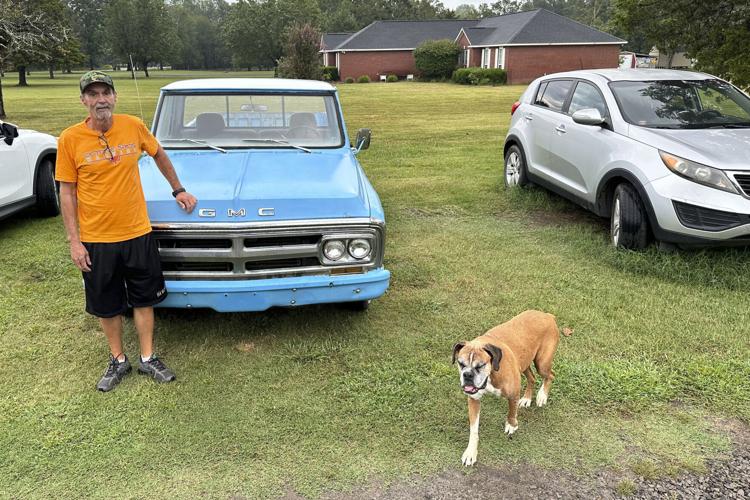
Ricky Dority poses for a photo with his 1969 GMC pickup and his family dog "Boots" on Sept. 22 outside his family's home in Greenwood, Ark.
It's a jarring change from where he was just several months ago, locked in a cell serving a life prison sentence at Oklahoma's Joseph Harp Correctional Center for a killing he said he didn't commit. After more than two decades behind bars, Dority had no chance at being released — until he used his pandemic relief funds to hire a dogged private investigator.
The investigator and students at the Oklahoma Innocence Project at Oklahoma City University, which is dedicated to exonerating wrongful convictions in the state, found inconsistencies in the state's account of a 1997 cold-case killing, and Dority's conviction was vacated in June by a Sequoyah County judge.
Now, the 65-year-old says he’s enjoying the 5-acre property in a quiet neighborhood of well-to-do homes in the rolling, forested hills of the Arkansas River Valley outside of Fort Smith. “If you’re gone for a lot of years, you don’t take it for granted anymore.”
People are also reading…
Dority is one of nearly 3,400 people who have been exonerated across the country since 1989, mostly over murder convictions, according to the National Registry of Exonerations. In Oklahoma, there have been more than 43 exonerations in that time, not including three new exonerations this year.
The cases underscore a serious problem facing a judicial system in which many old convictions resulted from overworked defense attorneys, shoddy forensic work, overzealous prosecutors and outdated investigative techniques.
The problem is particularly acute given Oklahoma's history of sending people to death row, where 11 inmates have been exonerated since 1981. The issue has pushed a Republican-led legislative panel to consider whether a death penalty moratorium should be imposed.
In Oklahoma County, Glynn Ray Simmons was freed after spending nearly 50 years in prison, including time on death row, in a 1974 killing after a judge determined prosecutors failed to turn over evidence in the case, including a police report that showed an eyewitness might have identified other suspects.
And just this week, Perry Lott, who served more than 30 years in prison, had his rape and burglary conviction vacated in Pontotoc County after new DNA testing excluded him as the perpetrator. Pontotoc County, in particular, has come under intense scrutiny for a series of wrongful convictions in the 1980s that have been the subject of numerous books, including John Grisham’s “The Innocent Man,” which he produced into a six-part documentary on Netflix.
The most common causes of wrongful convictions are eyewitness misidentification, misapplication of forensic science, false confessions, coerced pleas and official misconduct, generally by police or prosecutors, according to the Innocence Project, a national organization based in New York.
In Dority's case, he said he was railroaded by an overzealous sheriff and a state prosecutor eager to solve the killing of 28-year-old Mitchell Nixon, who was found beaten to death in 1997.
Investigators who reopened the case in 2014 coerced a confession from another man, Rex Robbins, according to Andrea Miller, the legal director of the Oklahoma Innocence Project. Robbins, who would plead guilty to manslaughter in Nixon's killing, implicated Dority, who at the time was in a federal prison on a firearms conviction. Dority said he knew he didn't have anything to do with the crime and found paperwork that proved he had been arrested on the day of the killing.
“I thought I was clear because I knew I didn’t have anything do with that murder,” Dority said. “But they tried me for it and found me guilty of it.”
Jurors heard about Robbins' confession and testimony from a police informant who said Dority had changed bloody clothes at his house the night of the killing. They convicted him of first-degree murder and recommended a sentence of life without parole.

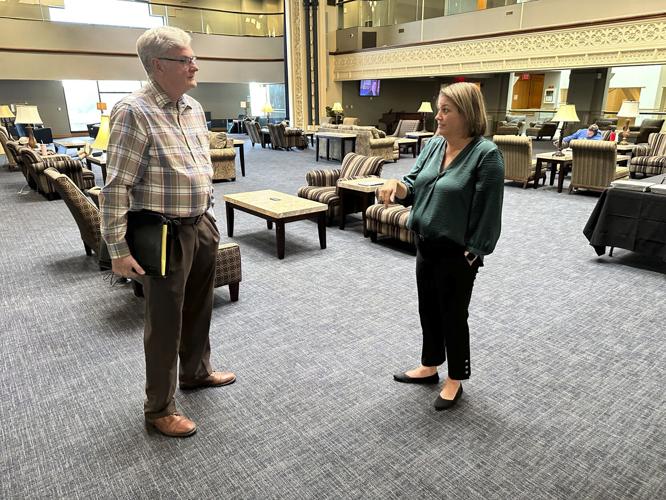
Private investigator Bobby Staton, left, speaks to Andrea Miller, director of Oklahoma City University's Innocence Project, on Sept. 19 in Oklahoma City.
After years in prison, while most inmates spent their federal COVID-19 relief check in the commissary, Dority used his to hire a private investigator, he said. Bobby Staton had mostly investigated insurance fraud, but he took on the case and realized quickly that it was riddled with holes, Staton said.
He eventually turned to the university's Oklahoma Innocence Project, which assigned a law student, Abby Brawner, to help investigate.
Their investigation turned when Staton and Brawner visited Robbins in the maximum-security Oklahoma State Reformatory in Granite, and he recanted his statement implicating Dority.
“It was pretty intimidating,” Brawner said. “Especially when you're going in to meet someone who doesn't know you're coming and doesn't want to talk to you.”
Brawner and Staton also learned the informant didn't live at the home where he told investigators Dority showed up in bloody clothes. When the actual homeowner testified at a hearing this summer, the judge dismissed the case.
Sequoyah County District Attorney Jack Thorp and former Sheriff Ron Lockhart did not respond to requests for comment from The Associated Press. But Assistant District Attorney James Dunn, who is overseeing the case and was not in the office when it was originally prosecuted, said he agreed with the judge's dismissal after hearing the homeowner's testimony and learning a witness “was not credible.”
“The last thing I want to see is an innocent person in prison for a crime they didn't commit," Dunn said. "Because that means the person who actually did commit the crime, or those persons, are still out there.”
Three Baltimore men freed from prison 36 years after they were wrongfully convicted of murder
Intro
Three Baltimore men who spent 36 years in prison were released Monday after authorities say they were falsely convicted of a 1983 murder.
Alfred Chestnut, Ransom Watkins and Andrew Stewart were granted a writ of innocence after being convicted of first-degree murder of a middle school student, DeWitt Duckett.
"That was hell," Chestnut said of his experience in jail. "That was miserable."
Chestnut and Watkins were 16 at the time of their arrest and Stewart was 17. The men are now in their early fifties preparing to enter adulthood on the outside for the first time. At least two have never driven a car before.
After Chestnut filed an information request this past spring, he discovered new evidence that was kept from his attorneys during trial. He reached out to Baltimore's Conviction Integrity Unit, which was reviewing old convictions.
Chestnut has maintained his innocence since his arrest. The parole board denied his early release at least in part because he refused to admit responsibility for the shooting, the state's attorney said.
He wasn't just seeking justice for himself, he told CNN.
"Whatever I did for myself, I did for them too," Chestnut said of Watkins and Stewart.
The crime

In this Oct. 23, 2019, file photo, Maryland State Attorney Marilyn Mosby, left, speaks during a viewing service for the late U.S. Rep. Elijah Cummings at Morgan State University in Baltimore. (AP Photo/Julio Cortez, File)
Duckett, 14, was shot and killed for his coveted Georgetown University basketball jacket in November 1983, police said.
The three teenagers had been skipping high school classes to visit former teachers at Harlem Park Junior High. Their teachers said they were being "silly," but not threatening. School security escorted them off campus about half an hour before the murder occurred, according to a joint petition filed by the men and Baltimore City State's Attorney Marilyn Mosby.
They were convicted based on witness testimony and what prosecutors at the time said was a crucial piece of evidence -- a Georgetown jacket found in Chestnut's bedroom.
However, Chestnut's jacket had no blood or gunshot residue. His mother was able to produce a receipt, and a store clerk testified that she had purchased it recently, the joint petition said.
CNN could not immediately locate the homicide detective involved in the case, Donald Kincaid, for comment. The assistant state's attorney at the time has since died.
The three teenagers were each arrested Thanksgiving morning, waking up with police with guns drawn on them, Watkins' lawyer told CNN.
Evidence hidden from the defense

Alfred Chestnut, Ransom Watkins and Andrew Stewart were granted a writ of innocence after being convicted of first-degree murder of a middle school student, DeWitt Duckett.
Lawyers involved in the case said they were "horrified" to see the amount of exculpatory evidence that was hidden from the defense team and jury. Both the suspects and trial witnesses, all minors, were interrogated by police without their parents. Potential witnesses were interviewed in a group and told to "get their story together," according to Chestnut's lawyers.
"We have intentional concealment and misrepresentation of the exculpatory evidence, evidence that would have showed that it was someone else other than these defendants," Mosby said.
Anonymous calls identifying another shooter were kept from the defense, Mosby said. That teenager was seen after the shooting wearing what appeared to be Duckett's jacket and confessing to the murder, she said.
That suspect has since died. All trial witnesses have since recanted, Mosby said.
The official apology
Mosby sat down with the men Friday and apologized, informing them that they would be freed.
"I don't think that today is a victory, it's a tragedy. And we need to own up to our responsibility for it," Mosby said. "There's no way we can repair the damage to these men, when 36 years of their life were stolen from them."
"You were all arrested on Thanksgiving 1983. Now you are free to spend the holidays with your loved ones for the first time in 36 years," Mosby said in a press conference.
Mosby added that Maryland currently has no formal system of compensation for those falsely convicted of a crime.

Now, she plans to advocate for laws that would establish a system of compensation for those falsely convicted, and formally require minors to have a parent in the room while being questioned by police. She has started Resurrection After Exoneration, which will offer medical help and guidance as exonerated people reintegrate to society.
Lawyers for Chestnut and Stewart said they planned to spend Thanksgiving with their respective families. Watkins's mother died before his arrest and most of his immediate family died while he was incarcerated. His lawyer said he would be spending Thanksgiving with loved ones.
Chestnut plans on spending quiet time readjusting to life with his family and fiancé.
"It's a lot of guys that I left behind, that are in the same situation that I'm in," Chestnut said. "They need a voice. I had an opportunity, by the grace of God, to have someone who heard me."