DUBAI — Iran is considering attending peace talks with the United States in Pakistan, a senior Iranian official told Reuters on Monday, following moves by Islamabad to end a U.S. blockade of Iran's ports, a major hurdle for Tehran to rejoin peace efforts.
However, the official stressed that no decision was made.
Adding to the uncertainty, a source told Reuters that Vice President JD Vance was still in the U.S., denying reports that he was already on his way to Pakistan's capital Islamabad for talks.
With a two-week ceasefire set to expire this week, the senior Iranian official said Tehran was "positively reviewing" its participation but no final decision had been made. The comments conveyed a clear change of tone from earlier statements ruling out attendance and pledging to retaliate for U.S. aggression.
The Iranian official said mediator Pakistan made positive efforts to end the U.S. blockade and ensure Iran's participation.
People are also reading…

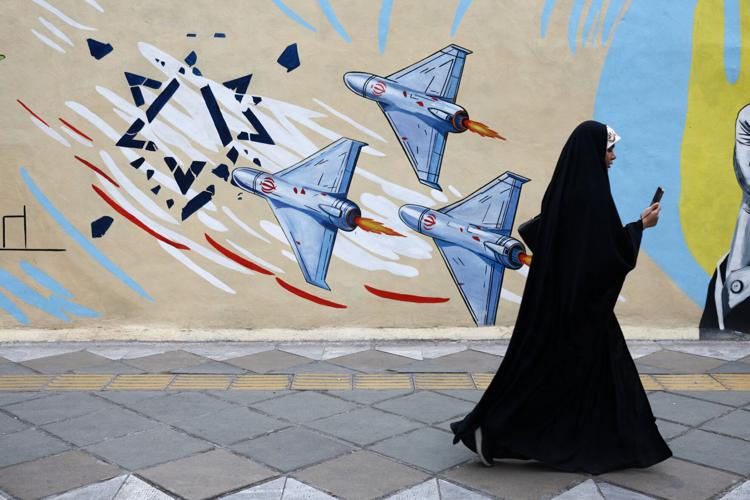
A woman walks next to an anti-Israeli mural Monday amid a ceasefire between U.S. and Iran, in Tehran, Iran.
Blockade a problem
The ceasefire had appeared in jeopardy after the U.S. said it seized an Iranian cargo ship that tried to run its blockade and Tehran vowed to retaliate.
A Pakistani security source said Pakistan's key mediator, Field Marshal Asim Munir, told U.S. President Donald Trump the blockade was an obstacle to talks, and that Trump promised to consider ending it.
The U.S. hoped to start negotiations in Pakistan shortly before the ceasefire expires, with sweeping security preparations under way in Islamabad.
However, Iran's President Masoud Pezeshkian said that "unconstructive & contradictory signals from American officials carry a bitter message; they seek Iran's surrender."
"Iranians do not submit to force," he added on social media.

A veteran from the group About Face holds a symbolic burial flag Monday to honor the dead as police arrest him during a protest against the Iran war in the Cannon House Office Building Rotunda on Capitol Hill in Washington.
Ceasefire to expire
Trump announced the two-week ceasefire with Iran on April 7, and didn't specify when precisely it ends.
A Pakistani source involved in the talks said it would expire at 8 p.m. ET on Wednesday, which would be midnight GMT or 3:30 a.m. Thursday in Iran.
The U.S. maintained its blockade of Iranian ports, while Iran lifted and then reimposed its own blockade of the Strait of Hormuz, which typically handles roughly one-fifth of the world's oil and liquefied gas supply.
Oil prices rose about 5% as traders remained fearful that the ceasefire would collapse. Traffic through the Strait of Hormuz was at a virtual standstill with just three crossings in the space of 12 hours, according to shipping data.
Trump said Monday he believed a nuclear deal the U.S. is negotiating with Iran will be better than a 2015 international agreement to limit Tehran's nuclear program.
"The DEAL that we are making with Iran will be FAR BETTER than the JCPOA, commonly referred to as 'The Iran Nuclear Deal,'" Trump wrote in a social media post after concerns expressed by Democrats and some nuclear experts that he is rushing negotiations on a highly complex topic.
During his first White House term, Trump withdrew from the Joint Comprehensive Plan of Action agreed to by Iran, the United States and world powers, calling it "the worst deal ever."

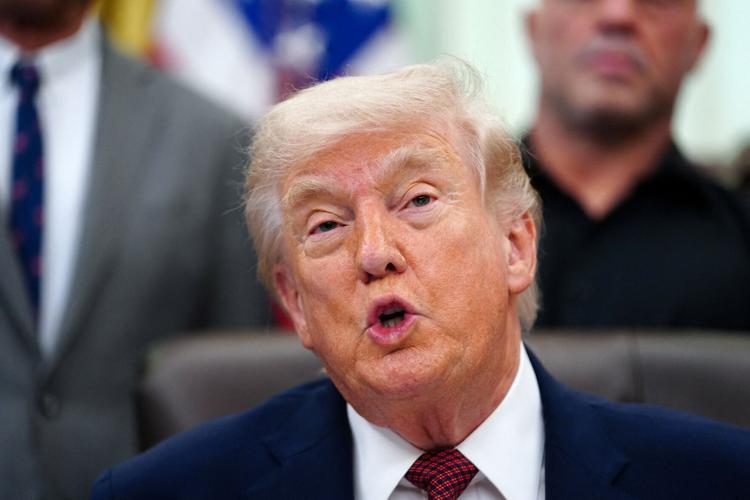
President Donald Trump speaks Saturday about research into mental health treatments in the Oval Office of the White House in Washington.
Marines board vessel
The U.S. military said it had fired on an Iranian-flagged cargo ship headed towards Iran's Bandar Abbas port on Sunday after a six-hour standoff, disabling its engines. U.S. Central Command released video showing
Marines descending ropes from helicopters onto the vessel.
The vessel is likely to have been carrying what Washington deems dual-use items that could be used by the military, maritime security sources said on Monday.
Iran's military said the ship had been traveling from China and accused the U.S. of "armed piracy," according to state media. They said they were ready to confront U.S. forces over the "blatant aggression," but were constrained by the presence of crew members’ families on board.
China, the main buyer of Iranian crude, expressed concern over the "forced interception," and Chinese President Xi Jinping called for ships to resume passage through the strait as normal and for the conflict to be resolved through political and diplomatic channels, state news agency Xinhua reported.
Trump warned Sunday that the U.S. would destroy every bridge and power plant in Iran if it rejected his terms, continuing a recent pattern of such threats.
Iran has said that if the United States were to attack its civilian infrastructure, it would strike power stations and desalination plants in its Gulf Arab neighbors.

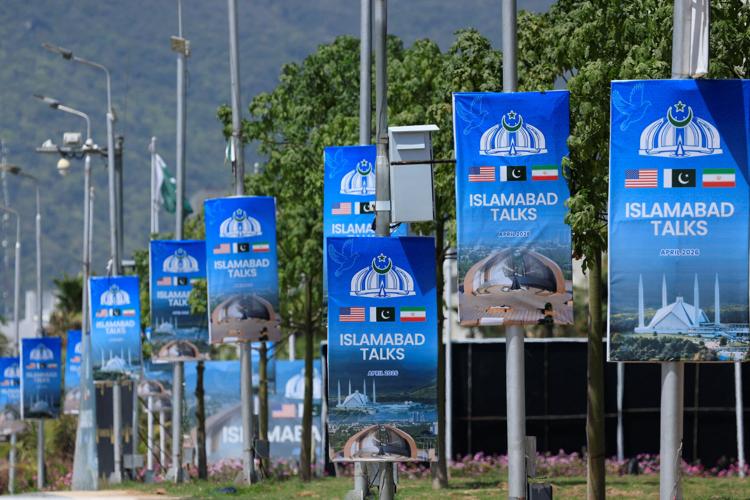
Signs are mounted on lamp posts Monday as Pakistan prepares to host the United States and Iran for a possible second phase of peace talks in Islamabad, Pakistan.
Preparing for talks
Pakistan geared up to host the talks despite uncertainty over whether they would go ahead. Nearly 20,000 security personnel have been deployed across the capital Islamabad, a government official and a security official said.
Thousands of people have been killed by U.S.-Israeli strikes on Iran and in an Israeli invasion of Lebanon conducted in parallel since the war began Feb. 28. Washington will host a second round of ambassador-level talks between Lebanon and Israel on Thursday as part of efforts to protect a fragile ceasefire.