WASHINGTON — Alexander Butterfield, the White House aide who inadvertently hastened Richard Nixon's resignation over the Watergate scandal when he revealed that the president had bugged the Oval Office and Cabinet Room and routinely recorded his conversations, has died. He was 99.
His death was confirmed to The Associated Press by his wife, Kim, and John Dean, who served as White House counsel to Nixon during the Watergate scandal and went on to, along with Butterfield, help expose the wrongdoing.

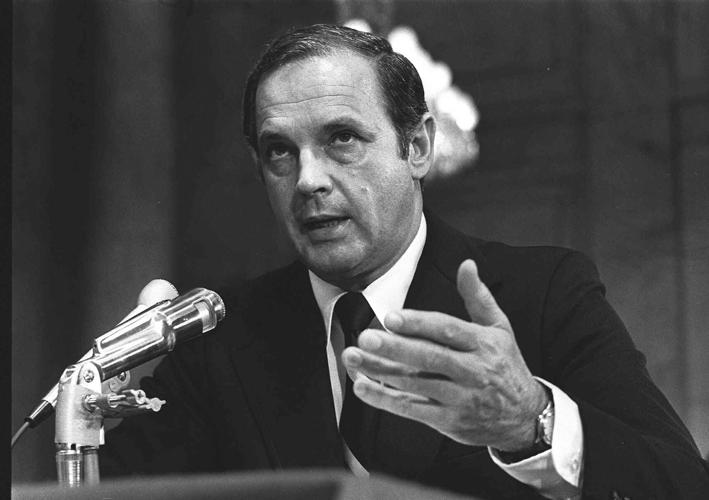
Alexander Butterfield testifies July 16, 1973, before the Senate Watergate Committee. Butterfield, the White House aide who inadvertently hastened Richard Nixon’s resignation over the Watergate scandal when he revealed that the president had bugged the Oval Office and Cabinet Room and routinely recorded his conversations, has died. He was 99.
Associated Press"He had the heavy responsibility of revealing something he was sworn to secrecy on, which is the installation of the Nixon taping system," Dean said. "He stood up and told the truth."
As a deputy assistant to the president, Butterfield oversaw the taping system connected to voice-activated listening devices that had been secretly placed in four locations, including Nixon's office in the Executive Office Building and the presidential retreat at Camp David.
Butterfield later said that, besides himself and the president, he believed that only White House chief of staff H.R. Haldeman, a Haldeman assistant and a handful of Secret Service agents knew about the taping system.
"Everything was taped … as long as the president was in attendance," Butterfield told Watergate investigators when testifying under oath during a preliminary interview.
The tapes would expose Nixon's role in the cover-up that followed the burglary in 1972 at the Democratic Party headquarters at the Watergate building. To avoid impeachment by the House, Nixon resigned on Aug. 9, 1974, less than a month after the Supreme Court had ordered him to surrender the relevant tapes to the Watergate special prosecutor.
Butterfield, a college friend of Haldeman's at UCLA who had contacted his friend to ask about opportunities in the new Nixon administration, served as a deputy assistant to Nixon from 1969 to 1973. In that capacity he worked under Haldeman and, among other duties, was secretary to the Cabinet and helped oversee White House operations.
The Air Force veteran had left the White House to become administrator of the Federal Aviation Administration when Senate committee staffers privately questioned him on July 13, 1973, during their investigation of the Watergate break-in. A routine question about the possibility of a taping system had been prompted by former White House counsel John Dean's testimony that he believed a conversation he had had with Nixon may have been recorded.
When Butterfield acknowledged that a taping system indeed existed, he was brought before a public hearing of the Senate Select Committee on Presidential Campaign Activities. The public revelation on July 16, 1973, of a taping system designed to record all the president's conversations stunned Nixon friends and foes alike. The tapes promised Watergate investigators a rich vein of evidence in their quest for determining what Nixon and others knew about the break-in — a great deal, as it turned out.
Efforts by investigators to gain access to the tapes sparked a yearlong legal battle that was resolved in July 1974 when the Supreme Court ruled unanimously that Nixon had to give them up.
The thousands of hours of tapes made public over the years — they are now controlled by the National Archives — provide a unique if often unflattering view of Nixon. His words exposed a bad temper, vulgar language, bigoted racial and religious views, and unvarnished opinions about national and international figures.
"I guess I didn't foresee that the president might be put out of office or impeached, but I thought it would be a perilous few years for him," Butterfield told the Nixon Library. "I guess I couldn't conceive of (Nixon) being forced out of office. It had never happened before."
Butterfield later said he believed that Nixon's successor, President Gerald Ford, fired him as FAA administrator in 1975 as part of an agreement worked out between the Nixon and Ford staff members. He said he had heard from White House friends that he had been targeted shortly after his testimony to the Senate committee.

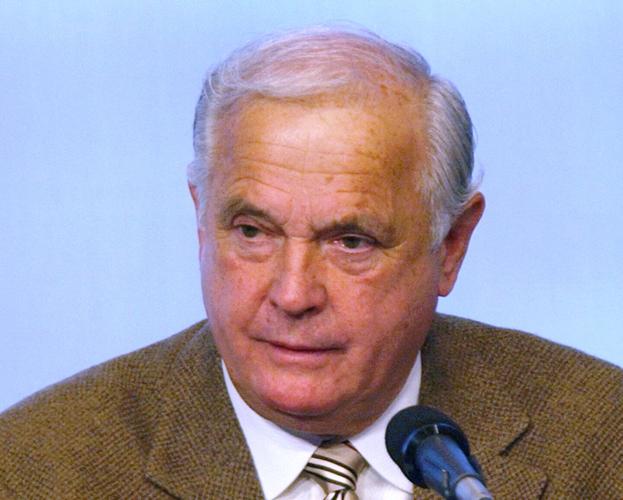
Alexander Butterfield, former deputy assistant to President Nixon, speaks during the Presidential Tapes Conference at the John F. Kennedy Library and Museum in Boston, Feb. 16, 2003. Butterfield, the White House aide who inadvertently hastened Richard Nixon’s resignation over the Watergate scandal when he revealed that the president had bugged the Oval Office and Cabinet Room and routinely recorded his conversations, has died. He was 99.
Chitose Suzuki, Associated PressAfter leaving the FAA, Butterfield worked as a business executive in California. He earned a master's degree from the University of California, San Diego, in 1994. He also received a bachelor's degree from the University of Maryland in 1956 and a master's degree from George Washington University in 1967.
In 1948, he joined the Air Force and served as an instructor at a base near Las Vegas during the Korean War and later served in Germany. In Washington, he was military assistant to the special assistant of the defense secretary in 1965 and 1966 and later served as senior military representative of the U.S. and representative for the commander-in-chief, Pacific Forces, Australia. He retired at the rank of colonel after 20 years in the Air Force.
Butterfield was unsparing in his criticism of the former president in later years. While he commended Nixon's achievements in foreign affairs, he considered his former boss "not an honest man" and "a crook" and believed that Nixon knew about the Watergate break-in before it occurred and was the architect of the ensuing cover-up.
Butterfield found himself "cheering … just cheering" the day Nixon resigned, he told the Nixon Library, because "justice had prevailed."
"I didn't think that it would for a while," he said. "This guy was the ringleader."
WATERGATE SCANDAL
- ASSOCIATED PRESS
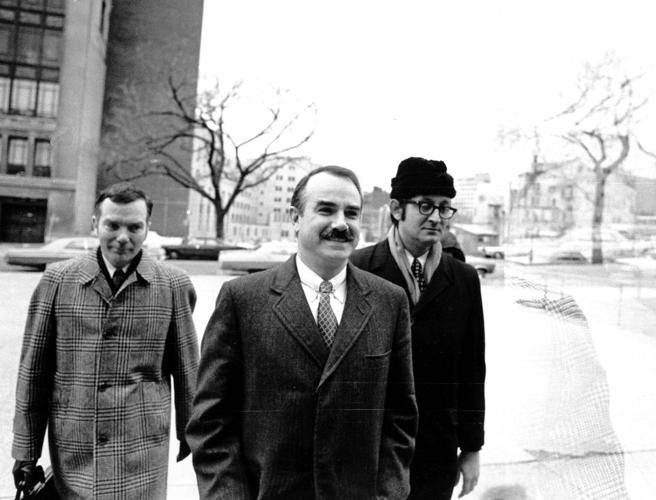
Three of the seven defendants, including G. Gordon Liddy, center, charged in connection with the break-in and alleged bugging of Democratic headquarters arrive at U.S. District Court for the start of their trial on Jan. 8, 1973. Others are unidentified. (AP Photo)
WATERGATE SCANDAL
- ASSOCIATED PRESS
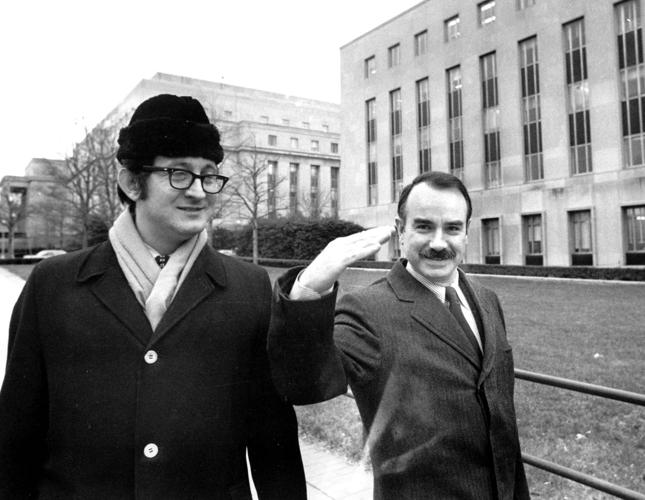
G. Gordon Liddy, 42, renders a salute on arrival at the U.S. District Court for appearance in connection with the Watergate trial on Jan. 15, 1973. It was understood that Liddy and another defendant were standing firm in their determination to go through with the political espionage trial. Other person is not identified. (AP Photo)

Edward M. Kennedy
- Anonymous
Sen.Edward M. Kennedy, (D-Mass)., levels charges at the Nixon administration in Indianapolis Friday, Oct. 7, 1972, during an outdoors rally. Kennedy echoed charges of corruption made by George McGovern Friday. Kennedy cited a campaign slush fund, the Soviet Grain deal, the Watergate affair, and others in his "corrupation" charge. Kennedy ended a five-city tour of Indiana with the Indianapolis rally. (AP Photo)

Alfred C. Baldwin III
- AP
Alfred C. Baldwin III, former FBI agent who said he monitored telephones as a spy for President Nixon's campaign committee, turns to talk with the reporters as he arrived Jan. 18, 1973, to testify for the prosecution in the Watergate trial in Washington. (AP Photo)
Mitchell
- RAY STUBBLEBINE
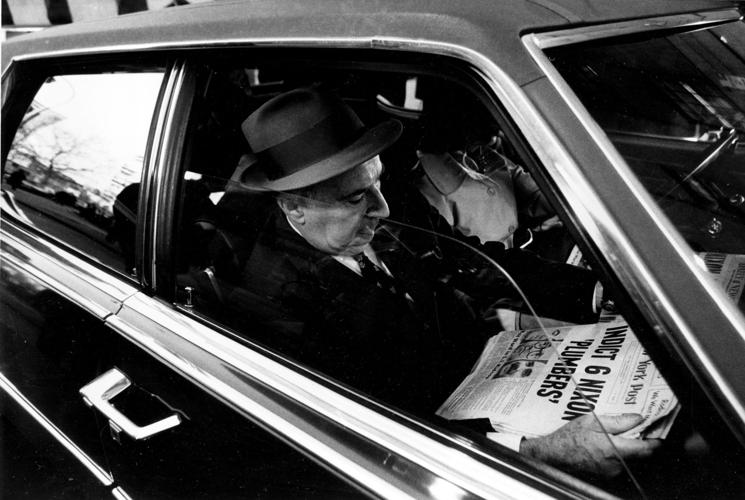
Former U.S. Attorney General John N. Mitchell reads newspaper front page headline, "Indict 6 Nixon Plumbers," inside his car as he leaves U.S. District Court in New York City, March 7, 1973. Mitchell is on trial for criminal conspiracy in the Watergate scandal. (AP Photo/Ray Stubblebine)
NIXON
- CHARLES TASNADI
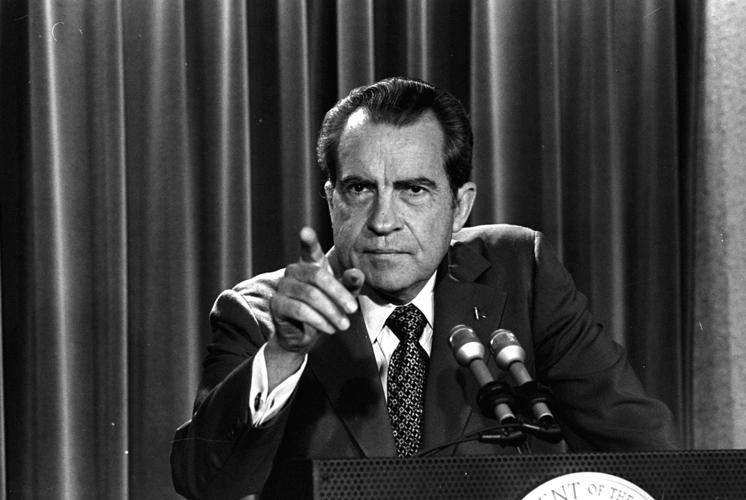
President Nixon tells a White House news conference, March 15, 1973, that he will not allow his legal counsel, John Dean, to testify on Capitol Hill in the Watergate investigation and challenged the Senate to test him in the Supreme Court. (AP Photo/Charles Tasnadi)
Senate Watergate Investigating committee
- ASSOCIATED PRESS
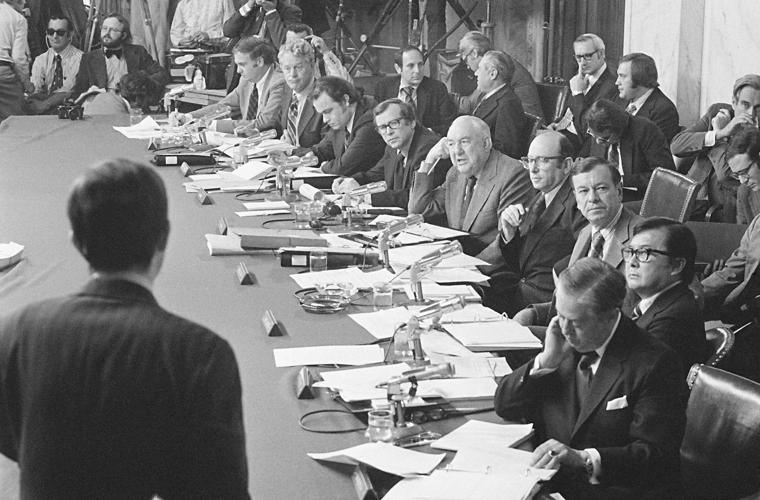
WASHINGTON, May 17, 1973- Members of the Senate Watergate Investigating committee in Washington, D.C., May 17, 1973, From left are; Sen. Lowell Weicker, R-Conn., Sen. Edward Gurney, R-Fla., Chief Minority Counsel Fred Thompson, Sen. Howard Baker, R-Tenn., Sen. Sam Ervin, D-N.C., Chairman, Chief counsel Samuel Dash, Sen, Herman Talmadge, D-Ga., Sen. Daniel Inouye, D-Hawaii and Sen. Joseph Montoya, D-N. Mexico. In foreground is witness Robert Odle. (AP Photo).
Senate Watergate Investigating committee
- ASSOCIATED PRESS
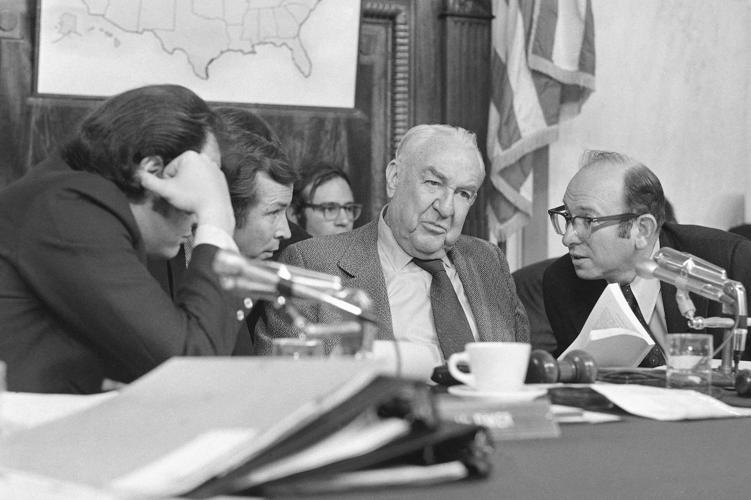
Senator Sam Ervin, D-N.C., chairman of the Watergate Investigating Committee, listens to other members of the committee Thursday May 18, 1973 during the first day of public hearings in Washington. They are, from left; Fred Thompson, chief minority couns. Sen. Howard Baker, R-Tenn., Ervin; and Samuel Dash, Chief majority. (AP Photo).
Senate Watergate Investigating committee
- AP
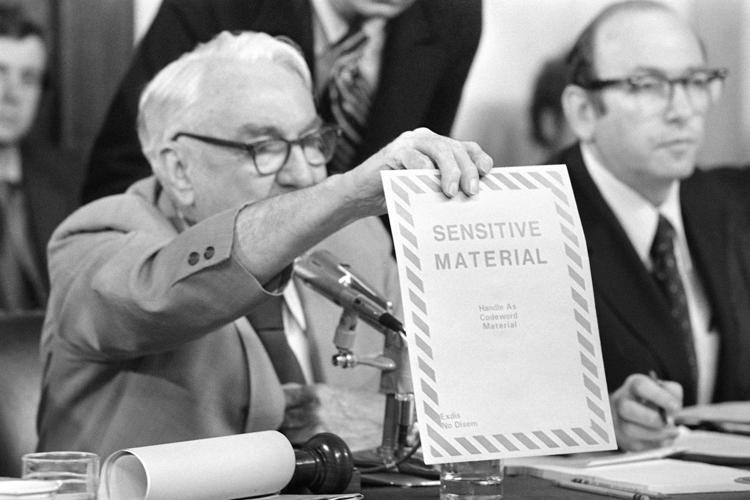
Chairman Sam Ervin, (D-N.C)., holds up "sensitive material" envelope Tuesday June 5, 1973 in the Senate Caucus Room during the testimony of Mrs. Sally J. Harmony before the Senate Watergate Committee. Ervin asked Mrs. Harmony if she could identify the envelope, she said she could not. (AP Photo).
Watergate Conference
- Anonymous
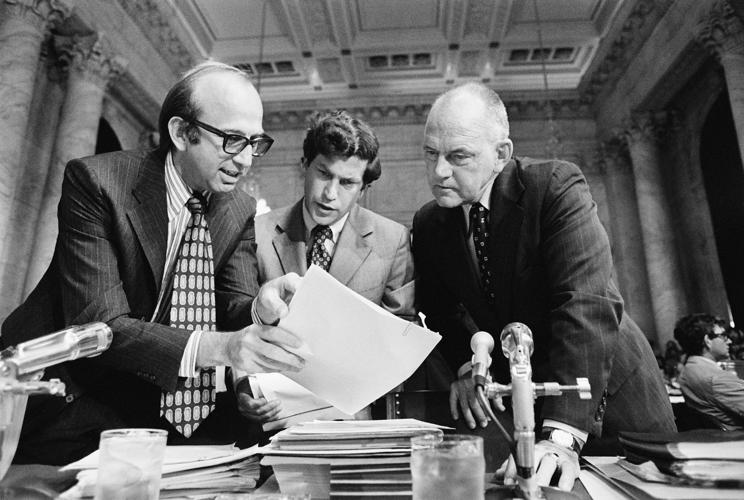
David Dorsen, assistant chief counsel, left, Stephen Sachs, attorney for Gray, and L. Patrick Gray III look over documents prior to Gray testifying before the Senate Watergate Committee Aug. 6, 1973 in Washington. (AP Photo)
WATERGATE COMPLAINT DOCUMENT
- ASSOCIATED PRESS
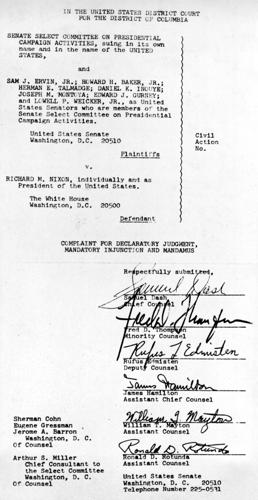
This photograph shows the first and last pages of the complaint filed in federal court in Washington, D.C., by the Senate Watergate Committee, Thursday, Aug. 9, 1973. The complaint names as defendant Richard M. Nixon, individually and as President of the United States. The signatures appear on the last page of the complaint. (AP Photo)
NIXON
- ASSOCIATED PRESS
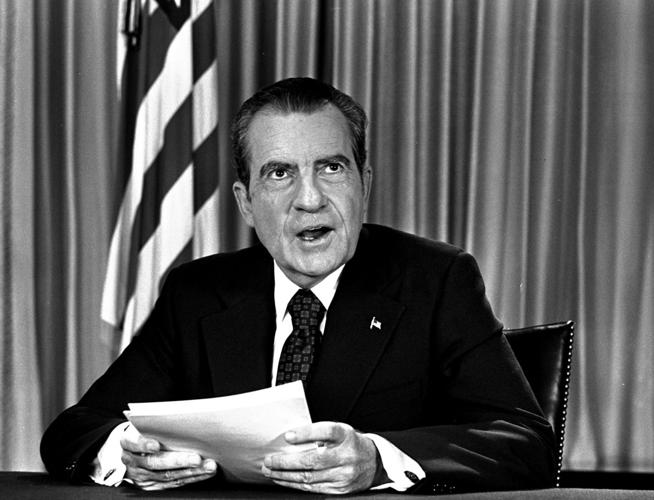
President Nixon sits in his White House office, August 16, 1973, as he poses for pictures after delivering a nationwide television address dealing with Watergate. Nixon repeated that he had no prior knowledge of the Watergate break-in and was not aware of any cover-up. (AP Photo/stf)
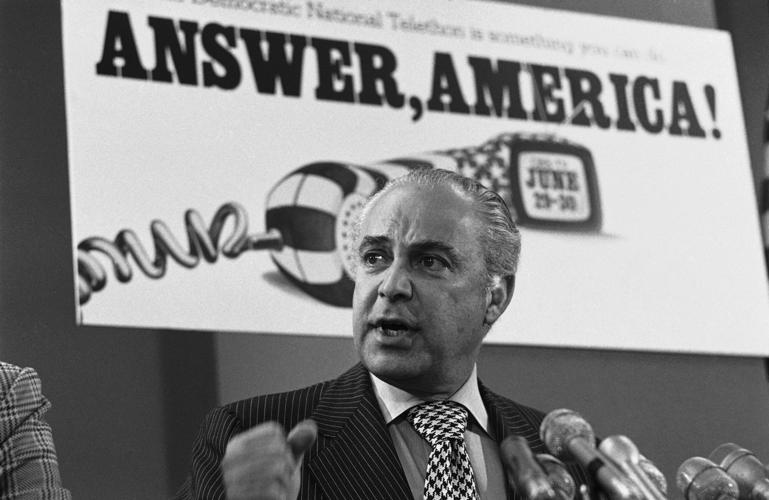
Robert S. Strauss
- Bob Daugherty
Democratic National Committee Chairman Robert S. Strauss tells newsmen in Washington on Wednesday, May 8, 1974, that the Democratic Party will hold another fund raising telethon in June. Strauss said party leaders had previously decided to stay away from President Richard Nixon's Watergate troubles and the impeachment move in the House but added, "We're rethinking that." (AP Photo/ Bob Daugherty)

WATERGATE
- ASSOCIATED PRESS
Pickets are shown marching outside the CBS Television studios in Washington, July 21, 1974, in protest over the network's handling of stories relating to the President. A spokesman for the pickets said the network did not report much of the good the President is doing, only problems he is having. (AP Photo)

Sen. Charles Percy
- Robert Child
U.S. Sen. Charles Percy, R-Ill., is shown at a news conference on Monday, May 7, 1973 in Bridgeport, Connecticut, where he said that he was pleased at the pending announcement by Attorney General designate Elliott Richardson that Richardson would appoint a special prosecutor in the Watergate investigation, and that the appointment of a special prosecutor was necessary to restore the public?s faith and confidence in government. Percy was in Bridgeport to address a meeting of the Connecticut Business and Industry Association. (AP Photo/Robert Child)
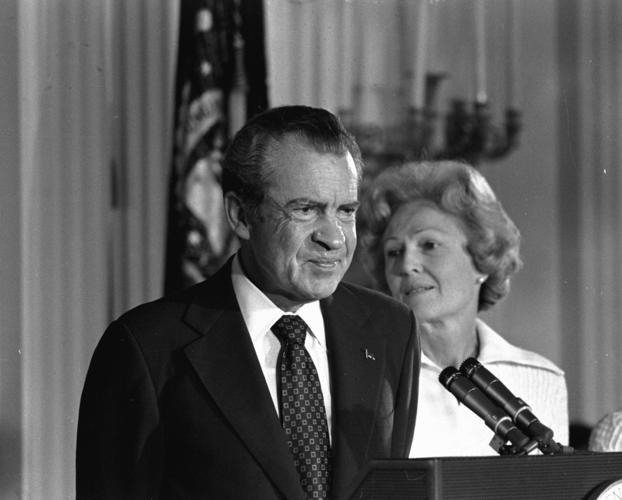
Richard M. Nixon, Pat Nixon
- Charlie Harrity
In this Aug. 9, 1974 black-and-white file photo, President Richard M. Nixon and his wife Pat Nixon are shown standing together in the East Room of the White House in Washington. Thirty-six years after Nixon testified secretly to a grand jury investigating Watergate, a federal judge ordered the first public release of the transcript. (AP Photo/Charlie Harrity, File)
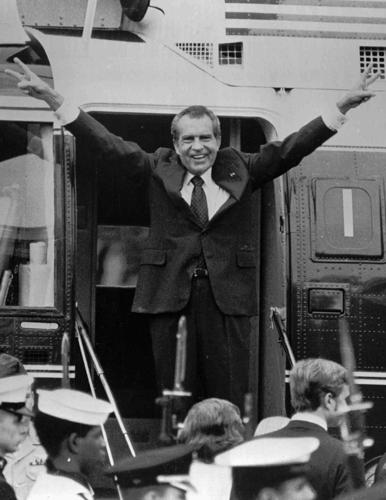
Richard Nixon
- BOB DAUGHERTY
FILE - In this Aug. 9, 1974, file photo, Richard Nixon says goodbye to members of his staff outside the White House in Washington as he boards a helicopter for Andrews Air Force Base after resigning the presidency in Washington. Nixon's grand jury testimony about the Watergate scandal that destroyed his presidency is finally coming to light. Four months after a judge ordered the June 1975 records unsealed, the government's Nixon Presidential Library was making them available online and at the California facility Thursday, Nov. 10, 2011. (AP Photo/Bob Daugherty, File)
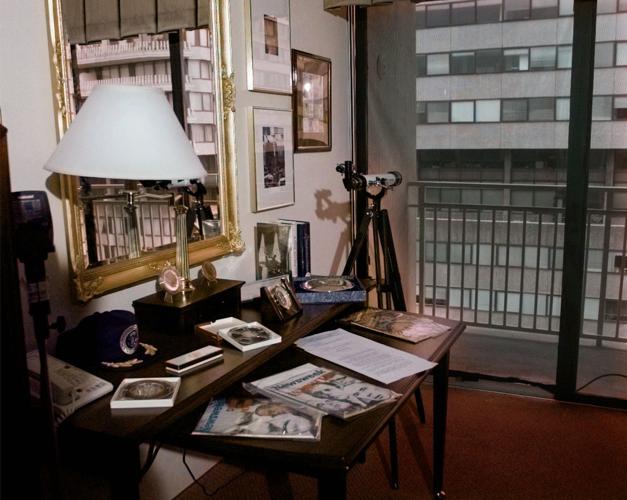
Watergate complex
- SUSAN WALSH
This is the the view of the Watergate complex, right, from room 723 of the former Howard Johnson Hotel in Washington Tuesday, June 17, 1997, on the 25th anniversary of the Watergate break-in, which led to the downfall of President Nixon. The room was used as a look-out during the break-in of the Democratic National Committee in the Watergate. (AP Photo/Susan Walsh)
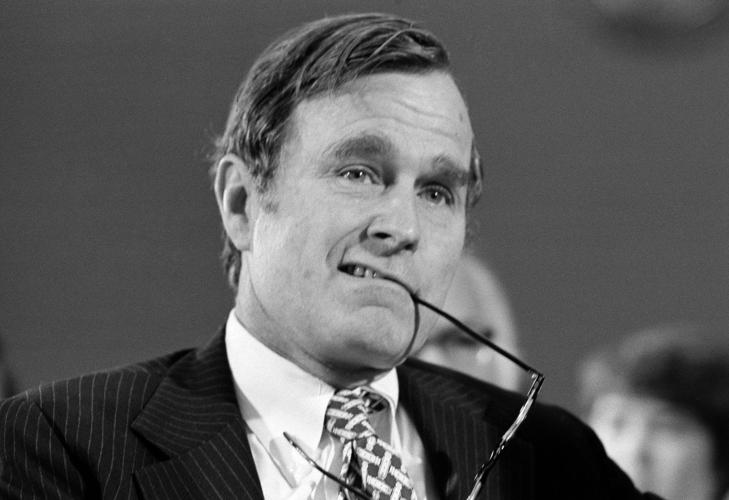
George H.W. Bush
- Bob Daugherty
Republican Party chairman George Bush calls a meeting of the Republican National Committee in Washington, April 26, 1973. He said he is still confident that President Nixon was not involved in any of the Watergate scandals. Bush said, "if I did not have confidence that President Nixon is telling the truth on Watergate, I would not stand here in this posture." (AP Photo/Bob Daugherty)
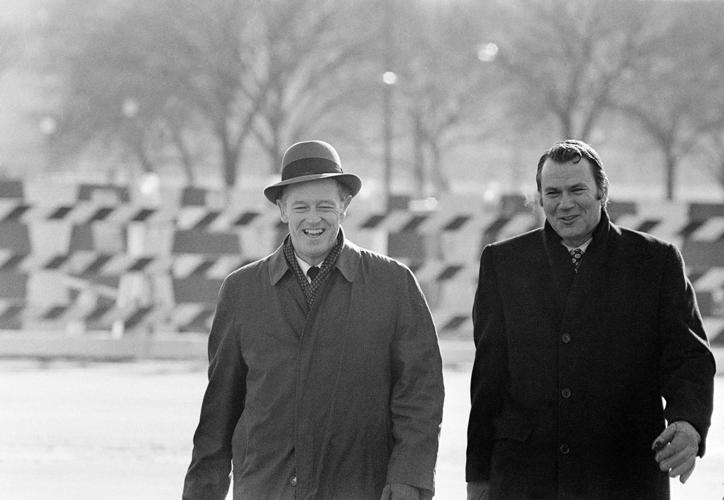
E. Howard Hunt Jr.
- William A. Smith
E. Howard Hunt Jr., Watergate political espionage defendant arrives at the U.S. District Court in Washington, Jan. 15, 1973. Hunt pleaded guilty last week. Earlier today four others pleaded guilty. Man at right is unidentified. (AP Photo/William A. Smith)
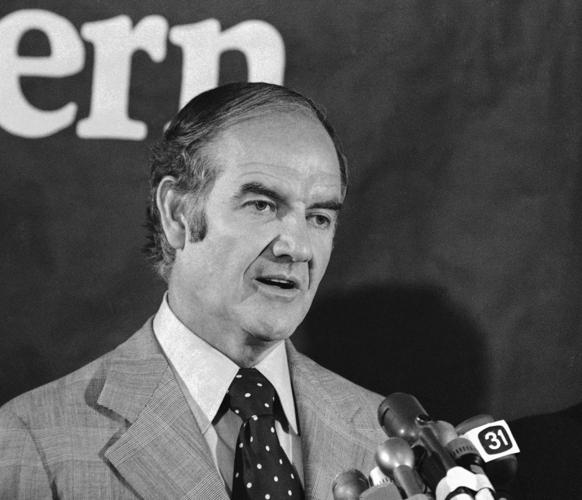
Sen. George McGovern
- Ray Stubblebine
Senator George McGovern denounced the weekend break-in at the democratic national committee headquarters in Washington by five men with bugging devices at news conference in New York on Monday, June 19, 1972. (AP Photo/ Ray Stubblebine)
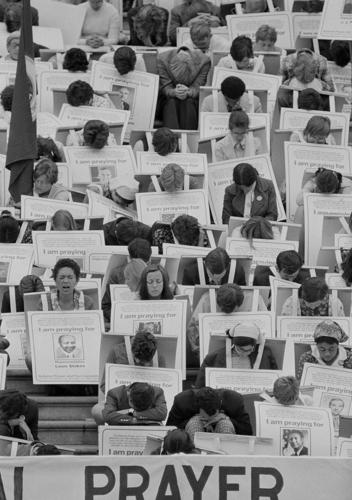
Richard Nixon, Richard M. Nixon, Richard Milhous Nixon
- Bob Daugherty
Supporters of President Nixon pray as they continue their fast and vigil as the House Judiciary Committee continues its impeachment inquiry, in Washington, D.C., July 23, 1974. The vigil was organized by supporters of the Rev. Sun Myung Moon of South Korea and the National Committee for Fairness to the Presidency, which is headed by Rabbi Baruch Korff. (AP Photo/Bob Daugherty)
FORD
- ASSOCIATED PRESS
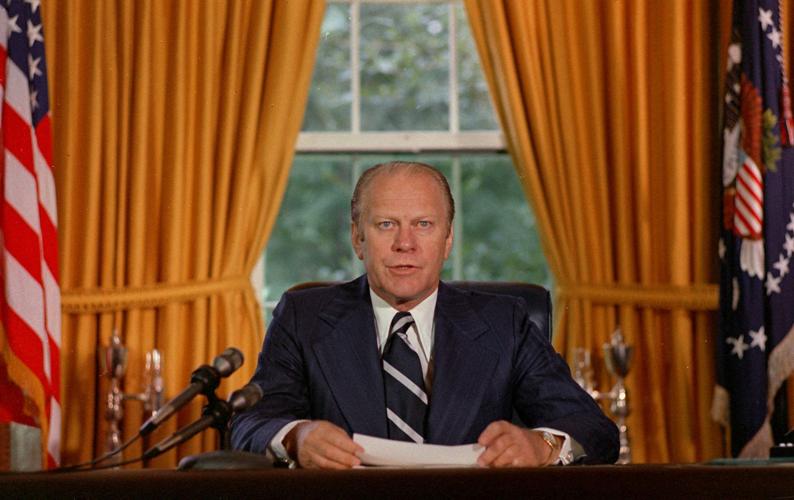
President Gerald Ford reads a proclamation in the White House on Sept. 8, 1974 granting former president Richard Nixon "a full, free and absolute pardon" for all "offenses against the United States" during the period of his presidency. (AP Photo)
Photos: Looking back at the Watergate scandal
President Donald Trump's surprise firing of FBI Director James Comey drew swift comparisons to the Nixon-era "Saturday Night Massacre." Both cases involve a president getting rid of an official leading an investigation that could ensnare the White House. As many people across the country contemplate the comparisons, here's a look back at the Watergate scandal in photos:
WATERGATE SCANDAL
- ASSOCIATED PRESS
Three of the seven defendants, including G. Gordon Liddy, center, charged in connection with the break-in and alleged bugging of Democratic headquarters arrive at U.S. District Court for the start of their trial on Jan. 8, 1973. Others are unidentified. (AP Photo)
WATERGATE SCANDAL
- ASSOCIATED PRESS
G. Gordon Liddy, 42, renders a salute on arrival at the U.S. District Court for appearance in connection with the Watergate trial on Jan. 15, 1973. It was understood that Liddy and another defendant were standing firm in their determination to go through with the political espionage trial. Other person is not identified. (AP Photo)
Edward M. Kennedy
- Anonymous
Sen.Edward M. Kennedy, (D-Mass)., levels charges at the Nixon administration in Indianapolis Friday, Oct. 7, 1972, during an outdoors rally. Kennedy echoed charges of corruption made by George McGovern Friday. Kennedy cited a campaign slush fund, the Soviet Grain deal, the Watergate affair, and others in his "corrupation" charge. Kennedy ended a five-city tour of Indiana with the Indianapolis rally. (AP Photo)
Alfred C. Baldwin III
- AP
Alfred C. Baldwin III, former FBI agent who said he monitored telephones as a spy for President Nixon's campaign committee, turns to talk with the reporters as he arrived Jan. 18, 1973, to testify for the prosecution in the Watergate trial in Washington. (AP Photo)
Mitchell
- RAY STUBBLEBINE
Former U.S. Attorney General John N. Mitchell reads newspaper front page headline, "Indict 6 Nixon Plumbers," inside his car as he leaves U.S. District Court in New York City, March 7, 1973. Mitchell is on trial for criminal conspiracy in the Watergate scandal. (AP Photo/Ray Stubblebine)
NIXON
- CHARLIE TASNADI
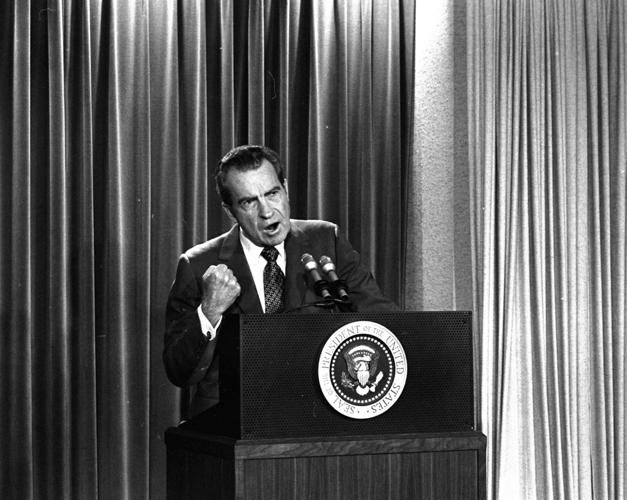
President Nixon tells White House newsmen, March 15, 1973, that he will not allow his legal counsel, John Dean, to testify on Capitol Hill on the Watergate investigation. (AP Photo/Charlie Tasnadi)
NIXON
- CHARLES TASNADI
President Nixon tells a White House news conference, March 15, 1973, that he will not allow his legal counsel, John Dean, to testify on Capitol Hill in the Watergate investigation and challenged the Senate to test him in the Supreme Court. (AP Photo/Charles Tasnadi)
WATERGATE SCANDAL
- ASSOCIATED PRESS
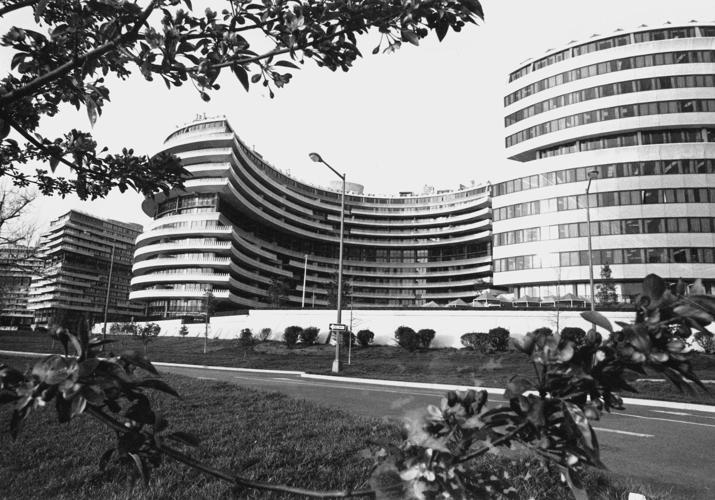
Democratic National Committee office in the luxurious Watergate complex in Washington, shown April 20, 1973. (AP Photo)
Watergate Woodward And Bernstein
- ASSOCIATED PRESS
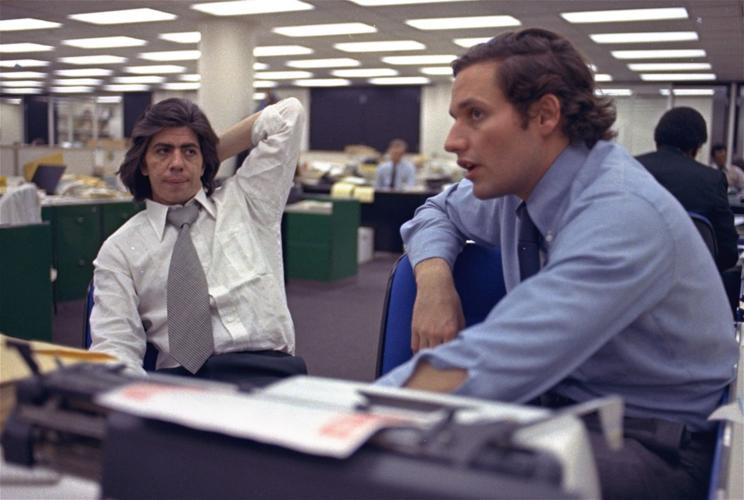
Reporters Bob Woodward, right, and Carl Bernstein, whose reporting of the Watergate case won them a Pulitzer Prize, sit in the newsroom of the Washington Post in Washington May 7, 1973. (AP Photo)
WATERGATE WOODWARD
- ASSOCIATED PRESS
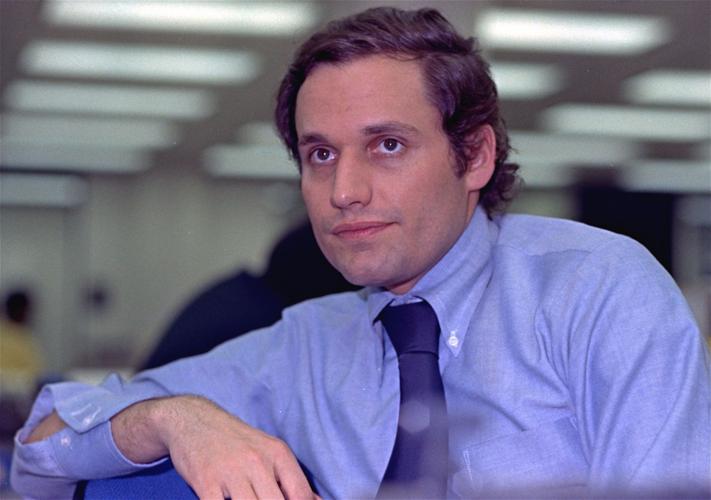
A May 7, 1973 close-up of reporter Bob Woodward, whose reporting of the Watergate case won a Pulitzer for the Washington Post. (AP Photo)
Senate Watergate Investigating committee
- ASSOCIATED PRESS
WASHINGTON, May 17, 1973- Members of the Senate Watergate Investigating committee in Washington, D.C., May 17, 1973, From left are; Sen. Lowell Weicker, R-Conn., Sen. Edward Gurney, R-Fla., Chief Minority Counsel Fred Thompson, Sen. Howard Baker, R-Tenn., Sen. Sam Ervin, D-N.C., Chairman, Chief counsel Samuel Dash, Sen, Herman Talmadge, D-Ga., Sen. Daniel Inouye, D-Hawaii and Sen. Joseph Montoya, D-N. Mexico. In foreground is witness Robert Odle. (AP Photo).
Senate Watergate Investigating committee
- ASSOCIATED PRESS
Senator Sam Ervin, D-N.C., chairman of the Watergate Investigating Committee, listens to other members of the committee Thursday May 18, 1973 during the first day of public hearings in Washington. They are, from left; Fred Thompson, chief minority couns. Sen. Howard Baker, R-Tenn., Ervin; and Samuel Dash, Chief majority. (AP Photo).
Senate Watergate Investigating committee
- AP
Chairman Sam Ervin, (D-N.C)., holds up "sensitive material" envelope Tuesday June 5, 1973 in the Senate Caucus Room during the testimony of Mrs. Sally J. Harmony before the Senate Watergate Committee. Ervin asked Mrs. Harmony if she could identify the envelope, she said she could not. (AP Photo).

Mitchell
- ASSOCIATED PRESS
Former Attorney General John N. Mitchell smokes a pipe as he listens to a question during his appearance before the Senate Watergate Committee in Washington, D.C., Tuesday, July 11, 1973. (AP Photo)
Watergate Conference
- Anonymous
David Dorsen, assistant chief counsel, left, Stephen Sachs, attorney for Gray, and L. Patrick Gray III look over documents prior to Gray testifying before the Senate Watergate Committee Aug. 6, 1973 in Washington. (AP Photo)
WATERGATE COMPLAINT DOCUMENT
- ASSOCIATED PRESS
This photograph shows the first and last pages of the complaint filed in federal court in Washington, D.C., by the Senate Watergate Committee, Thursday, Aug. 9, 1973. The complaint names as defendant Richard M. Nixon, individually and as President of the United States. The signatures appear on the last page of the complaint. (AP Photo)
NIXON
- ASSOCIATED PRESS
President Nixon sits in his White House office, August 16, 1973, as he poses for pictures after delivering a nationwide television address dealing with Watergate. Nixon repeated that he had no prior knowledge of the Watergate break-in and was not aware of any cover-up. (AP Photo/stf)
Robert S. Strauss
- Bob Daugherty
Democratic National Committee Chairman Robert S. Strauss tells newsmen in Washington on Wednesday, May 8, 1974, that the Democratic Party will hold another fund raising telethon in June. Strauss said party leaders had previously decided to stay away from President Richard Nixon's Watergate troubles and the impeachment move in the House but added, "We're rethinking that." (AP Photo/ Bob Daugherty)
WATERGATE
- ASSOCIATED PRESS
Pickets are shown marching outside the CBS Television studios in Washington, July 21, 1974, in protest over the network's handling of stories relating to the President. A spokesman for the pickets said the network did not report much of the good the President is doing, only problems he is having. (AP Photo)
ROSE MARY WOODS
- AP
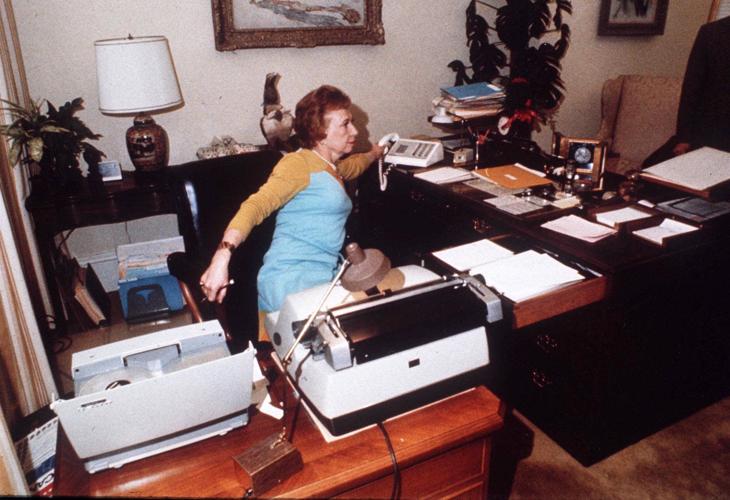
Rose Mary Woods, President Richard Nixon's secretary is shown at her White House desk in 1973, demonstrating the "Rose Mary Stretch" which could have resulted in the erasure of part of the Watergate tapes. (AP Photo)
Sen. Charles Percy
- Robert Child
U.S. Sen. Charles Percy, R-Ill., is shown at a news conference on Monday, May 7, 1973 in Bridgeport, Connecticut, where he said that he was pleased at the pending announcement by Attorney General designate Elliott Richardson that Richardson would appoint a special prosecutor in the Watergate investigation, and that the appointment of a special prosecutor was necessary to restore the public?s faith and confidence in government. Percy was in Bridgeport to address a meeting of the Connecticut Business and Industry Association. (AP Photo/Robert Child)

Thompson
- Anonymous
Sen. Fred D. Thompson, Chief Minority Counsel of the Senate Watergate Committee, is seen with Sen. Howard Baker (R-Tenn.), during the Watergate hearings in Washington, May 17, 1973. (AP Photo, File)
Thompson
- Anonymous
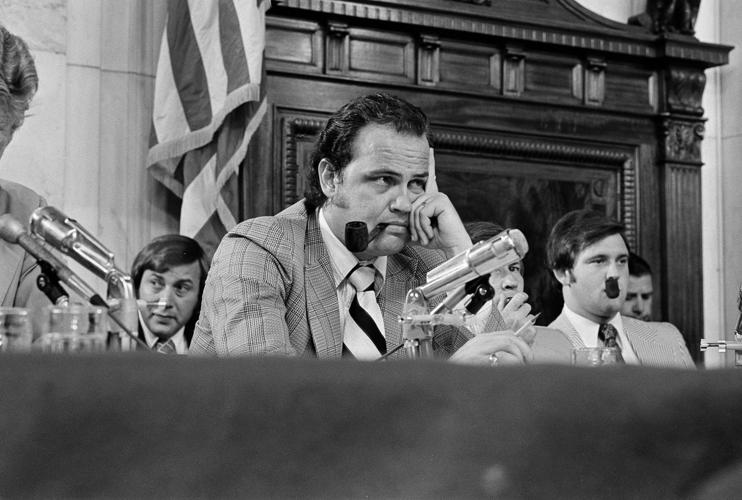
Sen. Fred Thompson, center, smokes a pipe as he listens to questions during the Senate Watergate Committee in Washington, July 11, 1973. Others are unidentified. (AP Photo)
Richard M. Nixon, Pat Nixon
- Charlie Harrity
In this Aug. 9, 1974 black-and-white file photo, President Richard M. Nixon and his wife Pat Nixon are shown standing together in the East Room of the White House in Washington. Thirty-six years after Nixon testified secretly to a grand jury investigating Watergate, a federal judge ordered the first public release of the transcript. (AP Photo/Charlie Harrity, File)
Richard Nixon
- BOB DAUGHERTY
FILE - In this Aug. 9, 1974, file photo, Richard Nixon says goodbye to members of his staff outside the White House in Washington as he boards a helicopter for Andrews Air Force Base after resigning the presidency in Washington. Nixon's grand jury testimony about the Watergate scandal that destroyed his presidency is finally coming to light. Four months after a judge ordered the June 1975 records unsealed, the government's Nixon Presidential Library was making them available online and at the California facility Thursday, Nov. 10, 2011. (AP Photo/Bob Daugherty, File)
Watergate complex
- SUSAN WALSH
This is the the view of the Watergate complex, right, from room 723 of the former Howard Johnson Hotel in Washington Tuesday, June 17, 1997, on the 25th anniversary of the Watergate break-in, which led to the downfall of President Nixon. The room was used as a look-out during the break-in of the Democratic National Committee in the Watergate. (AP Photo/Susan Walsh)
James McCord
- STF
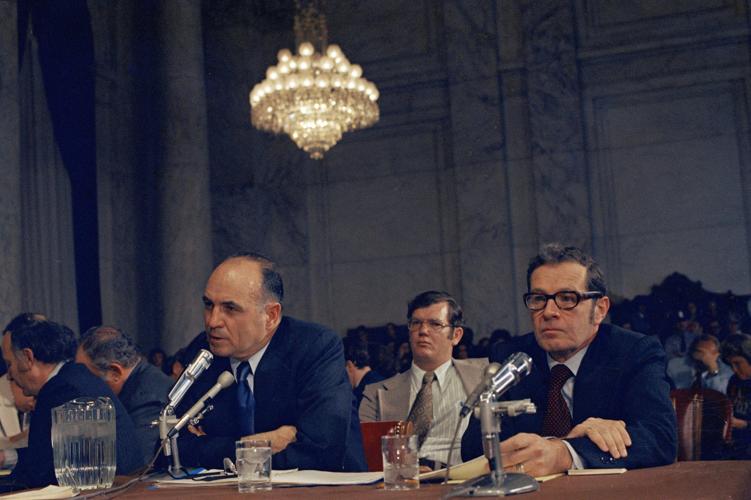
Watergate witness James McCord, left, testifies in the hearing of the Senate Select Committee on the Watergate case, May 22, 1973. (AP Photo)
Howard H. Baker
- STF
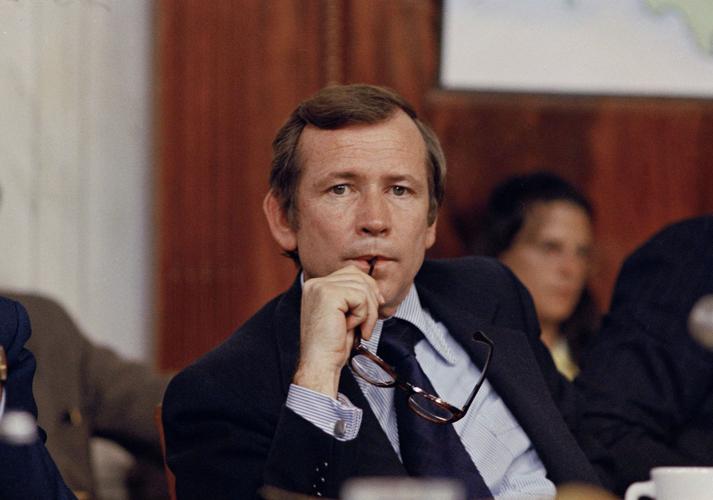
Sen. Howard H. Baker (R-Tenn.) is pictured at a hearing of the Senate Select committee on the Watergate case in Washington, May 18, 1973. (AP Photo)
George H.W. Bush
- Bob Daugherty
Republican Party chairman George Bush calls a meeting of the Republican National Committee in Washington, April 26, 1973. He said he is still confident that President Nixon was not involved in any of the Watergate scandals. Bush said, "if I did not have confidence that President Nixon is telling the truth on Watergate, I would not stand here in this posture." (AP Photo/Bob Daugherty)
Sally Harmony
- Henry Griffin
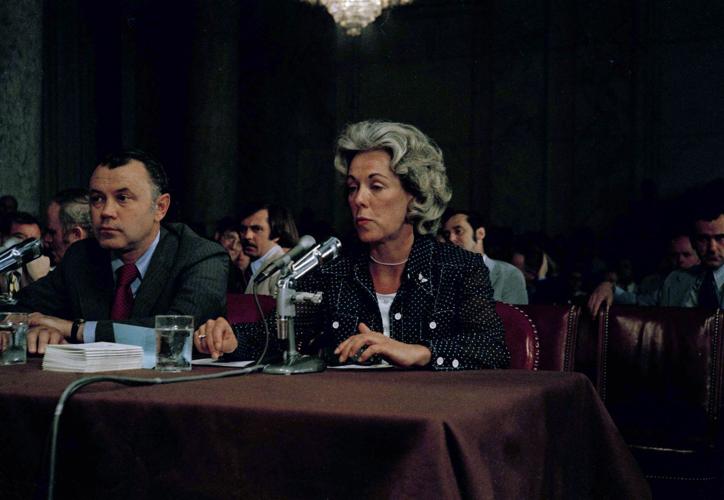
Watergate witness Sally Harmony, former secretary to G. Gordon Liddy, testifies in the Senate Select Committee hearings in Washington, June 5, 1973, in Washington, D.C. (AP Photo/Henry Griffin)
E. Howard Hunt Jr.
- William A. Smith
E. Howard Hunt Jr., Watergate political espionage defendant arrives at the U.S. District Court in Washington, Jan. 15, 1973. Hunt pleaded guilty last week. Earlier today four others pleaded guilty. Man at right is unidentified. (AP Photo/William A. Smith)
Sen. George McGovern
- Ray Stubblebine
Senator George McGovern denounced the weekend break-in at the democratic national committee headquarters in Washington by five men with bugging devices at news conference in New York on Monday, June 19, 1972. (AP Photo/ Ray Stubblebine)
Richard Nixon, Richard M. Nixon, Richard Milhous Nixon
- Bob Daugherty
Supporters of President Nixon pray as they continue their fast and vigil as the House Judiciary Committee continues its impeachment inquiry, in Washington, D.C., July 23, 1974. The vigil was organized by supporters of the Rev. Sun Myung Moon of South Korea and the National Committee for Fairness to the Presidency, which is headed by Rabbi Baruch Korff. (AP Photo/Bob Daugherty)
FORD
- ASSOCIATED PRESS
President Gerald Ford reads a proclamation in the White House on Sept. 8, 1974 granting former president Richard Nixon "a full, free and absolute pardon" for all "offenses against the United States" during the period of his presidency. (AP Photo)
Subscribe to stay connected to Tucson. A subscription helps you access more of the local stories that keep you connected to the community.
Obituaries Newsletter
Sign up to get the most recent local obituaries delivered to your inbox.