WASHINGTON — Bill Richardson, a two-term Democratic governor of New Mexico and an American ambassador to the United Nations who also worked for years to secure the release of Americans detained by foreign adversaries, has died at age 75.
The Richardson Center for Global Engagement, which he founded and led, said Saturday that he died in his sleep at his home in Chatham, Massachusetts.
"He lived his entire life in the service of others — including both his time in government and his subsequent career helping to free people held hostage or wrongfully detained abroad," said Mickey Bergman, the center's vice president. "There was no person that Gov. Richardson would not speak with if it held the promise of returning a person to freedom. The world has lost a champion for those held unjustly abroad and I have lost a mentor and a dear friend."
Before his election in 2002 as governor, Richardson was the U.S. envoy to the United Nations and energy secretary under President Bill Clinton and served 14 years as a congressman representing northern New Mexico.
He traveled the globe negotiating the release of hostages and American service members from North Korea, Iraq, Cuba and Sudan and bargained with a who's who of America's adversaries, including Iraqi dictator Saddam Hussein. It was a role that Richardson relished, once describing himself as "the informal undersecretary for thugs."
"I plead guilty to photo-ops and getting human beings rescued and improving the lives of human beings," he once told reporters.

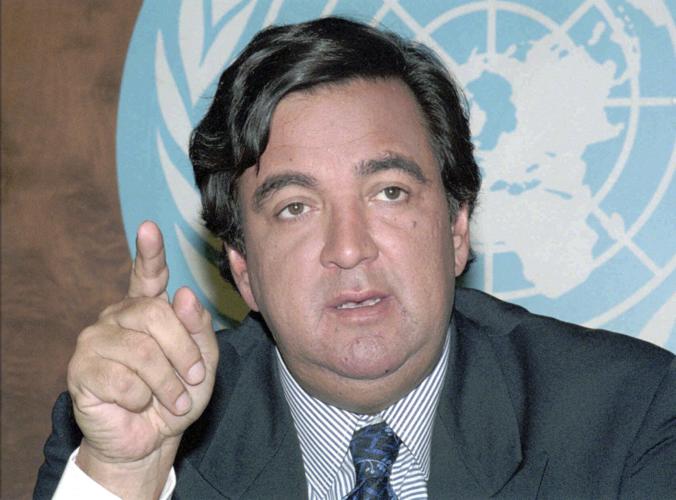
Bill Richardson, U.S. Ambassador to the United Nations, addresses the news media March 26, 1998, in Geneva, Switzerland.
He helped secure the 2021 release of American journalist Danny Fenster from a Myanmar prison and this year negotiated the freedom of Taylor Dudley, who crossed the border from Poland into Russia. He flew to Moscow for a meeting with Russian government officials in the months before the release last year of Marine veteran Trevor Reed in a prisoner swap and also worked on the cases of Brittney Griner, the WNBA star freed by Moscow last year, and Michael White, a Navy veteran freed by Iran in 2020.
Roger Carstens, the U.S. government's chief hostage negotiator, called Richardson "a friend and partner in bringing wrongfully detained Americans and hostages home." Posting on X, the platform formerly known as Twitter, Carstens said: "I will miss his wise counsel and friendship."
Richardson ran for the 2008 Democratic nomination for president in hopes of becoming the nation's first Hispanic president. He dropped out of the race after fourth-place finishes in the Iowa caucuses and New Hampshire primary.
He was the nation's only Hispanic governor during his two terms. He described being governor as "the best job I ever had."
"It's the most fun. You can get the most done. You set the agenda," Richardson said.
As governor, Richardson signed legislation in 2009 that repealed the death penalty. Other accomplishments included $50,000-a-year minimum salaries for the most qualified teachers in the state, an increase in the state minimum wage from $5.15 to $7.50 an hour, prekindergarten programs for 4-year-olds, renewable energy requirements for utilities and financing for large infrastructure projects, including a commercial spaceport and a $400 million commuter rail system.
U.S. Sen. Ben Ray Lujan, D-N.M., called Richardson a "giant in public service and government."
"In his post-government career, he was trusted to handle some of the most sensitive diplomatic crises, and he did so with great success. Here in New Mexico, we will always remember him as our governor. He never stopped fighting for the state he called home," Lujan said.

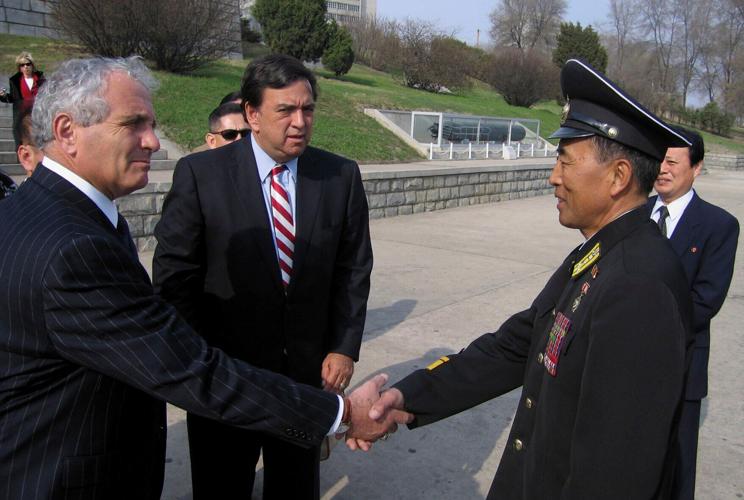
North Korean Col. Pak In Ho, right, shakes hands with Anthony Principi, former Secretary of Veterans Affairs, as Gov. Bill Richardson of New Mexico looks on April 9, 2007, in Pyongyang, North Korea.
Some of Richardson's most prominent global work began in December 1994, when he was visiting North Korean nuclear sites and word came that an American helicopter pilot had been downed and his co-pilot killed.
The Clinton White House enlisted Richardson's help and, after days of tough negotiations, the then-congressman accompanied the remains of Chief Warrant Officer David Hilemon while paving the way for Chief Warrant Officer Bobby Hall to return home.
The following year, and after a personal appeal from Richardson, Saddam Hussein freed two Americans who were imprisoned for four months, charged with illegally crossing into Iraq from Kuwait.
Richardson continued his freelance diplomacy even while serving as governor. He traveled to North Korea in 2007 to recover remains of American service members killed in the Korean War.
In 2006, he persuaded Sudanese President Omar al-Bashir to free Pulitzer Prize-winning American journalist Paul Salopek.
Richardson said he was proud of the work he had done to free dozens of people over the years and of his advocacy for the Navajo Nation.
William Blaine Richardson was born in Pasadena, California, but grew up in Mexico City with a Mexican mother and an American father who was a U.S. bank executive.
He attended prep school in Massachusetts and was a star baseball player. He later went to Tufts University and its graduate school in international relations, earning a master's degree in international affairs.
Richardson moved to New Mexico in 1978 after working as a Capitol Hill staffer. He campaigned for Congress two years later — his only losing race.
In 1982, he won a new congressional seat from northern New Mexico. He resigned from Congress in 1997 to join the Clinton administration as U.N. ambassador and became secretary of energy in 1998, holding the post until the end of the Clinton presidency.