HONOLULU — Bob Fernandez, a 100-year-old survivor of the Japanese bombing of Pearl Harbor, died shortly after deteriorating health prompted him to skip a trip to Hawaii to attend last week's remembrance ceremony marking the 83rd anniversary of the attack.
Fernandez died peacefully at the Lodi, Calif., home of his nephew, Joe Guthrie, on Wednesday. Guthrie's daughter, Halie Torrrell, was holding his hand when he took his last breath. Fernandez suffered a stroke about a month ago that caused him to slow down but Guthrie said doctors attributed his condition to age.
"It was his time," Guthrie said.

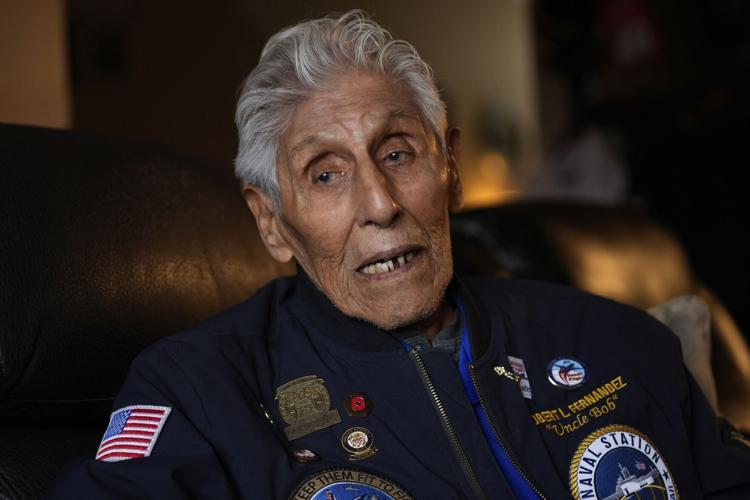
Pearl Harbor Navy veteran Bob Fernandez is photographed Nov. 19 at home in Lodi, Calif.
Fernandez was a 17-year-old sailor on board the USS Curtiss during the Dec. 7, 1941, attack that propelled the U.S. into World War II. A mess cook, he was waiting tables and bringing sailors morning coffee and food when they heard an alarm sound. Through a porthole, Fernandez saw a plane fly by with the red ball insignia known to be painted on Japanese aircraft.
He rushed down three decks to a magazine room where he and other sailors waited for someone to unlock a door storing shells so they could pass them to the ship's guns. He told interviewers over the years that some of his fellow sailors prayed and cried as they heard gunfire above.
"I felt kind of scared because I didn't know what the hell was going on," Fernandez told The Associated Press in an interview weeks before his death.
Fernandez's ship, the Curtiss, lost 21 men and nearly 60 of its sailors were injured. The bombing killed more than 2,300 U.S. service members. Nearly half, or 1,177, were sailors and Marines on board the USS Arizona, which sank during the battle.
"We lost a lot of good people, you know. They didn't do nothing," Fernandez said. "But we never know what's going to happen in a war."

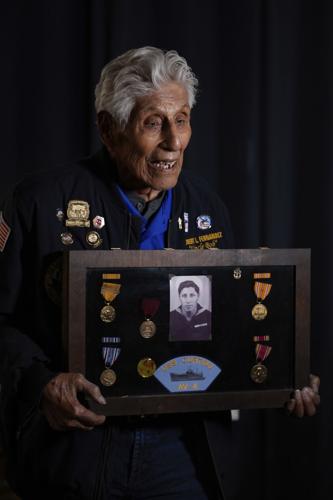
Pearl Harbor Navy veteran Bob Fernandez poses for a photograph with medals from his military service Nov. 19 in Lodi, Calif.
Fernandez planned to return to Pearl Harbor last week to attend an annual commemoration hosted by the Navy and the National Park Service but became too weak to make the trip, Guthrie said.
He was "so proud" of his six years in the Navy, all of it aboard the USS Curtiss, Guthrie said. Most of his casual clothes, like hats and shirts, were related to his service.
"It was just completely ingrained in him," his nephew said.
Fernandez worked as a forklift driver at a cannery in San Leandro, Calif., after the war. His wife of 65 years, Mary Fernandez, died in 2014.
He enjoyed music and dancing, and until recently attended weekly music performances at a local park and a restaurant. He helped neighbors in his trailer park take care of their yards until he moved in with Guthrie last year.
"I'd do yard work and split firewood and he'd swing the axe a little bit," Guthrie said. "We'd call it his physical therapy."

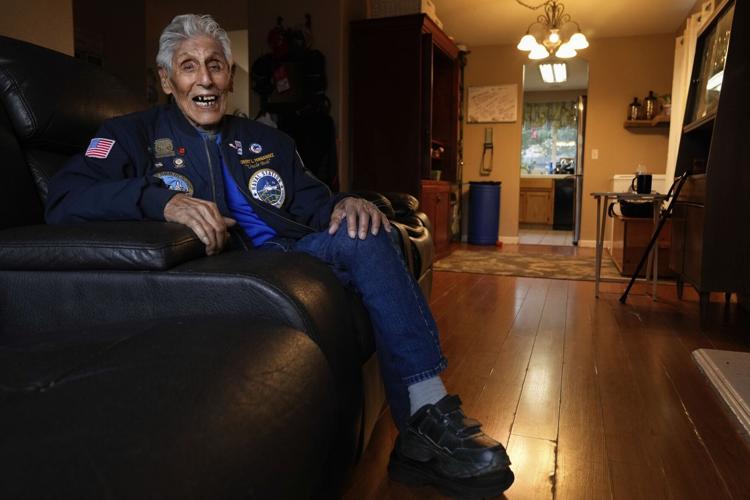
Pearl Harbor Navy veteran Bob Fernandez is photographed Nov. 19 at home in Lodi, Calif.
Fernandez's advice for living a long life included stopping eating once you're full and marching up stairs. He said it was OK to take a nap, but do something like laundry or wash dishes before going to bed. He recommended being kind to everyone.
Guthrie said he thinks Fernandez would want to be remembered for bringing people joy.
"He would rake people's yards if they couldn't do it. He would paint a fence. He would help somebody," Guthrie said. "He would give people money if they needed something. He was so generous and such a kind person. He made friends everywhere."
Fernandez is survived by his oldest son, Robert J. Fernandez, a granddaughter and several great-grandchildren.
There are 16 known survivors of Pearl Harbor still alive, according to a list maintained by Kathleen Farley, the California state chair of the Sons and Daughters of Pearl Harbor Survivors. All of them are at least 100 years old.
50 historical photos of the attack on Pearl Harbor

Three U.S. battleships are hit from the air during the Japanese attack on Pearl Harbor on Dec. 7, 1941. Japan's bombing of U.S. military bases at Pearl Harbor brings the U.S. into World War II. From left are: USS West Virginia, severely damaged; USS Tennessee, damaged; and USS Arizona, sunk. (AP Photo)

The battleship USS California is afire and listing to port in the Japanese aerial attack on Pearl Harbor, Hawaii, on Dec. 7, 1941 during World War II. (AP Photo)

FILE - In this Dec. 7, 1941 file photo, smoke rises from the battleship USS Arizona as it sinks during a Japanese surprise attack on Pearl Harbor, Hawaii. (AP File Photo)

FILE - In this Dec. 7, 1941 file photo, a Japanese plane goes into its last dive as it heads toward the ground in flames after it was hit by Naval anti-aircraft fire during a surprise attack on Pearl Harbor, Hawaii. (AP Photo)

In this aerial photo provided by the U.S. Navy, smoke from the burning battleship Arizona spreads a pall over Pearl Harbor naval base, Dec. 7, 1941, as a Japanese plane dodged through anti-aircraft fire to drive home the Japanese attack that launched a war on the U.S. (AP Photo/U.S. Navy)

FILE - In this Dec. 7, 1941 photo made available by the U.S. Navy, a small boat rescues a seaman from the USS West Virginia burning in the foreground in Pearl Harbor, Hawaii, after Japanese aircraft attacked the military installation. (U.S. Navy via AP, File)

FILE - American ships burn during the Japanese attack on Pearl Harbor, Hawaii, in this Dec. 7, 1941 file photo. (AP Photo, File)

Half a house was left of this resident of the Asian section of Honolulu in Japan's surprise bombing which wreaked havoc in nearby Pearl Harbor. Native and Japanese cyclists watch fireman pour water on wreckage on Dec. 7, 1941. (AP Photo)

In this photo provided by the Department of Defense, U.S. aircraft destroyed as a result of the Japanese bombing on Pearl Harbor is shown, Dec. 7, 1941. Heap of demolished hanger in background Army amphibian in foreground. (AP Photo/DOD)

Flaming oil throws a billow of smoke skyward in the Japanese attack on Hickam Field, Pearl Harbor, U.S. Air base near Honolulu, Dec. 7, 1941. (AP Photo)

A bombed U.S. Army truck with wheel still ablaze after the surprise attack, Dec. 7, 1941, which touched off a new war in the Pacific. (AP Photo)

U.S. Army barracks burning after the surprise attack at Hickam Field, Hawaii, Dec. 7, 1941. (AP Photo)

A Japanese plane, braving American anti-aircraft fire, proceeds toward “battleship row,” Pearl Harbor, after other bombers had hit USS. Arizona, from which smoke billows, Dec. 7, 1941. (AP Photo)

An unidentified officers' wife, investigating explosion and seeing smoke pall in distance at 8:15 am Dec. 7, 1941, heard neighbor Mary Naiden, then an army hostess, exclaim “There are red circles on those planes overhead. They are Japanese!" A boy and a woman carrying a dog flee toward quarters. (AP Photo/Mary Naiden)

The wreckage of the U.S.S. Oklahoma as it lies in the mud at Pearl Harbor, Hawaii after the Japanese aerial attack on Dec. 7, 1941. (AP Photo)

In this image provided by the U.S. Navy, general view of the burning and damaged ships of Pearl Harbor in Hawaii, during the Japanese aerial attack on Dec. 7, 1941. (AP Photo/U.S. Navy)

The Lunalilo High School situated near the Waikiki district which was almost totally destroyed by fire from a bomb which hit the roof at the center part of the main building on Dec. 7, 1941. Four fire companies fought to save the school. Several homes all around the school caught fire - but were saved by the fire fighters. All families for blocks around brought their personal belongings outside of their homes, fearing another attack. (AP Photo)

The pilot of this Japanese plane met flaming death in the first surprise attack on the principal Hawaiian island of Oahu on Dec. 7, 1941, when his plane was shot down, rammed a residence and set the house and the one adjoining on fire. In the foreground is part of the plane wreckage. The pilot, later established as being at least six feet tall, was cremated. Japanese families resided in the two houses, which were destroyed. (AP Photo)

Battleship Arizona at pearl Harbor, December 1941. The photo was taken shortly after the battleship was bombed and destroyed during the surprise attack by Japanese forces, December 7, 1941. The vessel at right is a rescue tug. Flag still flying the ship is resting on the bottom of the ocean with decks flooded. (AP Photo)

This photo shows the Japanese attack on Pearl Harbor on December 7, 1941. The USS Arizona is pictured in flames after the attack. (AP Photo/U.S. Navy)

Two ships are seen burning after the Japanese attack on Pearl Harbor in Hawaii on Dec. 7, 1941 during World War II. (AP Photo)

Heavy black smoke billows as oil fuel burns from shattered tanks on ships that were hit during the Japanese attack on Pearl Harbor, Hawaii on Dec. 7, 1941 during World War II. Visible through the murk is the U.S. battleship Maryland, center, and the hulk of the capsized USS Oklahoma to the right of it. (AP Photo/U.S. Navy)

Torpedoed and bombed by the Japanese, the battleship USS West Virginia begins to sink after suffering heavy damage, center, while the USS Maryland, left, is still afloat in Pearl Harbor, Oahu, Hawaii, Dec. 7, 1941 during World War II. The capsized USS Oklahoma is at right. (AP Photo/U.S. Navy)

The destroyer USS Shaw explodes after being hit by bombs during the Japanese surprise attack on Pearl Harbor, Hawaii, December 7, 1941. (AP Photo)

In this image provided by the U.S. Navy, sailors stand among wrecked airplanes at Ford Island Naval Air Station as they watch the explosion of the USS Shaw in the background, during the Japanese surprise attack on Pearl Harbor, Hawaii, on December 7, 1941. (AP Photo/U.S. Navy)

Rescue workers help evacuate the Lunalilo High School in Honolulu after the roof of the main building was hit by a bomb during the Japanese attack at Pearl Harbor, Hawaii on Dec. 7, 1941. (AP Photo)

Smoke still fogged the air at Pearl harbor, Dec. 7, 1941 as these tractors tugged at what the Navy said was a Japanese two-man submarine, not shown, pulling it up on the beach for inspection after it was disabled in the Japanese attack on Pearl Harbor, Hawaii. (AP Photo)

A mass of twisted metal wreckage lay along a Honolulu street after the city had been attacked by Japanese planes Dec. 7, 1941. (AP Photo)

A small crowd inspects the damage, both inside and outside, after a Japanese bomb hit the residence of Paul Goo during the raid on Honolulu Dec. 7, 1941. (AP Photo)

U.S. Navy seamen examine the wreckage of a Japanese torpedo plane shot down at Pearl harbor during the Japanese raid on Pearl Harbor, Dec. 7, 1941. (AP Photo)

Wreckage, identified by the U.S. Navy as a Japanese torpedo plane , was salvaged from the bottom of Pearl Harbor following the surprise attack Dec. 7, 1941. (AP Photo)

The wing of a Japanese bomber shot down on the grounds of the Naval Hospital at Honolulu, Hawaii, Dec. 7, 1941. (AP Photo)

An American Seaman looks at the charred corpse of a Japanese flier brought up from the bottom of Pearl Harbor where he crashed with his burning plane during the Japanese attack on Dec. 7, 1941 in Hawaii. (AP Photo)

Japanese plane, proceeds toward "Battleship Row" at Pearl Harbor after other bombers had hit USS Arizona, from which smoke billows, Dec. 7, 1941. Photo was taken from the yard of Army's Hickam Field Quarters by Mrs. Mary Naiden of New York City. (AP Photo)

The shattered wreckage of American planes bombed by the Japanese in their attack on Pearl Harbor is strewn on Hickam Field, Dec. 7, 1941. (AP Photo)

The battleship USS Arizona belches smoke as it topples over into the sea during Japanese surprise attack on Pearl Harbor, Hawaii, December 7, 1941. The ship sank with more than 80 percent of its 1,500-man crew, including Rear Admiral Issac C. Kidd. The attack, which left 2,343 Americans dead and 916 missing, broke the backbone of the U.S. Pacific Fleet and forced America out of a policy of isolationism. President Franklin D. Roosvelt announced that it was "a date which will live in infamy" and Congress declared war on Japan the morning after. This was the first attack on American territory since 1812. (AP Photo)

Planes are lined up at Hickham Field, Air Corps post on Oahu, Hawaii, in an undated image. Reports said that a Japanese bomb struck the field. Washington made the announcement Dec. 7, 1941. (AP Photo)

Believed to be the first bomb dropped on Pearl Harbor, Hawaii in the sneak-attack on Dec. 7, 1941, this picture was found torn to pieces at Yokusuka Base by photographer's mate 2/C Martin J. Shemanski of Plymouth, Pa. One Japanese plane is shown pulling out of a dive near bomb eruption (center) and another the air at upper right. (AP Photo)

Japanese family move their household goods out on their lawn, for fear of the fire spreading to their home from a fire caused by a falling bomb only a half block away during the air raid on Oahu, Hawaii on Sunday, Dec. 7, 1941. (AP Photo)

Black smoke pours from the U.S. Destroyer USS Shaw after a direct hit by bombs during the surprise aerial attack by the Japanese on Pearl Harbor, Hawaii, on Dec. 7, 1941. Defenders on the pier at left throw water into the blazing wreckage. (AP Photo/U.S. Navy)

Smoke clouds the sky over Pearl Harbor, Hawaii, on Dec. 7, 1941, as two sailors crouch with rifles on the pier at the submarine base trying to locate an enemy to fire on during World War II. Submarines berthed nearby are USS Tautog and USS Narwhal. (AP Photo)

Firemen and civilians rush to the scene with fire hoses to save homes and stores in the Japanese and Chinese sections of Honolulu, Hawaii, on Dec. 7, 1941. As Japanese aviators rained bombs on Pearl Harbor, starting war in the Pacific, offshore properties are also wrecked and burned. (AP Photo)

Youths inspect the wreckage of a Japanese bomber, Dec. 17, 1941 brought down by a United States P-40 plane during the Dec 7, 1941 attack on Oahu, Hawaii. (AP Photo)

Students of the Lunalilo High School in the Waikiki district of Honolulu watch their school burn after the roof of the main building, at center, is hit by a bomb during the Japanese bombing of Pearl Harbor, Hawaii, on Dec. 7, 1941. (AP Photo)

This is one of the first pictures of the Japanese raid on Pearl Harbor, Dec. 7, 1941. A P-40 plane which was machine-gunned while on the ground. (AP Photo)

In this image provided by the U.S. Department of Defense, destroyers in drydock at Pearl Harbor in Hawaii are battered by bombs after Japanese sneak attack on Dec. 7, 1941. Background in dock is battleship Pennsylvania, which suffered only minor damage. Destroyers are Downes, left, and Cassin, right. Machinery and fittings were transferred to new hulls and the destroyers were never stricken from Navy's active list. (AP Photo/U.S. Department of Defense)

In this photo provided by the Department of Defense, a battered American flag flies in the foreground at the military barracks at Hickam Field near Honolulu, during the Japanese surprise attack on Pearl Harbor, Dec. 7, 1941. (AP Photo/DOD)

Rider Joy Cummings examines a Japanese cherry tree that was cut down with the words "To hell with those Japanese," carved into it, Dec. 10, 1941. Irving C. Root, Parks Commissioner, termed it vandalism. In the background is the recently completed Jefferson Memorial. (AP Photo)

In this photo provided by the U.S. Army Signal Corps, wreckage of a U.S. Army pursuit ship is seen after the surprise attack by the Japanese on Pearl Harbor, Hawaii, Dec. 7, 1941. (AP Photo/U.S. Army Signal Corps)

Ruth Lee, hostess at a Miami Chinese restaurant, seen Dec. 15, 1941, doesn't want to be mistaken for Japanese when she sunbathes on her days off, and brings along a Chinese flag. Miss Lee is actually American-born. (AP Photo)