NEW YORK — Prepare to spot a rare, bright comet.
The space rock is slinging toward Earth from the outer reaches of the solar system and will make its closest pass on Saturday. It should be visible through the end of October, clear skies permitting.
Comet Tsuchinshan-Atlas should be bright enough to see with the naked eye, but binoculars and telescopes will give a better view.
"It'll be this fuzzy circle with a long tail stretching away from it," said Sally Brummel, planetarium manager at the Bell Museum in Minnesota.

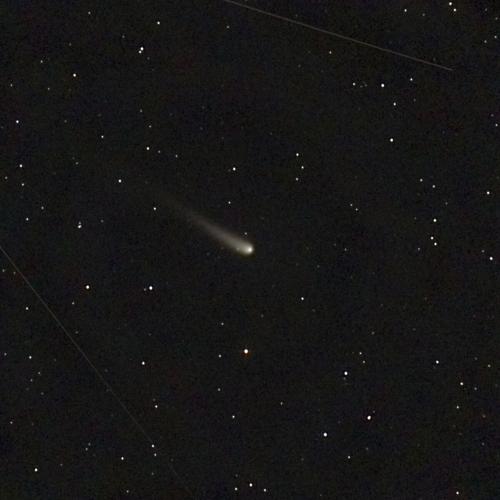
Comet Tsuchinshan-Atlas is seen June 6 from Eure-et-Loir, France.
What is a comet?
Comets are frozen leftovers from the solar system's formation billions of years ago. They heat up as they swing toward the sun, releasing their characteristic streaming tails.
People are also reading…
In 2023, a green comet that last visited Earth 50,000 years ago zoomed by the planet again.
Other notable flybys included Neowise in 2020, and Hale-Bopp and Hyakutake in the mid to late 1990s.

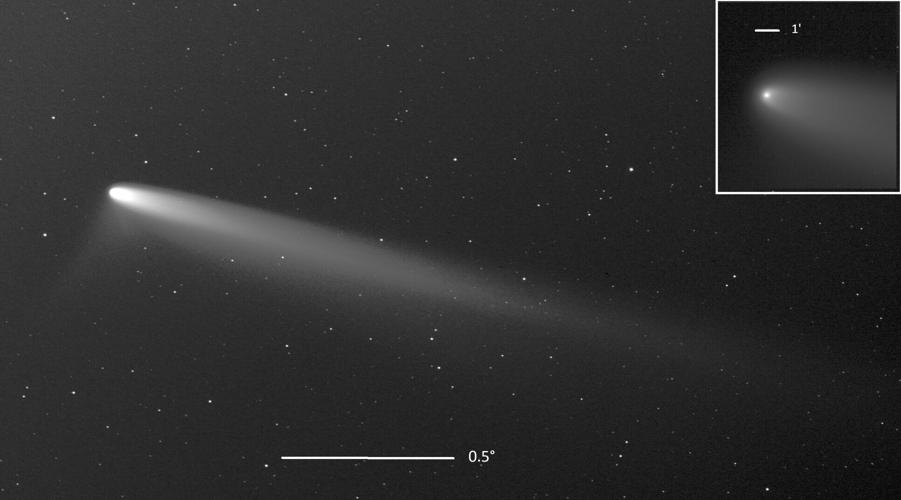
Two views of comet Tsuchinshan-Atlas with bars added to indicate its angular size, seen Sept. 24 from San Pedro de Atacama, Chile.
Where did comet Tsuchinshan-Atlas come from?
The comet, also designated C/2023 A3, was discovered last year and is named for the observatories in China and South Africa that spied it.
It came from what's known as the Oort Cloud well beyond Pluto. After making its closest approach within about 44 million miles of Earth, it won't return for another 80,000 years — if it survives the trip.
Several comets are discovered every year, but many burn up near the sun or linger too far away to be visible without special equipment, according to Larry Denneau, a lead researcher with the Atlas telescope that helped discover the comet.

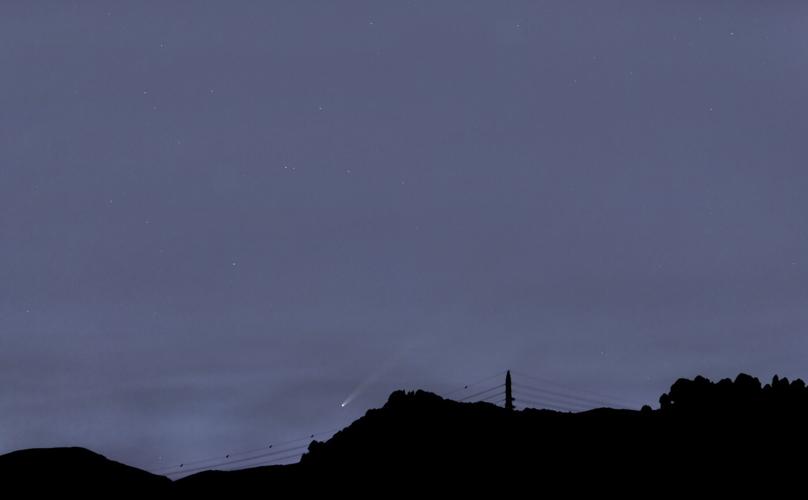
Comet Tsuchinshan-Atlas is seen Oct. 1 in the night sky of Granada, Spain.
How to view the comet
Those hoping to spot comet Tsuchinshan-Atlas should venture outside about an hour after sunset on a clear night and look to the west.
The comet should be visible from both the northern and southern hemispheres.
Photos: See comet Neowise streak through northern hemisphere

In this image released by NASA, Comet Neowise, left, is seen in the eastern horizon above Earth in this image taken from the International Space Station on Sunday, July 5, 2020. (NASA via AP)

Comet Neowise soars in the horizon of the early morning sky in this view from the near the grand view lookout at the Colorado National Monument west of Grand Junction, Colo., Thursday, July 9, 2020. The newly discovered comet is streaking past Earth, providing a celestial nighttime show after buzzing the sun and expanding its tail. (Conrad Earnest via AP)

The comet Neowise or C/2020 F3 is seen over the Turets, Belarus, 110 kilometers (69 miles) west of capital Minsk, early Tuesday, July 14, 2020. (AP Photo/Sergei Grits)

The comet Neowise or C/2020 F3 is seen behind an Orthodox church over the Turets, Belarus, 110 kilometers (69 miles) west of capital Minsk, early Tuesday, July 14, 2020. (AP Photo/Sergei Grits)

The comet Neowise or C/2020 F3 can be seen before sunrise behind a tower of Neuschwanstein Castle in Schwangau, Bavaria, Germany, early Tuesday, July 14, 2020. (Karl-Josef Hildenbrand/dpa via AP)

The comet Neowise is seen from near Effingham, Kan., Monday, July 13, 2020. (AP Photo/Charlie Riedel)

The Comet Neowise or C/2020 F3 is seen before sunrise over Balatonmariafurdo, Hungary, Tuesday, July 14, 2020. It passed closest to the Sun on July 3 and its closest approach to Earth will occur on July 23. (Gyorgy Varga/MTI via AP)

Comet Neowise appears over Mount Washington in the night sky as seen from Dee Wright Observatory on McKenzie Pass east of Springfield, Ore., Tuesday, July 14, 2020. According to NASA the lower tail, which appears broad and fuzzy, is the dust tail created when dust lifts off the surface of the comet's nucleus and trails behind the comet in its orbit. The upper tail is the ion tail, which is made up of gases that have been ionized by losing electrons in the sun's intense light. (Chris Pietsch/The Register-Guard via AP)

Comet Neowise streaks across the night sky over Wolf Lake in Brimson, Minn., Tuesday night, July 14, 2020. Comet C/2020 F3 Neowise is a bright comet that only passes close enough for viewing on Earth once every 6,800 years or so. The comet streaked across the sky over Wolf Lake in Brimson, on July 14, between 10 and 11 p.m. (Alex Kormann/Star Tribune via AP)