

A look back at Cassini spacecraft's amazing photos of Saturn, rings, moons
After a 20-year voyage, NASA's Cassini spacecraft is poised to dive into Saturn this week to become forever one with the exquisite planet. But first, here's a look back at some of its amazing images.
Space Cassini Saturn Photo Gallery

This Jan. 16, 2017 image made available by NASA shows one of Saturn's moons, Daphnis, as it grazes the outer edges of the planet's rings. The 5-mile (8 kilometer) moon orbits within the 42-kilometer (26-mile) wide Keeler Gap. The little moon's gravity raises waves in the edges of the gap in both the horizontal and vertical directions. (NASA/JPL-Caltech/Space Science Institute via AP)
Space Cassini Saturn Photo Gallery

This Jan. 28, 2016 image made available by NASA shows Saturn's rings, including the darker series of bands called the Cassini Division between the bright B ring, left, and dimmer A ring, right. It is almost as wide as the planet Mercury. The 2,980-mile-wide (4,800-kilometer-wide) division in Saturn's rings is thought to be caused by the moon Mimas. (NASA/JPL-Caltech/Space Science Institute via AP)
Space Cassini Saturn Photo Gallery

This Feb. 15, 2016 image made available by NASA shows cracks in Enceladus' icy shell caused by tectonic stresses, as seen from the Cassini spacecraft. Such features are also believed to be relatively young based on their lack of impact craters - a reminder of how geologically active the Saturninan moon is. (NASA/JPL-Caltech/Space Science Institute via AP)
Space Cassini Saturn Photo Gallery

This May 21, 2016 image made available by NASA shows the shadow of Saturn on its rings. The changing length of the shadow marks the passing of the seasons on Saturn. The moon Mimas is a few pixels wide, near the lower left in this image. (NASA/JPL-Caltech/Space Science Institute via AP)
Space Cassini Saturn Photo Gallery

This 2007 image made available by NASA shows a hydrocarbon sea named Ligeia Mare on Saturn's moon Titan, as seen by the Cassini spacecraft. Slight changes observed over several passes indicates that Titan's seas are not stagnant, but rather, dynamic environments. Ligeia is Titan's second-largest liquid hydrocarbon sea, and has a total area of about 50,000 square miles (130,000 square kilometers), making it 50 percent larger than Lake Superior on Earth. (NASA/JPL-Caltech/ASI/Cornell via AP)
Space Cassini Saturn Photo Gallery

This Dec. 3, 2015 image made available by NASA shows three of Saturn's moons - Tethys, above, Enceladus, second left, and Mimas, seen from the Cassini spacecraft. (NASA/JPL-Caltech/Space Science Institute via AP)
Space Cassini Saturn Photo Gallery

This Jan. 10, 2012 image made available by NASA shows Saturn and one of its moons, Tethys, as seen from the Cassini spacecraft. (NASA/JPL-Caltech/Space Science Institute via AP)
Space Cassini Saturn Photo Gallery

This Aug. 12, 2009 composite image made available by NASA shows Saturn in equinox seen by the approaching Cassini spacecraft. Saturn's equinox occurs only once in about 15 Earth years. (NASA/JPL/Space Science Institute via AP)
Space Cassini Saturn Photo Gallery

This July 19, 2013 image made available by NASA shows Saturn's rings and planet Earth, center right, as seen from the Cassini spacecraft. (NASA/JPL-Caltech/Space Science Institute via AP)
Space Cassini Saturn Photo Gallery

This May 4, 2014 image made available by NASA shows the persistent hexagonal cloud pattern on Saturn's north pole, as seen from the Cassini spacecraft. The hexagon is similar to Earth's polar vortex, which has winds blowing in a circular pattern around the polar region, and is nearly 25,000 kilometers (15,000 miles) across. Nearly four Earths could fit inside it. (NASA/JPL-Caltech/Space Science Institute via AP)
Space Cassini Saturn Photo Gallery

This May 21, 2015 image made available by NASA shows Saturn's moon Dione crossing the face of the gas giant, in a phenomenon astronomers call a transit. Transits play an important role in astronomy and can be used to study the orbits of planets and their atmospheres, both in our solar system and in others. (NASA/JPL-Caltech/Space Science Institute via AP)
Space Cassini Saturn Photo Gallery

This Aug. 14, 2014 image made available by NASA shows shadows of Saturn's rings projected on the southern hemisphere of the gas giant. The moon, Tethys, is at lower right, and Mimas, is seen as a slight crescent against Saturn's disk above the rings, at about 4 o'clock. (NASA/JPL-Caltech/Space Science Institute via AP)
Space Cassini Saturn Photo Gallery

This Aug. 23, 2014 image made available by NASA shows the fluid dynamics in Saturn's uppermost cloud layers. (NASA/JPL-Caltech/Space Science Institute via AP)
Space Cassini Saturn Photo Gallery

This Sept. 24, 2015 image made available by NASA shows the moons Enceladus, foreground, and Tethys temporarily aligned off the plane of Saturn's rings, as seen from the Cassini spacecraft. (NASA/JPL-Caltech/Space Science Institute via AP)
Space Cassini Saturn Photo Gallery

This Aug. 17, 2015 image made available by NASA shows the rough and icy crescent of Saturn's moon Dione as seen by the Cassini spacecraft. (NASA/JPL-Caltech/Space Science Institute via AP)
Space Cassini Saturn Photo Gallery

This Nov. 13, 2015 composite image made available by NASA shows an infrared view of Saturn's moon, Titan, as seen by the Cassini spacecraft. The near-infrared wavelengths in this image allow the cameras to penetrate the haze and reveal the moon's surface. (NASA/JPL/ESA/Italian Space Agency via AP)
Space Cassini Saturn Photo Gallery
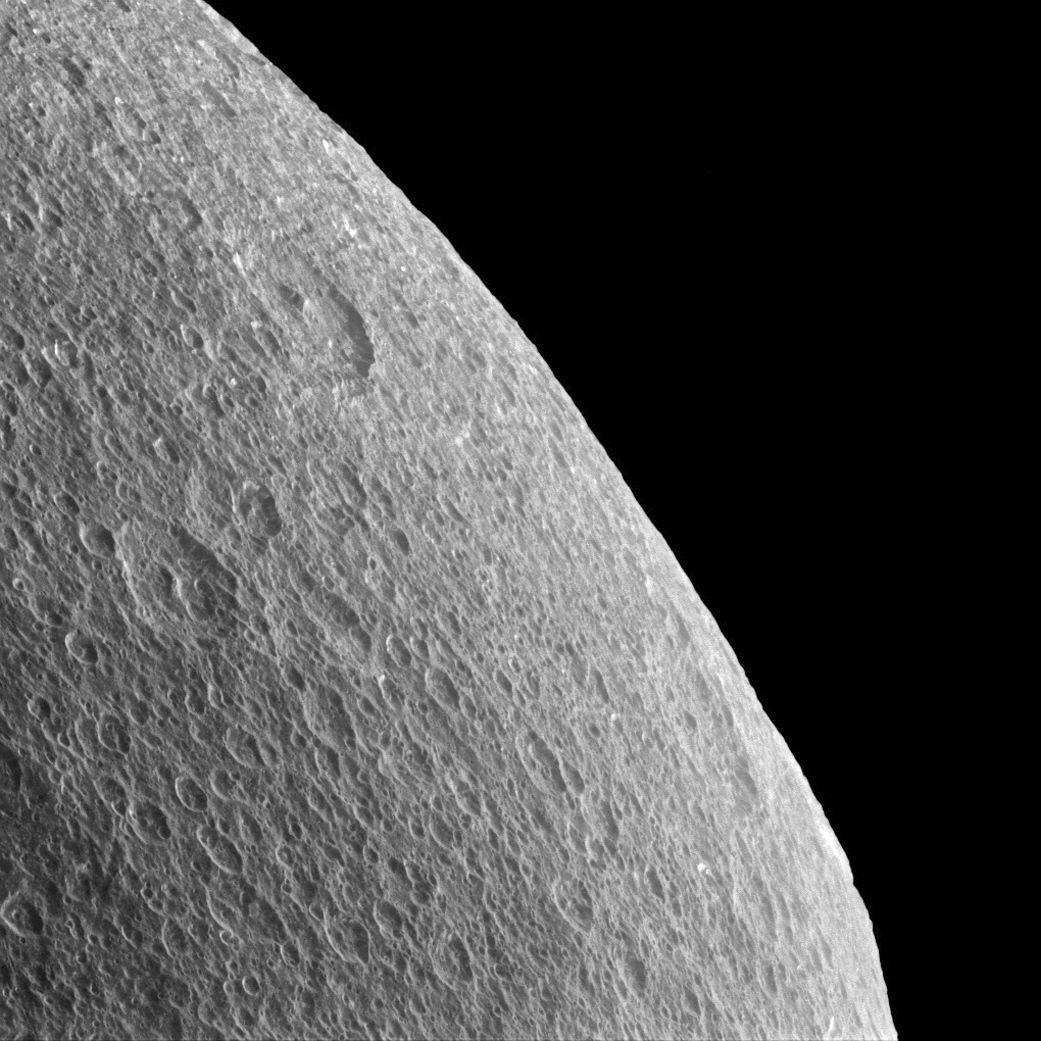
This Feb. 10, 2015 image made available by NASA shows the slightly irregular horizon of the Saturnian moon, Rhea. The surface of Rhea (949 miles or 1527 kilometers across) has been sculpted largely by impact cratering. On more geologically active worlds like Earth, the craters would be erased by erosion, volcanoes or tectonics. (NASA/JPL-Caltech/Space Science Institute via AP)
Space Cassini Saturn Photo Gallery

This March 25, 2015 image made available by NASA shows the crescents of three of Saturn's moons - Titan, right; Mimas, bottom, and Rhea, left. Titan appears fuzzy because of its cloud layers. Rhea's cratered surface shows a rough texture. (NASA/JPL-Caltech/Space Science Institute via AP)
Space Cassini Saturn Photo Gallery

This Aug. 11, 2013 image made available by NASA shows Saturn and one if its moons, Titan, seen from the Cassini spacecraft. Titan's crescent nearly encircles its disk due to the small haze particles high in its atmosphere scattering the incoming light of the distant Sun. (NASA/JPL-Caltech/Space Science Institute via AP)
Space Cassini Saturn Photo Gallery

This Feb. 17, 2005 image made available by NASA shows plumes of water ice and vapor from the south polar region of Saturn's moon Enceladus. The activity is understood to originate from the moon's subsurface ocean of salty liquid water, which is venting into space. (NASA/JPL/Space Science Institute via AP)
Space Cassini Saturn Photo Gallery

This April 26, 2017 photo made available by NASA shows turbulent clouds at Saturn's north pole, as seen from the Cassini spacecraft. (NASA/JPL-Caltech/Space Science Institute via AP)

For a very long time, Saturn was thought to be the only planet in our solar system with rings.

Astronomers have found the best evidence yet of a vast, young ocean beneath the icy exterior of Saturn’s Death Star lookalike mini moon Mimas.