NEW YORK — Burt Bacharach, the popular composer who delighted millions with the quirky arrangements and unforgettable melodies of "Walk on By," "Do You Know the Way to San Jose" and dozens of other hits, died at age 94.
The Grammy, Oscar and Tony winner died Wednesday at home in Los Angeles of natural causes, publicist Tina Brausam said Thursday.
Over the past 70 years, few other songwriters rivaled his genius for instantly catchy tunes that remained performed, played and hummed long after they were written. He had a run of top 10 hits from the 1950s into the 21st century, and his music was heard everywhere from movie soundtracks and radios to home stereo systems and iPods, whether "Alfie" and "I Say a Little Prayer" or "I'll Never Fall in Love Again" and "This Guy's in Love with You."

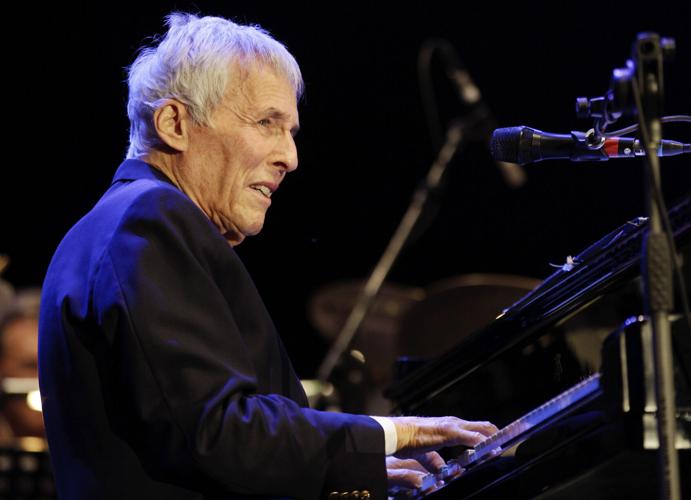
Composer Burt Bacharach performs July 16, 2011, in Milan, Italy.
Dionne Warwick was his favorite interpreter, but Bacharach, usually in tandem with lyricist Hal David, also created prime material for Aretha Franklin, Dusty Springfield, Tom Jones and many others. Elvis Presley, the Beatles and Frank Sinatra were among the countless artists who covered his songs, with more recent performers who sung or sampled him including White Stripes, Twista and Ashanti. "Walk On By" alone was covered by everyone from Warwick and Isaac Hayes to the British punk band the Stranglers and Cyndi Lauper.
People are also reading…
Bacharach was both an innovator and throwback, and his career seemed to run parallel to the rock era. He grew up on jazz and classical music and had little taste for rock when he was breaking into the business in the 1950s, often seeming more aligned with Tin Pan Alley than with Bob Dylan, John Lennon and other writers who later emerged.
"The shorthand version of him is that he's something to do with easy listening," Elvis Costello, who wrote the 1998 album "Painted from Memory" with Bacharach, said in a 2018 interview with The Associated Press. "It may be agreeable to listen to these songs, but there's nothing easy about them. Try playing them. Try singing them."
A box set, "The Songs of Bacharach & Costello," is due to come out March 3.

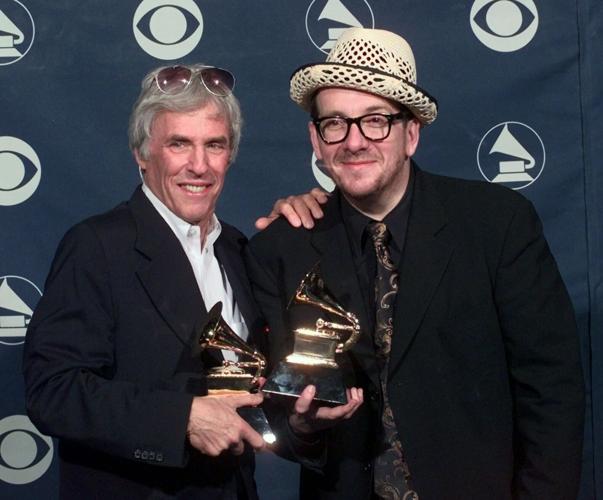
Burt Bacharach, left, and Elvis Costello hold their awards for best pop collaboration with vocals with "I Still Have That Other Girl" on Feb. 24, 1999, during the 41st Annual Grammy Awards in Los Angeles.
Bacharach was an eight-time Grammy winner, a prize-winning Broadway composer for "Promises, Promises" and a three-time Oscar winner. He received two Academy Awards in 1970, for the score of "Butch Cassidy and the Sundance Kid" and for the song "Raindrops Keep Fallin' on My Head" (shared with David). In 1982, he and his then-wife, lyricist Carole Bayer Sager, won for "Best That You Can Do," the theme from "Arthur." His other movie soundtracks included "What's New, Pussycat?", "Alfie" and the 1967 James Bond spoof "Casino Royale."
Bacharach was a frequent guest at the White House. In 2012, he was presented the Gershwin Prize by Barack Obama, who had sung a few seconds of "Walk on By" during a campaign appearance.
In his life, and in his music, he stood apart. Fellow songwriter Sammy Cahn liked to joke that the smiling, wavy-haired Bacharach was the first composer he ever knew who didn't look like a dentist. Bacharach was a "swinger," as they called such men in his time, whose many romances included actor Angie Dickinson, to whom he was married from 1965 to 1980, and Sager, his wife from 1982 to 1991.
He was a perfectionist who took three weeks to write "Alfie" and could spend hours tweaking a single chord.
It began with the melodies — strong yet interspersed with changing rhythms and surprising harmonics. He credited much of his style to his love of bebop and to his classical education, especially under the tutelage of Darius Milhaud, the famed composer. He once played a piece for piano, violin and oboe for Milhaud that contained a melody he was ashamed to have written, as 12-point atonal music was in vogue at the time. Milhaud, who liked the piece, advised the young man, "Never be afraid of the melody."
"That was a great affirmation for me," Bacharach recalled in 2004.

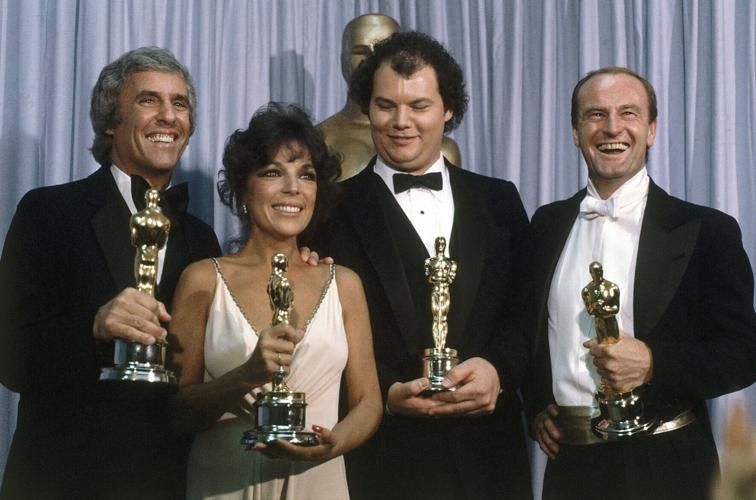
From left, Burt Bacharach appears March 29, 1982, with Carole Bayer Sager, Christopher Cross and Peter Allen, winners of the Oscar for best original song for "Arthur's Theme (Best That You Can Do)" at the 54th Annual Academy Awards in Los Angeles.
He was essentially a pop composer, but his songs became hits for country artists (Marty Robbins), rhythm and blues performers (Chuck Jackson), soul (Franklin, Luther Vandross) and synth-pop (Naked Eyes). He reached a new generation of listeners in the 1990s with the help of Costello and others.
In the 21st century, he was still testing new ground, writing his own lyrics and recording with rapper Dr. Dre.
He was married to his first wife, Paula Stewart, from 1953 to 1958, and married his fourth wife, Jane Hansen, in 1993. He is survived by Hansen, as well as his children Oliver, Raleigh and Cristopher, Brausam said. He was preceded in death by his daughter with Dickinson, Nikki Bacharach.
He was born in Kansas City, Missouri, but soon moved to New York City. His father was a syndicated columnist, his mother a pianist who encouraged the boy to study music. Although he was more interested in sports, he practiced piano every day after school, not wanting to disappoint his mother. While still a minor, he would sneak into jazz clubs, bearing a fake ID, and hear such greats as Dizzy Gillespie and Count Basie.
"They were just so incredibly exciting that all of a sudden, I got into music in a way I never had before," he recalled in the memoir "Anyone Who Had a Heart," published in 2013. "What I heard in those clubs turned my head around."