If stocks have taken a pounding over the last few weeks, there has been a bull market raging in Michael Jordan's range of Air Jordan sneakers.
In episode five of the blockbuster 10-part documentary series, "The Last Dance" we see Jordan nearly turn down Nike as his sponsor, potentially missing out on a billion-dollar opportunity.
The conception of the Air Jordan line of sneakers is also documented, and in what the basketball star thought would be his final ever appearance at Madison Square Garden, Jordan laces up a pair of his first signature sneakers: the Air Jordan 1 "Chicago," a shoe that was 13 years old at that point in 1998.
It's a trainer that has been coveted by sneakerheads ever since the ex-Chicago Bulls star wore them in his rookie year -- and it's only been rereleased a handful of times, most recently in 2015.
People are also reading…
And while prices on the resale market for this sneaker have always been buoyant, they have shot up since first episode of "The Last Dance" aired.

If stocks have taken a pounding over the last few weeks, there has been a bull market raging in Nike's range of Michael Jordan sneakers.
Cultural significance
According to Stockx, a website where people can buy and sell sneakers and streetwear -- much like traders buy and sell stocks -- between January 1 and the premiere of the series on April 18, 217 pairs of the 2015 Air Jordan 1 'Chicago' retro trainer were sold for an average price of $925.
In the two weeks since the series first aired on April 19, 60 pairs of the model were sold at an average price of $1,241.
Sneakerhead Paul Barber from Sunderland in the UK runs a sneaker art Instagram account called @Sneaksketchuk and is a collector of Air Jordan 1s.
"I purchased my pair of Chicago's back in December 2018," he tells CNN Sport. "Even back then they weren't cheap, but I found a pair in the States that came in 'cheaper' than what I could get them for on this side of the pond. That said, they still set me back just under £500 ($623)."
For Barber and many other sneakerheads, the Air Jordan 1 holds special significance, not just for its design but its cultural importance.

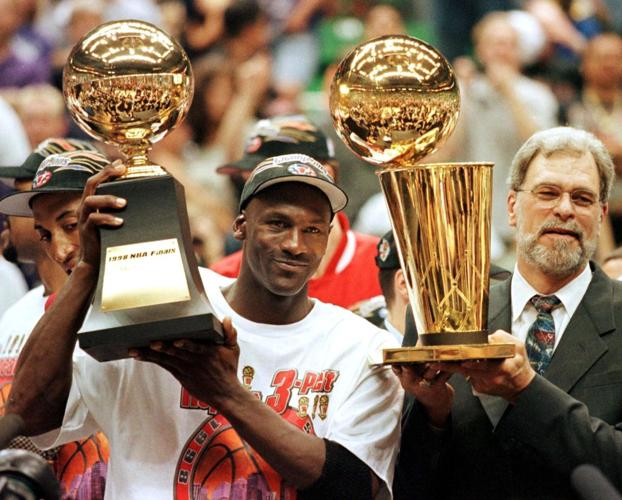
Michael Jordan, seen here with Phil Jackson, raises his NBA Finals MVP trophy following a last-second shot to secure a third straight title for the Chicago Bulls.
"That sneaker started a revolution, it sparked a fire that even 35 years later still burns bright. The Jordan 1 is symbolic, but also it's a good identifier for who you are," said Barber.
"People see you in that sneaker and they know instantly that you're into your kicks. You'll see people check out your sneakers and they'll give you a little nod of the head of appreciation."
It isn't just the 1s which are growing in value; the price of many other Air Jordans has risen since the show's premiere.
'Kobes'
Much like the stock market, the sneaker market is a reflection of real-world events.
When Kobe Bryant died in late January, the former LA Lakers star's line of sneakers rocketed in value.
Some "Kobes" that had previously been worth a few hundred dollars suddenly were being sold for thousands of dollars.
It was reported by a number of outlets that in response, Nike pulled Bryant-related merchandise to prevent profiteering by resellers.
Nike later denied this, saying instead that the company had just sold out of Kobe products.
The cultural significance of the Air Jordan 1 shouldn't be underestimaed.
In 2018, journalist and sneaker aficionado Russ Bengtson wrote: "If it's hard to separate the Air Jordan 1 from sneaker culture, it's because most of what we know as "sneaker culture" sprung up around the Air Jordan 1 itself."
Some 35 years on from the shoe's release, it is still making waves.
23 moments to watch in 'The Last Dance'
23 moments to watch for from ESPN’s ‘Last Dance’ documentary
1. Young M.J.

Before there was 1990s Michael Jordan, there was 1980s Michael Jordan. Baby-faced. Unproven. Just starting his climb and having no idea what all was ahead. Take a moment in the film’s opening sequence to soak in the excerpt of the mid-‘80s TV interview with Jordan expressing his youthful ambitions. “I just want the franchise and the Chicago Bulls to be respected as a team,” Jordan says. “Like the Lakers or the Philadelphia 76ers or the Boston Celtics. It’s very hard for something like that to happen but it’s not impossible. But hopefully, I can -- and this team and this organization -- can build a program like that.” OK, young fella. We’ll see. Eight years before the Dream Team captivated a worldwide audience, Michael Jordan teamed with future Dream Team members Patrick Ewing and Chris Mullin, along with Sam Perkins and Steve Alford, to win the gold medal with a 96-65 victory over Spain at the Los Angeles Summer Olympics.
2. In-his-prime M.J.

The playoff-record 63 points against the Celtics. The 55-point explosion at Madison Square Garden in his fifth game back from retirement. The flu game. The shrug. The first championship. The other five titles too. If you’ve seen the clips once, you’ve seen them a thousand times. Somehow, though, they never get old. Chicago Bulls guard Michael Jordan (23), left, is assisted by teammate Scottie Pippen in the closing moments of game five of the NBA Finals Wednesday, June 11, 1997, at the Delta Center in Salt Lake City, Utah.
3. Old M.J.

Between June 2018 and December 2019, Jordan sat for three interview sessions with the filmmakers, providing more than 8 hours of on-camera storytelling and introspection. Said director Jason Hehir: “From the moment that I first sat down Michael, he was surprisingly forthcoming and candid and eager to discuss a lot of the topics that people are going to be interested in. In our first hour of conversation, he went places I wasn’t sure he would go in two years.” Charlotte Hornets owner Michael Jordan responds to a question during a news conference on October 28, 2014, at Time Warner Cable Arena in Charlotte, N.C.
4. ’90s rap

The documentary begins with a dramatic piano interlude, with video of a silhouetted Jordan as he looks out over the ocean. A caption alludes to the five championships in seven years the Bulls had won heading into the 1997-98 season. Yet, as the Bulls aimed for their second three-peat, the film emphasizes, “The future of their dynasty is in doubt.” A blink later, we see Jordan in November 1997 giving a speech at the United Center ring ceremony for championship No. 5. Then, just a little more than 2 minutes in, suddenly it’s Puff Daddy, Ma$e and the Notorious B.I.G. providing the soundtrack for the introductory montage. “Been Around the World.” The beats provide the perfect tempo change. Just so fitting, so late-‘90s. This is indeed a period piece. And the music accompaniment consistently reminds us as much. LL Cool J. Coolio. Naughty By Nature. Big Punisher. Perfect. With fans reaching for a touch, Michael Jordan steps into the spotlight as he's introduced for the Bulls' 5th NBA Championships ring ceremony on Nov. 1, 1997, at the United Center.
5. The tension, the uncertainty
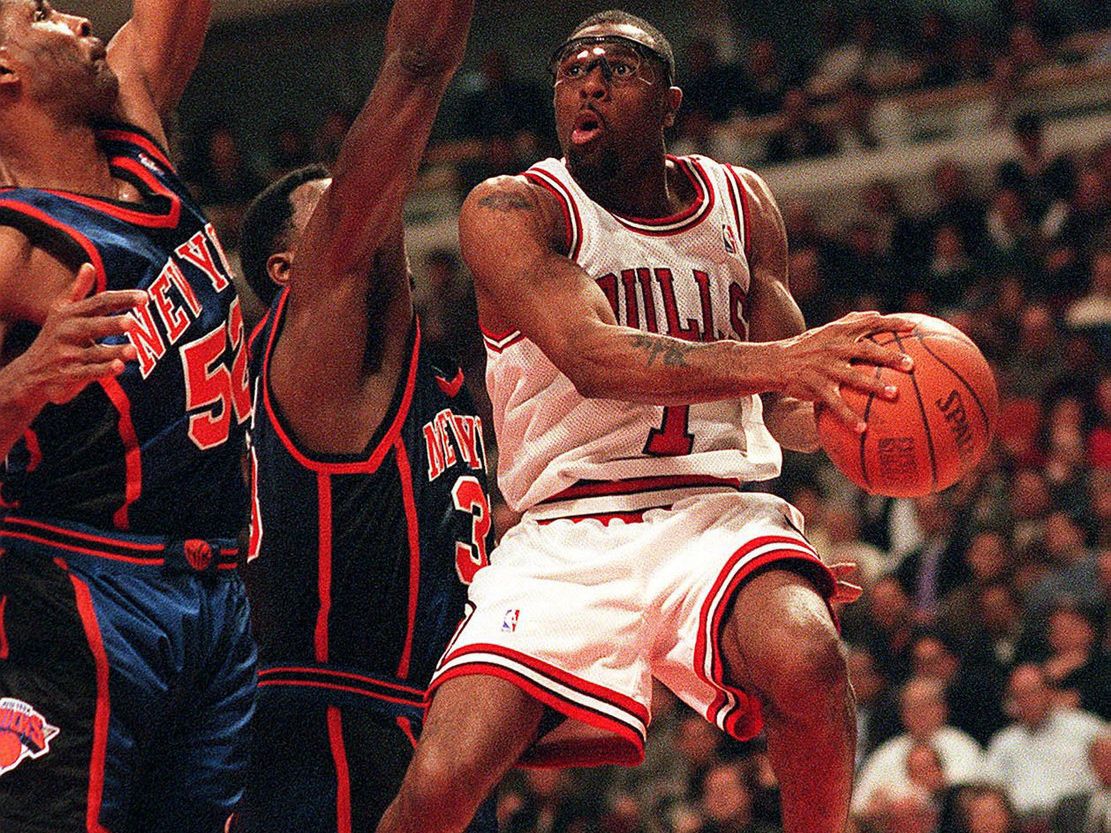
Five titles in seven years. The Bulls seemed cemented in the NBA mountaintop. Yet after the 1996-97 season, there was serious discussion at the top of the organization about possibly starting over. General manager Jerry Krause had an urge to. Chairman Jerry Reinsdorf didn’t immediately reject the proposal. Says Reinsdorf: “After the fifth championship … we were looking at this team and we realized that other than Michael, the rest of the guys were probably at the end of their high-productivity years. We had to decide whether we keep the team together or not. And we realized maybe this was the time to do a rebuild and not try to win a sixth championship.” This was the Bulls’ perplexing reality, the possibility of prematurely dismantling one of the greatest sports dynasties of all time led by arguably the greatest player in the history of the game. Chicago Bulls guard Randy Brown goes to the basket against the Knicks' Patrick Ewing and Buck Williams at the United Center on Dec. 9, 1997.
6. The mindset

Questions about the Bulls’ uncertain future already were being asked before the spilled champagne had dried at the United Center on the night the team beat the Jazz 90-86 in Game 6 of the NBA Finals to win its fifth championship. Proclaims Jordan at that night’s postgame news conference, “We are entitled to defend what we have until we lose it.” The Chicago Bulls' Michael Jordan and Lakers' Kobe Bryant look on during free throws in a game on Dec. 19, 1997, at the United Center in Chicago.
7. That sticky sentiment

Jerry Krause was skewered for emphasizing that organizations win championships, not just players and coaches. A misquote? “What I said,” Krause attempts to clarify after the firestorm had begun, “was that players and coaches alone don’t win championships. Organizations do. I do sincerely believe that organizations as a whole win. One part of it can’t win alone. The (reporter) left the world ‘alone’ out of there.” That word was significant. But it may not have helped to ease the strain between the front office and the team. Chicago Bulls General Manager Jerry Krause, left, with Phil Jackson at a June 1997 news conference announcing the coach had re-signed for one more season.
8. Poor M.J.

Michael Jordan is all smiles along with coach Dean Smith as Jordan announces at a 1984 press conference that he will forgo his senior year in college to play professional basketball.
9. The time machine

The smallest details quickly revive the excitement and the adrenaline rushes that were so prevalent during the Bulls run through the 1990s. The sounds of “Sirius” by the Alan Parsons project still pack a powerful punch. But other sights and sounds quickly conjure up the nostalgia as well. The “Charge!” horn piping from the United Center sound system. Johnny “Red” Kerr enthusiastically celebrating a big dunk. Cliff Levingston bellowing out “What time is it?!?” Even just the sounds of Marv Albert or Wayne Larrivee or Neil Funk from a game broadcast bring a little something back. Chicago Bulls' great Johnny "Red" Kerr, left, receives Basketball Hall of Fame award from Jerry Colangelo during a tribute during halftime of the game between the Bulls and Detroit Pistons at the United Center in Chicago, Illinois, Tuesday, February 10, 2009.
10. Carmen Electra

Oh, yeaaaahhhh. Of course. Carmen Electra was once a part of the Bulls’ orbit, the girlfriend and eventual wife of enigmatic forward Dennis Rodman. When Rodman asked for a short personal vacation in the middle of the 1997-98 season, Phil Jackson gave permission despite the reluctance of at least one other key figure on the team. Says Jordan: “I said, ‘Phil, you let this dude go on vacation, we’re not going to see him. You let him go to Vegas, we’re definitely not going to see him (again).” Still, Jackson granted Rodman 48 hours to get away and reset. So off Rodman went for his escape. To Vegas. With Electra. “It was an occupational hazard,” she says, “being Dennis’ girlfriend.” Michael Jordan pours bubbly on Dennis Rodman inside the locker room after winning the NBA title on June 14, 1998.
11. Scottie Pippen

With all of the spotlight on Jordan, the career arc of Pippen remains fascinating. From an unknown prospect out of Central Arkansas to a promising rookie to Jordan’s reliable right-hand man to seven-time All-Star and Dream Team member to an underpaid and underappreciated star. Pippen’s all-around game was a huge part of the Bulls’ success. Chicago Bulls' Scotty Pippen, (right), puts the pressure on Houston Rockets' Jakeem Olajuwon during 1997's NBA All-Star game.
12. The sparks of the fire

There’s footage of the late James Jordan, Michael’s father, from a mid-1980s TV interview offering a glimpse into his son’s psyche. “If you want to bring the best out in Michael,” James says, “tell him he can’t do something or that he can’t do it as good as someone else.” Roy Williams, an assistant under Dean Smith at North Carolina during Jordan’s three-year college career, offers his recollections of Jordan as a Tar Heel. “Michael Jordan was the only player who could ever turn it on and off,” Williams says. “And he never frickin’ turned it off.” Members of North Carolina's 1982 National Championship team Michael Jordan (left), James Worthy (52) and coach Dean Smith (right) enjoy a laugh together as they watch a video tribute to their team during halftime of the North Carolina vs. Wake Forest game at the Dean Smith Center in Chapel Hill, N.C., Saturday, February 10, 2007.
13. ‘The Sniff Brothers’

Jordan always had a sincere fondness for the security personnel at the Chicago Stadium and the United Center. It’s fair to say the affection was reciprocated. Get ready to meet “The Sniff Brothers.” Calvin Sniff. C.J. Sniff. Tom Sniff. John Michael Sniff. Brigadier General Gus Sniff. A view of the Michael Jordan statue in the the United Center atrium.
14. ‘The shot on Ehlo’

Jordan’s hanging, buzzer-beating, series-clinching jumper to knock the Cavaliers out of the 1989 playoffs remains iconic. As does the Bulls guard’s leaping, fist-pumping celebration. In many ways, it was the first truly significant postseason triumph for Jordan and the Bulls. But you might not remember Jordan already had hit a clutch go-ahead jumper seconds earlier to put the Bulls ahead 99-98 in that Game 5. Jordan’s bigger heroics were needed only after Ehlo beat the Bulls for a backdoor layup on a beautifully designed inbounds play with 6 seconds left that could have ended the Bulls season. The Chicago Bulls' Michael Jordan reacts after hitting the game-winning basket over Cleveland's Craig Ehlo, left rear, in Game 5 of the NBA playoffs May 7, 1989, in Cleveland, Ohio.
15. To the victor …

Barely a breath after the final buzzer of the Bulls’ tough-to-stomach 93-74 loss to the Pistons in Game 7 of the 1990 Eastern Conference finals, CBS sideline reporter Pat O’Brien stops Jordan on the court as he congratulates the Pistons. “All you can do is wish them good luck,” he tells O’Brien. “We fought hard. They were the better team. We want to be where they are. But we still have to wait our turn.” File that away. It’s important context for the following season when the Bulls are finishing a sweep of those same Pistons in the East finals. Yet Isiah Thomas, Bill Laimbeer and Co. can’t get off the court fast enough, bolting for the locker room with 7.9 seconds left in the Bulls’ series-clinching victory.
16. The introduction of the triangle offense

Jerry Krause long had admired Bulls assistant Tex Winter for his strategic acumen, particularly drawn to Winter’s offensive ideas. Coach Doug Collins, however, wasn’t such a huge fan of the triangle system, his offensive philosophy jokingly summed up after Jordan hit a game-winning shot to beat the Pistons during the 1989 playoffs. “That was ‘Get the ball to Michael, everybody get the (expletive) out of the way and go to the basket,’ ” Collins cracked. Collins’ tense disagreements with Winter show in the responsibilities and in-game seating Winter was allowed to have. Still, Krause was encouraging fellow Bulls assistant coach Phil Jackson to pick Winter’s brain on the triangle offense. You know, just in case. Former Kanas State coach Tex Winter (K-State 1953-1968), left, and Ernie Barrett (K-State 1948-1951) share a moment during a visit from Oklahoma State at Bramlage Coliseum in Manhattan, Kan., on Saturday, Jan. 24, 2015.
17. An icy reception to the triangle

Jordan, who won the NBA scoring title in all three seasons he played for Collins, was resistant when Jackson became the new Bulls coach in summer 1990 and began installing the triangle system. Says Jordan: “He was coming to take the ball out of my hands. Doug put the ball in my hands. … Everybody has an opportunity to touch the ball, but I didn’t want Bill Cartwright to have the ball with five seconds left. That’s not an equal-opportunity offense. That’s (expletive).” Chicago Bull's coach Phil Jackson hugs Michael Jordan after the Bulls won their 6th championship at the Delta Center in Salt Lake City, Utah.
18. The swarms, the swarms, the swarms

Boarding the bus. Exiting hotel elevators. In postgame interview sessions. Coming off the bus. Wherever Jordan went, the mobs followed. The film offers a detailed reminder of the intense fatigue factor Jordan and the Bulls always were fighting. Making official what had been known for months, Jordan retired from the Bulls for a second time on Jan. 13, 1999.
19. Away from the swarms

The behind-the-scenes footage from the 1997-98 season that’s folded into the film isn’t all that earth-shattering. But it doesn’t occasionally help set a mood. In one sequence, Jordan is chatting pregame with Ron Harper in the locker room. As the guards talk, Jordan, in full warmup attire, has a cigar in his mouth and is half-swinging a baseball bat while some gentle 1990s R&B plays on the sound system. Chicago Bulls' Michael Jordan, (left), and Ron Harper celebrate during the final seconds of Sunday's NBA finals game against the Utah Jazz. The Bulls hammered the Jazz 96-54 in game three of the 1998 NBA finals.
20. Those 1.8 seconds
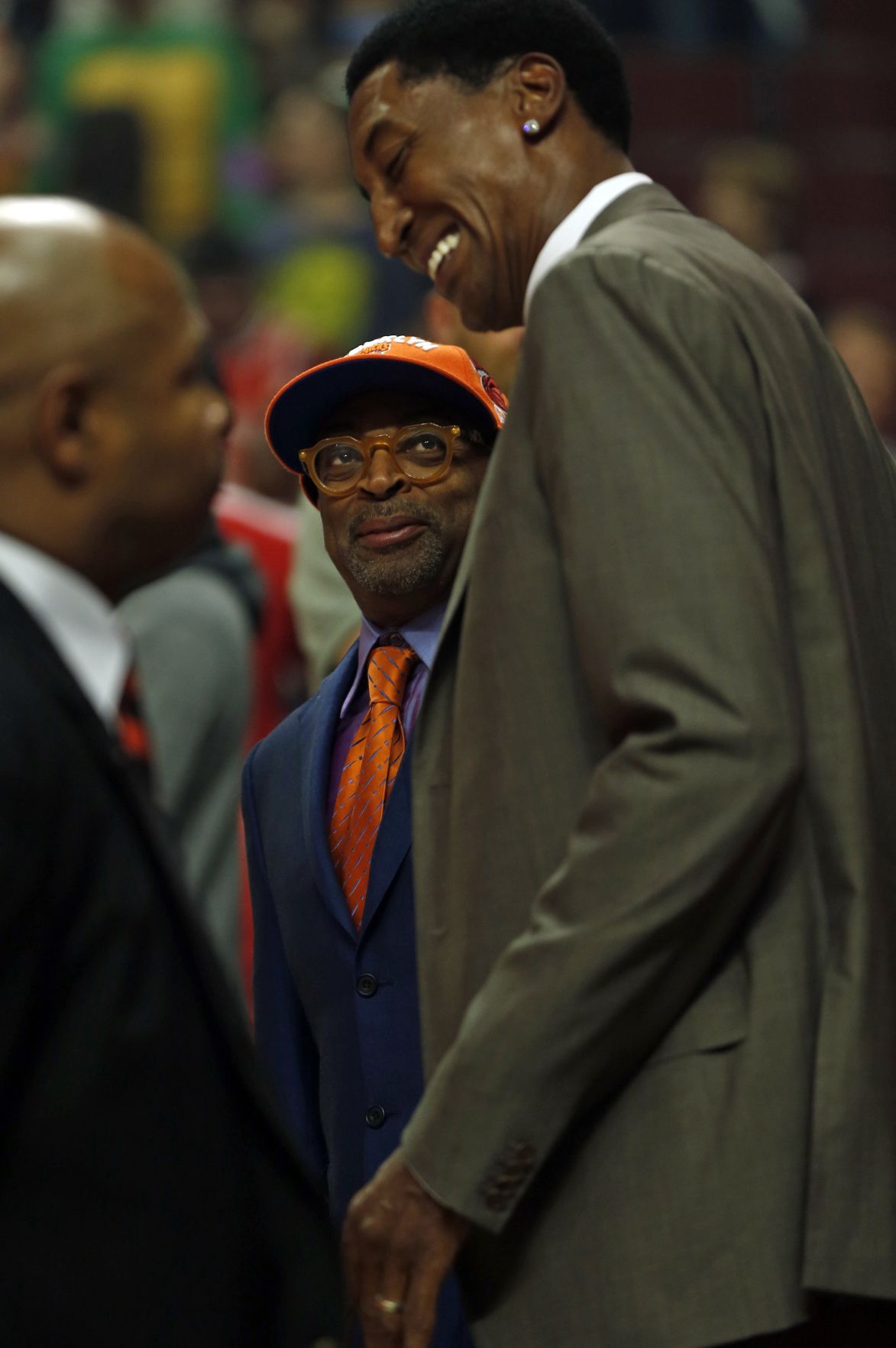
It’s still confounding 26 years later that Scottie Pippen chose the final play of a tied playoff game against the Knicks in 1994 to sulk, refusing to take the floor because the Bulls’ final play was designed for Toni Kukoc to take the last shot and not him. “That’s strange, isn’t it?” Johnny Kerr notes on the radio broadcast. “That Scottie would sit on this.” Somehow, the Bulls quelled the intense friction of that moment with a buzzer-beating, game-winning bucket. Pete Meyers inbounds to Kukoc, who turns on Anthony Mason and fires a 21-footer at the horn. All net. Spike Lee, middle, and former Chicago Bulls star Scottie Pippen, right, chat before the Bulls play host to the New York Knicks at the United Center in Chicago, Illinois, on Thursday, Oct. 31, 2013.
21. The grudges

There never has been an athlete who has needed less to feel slighted or to spark extra motivation within himself. That much has been clear forever with Jordan. But the documentary drives it home with telling anecdotes about LaBradford Smith, George Karl and Hornets-era B.J. Armstrong. Chicago Bulls' Michael Jordan tries to keep the ball from the Charlotte Hornets' B.J. Armstrong during the second period of Wednesday night's playoff game at the United Center in Chicago, Ill.
22. Poor Dan Majerle

Krause deeply admired the Suns guard as a defender. Jordan? Well, not quite as much. That’s one reason the Bulls star felt extra driven to dump in 246 points over six games against the Suns in the 1993 NBA Finals. In that series, Jordan had his competitive fire turned on Charles Barkley. Barkley was the NBA MVP that season. Privately, Jordan felt like he was more deserving. Still, he let his friend have that honor. The only appropriate response: “OK, fine. You can have that,” Jordan says. “I’m going to get this.” This, of course, being another Larry O’Brien trophy. Perhaps Karl Malone should have seen the same thing coming in 1997. Dan Majerle and Brent Barry laugh it up on the bench late in Tuesday's playoff game between the Miami Heat and New York Knicks at Madison Square Garden.
23. The ending

With production of Episodes 9 and 10 of the documentary still wrapping up, ESPN has yet to offer an advanced screening of the film’s conclusion, which, in part, will chronicle the Bulls’ final two playoff series in 1998. Seven games against the Pacers. Six against the Jazz. It’s the home stretch of a grueling journey. We don’t want to play spoiler here. But we can tell you that with 41.9 seconds left in Game 6 of the NBA Finals in Salt Lake City, the Bulls trail 86-83. It’s going to take something to special to rally and pull that one out. Stay tuned. Chicago Bulls' Scottie Pippen, left, and Michael Jordan show off their trophies Tuesday during the Bulls' championship rally at Grant Park in Chicago.