

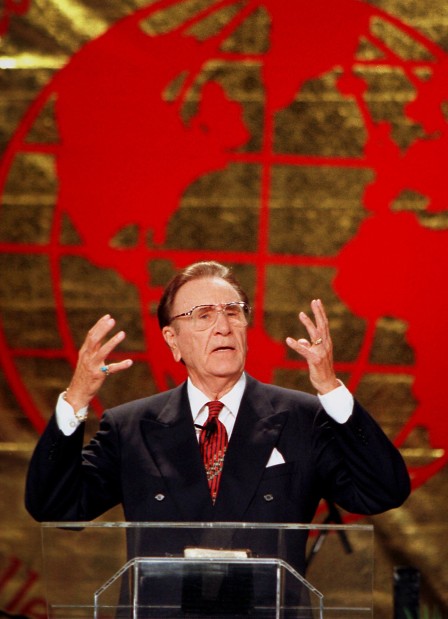
TULSA, Okla. - Oral Roberts, who helped pioneer TV evangelism in the 1950s and used the power of the new medium - and his message of God's healing power - to build a multimillion-dollar ministry and a university that bears his name, died Tuesday. He was 91.
Roberts died of complications from pneumonia in Newport Beach, Calif., according to his spokesman, A. Larry Ross. The evangelist was hospitalized after a fall on Saturday.
Roberts rose from humble tent revivals to become one of the nation's most famous and influential preachers. Along with Billy Graham, he pioneered religious TV, and he played a major role in bringing American Pentecostalism into the mainstream.
He also laid the foundation for the "prosperity gospel," the doctrine that has come to dominate televangelism. It holds that God rewards the faithful with material success. Its critics say it is used by preachers to enrich themselves at the expense of their followers.
People are also reading…
"In conservative Protestant culture, he's second only to Billy Graham," said Grant Wacker, a professor at Duke University's divinity school. "Jerry Falwell is important, too, but I think in the long run we'll see that Oral Roberts had more impact."
Roberts overcame tuberculosis at age 17, when his brother carried him to a revival meeting where an evangelist was praying for the sick. Roberts said he was healed of the illness and his stuttering.
He said that it was then that he heard God tell him he should build a university based on the Lord's authority - a promise fulfilled in 1963, with the founding of Oral Roberts University in Tulsa.
He gave up a pastorate in Enid in 1947 to pursue a strain of evangelism in which he called for prayer to heal the whole person - body, mind and spirit.
By the 1960s and '70s, he was reaching millions around the world through radio, television, publications and personal appearances. He remained on TV into the new century. He published dozens of books and conducted hundreds of crusades.
He credited his oratorical skills to his faith, saying: "I become anointed with God's word, and the spirit of the Lord builds up in me like a coiled spring. By the time I'm ready to go on, my mind is razor-sharp. I know exactly what I'm going to say."
While many of colleagues in healing evangelism were flamboyant in their preaching, Roberts was subdued in his delivery. His long sermons were filled with stories and anecdotes, and at the end of a service, the faithful would form a long healing line. Roberts would clasp his hands on each person's head, shutting his eyes while he prayed.
Roberts espoused a "Seed-Faith" theology, which held that those who give to God will get things in return.
The generation of "prosperity preachers" who followed Roberts point to their own luxury homes and private jets as evidence of God's favor. In 2007, Republican Sen. Charles Grassley of Iowa launched an investigation of six prosperity preachers, including three who sat on the Oral Roberts University board of regents at the time. The inquiry is still under way.
Roberts' ministry hit rocky times in the 1980s. There was controversy over his City of Faith medical center, a $250 million investment that eventually folded. And Roberts was widely ridiculed when he retreated to his prayer tower and proclaimed that God would "call me home" if he failed to meet a fund-raising goal of $8 million.


