Here's a look back at the top stories from the last week.
Cheslie Kryst, former Miss USA, dies at 30
NEW YORK (AP) — Cheslie Kryst, the 2019 winner of the Miss USA pageant and a correspondent for the entertainment news program "Extra," has died at age 30.
Police said Kryst jumped from a Manhattan apartment building and was pronounced dead at the scene Sunday morning. Her family confirmed her death in a statement.
The National Suicide Prevention Lifeline is available for those in distress: 1-800-273-8255.
"In devastation and great sorrow, we share the passing of our beloved Cheslie. Her great light was one that inspired others around the world with her beauty and strength," her family said.
"Cheslie embodied love and served others, whether through her work as an attorney fighting for social justice, as Miss USA and as a host on EXTRA. But most importantly, as a daughter, sister, friend, mentor and colleague – we know her impact will live on," her family said.
Kryst, a former Division I athlete and North Carolina attorney, won the Miss USA pageant in May, 2019, and competed in the Miss Universe pageant that year.
When Kryst was crowned, it marked more than a personal triumph: It meant that for the first time, three Black women were the reigning Miss USA, Miss Teen USA and Miss America.
In a statement Sunday, the nationally syndicated program "Extra" described Kryst as "not just a vital part of our show, she was a beloved part of our Extra family and touched the entire staff. Our deepest condolences to all her family and friends."
Kryst provided commentary at last month's Miss Universe pageant, which called her "one of the brightest, warmest, and most kind people we have ever had the privilege of knowing. Our entire community mourns her loss."
University of South Carolina praised the former student-athlete, calling her "a woman of many talents." Kryst also held an MBA from Wake Forest University.
According to police, Kryst's body was found at approximately 7 a.m. Sunday in front of the Orion building, a high-rise on West 42nd Street in midtown Manhattan.
***
Photos: Notable deaths in 2022
Sidney Poitier
Sidney Poitier, the groundbreaking actor and enduring inspiration who transformed how Black people were portrayed on screen and became the first Black actor to win an Academy Award for best lead performance and the first to be a top box-office draw, died Jan. 6, 2022. He was 94. Poitier won the best actor Oscar in 1964 for “Lilies of the Field.”
AP file, 2008
Bob Saget
Bob Saget, the actor-comedian known for his role as beloved single dad Danny Tanner on the sitcom “Full House” and as the wisecracking host of “America’s Funniest Home Videos,” died Jan. 9, 2022. He was 65.
AP file, 2019
Peter Bogdanovich
Peter Bogdanovich, the ascot-wearing cinephile and director of 1970s black-and-white classics like “The Last Picture Show” and “Paper Moon,” died Jan. 6, 2022. He was 82. Bogdanovich was heralded as an auteur from the start, with the chilling lone shooter film “Targets” and soon after “The Last Picture Show,” from 1971, his evocative portrait of a small, dying town that earned eight Oscar nominations and catapulted him to stardom.
AP file, 2005
Marilyn Bergman
Marilyn Bergman, the Oscar-winning lyricist who teamed with husband Alan Bergman on “The Way We Were,” “How Do You Keep the Music Playing?” and hundreds of other songs, died Jan. 8, 2022. She was 93.
AP file, 1980
Dan Reeves
Dan Reeves, who won a Super Bowl as a player with the Dallas Cowboys but was best known for a long coaching career highlighted by four more appearances in the title game with the Denver Broncos and the Atlanta Falcons, all losses, died Jan. 1, 2022. He was 77.
AP file, 2014
Don Maynard
Don Maynard, a Hall of Fame receiver who made his biggest impact catching passes from Joe Namath in the wide-open AFL, died Jan. 10, 2022. He was 86. When Maynard retired in 1973, he was pro football’s career receiving leader with 633 catches for 11,834 yards and 88 touchdowns. The Jets retired his No. 13 jersey.
AP file, 1968
Michael Lang
Michael Lang, a co-creator and promoter of the 1969 Woodstock music festival that served as a touchstone for generations of music fans, died Jan. 8, 2022. He was 77.
AP file, 2009
Lawrence N. Brooks
Lawrence N. Brooks, the oldest World War II veteran in the U.S. — and believed to be the oldest man in the country — died Jan. 5, 2022, at the age of 112.
AP file, 2019
Dwayne Hickman
Dwayne Hickman, the actor and network TV executive who despite numerous achievements throughout his life would always be remembered fondly by a generation of baby boomers for his role as Dobie Gillis, died Jan. 9, 2022. He was 87.
AP file
Ronnie Spector
Ronnie Spector, the cat-eyed, bee-hived rock ‘n’ roll siren who sang such 1960s hits as “Be My Baby,” “Baby I Love You” and “Walking in the Rain” as the leader of the girl group The Ronettes, died Jan. 12, 2022. She was 78.
AP file, 2010
Charles McGee
Charles McGee, a Tuskegee Airman who flew 409 fighter combat missions over three wars and later helped to bring attention to the Black pilots who had battled racism at home to fight for freedom abroad, died Jan. 16, 2022. He was 102.
AP file, 2019
Gaspard Ulliel
French actor Gaspard Ulliel, known for appearing in Chanel perfume ads as well as film and television roles, died Jan. 19, 2022, after a skiing accident in the Alps. He was 37. Ulliel portrayed the young Hannibal Lecter in 2007's “Hannibal Rising” and fashion mogul Yves Saint Laurent in the 2014 biopic “Saint Laurent.” He is also in the Marvel series “Moon Knight."
AP file, 2015
André Leon Talley
André Leon Talley, a towering figure who made fashion history as a rare Black editor in an overwhelmingly white industry, died Jan. 18, 2022. He was 73. Talley was the former creative director and editor at large of Vogue magazine. Often dressed in sweeping capes, he was a highly visible regular in the front row of fashion shows in New York and Europe for decades.
AP file, 2016
2022: Meat Loaf
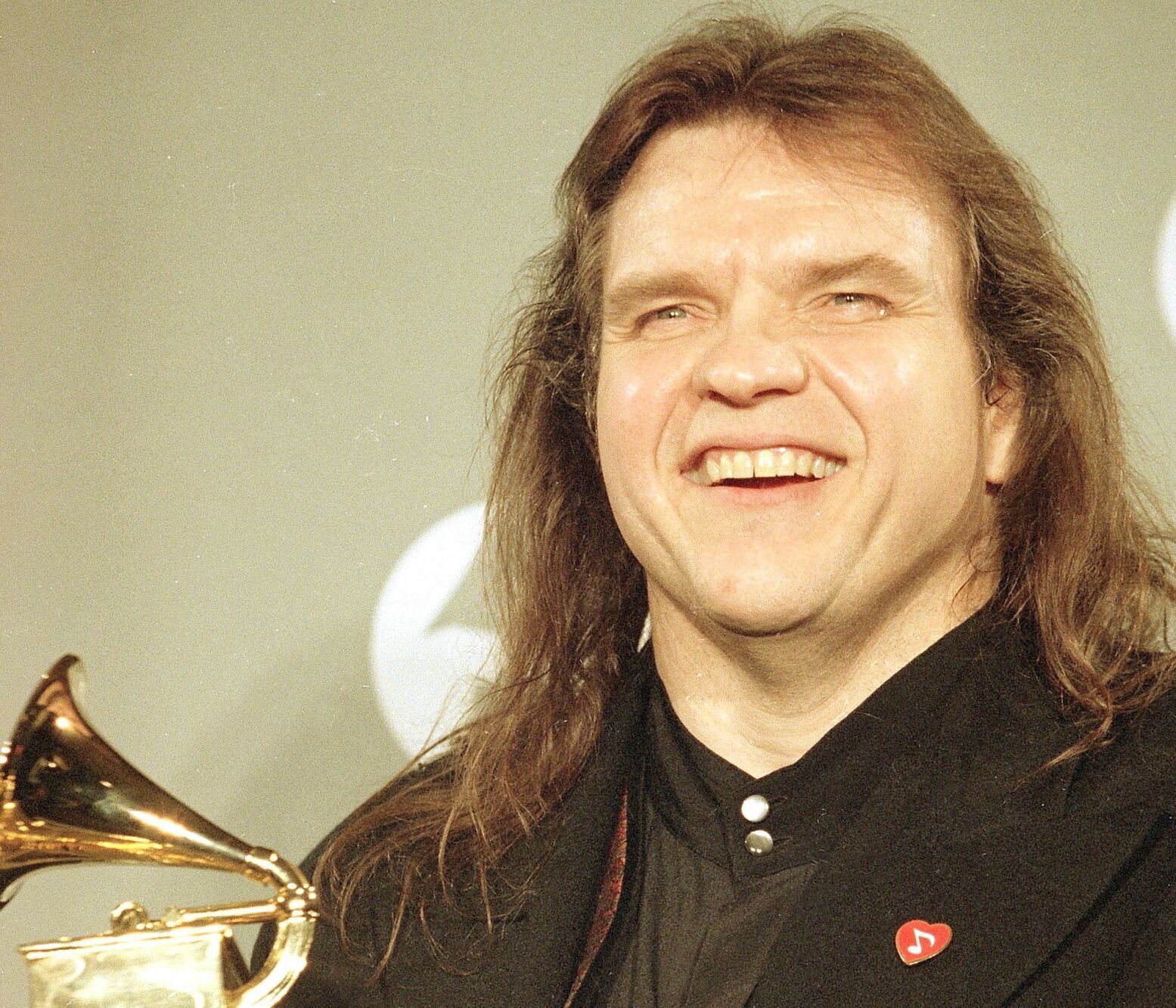
One year ago: Meat Loaf, the rock superstar known for his “Bat Out of Hell” album and for such theatrical, dark-hearted anthems as “Paradise By the Dashboard Light” and “Two Out of Three Ain’t Bad,” died at age 74.
AP file, 1994
Louie Anderson
Louie Anderson, whose four-decade career as a comedian and actor included his unlikely, Emmy-winning performance as mom to twin adult sons in the TV series “Baskets,” died Jan. 21, 2022. He was 68. In 2016, Anderson won a best supporting actor Emmy for his portrayal of Christine Baskets, mother to twins, in the FX series “Baskets.” He was a familiar face elsewhere on TV, including as host of a revival of the game show “Family Feud” from 1999 to 2002.
AP file, 2017
Manfred Thierry Mugler
French fashion designer Manfred Thierry Mugler, whose dramatic designs were worn by celebrities like Madonna, Lady Gaga and Cardi B, died Jan. 23, 2022. He was 73. Mugler, who launched his brand in 1973, became known for his architectural style, defined by broad shoulders and a tiny waist. The use of plastic-like futuristic fabric in his sculpted clothing became a trademark.
AP file, 2001
Howard Hesseman
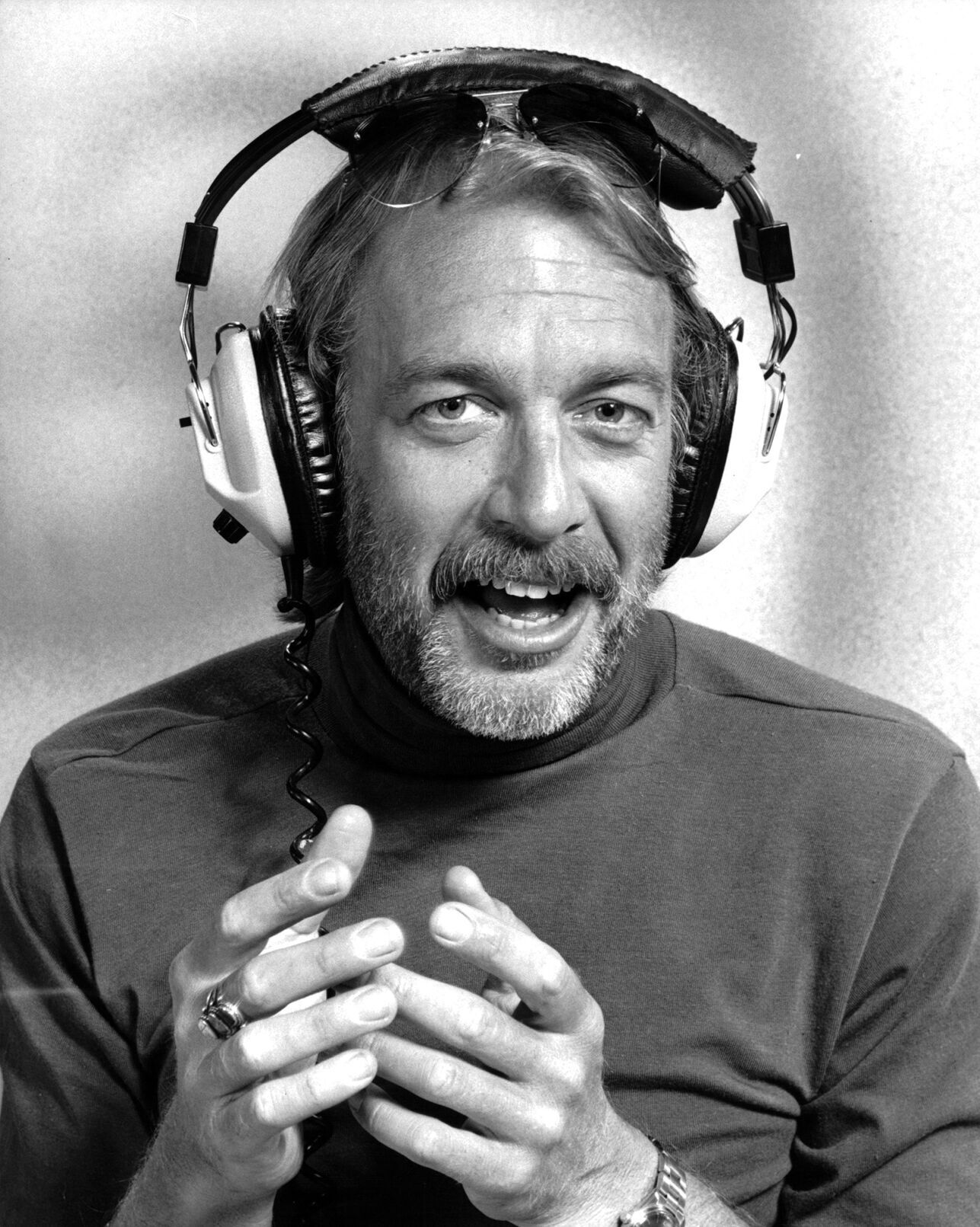
Howard Hesseman, best known as the hard-rocking disc jockey Dr. Johnny Fever on the sitcom "WKRP in Cincinnati," died Jan. 28, 2022. In addition to earning two Emmy nominations for his role on "WKRP," Hesseman also appeared on "Head of the Class" and "One Day at a Time," along with guest appearances on "That 70's Show," among others. The Oregon native also hosted "Saturday Night Live" several times. — CNN
Photo by Michael Ochs Archives/Getty Images, 1978
Bill Fitch
Bill Fitch, who guided the Boston Celtics to one of their championships during a Hall of Fame coaching career spanning three decades, died Feb. 2, 2022. He was 89. A two-time NBA coach of the year, Fitch coached for 25 seasons in the NBA, starting with the expansion Cleveland Cavaliers in 1970. He was Larry Bird's first pro coach with Boston in 1979, won a title with the Celtics in 1981 and spent time with Houston, New Jersey and the Los Angeles Clippers.
AP file, 1981
Ivan Reitman
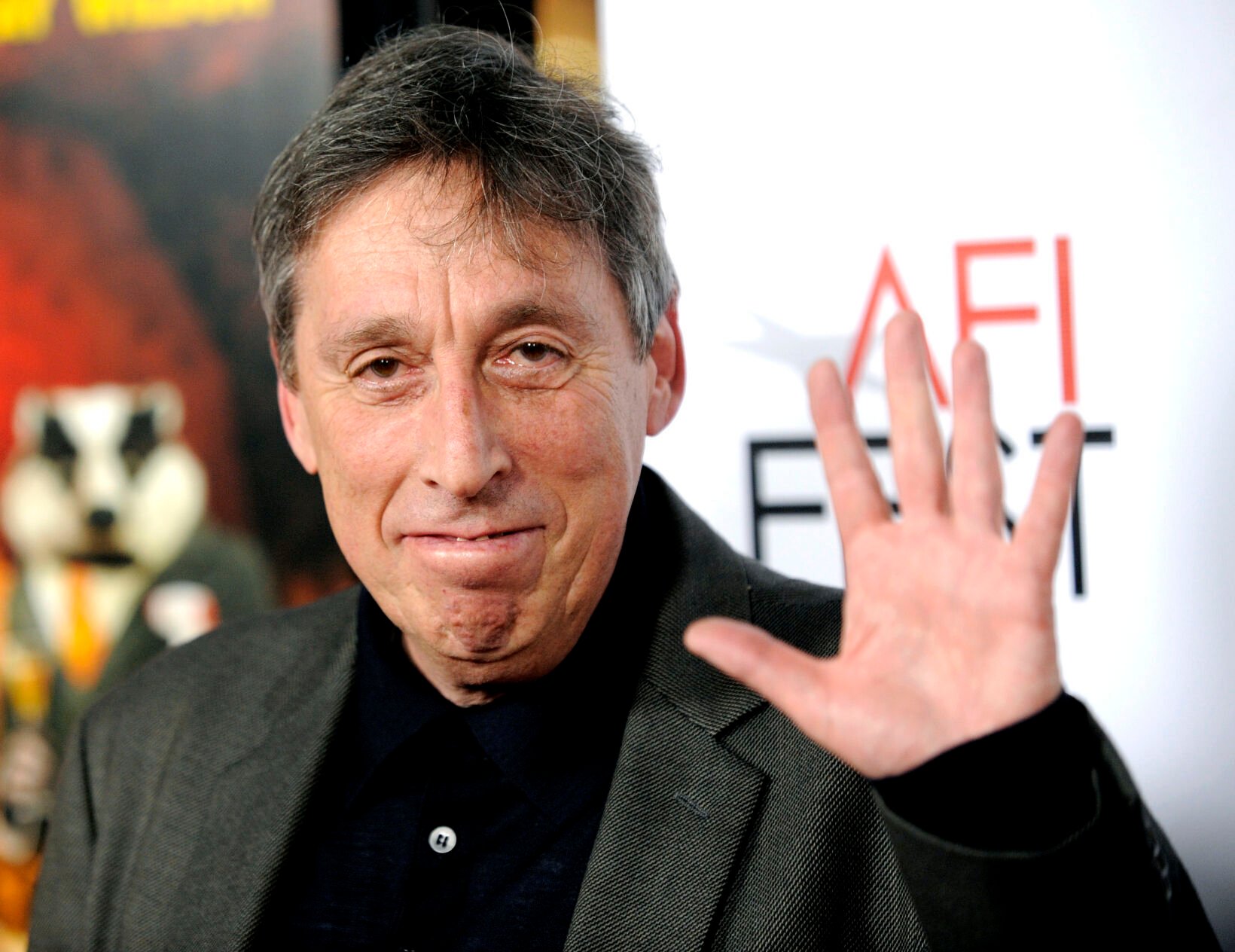
Ivan Reitman, the influential filmmaker and producer behind many of the most beloved comedies of the late 20th century, from “Animal House” to “Ghostbusters,” died Feb. 12, 2022. He was 75. Known for bawdy comedies that caught the spirit of their time, Reitman’s big break came with the raucous, college fraternity sendup “National Lampoon’s Animal House,” which he produced. He directed Bill Murray in his first starring role in the summer camp flick “Meatballs," and then again in 1981's “Stripes,” but his most significant success came with 1984’s “Ghostbusters.”
AP file, 2009
Gary Brooker
Gary Brooker, the Procol Harum frontman who sang one of the 1960s' most enduring hits, “A Whiter Shade of Pale,” died Feb. 19, 2022. He was 76. Brooker was singer and keyboard player with the band, which had a huge hit with its first single, “A Whiter Shade of Pale.” With its Baroque-flavored organ solo and mysterious opening line - “We skipped the light fandango, turned cartwheels cross the floor" — the song became one of the signature tunes of the 1967 “Summer of Love.”
AP file, 2006
Charley Taylor
Charley Taylor, the Hall of Fame receiver who ended his 13-season career with Washington as the NFL's career receptions leader, died Feb. 19, 2022. He was 80. Taylor was the 1964 NFL rookie of the year and was selected to the Pro Football Hall of Fame's All-1960s Team. The eight-time Pro Bowl selection was a first-team all-NFL pick in 1967.
AP file
Elon Musk offered a Florida teen $5,000 to delete a Twitter account tracking his jet. It wasn't enough
Jack Sweeney, a 19-year-old from Florida, rejected a $5,000 offer from Elon Musk to delete his Twitter account that tracks the billionaire's private jet.
ElonJet has over 150,000 followers, and uses a bot that Sweeney developed to monitor Musk's flights. The feed then tweets out when and where the plane takes off or lands and the duration of each trip.
The college freshman has developed about a dozen other flight bot accounts that track the travels of high-profile tech titans, including Bill Gates and Jeff Bezos.
The initial direct message from Musk came November 30, Protocol first reported.
"Can you take this down?," Musk asked Sweeney. "It's a security risk."
The Tesla and SpaceX CEO eventually offered the teenager $5,000 to help prevent "crazy people" from tracking his flights. Sweeney countered asking for $50,000, saying he could use the money for college and maybe a Tesla Model 3.
"I don't love the idea of being shot by a nutcase," Musk said.
The last message exchange was Wednesday, Jan. 19, when Musk said it didn't feel right "to pay to shut this down." CNN Business has viewed the messages.
"Options other than remuneration like an internship would make taking it down a lot easier," Sweeney replied. Musk has not yet responded.
CNN has reached out to SpaceX for comment.
Sweeney said he's been a fan of SpaceX since the first Falcon Heavy launch in 2018. His father works for an airline, fueling his interest in aviation.
"5,000 is not enough for how much I get out of it," Sweeney said. "It doesn't replace anything, like the enjoyment factor."
Sweeney did offer Musk some technical advice, telling the billionaire about a blocking program he could use to counter flight tracking programs.
"It looks like he took that advice," Sweeney said, saying it appears Musk is currently using the blocking program.
So is Sweeney is still able to track Musk's flights despite the blocking program? "I am," Sweeney said. "It's just a bit more complicated."
***
How the richest person in each state made a fortune
How the richest person in every state made a fortune
Whether it's a hedge-fund billionaire, tech giant, industrial titan, or someone simply born into the right family, the wealthiest people in every state each have their own stories. In today's political climate, the super-rich have plenty of influence over our political process, from lobbying members of the government and contributing to presidential bids to running ad campaigns in favor of specific causes.
To figure out who's on top of each state's rich list, Forbes tracks groups of billionaires (or centimillionaires in states with no billionaires) and updates their findings annually. Stacker analyzed this data to compile a list of the uber-wealthy and then broke down how each person earned their fortune. This list accounts for individuals' wealth as of June 26, 2019, but keep in mind the tides of fortune are always shifting. Many of the figures can change based on a dip in the stock market alone.
Sometimes billionaires are made overnight, others over the course of generations. The distribution of billionaires and other super-rich individuals isn't evenly distributed; plenty more live on the coast than the Midwest, with a few key exceptions. Curious who the richest person is in your home state? Keep reading to find out.
Known colloquially as the Yella Fella, Jimmy Rane is a lumber magnate who built his fortune from his family's small plant into billion-dollar behemoth Great Southern Wood Preserving. As the wealthiest person in Alabama, Rane keeps his money close to home. He's revitalized his hometown and supports several universities by offering scholarships (more than 400 to date) through The Jimmy Rane Foundation. The Auburn University alum still sits on the board of his alma mater as chair of the board's governmental affairs.
smspsy // Shutterstock
Alaska: Leonard Hyde, Jonathan Rubini and families
- Net worth: $300 million each (as of June 18, 2019)
- Age: 62, 64
- Source of wealth: real estate
- Residence: Anchorage, AK
Real estate tycoons Leonard Hyde and Jonathan Rubini began amassing their fortunes by buying up Alaskan properties during economic downturns. Today, the partners head JL Properties, which owns the tallest building in Anchorage, massive residential units, and much more.
Raymona Pooler // Shutterstock
Arizona: Ernest Garcia II
- Net worth: $5.7 billion
- Age: 62
- Source of wealth: used cars, self-made
- Residence: Tempe, AZ
The stereotype of the used car salesman—ill-fitting shirt, sweaty skin, dusty parking lot—has never looked so good. Ernest Garcia II, an ex-con, made his fortune through operating the fourth-largest used car retailer in the country, DriveTime Automotive, along with owning plenty of stock of Carvana, a used car e-commerce platform.
Bradley Gordon // Flickr
Arkansas: Jim Walton
- Net worth: $52.1 billion
- Age: 71
- Source of wealth: Walmart
- Residence: Bentonville, AR
According to Forbes, Jim Walton is the 11th wealthiest person in America, and is one of many heirs to the Walmart fortune that was amassed by his father, Sam Walton. Jim Walton lives in Bentonville—home to the Walmart world headquarters—and runs the family's Arvest Bank, which has assets listed at $16 billion.
Rick T. Wilking // Getty Images
California: Mark Zuckerberg
- Net worth: $79.5 billion
- Age: 35
- Source of wealth: Facebook, self-made
- Residence: Palo Alto, CA
As the creator of Facebook, the world's largest social network, Mark Zuckerberg isn't just the wealthiest Californian, but one of the five wealthiest Americans (stock price dependent). Zuckerberg hasn't been shy about giving his money away: He's one of the many ultra-rich to promise to donate half his wealth to The Giving Pledge.
Philip Anschutz is one of the most diversified billionaires on this list, with businesses ranging from sports and movies to oil and real estate. Anschutz's father was an oil tycoon, giving him a leg-up, but Phillip has far surpassed anything his family ever accomplished. Today, Anschutz owns sports teams, an entertainment conglomerate (including Coachella), and is one of the biggest individual landowners in the United States. Anschutz has also given away more than $2 billion to charity.
Michael Kovac // Getty Images for NARAS
Connecticut: Ray Dalio
- Net worth: $18.7 billion
- Age: 70
- Source of wealth: hedge funds, self-made
- Residence: Greenwich, CT
After earning an MBA from Harvard Business School in 1975, Ray Dalio started Bridgewater Associates, which has since become the largest hedge fund in the world with an estimated $160 billion under management. Dalio is also actively philanthropic—his family has given more than $1.3 billion via the Dalio Foundation, and he's promised to give away half his wealth through The Giving Pledge.
Web Summit // Flickr
Delaware: Robert Gore and Elizabeth Snyder
- Net worth: $885 million each (as of June 18, 2019)
- Age: 82, 72
- Source of wealth: Gore-Tex
- Residence: Newark and Wilmington, DE
Together, the heirs to Gore-Tex would be worth over a billion dollars; but since Elizabeth Snyder has five siblings, Delaware has zero billionaires. Gore-Tex is a lightweight, waterproof fabric and is commonly used in high-end raincoats to keep the cold and wet out.
Santeri Viinamaki // Wikimedia Commons
Florida: Thomas Peterffy
- Net worth: $16.9 billion
- Age: 75
- Source of wealth: discount brokerage, self-made
- Residence: Palm Beach, FL
A self-made billionaire, Thomas Peterffy is a Hungarian immigrant who came to America at 21 with no money. He earned his fortune by creating Discount Brokerage, a digital trading platform used by brokers and investors around the world. One of Peterffy's biggest causes is railing against socialism—he's spent millions in political ads.
James Leynse/Corbis // Getty Images
Georgia: Jim Kennedy
- Net worth: $10 billion
- Age: 72
- Source of wealth: media, automotive
- Residence: Atlanta, GA
Jim Kennedy inherited his 25% stake in Cox Enterprises—owners of TV and radio stations, newspapers, and digital services—from his mother, Barbara Cox Anthony. Kennedy had already served as CEO of the mega-media company from 1988 to 2008, raising its revenues from $1.8 billion to $15.4 billion. Kennedy is involved in a variety of philanthropic endeavors, including education, health care, and sustainability causes.
Since founding eBay, Pierre Omidyar has pulled back from the company (though he still sits on its board). He has launched other ventures including First Look Media and the Press Freedom Defense Fund, which supports journalists in legal battles.
ames Leynse/Corbis // Getty Images
Idaho: Frank VanderSloot
- Net worth: $3.8 billion
- Age: 71
- Source of wealth: nutrition, wellness products, self-made
- Residence: Idaho Falls, ID
Frank VanderSloot isn't just rich; he's experienced in the political sector, too. The founder of Melaleuca, which calls itself the “largest online shopping club,” VanderSloot was a national finance co-chair for both of Republican Mitt Romney's presidential bids.
Jeremy112233 // Wikimedia Commons
Illinois: Kenneth Griffin
- Net worth: $13.1 billion
- Age: 51
- Source of wealth: hedge funds, self-made
- Residence: Chicago, IL
Ken Griffin runs Citadel, which manages more than $30 billion. Griffin got his start making trades from his Harvard dormitory, where he even reportedly put a satellite dish on the roof to get real-time quotes. Today, Griffin is considered an active philanthropist and gives to a range of causes in his native Illinois.
Paul Elledge // Wikimedia Commons
Indiana: Carl Cook
- Net worth: $10.6 billion
- Age: 57
- Source of wealth: medical devices
- Residence: Bloomington, IN
Carl Cook is CEO of Cook Group, a medical device manufacturer started by Cook's parents in 1963. Cook inherited the bulk of the family fortune in stock transfers over a 15-year period, avoiding estate taxes. Cook is famously private, owing in part to his mother's 1989 two-day kidnapping.
Sergey Ryzhov // Shutterstock
Iowa: Harry Stine
- Net worth: $5.5 billion
- Age: 78
- Source of wealth: agriculture, self-made
- Residence: Adel, IA
Agriculture billionaire Harry Stine was born and raised on a farm, so it's little surprise that he made his fortune selling seeds. Stine Seed is one of the largest independent producers of genetically modified seeds, sold to multinational corporations like Monsanto and Syngenta. Stine is also active in philanthropy and has promised to give away at least half of his money through The Giving Pledge.
Charles Koch has served as chairman and CEO of Koch Industries since 1967. The company was started by Koch's father, and deals heavily in oil, gas, ranching, and finance, among other industries. Koch is also involved in politics and has funded a number of think tanks, including The Heritage Foundation and The Cato Institute.
Patrick T. Fallon for The Washington Post // Getty Images
Kentucky: Tamara Gustavson
- Net worth: $5.1 billion
- Age: 58
- Source of wealth: self storage
- Residence: Lexington, KY
Have you ever needed a place to put your junk? Gustavson's probably profited from you. The owner of 11% of Public Storage, a company her father cofounded, Gustavson is a generous donor to causes such as the HollyRod Foundation, which researches Alzheimer's and autism.
Ken Wolter // Shutterstock
Louisiana: Gayle Benson
- Net worth: $3.1 billion
- Age: 73
- Source of wealth: pro sports teams
- Residence: New Orleans, LA
Gayle Benson is the wife of the late Tom Benson, who made his money in car dealerships and banking. Gayle Benson inherited the New Orleans Saints and the New Orleans Pelicans when her husband died in 2018. The Bensons are known for their extraordinary charity work, giving to Catholic causes as well as establishing the Gayle and Tom Benson Cancer Center in Jefferson, Louisiana.
Todd Kirkland // Getty Images
Maine: Susan Alfond
- Net worth: $1.8 billion
- Age: 74
- Source of wealth: shoes
- Residence: Scarborough, ME
Shoe heiress Susan Alfond inherited her money from father Harold Alfond, who started the Dexter Shoe Company in 1958. When Alfond sold the company to Warren Buffett in exchange for Berkshire Hathaway stock in 1993, the family fortunes increased exponentially.
SenseiAllen // Flickr
Maryland: Ted Lerner and family
- Net worth: $5.6 billion
- Age: 94
- Source of wealth: real estate, self-made
- Residence: Chevy Chase, MD
Ted Lerner owns more than 20 million square feet comprising hotels, commercial and retail space, and apartments. The Lerner family also owns the Washington Nationals, and shares of the Washington Wizards and the Washington Capitals. Additionally, they're owners of Maryland's White Flint Mall. The family gives to a variety of causes including education, health and human services, arts and culture, and Jewish organizations.
John McDonnell/The Washington Post // Getty Images
Massachusetts: Abigail Johnson
- Net worth: $16.5 billion
- Age: 58
- Source of wealth: money management
- Residence: Milton, MA
Even though Abigail Johnson is the granddaughter of Fidelity founder Edward C. Johnson II, no one can say she didn't pay her dues. Johnson earned her MBA from Harvard Business School and started working at the family company in 1988. As CEO, she manages assets valued in the trillions. Johnson is also a trustee of the Fidelity Foundation, which has given hundreds of millions of dollars to nonprofits around the country.
Drew Angerer // Getty Images
Michigan: Daniel Gilbert
- Net worth: $6.8 billion (as of June 18, 2019)
- Age: 57
- Source of wealth: Quicken Loans
- Residence: Franklin, MI
Ohioans might be surprised to see Daniel Gilbert representing Michigan, considering that he owns the Cleveland Cavaliers. Gilbert made his money from Quicken Loans, now America's largest mortgage lender, with headquarters in Detroit. Gilbert is also known for helping revitalize downtown Detroit by investing billions of dollars.
Nicholas Hunt // Getty Images
Minnesota: Glen Taylor
- Net worth: $2.8 billion
- Age: 78
- Source of wealth: printing, self-made
- Residence: Mankato, MN
Glen Taylor is a self-made billionaire who turned a small wedding business into a printing empire with billions of dollars in sales. Born and raised in Minnesota, Taylor is also the owner of the NBA's Minnesota Timberwolves and The Minneapolis Star Tribune, the state's largest newspaper. Taylor is also active in charity and has donated generously to Minnesota State University.
Elsa // Getty Images
Mississippi: James and Thomas Duff
- Net worth: $1.4 billion
- Age: 58
- Source of wealth: tires, diversified
- Residence: Hattiesburg, MS
Some people get rich from inventing groundbreaking technology. Some people, like the Duff brothers, just figured out how to sell tires better. Though they live private lives, the richest two men in Mississippi made it happen through good business practices and solid service.
Morio // Wikimedia Commons
Missouri: Pauline Macmillan Keinath
- Net worth: $7 billion
- Age: 86
- Source of wealth: Cargill
- Residence: St. Louis, MO
Cargill is the largest private company in the United States, and Pauline MacMillan Keinath is its largest shareholder. The company was started by her great-grandfather in 1865, and is now a multi-billion-dollar conglomerate focused on food, agriculture, nutrition, and risk management.
- Source of wealth: construction, mining, self-made
- Residence: Missoula, MT
The wealthiest man in Montana is also the state's most charitable. Dennis Washington is the head of Washington Companies, which owns mines, railroads, and shipping containers. The Dennis and Phyllis Washington Foundation has given away hundreds of millions of dollars, including hundreds of scholarships to students in Montana.
Stapanov Alexander // Wikimedia Commons
Nebraska: Warren Buffett
- Net worth: $87.6 billion
- Age: 89
- Source of wealth: Berkshire Hathaway, self-made
- Residence: Omaha, NE
Warren Buffett is affectionately known as the Oracle of Omaha, and for good reason. He's one of the wealthiest individuals in the world. Buffet is head of Berkshire Hathaway, the investment company he founded, which owns dozens of other companies. Buffet, along with Bill and Melinda Gates, started The Giving Pledge, which challenges billionaires to give away half their assets to improve the world. Buffet, however, has vowed to give away 99% of his fortune.
Fortune Live Media // Flickr
Nevada: Sheldon Adelson
- Net worth: $37.6 billion
- Age: 86
- Source of wealth: casinos, self-made
- Residence: Las Vegas, NV
Though Sheldon Adelson is known as a casino magnate, he didn't actually break into that business until later in life. Adelson is a serial entrepreneur who made his first mega-fortune with COMDEX, the computer trade show, selling it for hundreds of millions of dollars. Adelson's casino empire is worth billions, and he's used much of his wealth to support Jewish cultural endeavors and conservative political causes.
Bectrigger // Wikimedia Commons
New Hampshire: Andrea Reimann-Ciardelli
- Net worth: $720 million (as of June 18, 2019)
- Age: 62
- Source of wealth: consumer goods
- Residence: Hanover, NH
Andrea Reimann-Ciardelli inherited her money from Luxembourg-based company JAB. Though she sold her stake in 2003, it's easy to understand why JAB is such a juggernaut. The company currently owns everything from Peet's Coffee and Tea and Krispy Kreme to Panera Bread and Dr. Pepper. Reimann-Ciardelli directs much of her money through the Emily Landecker Foundation she helped establish, which donates to a variety of scientific institutions.
Miosotis Jade // Wikimedia Commons
New Jersey: John Overdeck
- Net worth: $6.1 billion
- Age: 50
- Source of wealth: hedge funds, self-made
- Residence: Millburn, NJ
Making the bulk of his money in the hedge-fund space, John Overdeck is a technical wizard who combined his math skills with machine learning to help predict market forces. It obviously worked (to the tune of $5.5 billion), but Overdeck and wife Laura spend much of their money and time on charitable causes. Through the Overdeck Family Foundation, the couple has donated more than $145 million to children's educational causes.
Thos Robinson // Getty Images for Code-to-Learn Foundation
New Mexico: Mack C. Chase
- Net worth: $700 million (as of June 18, 2019)
- Age: 88
- Source of wealth: oil
- Residence: Artesia, NM
Mack C. Chase is a self-made oil tycoon who got his start tapping wells in Texas and New Mexico. Chase is now the head of Mack Energy Corp., which drills for and produces oil and gas. Chase also started the Chase Foundation, a nonprofit that helps communities in New Mexico by providing grants to charitable organizations.
Sopotnicki // Shutterstock
New York: Michael Bloomberg
- Net worth: $59.9 billion
- Age: 77
- Source of wealth: Bloomberg LP, self-made
- Residence: New York, NY
Best known as New York's Republican-turned-Independent mayor, Michael Bloomberg owns 88% of the company which bears his name and brings news to millions of consumers worldwide. He made an unsuccessful bid in 2020 for the Democratic nomination for president.
Ralph Alswang/Center for American Progress // Flickr
North Carolina: James Goodnight
- Net worth: $8.2 billion
- Age: 77
- Source of wealth: software, self-made
- Residence: Cary, NC
James Goodnight became the wealthiest man in North Carolina by co-founding software company SAS in 1976. Today, the company has more than 14,000 employees, and its software is used in 145 countries and 83,0000 businesses, generating more than $3 billion a year in revenue. Goodnight and SAS co-founder John Sall also started Cary Academy, a college preparatory school in North Carolina.
World Economic Forum // Wikimedia Commons
North Dakota: Gary Tharaldson
- Net worth: $1 billion
- Age: 74
- Source of wealth: hotels, self-made
- Residence: Fargo, ND
Gary Tharaldson is as self-made as they come. Growing up on a farm in rural North Dakota, Tharaldson made his money by buying and operating hundreds of motels and hotels. The wealth part came from selling a huge chunk of his portfolio to Goldman Sachs for more than a billion dollars.
Jimmy Emerson // Flickr
Ohio: Les Wexner and family
- Net worth: $4.5 billion
- Age: 82
- Source of wealth: retail, self-made
- Residence: New Albany, OH
Until his connection to disgraced financier Jeffrey Epstein came to light, Les Wexner wasn't a household name outside of Ohio, but every facet of his empire is. Wexner founded L Brands, which owns Victoria's Secret and Bath & Body Works. Wexner got his start in retail in 1963, when he opened The Limited. He bought Victoria's Secret in 1982 for a million dollars. Notoriously charitable, Wexner and wife Abigail started The Wexner Foundation, which has given away hundreds of millions of dollars to a variety of Jewish organizations, as well as state institutions like Ohio State University's Wexner Medical Center and Columbus, Ohio's Wexner Center.
Harold Hamm had been in the oil business for years when he struck black gold by transforming the industry with the use of hydraulic fracturing (fracking) in North Dakota's Bakken formation. Hamm and his family have donated millions of dollars to the University of Oklahoma, which built the Harold Hamm Diabetes Center.
Alex Wong // Getty Images
Oregon: Phil Knight and family
- Net worth: $39.6 billion
- Age: 81
- Source of wealth: Nike, self-made
- Residence: Hillsboro, OR
Phil Knight created Nike with his college track coach and started selling shoes out of the trunk of his car at track meets. Today, Nike has revenues of $34 billion, easily making Knight the wealthiest man in Oregon. Beyond shoes, Knight and wife Penny are known for their charity work and have given hundreds of millions of dollars to the University of Oregon and Stanford.
Steve Dykes // Getty Images
Pennsylvania: Victoria Mars
- Net worth: $7.7 billion
- Age: 63
- Source of wealth: candy, pet food
- Residence: Philadelphia, PA
An heiress to the Mars Inc. fortune (Pedigree, Whiskas, M&M's, Twix, Skittles, Orbit gum, Uncle Ben's, Bounty, Snickers, and others), Victoria Mars became a multibillionaire when her father Forrest Mars Jr. left her 8% of the sixth-largest private company in America. As chairman of the board of directors at Salzburg Global Seminar, Mars runs an organization that helps with sustainable global development.
Kirill Kukhmar/TASS // Getty Images
Rhode Island: Jonathan Nelson
- Net worth: $1.8 billion
- Age: 63
- Source of wealth: private equity, self-made
- Residence: Providence, RI
A Harvard Business School graduate, Jonathan Nelson is the CEO of Providence Equity Partners, a private equity firm with $42 billion under management. Nelson started the firm in 1989 and has invested in hundreds of companies around the world. Part of The Giving Pledge, Nelson has promised to give away at least half of his money to charity and has already donated millions of dollars to a variety of causes and institutions.
Scott Olson // Getty Images
South Carolina: Anita Zucker
- Net worth: $1.9 billion
- Age: 68
- Source of wealth: chemicals
- Residence: Charleston, SC
Anita Zucker is CEO of InterTech Group, a private chemicals manufacturer that was started by her late husband Jerry Zucker in 1982. Zucker's company also deals in aerospace, real estate, financial services, and other industries. Through the Jerry and Anita Zucker Family Foundation, the Zuckers have given away millions to organizations in South Carolina.
- Source of wealth: banking, credit cards, self-made
- Residence: Sioux Falls, SD
This banking billionaire has vowed to die broke by giving away all his money to charitable causes. T. Denny Sanford made his fortune from First Premier Bank, notorious for offering credit cards to high-risk borrowers. Sanford is also a member of The Giving Pledge, promising to give away at least half of his money, of which he's already donated more than $1 billion.
BRUCE BISPING/Star Tribune // Getty Images
Tennessee: Thomas Frist Jr. and family
- Net worth: $12.6 billion
- Age: 81
- Source of wealth: hospitals, self-made
- Residence: Nashville, TN
A former Air Force surgeon, Thomas Frist founded Hospital Corp. of America in 1968, took it public three times, and amassed an enormous amount of personal wealth. Now, Hospital Corp. operates 179 hospitals in the U.S. and London.
Drew Angerer // Getty Images
Texas: Alice Walton
- Net worth: $51.8 billion
- Age: 70
- Source of wealth: Walmart
- Residence: Fort Worth, TX
The second Walton on the list, Alice Walton, like her brother Jim, is an heir to the vast Walmart fortune created by their father. As the only daughter of Sam Walton, Alice has focused her wealth on the arts, with a personal collection valued in the hundreds of millions. She opened the Crystal Bridges Museum of American Art in Bentonville, Arkansas.
Rick T. Wilking // Getty Images
Utah: Gail Miller
- Net worth: $1.6 billion
- Age: 76
- Source of wealth: car dealerships, self-made
- Residence: Salt Lake City, UT
Gail Miller and late husband Larry are Utah staples who amassed their wealth by turning a single car dealership into an empire. Miller is also the owner of the Utah Jazz, purchased in 1986. The Larry H. & Gail Miller Family Foundation was established in 2007 and gives to nonprofit organizations like the Huntsman Cancer Institute, the American Red Cross, and the American Cancer Society.
Alex Goodlett // Getty Images
Vermont: John Abele
- Net worth: $640 million (as of June 18, 2019)
- Age: 82
- Source of wealth: Health care
- Residence: Shelburne, VT
After co-founding Boston Scientific in 1979, John Abele made his first billion when he took the company public in 1992. Since then, Abele has dedicated his life to giving his fortune away, largely through the Argosy Foundation, which donates to the arts, educational causes, environment sustainability, and more.
Jacqueline Mars's grandfather created Mars, Inc. in 1911. Mars owns a third of the privately held company and is well known for her charitable work. The Mars Foundation gives to environmental, animal rights, and other conservation groups, while Mars has personally donated millions to the arts and other causes.
Ron Sachs/Pool // Getty Images
Washington: Jeff Bezos
- Net worth: $113.5 billion
- Age: 56
- Source of wealth: Amazon, self-made
- Residence: Seattle, WA
If you don't know his name, perhaps you'll know his company: Amazon. Amazon dominates internet sales, but wants to be known as more than a retail marketplace; from its purchase of Whole Foods to its numerous award-winning Amazon Prime Original TV shows and movies, Bezos is amassing both a cultural and physical empire, making him the richest man in the world by far.
MARK RALSTON/AFP // Getty Images
West Virginia: Jim Justice II
- Net worth: $1.5 billion
- Age: 68
- Source of wealth: coal
- Residence: Lewisburg, WV
Jim Justice II is governor of West Virginia, but he didn't make his fortune in politics. Justice inherited a coal business from his father and is a major owner of coal mines across the country. Justice is also a charitable man and has given millions to the Boy Scouts of America, the Cleveland Clinic, and Marshall University.
Hunter Martin // Getty Images
Wisconsin: John Menard Jr.
- Net worth: $12 billion
- Age: 80
- Source of wealth: home improvement stores, self-made
- Residence: Eau Claire, WI
Menard's, a competitor of Home Depot and Lowe's, is a successful home-improvement chain with over 300 stores. This past May, he received an honorary doctorate for lifetime achievement from the University of Wisconsin-Eau Claire.
Eric Glenn // Shutterstock
Wyoming: John Mars
- Net worth: $30.9 billion
- Age: 84
- Source of wealth: candy, pet food
- Residence: Jackson, WY
Owner of one-third of the Mars candy and pet food empire, John Mars (like his siblings) inherited his fortune from his father when he died in 1999. As part of The Mars Foundation, John Mars helps direct money to animal welfare and environmental groups. He and his wife are also big supporters of the Smithsonian.
Why drinking apple cider vinegar can be life changing for your health
Tom Brady officially announces retirement after 22 seasons, 7 Super Bowl titles
FILE - Tampa Bay Buccaneers quarterback Tom Brady (12) waves toward the fans as he leaves the field after an NFL preseason football game against the Houston Texans, Saturday, Aug. 28, 2021, in Houston.
AP Photo/Matt Patterson, File
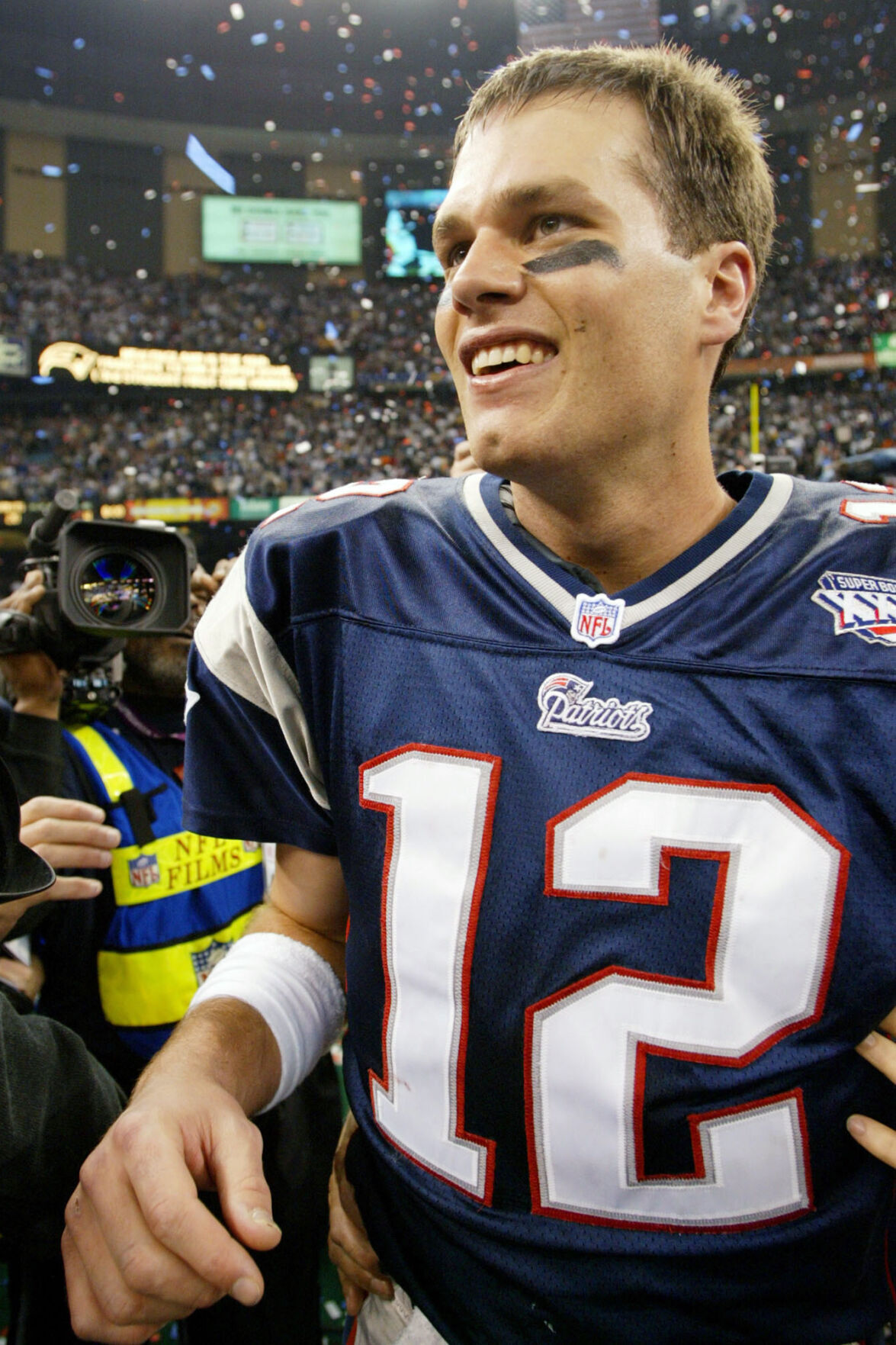
TAMPA, Fla. (AP) — Tom Brady, the most successful quarterback in NFL history, has retired after winning seven Super Bowls and setting numerous passing records in an unprecedented 22-year career.
"This is difficult for me to write, but here it goes: I am not going to make that competitive commitment anymore," Brady wrote in a lengthy post on Instagram. "I have loved my NFL career, and now it is time to focus my time and energy on other things that require my attention."
Brady has long stated his desire to spend more time with his wife, supermodel Gisele Bundchen, and three children despite still playing at the top of his game.
The 44-year-old Brady goes out after leading the Tampa Bay Buccaneers to a Super Bowl title last season and NFC South championship this season.
News of Brady's pending retirement leaked Saturday. His family and the Buccaneers denied that he had made a final decision, and he said Monday night on his SiriusXM podcast he wasn't ready to finalize his plans.
That came Tuesday morning.
"I've done a lot of reflecting the past week and have asked myself difficult questions," Brady said in his post. "And I am so proud of what we have achieved. My teammates, coaches, fellow competitors, and fans deserve 100% of me, but right now, it's best I leave the field of play to the next generation of dedicated and committed athletes."
Brady thanked the Buccaneers organization, his teammates, ownership, general manager Jason Licht, coach Bruce Arians, his trainer Alex Guerrero, agents Don Yee and Steve Dubin and his family in his nine-page post. He didn't mention the New England Patriots, where he spent his first 20 seasons and won six Super Bowls. Of course, Brady thanked the Patriots and coach Bill Belichick after he left the team to sign with the Buccaneers in March 2020.
Brady said he's still figuring out how he'll spend his time but he plans to be involved in his TB12 health and wellness company, Brady clothing line and NFT company.
The career of Tom Brady, in photos
Michigan quarterbacks from left, Drew Henson, (7), Jason Kapsner, (13) and Tom Brady (10) pose during media day in Ann Arbor, Aug. 13, 1999. (AP Photo/Carlos Osorio, File)
CARLOS OSORIO
FILE - In this Aug. 4, 2000, file photo, New England Patriots backup quarterback Tom Brady warms up on the sidelines before an NFL football game against the Detroit Lions at the Silverdome in Pontiac, Mich. (AP Photo/Carlos Osorio, File)
Carlos Osorio
FILE - In this Feb. 3, 2002, file photo, New England Patriots quarterback Tom Brady smiles after the Patriots defeated the St. Louis Rams 20-17 in NFL football's Super Bowl XXXVI in New Orleans. (AP Photo/Doug Mills, File)
DOUG MILLS
New England Patriots quarterback Tom Brady talks with Terry Bradshaw, left, after being name MVP of the Super Bowl, Sunday, Feb. 3, 2002, in New Orleans. The Patriots beat the St. Louis Rams 20-17. (AP Photo/Michael Conroy)
MICHAEL CONROY
FILE - In this Feb. 1, 2004, file photo, New England Patriots quarterback Tom Brady holds the Vince Lombardi Trophy after the Patriots beat the Carolina Panthers 32-29 in Super Bowl XXXVIII in Houston. (AP Photo/Dave Martin, File)
DAVE MARTIN
New England Patriots quarterback Tom Brady, right, talks with Indianapolis Colts quarterback Peyton Manning after the Patriots 24-14 win during their AFC Championship game in Foxboro, Mass., in this Jan. 18, 2004 file photo. (AP Photo/Charles Krupa)
CHARLES KRUPA
New England Patriots quarterback Tom Brady laughs during media day at Reliant Stadium in Houston Tuesday Jan. 27, 2004. The Patriots and Carolina Panthers face off in Super Bowl XXXVIII on Sunday Feb. 1 (AP Photo/Eric Gay)
ERIC GAY
New England Patriots quarterback Tom Brady holds up the Super Bowl XXXIX after the Patriots defeated the Philadelphia Eagles 24-21 in Jacksonville, Fla., on Sunday, Feb. 6, 2005. (AP Photo/Carlos Osorio)
CARLOS OSORIO
New England Patriots quarterback Tom Brady, center, and tight end Daniel Graham (82) congratulate cornerback Asante Samuel (22) after Samuels' fourth-quarter interception and touchdown off a pass by New York Jets quarterback Chad Pennington in an a AFC wild card playoff football game in Foxborough, Mass., Sunday, Jan. 7, 2007. (AP Photo/Elise Amendola)
Elise Amendola
New England Patriots quarterback Tom Brady, top center, is surrounded by the media as he takes their questions while standing in front of his locker at the football team's training facility in Foxborough, Mass., Wednesday morning, Oct. 10, 2007. The 5-0 Patriots will play the 5-0 Dallas Cowboys on Sunday, Oct. 14, in Dallas. (AP Photo/Stephan Savoia)
Stephan Savoia
New England Patriots quarterback Tom Brady celebrates after throwing a touchdown pass to tigh end Benjamin Watson during the second half of a NFL divisional playoff football game against the Jacksonville Jaguars, Saturday, Jan. 12, 2008 in Foxborough, Mass. (AP Photo/Winslow Townson)
Winslow Townson
New England Patriots quarterback Tom Brady, left, speaks to a crowd of 15,000 fans during a send off rally at Gillette Stadium in Foxborough, Mass., Sunday, Jan. 27, 2008. At right is New England Patriots linebacker Junior Seau, and second right, team owner Robert Kraft. (AP Photo/Stew Milne)
STEW MILNE
New England Patriots quarterback Tom Brady (12) celebrates a touchdown by running back Laurence Maroney during the second quarter of the Super Bowl XLII football game against the New York Giants at University of Phoenix Stadium on Sunday, Feb. 3, 2008 in Glendale, Ariz. (AP Photo/Ross D. Franklin)
Ross D. Franklin
Tom Brady and Gisele Bundchen arrive at the Metropolitan Museum of Art's Costume Institute Gala, in New York on Monday, May 5, 2008. (AP Photo/Peter Kramer)
Peter Kramer
New England Patriots quarterback Tom Brady (12) throws a pass wide receiver Sam Aiken as running back Laurence Maroney (39) and Patriots offensive lineman Sebastian Vollmer (76) block during the third quarter of their NFL football game against the Tennessee Titans in Foxborough, Mass., Sunday afternoon, Oct. 18, 2009. Brady was 29 of 34 for 380 yards and six touchdowns in less than three quarters of play as the Patriots defeated the Titans 59-0. (AP Photo/Stephan Savoia)
Stephan Savoia
New England Patriots' Tom Brady lifts his son Jack after NFL football training camp Tuesday, Aug. 9, 2011, in Foxborough, Mass. (AP Photo/Michael Dwyer)
Michael Dwyer
New England Patriots quarterback Tom Brady (12) flips over on his head after he was hit hard by San Diego Chargers defensive tackle Cam Thomas, not seen, in the second half of an NFL football game in Foxborough, Mass., Sunday, Sept. 18, 2011. (AP Photo/Charles Krupa)
Charles Krupa
New England Patriots quarterback Tom Brady answers questions during Media Day for NFL football's Super Bowl XLVI Tuesday, Jan. 31, 2012, in Indianapolis. (AP Photo/David J. Phillip)
David J. Phillip
Fans hoping for an autograph hold out items next to New England Patriots quarterback Tom Brady after the Patriots' joint NFL football practice with the New Orleans Saints in Foxborough, Mass., Tuesday, Aug. 7, 2012. (AP Photo/Stephan Savoia)
Stephan Savoia
New England Patriots quarterback Tom Brady (12) celebrates after the NFL Super Bowl XLIX football game against the Seattle Seahawks Sunday, Feb. 1, 2015, in Glendale, Ariz. The Patriots won 28-24. (AP Photo/David J. Phillip)
David J. Phillip
New England Patriots quarterback Tom Brady looks on as his son Benjamin hugs a Vince Lombardi Trophy during a parade in Boston, Wednesday, Feb. 4, 2015, to honor the NFL football teams victory over the Seattle Seahawks in Super Bowl XLIX in Glendale, Ariz. . (AP Photo/Winslow Townson)
Winslow Townson
New England Patriots quarterback Tom Brady leaves federal court Wednesday, Aug. 12, 2015, in New York. Brady left the courthouse after a full day of talks with a federal judge in his dispute with the NFL over a four-game suspension. (AP Photo/Frank Franklin II)
Frank Franklin II
New England Patriots quarterback Tom Brady, left, and Denver Broncos quarterback Peyton Manning speak to one another following the NFL football AFC Championship game between the Denver Broncos and the New England Patriots, Sunday, Jan. 24, 2016, in Denver. The Broncos defeated the Patriots 20-18 to advance to the Super Bowl. (AP Photo/David Zalubowski)
David Zalubowski
New England Patriots quarterback Tom Brady gestures during a promotional event Thursday, June 22, 2017, in Tokyo. The Super Bowl-winning quarterback is on a week long promotional tour of China and Japan for a sportswear maker. (AP Photo/Eugene Hoshiko)
Eugene Hoshiko
New England Patriots quarterback Tom Brady celebrates after completing a pass during a football clinic in Tokyo, Wednesday, June 21, 2017. The Super Bowl-winning quarterback was on a week long promotional tour of China and Japan for a sportswear maker. (AP Photo/Shizuo Kambayashi)
Shizuo Kambayashi
New England Patriots' Tom Brady raises the Vince Lombardi Trophy after defeating the Atlanta Falcons in overtime at the NFL Super Bowl 51 football game Sunday, Feb. 5, 2017, in Houston. The Patriots defeated the Falcons 34-28. (AP Photo/Darron Cummings)
Darron Cummings
Tom Brady, left, and Gisele Bundchen attend The Metropolitan Museum of Art's Costume Institute benefit gala celebrating the opening of the Heavenly Bodies: Fashion and the Catholic Imagination exhibition on Monday, May 7, 2018, in New York. (Photo by Charles Sykes/Invision/AP)
Charles Sykes
New England Patriots quarterback Tom Brady sits on the field after fumbling against the Philadelphia Eagles during the second half of the NFL Super Bowl 52 football game Sunday, Feb. 4, 2018, in Minneapolis. (AP Photo/Eric Gay)
Eric Gay
New England Patriots' Tom Brady (12) embraces Patriots owner Robert Kraft after the NFL Super Bowl 53 football game against the Los Angeles Rams, Sunday, Feb. 3, 2019, in Atlanta. The Patriots won 13-3. (AP Photo/Morry Gash)
Morry Gash
New England Patriots' Tom Brady rides a duck boat during the Patriots parade through downtown Boston, Tuesday, Feb. 5, 2019, to celebrate their win over the Los Angeles Rams in Sunday's NFL Super Bowl 53 football game in Atlanta. (AP Photo/Michael Dwyer)
Michael Dwyer
New England Patriots quarterback Tom Brady, left, celebrates with head coach Bill Belichick after defeating the Miami Dolphins 41-13 in an NFL football game Sunday, Dec. 14, 2014, in Foxborough, Mass. (AP Photo/Charles Krupa)
Charles Krupa
Tampa Bay Buccaneers quarterback Tom Brady (12) throws a pass against the Minnesota Vikings during the first half of an NFL football game Sunday, Dec. 13, 2020, in Tampa, Fla. (AP Photo/Mark LoMoglio)
Mark LoMoglio
FILE - Tampa Bay Buccaneers quarterback Tom Brady (12) waves toward the fans as he leaves the field after an NFL preseason football game against the Houston Texans, Saturday, Aug. 28, 2021, in Houston. Brady is retiring from the NFL after an unprecedented career in which he won seven Super Bowls and set numerous passing records, according to ESPN. ESPN reported Brady's retirement on Saturday, Jan. 29, 2022, citing unidentified sources. (AP Photo/Matt Patterson, File)
Matt Patterson
Tampa Bay Buccaneers tight end Rob Gronkowski, left, and quarterback Tom Brady celebrate after defeating the Kansas City Chiefs in the NFL Super Bowl 55 football game Sunday, Feb. 7, 2021, in Tampa, Fla. The Buccaneers defeated the Chiefs 31-9 to win the Super Bowl. (AP Photo/Ashley Landis)
Ashley Landis
Tampa Bay Buccaneers quarterback Tom Brady (12) reacts as he leaves the field after the team lost to the Los Angeles Rams during an NFL divisional round playoff football game Sunday, Jan. 23, 2022, in Tampa, Fla. (AP Photo/Mark LoMoglio)
Mark LoMoglio
Army to immediately start discharging vaccine refusers
The U.S. Army has reportedly developed a vaccine to fight all variants of COVID-19.
WASHINGTON (AP) — The Army said Wednesday it will immediately begin discharging soldiers who have refused to get the mandatory COVID-19 vaccine, putting more than 3,300 service members at risk of being thrown out soon.
The Army's announcement makes it the final military service to lay out its discharge policy for vaccine refusers. The Marine Corps, Air Force and Navy have already discharged active-duty troops or entry-level personnel at boot camps for refusing the shots. So far, the Army has not discharged any.
According to data released by the Army last week, more than 3,300 soldiers have refused to get the vaccine. The Army has said that more than 3,000 soldiers have been issued official written reprimands, which suggests they are already identified in the disciplinary process, and some of them could be among the first to be discharged.
The Pentagon has ordered all service members — active-duty, National Guard and Reserves — to get the vaccine, saying it is critical to maintaining the health and readiness of the force. COVID-19 cases continue to surge around the country as a result of the omicron variant.
Roughly 97% of all Army soldiers have gotten at least one shot. More than 3,000 have requested medical or religious exemptions.
Army Secretary Christine Wormuth issued the directive Wednesday ordering commanders to begin involuntary separation proceedings against those who have refused the shots and do not have a pending or approved exemption.
"Army readiness depends on soldiers who are prepared to train, deploy, fight and win our nation's wars," she said. "Unvaccinated soldiers present risk to the force and jeopardize readiness. We will begin involuntary separation proceedings for Soldiers who refuse the vaccine order and are not pending a final decision on an exemption."
The order includes active-duty soldiers, reserves serving on active duty, and cadets at the Military Academy at West Point, its prepatory school and ROTC.
The detailed order said soldiers will be discharged for misconduct, and noted that those who are eligible to retire may do so before July 1.
Overall, nearly 600 Marines, airmen and sailors have been thrown out of the military or dismissed from entry-level training at boot camps as of last week.
The military services have been going through a methodical process to deal with those who refuse the vaccine as well as those who request medical, administrative or religious exemptions. The reviews require counseling with medical personnel and chaplains as well as senior commanders.
US Army history from the year you were born
Intro
Much has changed since the 1920 amendment to the National Defense Act reorganized the United States Army. The U.S. Cavalry that fought in the Indian Wars has faded into history, those who protested for promised pay in post-World War I have died out, and the soldiers of the Greatest Generation who landed at Normandy Beach are almost gone.
To explore the fascinating history of the U.S. Army, Stacker scoured resources from newspaper articles and primary documents to studies and various governmental websites. Army strength numbers for each year are sourced from the Defense Manpower Data Center (DMDC).
Over the course of the last century, Army history has changed demographically, physically, and ideologically. Countries have fallen and risen, women are now permitted on the front lines of open combat, and training facilities have begun to employ video games to prepare recruits for 21st-century warfare. Women are also training in co-ed facilities, something unheard of 100 years ago when the world was still reeling from a war that had rocked the globe with its modern tactics and immense scope.
But the history of the Army isn’t only about warfare: During the Great Depression, it operated Civilian Conservation Corps (CCC) camps out of which previously unemployed, unmarried men worked on infrastructure programs designed to help stabilize a failing economy and provide jobs to those unable to find work.
The 1940s saw another war that affected the entire world. The U.S. was reluctant to get involved until the Pearl Harbor attack, which changed the national consensus and led the country to massively mobilize into stopping the Nazi regime and its allies. The 1950s was a decade that included the Korean War, nuclear testing, and Sen. Joseph McCarthy attacking the Army for being too easy on communists.
The 1960s brought another set of challenges. The Cold War began that decade, and Cuba became the face of America’s closest communist threat. Vietnam, a war that many protested, began with troops arriving in the country as early as 1965. From the 1970s to the 1980s, the U.S. struggled with recruitment and painting a new face on the Army. The 1990s and 2000s began a tech revolution, as well as fighting in the Middle East—which continues to this day. The U.S. Army has changed, but it endures and is still the main infantry force defending America.
Keep reading to learn more about Army history from the year you were born.
- Army strength: 204,292 people (0.19% of U.S. population)
The National Defense Act of 1920 provided updates to the 1916 National Defense Act, including the reorganization of the U.S. Army as a three-part organization composed of the standing Regular Army, the National Guard, and the Organized Reserve. The act strengthened the National Guard and Organized Reserve in particular, stipulating that the Militia Bureau's chief be a National Guard officer and allowing National Guard officers to perform as Army general staff. Also in 1920, there was a big push for universal weight standards to ensure those who enlisted could meet the responsibilities of war.
Public Domain // Courtesy submission
1921: The Army intervenes at the Battle of Blair Mountain
- Army strength: 230,725 people (0.21% of U.S. population)
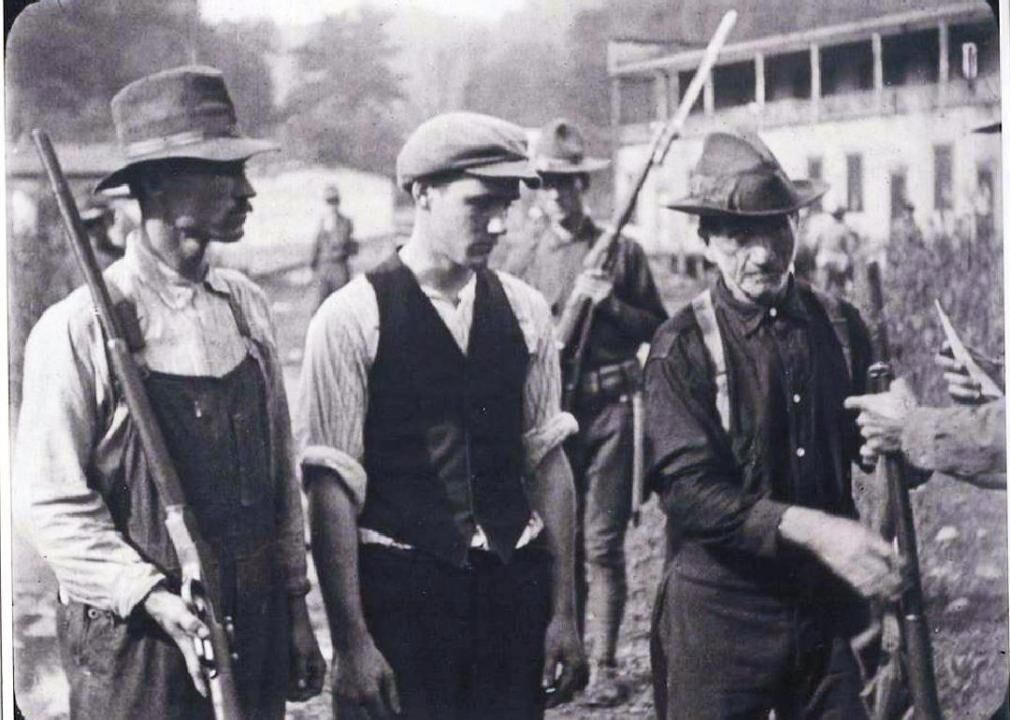
Four labor uprisings between 1919 and 1921 required Army intervention, but the largest of these—and the largest in U.S. history—took place over five days in late August and early September of 1921 as part of the Coal Mine Wars, multiple labor disputes throughout Appalachia.
Around 10,000 fully armed coal miners who sought to unionize marched to Logan County in West Virginia to confront 3,000 “Logan Defenders” (strike bearers backed by coal operators) and law-enforcement officers, and force the coal mines into a contract. Roughly 1 million rounds were fired, up to a 100 people killed (though this report varies), and many more arrested. The Army was deployed by a presidential order to stop the fighting and famously managed to send thousands of miners home without firing a single shot.
Public Domain // Wikimedia Commons
1922: Col. Charles Young dies
- Army strength: 148,763 people (0.14% of U.S. population)
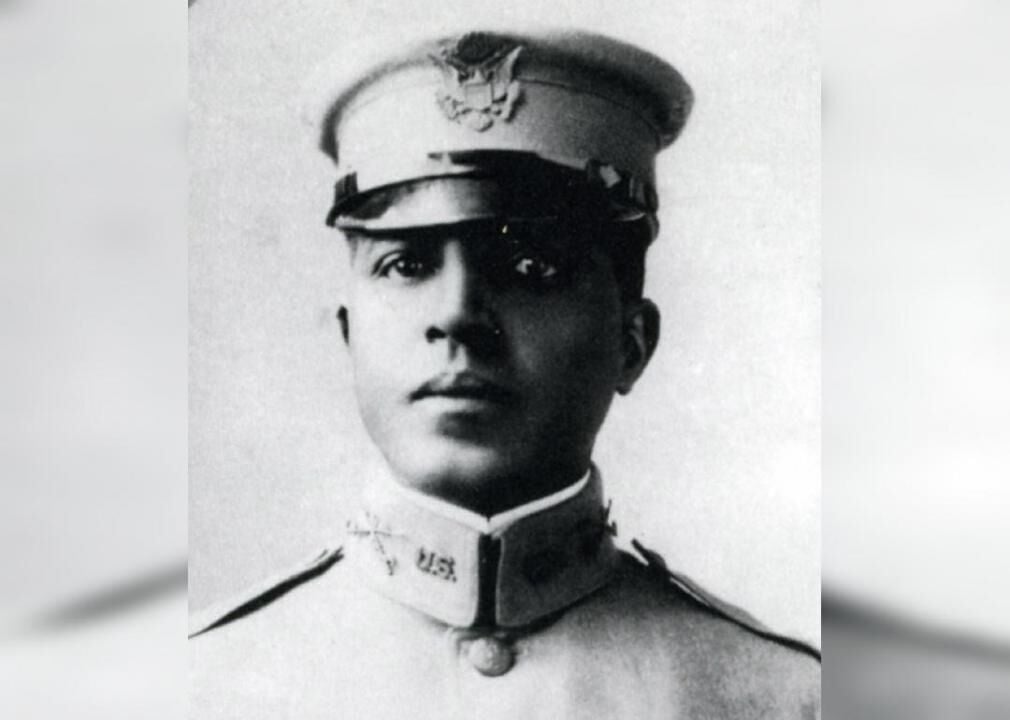
Col. Charles Young was the first Black colonel in the United States Army, the first Black U.S. national park superintendent, first Black military attache, and third Black graduate of the United States Military Academy. The son of former slaves, Young led the U.S. Calvary into Mexico in Pershing's Punitive Expedition. At the time of his death in 1922, he was the highest-ranking Black officer in the Regular Army.
Public Domain // U.S. Army
1923: Harding orders troops home from Germany
- Army strength: 133,243 people (0.12% of U.S. population)
Four years after the end of World War I, President Warren G. Harding ended the U.S. occupation of the Rhine through an executive order, effectively calling the last of the U.S. troops back home from Germany. Six months later, Harding and his wife embarked on a “voyage of understanding” speaking tour throughout Alaska and other western U.S. states in order to connect with voters there, amidst multiple scandals dogging the Harding presidency.
Public Domain // Wikimedia Commons
1924: Philippines scouts rebel
- Army strength: 142,673 people (0.13% of U.S. population)
Philippine scouts trained by members of the U.S. Army mutinied because they were not given the same pay and treatment as their stateside counterparts. The men, who were essential to American rule in the Philippines in spite of not receiving equal benefits or pay to American soldiers, were sent to jail for rebelling and defying orders. The U.S. Army ignored their requests for equal pay and changed nothing about recruitment methods or leadership.
Public Domain // US Army Military History Institute
1925: Black soldiers evaluated for wartime fitness
- Army strength: 137,048 people (0.12% of U.S. population)
The Army War College in 1925 began a study of the service and fitness of Black soldiers. After review, the college found that Black soldiers who were led by white officers could enter into wartime conflicts. For many years this policy was in place; the segregation of troops continued until 1948, just two years before the start of the Korean War.
Public Domain // National Archives
1926: Sgt. Stubby dies
- Army strength: 134,938 people (0.11% of U.S. population)
Sgt. Stubby, the mascot of the 102nd Infantry Regiment, died in his sleep March 16, 1926. Stubby was famous for grabbing a German by the seat of his pants, and shook paws with three presidents (Woodrow Wilson, Warren Harding, and Calvin Coolidge). The dog was an honorary member of the American Red Cross, YMCA, and American Legion. He sniffed out poison gas and tracked down wounded and dead soldiers, and survived shrapnel wounds and a gas attack over the course of 17 battles. He was the most highly decorated dog of World War I and so beloved that when he died, his body was preserved. He still wears his blanket decorated with his medals and can be seen at the Smithsonian Institution in Washington D.C.
Public Domain // Wikimedia Commons
1927: Joint Army and Navy Basic War Plan Red
- Army strength: 134,829 people (0.11% of U.S. population)
Surrounding the Geneva Naval Conference in 1927, the U.S. Army developed a series of color-coded war plans for hypothetical conflict scenarios with Japan, Germany, Mexico, and England. War Plan Red outlined a hypothetical plan for defending and invading British-held Canada. The plan described first sending the Joint Army in to capture Halifax in order to cut off Canadians from British allies before overtaking power plants around Niagara falls, causing Canadians to freeze. Mounting attacks—from marches into Montreal and Quebec to seizing nickel mines in Ontario—were intended to gain complete control.
War Plan Red was approved in 1930 by Secretary of War Patrick J. Hurley and Secretary of the Navy Charles Francis Adams III. Updates came to the war plan in 1934 and 1935, but it was never presented to Congress for an actual war declaration.
Community Archives // Wikimedia Commons
1928: First US Army Day
- Army strength: 136,084 people (0.11% of U.S. population)
The first official U.S. Army Day was celebrated May 1, 1928. It was timed for the same day as Workers' Day, a communist celebration. Army Day was moved to April 6 in 1929 in honor of the anniversary date of the U.S. entering World War I. The holiday is meant to introduce the public to the activities of the U.S. Army, convey the importance of preparedness for the military, and to bring attention to national defense.
Public Domain // Wikimedia Commons
1929: Escobar revolutionaries send stray bullets to US
- Army strength: 139,118 people (0.11% of U.S. population)
In El Paso, Texas, the U.S. Calvary was under threat from the Escobar Revolution. The revolutionaries fought so close to the U.S border that stray bullets landed on the U.S side and several injuries were reported.
1930: Douglas MacArthur is appointed Army chief of staff
- Army strength: 139,378 people (0.11% of U.S. population)
Gen. Douglas MacArthur was superintendent at West Point before being appointed Army chief of staff with the rank of general by President Herbert Hoover. In his new position, MacArthur caused an uproar in 1932 when he authorized excessive force to remove the Bonus Army—unemployed, protesting World War I veterans—from Washington D.C.
Public Domain // United States Army
1931: US Army wins International Military Team Trophy
- Army strength: 140,516 people (0.11% of U.S. population)
In a show of Calvary skills, the U.S. Army used a myriad of horse skills to win the 1931 International Military Team Trophy at Madison Square Garden. France lost and supporters were visibly upset, as reported by the New York Times.
William Warhurst/Topical Press Agency // Getty Images
1932: Calvary soldiers attack veterans
- Army strength: 134,957 people (0.11% of U.S. population)
Twenty thousand veterans from World War I were forced out of Washington D.C. when Calvary soldiers rode into the crowd, sabering the veterans and lobbing tear gas. The veterans were unemployed, and protesting the bonus certificates they were awarded that could not be used until 1945. MacArthur spearheaded the charge, publicly leading the soldiers to the Hoovervilles to disperse the veterans by force.
Public Domain // U.S. Army
1933: US Army aids Civilian Conservation Corps
- Army strength: 136,547 people (0.11% of U.S. population)
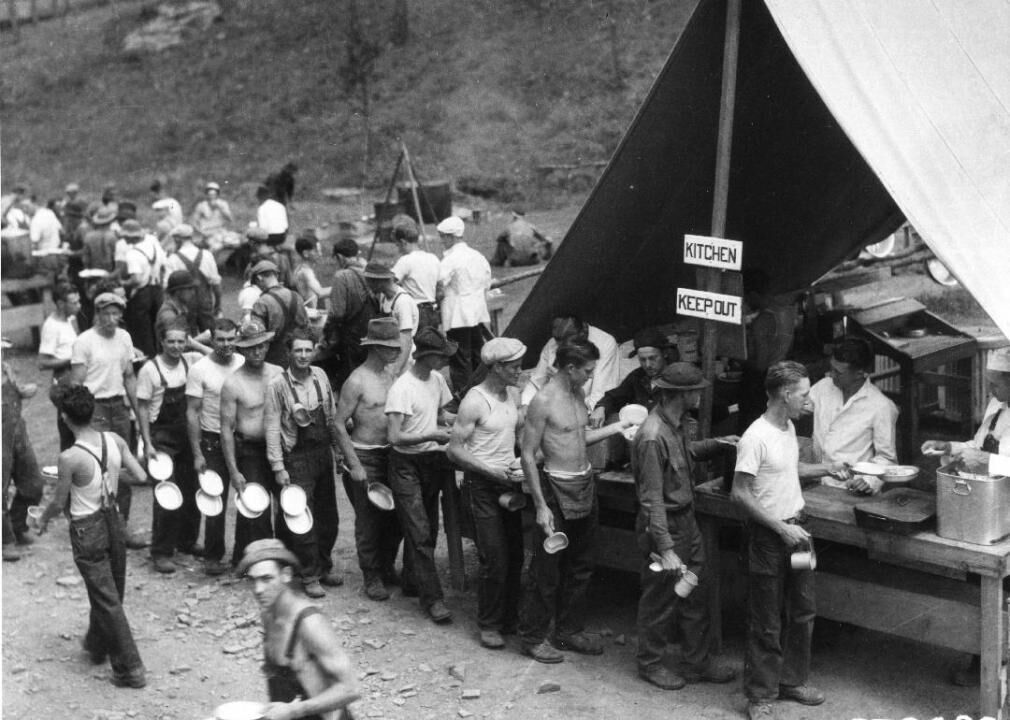
The U.S. Army transported 25,000 Civilian Conservation Corps recruits to conditioning camps in 1933. The CCC was formed to get young men to work, due to the Great Depression's impact on jobs. The work of the Army's involvement in the CCC aided in training mobilization units for World War II.
OSU Special Collections & Archives // Wikimedia Commons
1934: Army takes over the mail
- Army strength: 138,464 people (0.11% of U.S. population)
President Franklin D. Roosevelt in 1934 halted all service of the Post Office amidst allegations of U.S. Air Mail contract scandals. The U.S. Army Air Corps was ordered in February 1934 to take over air mail transportation, to disastrous results. Intense winter weather contributed to multiple crashes and the deaths of 12 pilots. The public outcry was so severe that full airline service was restored by June of that year, and Congress passed the Air Mail Act.
1935: Final flight of US Army Air Corps LTA operations
- Army strength: 139,486 people (0.11% of U.S. population)
Before the dissolution of the U.S. Army Air Corps “lighter-than-air” (LTA) operations, the branch created a final and fluid airship that was also the largest ever flown. The TC-14 flew for two hours and was clocked at a top speed of 90 mph. The airship took more than three years to build, largely due to a very small budget dispensed during the Great Depression.
United States Air Force
1936: M1 Garand becomes go-to Army rifle
- Army strength: 167,816 people (0.13% of U.S. population)
The M1 Garand was adopted as the Army's go-to rifle. The new rifle was created with the height of modernized small arms technology. The rifle was strong and light, weighing only 9 pounds; it was the perfect weapon for the new Army's needs. This semi-automatic weapon would go on to be the primary choice of arms for World War II.
US Army // Wikimedia Commons
1937: Army's Airship Program ends
- Army strength: 179,968 people (0.14% of U.S. population)
The army's Airship Program was terminated and the balloons sold off in 1937. Airships were used all through the 1930s, and in World War I to spy and acquire information.
Public Domain // WIkimedia Commons
1938: 15th Regiment returns home from China
- Army strength: 185,488 people (0.14% of U.S. population)
After decades of service in China, the 15th Regiment arrived back on U.S. soil March 24, 1938. The soldiers spent their time escorting Chinese supply boats upriver and tracking down headhunters. The homecoming was similar in style to those in World War I as the USAT Grant came ashore with 808 enlisted men and officers, and 417 wives and children.
Public Domain // WIkimedia Commons
1939 US Army (and its Calvary) ranks 39th in the world
- Army strength: 189,839 people (0.15% of U.S. population
The Army still used Calvary and had horses to pull artillery, and ranked 39th in the world for military strength. That low ranking didn't bode well for the ongoing war in Europe. The Calvary was 50,000 strong in 1939 and the nation was not ready for a war.
- Army strength: 269,023 people (0.20% of U.S. population)
The Selective Training and Service Act of 1940 called for every man between 21 and 45 years old to register for the draft. Even though it was peacetime, the government believed there would be a call for war soon. That same year, height standards for the Army dropped down to 5 feet (from 5 feet and 3 inches in 1923).
Topical Press Agency // Getty Images
1941: ‘It's only a maneuver’
- Army strength: 1.46 million people (1.10% of U.S. population)
- Army strength: 3.08 million people (2.28% of U.S. population)
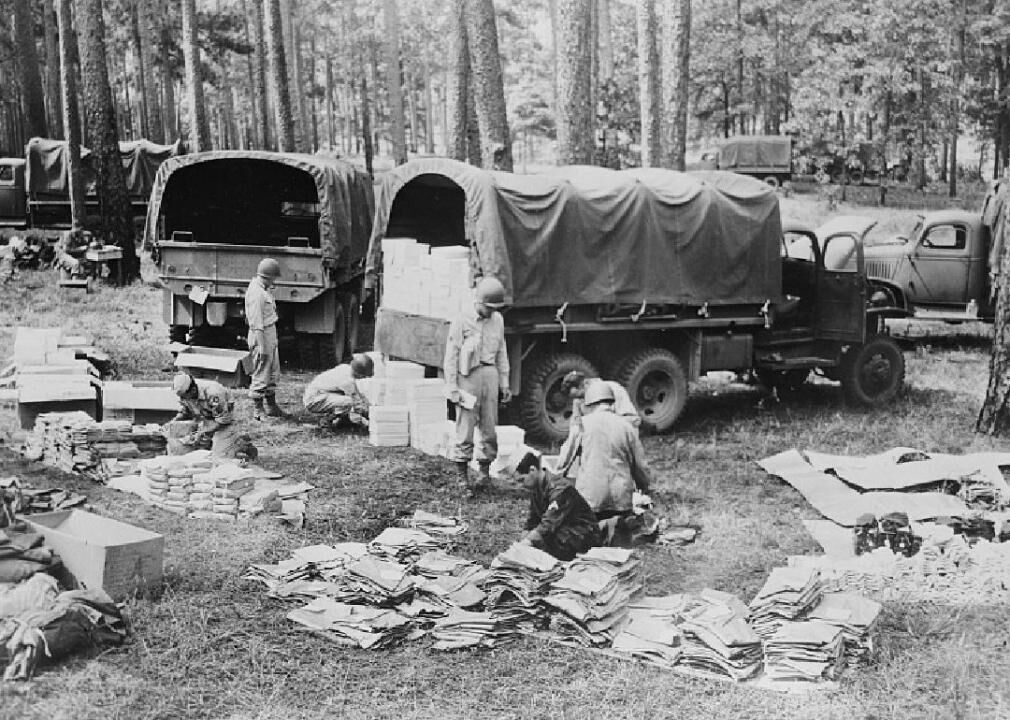
The Dogs Defense group was formed in 1942 in order to train dogs for sentry duty. The Army saw that the working dogs were skilled, and signed into existence the first K9 corp.
Public Domain // Wikimedia Commons
1943: US Army Fights the Japanese in Alaska
- Army strength: 6.99 million people (5.12% of U.S. population)
In Attu, Alaska, two amphibious landings by the U.S. Army were put in place to attack the Japanese who had occupied the island without any resistance. The battle lasted for two weeks and the majority of fighting was hand-to-hand combat. It is the only battle on a U.S. territory that was fought under arctic conditions.
Library of Congress's Prints and Photographs division // WIkimedia Commons
1944: Operation Neptune
- Army strength: 7.99 million people (5.78% of U.S. population)
On June 6, 1944, D-Day—or Operation Neptune—was carried out. This battle allowed the allies to begin the liberation of France and push the Germans back.
- Army strength: 8.27 million people (5.91% of U.S. population)
The 42nd and 45th division liberated more than 32,000 prisoners in Dachau concentration camp. However, many Nazis escaped and began a death march with 7,000 prisoners, murdering those unable to continue to march.
Pixabay
1946: The 'mutiny of American troops after WWII
- Army strength: 1.44 million people (1.02% of U.S. population)
With Germany's surrender in May 1945 and Japan's surrender that September, World War II was officially over. U.S. troops were anxious to get home—but getting the troops back before Christmas was no small task. Thousands of restless soldiers from the time of Japan's surrender through January 1946 protested delays by marching and holding rallies at bases around the world, many times with signs that mocked commanders.
Fox Photos // Getty Images
1947: The World War II draft expires
- Army strength: 685,458 people (0.48% of U.S. population)
Throughout World War II, the War Manpower Commission had to recruit upwards of 200,000 men per month in order to secure 9 million men in the U.S. Armed Forces before the close of 1943. The draft ran from 1940 until 1946, at which point the draft was suspended. The authorization for that draft expired in 1947 with no push by Congress for an extension.
Library of Congress
1948: Truman desegregates the US Military
- Army strength: 554,030 people (0.38% of U.S. population)
President Harry Truman desegregated the U.S. Military despite extensive opposition to the legislation and threats of a filibuster from Southern senators. The military by 1946 had become the largest employer of minorities, and in 1946 Truman's appointed panel, President's Commission on Civil Rights, recommended further civil rights protections that included anti-poll tax laws and anti-lynching laws. Truman in 1948 used his executive powers to enact all of the committee's recommendations, appoint the first African American federal judge, and desegregate the Armed Forces, among many other milestones.
Keystone // Getty Images
1949 Army withdraws from Korea
- Army strength: 660,473 people (0.44% of U.S. population)
The U.S. Army withdrew troops from Korea, blaming limited military power. The government assured the public that if the Army is needed, more troops will go back.
- Army strength: 593,167 people (0.39% of U.S. population)
Gen. Douglas MacArthur in 1950 authorized the U.S. 7th Infantry Division to launch an amphibious attack on Korea. It was the beginning of a war between Communist-supported North Korea and the United States and United Nations-backed South Korea.
U.S. Air Force photo
1951: China supports North Korea
- Army strength: 1.53 million people (0.99% of U.S. population)
China entered the war on the North Korean side and planned a total annihilation of the U.S. Army in South Korea. The Ridgeway offensive was the U.S. Army's answer; they wanted to hold ground and keep Seoul.
Keystone // Getty Images
1952: Armistice talks stall
- Army strength: 1.60 million people (1.01% of U.S. population)
In the U.S. Army's third year of the Korea war, armistice talks stalled as the fighting continued. The newly elected President Dwight D. Eisenhower traveled to Korea to discuss a ceasefire. The Korean Demilitarized Zone was established, and in March 1953, Joseph Stalin's death helped push a prompt conclusion to the negotiations.
Keystone // Getty Images
1953: Korean War ends
- Army strength: 1.53 million people (0.96% of U.S. population)
The Korean war ended in July 1953 with an armistice serving as a ceasefire. The U.S. Army worked to create an official line of demarcation between North and South Korea. The ceasefire was between military forces, not governments—and with no peace treaty signed, the Korean War never officially stopped.
U.S. Navy // Wikimedia Commons
1954: McCarthy hearings begin
- Army strength: 1.4 million people (0.86% of U.S. population)
Joseph McCarthy accused the U.S. Army in 1954 of being soft on communists. The case resulted in McCarthy being barred from speaking in the U.S. Senate.
- Army strength: 1.11 million people (0.67% of U.S. population)
Operation Gyroscope was a project that sought a more cost-effective option for sending much-needed troops to Europe for rebuilding efforts. Instead of flying soldiers trained out West into New York, before loading them onto ships with equipment bound for Europe, the soldiers boarded ships in California and shipped out via the Panama Canal.
Keystone // Getty Images
1956: M113 ships to Vietnam
- Army strength: 1.03 million people (0.61% of U.S. population)
The M113 personnel carrier was shipped to Vietnam to test its armor and capabilities. The vehicle—created by the Food Machinery Corp—was used throughout the Vietnam War.
Donn A. Starry // Wikimedia Commons
1957: Operation Plumbbob
- Army strength: 997,994 people (0.58% of U.S. population)
The government launched a series of nuclear bombs tests called Operation Plumbbob in 1957. To see how the U.S. Army troops responded to nuclear bombs, they conducted an airlift assault.
National Nuclear Security Administration / Nevada Site Office // Wikimedia Commons
1958: Elvis Presley joins up
- Army strength: 898,925 people (0.51% of U.S. population)
Most young men 18 and older had to sign up for the draft. Elvis Presley had his number come in and was drafted into the U.S. Army in 1958. He reportedly had the option to fulfill his service a recruiting model and an entertainer for the troops, but Presley chose to become a common soldier instead.
Associated Press // Wikimedia Commons
1959: First soldiers killed in Vietnam
- Army strength: 861,964 people (0.48% of U.S. population)
Maj. Dale Buis and Master Sgt. Chester Ovnand, part of a military assistance advisory group in Bien Hoa, north of what was formerly called Saigon, were the first Americans killed in the Vietnam War. Viet Cong guerrillas attacked the group, which had been coming to South Vietnam since November 1955 to provide help and advice to Vietnam's ministry of defense.
U.S. Army Sgt. 1st Class Michael J. Carden // Wikimedia Commons
1960: Laos is determined to be non-threatening
- Army strength: 873,078 people (0.48% of U.S. population)
Three groups of the U.S. Army in 1960 were set to be deployed to Southeast Asia. The battle groups were canceled when the government decided that there weren't any threats coming from Laos.
Hulton Archive // Getty Images
1961: Green Berets receive real green berets
- Army strength: 858,622 people (0.47% of U.S. population)
The Green Berets were given actual, green berets to wear for the first time in 1961 as a part of their uniform. President John F. Kennedy visited the group (the name for the U.S. Army Special Forces) at Fort Bragg in North Carolina to commend them for their service.
U.S. Army Courtesy Photo
1962: Army troops head to Florida airfields
- Army strength: 1.07 million people (0.57% of U.S. population)
The U.S. Army in 1962 sent troops to Florida airfields that were closest to Cuban Missile ranges. The Army also received a convoy citation from a Virginia state trooper for an overloaded caravan.
mediadefense.gov
1963: Operation Biglift
- Army strength: 975,916 people (0.52% of U.S. population)
The U.S. Army participated in Operation Biglift in 1963 in order to demonstrate its might. Almost 15,000 soldiers were flown over to Europe to show how fast the U.S. was ready to fight if need be.
USAMHI // Wikimedia Commons
1964: South Vietnamese training begins
- Army strength: 973,238 people (0.51% of U.S. population)
The U.S. Army in 1964 sent a mobile forces team to train the South Vietnamese. The entire plan was supposed to succeed and stop the Viet Cong by the end of 1964.
- Army strength: 969,066 people (0.50% of U.S. population)
The U.S. Army sent the first 3,500 combat troops to Vietnam on March 8, 1965. The men, who landed at China Beach and joined 23,000 American military advisers already there, were sent in defense of the American air base at Da Nang in the wind-up to the Vietnam War. That same year, President Lyndon Johnson authorized air strikes on the North Vietnamese.
U.S. Army // Getty Images
1966: Army forces in Vietnam number 200,000
- Army strength: 1.2 million people (0.61% of U.S. population)
More than 200,000 U.S. Army soldiers were stationed at various bases throughout Vietnam in 1966. Army officers worked with their South Vietnamese counterparts.
Hulton Archive // Getty Images
1967: Operation Malheur I and II
- Army strength: 1.44 million people (0.73% of U.S. population)
The U.S. Army conducted Operation Malheur I and Operation Malheur II as a series of search and destroy actions intended to thwart Viet Cong force activity in the northern reaches of South Vietnam. Air assaults effectively disrupted activity but failed to end it; the operations contributed to the 6,400 civilian casualties reported for the province that year.
Photo courtesy of U.S. Army Heritage and Education Center, Vietnam War Photograph Collection
1968: My Lai massacre
Army strength: 1.57 million people (0.78% of U.S. population)
In the My Lai massacre in March 1968, soldiers massacred hundreds of unarmed people in the Sơn Tịnh District, South Vietnam, including children and monks. Until it was challenged by a helicopter pilot, the Army called My Lai a victory. Earlier in 1968 came the Tet Offensive, a series of attacks against the South Vietnamese Army of the Republic of Vietnam, the U.S. Armed Forces, and allies by the Viet Cong and North Vietnamese People’s Army of Vietnam. The offensive represents one of the widest-reaching military actions of the Vietnam War.
DAVID LAMB/AFP // Getty Images
1969: The Battle of Hamburger Hill
- Army strength: 1.51 million people (0.75% of U.S. population)
In the bloody 1969 Battle of Hamburger Hill, U.S. soldiers fought for control of a 3,000-foot-tall hillside in a remote part of South Vietnam. The battle kicked off Operation Apache Snow, a calculated offensive against the northern People's Army of Vietnam. The Battle of Hamburger Hill—expected to take several hours—went on for 11 days and 12 assaults, and caused 72 American deaths, more than 370 American injuries, and more than 630 North Vietnamese casualties. After winning the hill, the U.S. Army abandoned it and Vietnamese troops reoccupied it.
United States Army Military History Institute // Wikimedia Commons
1970: Koza riot in Okinawa, Japan
- Army strength: 1.32 million people (0.64% of U.S. population)
A drunken soldier on the night of Dec. 20, 1970, crashed into an Okinawan pedestrian and, after checking on him, the soldier attempted to get back into his car. But an angry crowd surrounded him, and the Koza riot began and continued into the next day: Thousands of Okinawans were pitted against 700 soldiers.
Larry Gray, United States Government military member // Wikimedia Commons
1971: Women recruitment is up
- Army strength: 1.12 million people (0.54% of U.S. population)
At the beginning of the 1970s, women were recruited to the U.S. Army in larger numbers. The jump was due to the end of the draft, the conclusion of the Vietnam War, and notable strides in the feminist movement.
Senior Airman Tiffany M. Deuel // U.S. Air Force photo
1972: Withdrawals begin from Vietnam
- Army strength: 810,960 people (0.39% of U.S. population)
Between 1969 and 1972, more than 500,000 American servicemen—336,000 of whom were Army personnel—were redeployed in 12 increments from the Republic of Vietnam. The final five of those withdrawals happened in 1972.
Tullio Saba // Flickr
1973: Withdrawal from Vietnam concludes
- Army strength: 800,973 people (0.38% of U.S. population)
In Operation Homecoming Feb. 12, 1973, the release of 591 American prisoners of war was initiated. Final troops withdrew from Vietnam March 29 of the same year, marking America's first defeat—and longest war.
U.S. Air Force photo
1974: Tensions rise
- Army strength: 783,330 people (0.37% of U.S. population)
In the wake of an unpopular war and rising tensions, discontent between races spiked throughout 1974 and Army barracks became undisciplined. The Army reduced its size and began refining its recruiting process.
1975: Mandatory defensive weapons training for women
- Army strength: 784,333 people (0.36% of U.S. population)
The Army enacted mandatory defensive weapons training for women members of the Army in 1975. The Women's Army Corps, begun in 1942, also provided women with more opportunities.
Scott Olson // Getty Images
1976: Operation Paul Bunyan
- Army strength: 779,417 people (0.36% of U.S. population)
Two soldiers in 1976 were axed to death in the Korean demilitarized zone. In retaliation, U.S. soldiers enacted Operation Paul Bunyan, in which they hacked down an old tree the murdered soldiers had been there to remove. The action showed force and intimidated North Koreans, who quickly took the blame for the murders.
Wayne Johnson // Wikimedia Commons
1977: Army admits to 27 germ warfare tests conducted on public property
- Army strength: 782,246 people (0.36% of U.S. population)
In a scathing Washington Post report March 9, 1977, the U.S. Army admitted to 239 open-air, secret “germ warfare tests” between 1949 and 1969, including 27 conducted on public property. The newly disclosed locations where the Army tests toxins included Washington D.C.'s Greyhound bus terminal and National Airport, two tunnels along the Pennsylvania Turnpike, and at various sports in New York City, San Francisco, and in Florida's Key West and Panama City.
Sgt. Eliverto V Larios // DoD photo
1978: Jonestown Massacre
- Army strength: 771,624 people (0.35% of U.S. population)
On Nov. 18, 1978, in Jonestown, Guyana, 918 followers of Pentecostal cult leader Jim Jones died—some by willingly drinking fruit punch dosed with cyanide, others (mostly children) by forced syringes of the lethal cocktail, and others by gunfire (dispensed by Jones' guards) when they tried to flee into the nearby jungle. More than 300 children died in the shocking group suicide, which the Army was sent in to clean up.
Larry Downing // Getty Images
1979: Faulty pilot ejection controls found
- Army strength: 758,852 people (0.34% of U.S. population)
U.S. Army helicopter injuries were reviewed in 1979 for safety issues. It was found that there wasn't any way for the pilots to eject in time. Almost 300 crashes were recorded between 1979 and 1985.
Frank Barratt/Stringer // Getty Images
1980: Bright Star military exercise commences
- Army strength: 777,036 people (0.34% of U.S. population)
The United States and Egypt held their first Operation Bright Star together in Egypt in 1980. The training exercises are intended to improve military ties between the two countries and include tactical air, ground, and naval operations. Bright Star is held every two years and grew in 1995 to include troops from the UAE, France, U.K., and several countries in the Middle East and west. The following year, NATO nations (France, U.K., Germany, and UAE) were added, with Kuwait added as well in 1998. Bright Star became among the biggest exercises with U.S. troops worldwide. 1980 also represents the start of the U.S. Army's new tagline, “Army. Be all that you can be,” which was in use until 2001.
Norbert Schiller/Stringer // Getty Images
1981: US Army gets a new look
- Army strength: 781,419 people (0.34% of U.S. population)
The U.S. Army switched its uniform design to woodland camouflage, which was in use in the U.S Army until 2004. The inspiration came from the Vietnamese jungle.
Cpl. Ilwoong Kong // DoD photo
1982: New recruits, new (amended) requirements
- Army strength: 780,391 people (0.34% of U.S. population)
The U.S. Army in 1980 changed its Army Physical Fitness Test (APFT) requirements for new recruits in 1980, reflecting that recruits must run 2 miles, and complete push-ups and sit-ups. A 1982 amendment to the APFT offered alternative tests to recruits with physical barriers.
Sgt. Mike MacLeod // Army National Guard
1983: US Army invades Grenada
- Army strength: 779,643 people (0.33% of U.S. population)
The United States invasion of Grenada came about following unrest within the People's Revolutionary Government there and the execution of Grenada's Prime Minister Maurice Bishop. On Oct. 25, 1983, the U.S. Army's Rapid Deployment Force, U.S. Army Delta Force, and multiple other military branches invaded and promptly overwhelmed Grenadian forces.
Sgt. Michael Bogdanowicz, U.S. Army // Wikimedia Commons
1984: Pedro Colondres-Rosa defrauds US Army
- Army strength: 780,180 people (0.33% of U.S. population)
Pedro A. Rodríguez-Colondres joined the U.S. Army in the 1970s under the assumed name of Pedro Colondres-Rosa, but was discharged in the 1970s for not passing the fitness tests. From 1984 until 2011, Colondres-Rosa used a false name to receive veterans benefits. He was arrested in 2014 for defrauding the U.S. Army Reserve.
- Army strength: 780,787 people (0.33% of U.S. population)
A raid in El Salvador by U.S. Army Rangers was conducted in 1985 in retaliation for the deaths of six soldiers. The Rangers ended up killing 83 guerillas at a training camp.
The U.S. Army // Wikimedia Commons
1986: US troops arrive in Honduras
- Army strength: 780,980 people (0.33% of U.S. population)
More than 3,000 U.S. troops arrived in Honduras in 1986 to show support for that country's government in its war with Nicaragua. Honduras claimed Nicaraguan troops had illegally crossed into Honduras while attempting to detain Nicaraguan rebels. That same year, the U.S. Army sent assistance to Bolivia for anti-narcotics operations, which included extensive cocaine raids throughout the country.
TSGT Bob Simons, USAF // National Archives Catalog
1987: US Army Airborne heads to Honduras
- Army strength: 780,815 people (0.32% of U.S. population)
The U.S. Army Airborne Division was deployed to Honduras to the Nicaraguan border for army exercises. The exercises were created to show the continued strength of the U.S. military.
SSGT Scott Stewart // National Archives Catalog
1988: US takes on Nicaraguan insurgents
- Army strength: 771,847 people (0.32% of U.S. population)
More than 2,000 U.S. soldiers were flown to Honduras in 1988, where Nicaraguan insurgents were threatening the border. While there, the U.S. Army demonstrated its might with repeated training exercises.
TSGT Bob Simons, USAF // National Archives Catalog
1989: Operation Just Cause
- Army strength: 769,741 people (0.31% of U.S. population)
The Invasion of Panama called Operation Just Cause ended with the U.S. defeating Manuel Noriega with 26,000 deployed combat troops. President H.W. Bush used four justifications for the invasion: protecting U.S. citizens living in Panama; safeguarding the Torrijos-Carter Treaties; protecting human rights and democracy in the country; and fighting drug traffickers.
- Army strength: 732,403 people (0.29% of U.S. population)
To leverage Iraq’s requests for cancellation of debt to Gulf creditors following the Iran-Iraq war, Iraqi President Saddam Hussein threatened neighboring Kuwait. The threats escalated when Kuwait turned down Hussein's requests for debt forgiveness, and as the president accused the United States of intentionally weakening Iraq by pushing for reduced oil prices in Kuwait. A report 100,000 Iraqi troops invaded Kuwait on Aug. 2, 1990, overrunning the country.
US Air Force // Wikimedia Commons
1991: Gulf ground war begins
- Army strength: 710,821 people (0.28% of U.S. population)
The U.S. led an air and ground war invasion of Iraq just after the new year on Jan. 16, 1991. By the end of the first day, the first wave of troops took more than 10,000 of Hussein's soldiers prisoner. The Iraqi retreat from Kuwait and the end of the war came soon after on Feb. 28.
DOD/Handout // Getty Images
1992: US troops offer humanitarian aid in Somalia
- Army strength: 610,450 people (0.24% of U.S. population)
Somalians cheered U.S. troops coming to help with humanitarian aid. Gradually, the U.S. became part of the strife and inter-clan wars.
Staff Sgt. Gustavo Castillo // Air Force photo
1993: Battle of Mogadishu
- Army strength: 572,423 people (0.22% of U.S. population)
Operation Gothic Serpent and the Battle of Mogadishu commenced as 160 U.S. soldiers—comprised mainly of Army Rangers and Delta Force Operators—in Black Hawk Helicopters were attacked and shot at by Somalis from the streets. What was intended as an hour and a half mission turned into a battle that stretched on for 15 hours as the Black Hawks fell from the sky and U.S. soldiers were surrounded.
TSGT PERRY HEIMER // Wikimedia Commons
1994: Operation Uphold Democracy
- Army strength: 541,343 people (0.21% of U.S. population)
More than 20,000 troops entered Haiti as part of Operation Uphold Democracy. They landed without any opposition in their mission to help ensure a peaceful transition to a democratic government in Haiti.
- Army strength: 508,559 people (0.19% of U.S. population)
Following a U.S.-brokered peace treaty, American members of the military—including the Army—were welcomed into the country with open arms. The treaty concluded what had been the most brutal, violent armed European conflict since World War II.
MICHEL GANGNE // Getty Images
1996: All-Black Korean War unit has honor restored
- Army strength: 491,103 people (0.18% of U.S. population)
The all-Black Korean War unit that was stripped of its honor and whose members were called cowards had its honor restored in an official Army report released publicly in April 1996. It wasn't until 1995 that researchers found that the unit performed similarly to the white units under the same stress and combat.
People's pictorial // Wikimedia Commons
1997: 7 Black WWII soldiers get Medal of Honor
- Army strength: 491,707 people (0.18% of U.S. population)
Not one Medal of Honor was awarded to a Black soldier for service during World War II until a U.S. Army-commissioned 1993 study looked into racial discrimination in awarding medals. Results from the study showed a number of Distinguished Service Cross recipients ought to be rightfully upgraded to receive the Medal of Honor. President Bill Clinton did so on Jan. 13, 1997, when he awarded the highest military honor to seven Black veterans from World War II. Of those named, only one—Vernon Baker—was alive to receive his medal.
JAMAL WILSON/Stringer // Getty Images
1998: Bosnia mission zaps US Army strength
- Army strength: 484,928 people (0.18% of U.S. population)
The high costs, time, and troop requirements of the U.S. mission in Bosnia led many to complain about the 6,900 combat troops in Bosnia. Many claimed U.S. troops there weakened the overall military strength of the Army.
MIKE NELSON/Stringer // Getty Images
1999: Yugoslavians hold U.S. soldiers captive
- Army strength: 477,788 people (0.17% of U.S. population)
Three U.S. Army soldiers in Yugoslavia for a peacekeeping mission were taken captive and held as prisoners of war for 32 days. Christopher Stone, Army Staff Sgt., Andrew Ramirez, and Specialist Steven Gonzales were ambushed while driving a Humvee and put in prison. National POW/MIA Recognition Day, held on the third Friday in September, was established to honor those veterans like Stone, Ramirez, and Gonzales who were prisoners of war—as well as those still missing in action.
- Army strength: 483,115 people (0.17% of U.S. population)
As relations in Bosnia and Herzegovina improved, a scaling-down of U.S. military presence there began in 1999. Army numbers dropped from 5,400 that year to 3,900 by February 2000. As the 10th Mountain Division returned home in March of that year, it was replaced by the 49th Armored Division, Texas Army National Guard—marking the first deployment outside the U.S. of a division-sized reserve component formation since the Korean War.
Spc. Christina Westover // US Army Photo
2001: 9/11
- Army strength: 482,655 people (0.17% of U.S. population)
In the wake of the 9/11 attacks, President George W. Bush's administration launched Operation Enduring Freedom, the official name for the global War on Terror, which commenced with allied air strikes on various al-Qaida and Taliban targets.
Michael Foran // Wikimedia Commons
2002: Army uses video games for recruitment, training
- Army strength: 488,631 people (0.17% of U.S. population)
Video games became not only a thing of pleasure, but of recruitment and training, at the turn of the 21st century. The first video game used for Army recruitment was “America's Army,” a two-part, first-person shooter game.
Aletha Frost // U.S. Air Force
2003: US Army invades Baghdad amidst looters
- Army strength: 497,770 people (0.17% of U.S. population)
During the U.S. Army invasion of Baghdad, mobs took the opportunity to loot and burn multiple locations throughout the city, including various offices, embassies, and university labs. Members of the military were criticized for not intervening.
Marco Di Lauro/Stringer // Getty Images
2004: Second Battle of Fallujah
- Army strength: 498,428 people (0.17% of U.S. population)
The second Battle of Fallujah was fought with the U.S. Marines and Army together with British forces. It was one of the heaviest battles since the Vietnam war.
Lance Corporal Samantha L. Jones, USMC // Wikimedia Commons
2005: Iraqi election
- Army strength: 490,632 people (0.17% of U.S. population)
The U.S. began involving itself in the politics of Iraq as U.S. Army troops provided a presence to increase safety for voters in the Iraqi parliamentary election. The United Iraqi Alliance took 48% of the vote against the Democratic Patriotic Alliance of Kurdistan and the Iraqi List earned 26% and 14% of the vote, respectively.
Also in 2005, Sgt. Leigh Ann Hester became the first woman in U.S. history to earn the Silver Star for direct combat action.
Pool // Getty Images
2006: President Bush visits Afghanistan
- Army strength: 507,131 people (0.17% of U.S. population)
Five years after launching Operation Enduring Freedom, President George W. Bush paid a visit to Afghanistan. There, he met with Afghan President Hamid Karzai and said he was sure Osama bin Laden would be “brought to justice” soon. Five more years passed before bin Laden was shot and killed. That year, the Army's 3rd Brigade Combat Team and two Battalion Task Forces from the 4th Brigade Combat Team deployed to Afghanistan and were there until 2007.
U.S. Army/Handout // Getty Images
2007: Troops need more sleep
- Army strength: 522,190 people (0.17% of U.S. population)
Working hard and pulling long shifts began having an effect on the troops, who news outlets reported being overwhelmed by fatigue with little sleep. Stress and exhaustion were taking their toll, the Guardian reported that year, and were contributing to desertions.
Martyn Aim/ Stringer // Getty Images
2008: Felons join up
- Army strength: 544,150 people (0.18% of U.S. population)
Convicted felons in 2008 were able to receive military waivers in order to join the U.S. Army. Crimes like assault, drug dealing, and making terrorist threats were all waived.
Motortion Films // Shutterstock
2009: Army major kills 13 in Fort Hood
- Army strength: 553,579 people (0.18% of U.S. population)
A U.S. Army major opened fire in Fort Hood, Texas, killing 13 and injuring 30. The military psychiatrist's shooting spree represents the worst mass murder at a U.S. military installation in history.
- Army strength: 566,045 people (0.18% of U.S. population)
Members of the U.S. Army returned to Haiti in 2010 following a large earthquake there. More than 20,000 soldiers and other members of services attended to victims of the earthquake.
Fred W. Baker III // DoD photo
2011: US troops leave Iraq
- Army strength: 565,463 people (0.18% of U.S. population)
The last U.S. troops left Iraq in December 2011. The war took 4,500 American lives and countless lives of Iraqis.
Mario Tama // Getty Images
2012: Military gets trimmed
- Army strength: 550,063 people (0.18% of U.S. population)
President Barack Obama shrank the military with a cut of 40,000 active duty service members in 2012. The president blamed slashes to the budget and defaulted government loans for the cutbacks.
Lawrence Jackson // Official White House Photo
2013: Women join the front lines
- Army strength: 532,043 people (0.17% of U.S. population)
Secretary of Defense Leon Panetta in January 2013 lifted the direct ground combat exclusion that banned women from fighting on the front lines. That month, women began integrating into those units.
Win McNamee // Getty Images
2014: Army hairstyles get a closer look
- Army strength: 508,210 people (0.16% of U.S. population)
In a 2014 review of Army policy regarding unauthorized hairstyles, previously restricted hairdos were found to be disproportionately restrictive for natural, African American hairstyles. The restrictions had been put in place in March of that year, to fierce backlash. Updated guidelines allow for two-strand twists, larger accepted braid sizes, and the removal of the phrase “matted and unkempt” from guidelines.
- Army strength: 491,365 people (0.15% of U.S. population)
To meet new budgetary guidelines, the Pentagon announced in 2015 that the U.S. Army would contract to levels unseen since prior to World War II. Other cuts included the retirement of the A-10 aircraft and lowered benefits for military members.
US Air Force // Wikimedia Commons
2016: Army reduced further
- Army strength: 475,400 people (0.15% of U.S. population)
Budget cuts in 2016 slashed the U.S. Army further. The lowest amount of active-duty soldiers in years was achieved that year, with further cuts desired.
Sgt. Sean Mathis // Wikimedia Commons
2017: Immigrant recruits can't serve
- Army strength: 476,245 people (0.15% of U.S. population)
More than 500 immigrant recruits were discharged within a single year following the tabling of the Military Accessions Vital to the National Interest recruiting program, which drew in talent from around the globe with the promise of expedited tracks to citizenship. The recruits, courted for their medical skills or language abilities, were let go without due cause when fears arose that the vetting system for said recruits was not thorough enough.
Staff Sgt. Melanie Holochwost // U.S. Air Force
2018: US Army has stations throughout Africa
- Army strength: 413,593 people (0.13% of U.S. population)
Much to the surprise of the public, the U.S. Army and other service branches were on missions in more than 20 African countries in 2018 alone. The American presence was largely to offer African militaries assistance and training as needed. The only permanent U.S. military base in Africa is in Djibouti, along the continent's east coast.
US Army Africa // Wikimedia Commons
2019: First woman poised to lead US Army Infantry division
- Army strength: 416,876 people (0.13% of U.S. population)
Brig. Gen. Laura Yeager became the first woman to lead any U.S. Army infantry when Maj. Gen. Mark Malanka retired from the California National Guard's 40th Infantry Division on June 29, 2019. The division was led by men since its inception in 1917. Yeager was promoted in 2016 to brigadier general—at the time, only the fourth woman to reach such a rank in the California National Guard.
Cpl. Danielle Rodrigues // Wikimedia Commons
2020: COVID-19 upends the military
- Army strength: 482,343 people (0.14% of U.S. population)
As the full breadth of the coronavirus pandemic took shape around the world, the Pentagon in March 2020 banned the majority of unofficial troop travel and family members. Gen. Gus Perna, who served as head of Army Materiel Command, was tasked with heading Operation Warp Speed, the national vaccine distribution task force.
U.S. Army photo
2021: Extended-range guided rocket successfully traverses 80 km
The extended-range version of theU.S. Army’s Guided Multiple Launch Rocket Systemin March 2021 successfully traveled 80 kilometers (nearly 50 miles) in a flight demonstration held at White Sands Missile Range in New Mexico. Eventually, the goal is to get the rocket to travel at least 150 kilometers, or 93.2 miles.
The Los Angeles Rams rallied past the San Francisco 49ers 20-17 for the NFC title, and will play the Super Bowl at home against Cincinnati.
The Rams hosted San Francisco at SoFi Stadium, which will be the site of the Feb. 13 Super Bowl. The Rams were 14-5 and San Francisco 12-7.
Matthew Stafford passed for 337 yards and hit Cooper Kupp with two touchdown passes for the Rams (15-5), who began the fourth quarter down 17-7. But after Kupp’s second TD catch and a tying field goal on a drive extended by Jaquiski Tartt’s brutal dropped interception, the Rams drove for Matt Gay’s go-ahead, 30-yard field goal with 1:46 to play.
Earlier, matching the biggest comeback in an AFC championship game, the Bengals rallied from an 18-point hole to stun Kansas City 27-24 in overtime Sunday for their first trip to the big game since the 1988 season. The team that won only two games in 2019, earning them the top overall draft pick that they used on quarterback Joe Burrow, pretty much dominated the Chiefs after the first quarter.
Photos: 49ers vs. Rams
San Francisco 49ers' Dre Greenlaw (57) stops Los Angeles Rams' Matthew Stafford during the first half of the NFC Championship NFL football game Sunday, Jan. 30, 2022, in Inglewood, Calif. (AP Photo/Mark J. Terrill)
Mark J. Terrill
Los Angeles Rams' Cooper Kupp reacts after catching a touchdown pass during the first half of the NFC Championship NFL football game against the San Francisco 49ers Sunday, Jan. 30, 2022, in Inglewood, Calif. (AP Photo/Mark J. Terrill)
Mark J. Terrill
San Francisco 49ers wide receiver Deebo Samuel (19) dives into the end zone to score past Los Angeles Rams cornerback Jalen Ramsey (5) during the first half of the NFC Championship NFL football game Sunday, Jan. 30, 2022, in Inglewood, Calif. (AP Photo/Elaine Thompson)
Elaine Thompson
Los Angeles Rams' Matthew Stafford throws as he is hit during the first half of the NFC Championship NFL football game against the San Francisco 49ers Sunday, Jan. 30, 2022, in Inglewood, Calif. (AP Photo/Marcio Jose Sanchez)
Marcio Jose Sanchez
Los Angeles Rams' Ben Skowronek can't catch a pass in the end zone during the first half of the NFC Championship NFL football game against the San Francisco 49ers Sunday, Jan. 30, 2022, in Inglewood, Calif. (AP Photo/Jed Jacobsohn)
Jed Jacobsohn
San Francisco 49ers' Jimmie Ward (1) celebrates with teammates after an interception during the first half of the NFC Championship NFL football game against the Los Angeles Rams Sunday, Jan. 30, 2022, in Inglewood, Calif. (AP Photo/Elaine Thompson)
Elaine Thompson
San Francisco 49ers head coach Kyle Shanahan, right, argues a call during the first half of the NFC Championship NFL football game against the Los Angeles Rams Sunday, Jan. 30, 2022, in Inglewood, Calif. (AP Photo/Elaine Thompson)
Elaine Thompson
San Francisco 49ers' Robbie Gould (9) kicks a field goal during the first half of the NFC Championship NFL football game against the Los Angeles Rams Sunday, Jan. 30, 2022, in Inglewood, Calif. (AP Photo/Mark J. Terrill)
Mark J. Terrill
San Francisco 49ers' Jimmy Garoppolo (10) scrambles during the first half of the NFC Championship NFL football game against the Los Angeles Rams Sunday, Jan. 30, 2022, in Inglewood, Calif. (AP Photo/Elaine Thompson)
Elaine Thompson
The Chainsmokers perform during halftime of the NFC Championship NFL football game between the Los Angeles Rams and the San Francisco 49ers Sunday, Jan. 30, 2022, in Inglewood, Calif. (AP Photo/Elaine Thompson)
Elaine Thompson
San Francisco 49ers' Jimmy Garoppolo (10) hands off to Elijah Mitchell during the second half of the NFC Championship NFL football game against the Los Angeles Rams Sunday, Jan. 30, 2022, in Inglewood, Calif. (AP Photo/Elaine Thompson)
Elaine Thompson
San Francisco 49ers' Jimmy Garoppolo, left, escapes a sack attempt by Los Angeles Rams' Obo Okoronkwo during the second half of the NFC Championship NFL football game Sunday, Jan. 30, 2022, in Inglewood, Calif. (AP Photo/Elaine Thompson)
Elaine Thompson
San Francisco 49ers' Jimmy Garoppolo throws during the second half of the NFC Championship NFL football game against the Los Angeles Rams Sunday, Jan. 30, 2022, in Inglewood, Calif. (AP Photo/Mark J. Terrill)
Mark J. Terrill
San Francisco 49ers' George Kittle can't catch a pass during the second half of the NFC Championship NFL football game against the Los Angeles Rams Sunday, Jan. 30, 2022, in Inglewood, Calif. (AP Photo/Elaine Thompson)
Elaine Thompson
Fans cheer during the second half of the NFC Championship NFL football game between the Los Angeles Rams and the San Francisco 49ers Sunday, Jan. 30, 2022, in Inglewood, Calif. (AP Photo/Elaine Thompson)
Elaine Thompson
Actor Jeremy Renner, middle, has some fun during the first half of the NFC Championship NFL football game between the Los Angeles Rams and the San Francisco 49ers Sunday, Jan. 30, 2022, in Inglewood, Calif. (AP Photo/Mark J. Terrill)
Mark J. Terrill
Los Angeles Rams' Kendall Blanton, middle, is tackled between San Francisco 49ers' Ambry Thomas, bottom, and Azeez Al-Shaair during the second half of the NFC Championship NFL football game Sunday, Jan. 30, 2022, in Inglewood, Calif. (AP Photo/Elaine Thompson)
Elaine Thompson
San Francisco 49ers' D.J. Jones (93) applies pressure to Los Angeles Rams' Matthew Stafford during the second half of the NFC Championship NFL football game Sunday, Jan. 30, 2022, in Inglewood, Calif. (AP Photo/Elaine Thompson)
Elaine Thompson
San Francisco 49ers' George Kittle (85) catches a touchdown pass during the second half of the NFC Championship NFL football game against the Los Angeles Rams Sunday, Jan. 30, 2022, in Inglewood, Calif. (AP Photo/Jed Jacobsohn)
Jed Jacobsohn
Los Angeles Rams' Kendall Blanton (86) runs during the second half of the NFC Championship NFL football game against the San Francisco 49ers Sunday, Jan. 30, 2022, in Inglewood, Calif. (AP Photo/Elaine Thompson)
Elaine Thompson
A Los Angeles Rams fan watches during the second half of the NFC Championship NFL football game between the Rams and the San Francisco 49ers Sunday, Jan. 30, 2022, in Inglewood, Calif. (AP Photo/Mark J. Terrill)
Mark J. Terrill
Los Angeles Rams' Kendall Blanton, left, congratulates Cooper Kupp on his touchdown catch during the second half of the NFC Championship NFL football game against the San Francisco 49ers Sunday, Jan. 30, 2022, in Inglewood, Calif. (AP Photo/Jed Jacobsohn)
Jed Jacobsohn
San Francisco 49ers' Elijah Mitchell (25) runs during the second half of the NFC Championship NFL football game against the Los Angeles Rams Sunday, Jan. 30, 2022, in Inglewood, Calif. (AP Photo/Elaine Thompson)
Elaine Thompson
San Francisco 49ers' Elijah Mitchell (25) runs during the second half of the NFC Championship NFL football game against the Los Angeles Rams Sunday, Jan. 30, 2022, in Inglewood, Calif. (AP Photo/Marcio Jose Sanchez)
Marcio Jose Sanchez
San Francisco 49ers' Jimmie Ward, left, is called for a penalty as he hits Los Angeles Rams' Odell Beckham Jr. during the second half of the NFC Championship NFL football game Sunday, Jan. 30, 2022, in Inglewood, Calif. (AP Photo/Mark J. Terrill)
Mark J. Terrill
San Francisco 49ers' Jimmy Garoppolo (10) throws as he is hit during the second half of the NFC Championship NFL football game against the Los Angeles Rams Sunday, Jan. 30, 2022, in Inglewood, Calif. (AP Photo/Marcio Jose Sanchez)
Marcio Jose Sanchez
Texas Roadhouse CEO Kent Taylor dies by suicide after fight with virus symptoms
Kent Taylor, CEO of Texas Roadhouse, Dead at 65. Founder and CEO of Texas Roadhouse Kent Taylor died on March 18. Greg Moore, lead director of Texas Roadhouse, confirmed Taylor’s death in a statement. . We are deeply saddened by the loss of Kent Taylor. He founded Texas Roadhouse and dedicated himself to building it into a legendary experience for 'Roadies' and restaurant guests alike, Greg Moore, via ‘People’. Moore went on to praise Taylor for his selflessness during the COVID-19 pandemic. He gave up his entire compensation package to help support his frontline workers. This selfless act was no surprise to anyone who knew Kent and his strong belief in servant leadership. He was without a doubt, a people-first leader, Greg Moore, via ‘People’. In addition to donating his salary and bonus, which totaled more than $800,000, Taylor bought protective gear for all his employees. Employees at 537 Texas Roadhouse locations in the United States received latex gloves, masks and eyewear. . Taylor also contributed $5 million of his own money to an emergency fund he created nearly 10 years ago for his workers. The fund, called Andy’s Outreach, helps cover mortgage payments, rent, utility bills and funeral expenses. . I'm 64 years old and I call people under 55 kids. So I have 70,000 kids, and you want to take care of them … I relate it to my own personal family and I want to take care of my family, is how I look at it, Kent Taylor, to ‘People’ (2020)
Texas Roadhouse founder and CEO Kent Taylor died Thursday, according to a post on the restaurant chain's Facebook page. He was 65.
"Our community and the restaurant industry lost a legend and the Taylor family lost a wonderful son, father and grandad this week," said a joint statement from Taylor's family and Texas Roadhouse on Saturday.
The statement said Taylor died by suicide after a battle with COVID-19-related symptoms, including severe tinnitus, or ringing in the ear, and his suffering had increased in recent days.
Texas Roadhouse founder and CEO Kent Taylor
Texas Roadhouse
Taylor had funded a clinical study to help members of the military suffering with tinnitus, the statement said.
"Kent leaves an unmatched legacy as a people-first leader, which is why he often said that Texas Roadhouse was a people company that just happened to serve steaks," the statement said. "He changed the lives of hundreds of millions of employees and guests over the past 28 years."
Texas Roadhouse is based in Louisville, Kentucky. Louisville Mayor Greg Fischer tweeted Thursday that the city had "lost a much loved and one-of-a-kind citizen."
Taylor gave up his salary from March 2020 through January 2021 and donated the funds to assist frontline restaurant employees during the pandemic, CNN affiliate WAVE reported.
A company Facebook post Friday said: "We will miss you, Kent. Because of you and your dream of Texas Roadhouse, we get to say we (love) our jobs every day." The post used a heart emoji instead of the word love.
Taylor created the idea that would later become Texas Roadhouse on a cocktail napkin, the family's statement said.
Texas Roadhouse first opened in 1993, according to the company's website, and has more than 600 locations in the United States and 10 restaurants in other countries.
Photos: Notable Deaths in 2021
Already, 2021 has seen the passing of several notable people in news, entertainment and sports. A look at those we've lost this year.
Photos: Notable Deaths in 2021
Cloris Leachman
Cloris Leachman, a character actor whose depth of talent brought her an Oscar for the “The Last Picture Show” and Emmys for her comedic work in “The Mary Tyler Moore Show” and other TV series, has died. She was 94. Millions of viewers knew the actor as the self-absorbed neighbor Phyllis in “The Mary Tyler Moore Show.” She also appeared as the mother of Timmy on the “Lassie” series. She played a frontier prostitute in “Butch Cassidy and the Sundance Kid,” a crime spree family member in “Crazy Mama,” and the infamous Frau Bucher in Mel Brooks’ “Young Frankenstein.”
AP FILE, 2014
Christopher Plummer
Christopher Plummer, the dashing award-winning actor who played Captain von Trapp in the film “The Sound of Music” and at 82 became the oldest Academy Award acting winner in history, died Feb. 5, 2021. He was 91. Over more than 50 years in the industry, Plummer enjoyed varied roles ranging from the film “The Girl With the Dragon Tattoo,” to the voice of the villain in 2009′s “Up” and as a canny lawyer in Broadway’s “Inherit the Wind.” But it was opposite Julie Andrews as von Trapp that made him a star.
AP FILE, 2011
Hank Aaron
Hank Aaron, who endured racist threats with stoic dignity during his pursuit of Babe Ruth’s home run record and gracefully left his mark as one of baseball’s greatest all-around players, died Jan. 22, 2021. He was 86. “Hammerin’ Hank” set a wide array of career hitting records during a 23-year career spent mostly with the Milwaukee and Atlanta Braves, including RBIs, extra-base hits and total bases. But the Hall of Famer will be remembered for one swing above all others, the one that made him baseball’s home-run king.
AP FILE, 1974
Cicely Tyson
Cicely Tyson, the pioneering Black actor who gained an Oscar nomination for her role as the sharecropper’s wife in “Sounder,” won a Tony Award in 2013 at age 88 and touched TV viewers’ hearts in “The Autobiography of Miss Jane Pittman,” died Jan. 28, 2021, at 96. Besides her Oscar nomination, she won two Emmys for playing the 110-year-old former slave in the 1974 television drama “The Autobiography of Miss Jane Pittman.” A new generation of moviegoers saw her in the 2011 hit “The Help.”
AP FILE, 2010
Rush Limbaugh
Rush Limbaugh, the conservative media icon who for decades used his perch as the king of talk-radio to shape the politics of both the Republican Party and nation, died Feb. 17, 2021, after a battle with cancer. He was 70. A pioneer of AM talk-radio, Limbaugh for 32 years hosted "The Rush Limbaugh Show," a nationally syndicated program with millions of loyal listeners that transfigured him into a partisan force and polarizing figure in American politics. In many ways, his radio show was like the big bang of the conservative media universe. "The Rush Limbaugh Show" helped popularize the political talk-radio format and usher in a generation of conservative infotainment. - CNN
Photo by Bill Pugliano/Getty Images
Mary Wilson
Mary Wilson, the longest-reigning original Supreme, died Feb. 8, 2021. She was 76. Wilson, Diana Ross and Florence Ballard made up the first successful configuration of The Supremes. Ballard was replaced by Cindy Birdsong in 1967, and Wilson stayed with the group until it was officially disbanded by Motown in 1977.
AP FILE, 2014
Leon Spinks
Leon Spinks, who won Olympic gold and then shocked the boxing world by beating Muhammad Ali to win the heavyweight title in only his eighth pro fight, died Feb. 5, 2021. He was 67. A lovable heavyweight with a drinking problem, Spinks beat Ali by decision in a 15-round fight in 1978 to win the title. He was unranked at the time, and picked as an opponent because Ali was looking for an easy fight.
AP FILE, 1978
Larry Flynt
Larry Flynt, who turned his raunchy Hustler magazine into an empire while fighting numerous First Amendment court battles and flaying politicians with stunts such as a Donald Trump assassination Christmas card, died Feb. 10, 2021. He was 78. Flynt was shot in a 1978 assassination attempt and left paralyzed from the waist down but refused to slow down, building a flamboyant reputation along with a fortune estimated at $100 million.
AP FILE, 2003
Larry King
Larry King, the suspenders-sporting everyman whose broadcast interviews with world leaders, movie stars and ordinary Joes helped define American conversation for a half-century, died Jan. 23, 2021. He was 87. A longtime nationally syndicated radio host, from 1985 through 2010 he was a nightly fixture on CNN, where he won many honors, including two Peabody awards. With his celebrity interviews, political debates and topical discussions, King wasn’t just an enduring on-air personality. He also set himself apart with the curiosity he brought to every interview, whether questioning the assault victim known as the Central Park jogger or billionaire industrialist Ross Perot, who in 1992 rocked the presidential contest by announcing his candidacy on King’s show.
AP FILE, 2007
Hal Holbrook
Hal Holbrook, the award-winning character actor who toured the world for more than 50 years as Mark Twain in a one-man show and uttered the immortal advice “Follow the money” in the classic political thriller “All the President’s Men,” died Jan. 23, 2021. He was 95.
AP FILE, 2008
Dustin Diamond
Dustin Diamond, who played the role of Screech on the popular 1990s high school comedy "Saved by the Bell," died Feb. 1, 2021, after a recent cancer diagnosis. He was 44.
Noel Vasquez/Getty Images
Tanya Roberts
Tanya Roberts, who captivated James Bond in “A View to a Kill” and appeared in the sitcom “That ’70s Show,” died Jan. 4, 2021. She was 65. Roberts played geologist Stacey Sutton opposite Roger Moore in 1985′s “A View to a Kill." She also appeared in such fantasy adventure films as “The Beastmaster” and “Hearts and Armour.” She replaced Shelley Hack in “Charlie’s Angels,” and also played comic book heroine Sheena — a female version of the Tarzan story — in a 1984 film. A new generation of fans saw her on “That ’70s Show” from 1998 and 2004, playing Midge, mother to Laura Prepon’s character Donna.
AP FILE, 2007
Tommy Lasorda
Tommy Lasorda, the fiery Hall of Fame manager who guided the Los Angeles Dodgers to two World Series titles and later became an ambassador for the sport he loved during his 71 years with the franchise, died Jan. 7, 2021. He was 93. Lasorda worked as a player, scout, manager and front office executive with the Dodgers dating to their roots in Brooklyn. He compiled a 1,599-1,439 record, won World Series titles in 1981 and ’88, four National League pennants and eight division titles while serving as Dodgers manager from 1977-96. He was elected to baseball’s Hall of Fame in 1997 as a manager. He guided the U.S. to a baseball gold medal at the 2000 Sydney Olympics.
AP FILE, 1981
George P. Shultz
Former Secretary of State George P. Shultz, a titan of American academia, business and diplomacy who spent most of the 1980s trying to improve Cold War relations with the Soviet Union and forging a course for peace in the Middle East, died Feb. 6, 2021. He was 100. Shultz was labor secretary, treasury secretary and director of the Office of Management and Budget under President Richard M. Nixon before spending more than six years as President Ronald Reagan’s secretary of state.
AP FILE, 1987
John Chaney
John Chaney, one of the nation’s leading Black coaches and a commanding figure during a Hall of Fame basketball career at Temple, died Jan. 29, 2021. He was 89. Chaney led Temple to 17 NCAA Tournament appearances over 24 seasons, including five NCAA regional finals. Chaney had 741 wins as a college coach. He was twice named national coach of the year and his teams at Temple won six Atlantic 10 conference titles.
AP FILE, 2006
Sheldon Adelson
Sheldon Adelson, who rose from a modest start as the son of an immigrant taxi driver to become a billionaire Republican powerbroker with a casino empire and influence on international politics, died Jan. 11, 2021. He was 87. In business, Adelson transformed a landmark Las Vegas casino that was once a hangout of Frank Sinatra's Rat Pack into a towering Italian-inspired complex. In politics, Adelson was a record-breaking campaign donor who had the ear of domestic and international leaders, including President Donald Trump.
AP FILE, 2017
Joanne Rogers
Joanne Rogers, an an accomplished concert pianist who celebrated and protected the legacy of her husband, the beloved children's TV host Mister Rogers, died Jan. 14, 2021. She was 92. Joanne and Fred Rogers were married for more than 50 years, spanning the launch and end of the low-key, low-tech “Mister Rogers’ Neighborhood,” which presented Fred Rogers as one adult in a busy world who always had time to listen to children. His pull as America’s favorite neighbor never seemed to wane before his death in 2003.
AP FILE, 2018
Tom Moore
Capt. Tom Moore, the World War II veteran who walked into the hearts of a nation in lockdown as he shuffled up and down his garden to raise money for health care workers, died Feb. 2, 2021, after testing positive for COVID-19. He was 100.
AP FILE, 2020
Siegfried Fischbacher
Siegfried Fischbacher, the surviving member of the magic duo Siegfried & Roy who entertained millions with illusions using rare animals, died Jan. 13, 2021, in Las Vegas. He was 81. The duo astonished millions with their extraordinary magic tricks until Horn was critically injured in 2003 by one of the act’s famed white tigers. For years, Siegfried & Roy was an institution in Las Vegas, where Fischbacher and Horn's magic and artistry consistently attracted sellout crowds. The pair performed six shows a week, 44 weeks per year.
AP FILE, 2003
Phil Spector
Phil Spector, the eccentric and revolutionary music producer who transformed rock music with his “Wall of Sound” method and who later was convicted of murder, died Jan. 16, 2021. He was 81. Spector was convicted of murdering actress Lana Clarkson in 2003 at his castle-like mansion on the edge of Los Angeles. After a trial in 2009, he was sentenced to 19 years to life. Decades before, Spector had been hailed as a visionary for channeling Wagnerian ambition into the three-minute song, creating the “Wall of Sound” that merged spirited vocal harmonies with lavish orchestral arrangements to produce such pop monuments as “Da Doo Ron Ron,” “Be My Baby” and “He’s a Rebel.”
AP FILE, 1989
Dianne Durham
Dianne Durham, the first Black woman to win a USA Gymnastics national championship, died Feb. 4, 2021. She was 52. Durham was a pioneer in American gymnastics. Her victory in the all-around at the 1983 national championships as a teenager was the first by a Black woman in the organization's history.
AP FILE, 1983
Chick Corea
Chick Corea, a towering jazz pianist with a staggering 23 Grammy Awards who pushed the boundaries of the genre and worked alongside Miles Davis and Herbie Hancock, died Feb. 9, 2021. He was 79. A prolific artist with dozens of albums, Corea in 1968 replaced Herbie Hancock in Miles Davis’ group, playing on the landmark albums “In a Silent Way” and “Bitches Brew.”
AP FILE, 2020
Marty Schottenheimer
Marty Schottenheimer, who won 200 regular-season games with four NFL teams thanks to his “Martyball” brand of smash-mouth football but regularly fell short in the playoffs, died Feb. 8, 2021. He was 77. Schottenheimer was the eighth-winningest coach in NFL history. He went 200-126-1 in 21 seasons with Cleveland, Kansas City, Washington and San Diego.
AP FILE, 1996
Paul Westphal
Paul Westphal, a Hall of Fame player who won a championship with the Boston Celtics in 1974 and later coached in the league and in college, died Jan. 2, 2021. He was 70. A five-time All-Star guard, Westphal played in the NBA from 1972-84. After winning a championship with the Celtics, he made the finals in 1976 with Phoenix, where he was a key part of one of the most riveting games in league history. After his playing career ended, Westphal moved into coaching. He led the Suns to the NBA Finals in 1993, and also was head coach of Seattle and Sacramento.
AP FILE, 2009
Don Sutton
Don Sutton, a Hall of Fame pitcher who was a stalwart of the Los Angeles Dodgers’ rotation spanning an era from Sandy Koufax to Fernando Valenzuela, died Jan. 19, 2021. He was 75. A four-time All-Star, Sutton had a career record of 324-256 and an ERA of 3.26 while pitching for the Dodgers, Houston Astros, Milwaukee Brewers, Oakland Athletics, California Angels and the Dodgers again in 1988, his final season. The durable Sutton never missed a turn in the rotation in 756 big league starts. Only Cy Young and Nolan Ryan made more starts than Sutton, who never landed on the injured list in his 23-year career.
AP FILE, 1978
Gerry Marsden
Gerry Marsden, lead singer of the 1960s British group Gerry and the Pacemakers that had such hits as “Ferry Cross the Mersey” and the song that became the anthem of Liverpool Football Club, “You’ll Never Walk Alone,” died Jan. 3, 2021. He was 78.
AP FILE, 2009
Gregory Sierra
Gregory Sierra, best known for his roles in "Sanford and Son" and "Barney Miller," died on Jan. 4, 2021, from cancer. He was 83. Sierra's most prominent roles were in sitcoms from the 1970s. In NBC's "Sanford and Son," he was a series regular as the Sanfords' neighbor Julio Fuentes. Later, he portrayed Miguel "Chano" Amanguale, a detective on ABC's "Barney Miller." Sierra also had supporting or guest roles in "All in the Family," "Hill Street Blues," "Miami Vice," and "The Fresh Prince of Bel-Air."
Photo by Walt Disney Television via Getty Images Photo Archives/Walt Disney Television via Getty Images
Jim Weatherly
Hall of Fame songwriter Jim Weatherly, who wrote “Midnight Train to Georgia" and other hits for Gladys Knight, Glen Campbell and Ray Price, died Feb. 3, 2021. He was 77. Weatherly, who was also a star quarterback for Ole Miss in the 1960s, wrote a number of hits for Gladys Knight & The Pips, including “(You’re the) Best Thing That Ever Happened To Me,” “Neither One of Us (Wants to Be the First to Say Goodbye)” and “Where Peaceful Waters Flow."
AP FILE, 2014
Pedro Gomez
Pedro Gomez (left in photo), a longtime baseball correspondent for ESPN who covered more than 25 World Series, died Feb. 7, 2021. He was 58. Gomez joined ESPN as a Phoenix-based reporter in 2003 after being a sports columnist and national baseball writer at The Arizona Republic since 1997. He was best known at the network for his coverage of Barry Bonds and his pursuit of the home-run record during the steroid controversy.
AP FILE, 2008
Floyd Little
Floyd Little, the versatile running back who starred at Syracuse and for the Denver Broncos, died Jan. 1, 2021, after a long bout with cancer. He was 78. Little was a three-time All-American at Syracuse, where he wore No. 44 like Jim Brown and Ernie Davis before him. From 1964-66, he ran for 2,704 yards and 46 touchdowns. Little was the sixth overall pick in the 1967 AFL-NFL draft. He played nine seasons in Denver, where he earned the nickname “The Franchise” because his signing was credited with keeping the team from relocating.
AP FILE, 2010
Nancy Bush Ellis
Nancy Bush Ellis, a longtime Democrat who helped her Republican brother and nephew get elected president, died Jan. 10, 2021, of complications of the coronavirus. She was 94. She supported and campaigned not only for her brother George H.W. Bush, and her nephew George W. Bush, but for other family members running for public office, including nephew Jeb Bush, former governor of Florida.
AP FILE, 1990
Johnny Pacheco
Salsa idol Johnny Pacheco, who was a co-founder of Fania Records, Eddie Palmieri’s bandmate and backer of music stars such as Rubén Bladés, Willie Colón and Celia Cruz, died Feb. 15, 2021. He was 85.
AP FILE, 2010
Prince Markie Dee
Prince Markie Dee, a member of the Fat Boys hip-hop trio who later formed his own band and became a well-known radio host, died Feb. 18, 2021. He was 52. Born Mark Morales in Brooklyn, Prince Markie Dee was a prolific songwriter and founding member of the Fat Boys, a group known for beatboxing that released several popular albums in the 1980s such as the platinum record “Crushin'.”
AP FILE, 1987
Arturo Di Modica
Arturo Di Modica, the artist who sculpted Charging Bull, the bronze statue in New York which became an iconic symbol of Wall Street, died Feb. 19, 2021, in his hometown in Sicily at age 80. The sculptor lived in New York for more than 40 years in New York. He arrived in 1973 and opened an art studio in the city's SoHo neighborhood. With the help of a truck and crane, Di Modica installed the bronze bull sculpture in New York’s financial district without permission on the night of Dec. 16, 1989.
AP FILE, 2017
Neil Sheehan
Neil Sheehan, a reporter and Pulitzer Prize-winning author who broke the story of the Pentagon Papers for The New York Times and who chronicled the deception at the heart of the Vietnam War in his epic book about the conflict, died Jan. 7, 2021. He was 84. His account of the Vietnam War, “A Bright Shining Lie: John Paul Vann and America in Vietnam,” took him 15 years to write. The 1988 book won the Pulitzer Prize for nonfiction.
AP FILE, 1972
Vernon Jordan
Vernon Jordan, who rose from humble beginnings in the segregated South to become a champion of civil rights before reinventing himself as a Washington insider and corporate influencer, died March 1, 2021. After stints as field secretary for the Georgia NAACP and executive director of the United Negro College Fund, he became head of the National Urban League, becoming the face of Black America’s modern struggle for jobs and justice for more than a decade. He was nearly killed by a racist’s bullet in 1980 before transitioning to business and politics. His friendship with Bill Clinton took them both to the White House.
AP FILE, 1977
Bunny Wailer
Bunny Wailer, a reggae luminary who was the last surviving founding member of the legendary group The Wailers, died March 2, 2021, in his native Jamaica. He was 73. Wailer, a baritone singer whose birth name is Neville Livingston, formed The Wailers in 1963 with late superstars Bob Marley and Peter Tosh when they lived in a slum in the capital of Kingston. They catapulted to international fame with the album, “Catch a Fire" and also helped popularize Rastafarian culture among better-off Jamaicans starting in the 1970s.
AP FILE, 2014
Carla Wallenda
Carla Wallenda, a member of “The Flying Wallendas” high-wire act and the last surviving child of the famed troupe's founder, died March 6, at the age of 85. She was the daughter of Karl Wallenda, who had founded the troupe in Germany before moving to the United States in 1928 to great acclaim. She was the aunt of aerialist Nik Wallenda.
AP FILE, 1972
Roger Mudd
Roger Mudd, the longtime political correspondent and anchor for NBC and CBS who once stumped Sen. Edward Kennedy by simply asking why he wanted to be president, died March 9, 2021. He was 93. During more than 30 years on network television, starting with CBS in 1961, Mudd covered Congress, elections and political conventions and was a frequent anchor and contributor to various specials.
AP FILE, 2001
Marvin Hagler
"Marvelous" Marvin Hagler, the middleweight boxing great whose title reign and career ended with a split-decision loss to “Sugar” Ray Leonard in 1987, died March 13, 2021. He was 66. Hagler was 62-3-2 with 52 knockouts from 1973 to 1987. He was the undisputed middleweight champion from 1980 until his loss to Leonard at Caesars Palace in Las Vegas on April 6, 1987. The fierce left-hander had two of his biggest victories at Caesars Palace, unanimously outpointing Roberto Duran in 1983 and knocking out Thomas Hearns in the third round in 1985.
AP FILE, 1983
Yaphet Kotto
Yaphet Kotto, the commanding actor who brought tough magnetism and stately gravitas to films including the James Bond movie “Live and Let Die” and “Alien," died March 15, 2021. He was 81. Standing 6-foot-3-inches, Yaphet Frederick Kotto was a regular and compelling presence across films, television and Broadway beginning with the films “Nothing But a Man” (1964) and “The Thomas Crown Affair” (1968). He made his stage debut in a Boston production of “Othello.” In 1969, he replaced James Earl Jones in the Pulitzer-winning “The Great White Hope” on Broadway. His big-screen breakthrough came as Lieutenant Pope in 1972's “Across 110th Street."
AP FILE, 1998
James Levine
Conductor James Levine, who ruled over the Metropolitan Opera for more than four decades before being eased aside when his health declined and then was fired for sexual improprieties, died March 9, 2021. He was 77. Levine made his Met debut in 1971 and became one of the signature artists in the company’s century-plus history, conducting 2,552 performances and ruling over its repertoire, orchestra and singers as music or artistic director from 1976 until forced out by general manager Peter Gelb in 2016 due to Parkinson’s disease.
AP FILE, 2006
Dick Hoyt
Dick Hoyt, who inspired thousands of runners, fathers and disabled athletes by pushing his son, Rick, in a wheelchair in dozens of Boston Marathons and hundreds of other races, died March 17, 2021. He was 80.
AP FILE, 2013
Elgin Baylor
Elgin Baylor, the Lakers’ 11-time NBA All-Star who soared through the 1960s with a high-scoring style of basketball that became the model for the modern player, died March 22, 2021. He was 86. With a silky-smooth jumper and fluid athleticism, Baylor played a major role in revolutionizing basketball from a ground-bound sport into an aerial show. He spent parts of 14 seasons with the Lakers in Minneapolis and Los Angeles during his Hall of Fame career, teaming with Jerry West throughout the ’60s in one of the most potent tandems in basketball history.
AP FILE, 2018
George Segal
George Segal, the banjo player turned actor who was nominated for an Oscar for 1966's “Who’s Afraid of Virginia Woolf?” and worked into his late 80s on the ABC sitcom “The Goldbergs,” died March 23, 2021, at age 87. Segal was always best known as a comic actor, becoming one of the screen's biggest stars in the 1970s when lighthearted adult comedies thrived. But his most famous role was in a harrowing drama, “Who's Afraid of Virginia Woolf?", based on Edward Albee's acclaimed play. To younger audiences, he was better known for playing magazine publisher Jack Gallo on the long-running NBC series “Just Shoot Me" from 1997 to 2003, and as grandfather Albert “Pops” Solomon on the “The Goldbergs” since 2013.
AP FILE, 1997
Bobby Brown
Bobby Brown, an infielder who played on five World Series champions with the New York Yankees and later became a cardiologist and president of the American League, died March 25, 2021. He was 96. Brown played with the Yankees from 1947-54, with Yogi Berra his roommate. He spent eight seasons in the majors and played in a career-high 113 games in 1948, batting .300 with three home runs, 48 RBIs. Overall, he batted .279 with 22 home runs and 237 RBIs. He was president of the American League from 1984-94. Commissioner Rob Manfred called him a “proud Yankee” and “quiet star.”
AP FILE, 1950
Jessica Walter
Jessica Walter, whose roles as a scheming matriarch in TV’s “Arrested Development” and a stalker in “Play Misty for Me” were in line with a career that drew on her astringent screen presence more than her good looks, died March 24, 2021. She was 80.
AP FILE, 2017
Larry McMurtry
Larry McMurtry, the prolific and popular author who took readers back to the old American West in his Pulitzer Prize-winning “Lonesome Dove” and returned them to modern-day landscapes in works such as his emotional tale of a mother-daughter relationship in “Terms of Endearment,” died March 25, 2021. He was 84.
AP FILE, 2014
Beverly Cleary
Beverly Cleary, the celebrated children’s author whose memories of her Oregon childhood were shared with millions through the likes of Ramona and Beezus Quimby and Henry Huggins, died March 25, 2021. She was 104. Cleary published her first book, "Henry Huggins," in 1950, and more than 40 other books in years following, according to HarperCollins. Cleary's books have sold more than 85 million copies and were translated into 29 different languages. Her protagonists were pests, goody-goodies, bullies and daydreamers, sometimes all at once. She mined memories of her youth and the struggles of kids she knew to capture children's views of the adult world, where fathers sometimes lost their jobs and mothers sometimes parented alone. - CNN, AP
Getty Images
Howard Schnellenberger
Howard Schnellenberger, who revived football at the University of Miami and Louisville and started the program at Florida Atlantic during a coaching career that spanned a half century, died March 27, 2021. He was 87. Schnellenberger had a career record below .500, but when it came to building, he was a winner. His legacy includes campus stadiums at Louisville and Florida Atlantic.
AP FILE, 2014
Sarah Obama
Sarah Obama, the matriarch of former U.S. President Barack Obama's Kenyan family has died. She was at least 99 years old. Mama Sarah, as the step-grandmother of the former U.S. president was fondly called, promoted education for girls and orphans in her rural Kogelo village.
AP FILE, 2012
G. Gordon Liddy
G. Gordon Liddy, a mastermind of the Watergate burglary and a radio talk show host after emerging from prison, died March 30, 2021, at age 90. Liddy, a former FBI agent and Army veteran, was convicted of conspiracy, burglary and illegal wiretapping for his role in the Watergate burglary, which led to the resignation of President Richard Nixon. He spent four years and four months in prison, including more than 100 days in solitary confinement.
AP FILE, 1973
'Jeopardy! champion Amy Schneider's history-making run ends. See the clue that stumped her.
LOS ANGELES (AP) — "Jeopardy!" champion Amy Schneider's dazzling streak is over, snapped Wednesday by a Chicago librarian after 40 consecutive wins and nearly $1.4 million in prize money.
Schneider's success put her in the ranks of Ken Jennings, who's serving as guest host, and the quiz show's other all-time greats. It also made Schneider, a trans woman, a visible symbol of achievement for often-marginalized people.
"It's still a little hard to believe," she said of her impressive run. "It's something that I'm going to be remembered for, and that's pretty great,"
New champ Rhone Talsma had the correct response to the final "Jeopardy!" clue for a winning total of $29,600. Schneider, who found herself in the unusual position of entering the last round short of a runaway, was second with $19,600.
"I'm still in shock," Talsma said in a statement. "I did not expect to be facing a 40-day champion, and I was excited to maybe see someone else slay the giant. I just really didn't think it was going to be me, so I'm thrilled."
Schneider told The Associated Press that Talsma played well and did a "great job of taking the opportunities when they came up and putting himself position to be able to win."
The answer that stumped Schneider was about countries of the world: The only nation whose name in English ends in an "h" and which is also one of the 10 most populous. (Cue the "Jeopardy!" music — and the response is, "What is Bangladesh?")
Among her immediate reactions when the game and her streak ended: She was sad but also relieved that "I don't have to come up with anymore anecdotes," the stories that contestants share during game breaks.
Contestants receive their winnings after their final game airs, and Schneider's spending plans include clothes shopping and, especially, travel.
An engineering manager and Dayton, Ohio, native who lives in Oakland, California, Schneider's regular-season play made her No. 2 in consecutive games won, placing her between Jennings with 74 games and Matt Amodio, winner of 38 games in 2021.
Schneider's prize total of $1,382,800 puts her in fourth place on the regular-season winnings list, behind Jennings ($2,520,700), James Holzhauer ($2,462,216) and Amodio ($1,518,601).
Schneider, will be part of the show's "Tournament of Champions," and is the first trans person to qualify,
She was braced for her streak to end, she told AP.
"I had a feeling my time was winding down, even though it didn't look that way in the scores," Schneider said. The routine of traveling to Los Angeles for tapings — five shows a day, two days a week — was tiring, and that took a toll.
After she surpassed Amodio's tally of consecutive victories, she added, the prospect of trying to break Jennings' long-standing record was "hard to imagine."
Schneider's depth of knowledge, lightning-fast answers and gracious but efficient manner won her a devoted fan base. Comedy writer Louis Virtel, a former "Jeopardy!" contestant, tweeted earlier this month that Schneider was like a "case worker assigned to each episode, and when she's done she picks up her briefcase, nods, and leaves."
She was also admired for her handling of anti-trans trolls, with one measured reply prompting a shoutout to her from writer and Broadway star Harvey Fierstein.
"The best outcome of all of this always is going to be whatever help I've been able to offer the trans community," Schneider said. "I'm here because of the sacrifices countless trans people have made, often to the extent of risking their lives. To do my part to move that cause forward, it's really special."
Schneider has a message for "Jeopardy!" viewers who will miss making her part of their daily routine: "I realized that I am really just so sad for all my fans. ... I want to thank them for all their support, and tell them that's it's OK."
For the season through Jan. 17, "Jeopardy!" ranked as the most-watched syndicated program with an average 9.4 million viewers – a substantial increase of 563,000 over the last season. The show averaged 11 million viewers for the week of Jan. 10-17, according to Nielsen.
Photos: Looking back at the life and career of Alex Trebek
Alex Trebek is photographed in his home on Mullholland Dr. in Los Angeles on July 7, 1988. (AP Photo/Alan Greth)
Alan Greth
Alex Trebek poses for a photo in 1988. (AP Photo)
ASSOCIATED PRESS
Alex Trebek, the host of the television game show "Jeopardy," poses with his wife Jean Currivan, on the stern of the yacht "Jacana" on July 2, 1990 in New York. (AP Photo/Ed Bailey)
ED BAILEY
Game show creator Merv Griffin, left, shares a laugh with "Jeopardy!" host Alex Trebek, second from left, and "Wheel of Fortune" hosts Vanna White and Pat Sajak, right, during a news conference in Atlanta Thursday, March 28, 1996 to announce their Olympic marketing plans. The popular game shows are Olympic sponsors and begining in April will launch major Olympic promotions and offer Olympic-related merchandise to their viewers. (AP Photo/John Bazemore)
JOHN BAZEMORE
Alex Trebek, right, and the 38th Pillsbury Quick & Easy Bake-Off winner Ellie Mathews of Seattle, raise their hands in victory Tuesday, Feb. 24, 1998, in Orlando, Fla. Trebek hosted the live television show where Mathews was named the winner of the $1 million grand prize for the best recipe cooking competition. (AP Photo/Ed Bailey)
ED BAILEY
In this May 17, 1999 file photo, Emmy award-winning game show host Alex Trebek celebrates his newly-dedicated star on the Hollywood Walk of Fame in Los Angeles. (AP Photo/Nick Ut, File)
Nick Ut
Jason Borschow of San Juan, P.R., left, reacts after missing a question during the 1999 National Geography Bee, Wednesday, May 26, 1999 at the National Geographic Society in Washington. Host Alex Trebek is at center and eventual winner David Beihl of Saluda, S.C. is at right. (AP Photo/Ron Edmonds)
RON EDMONDS
Quiz show host Alex Trebek, left, talks with boxing promoter Don King at the National Association of Television Program Executives convention in New Orleans, Wednesday, Jan. 26, 2000. (AP Photo/Judi Bottoni)
JUDI BOTTONI
Actor Leslie Nielsen, right, chats with Alex Trebek, host of Jeopardy, Thursday, Oct. 23, 2003, at the Canadian consul general's residence in the Hancock Park section of Los Angeles. The Alliance of Canadian Cinema, Television and Radio Artists (ACTRA) celebrated its 60th anniversary and presented its "Award of Excellence" to Nielsen at the Canadian residence. (AP Photo/Ric Francis)
RIC FRANCIS
Alex Trebek poses for photographers as he arrives for the 32nd Annual Daytime Emmy Awards in New York, Friday, May 20, 2005. (AP Photo/Tina Fineberg)
TINA FINEBERG
From left: Alex Trebek, Vanna White, Merv Griffin, Pat Sajak and honorary Mayor of Hollywood Johnny Grant pose for a photo during a ceremony honoring White with a star on the Hollywood Walk of Fame Thursday, April 20, 2006, in Los Angeles.(AP Photo/Nick Ut)
NICK UT
In this Friday, April 28, 2006, file photo, Alex Trebek holds the award for outstanding game show host, for his work on "Jeopardy!" backstage at the 33rd Annual Daytime Emmy Awards in Los Angeles. Sony Television spokeswoman Paula Askanas said Sunday, June 24, 2012, that Trebek is in a Los Angeles hospital recovering from a mild heart attack. (AP Photo/Reed Saxon, File)
REED SAXON
Show host Alex Trebek takes part in a taping of "Celebrity Jeopardy!" to celebrate the 5000th episode of "Jeopardy!" at Radio City Music Hall, Thursday, Oct. 5, 2006, in New York City. "Celebrity Jeopardy!" will showcase 30 stars competing for $1,000,000 dollars for charity. (AP Photo/Paul Hawthorne)
PAUL HAWTHORNE
Pat Sajak, left, host of TV game show "Wheel of Fortune", and his wife Lesly Brown, talk with "Jeopardy!" host Alex Trebek during funeral services for Merv Griffin at Church of the Good Shepherd in Beverly Hills, Calif., Friday, Aug. 17, 2007. (AP Photo/Kevork Djansezian, Pool)
Kevork Djansezian
Game show host Alex Trebek and his wife Jean Trebek arrive at the 17th annual Broacasting and Cable Hall of Fame awards dinner at Cipriani's 42nd street, Monday, Oct. 22, 2007 in New York. (AP Photo/Peter Kramer)
Peter Kramer
Alex Trebek is seen on stage at the 37th Annual Daytime Emmy Awards on Sunday, June 27, 2010, in Las Vegas. (AP Photo/Eric Jamison)
Eric Jamison
Television personality Pat Sajak, left, and, television personality Alex Trebek pose together with their awards in the press room at the 38th Annual Daytime Emmy Awards in Las Vegas on Sunday, June 19, 2011. Sajak and Trebek both received Lifetime Achievement Awards. (AP Photo/Dan Steinberg)
Dan Steinberg
Honoree Alex Trebek attends the 71st Annual Peabody Awards in New York, Monday, May 21, 2012. (AP Photo/Charles Sykes)
Charles Sykes
Masters of ceremony Alex Trebek, left, and David Pogue host the 66th Annual Technology & Engineering Emmy® Awards, held Thursday, Jan. 8, 2015, at The Bellagio Las Vegas in Las Vegas. (Photo by Isaac Brekken/Invision for the Television Academy/AP Images).
Isaac Brekken
Alex Trebek attends the SNL 40th Anniversary Special at Rockefeller Plaza on Sunday, Feb. 15, 2015, in New York. (Photo by Evan Agostini/Invision/AP)
Evan Agostini
In this April 24, 2015 file photo, Alex Trebek, left, and Florence Henderson arrive at the 2015 Daytime Creative Arts Emmy Awards at The Universal Hilton in Universal City, Calif. (Photo by Rich Fury/Invision/AP, File)
Rich Fury
In this April 30, 2017 file photo, Alex Trebek speaks at the 44th annual Daytime Emmy Awards at the Pasadena Civic Center in Pasadena, Calif. (Photo by Chris Pizzello/Invision/AP, File)
Chris Pizzello
Alex Trebek inducted into the NAB Broadcasting Hall of Fame at the NAB Broadcasting Hall of Fame Awards at the Encore Wynn Hotel on Monday, April 9, 2018, in Las Vegas. (Photo by Robb Cohen/Invision/AP)
Robb Cohen
Moderator Alex Trebek, center, speaks during a gubernatorial debate between Democratic Gov. Tom Wolf, right, and Republican Scott Wagner in Hershey, Pa., Monday, Oct. 1, 2018. The debate is hosted by the Pennsylvania Chamber of Business and Industry. (AP Photo/Matt Rourke)
Matt Rourke
In this Oct. 1, 2018, photo, "Jeopardy!" host and moderator Alex Trebek speaks during a gubernatorial debate between Democratic Gov. Tom Wolf and Republican Scott Wagner in Hershey, Pa. (AP Photo/Matt Rourke)
Alex Trebek poses in the press room at the 46th annual Daytime Emmy Awards at the Pasadena Civic Center in Pasadena, Calif., on May 5, 2019. (Photo by Richard Shotwell/Invision/AP, File)
The streaks by Schneider and Amodio have helped ease "Jeopardy!" past the mishandled replacement of its admired host, the late Alex Trebek. Executive producer Mike Richards was picked by Sony Pictures Television to replace Trebek last year, but quickly exited the show after old podcasts surfaced that included his misogynistic and other demeaning comments.
A permanent host has yet to be named, with Mayim Bialik, who was named host of prime-time "Jeopardy!" specials, and Jennings trading off this season. Jennings is also a consulting producer for the show.
***
Can you guess which actresses these real 'Jeopardy!' clues are about?
Can you guess which actresses these real 'Jeopardy!' clues are about?
Awards season is just around the corner. To prep yourself for the nominations, red carpet styles, and moving speeches, this is the perfect quiz for all you Rotten Tomatoes raters and aspiring auteurs.
This has been a year for movies unlike any other, with many films getting delayed, stuck in limbo, and theaters around the country closed during the coronavirus pandemic. Still, it’s always a good time to reassess some of Hollywood’s leading ladies, who have inspired, dazzled, and fought for equity through their roles.
Stacker compiled a quiz of 25 “Jeopardy!” clues about actresses using movie databases and primary news sources. Clues were taken from J-Archive, the “Jeopardy!” database, as of November 2020. Each “clue slide” includes the original clue, category, value, and date the episode aired, while each “answer slide” uses the classic “Jeopardy!” format of a “who is/what is” question.
Do you know the slew of animated movies a certain stand-up comic has lent her voice to? What about the sitcom and movie star who began with a memorable role in a 1980s made-for-TV movie about teenage drug use? Or the former beauty queen who perfectly portrayed a “drama queen” on primetime TV?
Here are the answers to those questions and more. Learn about the actresses who’ve won multiple Oscars, Emmys, and Tonys, as well as the Irish-born actress who has become a vocal proponent of ending the gender wage gap in Hollywood.
This story is sure to delight longtime fans of “Jeopardy!” and the late Alex Trebek, as well as avid moviegoers biding time before they can cozy up again with a tub of popcorn in their favorite cinema. Also, be sure to check out some of Stacker's other Jeopardy! quizzes.
- Clue: She has a different take on motherhood in her comedy specials “Baby Cobra” and “Hard Knock Wife.”
- Category: We Have a Few Specials
- Value: $1000
- Date episode aired: March 9, 2020
Amanda Edwards // Getty Images
Answer #1: Who is Ali Wong?
Ali Wong has also been featured on a number of animated shows like “Big Mouth,” “Tuca & Bertie,” and “Bojack Horseman.” In 2019, she wrote and starred in the romantic comedy “Always Be My Maybe,” which was praised for the diversity of its Asian American cast.
Rich Fury // Getty Images
Clue #2
- Clue: 1974 best supporting comedy actress winner for playing Phyllis Lindstrom on “The Mary Tyler Moore Show.”
- Category: The Emmys
- Value: $800
- Date episode aired: June 24, 2004
Amanda Edwards // Getty Images
Answer #2: Who is Cloris Leachman?
The Emmy Awards could also be called the Cloris Leachman Awards—the Clories, due to her success in TV. Leachman has won eight Primetime Emmy Awards, and also has an Oscar and a Daytime Emmy in her trophy case. At 82, Leachman even competed on “Dancing With the Stars.”
Jason LaVeris // Getty Images
Clue #3
- Clue: She won a supporting actress Oscar for her role in “If Beale Street Could Talk.”
Regina King wept the first time she watched her emotional performance in “If Beale Street Could Talk,” saying the movie “sat with me for days.” King first burst onto the screen with memorable performances in “Boyz N the Hood” and “Poetic Justice,” both directed by the late John Singleton.
Frazer Harrison // Getty Images
Clue #4
- Clue: This actress’ last name made her most appropriate to play the female lead in “King Arthur.”
- Category: She’s So Cool
- Value: $1600
- Date episode aired: May 3, 2012
Amanda Edwards // Getty Images
Answer #4: Who is Keira Knightley?
Keira Knightley starred as Guinevere opposite Clive Owen in Antoine Fuqua’s adaptation of “King Arthur.” The British star has a history of choosing period films, having played author Sidonie-Gabrielle Colette; cryptanalyst Joan Clarke; and Georgiana Cavendish, the Duchess of Devonshire. Knightley, who broke it big playing a soccer prodigy in “Bend It Like Beckham,” is a noted fan of English club West Ham United.
Axelle/Bauer-Griffin // Getty Images
Clue #5
- Clue: “As Good As It Gets” (Oscar) and “Mad About You” (Emmy)
- Category: I’ve Won an Oscar and an Emmy
- Value: $800
- Date episode aired: Sept. 22, 2006
Amanda Edwards // Getty Images
Answer #5: Who is Helen Hunt?
Helen Hunt, like many thespians, first starred in roles on TV movies—in her case, Hunt notably played a drug-addicted teen who jumps out a window in “Desperate Lives.” However, Hunt was unique in being able to seamlessly transition from sitcoms into big budget films, starring in “Twister,” “Cast Away,” and “Pay It Forward.” In 2019, she rejoined Paul Reiser in a revival of “Mad About You.”
- Clue: This actress received her first of seven Oscar nominations for playing Queen Victoria in 1997’s “Mrs. Brown.”
- Category: Movie Queens
- Value: $2000
- Date episode aired: Sept. 14, 2017
Amanda Edwards // Getty Images
Answer #6: Who is Judi Dench?
Among the other films Judi Dench earned Oscar noms for are “Shakespeare In Love” and “Notes on a Scandal.” Earlier this year, after being featured in the much-maligned “Cats,” Dench gracefully acknowledged being nominated for a “Razzie,” an award going to the worst films of the year.
Dave M. Benett // Getty Images
Clue #7
- Clue: She already had two exhibitions under her belt before stardom in “Charlie's Angels” on film and “Elementary” on TV.
- Category: Celebrity Artists
- Value: $1600
- Date episode aired: Nov. 27, 2019
Amanda Edwards // Getty Images
Answer #7: Who is Lucy Liu?
Lucy Liu’s art portfolio includes sculpture, silkscreens, and a reimagined American flag inspired by a pro-choice rally the actress attended in 1992. On screen, Liu, who shined in “Kill Bill: Vol. 1” and “Chicago,” was most recently seen in the 2020 film “Stage Mother,” about a church choir director who inherits a drag club.
Matt Winkelmeyer // Getty Images
Clue #8
- Clue: This object of Borat’s affection who, in 2008, had a romantic Valentine’s Day performing at a Paris strip club.
Pamela Anderson later told actor Sacha Baron Cohen that their infamous scene in “Borat” ended her marriage to Kid Rock. Anderson rose to fame on TV in “Baywatch,” although her first feature film “Barb Wire” was a flop.
THOMAS SAMSON // Getty Images
Clue #9
- Clue: This “How to Get Away with Murder” actress graduated from Juilliard in 1993 and is an Emmy, Oscar and Tony award winner.
- Category: African American Performers
- Value: $1000
- Date episode aired: March 24, 2020
Amanda Edwards // Getty Images
Answer #9: Who is Viola Davis?
Viola Davis was recently named to the New York Times’ list of 25 Greatest Actors of the 21st century. In the article, Denzel Washington, who was #1 on the list, called Davis “a once-in-a-generation talent”—the two worked together on “Antwone Fisher” and “Fences.” Davis has won an Oscar, an Emmy, and a Tony Award.
Alberto E. Rodriguez // Getty Images
Clue #10
- Clue: In a memoir called “Wildflower,” she thanks Steven Spielberg, calling the making of “E.T.” magical.
- Category: Celebrity Memoirs
- Value: $400
- Date episode aired: June 16, 2017
Amanda Edwards // Getty Images
Answer #10: Who is Drew Barrymore?
Drew Barrymore comes from a long line of Hollywood royalty, led by her grandfather John Barrymore, who was noted for his roles in Shakespeare reproductions. Drew Barrymore was a child star, had some personal setbacks, but re-emerged as a romantic lead and now she hosts her own talk show.
- Clue: She did her own skating when she played roller derby star “K.C.” Carr in “Kansas City Bomber.”
- Category: Fast Women
- Value: $500
- Date episode aired: Jan. 23, 1998
Amanda Edwards // Getty Images
Answer #11: Who is Raquel Welch?
Raquel Welch’s breakout role came in 1966’s “Fantastic Voyage.” Next, she was featured in “One Million Years B.C.”—her famous cave girl outfit was memorialized on a poster in “The Shawshank Redemption.” Welch showed off her acting chops in “The Three Musketeers,” winning a Golden Globe.
Jason LaVeris // Getty Images
Clue #12
- Clue: Later one of the “Desperate Housewives,” she was 1998’s Miss Corpus Christi, Texas.
- Category: Beauty Queens
- Value: $800
- Date episode aired: Oct. 26, 2012
Amanda Edwards // Getty Images
Answer #12: Who is Eva Longoria?
Eva Longoria, who was born in Corpus Christi, Texas, attended Texas A&M University Kingsville, where she also won a 1996 beauty pageant. After “Desperate Housewives,” Longoria starred in films like “The Heartbreak Kid” and “In a World ...”
Philipp Schmidli // Getty Images
Clue #13
- Clue: Appropriately, she is the host at the past lives pavilion in Albert Brooks’ 1991 film “Defending Your Life.”
Shirley MacLaine is one of Hollywood’s most decorated actresses, collecting an Oscar, Golden Globes, BAFTAS, and an Emmy. It was another director named Brooks—James L.—who cast MacLaine in perhaps her most famous role in, “Terms of Endearment.” In the twilight of her career, MacLaine appeared on the TV hit “Downton Abbey.”
Frazer Harrison // Getty Images
Clue #14
- Clue: In the 1991 remake of “Father of the Bride,” she played the mother of the bride.
- Category: A “Ton” of People
- Value: $400
- Date episode aired: Oct. 24, 2011
Amanda Edwards // Getty Images
Answer #14: Who is Diane Keaton?
Diane Keaton is another leading lady who’s won multiple prestigious awards. She was an icon in the 1970s, starring in “The Godfather” films and later in a series of Woody Allen flicks—Keaton’s performance in “Annie Hall” earned her an Oscar. Keaton has also written a few books, including a memoir “Brother & Sister,” released this year.
Rodin Eckenroth // Getty Images
Clue #15
- Clue: This Irish-raised lass was just 13 when she got her first Oscar nomination for “Atonement.”
- Category: Actresses
- Value: $2000
- Date episode aired: July 8, 2019
Amanda Edwards // Getty Images
Answer #15: Who is Saoirse Ronan?
Saoirse Ronan lost to Tilda Swinton at the 80th Oscars, but has continued to gain accolades as one of Hollywood’s best actresses. She earned rave reviews in “Lady Bird” and has become a favorite of director Wes Anderson. Recently, Ronan has become a vocal critic of the gender wage gap in film.
Newark native Queen Latifah gained recognition as a rapper in the early 1990s, with hit songs like “U.N.I.T.Y.” She starred in the TV comedy/drama “Living Single” and other films like “Bringing Down the House” and “Hairspray.” This multi-talented star has won a Grammy for “U.N.I.T.Y.,” an Emmy, and an NAACP Image Award.
Gilbert Carrasquillo // Getty Images
Clue #17
- Clue: In the 2016 drama “Allied,” this actress and Brad Pitt are married spies who may be on the same side.
- Category: Movie Stars
- Value: $800
- Date episode aired: March 21, 2017
Amanda Edwards // Getty Images
Answer #17: Who is Marion Cotillard?
After earning a name on the screen in France, Cotillard made a splash in Hollywood with the 2003 film “Big Fish.” Soon, Cotillard landed the role of a lifetime, playing Édith Piaf in “La Vie en Rose,” for which she won an Oscar. Cotillard then worked with director Christopher Nolan on “Inception” and “The Dark Knight Rises.”
ALBERTO PIZZOLI // Getty Images
Clue #18
- Clue: This beloved actress, civil rights activist, and wife of Ossie Davis passed away at age 91.
Ruby Dee was a classic storyteller, helping make “A Raisin in the Sun,” “The Jackie Robinson Story,” and “Do The Right Thing” iconic films about the Black experience. Off stage, Dee advocated vocally for civil rights as a member of CORE, the SLCC, SNCC, and the NAACP. Frequent collaborator Spike Lee called Dee an artist and an activist, and a “spiritual mother.”
Anthony Barboza // Getty Images
Clue #19
- Clue: This actress was the spicy Maria Elena in “Vicky Cristina Barcelona.”
- Category: Supporting Actress Oscar Winners
- Value: $600
- Date episode aired: March 26, 2018
Amanda Edwards // Getty Images
Answer #19: Who is Penelope Cruz?
Penelope Cruz has three Oscar nominations; aside from her win in Woody Allen’s “Vicky Cristina Barcelona,” she earned noms for “Volver” and “Nine.” Cruz, who was born in Madrid, also earned praise in TV’s “The Assassination of Gianni Versace: American Crime Story.” Cruz has modeled for several notable brands, including Chanel.
Pablo Cuadra // Getty Images
Clue #20
- Clue: This actress whose dad is from Senegal followed up “Precious” with a role as a student on “The Big C.”
- Category: $1000
- Value: MGM Would Have Changed Your Name
- Date episode aired: April 13, 2011
Amanda Edwards // Getty Images
Answer #20: Who is Gabourey Sidibe?
Gabourey Sidibe earned an Academy Award nomination for her role in “Precious,” and has been open about how Hollywood didn’t cling to her talent like other actresses who came up during her time. Still, the persistent Sidibe has continued to churn out impressive performances in the “American Horror Story” series and on “Empire.” In 2017, she released a memoir, “This Is Just My Face: Try Not to Stare.”
- Clue: Seen here, she earned an Oscar nomination as the girl to whom Peter Sarsgaard gave “An Education.”
- Category: May-December Movies
- Value: $2000
- Date episode aired: March 8, 2012
Amanda Edwards // Getty Images
Answer #21: Who is Carey Mulligan?
Carey Mulligan first made waves in English theater, before landing on Hollywood’s radar in 2005’s “Pride & Prejudice.” Since then, she has stood out in “Never Let Me Go,” “Drive,” and “The Great Gatsby.” In 2015, Mulligan was nominated for a Tony Award for her performance in “Skylight.”
J. Merritt // Getty Images
Clue #22
- Clue: In “Mommie Dearest,” she played a dead-on Joan Crawford as an abusive mom who’s lost control.
- Category: She’s Lost Control
- Value: $800
- Date episode aired: March 31, 2005
Amanda Edwards // Getty Images
Answer #22: Who is Faye Dunaway?
In addition to her Oscar, Emmys, and Golden Globes, Faye Dunaway was awarded the French Officer of the Order of Arts and Letters medal. Dunaway’s career highlights include roles in “The Three Musketeers,” “Chinatown,” and stage plays like “A Streetcar Named Desire.” She has also written an autobiography, “Looking for Gatsby: My Life.”
Taylor Hill // Getty Images
Clue #23
- Clue: Costume designer Edith Head created many sketches of this actress for Hitchcock’s “Rear Window.”
After winning an Oscar for her role in “The Country Girl,” Grace Kelly performed in a few more films before marrying Prince Rainier III of Monaco to become the Princess of Monaco. At 52, Kelly died in a car accident in Monte Carlo. Today, Kelly is still recognized as an icon of style and the silver screen.
William KAREL // Getty Images
Clue #24
- Clue: Mia Thermopolis in “The Princess Diaries.”
- Category: Her Major Movie Debut
- Value: $400
- Date episode aired: April 27, 2020
Amanda Edwards // Getty Images
Answer #24: Who is Anne Hathaway?
After her breakout role as Mia Thermopolis, Anne Hathaway starred in a sequel to “The Princess Diaries” but became recognized as one of Hollywood’s top dramatic actresses. “Brokeback Mountain,” “Rachel Getting Married,” and “Interstellar” provided some of Hathaway’s more notable dramatic roles, but she also retained her pop culture appeal in box office hits “The Devil Wears Prada” and “Les Misérables.” Throughout her career, Hathaway has developed a bit of a reputation as a “theater kid.”
Jason Merritt/TERM // Getty Images
Clue #25
- Clue: As a student at Brown University, this actress appeared in a play written by her father, Romulus Linney.
- Category: Actresses & Playwrights
- Value: $800
- Date episode aired: June 2, 2004
Amanda Edwards // Getty Images
Answer #25: Who is Laura Linney?
Laura Linney earned her stripes on Broadway before breaking through in Hollywood. “The Truman Show,” “The Squid and the Whale,” and “The Savages” are some of Linney’s best-known works, and she still occasionally performs on stage. And yes, Linney has also appeared on TV, earning praise for roles on “The Big C” and “Ozark.”
Omicron will push US deaths past 1 million, expert predicts
Omicron, the highly contagious coronavirus variant sweeping across the country, is driving the daily American death toll higher than during last fall's delta wave, with deaths likely to keep rising for days or even weeks.
The seven-day rolling average for daily new COVID-19 deaths in the U.S. has been climbing since mid-November, reaching 2,267 on Thursday and surpassing a September peak of 2,100 when delta was the dominant variant.
Now omicron is estimated to account for nearly all the virus circulating in the nation. And even though it causes less severe disease for most people, the fact that it is more transmissible means more people are falling ill and dying.
“Omicron will push us over a million deaths,” said Andrew Noymer, a public health professor at the University of California, Irvine. “That will cause a lot of soul searching. There will be a lot of discussion about what we could have done differently, how many of the deaths were preventable.”
Omicron symptoms are often milder, and some infected people show no symptoms, researchers agree. But like the flu, it can be deadly, especially for people who are older, have other health problems or who are unvaccinated.
With more than 878,000 deaths, the United States has the largest COVID-19 toll of any nation.
Scientists and health officials around the world are keeping their eyes on a descendant of the omicron variant that has been found in more than 50 countries, including the United States.
This version of the coronavirus, which scientists call BA.2, is widely considered stealthier than the original version of omicron because particular genetic traits make it somewhat harder to detect. Danish scientists reported this week that preliminary information suggests it may be 1 1/2 times more contagious then the original variant.
Receipt of three doses of an mRNA COVID-19 vaccine is associated with protection against delta and omicron compared with being unvaccinated and receipt of two doses, according to a study published online Jan. 21 in the Journal of the American Medical Association.
These 10 charts show you vaccination and virus trends in our state and nation