

“These lakes have probably existed for much of Mars’ history,” said planetary scientist Roberto Orosei of the National Institute for Astrophysics in Italy in the press release.
CAPE CANAVERAL, Fla. — A network of salty ponds may be gurgling beneath Mars' South Pole alongside a large underground lake, raising the prospect of tiny, swimming Martian life.
Italian scientists reported their findings Monday, two years after identifying what they believed to be a large buried lake. They widened their coverage area by a couple hundred miles, using even more data from a radar sounder on the European Space Agency's Mars Express orbiter.
In the study hailed as significant and appearing in the journal Nature Astronomy, the scientists provide further evidence of this salty underground lake, estimated to be 12 miles to 18 miles across and buried 1 mile beneath the icy surface.
People are also reading…
Even more tantalizing, they've also identified three smaller bodies of water surrounding the lake. These ponds appear to be of various sizes and are separate from the main lake.

This 2003 image made available by NASA shows Mars as it lines up with the sun and the Earth.
Roughly 4 billion years ago, Mars was warm and wet, like Earth. But the red planet eventually morphed into the barren, dry world it remains today.
The research team led by Roma Tre University's Sebastian Emanuel Lauro used a method similar to what's been used on Earth to detect buried lakes in the Antarctic and Canadian Arctic. They based their findings on more than 100 radar observations by Mars Express from 2010 to 2019; the spacecraft was launched in 2003.
Martian family vacations take on a whole new meaning with Valles Marineris, which is about 10 times longer and five times deeper than Earth's Grand Canyon.
All this potential water raises the possibility of microbial life on — or inside — Mars. High concentrations of salt are likely keeping the water from freezing at this frigid location, the scientists noted. The surface temperature at the South Pole is an estimated minus 172 degrees Fahrenheit (minus 113 degrees Celsius), and gets gradually warmer with depth.
These bodies of water are potentially interesting biologically and "future missions to Mars should target this region," the researchers wrote.
The Mars findings come on the heels of another recent study that found a potential sign of life high in the atmosphere of Venus. Read about that discovery here:

Images of Mars
Here's a look back at some of the amazing images sent back to Earth by NASA’s Opportunity rover, which was active on Mars from 2004 until the middle of 2018.
11 of Opportunity's most amazing images from 15 years of roaming Mars
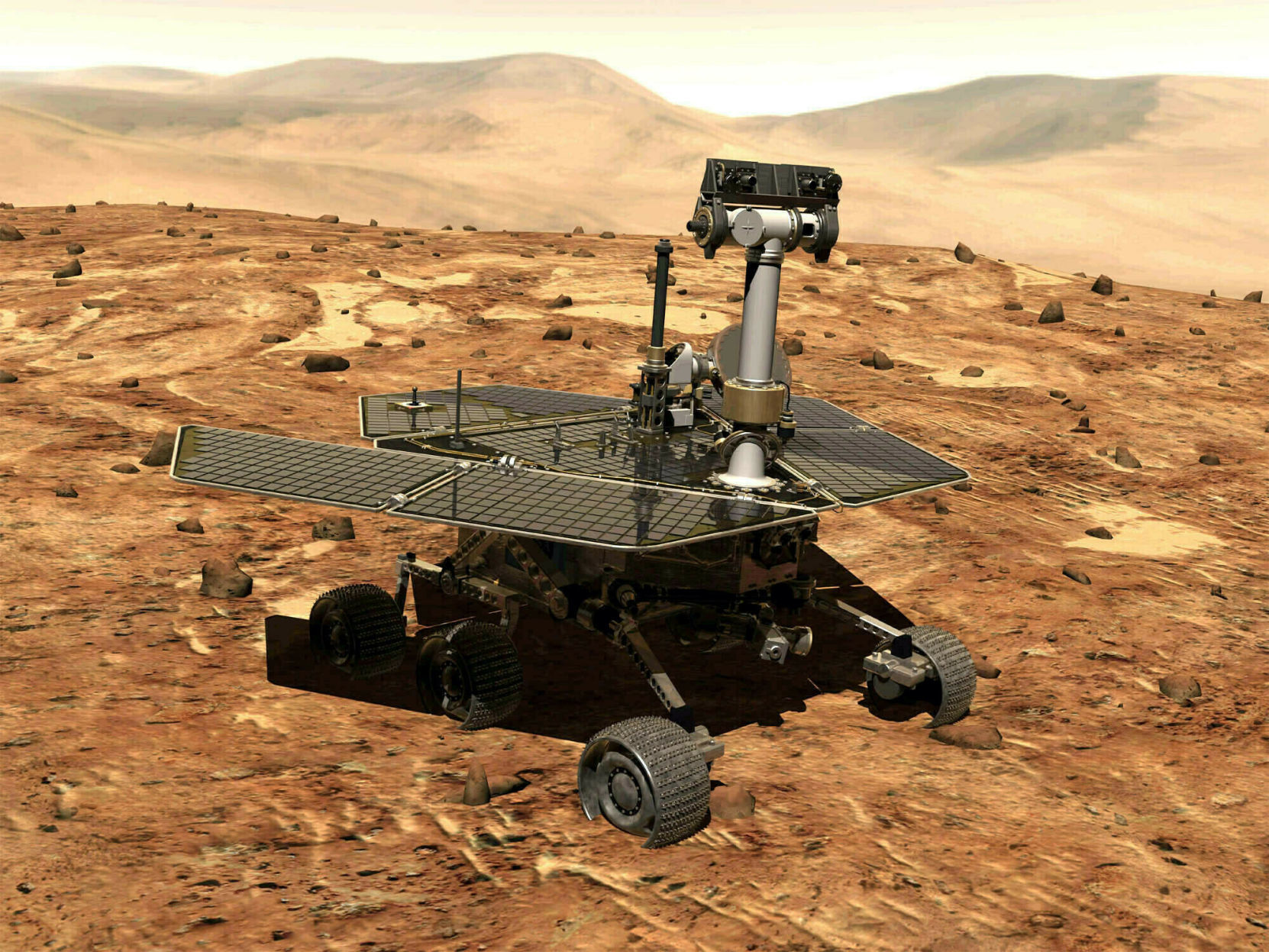
FILE - This illustration made available by NASA shows the rover Opportunity on the surface of Mars. The exploratory vehicle landed on Jan. 24, 2004, and logged more than 28 miles (45 kilometers) before falling silent during a global dust storm in June 2018. There was so much dust in the Martian atmosphere that sunlight could not reach Opportunity's solar panels for power generation. (NASA via AP)

This 360-degree panorama is one of the first images beamed back to Earth from the Mars Exploration Rover Opportunity shortly after it touched down at Meridiani Planum, Mars. The unmanned, six-wheeled rover landed at 9:05 p.m. PST Saturday Jan. 24, 2004, in Meridiani Planum, NASA said. The image was captured by the rover's navigation camera. (AP Photo/NASA)

FILE - This photo released Thursday, Feb. 5, 2004 made by one of the rear hazard-avoidance cameras on NASA's Opportunity rover, shows Opportunity's landing platform, with freshly made tracks leading away from it. Opportunity rolled about 11 feet on Thursday, the first day it has moved since it left the lander on Saturday. Engineers commanded Opportunity to turn slightly during the drive, to test how it steers while rolling through the martian soil. (NASA/JPL via AP)

This photo made available by NASA on Aug. 6, 2004, shows sand dunes less than 1 meter (3.3 feet) high in the "Endurance Crater" on the planet Mars, seen by the Opportunity rover. (NASA/JPL/Cornell via AP)

This image sent by NASA's Opportunity rover on Wednesday, Jan. 7, 2015, shows a view from atop a hill on Mars. (NASA via AP)

FILE - This composite of March 2015 photos made available by NASA shows a shallow crater called Spirit of St. Louis, about 110 feet (34 meters) long and about 80 feet (24 meters) wide, with a floor slightly darker than surrounding terrain. The rocky feature toward the far end of the crater is about 7 to 10 feet (2 to 3 meters) tall, rising higher than the crater's rim. (NASA/JPL-Caltech/Cornell University/Arizona State University via AP)

This March 31, 2016, photo made available by NASA shows a dust devil in a valley on Mars, seen by the Opportunity rover perched on a ridge. The view looks back at the rover's tracks leading up the north-facing slope of "Knudsen Ridge," which forms part of the southern edge of "Marathon Valley." (NASA/JPL-Caltech via AP)

This March 22, 2016, photo made available by NASA shows the shadow and wheel tracks of the Mars Exploration Rover Opportunity just after a drive on a slope above Endeavour Crater. The image has been rotated 13.5 degrees to adjust for the tilt of the rover on a hillside. (NASA/JPL-Caltech via AP)

This Jan. 5, 2016, photo made available by NASA shows the tool turret at the end of the the Opportunity rover's robotic arm on the southern side of "Marathon Valley," which goes through the western rim of Endeavour Crater. (NASA/JPL-Caltech via AP)

This composite of May 2017 photos made available by NASA shows "Perseverance Valley" which just on the other side of the dip in the crater rim as seen by the Mars Exploration Rover Opportunity, in preparation for driving down into the valley. (NASA/JPL-Caltech via AP)

This October 2017 photo made available by NASA shows an enhanced-color view of ground sloping downward to the right in "Perseverance Valley," seen by the Opportunity rover on Mars. The textures may be due to abrasion by wind-driven sand. (NASA/JPL-Caltech/Cornell University/Arizona State University via AP)

In this Feb. 15, 2018, photo made available by NASA, the sun rises as seen by the Mars Exploration Rover Opportunity. This is a processed, approximately true-color scene. (NASA/JPL-Caltech/Cornell/Arizona State University/Texas A&M via AP)
CNN contributed to this report.


