


Scientists are both thinkers and tinkerers.
At their core, Scientists are both thinkers and tinkerers.
At their core, they are not far removed from their childhood selves, ripping apart their parents' electronic devices just to see what makes them tick.
At the frontiers of scientific research at the University of Arizona, the scientists are still kids at heart, only now the gadgets are way cooler than anything they ever laid their hands on at home - and far more expensive.they are not far removed from their childhood selves, ripping apart their parents' electronic devices just to see what makes them tick.
At the frontiers of scientific research at the University of Arizona, the scientists are still kids at heart, only now the gadgets are way cooler than anything they ever laid their hands on at home - and far more expensive.
People are also reading…
They still tear them apart and reconfigure them and use them for purposes the manufacturer never intended. Even better, they now get to build things nobody has seen before.
Below is some of the latest gadgetry being invented or reimagined by some of the UA's greatest scientific minds.
1. ATOMIC FORCE MICROSCOPY
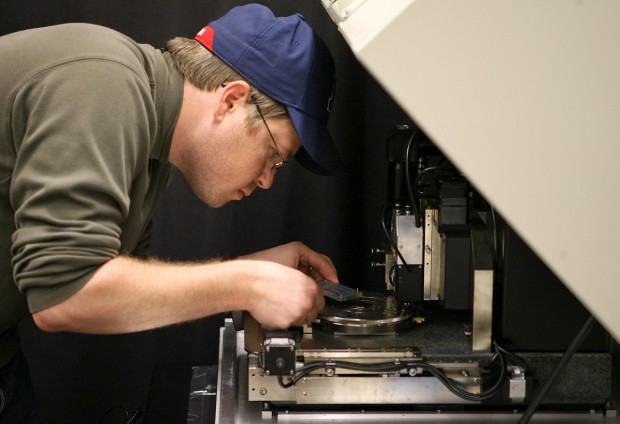
In the Keck Center for Nano-scale Structure and Dynamics in the UA's Department of Chemistry and Biochemistry, Brooke Beam presides over an array of gadgets that measure really small stuff.
The center is open by appointment to the university community and heavily used by researchers a few floors up in the Energy Frontier Research Center, where 15 million of your U.S. Department of Energy stimulus dollars are working on a five-year program to get cheap electricity from thin-film photovoltaic media.
The microscopic image of the medium comes from an atomic force microscope - the "most resolute microscope you can buy," said Beam.
It measures in three dimensions by using a nano-scale probing tip. Its dips are measured by laser light pulses bounced off the back of the stylus that holds it. It produces pictures at the nanometer (one-billionth of a meter) scale.
Neal Armstrong, principal investigator for the center, said these close-up images show how the molecules of organic dyes being tested stack up, deploy and interact - good things to know when you are using them as active components of a solar cell.
On a bench in the corner of the Keck lab is an instrument under construction. Beam is assembling a total internal reflection fluorescence microscope that will be tailored to the needs of this lab.
Scott Saavedra, co-chair of the department, who built one for his lab, said it allows researchers to tell how quickly and efficiently their materials transmit electrical charges - important things to know when you're developing new photovoltaic technology.
Necessity remains the mother of invention, Saavedra said. "For most of the measurements we want to make, a commercially available instrument is not out there," he said. "You have to build it."
2. REMAKING MACHINES
Michael Gehm is one of those guys who just can't stand to see a good machine not live up to its potential.
When Gehm, an assistant professor in the Electrical and Computer Engineering Department, acquired a 3-D printer, he taught it how to fabricate things that actually do stuff - electromagnetic optical sensing, to be precise.
The machine, which already knew how to make models of things from UV-curable plastic, just had to be told by the computer how to perform more useful tasks, transforming it from model-making to rapid fabrication.
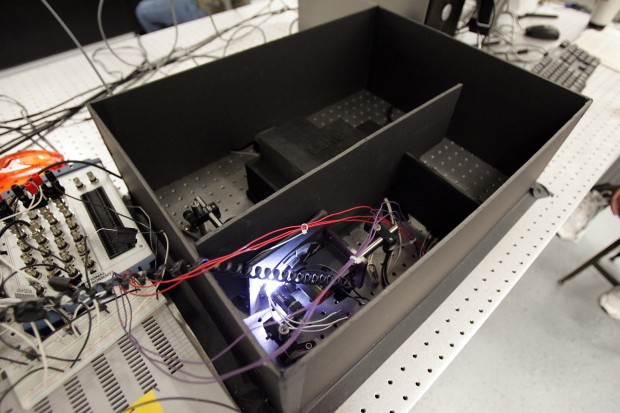
The major effort of Gehm's Laboratory for Engineering Non-traditional Sensors (LENS) these days is a multiuniversity project to build a 50-gigapixel camera for the Defense Advanced Research Projects Agency. But he has another little project - teaching a spectrometer how to make quicker decisions.
Gehm figured that an ordinary spectrometer, which uses light to identify the chemical components of a sample, works far too slowly to make it useful in instances where speed is critical - security screenings, medical settings.
So he took apart some $100 computer projectors to remove the tiny mirror arrays in them. Those little gadgets have a quarter-million tiny mirrors arrayed in changing patterns. He uses them to narrow the options the spectrometer has for identifying a given element. Instead of going through the entire universe of possibilities, it reconfigures itself to zero in on those closest to the spectral signature of the sample being tested.
In a test run in the lab, without the mirrors deployed, it took 1,546 measurements to come up with an answer. With mirrors speeding things up, it took 14.
Gehm likes to think of measurements as tools, not answers.
"Usually, you measure something directly, then process, process, process," he said. But when you're screening people or vehicles or cargo, you don't have time to do that. "This way, you get to an accurate answer much, much quicker," he said.
His goal is a handheld device that will quickly sniff out explosives or toxins with the tiniest whiff of a sample.
3. SCANNING PENTAPRISM TEST
Devising a new way to measure things is especially important when you are building something that has never been built.
That was the task given to Jim Burge of the UA's College of Optical Sciences when the Steward Observatory Mirror Lab started building the world's most aspherical mirror.
Telescope mirrors are coated pieces of glass designed to reflect all the light that strikes them to a single focal point. Simple enough when the mirror is spherical, basically one slice of a ball.
For the Large Magellan Telescope - seven giant mirrors, each 8.4 meters (27.6 feet) in diameter - only the center mirror is spherical. The others will be arrayed to the sides, but still must reflect light to the same focal point as the center one.
They will be off-axis and deeper than the average mirror, with the shape of one of those nesting potato chips.
You can't grind or polish a mirror to that shape unless you can measure it.
Burge, working with his Steward Observatory colleagues, came up with a test that uses two mirrors, lasers and a holograph, plus two tests to check that test.
Then he, along with the Steward team led by Buddy Martin, devised and built a fourth, totally independent test known as the scanning pentaprism.
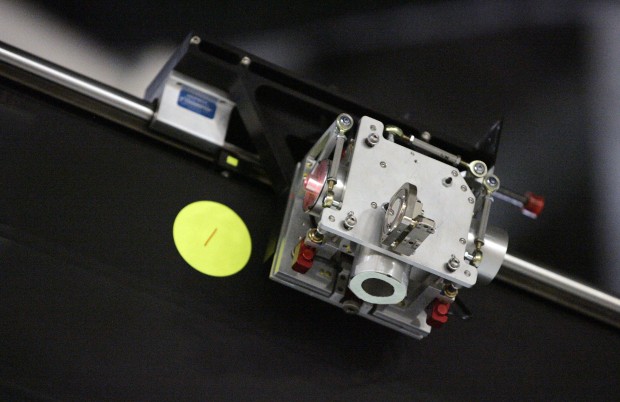
Its 20-foot arm beams light from a laser onto the surface of the mirror in a 2-inch patch, then moves to scan the entire surface. The light is focused onto a camera 18 meters above the mirror being tested.
"If the mirror is perfect," Martin wrote, "all the separate spots will coincide in the focal plane."
The scientists use a CCD camera at the focal point to map the mirror's contours, then grind and polish to make it smooth. Martin says the team is looking for "good enough," not perfection - no bumps or valleys of more than 25 nanometers, or a millionth of an inch.
4. CONCENTRATING SUNLIGHT
Roger Angel, who originally dreamed up the concept for the Steward Observatory Mirror Lab and most of its projects, including the Giant Magellan Telescope, is on a new mission - and it requires new gadgets.
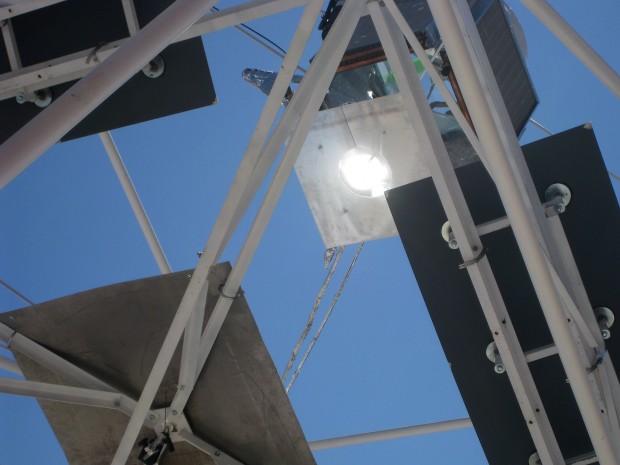
The glowing ball is his solution for gathering sunlight at the focus of his new concentrating photovoltaic system and funneling it to the triple junction solar cells that will convert it to electricity.
The ball is pure glass, made from the finest sand.
In his prototype, sunlight reflected by four mirrors comes to a focus near the center of the ball lens, and is funneled evenly onto eight solar cells.
In full scale, sunlight falling on an array of mirrors will be focused through the ball onto a concave array of optical funnels that direct the light evenly onto 36 solar cells.
By concentrating the sunlight 1,200 times normal and using small, efficient solar cells, Angel projects he can generate electricity for 16 cents a watt, six times cheaper than any solar panel now in operation.
If he can keep the production and assembly of towers and mirrors that collect the sunlight under 80 cents per watt, something the Mirror Lab is building and testing, the entire system will generate electricity at less than $1 per watt, making it competitive with the cheapest forms of fossil fuel.


