

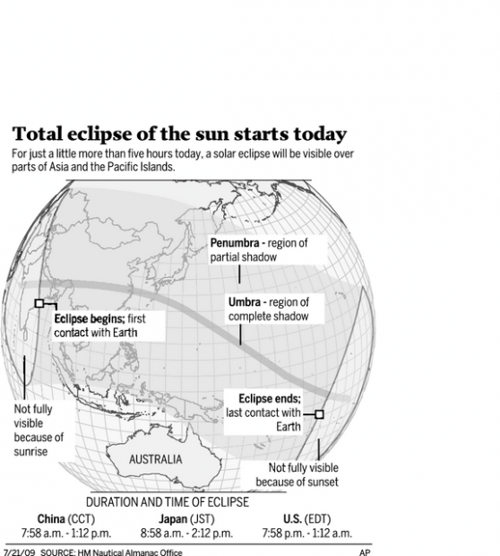
BANGKOK, Thailand — Millions of people across Asia will witness the longest total solar eclipse that will happen this century, as vast swaths of India and China, the entire city of Shanghai and southern Japanese islands are plunged into darkness Wednesday for about five minutes.
Streams of amateur stargazers and scientists are traveling long distances to witness the once-in-a-lifetime event.
Astronomers hope the eclipse will unlock clues about the sun. Some in India are advising pregnant relatives to stay indoors to follow a centuries-old tradition of avoiding the sun's invisible rays.
The eclipse will appear first at dawn in India's Gulf of Khambhat, just north of the metropolis of Mumbai.
It will move east across India, Nepal, Myanmar, Bangladesh, Bhutan and China before hitting the Pacific. The eclipse will cross some southern Japanese islands and be last visible from land at Nikumaroro Island, in the South Pacific nation of Kiribati. Elsewhere, a partial eclipse will be visible in much of Asia.
People are also reading…
For astronomers, it will be a chance for a prolonged view of the sun's corona, a white ring 600,000 miles from the sun's surface. The previous total eclipse, in August 2008, was two minutes and 27 seconds. This one will last 6 minutes and 39 seconds at its maximum point.
Scientists are hoping data from the eclipse will help explain solar flares and other structures of the sun and why they erupt, said Alphonse C. Sterling, a NASA astrophysicist who will be following the eclipse in China.
"We'll have to wait a few hundred years for another opportunity to observe a solar eclipse that lasts this long, so it's a very special opportunity," said Shao Zhenyi, an astronomer at the Shanghai Astronomical Observatory.
Man has been recording solar eclipses for 4,000 years, and even today they inspire a combination of fear, fascination and wonder.
One astrologer in Myanmar, also known as Burma, predicted in a magazine that the eclipse would trigger wars, instability and natural disasters for the next several months.
In India, hundreds of scientists are gathering in the village of Taregna, in Bihar state. One team, led by R.K. Sinha of Patna University, will study bird behavior.
"The researchers will observe whether they suddenly move back to their nests, sound differently and behave in an unusual manner due to sudden darkness," he said.
In Japan, where the last total eclipse occurred in 1963, people are flocking to the small southern island of Yakushima, which is holding a a two-day festival with fireworks, dancing, grilled squid and cotton candy. The island's 180 hotels are fully booked.
on the net
• Eclipses Online: www.eclipse.org.uk
• Mr. Eclipse: mreclipse.com


