

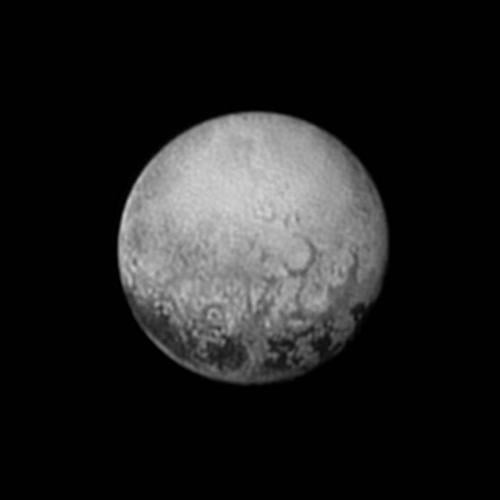
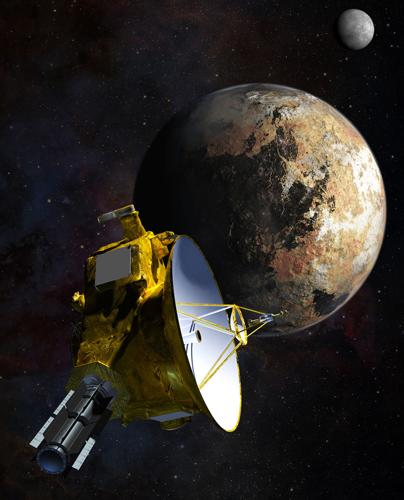

The New Horizons spacecraft is speeding toward humanity’s first close encounter with Pluto and its five known moons.
On Tuesday at 4:49 a.m. Arizona time, it will come within 7,750 miles of Pluto, with all its cameras and scientific instruments trained on the planet’s surface for a one-time flyby.
It will be brief. Pluto, two-thirds the size of Earth’s moon, is only 1,471 miles in diameter and the spacecraft will be traveling at 31,000 mph.
Scientists at mission control at the Applied Physics Lab of Johns Hopkins University in Laurel, Maryland, will have to wait until 9 p.m. to receive a preprogrammed “beep” from the spacecraft announcing that all went well.
Images will be sent Earthward the following day.
“I will breathe a sigh of relief on July 14 when we actually get the signal from the spacecraft that it’s all OK,” said Mark Showalter, a mission scientist on the hazard team that pronounced the path free of obstacles.
People are also reading…
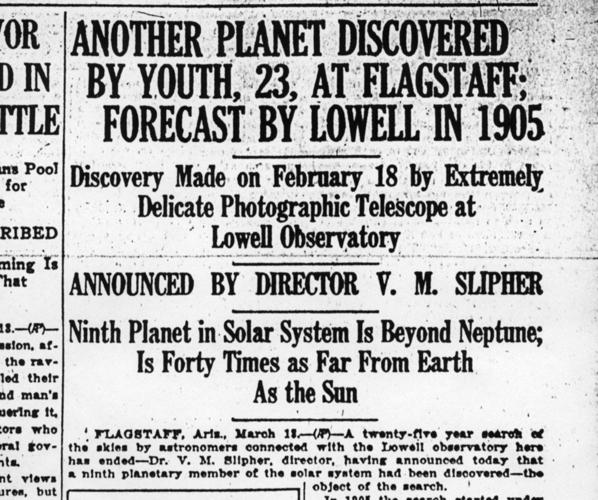
At Lowell Observatory in Flagstaff, where the planet was discovered by astronomer Clyde Tombaugh in 1930, an evening New Horizons Phones Home celebration will cap a daylong celebration of Encounter Day.
Pluto is the last of the traditional planets to be explored and the first of what astrophysicist Steve Desch calls the “third zone” of the solar system — the vast realm of Pluto and an estimated trillion other icy objects in the Kuiper Belt, including at least a handful close to Pluto’s size.
“We have been sending interplanetary probes to the inner zone since the 1960s, and the giant planet zone since the 1970s, but here it is the 2010s and we are only beginning to explore this new space,” said Desch, a professor at Arizona State University’s School of Earth and Space Exploration.
“Pluto isn’t the last planet in a list being checked off — it’s the first of its kind to be explored.”


