

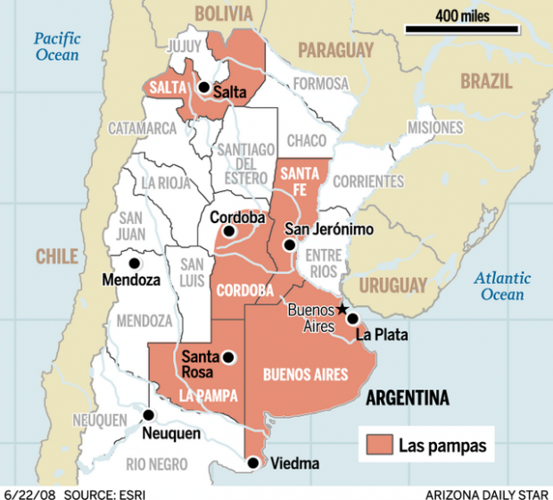



SANTA FE PROVINCE, Argentina — Standing on his patio overlooking an endless sea of green, Jorge Lagger struggles to imagine these lands as they were just one year ago.
San Jerónimo Norte, a farming community in the province of Santa Fe, once resembled a quilt of different crops alternating with pastures filled with grazing dairy cows. Now it is nearly impossible to tell where one man's land ends and another's harvest begins.
Bordered by the Río Paraná, South America's second-biggest river, this agricultural district 300 miles north of Buenos Aires represents the northern region of the pampas — once the famed beef-growing plains of Argentina. But today, the sod has been broken to make way for a foodstuff no gaucho would have dreamed of eating: soy.
Lagger, a newly-converted soy farmer, found himself in a "desperate situation last year," and retired his three-generation-old dairy farm to take part in the biggest makeover of Argentina's ecosystem in history.
People are also reading…
"Even in the 1970s soy production was unknown here. Soy was a very new cultivation," says Alejandro Krumm, Santa Fe regional coordinator for the Argentine Agrarian Federation.
This development, typically referred to as a soy invasion, "didn't even really boom until 2001, when it helped us deal with the terrible crisis of the times," says Krumm. In 2001 when Argentina defaulted on its international loans, the collapse of its peso was so deep that exports became far cheaper and more competitive worldwide. The low price offered by Argentine soy producers spurred a boom of foreign investment.
Soybeans, the only vegetable crop to offer complete protein, have grown in popularity in recent decades. In 1999 the U.S. Food and Drug Administration announced that soy could even help reduce heart disease. Soybeans have become part of the low-cost, high-protein diet that consumers want and, as a result, global demand has soared.
But soy hasn't meant purely economic salvation to Argentina. Dust spirals into the air as Lagger peels the white tarp from a milk cooler unused for a year. Last March, about 24 inches of rain fell over San Jerónimo in three days, flooding his land and neighboring farms.
"I had my cows sleeping on the asphalt," he says, pointing to the only paved two-lane road in town.
The floods, many Argentines allege, are the result of deforestation in northern Argentina to make room for even more soy cultivation. Due to the advancement of soy, "Soils have lost half of their capacity to retain water," says Miguel Pilatti, professor of soil sciences at Argentina's National University of Litoral. In the week after the flood, Lagger lost 25 percent of his herd, leading him to try something new.
"I had come to the decision of either staying with dairy or dedicating myself to agriculture," he says, indicating the 250 acres of soy where he once pastured 170 cows. A barbed-wire fence keeps the 15 cows he has left from eating his new investment.
Lagger is not alone. All across the pampas, dairy farmers and cattle ranchers are turning in their grasslands to make room for this cash crop.
"Last year, a company paid us cash in advance to plant soy — land that probably had never been cultivated in human history," says Mike Skowronek.
An American married to an Argentine, Skowronek moved here in 2003 to help manage his wife's family's century-old cattle ranch. Half of their 2,500-acre estancia is now contracted to soy cultivation.
"The money was irresistible," Skowronek explains. Cattlemen "have been saddled with restrictions such as slaughter, weight, sales prices, export restrictions, and retail-price controls. Our cow-calf operation began to feel less and less like a way of life, especially in light of the feedlot operations that were sprouting all over the countryside."
Last year residents of Buenos Aires were stunned to see something nearly unprecedented in their city: gentle snowfall. This year has brought another surprise: smoke so thick that visibility downtown was reduced to a few feet. The snow has been attributed to unpredictable climate change. The smoke, however, is being blamed on soy.
Throughout April, raging fires in the Buenos Aires province consumed about 300 square miles of previously unused, second-rate farmland. The blazes were set by cattle ranchers desperate for any land yet unconverted to soy.
Soy is not only displacing grasslands. Greenpeace-Argentina estimates that the northern regions have lost about 70 percent of their native forest due to increased soybean cultivation.
"Many animals die in deforestation," says Hernán Giardini of Greenpeace-Argentina's Campaign for Biodiversity. In the forests of Salta, in northern Argentina, Giardini explains, "Animals such as jaguars, giant armadillos, and pumas are losing their habitats to soybeans."
Fernando Miñarro , grasslands program coordinator for the Argentine Wildlife Foundation, says a native species, the pampas deer, has been drastically affected by the agriculture expansion. Once, it ranged from the Argentine pampas to Uruguay, Bolivia, Brazil, and Paraguay. Soy cultivation in all those countries has contributed to its habitat's being reduced to a pampas reserve of fewer than 1,500 deer.
What especially frustrates Giardini is that "soy is not eaten here." About 90 percent of Argentina's soy is exported, principally to China and Europe.
The government recently slapped an export tax on soy producers to encourage them to produce food to feed their own country. The tax, raised from 35 percent to 45 percent, resulted in a three-week protest during March in which most highways leading to Buenos Aires were blocked. The protest was suspended for a month of talks between growers and the government. With no resolution, the blockades resumed, leading to food and gas shortages across the country this month and street protests over the government's handling of the conflict.
Argentina, now the world leader in exports of soy oil and soy meal, has begun to consider the consequences of its agricultural revolution. "The problem is that Argentina right now is producing more soy crops than any other food staple. This proposes dire consequences for other sectors. Beef is now being imported from Brazil," says the Agrarian Federation's Krumm.
The use of genetically modified soybeans, herbicides and mechanized planters that puncture the prairies has brought other problems. Some recently-converted soy farmers are considering turning to forage crops, such as alfalfa. But ranchers recognize that once they've broken up the grasslands, they can't rebuild the pampas.
Antonio De Petre, soil scientist at the National University of Entre Rios, explains that the method of direct sowing used by soy producers has aided them in producing more soy in less time. Soy can now be harvested any time of the year in most parts of the country. But according to the Argentine Association of the Study of Soils, continual soybean harvests without crop rotation have resulted in loss of nutrients and a decrease in organic life in soil. In the province of Santa Fe, soils have lost 33 percent to 50 percent of their capacity to produce.
To many Argentines, the very essence of their country is embodied in the asado: eating grilled fine, grass-fed beef. The greatest tragedy for many is soy's entrance into the cattle's diet. "Beef from grass-fed cows is much more flavorsome than grain-fed beef, which has more fat and cholesterol," laments government agro-technician Gustavo Olmos.
"A diet made up of soy and corn is not traditional nourishment for Argentine cattle," agrees Marcelo Schang, dean of Agricultural Sciences at the Catholic University of Argentina. "If the model continues this way, the quality of the meat will decline."
Already, Argentines complain of the mushiness and milder flavor of grain-fed sirloin appearing in supermarkets. Although taste is important, says Miñarro of the Argentine Wildlife Foundation, the nutrition of the earth is generally overlooked.
"To maintain a healthy ecosystem we must work together with the ranchers." But like many environmentalists, he worries that cooperation with cattlemen may not be enough, because they now have a common foe that they fear will soon take over all of Argentina's productive lands.
About the writers
Mia Mitchell is an honors senior majoring in Spanish literature with a minor in Latin American Studies. She plans to teach English abroad after graduation.
Andrea Goodrich graduated in May with a bachelor's degree in anthropology and a minor in Latin American Studies. She will pursue a master's degree in Information Resources and Library Science. She was born in Bolivia and raised in North America.
A bilingual, bicultural native of Nogales, Ariz., Dalina Castellanos is majoring in journalism and expects to graduate in December.


