

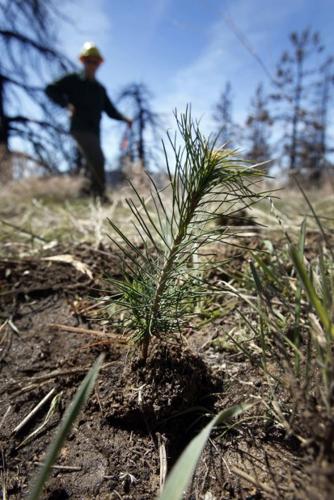
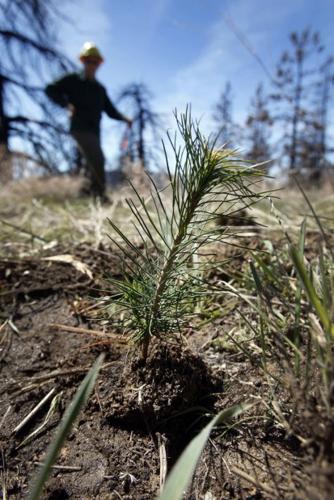
LOS ANGELES - Federal forester Steve Bear stood on a fire-stripped slope of the San Gabriel Mountains this month, trying to find just one pine sapling, any sapling, pushing through the bright green bedspread of vegetation.
It would give him hope after a year of disappointment.
Last April, U.S. Forest Service crews planted nearly a million pine and fir trees to try to reclaim land scorched clean by the devastating Station Fire. Most of them shriveled up and died within months, as skeptics had predicted.
"That's too bad," said Bear, resource officer for the service's Los Angeles River Ranger District, shaking his head in disappointment. "When we planted seedlings, conditions were ideal in terms of soil composition and temperature, rainfall and weather trends. Then the ground dried out and there just wasn't enough moisture after we planted."
People are also reading…
Foresters estimate that just a quarter of the 900,000 seedlings planted across 4,300 acres are thriving. That is far below the 75 percent to 80 percent survival rate the agency wanted.
On most slopes, instead of small trees, the ground nurtures dense shrubs and grass in the shadows of skeletal dead trees scorched by the 2009 blaze.
The most ambitious recovery effort ever attempted in the Angeles National Forest began with a promise to plant up to 3 million seedlings over five years across 11,000 acres charred by the worst fire in Los Angeles County history. Although intense sun and wind-dried soil were the main reasons seedlings died, other unforeseen challenges are forcing the Forest Service to scale back its plans.
The agency now realizes that much of the terrain is too remote, rocky and steep for reforestation. "That was an unreasonably optimistic target based on a rapid assessment of the landscape," Bear said of the original plan. The goal now is to plant enough seedlings so that five years from now, 900,000 trees will be growing on 4,400 acres.
Skeptics had expected problems because the plan conflicted with the natural state of Angeles National Forest.
"The reality we live in is a Mediterranean climate, and there is just not enough water to create what they have in mind," said Rick Halsey, founder and president of the California Chaparral Institute in San Diego. "I do not believe they will succeed because this is Southern California, not rain-drenched Oregon."
In 2009, 70 percent of the land was chaparral and just 23 percent was forest. The rest was either riparian or desert. The Station Fire, which covered 161,000 acres, or nearly 25 percent of the land, triggered the birth of chaparral plants that require fire to germinate. Critics warned that revived patches of chaparral would compete with seedlings for nutrients.
In addition, most of last year's plantings were from Coulter pine seeds harvested from trees that evolved in other mountain ranges, including the Cleveland, Los Padres and San Bernardino national forests. Although Coulter pines have grown in the San Gabriels, biologists and forest historians suspect that many were planted by settlers and are not indigenous.
Forest Service officials say they aren't trying to establish forest cover over the entire San Gabriel range, but only to restore the pockets of trees that existed before the blaze.


