

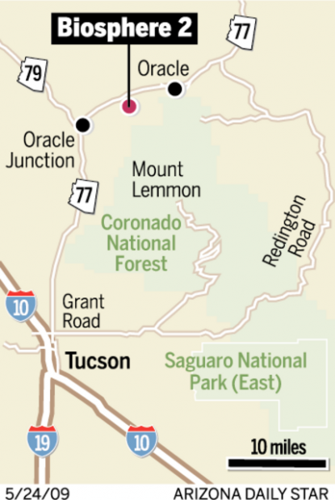
ORACLE — They've ripped out the soil that once grew food for eight Biospherians sealed inside a glass replica of the Earth for two years, starting in 1991.
A partition now segregates Biosphere 2's rain forest "biome" from what was designed to be one big, breathing organism under glass in the northern foothills of the Catalina Mountains.
If they need to, say researchers, they'll kill every tree in that biome to uncover mechanisms that could doom vast tracts of South American rain forest under models proposed by climate-change studies.
There is a sense of urgency inside the towering glass temple that first attracted worldwide attention in 1991 for its "human experiment," which locked eight people inside for two years.
Biosphere 2 now seeks to attract researchers from across the globe to an ever-changing series of experiments aimed at answering one grand question: "How does life affect the way the world works?"
People are also reading…
The urgency, says Biosphere 2 Director Travis Huxman, comes from the need to understand how life on Earth will be affected by predicted levels of climate change and from the need to attract funding for the scientific studies being proposed.
The University of Arizona, with $30 million in start-up funds from the Philecology Foundation, is building the infrastructure that will allow scientists to answer a broad array of questions in a unique setting midway between laboratory and real world.
The foundation is headed by Texan Edward Bass, who originally bankrolled the facility. It provided most of Biosphere 2's $5.5 million budget this year.
The grant, which began in July 2007, decreases yearly, and when it disappears after 10 years, the institute will have to support itself with increased revenues from tourism, conferences and scientific foundations. "We have to do what faculty members do in their own labs — write grants," said Huxman.
Huxman said he expects revenue from conferences and tourism, anticipated to net $850,000 this fiscal year, to grow to $2 million. Huxman also said he fully expects the Biosphere to attract top scientists and lucrative grants to produce prominently published research that will keep that cycle going.
It's a unique opportunity that is already attracting a lot of interest, he said. The Biosphere, with its 3.14 acres under glass, is larger than any laboratory available to scientists and more controllable than the larger biosphere in which we live.
The rain forest and the former farm are cases in point. The rain forest
Scott Saleska, an assistant professor of ecology and evolutionary biology who investigates the effect of climate change on rain forests with Amazon PIRE (Partnership for International Research and Education), was surprised when his measurements of the effects of the 2005 Amazon drought in Brazil did not match computer models that predicted large releases of carbon dioxide.
The towering trees were apparently tapping into reserve sources of water. The rain stopped, but the rain forest canopy did not dry out.
"At some point, obviously, that can't last. A little bit of drought is OK, but if you cut it (rainfall) off, at some point, it has a big effect. Maybe the theoretical models represent an overly fragile forest," Saleska said.
Saleska could not induce more drought in the Amazon.
However, "One thing we can do (in Biosphere 2) is make different-sized droughts in a systematic way that we can study. It's an exciting opportunity. There are people eager to use it, and I'm one of them."
The grants that fund Amazon PIRE include a $1.5 million component for study at the Biosphere.
Javier Espeleta, associate director of Biosphere 2's science arm, encountered similar problems while studying rain forests in Costa Rica. Funding ran out before the team encountered a single "good El Niño year" — an ocean-warming phenomenon that can trigger drought.
Even when the timing is right, Espeleta said, it's difficult to measure all the mechanisms that rain-forest drought might trigger — in the leaves and stems of plants, in the roots, in the soil, in the atmosphere and in ways yet to be discovered.
It's easier to study the effects in this "mesocosm" midway between laboratory and real world and just up the road from a major research university, he said.
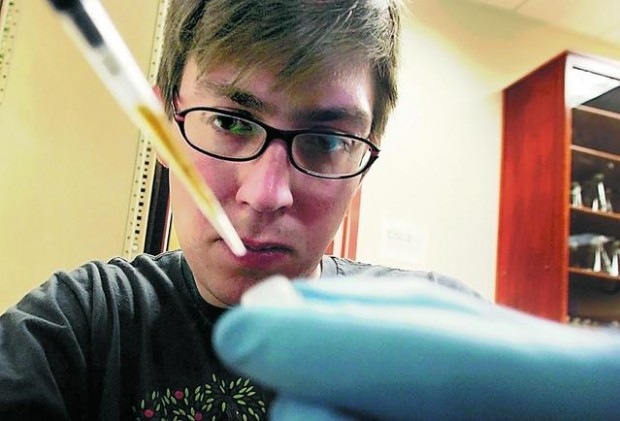
Proximity will allow scientists to continuously study the mechanics at work with an array of instrumentation — from the newest scientific instruments that track molecules of gases marked with a radioactive isotope to the cheaper, lightweight dendrometers that a Tucson plumber invented to help his scientist wife measure the cyclical growth of tree bark.
Five towers are being erected to record components of the atmosphere in the 80-foot-tall biome where mature trees scrape against the ceiling. Vaults are being dug in the soil to measure root growth and study all of the interactions below ground. The hill-slope experiment
The former farm, or "intensive-agriculture biome," has been scraped bare of its plants and 4,000 tons of soil to make way for three hill slopes that will give scientists a closer understanding of how watersheds develop.
John Adams, assistant director of planning and facilities, said the brainstorming sessions that devised the experiment concluded that the fortified topsoil designed for maximum plant productivity needed to be replaced with a base of basaltic rock, ground to specific size.
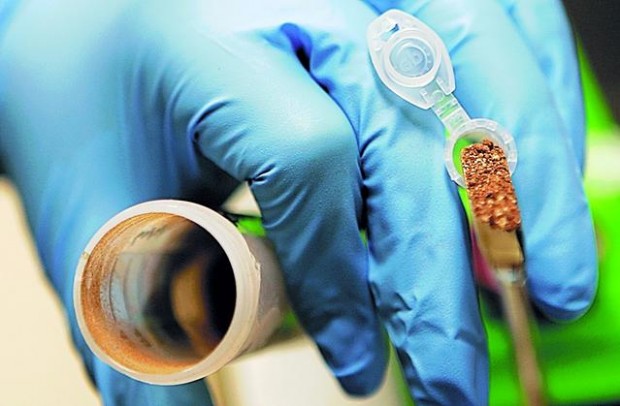
Scientists will "weatherize" the rock at an accelerated pace, allowing them to answer questions about infiltration, runoff, evaporation and transpiration at various stages of a watershed's development.
The hillsides will be embedded with an array of instruments to discover where the water goes, how the chemistry changes and how bacteria grow. Temperature and rainfall can be carefully controlled for each of the three identical slopes.
Adams compared the infrastructure with the particle accelerators built to attract scientists studying quantum mechanics and subatomic particles.
Providing the controlled circumstances and a basic array of measuring devices will allow scientists to propose further manipulations and devise new instruments for measuring things not contemplated and answering questions not yet asked.
"It's a bit of a 'build it and they will come' type of strategy," said director Huxman.
For a time, the hill-slope experiment will be simply water running over rock. Then, said Espeleta, they will "add in complexity" — grasses, followed by plants and small trees. Mechanistic understanding
Espeleta said he and other scientists at Biosphere 2 don't claim they can fathom all the complexities of the natural world "using, for instance, this very cartoonish version of a rain forest."
Scientists, though, "can't go and sample and monitor every system on the globe," he said.
In Biosphere 2, they can set up any imagined circumstances to "find a mechanistic understanding of how things work and use that to extrapolate."
In Biosphere 2's rain forest, "we might want to push it to an extreme and kill it," he said.
There are no plans for that, he said, but he doesn't rule it out if such an experiment could answer one of the cutting-edge questions posed by scientists.
Espeleta said Biosphere 2 is also a place where scientists can broaden their understanding of how things work. Espeleta studies "below-ground ecology" and began his career studying the exchange mechanisms of fine roots. You can get lost in a narrow field, he said. "I've always wanted my science connected to something else."
These hill slopes, he said, will bring together geologists, hydrologists, botanists, microbiologists, soil scientists, geneticists and many other specialists.
That interdisciplinary approach is one of the main tenets of B2 Earthscience, the scientific arm of the UA's undertakings here, said Huxman.
"We want to find ways of connecting groups, especially groups that don't normally talk to each other," he said.
Not everyone is happy about the Biosphere's partitioning.
John Allen, who invented and devised the original experiment, said during a recent visit to Tucson that he was pleased the UA is ramping up research, but he wishes the experiment were still intact, integrated and closed off.
Allen was promoting his book, "Me and the Biospheres," in which he writes of the focus on individual biomes: "Good research but not taking advantage of the unique potential a minibiosphere offers."
Being able to change Bio-sphere 2's interior components was a critical part of the negotiations over leasing the facility, said Huxman. "We can manipulate the facility to create the experiments we need," he said.
Huxman said the university consulted with marketing experts when it took over the Bio-sphere operations two years ago to determine whether it was necessary to rebrand the place — to separate the science the UA was gearing up to do from the more philosophical "human experiment" devised by Allen and the Biospherians.
They decided to keep the name. Biosphere 2 was too good a brand to give up, he said. It is known internationally.
Huxman said UA officials never considered restoring the dome to a single, closed system.
While he agrees with Allen that it would be interesting to continue or replicate the larger experiment, "we don't have the luxury of asking exotic questions anymore. We have an impending global crisis."
More online
Information about tours and research is at www.b2science.com


