

BAGHDAD — It had to be done quickly.
Rogue Shiite militiamen were holding hostage a group of Sunni and Shiite tribal sheiks who had joined a revolt against al-Qaida.
For the Iraqi government and its U.S. backers, the seven men represented a rare symbol of national unity.
A daring rescue operation secured their freedom.
A meeting Tuesday between most of the former captives and military officials — including the Iraqi commander of the rescue operation — offered the first detailed picture of the tense and fast-moving events: the kidnapping, the slaying of one captive and the seven-hour rescue mission Monday converging on an area that was "not fit for rats."
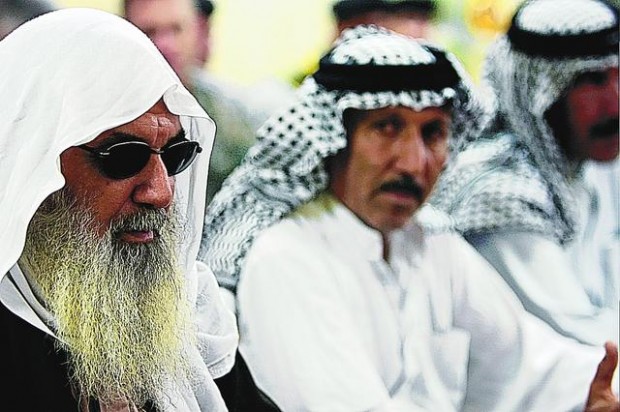
The sheiks, recounting their 30-hour ordeal to a small group of reporters including The Associated Press, said they were tortured and humiliated.
People are also reading…
At least three of the sheiks were visibly bruised. One man's left eye was red and swollen. The two others had bruises on their backs, arms and legs.
But they insisted that they emerged from captivity more determined than ever to continue their fight.
"We already forgot the pain and the wounds from our ordeal," said Haroon al-Mohammedawi, the leader of the group from Khalis, a region in Diyala province where the terror organization has a heavy presence.
"We pledge to you, the people and leadership of Iraq, that we will stay the course."
Al-Qaida militants, the sheiks told Iraqi and U.S. commanders, had prevented food rations from reaching them for a year, cut off power to their villages and ruined their orchards.
"Al-Qaida has condemned us to death," said al-Mohammedawi, a Shiite. "But we have a strong uprising and we have volunteers from the age of 14 to 75."
The kidnapping came shortly after the sheiks attended a meeting Sunday with government officials in Baghdad about battling al-Qaida and fostering peace between Shiites and Sunnis.
Attackers intercepted minibus
They were traveling back to their homes in Diyala when the attackers intercepted their minibus in the capital's Shiite Shaab neighborhood. One of the seven sheiks resisted the kidnappers. He was shot and killed.
The swift action to rescue the sheiks, launched by about 200 Iraqi soldiers and backed by the U.S. military, reflected the strategic importance of local reconciliation initiatives and the forging of alliances with Sunni tribes in areas where the terror network remains active.
The strategy was stunningly effective in several Baghdad neighborhoods, areas south of the capital known as the "triangle of death" and in the vast western province of Anbar, forcing al-Qaida militants to flee and reducing the levels of violence.
Failure to free the hostages would have dealt a blow to efforts to rally the residents of Diyala, a mix of Shiites, Sunnis and Kurds, behind the U.S. and Iraqi forces in the fight against al-Qaida.
Lt. Gen. Abboud Qanbar, the overall Iraqi commander of Baghdad, said the kidnappers belonged to "criminal gangs."
The seven-hour rescue mission began Monday afternoon and lasted well into the night.
Maj. Gen. Riyadh al-Qusaibi said he and his men had only "foggy" intelligence to work with when they set out to search for the sheiks.
They combed orchards and raided homes in a wide area to the northeast of Baghdad before they finally located the house where the sheiks were held prisoner, he said.
"The area where the house was is not fit for rats to live in," al-Qusaibi said.
"The kidnappers' response to our arrival was slow, and the gunfight lasted only minutes."
Four of the kidnappers were killed in the gunfight and six were detained, according to the Iraqi Defense Ministry.
Al-Qusaibi said several of his men were superficially wounded, but none was killed.
The U.S. military has sought to play down its role in the rescue operation, touting the success as evidence of the growing capabilities of the Iraqi forces.
Coordination was vital
"The ... rescue mission is one that required advanced coordination and execution that couldn't have been accomplished without significant coalition support just a few months ago," said Brig. Gen. John F. Campbell, who was closely involved in the rescue.
"We had U.S. advisers on the ground that assisted with aerial support, and we also had some additional ground forces that could have supported if required," he told the AP.
U.S. Army Col. Philip L. Swinford, a senior adviser to al-Qusaibi's unit, said the speed with which the Iraqis prepared and launched the operation was the key to its success.
Find breaking news coverage of developments in Iraq, Afghanistan and elsewhere in the war against terrorism, plus a gallery of latest Iraq photos at azstarnet.com/attack


