

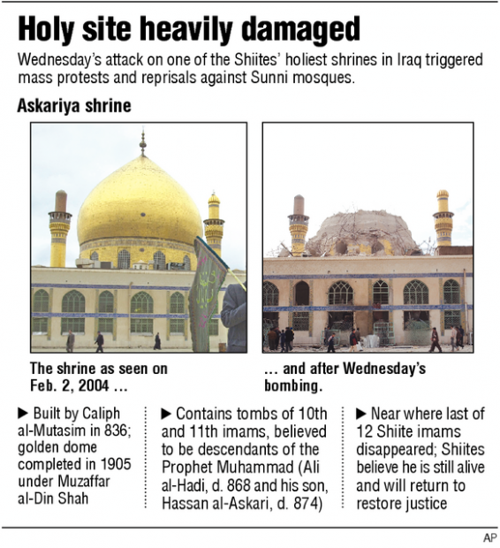
SAMARRA, Iraq — Insurgents posing as police destroyed the golden dome of one of Iraq's holiest Shiite shrines Wednesday, setting off an unprecedented spasm of sectarian violence.
Angry crowds thronged the streets; militiamen attacked Sunni mosques; and at least 19 people were killed.
With the gleaming dome of the 1,200-year-old Askariya shrine reduced to rubble, some Shiites lashed out at the United States as partly to blame.
The violence — many of the 90 attacks on Sunni mosques were carried out by Shiite militias — seemed to push Iraq closer to all-out civil war than at any point in the three years since the U.S.-led overthrow of Saddam Hussein.
Many leaders called for calm. "We are facing a major conspiracy that is targeting Iraq's unity," said President Jalal Talabani, a Kurd. "We should all stand hand in hand to prevent the danger of a civil war."
People are also reading…
President Bush pledged American help to restore the mosque after the bombing north of Baghdad, which dealt a severe blow to U.S. efforts to keep Iraq from falling deeper into sectarian violence.
"The terrorists in Iraq have again proven that they are enemies of all faiths and of all humanity," Bush said. "The world must stand united against them, and steadfast behind the people of Iraq."
British Prime Minister Tony Blair also condemned the bombing and pledged funds toward the shrine's reconstruction.
U.S. Ambassador Zalmay Khalilzad and the top American commander in Iraq, Gen. George Casey, called the attack a deliberate attempt to foment sectarian strife and warned it was a "critical moment for Iraq."
Some Shiite political leaders already were angry with the United States because it has urged them to form a government in which nonsectarian figures control the army and police. Khalilzad warned this week — in a statement clearly aimed at Shiite hard-liners — that America would not continue to support institutions run by sectarian groups with links to armed militias.
One top Shiite political leader accused Khalilzad of sharing blame for the attack on the shrine in Samarra.
"These statements … gave green lights to terrorist groups. And, therefore, he shares in part of the responsibility," said Abdul-Aziz al-Hakim, head of the Supreme Council for the Islamic Revolution in Iraq and the former commander of its militia.
The interior minister, who controls the security forces that Sunnis accuse of widespread abuses, is a member of al-Hakim's party.
No one was reported injured in the bombing of the shrine in Samarra.
But at least 19 people, including three Sunni clerics, were killed in the reprisal attacks that followed, mainly in Baghdad and predominantly Shiite provinces to the south, according to the Iraqi Islamic Party, the country's largest Sunni political group.
Many of the attacks appeared to have been carried out by Shiite militias that the United States wants to see disbanded.
In predominantly Shiite Basra, police said militiamen broke into a prison, hauled out 12 inmates, including two Egyptians, two Tunisians, a Libyan, a Saudi and a Turk, and shot them dead in reprisal for the shrine attack.
Major Sunni groups joined in condemning the attack, and a leading Sunni politician, Tariq al-Hashimi, urged clerics and politicians to calm the situation "before it spins out of control."
The country's top Shiite cleric, Grand Ayatollah Ali al-Sistani, sent instructions to his followers forbidding attacks on Sunni mosques, and called for seven days of mourning.
But he hinted, as did Vice President Adil Abdul-Mahdi, that religious militias could be given a bigger security role if the government cannot protect holy shrines — an ominous sign of the Shiite reaction ahead.
The shrine is one of four major Shiite shrines in Iraq, and the site has special meaning because two of the 12 imams revered by mainstream Shiites are buried there: Ali al-Hadi, who died in 868 A.D., and his son, the 11th imam, Hassan al-Askari.
Also, according to legend, the 12th Imam, Muhammad al-Mahdi, known as the "Hidden Imam," was at the site of the shrine before he disappeared.
Both Sunnis and the United States fear the rise of such militias, which the disaffected minority views as little more than death squads. American commanders believe they undercut efforts to create a professional Iraqi army and police force.
The new tensions came as Iraq's various factions have been struggling to assemble a government after the Dec. 15 parliamentary elections.
The Shiite fury sparked by Wednesday's bombings — the third major attack against Shiite targets in as many days — raised the likelihood that Shiite religious parties will reject U.S. demands to curb militias.
"We should all stand hand in hand to prevent the danger of a civil war."
President Jalal Talabani


