

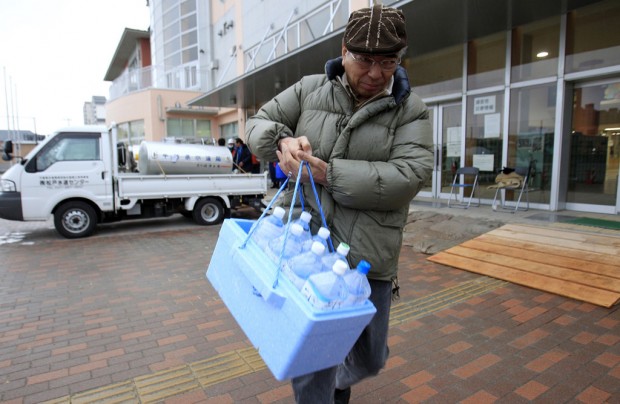
TOKYO - Workers loaded trucks with boxes of bottled water to distribute across the city today after residents cleared store shelves following warnings that Tokyo's tap water had elevated radiation coming from Japan's tsunami-damaged nuclear complex.
Anxiety over food and water supplies soared a day after city officials reported that radioactive iodine in the tap water was measured at levels considered unsafe for babies over the long term.
"The first thought was that I need to buy bottles of water. I also don't know whether I can let her take bath," real estate agent Reiko Matsumoto said of her daughter, Reina, age 5. "I am very worried."
Tokyo supermarket clerk Toru Kikutaka said water sold out almost immediately after the news broke Wednesday, despite a limit of two, 2-liter bottles per customer. "I've never seen anything like this," he said, surveying the empty shelves.
People are also reading…
The panic in Japan's largest city, home to around 13 million people, added to growing fears over the nation's food supply as nuclear workers at the Fukushima Dai-ichi plant 140 miles to the north struggled to regain control of the facility.
The nuclear power plant has been leaking radiation since the tsunami engulfed its cooling systems, leading to explosions and fires in four of its six reactors. After setbacks and worrying black smoke forced an evacuation, workers were back to work today, said Hidehiko Nishiyama of the Nuclear and Industrial Safety Agency.
Government spokesman Yukio Edano sought to allay fears over the tap water readings.
"We ask people to respond calmly" to the water situation, he said at a briefing today. "The Tokyo metropolitan government is doing its best."
Households with infants will get three, half-liter bottles of water each - a total of 240,000 bottles - city officials said, begging Tokyo residents to buy only what they need for fear that hoarding could hurt the thousands of people without any water in areas devastated by the March 11 earthquake and tsunami.
Nearly two weeks after the magnitude-9 quake, 660,000 household still do not have water in Japan's northeast, the government said today. Electricity has not been restored to 209,000 homes, Tohoku Electric Power Co. said.
The figures were a reminder of the grim humanitarian situation that hundreds of thousands continue to face in the wake of twin disasters that are proving to be the most costly natural disaster on record. Damages are estimated at up to $309 billion, the government said.
Hundreds of thousands remain homeless, squeezed into temporary shelters without heat, warm food or medicine and no idea what to call home after the colossal wave swallowed up communities along the coast and dozens of strong aftershocks continued to shake the nation.
Fears about food safety began to spread overseas as radiation seeped into raw milk, seawater and 11 kinds of vegetables, including broccoli, cauliflower and turnips, from areas around the plant.
The latest data showed sharp increases in radioactivity levels in a range of vegetables. In an area about 25 miles northwest of the nuclear plant, levels for one locally grown leafy green called kukitachina measured 82 times the government limit for radioactive cesium and 11 times the limit for iodine.
The U.S. and Australia said they were halting imports of Japanese dairy and produce from the region near the facility; Hong Kong said it would require that Japan perform safety checks on meat, eggs and seafood, and Canada said it would upgrade controls on imports of Japanese foods by requiring documents verifying their safety.
Concerns also spread to Europe. In Iceland, officials said they measured trace amounts of radioactive iodine in the air but assured residents it was "less than a millionth" of levels found in European countries in the wake of the 1986 Chernobyl disaster.
The overall situation at the Fukushima plant remains of serious concern, the International Atomic Energy Agency said. The deposition of radioactive iodine and cesium varies across 10 prefectures on a day to day basis but "the trend is generally upward," said Graham Andrew, senior adviser to IAEA chief Yukiya Amano.
Nuclear workers have struggled for days to stabilize and cool down the overheated plant.
1 dead; Fewer than 10 Americans missing
WASHINGTON - The United States says it is searching for fewer than 10 Americans who remain unaccounted for in Japanese areas affected by the March 11 earthquake and tsunami.
State Department spokesman Mark Toner said one U.S. citizen has been confirmed dead from the disaster.
He said thousands have been accounted for.
The body of 24-year-old English teacher Taylor Anderson was discovered this week, making her the first fatality of a U.S. citizen in the disaster.


