

Photos: GMT mirror casting at UA
The Steward Mirror Lab at the University of Arizona is casting the third massive mirror for the Giant Magellan Telescope in Chile.
GMT mirror casting at UA
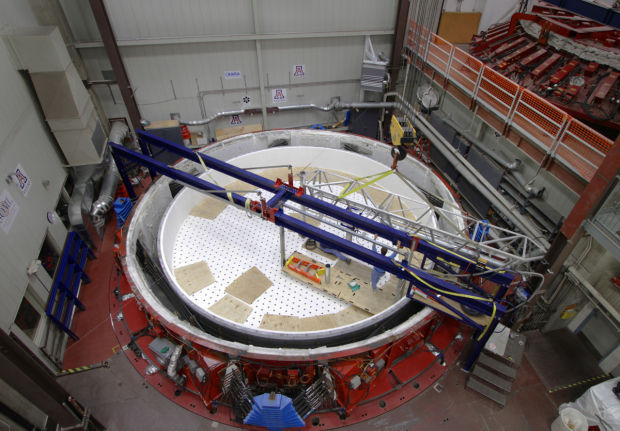
GMT3: The assembly of the oven tub walls and flooring for the rotating oven that will contain the mold and 38,000 pounds of Ohara borosilicate glass takes the Mirror Lab casting team several months to complete. The top for the oven is stored above (upper right in photo), and will be lowered down onto the oven once the assembly of the oven and mold are completed , and the glass has been loaded.
GMT mirror casting at UA

GMT3: Members of the Mirror Lab casting team load 38,500 pounds of Ohara E6 borosilicate glass into the oven mold in preparation for spin casting the 8.4 meter diameter mirror blank. The photo was taken shortly before the first layer of glass was completed. The entire proceedure takes three experienced casting team members about eight hours to completely load the glass. L to R: Randy Lutz, casting team manager, and senior staff technicians John Martin and Phil Muir load individual hand sized chunks that have been inspected, graded and weighed previous to the loading operation. The distribution of each glass chunk is closely monitored to guarantee the best result when the glass is heated in the covered spinning oven. Protective eyewear is mandatory, and special gloves are used not only to protect Lab personnel handling the glass, but to keep skin oils and moisture from contacting and contaminating the glass, further assuring the cleanliness of the casting process.
GMT mirror casting at UA

GMT2: Nearly 1700 unique hexagonally shaped alumina-silicate fiber refractory cores are installed to form the 8.4 meter diameter oven mold for this second mirror casting for the Giant Magellan Telescope (GMT). Randy Lutz, manager of the Mirror Lab casting team, installs each of the cores individually in a precisely determined location and distribution within the oven tub walls. The core installation, metrology, inspection, and cleaning procedures take the team about six weeks to complete. Hexagonal shaped refractory caps bonded to the tops of the cores form the base on which the borosilicate glass chunks will be loaded. During the oven firing and spinning cycle, the molten glass will flow accross the surface formed by the core tops and down into the spaces between the cores, forming the curved paraboloid upper faceplate and the honeycomb like supporting structure for the interior "ribs" of the mirror.
GMT mirror casting at UA

GMT2: The Steward Observatory Mirror Lab casting crew inspects over 38,000 pounds of E6 borosilicate glass pieces for every 8.4 meter diameter mirror blank cast. Randy Lutz, manager of the Lab casting team, uses polarized lighting and glasses to verify the quality of each glass piece shipped from Ohara in Japan. Only the highest quality glass is used in the casting process.
GMT mirror casting at UA

GMT2: The Steward Observatory Mirror Lab casting oven is being prepared in this view from above for final electrical, mechanical, and computer control systems testing before the oven heaters are turned on and rotation begins. Members of the Lab technical stff are conducting electrical checks on the control systems on the exterior of the closed oven.
UA Mirror Lab
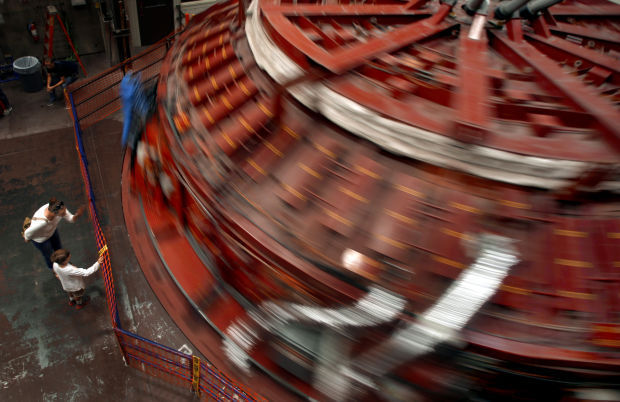
Visitors watch the rotating oven as it spins at 4.8 RPM at 1,165 degrees Celsius while melting the glass and forming the blank for the third mirror for the Giant Magellan Telescope being made at the UA’s Steward Observatory Mirror Lab.
UA Mirror Lab
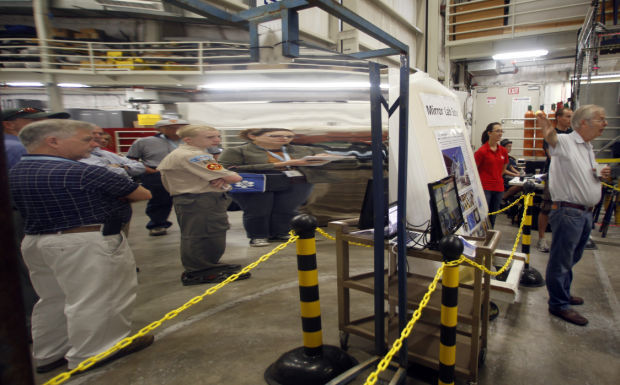
Regents Professor J. Roger Angel talks to a tour group, reflected in a parabolic trough mirror, as guests get a look at the operation and the melting of glass for the third mirror blank for the Giant Magellan Telescope being made at the Steward Observatory Mirror Lab.

It took seven years and $27 million to create the first of seven mirrors for the Giant Magellan Telescope (GMT), but now UA astronomers and op…

He enjoys clearest view of a celestial object the human eye's ever seen.

After moving to Tucson due to their husbands' astronomy work, Chilean women form a breakfast club to support each other in a new place.