

Photos: History of aviation in Tucson
Check out a photographic history of flight in the Old Pueblo — from the first flight in 1910 through a special visit from a space shuttle in 1986.
1910: First airplane flight in Tucson

On Feb. 19, 1910, Charles K. Hamilton becomes the first to fly a plane in Tucson, showing off in his biplane for a crowd at Elysian Grove, an old amusement park southwest of where the Tucson Convention Center stands today. The photo was taken by prominent Tucson scientist Godfrey Sykes and eventually made its way into the hands of Rose Gerber 10 or 12 years ago. She found it behind another picture in a frame given to her by a friend.
1915: First official air mail delivery made in Tucson

Katherine Stinson, the "teenage aviatrix," flew this plane in 1915 to carry mail from the old fairgrounds on South Sixth Avenue to the Downtown post office - making this flight the first official air mail delivery in Arizona. She was in town to perform aerial stunts at the annual fair.
1927: Lindbergh comes in for a landing

Charles Lindbergh flies over Davis-Monthan Airfield on Sept. 23, 1927 to dedicate Tucson's new airport. Local resident Hal Burns created a cactus "Spirit of Tucson" plane made of cacti in the likeness of Lindbergh's "Spirit of St. Louis" plane for the event. It sits in the foreground of this photo.
1927: Lindbergh touches down in Tucson

The Spirit of St. Louis, the plane flown by Charles Lindbergh, taxis at Davis-Monthan Airfield on Sept. 23, 1927. Lindy arrived to dedicate the city's new airport, which was called Davis-Monthan Field. The name honors two World War I pilots, Lieutenants Samuel H. Davis and Oscar Monthan.
1927: Thousand of people — and cacti — greet Lindbergh

Twenty thousand people greeted Charles A. Lindbergh when he landed at Davis-Monthan Airfield on Sept. 23, 1927, to dedicate city's new airport. At that time, Davis-Monthan was the nation's largest municipal airport. He posed for photos in front of the "Spirit of Tucson," a cactus model of Lindbergh's plane made by Tucson florist Hal Burns.
1927: First and largest municipal airport dedicated by Lindbergh

Col. Charles A. Lindbergh dedicating Davis-Monthan Airfield, which was located on Old Nogales Highway where the rodeo grounds are today, in 1927. At that time, it was the largest municipal airport in the U.S. It was also the first municipal airport in the United States.
1929: Before the base

1929 aerial view of the municipal landing field, now Davis-Monthan Air Force Base.
1929: Tucson receives first commercial flight

On November 28, 1929, the first commercial flight landed in Tucson. Jack Frye, president of Standard Airlines (which later became American Airlines), piloted a Fokker monoplane from California to the Tucson Municipal Airport. Swede Myerhofer piloted the first plane to land at that same site in Nov. 20, 1919. The first of its kind in the U.S., Municipal Airport was located on Old Nogales Highway, where the rodeo grounds are today.
1930: Tucson gets air-mail service

Regular air mail service arrived in Tucson on Oct. 15, 1930. Several thousand people attend a ceremony at Davis-Monthan Field where 259 pounds of air mail is given to the pilot. Tucson gives more mail to the pilot than Pheonix, and locals say it proves that more Tucsonans know how to write.
1930s: Amelia Earhart was here

A close-up view of Amelia Earhart's signature, which is listed in the Davis-Monthan Airfield register. Earhart landed at the site, which is now Davis-Monthan Air Force Base, several times in the 1930s. Numerous pilots from years ago entered their names in this log, which is still at the base.
1940: The U.S. Air Corps comes to town

Davis Monthan Field - A bright slash in the desert when, in 1940, the US Army Air Corps came to Tucson.
1944: World War II fighters come to Tucson for modification

Backed by the Catalina Mountains, a B-24 Liberator sits on the grounds of what is now Tucson International Airport. In the 1940s, a Consolidated modification plant on the site modified fighter aircraft for use in World War II.
1944: B-24 Liberators get geared up for war at Consolidated center
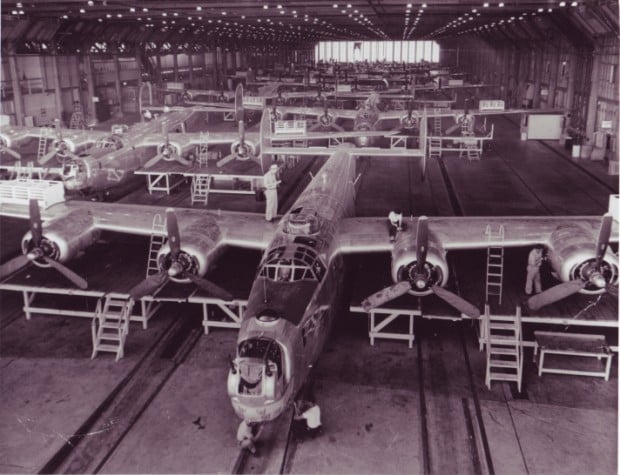
B-24 Liberators are organized into staggered lines for upgrades in the 1944 at the Tucson Consolidated modification center, which was located on the grounds of what today is Tucson International Airport. According to the July 1944 issue of Popular Mechanics, new planes were flown here from the Consolidated assembly plant in San Diego to be modified by "Quick change artists, these boys at Tucson, and similar center, for they must meet the ever and swiftly changing problems of the war. Shift in enemy tactics must be met by immediate changes in Uncle Sam's equipment, without upsetting the flow of airplanes off the assembly line at the manufacturer's plants."
1949: 'City of Tucson' visits its namesake

Pictured are the maintenance crew of the City of Tucson, first armed B-50 to land at Davis-Monthan Air Force Base and dedicated Sept. 19, 1948 in Air Force day ceremonies. Photo taken when plane became the first B-50 to exceed the 500-hour mark in flying time in spring 1949. Left to right are Tech. Sgt. John Weisenberger, crew chief; Staff Sgt. James Rahbe, assistant crew chief; Sgt. David A. Newberry, mechanic; Sgt. William D. D'Ottavio, mechanic; Sgt. Roger Luikens, mechanic.
1949: First American Airlines flight lands at Tucson Municipal Airport
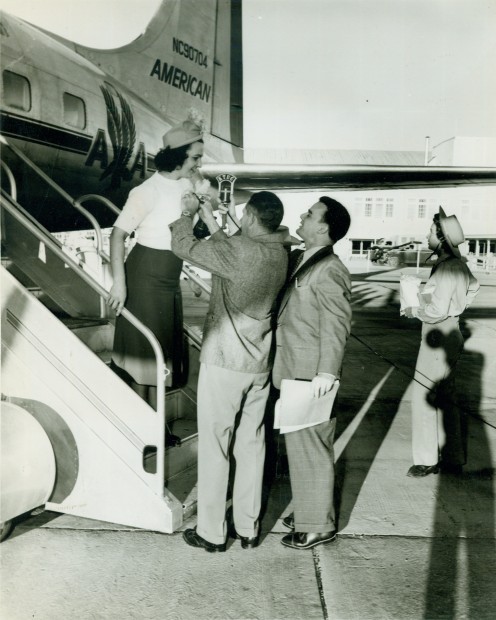
The first passenger off an American Airlines plane that began a schedule of regular flights to Tucson in 1949, shortly after the Tucson Airport Authority was formed, is greeted with an orchid from the Chamber of Commerce. Scott Henderson, former Tucson radio and advertising man, is shown with the KTUC microphone.
1949: Historic plane visits Davis-Monthan Air Force Base

The Lucky Lady II, a B-50A, visits Davis-Monthan Air Force Base. In 1949, the plane completed the first non-stop flight around the world in 94 hours and 1 minute.
1957: A first look at Tucson's newest tower

Artist's rendering of what the control tower and operations building at Tucson International Airport will look like, January 14, 1957.
1958: Third-tallest tower in Tucson nears completion

Members of the Tucson Airport Authority head for the new control tower and operations building at Municipal Airport for their annual meeting on Jan. 13, 1958. When the control tower was opened and celebrated Oct. 18-19, 1958, it was Tucson's third-tallest building.
1961: It's not a horseshoe crab, it's a new-age airport terminal

Architect Terry Atkinson puts the final touches on his model of a $3 million airliner terminal, which Tucson Airport Authority hopes to have completed at the airport by the end of 1961. The building is designed so that everybody moves with a minimum of effort. The three-level structure is 750 feet across and will be built at the south end of Tucson Blvd. The model is on display this week in Steinfeld's Department store in celebration of the authority's 10th anniversary.
1963: Tucson International Airport terminal under construction

This aerial view shows the new Tucson International Airport terminal scheduled for dedication ceremonies in November 1963. The $3.5 million complex is designed for easy expansion as the need arises. The large structure in the center of the complex is the main terminal. The design was by architect Terry Atkinson. The terminal, which served seven airlines, covers approximately 130,000 square feet and is divided into three levels.
1963: New terminal under construction

Construction of Tucson International Airport terminal on May 11, 1963.
1963: New terminal opens at Tucson International Airport

Thomas G. Hickey, left, Sky Chef manager in Tucson, and Charles Broman, Tucson Airport Authority general manager, examine the lobby in the new airline terminal at Tucson International Airport as final preparations are made for the formal dedication this weekend. Sky Chef is spending $300,000 on its facilities.
1969: B-24 Liberator sets Tucson as its destination for final flight

The solid line shows planned flight path from India of the B-24 Liberator, which the 9428th Air Reserve Squadron plans to donate to the Tucson Air Museum. In the event extra fuel tanks cannot be obtained, the plane will fly an alternate route (represented by the dotted line) from Madrid. Davis-Monthan Air Force Base was a major training center for B-24 crews during World War II, but no B-24s are currently displayed here.
1976: The first A-10s arrive in Tucson

Davis-Monthan Air Force Base's 333rd Tactical Fighter Training Squadron got its first two A-10s yesterday (March 22, 1976) and will get more as they come off the Fairchild Republic Co. production lines. The Air Force's first A-10 unit is being formed at Davis-Monthan. In the background ate D-M's A-7Ds, which will be phased out over a 1.5-year period as the A-10s come in. A spokesman said the Air Force planned to buy 733 of the A-10s. Total cost of the project, including research, training and other development costs, is $4.2 billion. A-10s are intended for use in close support of ground troops. The Air Force claims the new planes are quieter than the A-7Ds. Air Force photo by Sgt. Jim Williams.
1976: Tucson Air Museum opens

With 75 aircraft on display, the Tucson Air Museum opened to fanfare on May 8, 1976.
1976: From 75 planes to more than 200

This aerial view of what is now known as the Pima Air & Space Museum was taken not long after the museum opened on May 8, 1976. Originally, 75 aircraft were on display at the site. Now the largest privately-funded air museum in the country, more than 200 aircraft can be seen on its grounds.
1978: All lit up

Tucson International Airport, as seen at night on Dec. 27, 1978.
1986: Space shuttle makes a pit stop
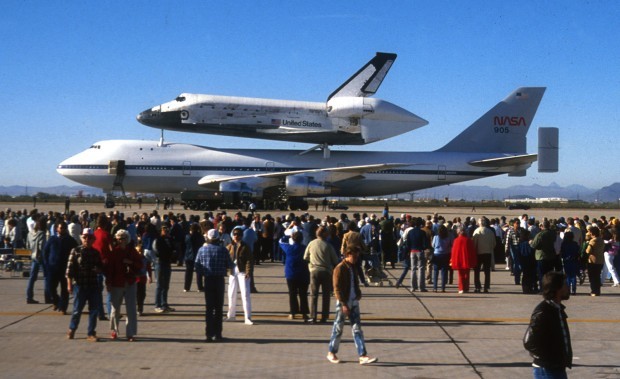
On January 22, 1986, the Space Shuttle Columbia landed at Davis-Monthan Air Force Base for a refueling stop before heading for Texas, where they will spend the night and then head for Florida. January 22, 1986. Space shuttle Columbia visited Tucson twice in its long life — in January 1986 and January 1990. NASA's oldest shuttle rode atop a Boeing 747 transporter, which stopped at Davis-Monthan Air Force Base to refuel on the way from California back to Kennedy Space Center, Fla. Shuttles Challenger and Atlantis also made piggyback pit stops at D-M over the years when returning to Florida. In June 1991, a planned stop by Columbia and its transporter was waved off due to extreme heat in Tucson. Higher temperatures reduce lift on any aircraft, requiring higher takeoff speeds and greater runway lengths.

• Charles Lindbergh dedicated the Tucson landing field Sept. 27, 1927, for two longtime Tucsonans who died in separate aerial accidents while …

While you're out at Davis-Monthan Air Force Base at Aerospace and Arizona Days, try to imagine Davis-Monthan as a dirt field with the Spirit o…

1888: An Apache Indian who had fired one shot that killed two men is tried for murder in one of the deaths and acquitted. He later was tried a…

1919: The city of Tucson gives 82 acres on South Sixth Avenue to the War Department for use as an aviation field. The site later becomes home …

In honor of Apollo 12 Astronaut Dick Gordon, who passed away Monday, November 6, 2017, at age 88, we present these photos showing the history …